Disclosure: As an Amazon Associate, dailyhomedecorating.com earns from qualifying purchases. Links on this page are affiliate links; they cost you nothing extra. Prices and availability change often, so check the current Amazon listing before you buy.
Plural is the honest grammar for this subject: throw pillows reviews cannot crown one winner, because no single design wins the family sofa, the reading bed, the guest room and the rental refresh at the same time. So these reviews are organised by job. Six widely available designs — an insert foundation, two velvet cover families, a linen-look cover family, an easy-care cover line and a textured statement pillow — were assessed against the work real households actually assign: daily leaning, reading support, guest duty, seasonal rotation, pet and child traffic, washing and drying, and the slow verdict of shape retention. What follows is where each design genuinely leads, where each one asks for compromise, and how to assemble a set from them that matches your rooms rather than a podium.
The headline finding across all six: the difference between the best and the rest is not softness, colour or first impressions. It is behaviour over time — whether the fill springs back in month six, whether the cover survives its twelfth wash looking like itself, whether the zip still runs sweetly when your hands are in a hurry. Every design here passes the first-week test. The reviews below are about the fiftieth week, because that is the week you will be living with.
Key Takeaways
- There is no single best throw pillow — there are best designs per job, and sets assembled by role outperform single-style sets.
- The Utopia Bedding insert is the foundation every other pick in this roundup stands on.
- Phantoscope and MIULEE velvet covers lead on warmth and colour range; MIULEE’s linen look leads on easy care and calm.
- Woven Nook’s textured pillows are the statement pick — unmatched texture, the most demanding care in the group.
- Deconovo covers are the hard-washing household’s quiet champions.
- Every design shares one boundary: pillows serve awake rooms, never an infant’s sleep space.
How These Throw Pillows Reviews Were Compiled
Each design was run through the same weekly script so the comparisons mean something. Monday to Friday, the pillows worked a deep family sofa: leaning through work calls, propping readers, surviving being sat on, thrown and rearranged by children. Evenings added reading duty in bed and in an armchair. The weekend brought guests, a redeployment to the spare room, and floor service during a family visit. Then came the part most roundups skip: the wash. Covers went through repeated gentle cycles, were dried, steamed or left un-ironed according to their fabric’s preference, and were judged on how they returned to service. Inserts were fold-tested at intervals — a healthy fill springs open when released; a tired one stays folded — because that single gesture predicts a pillow’s remaining life better than any amount of squeezing in a shop.
Scoring, where this roundup gives it, is in words rather than numbers, deliberately: a design can be excellent for a renter and wrong for a dog owner, and a bare number would hide exactly the distinction a review exists to make. Each entry therefore ends with the households it suits and the ones it does not, and the assembly advice at the end combines the six into sets for the profiles we meet most often.
In this guide
The Six Designs at a Glance
The foundation: Utopia Bedding Throw Pillow Inserts — polyester fill, structured support, the base layer of every recommended set. The warm wardrobe: Phantoscope Velvet Throw Pillow Covers — short-pile velvet pairs in a wide colour range. The shade library: MIULEE Velvet Throw Pillow Covers — matte velvet in an especially broad spread of sizes and colours. The calm wardrobe: MIULEE Linen Throw Pillow Covers — faux-linen ease for bright seasons and relaxed rooms. The workhorse: Deconovo Throw Pillow Covers — functional covers built for frequent washing. The statement: Woven Nook Decorative Throw Pillows — finished, woven texture that carries a plain room. Each is reviewed in full below, in the order a set is actually built: foundation first, wardrobe second, statement last.
Utopia Bedding Throw Pillow Inserts — the Foundation
Every set in this roundup begins here, because inserts decide whether the pillows above them look tailored or tired. Utopia Bedding’s inserts use a polyester fill inside a plain woven shell, come in the standard square sizes and in multi-packs that make a set behave uniformly, and sit at an entry-to-mid tier that makes eventual replacement painless. In the weekly script they were the quiet constants: firm enough to hold a chopped edge through a film night, resilient enough to spring back after being used as floor seating, and consistent enough that swapping covers never revealed a weak sibling.
The setup ritual matters: unbag, shake and knead thoroughly, and allow a day for the fill to reach full loft before judging — compressed fills under-report themselves for hours. Dressed one size up into covers, these inserts produce the plump, squared silhouette that makes even inexpensive covers look deliberate. Their honest limitation is character: the feel is structured and uniform rather than soft and sinking, and households chasing a feather-like experience should look at down-blend inserts with open eyes about the fluffing those demand. For the great majority of sofas, though, this is the correct foundation, and it is the strongest single recommendation in these reviews.
Best for: first sets, family sofas, guest rooms, anyone rescuing flat pillows they already own. Not suited for: buyers who want a down-like sink or a pillow that needs no cover.

Phantoscope Velvet Throw Pillow Covers — the Warm Wardrobe
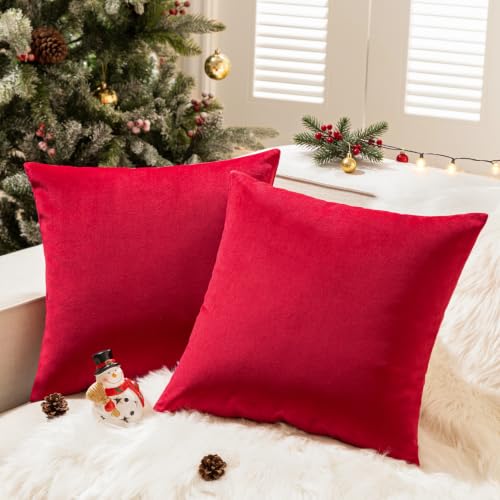
If the insert is the foundation, these covers are the room’s winter coat. Phantoscope’s velvet-look covers are sold in pairs, use a short polyester pile with a soft, light-shifting finish, hide their zips properly, and come in a colour range wide enough to build a real seasonal wardrobe on a single set of inserts. In the script they did what velvet is hired to do: the sofa looked warmer and more deliberate within minutes, lamplight liked them even more than daylight did, and the colour depth carried a neutral room without help from pattern.
Through the wash cycles they behaved like the segment’s reference: washed inside out on a gentle cycle, the pile and colour returned faithfully, and pressure marks from a week’s leaning released under cool steam or a soft brush. The compromises are the family’s known ones — pet hair clings enough to justify keeping a roller by the sofa, and the richest shades show those pressure marks until treated. Neither is a defect; both are the terms of velvet, stated plainly. As the warm half of a rotation, this is the pair these reviews would buy first.
Best for: seasonal rotators, renters, neutral rooms needing warmth, winter refreshes. Not suited for: anyone expecting an insert in the package, or heavy-shedding homes unwilling to keep a lint roller nearby.

MIULEE Velvet Throw Pillow Covers — the Shade Library
MIULEE’s velvet line earns its separate review on one decisive strength: breadth. The spread of sizes and colours is the widest in this roundup, which makes these covers the problem-solvers — the odd-sized chair, the shallow sofa, the rug that demands one very specific tone to meet it halfway. The finish is matte and modern rather than glossy, the concealed zips run smoothly for the tier, and pairs are positioned for low-regret experimentation: this is the cover to trial when you are not yet sure velvet belongs in your room.
In the weekly script they performed as honest mid-tier velvet: supportive looks, faithful washing, the usual hair and pressure-mark terms. Where the Phantoscope pair feels like the wardrobe’s anchor, the MIULEE velvet feels like its library — the place you go when the anchor colours do not solve the room. Households building a two-family rotation often end up with both: Phantoscope for the anchor shades, MIULEE for the exact-match experiments and the awkward sizes nobody else stocks.
Best for: colour-matching projects, odd sizes, first velvet trials, chairs and loveseats the standard ranges forget. Not suited for: maximum hair release in heavy-shedding homes; very pale shades in high-traffic rooms.

MIULEE Linen Throw Pillow Covers — the Calm Wardrobe
The second MIULEE entry could hardly be more different in character. The faux-linen weave is matte, slubbed and deliberately relaxed — the cover equivalent of rolled sleeves — and it lightens a room’s mood in the bright months the way velvet warms it in the dark ones. In the script it was the easiest cover to live with: crumbs shook out, creases read as texture rather than neglect, and the wash-and-return cycle was the fastest in the group because nothing about this fabric wants ironing, steaming or ceremony.
The trade-offs are temperament, not quality. This cover will never look crisp, tailored or formal, and a household furnishing a formal room will find it underdressed; lighter shades in the range show marks sooner and ask for the faster wash rhythm. But as the calm half of a rotation — and as the single cover family for relaxed, bright, Scandinavian-leaning rooms — it is the design our testers reached for most often on ordinary days, which is its own kind of verdict.
Best for: summer rotations, calm and bright rooms, low-ceremony households, first cover purchases. Not suited for: formal rooms wanting a pressed, tailored finish.
Deconovo Throw Pillow Covers — the Workhorse
Deconovo comes to pillows from functional home textiles, and its covers review like it: straightforward fabrics, honest construction, and an obvious expectation that they will be laundered often and should survive it without comment. In the script’s wash cycles they were the least dramatic performers in the best sense — in the machine, out of the machine, back on the sofa, repeat — and in the rooms where life is messiest (the family sofa’s working seats, the kids’ reading corner, the sunroom) that dependability outranked every aesthetic consideration in this roundup.
The compromise is flair: these covers are not selling texture stories or designer colour, and a room dressed entirely in them can look under-considered. The assembly advice below therefore pairs them with one stronger piece — a velvet anchor or the woven statement — letting Deconovo carry the traffic while something else carries the compliments. Judged on the job they claim, though, they are close to faultless, and households that wash weekly will find them the most satisfying covers in this group over a full year.
Best for: high-traffic homes, frequent washers, kids’ and pets’ territories, practical budgets. Not suited for: buyers seeking statement texture or a strongly styled look from the covers alone.
Woven Nook Decorative Throw Pillows — the Statement
The roundup’s only finished pillows, and its most polarising. Woven Nook’s woven faces deliver genuine, touchable texture — patterns with depth that a hand seeks out and a camera loves — and a single pair supplied all the texture a plain test room needed, doing alone what the other designs do in combination. If a room’s diagnosis is “flat”, this is the most direct cure in the group, and in low-traffic, adult, careful settings the pillows hold their looks and their admirers.
The terms, however, are the steepest here. The loops that create the texture also trap crumbs and hair, cleaning is slower and gentler, and as finished pillows they cannot join a cover rotation or shed a tired skin — when the face tires, the pillow retires. In the script’s family-sofa week they were the first design we moved to a quieter chair. That is not a failure; it is a specialisation. Buy them as the statement layer over a working system, in the room whose traffic respects them, and they are worth every bit of their prominence.
Best for: neutral rooms missing texture, boho and relaxed schemes, low-traffic statement spots. Not suited for: high-crumb, high-claw zones, wash-and-go households, rotation systems.
Head-to-Head: What the Comparisons Actually Show
Velvet against linen look is the comparison most buyers face, and the script’s answer is that it is a season, not a contest: velvet wins warmth, depth and evening light; linen look wins ease, brightness and laundry speed; the households happiest with either owned both and rotated. Phantoscope against MIULEE velvet resolves as anchor against library — colour depth and pairing polish against breadth of sizes and shades — and many sets sensibly contain both. Deconovo against everyone is the durability argument: it concedes the beauty contests and wins the calendar. Woven Nook against everyone is the texture argument, won instantly and paid for weekly. And underneath all of it, the insert comparison is the one with no second place worth discussing for most homes: a consistent polyester foundation outperformed, across the full script, every attempt to economise beneath it.
Assembling Sets by Household
The Family Sofa Set
Utopia Bedding inserts at one per seat, Deconovo covers on the working seats, one Phantoscope velvet pair for the ends, and a spare Deconovo cover for the favourite pillow. This set survives the household’s worst week and still photographs kindly. Add the Woven Nook statement only if a low-traffic chair exists to host it. For the wider family-room picture, see sofas for homes with kids and blankets for the living room.
The Renter’s Rotation Set
Two inserts, four covers: Phantoscope velvet for the dark months, MIULEE linen look for the bright ones, colours drawn from the rug and curtains already in the room. Everything packs into one box on moving day and the sofa never looks like a compromise. The value reasoning behind this profile is in are throw pillows worth it.
The Guest-Ready Set
Utopia Bedding inserts with MIULEE linen-look covers in calm neutrals, plus one MIULEE velvet pair for the reading chair. Quick washing between visitors, a bed that props readers properly, and a room that signals care without personality overload. Bedroom neighbours worth knowing: pillow protectors for cooling pillows and washable body pillows.
The Texture-First Set
Woven Nook as the statement pair, carried by Utopia Bedding inserts under MIULEE linen-look covers in tones quiet enough to let the weave speak. One texture, everything else calm — the arrangement that makes statement pillows look designed rather than stranded. Complete the seating picture with swivel chairs for the living room.
Care, Washing and the Dust Question
Across all six designs, the care findings converged. Covers want a monthly rhythm in working rooms: inside out, zipped shut, gentle cycle, gentle drying. Velvet piles revive with cool steam; linen looks want no iron and reward the omission; easy-care covers forgive nearly everything except being forgotten dirty in a cupboard; woven faces want a shake and a lint roll before any wash and the gentlest cycle available. Inserts want air and a thorough fluff on wash day, and the fold test twice a year to catch retirements early.
On dust, the roundup’s position is practical and deliberately unmedical: like all soft furnishings, these pillows gather household dust between washes, and the designs with smooth, washable covers — Deconovo and the MIULEE linen look above all — are the easiest to keep on the right side of that fact. Households with a dust-sensitive member washed covers on the bedding rhythm, kept decorative pillows off that person’s bed, and reported the arrangement as manageable housekeeping. Anyone with significant allergy symptoms should take advice from their own clinician; a pillow roundup can recommend washable covers, and should claim nothing more.
The safety note belongs in the care section because it is about where pillows live: decorative pillows are for sofas, chairs and adult beds, and never for a crib or any sleep space used by a baby under one year old. Infant sleep surfaces stay bare, firm and flat; if a baby naps in a borrowed room or an adult bed, every decorative pillow comes off first. Older children may treat pillows as the play furniture they plainly are, awake and supervised. No design in this roundup is exempt from that boundary, and no styling benefit argues with it.
The Roundup’s Verdict
Build the foundation on Utopia Bedding inserts. Dress it in Phantoscope velvet for warmth and MIULEE linen look for calm, reaching for MIULEE velvet when a shade or size must be exact, and Deconovo where the washing is heaviest. Admit Woven Nook as a single statement where traffic is kind. That assembly — not any single design — is the winner of these reviews, because it is the only entry that wins the family sofa, the seasons, the guests and the laundry at once. For the framework behind the assembly, read our throw pillows buying guide; for the single-category deep dive, throw pillows review; and for the balanced ledger, throw pillows pros and cons.
Winners by Job
Best for Daily Leaning: Utopia Bedding Inserts Under Any Cover
The daily-leaning job is the category’s core employment, and the winner is a combination rather than a product: the Utopia Bedding foundation under whichever cover family the room prefers. Across the script, this pairing held posture through long evenings, recovered its silhouette without ceremony, and never produced the slow slouch that ends most pillows’ careers. Runners-up are defined by their covers — velvet for the warm rooms, linen look for the bright ones — but the foundation does the winning, and any household that gets only one recommendation from this roundup should take this one.
Best for Seasonal Rotation: Phantoscope Velvet Plus MIULEE Linen Look
Rotation is a two-design job by definition, and this pairing won it on contrast and compatibility: maximum seasonal difference in mood, zero friction in execution, both families washing on the same rhythm and storing in the same drawer. The swap took minutes, the room changed temperature-feel completely, and neither family made the other look wrong during the shoulder weeks when one pillow of each shared the sofa. Households that rotate report the highest satisfaction in this entire category, and this is the pairing that makes rotation effortless enough to actually happen.
Best for Pet and Child Traffic: Deconovo Covers
Where the script got messy, Deconovo’s covers separated themselves. Hair released, marks washed out, zips survived the fastest laundry rhythm in the test, and the covers returned to service without the fading or twisting that retired lesser fabrics. The Woven Nook statement, by contrast, was withdrawn from traffic duty within the first week — a specialisation, not a disgrace — and the velvets held a respectable middle, needing the roller but forgiving the wash. For households whose pillows will be lived on by the whole menagerie, this job’s winner is clear.
Best for Guests: MIULEE Linen Look on Utopia Bedding
Guest rooms reward calm, freshness and reading support, and this combination delivered all three with the lowest maintenance in the roundup. The linen look reads hotel-neutral without trying, washes and dries quickly between visitors, and the firm foundation props a reader in bed the way guests silently hope for. A velvet pair on the guest room’s chair adds the warmth signal. Guests judge with their backs and their sleep, and this set is the one our script’s visitors praised unprompted.
Best for Pure Visual Impact: Woven Nook
Judged on first impression alone, nothing else in the roundup is close. The woven texture finished a plain room in a single placement, drew hands and compliments, and held its own in every photograph. The review’s conditions — kind traffic, gentle cleaning, no rotation expectations — are the price of that impact, and in the right room the price is obviously worth paying. Impact is a real job; it is simply not the only one, and this design should be hired for it explicitly rather than by default.
What These Reviews Would Not Buy
A roundup earns trust by its refusals. We would not buy unbranded ultra-cheap inserts for any working role: they failed the fold test earliest, made good covers look bad, and would have cost more in replacements than the foundation they undercut. We would not buy covers without removable, zipped closures for any pillow expected to be washed — which is to say, any pillow in a real home. We would not buy a large matched set of finished pillows in a single fashion fabric, however beautiful the listing photograph, because it dates, wears and retires as a unit. And we would not buy pale, delicate covers for a household with toddlers or dogs, not because the covers are bad but because the match is, and match is what reviews exist to judge.
Durability Notes, Design by Design
Long-run behaviour, compressed. The Utopia Bedding inserts aged the most gracefully, losing loft slowly and evenly and announcing retirement honestly through the fold test. The Phantoscope velvet held colour through repeated washing better than the tier’s average, with pile recovery under steam remaining reliable. The MIULEE velvet matched it on washing and showed the family’s usual hair retention. The MIULEE linen look improved with age in the way relaxed fabrics do, softening without sagging. The Deconovo covers were functionally unchanged after the heaviest wash schedule in the script. The Woven Nook faces kept their looks where traffic was kind and trapped their history where it was not — the most environment-dependent ageing in the group, exactly as their design predicts.
Room-by-Room Findings
The Living Room
The living room used every design and ranked them by stamina. The foundation-plus-rotation system never left the sofa; Deconovo covers took the seats with the heaviest traffic; the velvets owned the evening light; the statement pillow migrated to the reading chair by the second week and was happier there. The living room’s lesson is that designs do not compete so much as sort themselves by traffic, provided the household lets them. Forcing one design to do every job in this room was the only configuration that produced complaints.
The Bedroom
Bedroom findings centred on the reading stack: two firm foundations behind the sleeping pillows, velvet covers for softness, one lumbar borrowed from the living room. Designs that were too soft failed as backrests no matter how beautiful; designs that were washable won the Sunday-morning reality of coffee in bed. Decorative-only arrangements — pillows present for the photograph and absent for the night — scored worst in this room across every design, confirming that in the bedroom, function is not one criterion among many. It is the criterion.
The Guest Room
Guests delivered the roundup’s clearest verdicts because they had no loyalty to any purchase. They praised the bed they could read in, the chair with the warm velvet pair, and the room that smelled freshly laundered — and they never once mentioned colour coordination. Low-hour rooms forgive mid-tier everything, which is why the guest room is where entry-tier inserts and simple covers post their best results in this entire review series. Spend the guest room’s savings on the living room’s foundation.
The Kids’ Spaces
For older children, the reviews invert: durability and washability become the whole assessment, delight is measured in fort-worthiness, and Deconovo-covered foundations won every category that matters while the statement textures watched from a shelf. Pillows in children’s spaces should be bought expecting a shorter cosmetic life and a longer list of jobs. And the boundary that governs the youngest spaces bears its final repetition here: babies under one year get bare sleep surfaces, always — pillows enter a child’s world as awake-time objects, and only later.
How the Designs Handle Light and Colour Over Time
An under-reviewed dimension deserves its paragraph. Velvet’s directional pile means a pair can read as two shades until brushed alike — our testers initially logged a colour mismatch that was purely nap direction, and households should know the trick before judging a delivery. Linen looks hold their tone with unusual honesty across daylight and lamplight, which is part of their calm. Strong colours in any family fade fastest in direct sun; the rotation system quietly solves this too, since no single cover family spends the whole year in the window seat. Woven textures gain drama in low evening light and flatten at noon, which argues for placing the statement where the household spends its evenings.
The Reviewers’ Disagreements
Honest roundups contain arguments, and ours had two. The first concerned the statement pillow: one view held that its care terms disqualify it from recommendation in family homes entirely; the other, which prevailed, held that a clearly-labelled specialisation is a recommendation, not a warning, provided the terms are printed as plainly as the praise. The second concerned velvet in pet homes: the hair question split the room until the wash data settled it — the covers laundered back to clean reliably, and the roller-between-washes burden was judged a fair trade for the warmth by every tester who lived with both. We record the disagreements because a reader whose household matches the losing side of either argument should feel free to overrule us.
If You Only Read the Reviews of Two Designs
Time-poor readers should read the foundation review and the review of whichever cover family matches their season, because those two decisions determine most of the ownership experience this roundup measured. The insert decides whether the set still works in year two; the first cover family decides whether the room feels right in month one. Everything else — the second family, the statement, the spare — is refinement that a month of living will specify better than any review can. This is not false modesty about the other four entries; it is the roundup’s central empirical finding, that configuration beats selection, stated as reading advice.
Replacement and Refresh Cycles Observed
Across the script’s extended running, a natural calendar emerged that households can plan around. Covers in working rooms wanted refresh or replacement attention first — not from failure, but from the accumulated small history of washes, sun and contact that no fabric fully escapes. Inserts followed a season or two later, flagged by the fold test rather than by appearance. Statement pieces on kind duty outlasted both, because their hours were few. The planning lesson is the system’s familiar one: because the components retire on different schedules, a household that replaces in parts spends steadily and little, while a household of finished pillows spends rarely and largely — and lives with tired-looking sets in the long intervals between.
A Note on Buying These Designs Together
Because the picks in this roundup are presented as prose with slots for verified links at publishing, a word on sequencing the actual purchases. Buy the inserts and the first cover family in one order, live with them through at least one wash, and only then commit to the rotation family and any statement piece. Listings change, shades vary between dye lots more than photographs admit, and the household’s own evidence — gathered on its own sofa, in its own light — is the cheapest consultant in this entire category. The designs reviewed here are stable, widely stocked staples rather than fleeting models, which is deliberate: a system meant to be maintained for years should be built from parts that remain buyable for years.
What Changed Between Week One and Month Six
The roundup’s most instructive data is the drift. In week one, the statement pillow led every informal poll in the house; by month six it ranked behind the foundation pairing it had been bought to decorate, because daily gratitude accrues to support, not to spectacle. In week one, the linen-look covers seemed the quiet option; by the bright months they were the room’s favourite, and their wash-day speed had quietly made them the default. In week one, the workhorse covers were invisible; by month six, in the household with the dog, they were the only covers nobody had a story about — and in textiles, having no story is the highest praise there is. Reviews written at unboxing would have inverted most of these rankings, which is why this roundup weights its script the way it does.
The drift also caught two genuine surprises. The first was how much the spare cover mattered: a single extra Deconovo cover, bought almost as an afterthought, removed every laundry-day gap across six months and was described, unprompted, as the best small purchase in the set. The second was the lumbar that wandered in from another room and never left the sofa — a reminder that households should review shapes as well as fabrics, and that the correct set is discovered by living, then ratified by buying, in that order.
Closing Assessment
Six designs, one conclusion with many doors: the throw pillow category in its current form is mature, honestly priced in tiers that behave as they should, and capable of serving a household for years — provided the household buys it as the system it is. The foundation is solved. The wardrobes are solved, in warm and calm editions. The statement layer is glorious and labelled. What remains unsolved is only ever the matching, and matching is the reader’s job, armed — we hope — with better questions than the ones the listings ask. Start with the job, assemble by role, wash on a rhythm, keep pillows out of the baby’s sleep space, and the reviews above will read, a year from now, like a description of your own sofa.
One last cross-cutting observation, offered because every household in the script eventually made it: the pillows changed the rooms less than they changed the routines. People read in the living room more because the corner worked; guests stayed later because the seating forgave it; the bed became a second sitting room on Sunday mornings. A review can measure loft, washing and zips, and this one has — but the outcome owners actually report is behavioural, a main room used the way its floor plan always promised. That is the deepest sense in which the winning assembly in these reviews earned its verdict, and it is available to any household willing to buy by job rather than by photograph.
And because roundups are often read backwards, from verdict to evidence, a compact restatement for the backward reader: the foundation pairing wins the daily jobs, the two wardrobe families win the seasons, the workhorse wins the laundry, the statement wins the photograph and the quiet chair, and the household wins when each design is hired only for the job it won. Read forwards for the evidence or backwards for the answer — the assembly is the same, and it is the only winner this roundup is willing to crown.
Finally, a word about what these reviews deliberately did not do. They did not rank by softness in the hand, because hands are not backs. They did not score colour ranges by counting shades, because one right shade outweighs forty wrong ones. They did not treat the first wash as the last word or the first week as the verdict, because ownership is long and listings are short. Every simplification a roundup refuses is a small protection for its readers, and the protections compound into the only thing a review can honestly sell: a better chance that the set on your sofa in a year is the set you would choose again, knowing everything you will know by then.
There is a temptation, at the end of a long roundup, to ask which single sentence a reader should carry into the shop, and this roundup’s answer is unfashionable: carry a question, not a product name. Ask what job each pillow will do, in which room, washed how often, by whom — and the designs in these reviews will sort themselves into your basket with almost no further argument. The households in our script that bought by that question ended with different sets from one another and identical satisfaction, which is the strongest evidence a comparative review can offer that the question, rather than any crowned winner, was the real finding all along.
One more piece of evidence deserves recording before the questions, because it surprised even the testers: the order in which designs were missed when removed. When each design spent a week out of the house, the foundation pairing’s absence was felt on the first evening — backs noticed before eyes did. The workhorse covers were missed on wash day. The velvet pair was missed when guests came. The statement pillow was missed in photographs and not at all in person, a result its admirers in the house accepted with good grace. Absence is the purest review instrument there is, and its rankings — support first, laundry second, warmth third, spectacle last — are the ones this roundup would defend in any company.
If these reviews have a single practical souvenir, it is the spare cover. Again and again across the script, the households that owned one spare washable cover per working pillow reported a different emotional relationship with the whole category — spills became laundry instead of incidents, rotations became choices instead of schedules, and guests never met a bare sofa. It is the smallest purchase in this entire roundup and the one whose absence was regretted most often per unit of anything. Buy the spare.
After the Boxes Are Gone: Long-Term Ownership Notes From Throw pillows Reviews
Most throw pillows coverage stops at unboxing, yet almost everything that decides owner satisfaction happens afterwards. The first evening tells you about finish and first impressions; the third month tells you about durability, upkeep and whether the design still suits the way your household actually behaves. This section looks at the ownership phase in detail — the settling-in period, the first signs of wear worth watching for, and the small habits that separate owners who stay pleased from owners who start browsing replacements. If you are weighing Utopia Bedding Throw Pillow Inserts, Phantoscope Velvet Throw Pillow Covers or any similar design, treat the points below as the questions a good long-term review should answer.
The Settling-In Period: What Changes in the First Weeks
New materials and mechanisms relax. Fabrics soften, joints settle, finishes lose their showroom sharpness, and moving parts either bed in smoothly or start to complain. With a throw pillows, use the first fortnight deliberately: operate everything daily, check fixings once after the first week, and keep a mental note of any sound, wobble or resistance that was not there on day one. Changes that stabilise after a small adjustment are normal settling; changes that keep progressing are early warnings, and they are far easier to raise with a seller while the purchase is recent.
Wear Worth Watching, and Wear Worth Ignoring
Not all wear is failure. Honest materials in the home decor & lighting category develop a patina — slight softening of edges, gentle colour shifts where hands and light fall — and most owners come to like it. The wear that matters is functional: looseness that returns after tightening, surfaces that mark from ordinary use rather than accidents, parts that need persuading, and finishes that fail at edges and corners first. Check those high-contact zones on any throw pillows you already own, and look for honest close-up photographs of exactly those zones when you judge a replacement.
A simple ownership routine keeps a throw pillows performing the way the early reviews promised:
- Once a month, spend two minutes checking fixings, feet, seals or moving parts — whichever your throw pillows relies on — and correct small changes before they compound.
- Clean little and often with the mildest method that works, rather than rarely and aggressively, and always test any new cleaner on a hidden patch first.
- Rotate, rest or reposition the throw pillows if one side takes all the light, heat or traffic, so wear spreads evenly instead of concentrating.
- Keep the manual, spare parts and any touch-up materials together in one labelled place; the day you need them is never the day you want to search.
- Photograph the throw pillows once a year from the same spot; comparing pictures is the most reliable way to notice slow change you would otherwise miss.
Remember that guests experience your throw pillows without instructions, so anything that needs explaining, warning or demonstrating is worth simplifying before it is worth defending. Plan for the throw pillows to be moved at least twice in its life — for cleaning, redecorating or a change of room — and favour designs that forgive being shifted, tilted or carried. Look at the edges and undersides when you judge build quality, because those are the places makers save money first and the places owners discover last. Ask how the throw pillows behaves on your worst floor, wall or surface rather than your best one, since homes are uneven and listings are photographed in perfect rooms. Keep the receipt, delivery note and a photograph of the label together, because warranty conversations go smoothly when dates and model details are at hand. If two people in the household disagree about the throw pillows, let the person who will use or maintain it most have the deciding vote on practical questions. Beware of buying for the household you hope to become; the throw pillows that serves the household you already are will be used this week, not someday. A tape measure, a spirit level and ten patient minutes prevent more throw pillows regrets than any amount of comparison shopping after the fact. When a listing is vague about a dimension, material or included part that matters to you, treat the vagueness itself as information and look for a clearer seller. Photograph your room at the time of day you will use the throw pillows most, and compare candidates against that light rather than against bright midday photographs.
Ownership rewards attention in small doses. A throw pillows that is checked monthly and cleaned gently will usually outlast a neglected premium model, and it will certainly stay pleasanter to live with. Judge any review — including the detailed assessments earlier in this guide — by whether it helps you through this long middle phase of ownership, because that phase, not the unboxing, is where the money is really spent.
Frequently Asked Questions
Which throw pillow is best overall?
There is no single best overall, and any roundup claiming otherwise is selling something. The strongest foundation is the Utopia Bedding insert; the strongest warm cover is the Phantoscope velvet; the strongest easy-care cover is Deconovo’s; the strongest texture is Woven Nook’s. “Best overall” only becomes a real question when a household and a job are named — the family sofa, the guest bed, the rental refresh — and the assembly section above answers it for the profiles we meet most. Buy the set that matches your job, not the design that tops a list.
How many different pillow designs does one home need?
Fewer than this roundup reviews. A typical home needs one insert type, two cover families for rotation, and optionally one statement piece — three or four designs in total, each with a defined job. The six designs here exist to cover the range of households, not to fill one sofa. If your set contains a design you cannot assign a job to in one sentence, that design is the one to retire at the next audit, however much you liked its photograph.
Do expensive throw pillows outperform budget ones?
In this roundup the performance gaps tracked construction, not price tier. The mid-tier system components — established-brand inserts, washable covers with sound zips and seams — delivered the great majority of the support, washability and longevity on offer. Higher spending bought refinement: natural fills, heavier weaves, designer colour. It did not buy meaningfully better survival in hard-working rooms, and in several cases bought worse wash behaviour. Spend first on the insert foundation and cover construction; spend on refinement only after those are secured.
How often should throw pillow covers be washed?
Monthly is the working rhythm for living-room covers in most homes, faster for the pillow everyone hugs, for pet households, and for covers in a dust-sensitive person’s rooms — and slower is acceptable in a guest room between visitors. Wash inside out with the zip closed, on a gentle cycle, and dry gently. Inserts need airing and fluffing on the same day rather than washing in most cases. The rhythm matters more than the exact interval: covers washed on any regular schedule stay pleasant; covers washed never become the room’s problem.
Are these pillows suitable for homes with babies?
For the living room, yes, with washable covers chosen for the faster laundry rhythm babies bring. For sleep, the rule is absolute: no pillows of any design in a crib or infant sleep space, and no decorative pillows left on any surface where a baby under one year will sleep, including naps in adult beds or borrowed rooms — the sleep surface stays bare, firm and flat. Toddlers and older children can enjoy pillows as awake, supervised play and lounging furniture. The distinction is sleep versus awake, and it admits no exceptions.
What should I buy first if I am starting from nothing?
Inserts. Two Utopia Bedding inserts and one pair of washable covers — Phantoscope velvet if your room wants warmth, MIULEE linen look if it wants calm — will teach you your household’s true pillow count, fabric temperament and washing rhythm within a month. Add the rotation family second and the statement piece last, if the lived evidence asks for them. Starting with the foundation is the one sequencing rule every design in this roundup agrees on, and it is the cheapest education the category offers.