Disclosure: As an Amazon Associate, dailyhomedecorating.com earns from qualifying purchases. Links on this page are affiliate links; they cost you nothing extra. Prices and availability change often, so check the current Amazon listing before you buy.
Weighing up compost bin pros and cons is the honest way to decide whether home composting belongs in your household at all, because a compost bin is not a gadget you use once but a small ongoing system you live with: a caddy on the counter that must stay sweet, a bin or tumbler in the garden that must be fed, balanced, turned and emptied, and a set of rules about what goes in and what never does. For the right household the advantages are substantial and compounding — less waste leaving the home, a free soil amendment your garden visibly loves, and a daily routine many people find quietly satisfying. For the wrong household the disadvantages are equally real: odour and fruit flies when hygiene slips, physical effort, slow results, and a corner of the garden given over to a process that never quite gets managed. This article sets out both sides in full, without salesmanship in either direction, then translates the trade-offs by household type, shows how the main alternatives compare, and finishes with the buying and care habits that shrink the cons list in practice.
The quick verdict is this. A compost bin suits households that cook with fresh ingredients regularly, have even a modest garden or collection arrangement for the output, and can keep two small habits — washing the caddy and balancing greens with browns — without resentment. It does not suit households whose food waste is mostly cooked leftovers and packaging, whose outdoor space is a balcony overlooked by neighbours on every side, or whose honest self-assessment is that a new weekly chore will be dropped by the second month. Neither answer is a character judgement; composting is a logistics choice, and this article treats it as one.
Key Takeaways
- The biggest pro is a working loop: kitchen and garden waste becomes a soil amendment your beds and pots visibly benefit from.
- The biggest con is that the system is alive — it needs balancing, turning and hygiene, and it punishes neglect with smell.
- Odour and fruit flies are manageable with a sealed, filtered caddy, regular washing and dry browns layered over scraps.
- Meat, dairy and oils never belong in a residential bin; households whose waste is mostly those should use a municipal scheme instead.
- Check the rules where you live before siting an outdoor bin — placement and contents are regulated in some areas.
Compost Bin Pros And Cons: The Pros
Pro: Your Waste Stops Leaving and Starts Working
The foundational advantage is diversion. A large share of a typical kitchen’s bin is organic material — peelings, cores, coffee grounds, eggshells, stale bread ends — and a large share of a garden’s waste is equally compostable. A compost bin intercepts both streams at the point of production and converts them, on site, into something the same household uses. There is no transport, no processing plant, no intermediary: the loop closes within your own fence line. Households consistently report that the visible shrinkage of their general waste is the benefit they notice first and value most, because it is tangible every single week rather than theoretical. The caddy makes the interception effortless at the exact moment scraps are produced, and the outdoor bin or tumbler makes the destination equally effortless, and it is that pair of small conveniences, repeated daily, that moves real volume over a year.
Pro: Finished Compost Genuinely Improves Soil
The output is not a consolation prize; it is the point. Finished compost worked into beds, borders and pots improves soil structure, helps sandy soil hold moisture and heavy soil drain, feeds the soil biology that plants draw on, and returns organic matter that gardens steadily lose. Gardeners who make their own notice it in the crumb and colour of their beds and in how their soil behaves after rain. Just as valuable is the fit: homemade compost arrives in the quantities and at the seasons your garden actually wants it, spring and autumn, without a car trip or a stack of bags. It will not replace every soil product you use — seed and potting mixes remain specialist products — but as a bulk soil conditioner it is the rare household output that is both free at the point of use and better matched to your garden than the generic alternative, because it is quite literally made of your garden.
Pro: The Daily Routine Is Simpler Than the Reputation
Composting has a reputation for complexity that its daily reality does not deserve. The operating rules fit on an index card: scraps in the caddy, caddy emptied and rinsed regularly and washed properly on a cycle, contents layered with dry browns outdoors, a turn now and then, moisture kept like a wrung-out sponge. None of it requires expertise, instruments or precision, because the balance that matters is qualitative — visibly more browns than greens, a pile that smells earthy rather than sour, contents that are damp rather than dripping or dusty. People who enjoy cooking and gardening tend to find the routine slots into both without friction: the caddy lives where the chopping board lives, the tumbler gets its turns on the way to do something else in the garden. The learning curve is a few weeks of noticing what your pile does after different inputs, and that noticing is, for many owners, part of the pleasure rather than part of the cost.
Pro: A Sealed System Handles the Pest and Tidiness Problem
The modern end of this category — lidded, filtered caddies indoors and sealed tumblers outdoors — has largely engineered away the version of composting that put previous generations off. A tumbler’s closed drum excludes rodents and discourages flies at the pile itself, presents to the garden as a tidy piece of equipment rather than a heap, and contains the process in neighbourhoods where an open pile would be unwelcome or even impermissible under the rules where you live. Indoors, a charcoal filter in the caddy lid absorbs the gases of a few days of scraps, and a lid that seals properly keeps fruit flies away from their breeding ground. None of this makes hygiene optional — the cons section is clear about that — but it means a well-chosen system starts from a position of containment, and the owner’s habits only have to maintain what the design establishes. For overlooked gardens, small plots and households composting for the first time, that containment is often the difference between a system the whole street tolerates and one that becomes a source of friction.
Pro: It Scales and Adapts With the Household
Few household systems are as modular. You can start with a caddy alone, feeding a municipal collection, and add processing later. You can start with a compact tumbler for kitchen scraps and add a static bin when the garden’s ambitions grow, or run two tumblers in rotation, or park a simple static bin behind the shed purely for leaves. The inputs flex too: a household that takes up vegetable gardening, keeps a coffee habit, or inherits a bigger garden finds the same system absorbing the change, because the method — balance, air, moisture, time — is identical at every scale. Equipment bought early rarely becomes useless; the first caddy still works when the second bin arrives, and the first tumbler becomes the finishing unit when a larger one takes over fresh inputs. That adaptability protects the initial purchase and lets confidence, rather than a single large commitment, drive the investment.
Pro: It Teaches the Household What It Throws Away
An underrated advantage is visibility. A caddy on the counter is a daily, physical record of a household’s food waste, and households that compost routinely report that the record changes their behaviour upstream: less food bought to be wasted, leftovers planned rather than forgotten, vegetable trimmings diverted to stocks before they become scraps at all. The garden side teaches its own lessons — which materials arrive in surges, which beds consume the most compost, how the seasons drive both. None of this requires virtue or effort beyond the system itself; it is a by-product of handling your own waste stream instead of sealing it in a bag and forgetting it. For families, the bin becomes a practical education in decomposition, soil and seasons that no worksheet replicates, because the evidence is in the garden and the results go on the vegetables.
In this guide
The Cons
Con: Smell and Fruit Flies Are Real When Hygiene Slips
The most-cited disadvantage deserves first place and no softening. Decomposing scraps produce odour, and exposed fermenting material breeds fruit flies with impressive speed in warm weather. A compost system does not eliminate this biology; it manages it, through a sealed and filtered caddy, regular washing that removes the biofilm which is the true source of most kitchen smells, dry browns layered over wet scraps, and an outdoor pile kept balanced and aerated. Every one of those controls is a habit, and habits lapse on holidays, during busy weeks and in hot spells — which is precisely when the biology accelerates. The honest summary is that a well-run system smells of almost nothing indoors and of earth outdoors, but the margin is maintained by routine, not guaranteed by purchase. Households that know their routines collapse under pressure should weigh this con heavily, choose the most forgiving sealed designs, and build the washing habit into an existing routine — the caddy washed with the Sunday kitchen reset, for example — rather than relying on noticing a problem that announces itself too late.
Con: It Is a Living System That Needs Balancing
A compost pile is not storage; it is a process with inputs that must stay in rough proportion. Too many greens — the classic grass-clippings overload — and the pile slumps into a wet, airless mass that smells when disturbed and barely decomposes. Too many browns and it sits dry and inert, a tidy archive of last year’s leaves. Keeping the balance is not difficult, but it is continuous: browns must be sourced, stored dry and added deliberately, which means the composter needs a supply of leaves, shredded paper, cardboard or straw and somewhere to keep it. Households must also police the boundary rules without exception — no meat, no dairy, no oils or fats, no cooked food in oily sauces — because a residential bin cannot process them without smell and pests. For people who wanted a passive appliance, this ongoing judgement, however light, is a genuine con, and it is the main reason the alternatives in the comparison section exist.
Con: Results Are Slow and Seasonal
Even a well-run tumbler works in weeks-to-months, and a static bin works across seasons. Winter slows decomposition to a near-standstill in cold climates while inputs keep arriving, so capacity fills and patience is tested at exactly the moment motivation is lowest. The output also arrives on biology’s schedule, not the gardener’s: the batch you want for spring planting needed starting the previous year. Households expecting a machine-like transformation — waste in, compost out, promptly — will be disappointed by any bin at any price, because the constraint is microbial, not mechanical. Managing expectations is part of the purchase: composting rewards people who think in seasons and quietly frustrates people who think in weekends, and the second group is usually happier with a collection scheme that removes the material from their lives entirely.
Con: Space, Siting and Rules Constrain the Setup
A compost system occupies real estate at both ends. Indoors, the caddy takes permanent counter or cupboard space in kitchens that may have none to spare. Outdoors, the bin or tumbler needs a level, accessible spot, ideally on soil, within reach of water, far enough from seating and neighbours’ windows to be considerate, and positioned legally — you must check the rules where you live, because some municipalities regulate siting near boundaries and watercourses, some neighbourhoods restrict visible bins, and renters may need a landlord’s agreement. Shaded, frost-pocket or flood-prone corners slow or sour the process, so the legally and socially available spot is not always the biologically ideal one. Small and overlooked gardens feel this con most sharply, and for some homes it is decisive: the right answer there may be a caddy feeding a collection scheme, with no outdoor unit at all.
Con: There Is Physical Work, and It Is Yours
Turning a loaded tumbler, forking a static pile, carrying caddies and buckets, shredding or chopping bulky inputs, harvesting and sieving finished compost — composting distributes real physical effort across the year. It is not heavy labour by gardening standards, and many owners count it as part of gardening’s exercise, but it is not nothing, and it lands on whoever in the household actually operates the system. Strength, mobility, back health and simple willingness all belong in the decision. Designs can redistribute the effort — tumblers swap occasional heavy forking for frequent light turns — but none eliminate it, and a system bought for a household where the designated operator cannot comfortably run it will decay into the smell-and-neglect scenario of the first con. Buy for the operator you have, not the one the brochure imagines.
Con: The Wrong Inputs Create Problems That Outlast Them
Most household systems forgive a mistake within a week; input mistakes are the exception. Meat, dairy or oily food added to a residential bin can import odour and pests that persist long after the addition itself has been removed. Weed seeds and diseased plant material added to a cool, slow pile can survive it and be spread around the garden with the finished compost. Glossy paper, treated wood and the wrong kinds of ash contaminate a batch in ways you cannot see. The discipline required is not onerous — a short, fixed exclusion list, applied without exceptions — but it must be applied by everyone who uses the kitchen, including guests, teenagers and helpful relatives, which makes the bin a small exercise in household governance. Systems fail socially before they fail biologically: one person’s “just this once” becomes everyone’s fruit flies.
What the Trade-Offs Mean for You
Translate the lists above through four common profiles. The cooking-from-scratch family with a garden sits deepest in pro territory: their input stream is ideal, their garden consumes the output, and the cons reduce to habits they likely already half-keep. The small-space household with a collection scheme should take the pros of diversion and visibility through a caddy alone and skip the outdoor cons entirely — their correct purchase is a good caddy, and their correct answer to “should I process at home” is no. The keen gardener gains the soil pro at full strength and should accept the space and effort cons as part of gardening itself, usually with a static bin’s capacity mattering more than a tumbler’s speed. The reluctant waste-reducer, motivated but chore-averse, faces the truest trade-off: the pros are real for them too, but the hygiene and balancing cons strike exactly at their weakness, so their best configuration is maximum containment — a sealed, filtered caddy and a sealed tumbler — with routines bolted onto existing habits, or the honesty to choose a collection scheme instead. If you are still undecided after matching your profile, the decision framework in is a compost bin worth it walks the value question in full, and the selection method in how to choose a compost bin assumes the decision is made and turns to choosing well.
How a Compost Bin Compares With the Alternatives
| Option | What It Does Well | Where It Falls Short | Suits |
|---|---|---|---|
| Home compost bin or tumbler | Closes the loop on site; produces usable compost; no ongoing collection dependency | Needs space, balance, hygiene and patience | Gardeners and from-scratch cooks |
| Municipal organics collection | Removes almost all organics, including cooked food, with zero processing effort | No compost returned to your garden; depends on the scheme existing and its rules | Small-space and chore-averse households |
| Worm bin | Processes kitchen scraps in small spaces; output is exceptionally fine | A living colony to feed and shelter; narrower input tolerance | Apartment dwellers who enjoy the process |
| General waste bin | Effortless; accepts everything | Organics go to landfill; nothing returns to the garden | Households with no space and no scheme |
The table’s lesson is that the compost bin’s cons are mostly the price of its unique pro: it is the only option that returns the material to your own soil under your own control. Every alternative trades that away for convenience in a different currency. Households with a good municipal scheme available should compare honestly — the scheme wins on effort and on cooked-food tolerance, and loses only on output and independence. Households without a scheme are choosing between the bin and the landfill stream, which reframes the cons considerably: slow, seasonal and occasionally smelly beats gone-forever for most gardeners who try it.
The Pros and Cons Differ by Bin Type
It is worth separating the ledger by equipment, because “a compost bin” covers products with almost opposite profiles. The countertop caddy’s pros are concentrated in the kitchen: it intercepts scraps at the moment of production, keeps them contained and invisible, and makes the diversion habit effortless. Its cons are concentrated there too — it is the component that can smell, the component fruit flies target, and the component that must be washed — and it produces nothing by itself, so judged alone it can look like all burden and no reward. The static outdoor bin inverts the pattern: its pros are capacity, forgiveness and output, and its cons are slowness, exposure and the occasional heavy forking session. The tumbler sits between: tidier and faster than the static bin, more demanding of rhythm and balance, and the only type whose cons include mechanical ones — a frame, an axle and latches that live outdoors under load. Households often misjudge the category by generalising from one component: a bad caddy experience (“composting smells”) condemns a garden system that was never the problem, and a productive static bin cannot rescue a kitchen routine whose caddy nobody will wash. Weigh the components separately, buy each for its own job, and the overall ledger usually improves — which is why this cluster’s compost bin buying guide treats collection and processing as two purchases, not one.
The Environmental Ledger, Stated Honestly
Because environmental benefit is the reason many households consider composting at all, it deserves a clear-eyed paragraph rather than a slogan. The genuine gains are these: organic material diverted from landfill avoids the conditions under which it would generate methane as it rots without air; finished compost returns carbon and organic matter to soil, where it improves structure and water behaviour in ways that reduce other inputs over time; and the whole loop happens without transport or industrial processing. The honest qualifications matter too. A badly managed pile — wet, sealed and anaerobic — can itself produce the gases composting is meant to avoid, which is why balance and air are environmental practices and not just gardening fussiness. A household that drives across town to buy accessories for a tiny output is spending the benefit at the margin. And composting does nothing for the packaging and cooked-food streams that dominate some households’ waste, which is why it pairs best with, rather than replaces, reduction and any collection scheme available locally. Stated at that level of honesty, the environmental case remains a solid pro for gardening households — not a halo, but a real, compounding improvement in how a home handles its organic material, delivered by the same routines that keep the system pleasant to live with.
How to Buy Smart If the Pros Win
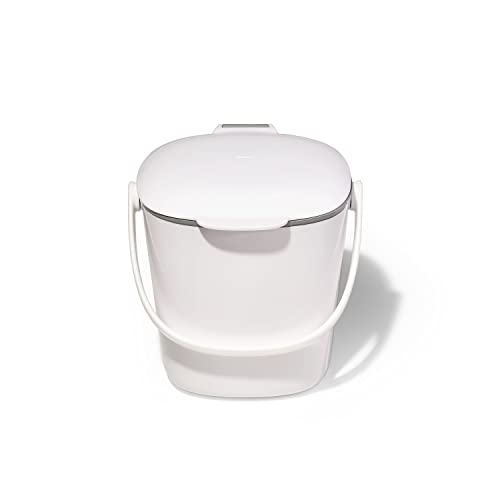
If your profile lands on the pro side, buy to shrink the cons. Indoors, that means a caddy chosen for hygiene above all: a lid that seals, a charcoal filter if your emptying rhythm runs to days, an interior you can wash properly without trapped corners, and a size matched to your cooking so it fills as you are ready to empty it. The representative caddies in this cluster span the main styles — the compost bin buying guide reviews them in full — but the slot-level shortlist is simple. A design-led integrated station like the Joseph Joseph Totem suits kitchens that want collection built into one unit. A straightforward washable caddy like the OXO Good Grips suits daily cooks who empty often. A filtered steel classic like the EPICA suits households emptying every few days. Outdoors, buy containment and turning ease if you are chore-averse, capacity if you are a gardener, and dual chambers if your input stream is continuous, which for most households it is.

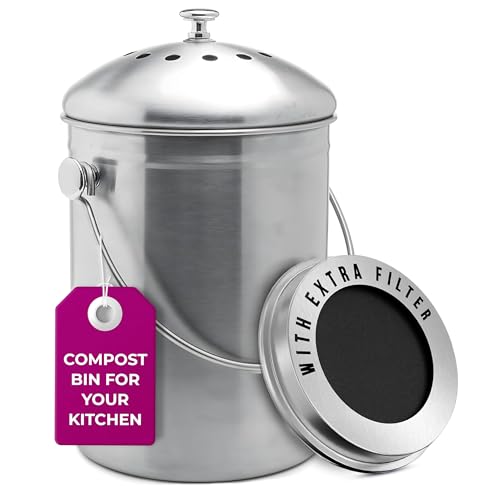
For the Hygiene-First Buyer: EPICA Stainless Steel Compost Bin
As the pros-and-cons pick for the kitchen, the EPICA represents the design that most directly attacks the biggest con: a stainless body that washes clean and absorbs nothing, and a charcoal filter in the lid that absorbs the gases of scraps held over several days. It does not repeal the hygiene rules — the filter is a consumable that must be replaced, and the wash cycle still matters — but it widens the margin for real households with imperfect rhythms, which is exactly what a cons-reduction purchase should do. Treat it as the caddy for buyers whose honest emptying pace is measured in days.
For the Garden Buyer: FCMP Outdoor Tumbler
Outdoors, the FCMP’s dual-chamber drum is the configuration that most reduces the balancing and batching cons: one side finishes while the other fills, the sealed body answers the pest and tidiness cons, and rotation replaces forking for the effort con. It still demands balanced feeding and frequent turns — no purchase removes the living-system con — but it organises those demands into the most forgiving rhythm available in a tumbler. The fuller multi-pick comparison lives in compost bin reviews.
Setup and Care That Reduce the Cons
Most cons shrink under a short list of practices, and it is worth reading them as the operating half of this article. Site the outdoor unit on level ground, on soil if it is a static bin, within reach of water, and after you check the rules where you live regarding placement. Start with a dry brown base layer, then keep browns visibly ahead of greens as you add, storing a dry supply of leaves, shredded paper or cardboard beside the bin so the balance is never postponed for want of material. Chop or shred large inputs; smaller pieces decompose faster and more evenly. Keep moisture at the wrung-out-sponge point — water a dry pile, fork browns into a wet one. Turn on a rhythm tied to something you already do weekly, so the habit survives motivation. Indoors, run the caddy protocol without negotiation: lid closed, filter replaced on schedule, a shredded-paper layer over wet scraps, a rinse at every emptying, a hot soapy wash on a regular cycle, dried before refilling, and a cool spot away from the oven’s heat. Enforce the exclusion list — no meat, no dairy, no oils or fats, ever — with everyone who cooks. Do these things and the cons section of this article becomes a description of other people’s composting, which is the realistic goal: not a system without disadvantages, but a system whose disadvantages you have organised out of your own daily experience.
A Second Season With the Same Bin: What Changes
Most published judgements about compost bins are written in the first season, and the pros and cons genuinely shift in the second. The hygiene cons usually shrink, because the routines that felt like a list in month one have become reflexes: the caddy gets washed without a decision, browns get added without a calculation, and the filter change has a place in the calendar. The speed con shrinks too, because a second-year system holds a reserve of finished and finishing material — the household stops waiting for compost and starts drawing from a pipeline, which changes the emotional experience of the whole enterprise from investment to income. What can grow in year two is complacency: the regulars who never smelled anything stop washing quite so often, a new household member never learns the exclusion list, a tumbler latch stiffens unnoticed until it fails under a full drum. The durable systems are the ones whose owners treat the second season as the time to re-teach the household, service the equipment — wash everything thoroughly, check seals, hinges, filters and frames, refresh the browns store before the autumn surge — and adjust capacity to the garden they now actually run. Judged across that longer arc, the category’s balance tilts further toward the pros than any first-season review can show, provided the household uses the quiet months to maintain the system rather than merely to use it. That long view is also the fairest way to read the rest of this cluster: the compost bin reviews judge the equipment, but the equipment is only half of a system whose other half is a household that has had time to learn it.
The Costs Nobody Puts on the Box
Three further disadvantages rarely appear in product descriptions, and fairness requires listing them. The first is consumables and companions: charcoal filters are recurring purchases for filtered caddies, a browns supply must be gathered or bought when the garden does not provide it, and many households add a harvesting sieve, a second caddy or a leaf store as the system grows — none of it ruinous, all of it real, and all of it arguing for the qualitative tier thinking used throughout this cluster rather than a single headline figure. The second is the learning tax on the first batch. Beginners commonly lose their first load to imbalance — too wet, too green, too compacted — and while the material is almost always rescuable with browns and air, the season spent rescuing it is a genuine cost in motivation. The third is social: a compost system is visible to everyone who uses the kitchen and shares the garden, and it requires their cooperation with the exclusion list and the washing routine. A household that cannot align on those small rules owns a recurring argument with a lid on it. None of these costs outweigh the pros for the profiles identified earlier, but a buyer who has priced them in — filters on the calendar, browns stored before they are needed, the household briefed before the bin arrives — will find the cons section of this article reading like a description of problems they mostly skipped.
What Changes Hands When It Works
Set against those hidden costs is a benefit that owners mention with surprising consistency and that deserves equal billing: composting changes the household’s relationship with its garden from consumption to circulation. Beds are fed by the kitchen that the beds will feed; leaves that were a disposal problem become the carbon bank that makes the whole system work; coffee grounds, peelings and prunings acquire destinations instead of a single grey one. Gardeners describe a particular satisfaction in spreading compost whose entire ingredient list they can recite, and in watching soil improve year over year in ways they can attribute to their own material. This is not a quantifiable pro, and this article has deliberately kept its ledger practical — but a buying decision made only on the practical ledger misses why so many households keep composting through the slow winters and the occasional smelly week. The system pays a small, steady dividend of competence and connection alongside the compost, and for the households in the pro profiles, that dividend, more than any saving, is what turns a purchase into a permanent feature of the home.
Reading the Cons as a Specification
There is a practical way to use this article at the point of purchase: read the cons list backwards, as a specification for the system you should buy. If the smell-and-flies con worries you most, your specification is maximum kitchen containment — a sealing lid, a charcoal filter you commit to replacing, a caddy interior with no corners you cannot wash, and a place for it away from heat. If the balancing con worries you, your specification is a stored browns supply and a forgiving processor: a static bin tolerates imbalance with patience, while a dual-chamber tumbler organises it into batches. If the slowness con worries you, your specification is particle size and rhythm — chop inputs, turn often, keep the pile at its moisture point — because those habits move any system toward the fast end of its range. If space and rules are your binding cons, your specification is a caddy alone feeding a collection scheme, chosen with the same care as a processor would be. And if effort is the binding con, specify for the operator: light frequent actions over heavy occasional ones, one-handed lids and latches, a turning height that suits the person turning. Worked through this way, the pros and cons stop being a verdict on composting in general and become a design brief for your household’s version of it — which is, in the end, the only version you will ever own. The households that thrive with a compost bin are rarely the ones with the fewest disadvantages; they are the ones who read their disadvantages early and bought, sited and routinised against them on purpose.
Bottom Line
One last consideration belongs in the balance, because it decides many real purchases: reversibility. A compost bin is among the most reversible improvements a household can make. The caddy can move to a collection-only role, the tumbler can be sold or passed on, the static bin can be lifted and the ground reclaimed in an afternoon, and nothing in the system commits you to a contract, a subscription or a permanent alteration of the house. That reversibility lowers the stakes of trying: a household that is seventy percent persuaded by the pros is not gambling much by testing them for a season, provided it buys honestly for its profile and keeps the hygiene routine while it decides. The households that regret composting are almost never the ones that tried and stopped; they are the ones that bought against their own profile — the chore-averse household with an open pile, the tiny kitchen with an oversized caddy, the meat-heavy waste stream with no collection backup — and then blamed the category. Read the profiles, trust them, and the trial is cheap, instructive and very likely permanent.
The compost bin pros and cons resolve into a single question: does your household produce a steady stream of compostable material, have somewhere for the output to go, and keep small routines reliably? If yes, the pros — diversion, soil, simplicity, containment, adaptability — comfortably outweigh cons that good buying and basic hygiene shrink to background chores. If no, the cons are not a challenge to rise to but information to act on, and a caddy feeding a collection scheme captures the main pros without the processing burden. Either way, decide with the full picture in view, and decide for the household you actually run — its cooking, its garden, its space, its tolerance for routine — rather than the household of the brochure, because every pro in this article is collected by a real routine and every con is charged to one. It is also worth remembering that the trial is cheap and reversible, and that a season of honest use teaches a household more about its own fit than any amount of reading, including this article. The deep-dive assessment is in our compost bin review, the selection criteria are in the buying guide linked above, and the garden context is in the best compost bins on this site and raised garden beds for your finished compost.
Where the Trade-Offs Show Up in Daily Use: Compost Bin in Practice
This section exists to move past the tidy two-column summary and watch where each advantage and disadvantage actually appears during an ordinary week. It adds a layer that a feature list cannot give you, grounded in the garden & lawn context this compost bin will actually live in. Where this guide names examples such as EPICA Stainless Steel Compost Bin, FCMP Outdoor Tumbler, use them as test cases for the checks below rather than as shortcuts past them.
Finally, plan the first fortnight. Decide where the compost bin will live from day one, what it replaces, what accessory or companion it needs straight away and what small job you will use to learn its habits while returning it is still simple. Keep the packaging until that learning period is over, note anything that surprises you, and deal with a mismatch early rather than adapting yourself around a poor fit for years. The households that end up happiest with a compost bin are rarely the ones that researched longest; they are the ones that checked fit honestly, bought for the ordinary week, and paid attention during the first days instead of assuming the decision ended at checkout.
One more angle is worth your time: the second-order costs. A compost bin changes what happens around it. It can demand a different cleaning product, a new storage habit, a moved piece of furniture, a rearranged cupboard or a standing arrangement with the people you live with. List those knock-on effects before you buy and decide whether you accept them as part of the deal. Sometimes the answer is an easy yes, and the compost bin earns its place by improving the whole routine around it. Sometimes the honest answer is that the supporting changes are the real project, and the purchase should wait until you are ready for them. Either answer is useful; the only bad outcome is discovering the knock-on effects by accident, one irritation at a time, after the decision can no longer be revisited.
It also helps to separate the problems a compost bin can solve from the problems it merely moves. If the underlying difficulty is space, the answer may be a smaller format or a different location rather than a more elaborate model. If the difficulty is time, look for the option that removes steps rather than the one that performs each step slightly better. If the difficulty is that several people want different things, a compromise design that everyone rates as good enough will usually outlast a specialist design that one person loves and everyone else avoids. Naming the real problem in one sentence, out loud, before you order, is a surprisingly powerful filter, and many shoppers find that the sentence itself points at a different compost bin than the one they started out researching.
Start with the unglamorous measurements. For a compost bin, the numbers that decide satisfaction are rarely the headline ones in a listing; they are gate width, path slope, storage in a shed that is already full and how far the work really is from the nearest tap or socket. Write the real dimensions of your space down, including the awkward constraints you normally work around without thinking, and hold every contender up against that sheet rather than against a showroom photograph. Then walk the route the compost bin will take on delivery day and during normal use. A choice that fits on paper but fights you every time it is moved, opened, cleaned or stored will lose its shine quickly, however strong its other qualities look in a comparison table.
Next, rehearse the week, not the ideal day. Picture the compost bin inside a Saturday catch-up after two weeks of growth, a quick tidy before visitors, and the wet week when everything is heavier and muddier. Most disappointment comes from buying for the best-case scenario: the tidy version of the household, the motivated version of yourself, the weather or the guest list you hope for rather than the one you usually get. If the compost bin only makes sense when everything goes to plan, it is the wrong size, the wrong format or the wrong purchase for now. If it still looks useful on the tired, rushed, slightly chaotic version of the day, it has passed the most honest test there is, and the remaining questions are about detail rather than direction.
Pay close attention to the recurring friction points, because they compound. With a compost bin, owners tend to run into blades, lines and fittings wearing quietly, parts clogging mid-job, and instructions that assume a flat, empty garden that nobody actually has. None of these is dramatic on its own, and that is exactly why they get underestimated at buying time. Ask how the design you are considering handles each one: can the wearing part be replaced, can the awkward part be reached without tools, does the job take two minutes or twenty. A compost bin that makes its own upkeep easy gets maintained; one that makes upkeep a project gets neglected, and neglected products perform badly in ways that then get blamed on the original purchase.
Use the listings as a checklist rather than as entertainment. For each compost bin you shortlist, note the exact variant, the included parts, what is sold separately, and which photographs show the item in a setting like yours rather than in a studio. If a model named elsewhere in this guide catches your eye, treat it as a worked example for this process: run it through the same measurements, the same weekly rehearsal and the same friction list before letting familiarity turn into preference. Consistency is the whole trick. Shoppers go wrong not by choosing the objectively weaker compost bin, but by judging one contender on features, the next on looks and the third on a single enthusiastic anecdote.
Think about who else has a vote. A compost bin is usually shared, moved, cleaned or complained about by more than one person, and the second user’s priorities are often the ones that surface after the return window closes. Check height, weight, reach, noise, heat, sharp edges or sheer visual presence, whichever apply, against the smallest, oldest or least enthusiastic person who will live with it. If you are buying for a household that includes children, pets, elderly relatives or lodgers, run the clumsy scenario too: the spill, the knock, the curious tug, the door left open. A robust compost bin choice survives other people; a fragile one only survives its buyer.
Frequently Asked Questions
What is the biggest disadvantage of a compost bin?
For most households it is the combination of smell and fruit flies when hygiene slips, because that is the con you experience indoors, daily, at face height. The good news is that it is also the most controllable con: a sealed lid, a fresh charcoal filter, regular hot soapy washing, thorough drying and a layer of shredded paper over wet scraps keep a caddy effectively odour-free. Outdoors, the equivalent discipline is balance and air — dry browns and turning. The disadvantage is real but it is a routine problem, not a product lottery.
What is the biggest advantage?
The closed loop. A compost bin turns two waste streams — kitchen scraps and garden material — into a soil amendment on your own property, shrinking your general waste every week and improving your beds, borders and pots every season. Other options can divert waste, but only home composting returns it to your soil under your control, in the quantities and at the seasons your garden wants. For gardening households, that single pro outweighs the entire cons list once basic routines are in place.
Can a compost bin attract rodents or pests?
An open pile fed the wrong inputs can; a managed system is designed not to. Sealed tumblers physically exclude rodents, static bins on soil with a lid and a balanced, buried-scrap routine rarely trouble anyone, and the strongest repellent is the exclusion list: no meat, no dairy, no oils or fats, ever, because those are what pests are actually after. Fruit flies are the common indoor nuisance, and they are a caddy-hygiene issue — lid, filter, washing — rather than a garden one. Check the rules where you live too, as some areas’ siting guidance is written with pests in mind.
Is composting too much work for a busy household?
It depends which work you count. The weekly total is modest — emptying and washing a caddy, adding browns, giving a tumbler its turns — but it is non-negotiable work in the sense that skipping it has consequences, unlike a chore that simply waits. Busy households succeed when the tasks are bolted onto existing routines and the equipment is maximum-containment: sealed, filtered, washable. They fail when the system needs remembering. Be honest in that assessment; a collection scheme used consistently beats a home system abandoned by spring.
Why did my compost go slimy and smelly?
Almost always too many greens, too little air and too much moisture acting together — the classic pattern is a load of grass clippings or wet kitchen scraps compacting into an airless mass. The rescue is mechanical and reliable: fork in a generous volume of dry browns such as shredded cardboard, dry leaves or straw, turn to reintroduce air, and let excess moisture drain or evaporate before adding anything wet again. Then rebalance future additions so browns stay visibly ahead. A pile that smells earthy is working; a pile that smells sour is asking for browns and air, in that order.
Do I have to stop composting in winter?
No, but you should change expectations and a few habits. Decomposition slows sharply in the cold while scraps keep arriving, so keep feeding in balanced layers, insulate where you can with extra browns, and accept that the winter load largely processes when warmth returns. Capacity pressure is the main winter issue, which is why generous sizing and a stored supply of dry browns matter. The caddy routine continues unchanged — indeed indoor hygiene matters more, not less, when the outdoor trip is cold and tempting to postpone.
Related Guides
Continue within the cluster with a full compost bin review and how to choose a compost bin step by step. For the garden the system serves, see soil for raised vegetable garden beds and rain barrels for garden watering.