Disclosure: As an Amazon Associate, dailyhomedecorating.com earns from qualifying purchases. Links on this page are affiliate links; they cost you nothing extra. Prices and availability change often, so check the current Amazon listing before you buy.
The honest answer to is a compost bin worth it depends on three things about your household and nothing about the bin: what your waste stream is made of, whether your garden can use what the bin produces, and whether someone will keep two small routines — washing a caddy and balancing a pile — without being nagged by a smell. Where those three align, a compost bin is one of the best-value systems a home can run: it diverts a visible share of your waste every week and returns it as a soil amendment your beds and pots genuinely benefit from, season after season, for an outlay measured in a caddy and a drum rather than in appliances. Where they do not align — a waste stream dominated by cooked food and packaging, no garden and no collection scheme, no willing operator — the same purchase becomes a smelly monument in a corner of the yard. This article works the question properly: what you actually get, what it really costs beyond money, the household profiles it pays off for and the ones it does not, the alternatives, and a decision checklist you can answer in two minutes.
Worth it if: you cook with fresh ingredients most days, you have a garden, beds, pots or even a collection scheme that can take the material, and your household can absorb a few minutes of routine a week. Not worth it if: your food waste is mostly meat, dairy, oily leftovers and packaging that a home bin cannot accept, your only outdoor space is a small balcony, or the honest answer to “who will wash and turn it” is nobody. Everything between those poles is a matter of configuration — sealed and filtered designs for the chore-averse, caddy-only setups for the space-poor — and this article treats those middle cases in full rather than forcing a verdict.
Key Takeaways
- Worth it is a household property, not a product property: waste stream, garden demand and a willing operator decide it.
- What you get is a working loop — weekly diversion plus a seasonal supply of finished compost your soil visibly uses.
- The real costs are space, a few weekly minutes, consumables like charcoal filters and browns, and a learning season.
- Meat, dairy and oils never belong in a home bin; households whose waste is mostly those should use a municipal scheme.
- A caddy-only setup captures much of the value where space or rules rule out an outdoor bin — check the rules where you live before siting one.
Is A Compost Bin Worth It? What You Actually Get
Strip away the lifestyle framing and a compost bin delivers four concrete things. The first is diversion you can see. A substantial share of a typical kitchen’s output is organic — preparation scraps, coffee grounds, eggshells, stale ends of bread — and a garden adds its own stream of clippings and leaves. A bin intercepts both at source. Households consistently describe the shrinking of their general waste as the benefit they notice first, because it is weekly, physical and cumulative: the bag that used to fill by Thursday now lasts the week, and the material has not vanished into a system somewhere else — it is visibly transforming in your own garden. The second delivery is the output itself. Finished compost is a real soil amendment: worked into beds it improves structure and moisture behaviour, fed to pots it stretches bought mixes further, and spread as a mulch-like dressing it returns organic matter that gardens steadily lose. It arrives at the two moments gardeners most want it, spring and autumn, in quantities that scale with your own inputs, and it is made of your garden’s own material, which is why experienced gardeners value it beyond its bagged equivalent.
The third delivery is independence. A home system has no collection calendar, no scheme rules about what this week’s truck accepts, no dependency on a service existing at your address at all. Households in areas without organics collection — where the alternative to a home bin is the landfill stream, full stop — are not weighing a convenience; they are weighing the only available loop. The fourth delivery is quieter: knowledge. Running a bin teaches a household what it throws away, and that visibility reliably changes behaviour upstream — less food bought to be wasted, leftovers planned, trimmings used. Families report the bin becoming a practical education for children in decomposition and seasons. None of these four deliveries requires the bin to be expensive, and all four compound with time: the second year of a running system, with its pipeline of finishing material and its reflex routines, delivers more than the first. That compounding is the heart of the worth-it case, and it is why this article judges the purchase across seasons rather than across the first enthusiastic month.
In this guide
The Real Costs Beyond Money
An honest worth-it analysis prices the non-monetary costs, because those are the ones that actually bankrupt home composting. Space is the first: a permanent position on the counter or in the cupboard for the caddy, and a level, reachable plot outdoors for the processor — space that small homes feel acutely and that must also satisfy neighbours and, in some areas, siting rules. Time and attention are the second: the weekly total is genuinely small — emptying and washing a caddy, adding browns, turning a drum — but it is recurring and non-deferrable in a way that, say, a garden bench is not, because the system is alive and a skipped month has a smell. The third cost is consumables and companions, stated qualitatively because figures vary: charcoal filters on a cycle for filtered caddies, a browns supply that must be gathered, stored dry and kept in stock, and the small kit — a trug, perhaps a sieve — that harvesting wants. The fourth cost is the learning curve, paid in the first season: most beginners lose time rescuing an early batch that went too wet or too green, and the tuition, while recoverable, is real. The fifth cost is social: the system needs every cook in the house to honour the exclusion list and the washing rhythm, which makes it a small exercise in household agreement. None of these costs is large. All of them are permanent. The worth-it question is therefore not “can we afford a bin” but “will this household happily pay these five small rents forever” — and households that answer yes in advance almost never regret the purchase, while households that never priced the rents are the ones whose bins appear in second-hand listings.
Who It Pays Off For
The from-scratch cooking family with a garden. This is the profile the category was born for. Their waste stream is rich in exactly the material a home bin handles best, their garden consumes the output at full value, and the routines — washing, layering, turning — attach naturally to cooking and gardening they already do. For them the bin pays off on every axis at once: diversion weekly, compost seasonally, and a system that scales as the family’s cooking and planting grow. Their only real decision is configuration, and the matched recommendations in compost bin reviews were written with them in mind.
The keen gardener whose soil is the point. For this profile the output is not a bonus but the purpose. A gardener who buys in bagged soil improvers every season, who runs beds, borders and pots that visibly respond to organic matter, converts a waste stream into their single most-used garden input. The bin pays off in the beds: in structure, in moisture behaviour, in the satisfaction of feeding soil with the garden’s own material. Keen gardeners also tend to run the system well, because the pile is part of the garden they already tend, and their configuration usually centres on capacity — a static bin, or a tumbler for kitchen material beside one.
The waste-motivated household without a collection scheme. Where no municipal organics service exists, the bin is the only loop available, and its payoff is measured against landfill rather than against a truck. These households often start with waste reduction as the motive and discover the garden benefits second, and their satisfaction tends to be high precisely because the comparison is stark. Sealed, contained designs serve them best — the system must be pleasant enough to keep for years, because there is no scheme to fall back on — and the hygiene guidance in the compost bin buying guide matters most to them.
Who Should Skip It
The household whose waste is mostly cooked and packaged. A residential bin cannot accept meat, dairy or food cooked in oil and fat, and it should not try. If your audit — and you should audit honestly, as how to choose a compost bin insists — shows a stream dominated by leftovers, takeaway remains and packaging, the compostable fraction is too thin to run a pile and the bin will sit underfed while the real waste goes elsewhere anyway. A municipal scheme, which processes cooked food industrially, is this household’s correct answer; a caddy feeding it captures the diversion value without the mismatch.
The household with no operator. Composting’s routines are small but they are someone’s. If every adult in the home travels constantly, dislikes the tasks, or assumes someone else will do them, the system will decay into the smell-and-flies scenario that gives the category its unfair reputation. This is not a moral failing; it is a logistics fact, and the honest purchase for such a household is no purchase — or, at most, a caddy feeding a collection, where the only routine is washing one washable object.
The household with nowhere legal or practical to put it. A small balcony overlooked on all sides, a rented garden where the landlord refuses, a plot where the rules where you live prohibit or tightly restrict outdoor bins — these are real vetoes, not obstacles for enthusiasm to override. Check the rules where you live early. Where they veto the outdoor half, the caddy-plus-scheme configuration may still deliver most of the value; where there is no scheme either, the worth-it answer for now is no, and it can be revisited when the address changes.
The Strengths and Trade-Offs of Owning One
Strengths of ownership
- A closed loop at home: waste becomes a garden input on your own property, with no transport, no scheme and no intermediary.
- Compounding returns: routines become reflexes and the pipeline of finishing compost makes the second year more rewarding than the first.
- Visibility that improves the household: handling your own waste stream reduces the waste itself, upstream, in the shopping and the cooking.
Trade-offs of ownership
- A living system, not an appliance: balance, moisture and air need light, permanent attention, and neglect announces itself as smell.
- Seasonal timing: output arrives on biology’s schedule, winter slows everything, and capacity must be planned for the slow months.
- Boundary discipline: the exclusion list — no meat, dairy or oils — must be honoured by everyone who cooks, forever.
Alternatives to Consider
Worth-it is always relative, so consider the bin against its real rivals. A municipal organics collection is the strongest alternative where it exists: it accepts a wider stream, including cooked food a home bin must refuse, and it asks nothing but a caddy and a calendar. Its costs are dependence — on the scheme existing, on its rules, on its charges where they apply — and the loss of the output, which leaves your postcode rather than feeding your beds. For households with no garden, it usually wins; for gardening households, the comparison is genuinely close, and many run both, sending cooked waste to the scheme and composting the clean stream at home. A worm bin is the small-space specialist: it processes kitchen scraps in a tray system that can live in a utility space, produces an exceptionally fine output for pots and houseplants, and suits households that enjoy tending a living colony. Its inputs are narrower, its capacity smaller, and it is a pet-keeping commitment in a way a tumbler is not. A simple static pile or bay, for gardeners with space, is the zero-mechanism alternative to a bought processor: it asks for a corner of ground and the same balance discipline, and returns the same compost — the bought bin’s advantages over it are tidiness, exclusion and containment, which matter in overlooked gardens and matter little in large ones. And the final alternative is doing nothing beyond the general waste bin: zero effort, zero output, and the organic stream landfilled. It is the right answer only for households that fail every profile above — no compostable stream, no garden, no scheme, no operator — a smaller group than the category’s sceptics usually assume.
If You Buy One Thing Outdoors: FCMP Outdoor Tumbler
For the profiles this article says yes to, the dual-chamber tumbler is the configuration whose value holds up best, and the FCMP is its reference design at a mid tier: one chamber filling while the other finishes, a sealed drum that excludes rodents and keeps an overlooked garden tidy, and turning that replaces forking. Its value case is the rhythm — continuous input matched to finishing output — and it is presented here prose-first, in the slot where its verified purchase link will sit at publishing. Households with bulky garden waste should read its verdict alongside the static bin’s case in compost bin pros and cons before deciding.

If You Buy One Thing Indoors: EPICA Stainless Steel Compost Bin
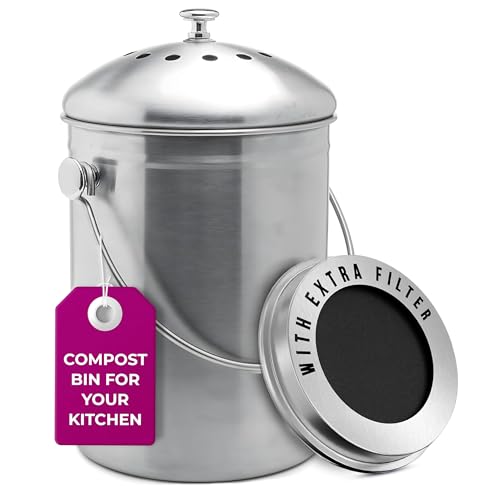
Indoors, the value pick for most households is the filtered steel caddy, because the kitchen half is where the habit is won and the filter is what lets a real household’s rhythm — emptying every few days, not after every meal — stay odour-free. The EPICA’s steel body supports the washing routine indefinitely, and its charcoal stage bridges the gaps that defeat simpler caddies. Budget its filters as a running cost of the configuration, the way this article has taught you to count costs, and the value case is complete.
How to Get the Most Value If You Buy
Value in composting is extracted by routine, so this section is the article’s practical core. Site the system for the worst month, not the best: the outdoor unit level, on soil if it is a static bin, close enough to the kitchen door that February trips stay short, and checked against the rules where you live before it is filled. Start balanced — a dry brown base, then greens and browns in layers with browns visibly ahead — because a pile started correctly teaches the household the method by example. Run the caddy protocol as a fixed liturgy: lid closed, shredded paper over wet scraps, rinse at every emptying, hot soapy wash on a weekly rhythm, dried before refilling, charcoal filter replaced on a calendar date. Keep browns in stock, dry, beside the outdoor unit, so balance is never postponed. Chop inputs small; it is the cheapest speed there is. Turn on a rhythm tied to an existing weekly event. Harvest finished material generously and use it visibly — on the beds, in the pots, around the shrubs — because a household that sees the output keeps feeding the input, and that feedback loop, more than any product feature, is what makes the purchase worth it in year two and beyond. Finally, teach the whole household the exclusion list once, properly, at the start: no meat, no dairy, no oils, no exceptions — the rule that protects every other routine on this page.
The Money Question, Handled Qualitatively
Readers reasonably ask what all this is worth in money, and this article’s refusal to print figures is a policy, not an evasion: prices change, listings change, gardens differ by an order of magnitude, and a number printed here would be wrong somewhere by the time it was read. What can be stated honestly is the shape of the exchange at each tier. At the entry end — a simple caddy and a compact or static processor — the outlay is that of a modest kitchen appliance, the running costs are browns and effort, and the return is the full loop at household scale: diversion weekly, compost seasonally. At the mid tier — a filtered steel caddy and a dual-chamber tumbler — the outlay buys containment, rhythm and finish, plus a perpetual small consumable in the charcoal filters; the return adds comfort and reliability in overlooked gardens and busy kitchens, which is where systems live or die. At the premium end — an integrated station, the largest drums — the outlay buys design and integration, and the compost produced is identical in kind, because microbes do not read price tags. The value question therefore splits: the loop itself is worth it at every tier for the right household, while each step up the tiers is worth it only if it buys a margin your household will feel — a filter for a slow rhythm, a second chamber for a continuous stream, a sealed drum for a watched garden. Buy the loop first and the margins knowingly, and the money side of worth-it takes care of itself; buy margins you will never feel, and even the right household can make the wrong purchase.
A Year of Ownership, Season by Season
Worth-it verdicts written in the first month are unreliable in both directions, so judge the purchase against the year it will actually live. Spring is the honeymoon: the pile wakes, the caddy fills with the trimmings of lighter food, and the first finished material — if the system was started the previous year — goes onto beds at exactly the moment gardeners crave it. Summer is the examination of hygiene: heat tests the caddy’s seal and filter, fruit flies probe every lapse, and the households that fixed their washing rhythm in spring sail through while the others learn, briefly and smellily, why this cluster repeats its liturgy. Autumn is the examination of capacity: leaves and clear-outs arrive together, the browns bank fills for winter, and systems sized for the average week reveal the error while systems sized for the peak absorb it in stride. Winter is the examination of commitment: biology slows, inputs accumulate, the garden trip is cold, and the purchase is either a dormant asset patiently filling or a regretted object quietly filling — the difference being the framing the household chose in advance and the capacity it bought in autumn. A compost bin that survives its first full turn of these examinations has, in practice, been judged worth it by the only jury that matters, and its second year — routines reflexive, pipeline established, output arriving on schedule — is when the compounding this article promised actually shows up in the beds and in the waste bin’s slower fill. Buy for the year, in other words, and let the year deliver the verdict.
The Environmental Value, Weighed Honestly
For many households the deciding argument is environmental, and it deserves the same honesty as the money. The genuine gains are structural: organic matter diverted from landfill avoids rotting in the airless conditions that generate methane; compost returned to soil rebuilds the organic matter and structure that gardens steadily lose, improving water behaviour in both drought and deluge; and the entire loop runs without transport or industrial processing, at the address where the waste arose. The qualifications are equally real. A neglected, waterlogged, airless pile can generate the very gases composting exists to avoid, which is why balance and turning are environmental acts and not mere gardening fussiness. A household that drives long distances to service a tiny system spends part of the benefit at the kerb. And composting addresses only the organic stream — it does nothing for packaging, and it is a complement to reducing waste, not a substitute for it. Weighed at that level, the environmental case is a solid supporting argument for the profiles this article recommends, and an insufficient sole argument for the profiles it does not: a bin abandoned by March delivers no environmental value at all, while a modest caddy feeding a municipal scheme, kept for a decade, delivers a great deal. The greenest system, as with the cheapest, is the one your household actually runs — which returns the worth-it question, by every route, to the same three facts: your stream, your garden, and your operator.
What Owners Report After the First Year
Patterns from households a year into ownership are consistent enough to count as evidence. The first is that the benefit ranking inverts: buyers arrive expecting the compost to be the prize and report, a year on, that the weekly diversion — the slower-filling waste bin, the scraps with a destination — is what they would least give up, with the compost as a valued second. The second is that the feared costs shrink in the telling: the washing and turning that loomed in prospect are described, a year on, as minutes attached to existing routines, while the unanticipated cost is the one this article flagged — the social work of keeping every cook in the house inside the exclusion list. The third pattern is configuration regret, and it is specific rather than general: owners rarely wish they had composted differently in principle, but they do name the mismatch they bought — the unfiltered caddy on a slow rhythm, the single chamber on a continuous stream, the drum sized for the average week in a garden with an autumn. Each regret is a checklist item in this cluster, which is why the choosing articles insist on rhythm, stream and peak before product. The fourth pattern is expansion: a striking share of one-year owners have added something — a browns store, a second unit, a bigger caddy — not because the first purchase failed but because the system earned trust and the household extended it. Taken together, the owner evidence supports this article’s structure: worth-it is decided by profile and configuration far more than by the bin itself, and the households that matched both are the ones reporting, a year on, that the question answers itself every time they open the caddy.
The Trial Option: Earning the Verdict Before You Buy
Households still undecided after the checklist have one more instrument, and it is nearly free: a month’s rehearsal with improvised equipment. Any lidded container can stand in for the caddy — run the true routine with it, shredded paper over wet scraps, rinsed at every emptying, washed properly each week, and carried out on your real rhythm. A corner of the garden or a borrowed bin can stand in for the processor, fed in balanced layers from your audited stream. At the month’s end, the worth-it question has usually answered itself in evidence rather than argument: either the routines fitted your household’s week so naturally that the purchase is merely the tidy version of a habit you already have, or the month exposed the friction — the rhythm that slipped, the operator who resented it, the stream that was thinner than memory claimed — and saved you the purchase entirely. This article recommends the trial without embarrassment, because a guide confident in its analysis should be: for the profiles it recommends, the rehearsal confirms; for the profiles it warns against, the rehearsal protects. Either way the household decides with a month of its own data, which is worth more than any verdict printed here — including this one.
Three Ways to Say Yes, at Three Levels of Commitment
Because worth-it is a spectrum, it helps to see the three configurations that correspond to its three honest answers. The lightest yes is the caddy alone, feeding a municipal or community scheme: one washable or filtered object, one routine, no garden footprint, no siting question beyond the counter. It captures the diversion value and the visibility value, surrenders the output, and suits small homes, renters and the chore-averse — and it is not a compromise to apologise for, since for many households it is the configuration that will still be running in a decade. The middle yes is the compact home system: a good caddy and a small sealed processor, run in batches, for households with a patio or small garden and a modest stream. It captures the full loop at kitchen scale, asks batch discipline in return, and is the configuration most likely to grow — its owners are the ones who add capacity in year two as confidence compounds. The full yes is the garden system: a caddy chosen for rhythm, a dual-chamber tumbler or static bin chosen for the stream, a browns store, a harvest kit — the complete infrastructure, for households whose cooking and gardening generate and consume at full scale. Notice what the ladder implies for the purchase decision: each level is complete in itself, none is a down payment on the next, and moving up is driven by evidence — a queue of scraps, a garden asking for more — rather than by ambition at the point of sale. Households that buy their current level honestly almost always find composting worth it; households that buy two levels above their evidence are the ones writing the disappointed reviews the rest of this cluster exists to prevent.
If It Does Not Work Out: The Downside, Priced Honestly
A fair worth-it analysis also prices the failure case, and here composting is kinder than most household purchases. The equipment is durable, simple and saleable: a caddy, a drum or a static bin that one household misjudged is exactly what another household is looking for, and the second-hand market for compost gear is active precisely because the products do not wear out in a season. The installation is reversible — nothing is plumbed, wired or built in, a tumbler leaves with its owner, and a static bin lifts off ground that reverts to garden in an afternoon. The running experiment costs little to pause: a system can be emptied, cleaned and stored while a household regroups, and a caddy can be demoted to collection-only duty feeding a scheme without wasting the purchase. Even the material is forgiving — a failed batch is not a loss but an unfinished one, rescuable with browns, air and time whenever the household chooses to return to it. Compare that downside profile with the fixed installations and subscriptions households routinely accept, and the trial nature of the purchase becomes part of its value: the realistic worst case is a season of learning, a cleaned bin sold or stored, and a household that now knows its own answer from evidence. That is a cheap price for certainty about a system that, when it fits, runs for decades — and it is the final reason this article’s verdict tilts generous: where the profile is anywhere near the line, the asymmetry between a compounding upside and a reversible downside makes trying the rational choice, provided the checklist’s operator question can be answered with a name.
The Decision Checklist
Answer yes or no, honestly, for your household as it is this year — not as it aspires to be.
- Does at least half of our food waste come from fresh preparation — vegetables, fruit, coffee, eggshells — rather than cooked leftovers and packaging?
- Do we have a garden, beds, pots or a collection arrangement that can actually use what the bin produces or collects?
- Is there a legal, practical spot for an outdoor unit — or a scheme that makes the caddy-only configuration work?
- Can we name the person who will wash the caddy and turn or fork the pile, and do they accept the job?
- Will every cook in the house honour the exclusion list — no meat, dairy or oils — without exception?
- Are we content for results to arrive seasonally, with winter slow and spring generous?
- Does the small weekly routine sound like a chore we would keep, or one we would quietly drop by the second month?
The rule for reading your answers: five or more yeses, with the operator question among them, means a compost bin is worth it for your household — choose the configuration by the guidance in this cluster and buy with confidence. Three or four yeses means buy the reduced configuration — a caddy feeding a scheme, or a sealed compact system — and let a successful year argue for expansion. Two or fewer means the honest answer is not yet: use whatever collection exists, revisit the question when your cooking, your garden or your address changes, and spend nothing on a system your household has just told you it will not run. The checklist takes two minutes; the purchase lasts years; that asymmetry is the whole argument for answering it honestly. For the selection itself, the step-by-step method is in how to choose a compost bin, and the garden your compost will feed is covered in raised garden beds, soil for raised vegetable garden beds and the best compost bins on this site.
A Final Word on Timing
When to buy deserves a paragraph, because the calendar quietly rigs the verdict. Start in spring and the system will flatter you: warming weather accelerates every batch, the garden is asking for compost, and the household’s motivation is at its annual peak — a kind season in which to build the routines before they are tested. Start in autumn and you buy capacity at the moment of maximum input, with winter’s slow months immediately ahead; that is the honest season to start, and households that begin then with eyes open tend to size generously and judge fairly. Start in winter only with the checklist firmly answered, because the system will give you nothing back for months and the purchase must survive on faith in spring. And whatever the season, set the system up within days of its arrival and run the first month deliberately, because the gap between buying and using is where good intentions go to be stored in the garage. The worth-it question, in the end, is not answered by this article or by any checklist: it is answered by a household, in its own kitchen and garden, across its own first full year — and the purpose of everything above is simply to make sure the household that runs that experiment is one the experiment was designed for.
The Break-Even Question in Real Life: When a Compost Bin Pays Its Way
This section exists to ask the break-even question honestly, counting not just the purchase but the space, upkeep and attention the item will claim for as long as it is owned. It adds a layer that a feature list cannot give you, grounded in the garden & lawn context this compost bin will actually live in. Where this guide names examples such as FCMP Outdoor Tumbler, EPICA Stainless Steel Compost Bin, use them as test cases for the checks below rather than as shortcuts past them.
Consider the edge cases that sit just outside normal use, because a compost bin will meet all of them eventually. The unusually large load, the unusually small task, the day you are in a hurry, the day something else in the room is broken and this has to cover for it. Versatility is not about a long feature list; it is about behaving predictably when conditions are imperfect. Where a design offers settings, modes, attachments or configurations, ask what each one is actually for in your home, and be suspicious of flexibility you cannot attach to a real occasion. One well-judged configuration used weekly beats five clever ones used once, and the honest compost bin for your home is the one whose strengths line up with your most frequent edge case, not your rarest.
Build a simple decision checklist and score it in writing. Five lines are enough: fit in the space, fit with the routine, ease of cleaning or upkeep, quality of the parts that move or wear, and how the compost bin will be stored or will look when it is not the centre of attention. Score each contender quickly, then look only at the lowest scores, because purchases are usually ruined by their weakest point rather than saved by their strongest. If two options tie, choose the one whose weakness is cheapest or easiest to live with. This sounds mechanical, and it is meant to: a written checklist is the best defence against the very human habit of falling for the last photograph you looked at.
Finally, plan the first fortnight. Decide where the compost bin will live from day one, what it replaces, what accessory or companion it needs straight away and what small job you will use to learn its habits while returning it is still simple. Keep the packaging until that learning period is over, note anything that surprises you, and deal with a mismatch early rather than adapting yourself around a poor fit for years. The households that end up happiest with a compost bin are rarely the ones that researched longest; they are the ones that checked fit honestly, bought for the ordinary week, and paid attention during the first days instead of assuming the decision ended at checkout.
One more angle is worth your time: the second-order costs. A compost bin changes what happens around it. It can demand a different cleaning product, a new storage habit, a moved piece of furniture, a rearranged cupboard or a standing arrangement with the people you live with. List those knock-on effects before you buy and decide whether you accept them as part of the deal. Sometimes the answer is an easy yes, and the compost bin earns its place by improving the whole routine around it. Sometimes the honest answer is that the supporting changes are the real project, and the purchase should wait until you are ready for them. Either answer is useful; the only bad outcome is discovering the knock-on effects by accident, one irritation at a time, after the decision can no longer be revisited.
It also helps to separate the problems a compost bin can solve from the problems it merely moves. If the underlying difficulty is space, the answer may be a smaller format or a different location rather than a more elaborate model. If the difficulty is time, look for the option that removes steps rather than the one that performs each step slightly better. If the difficulty is that several people want different things, a compromise design that everyone rates as good enough will usually outlast a specialist design that one person loves and everyone else avoids. Naming the real problem in one sentence, out loud, before you order, is a surprisingly powerful filter, and many shoppers find that the sentence itself points at a different compost bin than the one they started out researching.
Start with the unglamorous measurements. For a compost bin, the numbers that decide satisfaction are rarely the headline ones in a listing; they are gate width, path slope, storage in a shed that is already full and how far the work really is from the nearest tap or socket. Write the real dimensions of your space down, including the awkward constraints you normally work around without thinking, and hold every contender up against that sheet rather than against a showroom photograph. Then walk the route the compost bin will take on delivery day and during normal use. A choice that fits on paper but fights you every time it is moved, opened, cleaned or stored will lose its shine quickly, however strong its other qualities look in a comparison table.
Next, rehearse the week, not the ideal day. Picture the compost bin inside a Saturday catch-up after two weeks of growth, a quick tidy before visitors, and the wet week when everything is heavier and muddier. Most disappointment comes from buying for the best-case scenario: the tidy version of the household, the motivated version of yourself, the weather or the guest list you hope for rather than the one you usually get. If the compost bin only makes sense when everything goes to plan, it is the wrong size, the wrong format or the wrong purchase for now. If it still looks useful on the tired, rushed, slightly chaotic version of the day, it has passed the most honest test there is, and the remaining questions are about detail rather than direction.
Frequently Asked Questions
Is a compost bin worth it for a small household?
Often yes, provided the small household cooks fresh food and has somewhere for the output to go — a few beds, pots, or a collection scheme. Small households produce a gentler stream that a caddy and a compact tumbler handle in tidy batches, and the diversion is proportionally just as visible in their general waste. The configuration matters more than the verdict: choose sealed and compact, respect batch discipline, and do not buy garden-scale capacity for a kitchen-scale stream. Where there is no garden and no scheme, the honest answer flips to no.
How long until a compost bin pays for itself?
This article deliberately avoids a figure, because the honest answer is a shape rather than a date. The returns arrive as avoided waste and as finished compost you did not buy in bags, and they scale with how much of both your household produces and uses. A gardening household that cooks daily and works its output into beds every season feels the exchange as favourable early and increasingly so as the system matures; a household that composts a thin stream and buys most of its soil products anyway may never feel a payback moment, and should judge the purchase on diversion and satisfaction instead. Worth-it is a profile match, not an amortisation.
Is a compost bin worth it if I have a municipal collection?
It can be, and many households run both. The scheme wins on effort and on accepting cooked food, meat and dairy that a home bin must refuse. The home bin wins on output — compost for your own beds, made from your own material, available at planting seasons — and on independence from the scheme’s rules and existence. If you garden seriously, the home bin earns its place beside the collection; if you do not garden, the collection alone is usually the rational choice, with a good caddy as the only purchase. Judge by whether the output has a destination in your garden.
What puts people off after buying one?
Almost never the composting itself — it is the three avoidable failures this cluster repeats: smell from a caddy that is not washed or whose charcoal filter has silently expired, fruit flies from an unsealed lid and exposed wet scraps, and a pile that went slimy from greens without browns. Each has a routine fix, and households warned in advance — lid closed, paper layered, wash weekly, filter calendared, browns in stock, exclusion list absolute — rarely meet them. The buyers who regret the purchase are usually those whose profile never fitted, which is what the checklist above exists to catch before money moves.
Is a tumbler worth it over a simple bin?
For a steady stream of kitchen scraps in a tidy or overlooked garden, yes: the sealed drum excludes rodents, turning replaces forking, and batches finish faster than a pile’s base layer. For bulky, seasonal garden waste, no: capacity and forgiveness beat mechanism, and a static bin — or a simple bay — serves the stream better for less. The dual-chamber question follows the same logic: worth it wherever input is continuous, which is most family kitchens, and unnecessary where batches are the natural rhythm anyway. Buy the mechanism your stream actually needs.
Can renters make a compost bin worth it?
Yes, with the configuration chosen for reversibility. A caddy feeding a municipal or community scheme changes nothing about the property and captures the diversion value on its own. An outdoor tumbler is a freestanding object that leaves with you, but get the landlord’s agreement before siting one, keep it sealed and tidy, and check the rules where you live as well as the lease. Renters who garden in containers have a genuine use for the output, which strengthens the case; renters between short tenancies may find the caddy-only route is the proportionate answer.
Related Guides
Complete the cluster with the compost bin buying guide, compost bin reviews and compost bin pros and cons. For the wider system, see rain barrels for garden watering and gardening gloves for turning and harvest days. And if this article’s verdict was yes, act on it while the reasoning is fresh: choose the configuration, check the site, name the operator, and set the system up within days — because the households that gain the compounding returns described here are the ones whose first season starts now, in whichever month now happens to be, rather than in a perpetually postponed perfect one. Keep this page’s checklist with the equipment when it arrives, and re-read your own answers at the end of the first season: most households find the reality kinder than the anticipation, the routines smaller than feared, and the verdict easier than the deciding ever was. That, in the end, is the pattern this whole cluster keeps finding — the compost bin rewards the households that chose it honestly, and honesty, unlike equipment, costs nothing at all.