Disclosure: As an Amazon Associate, dailyhomedecorating.com earns from qualifying purchases. Links on this page are affiliate links; they cost you nothing extra. Prices and availability change often, so check the current Amazon listing before you buy.
This pantry storage containers review exists because the difference between a good dry-goods container and a mediocre one is invisible in a product photo and obvious by week three. Every container in this roundup looks tidy on day one. By week three, the weak seal has let the crackers soften, the awkward lid has started living next to the container instead of on it, and the size you guessed at has turned out to fit nothing you actually buy. So this review judges pantry storage containers the way a pantry does: on seals that seat without thought, on sizes matched to real bags, on lids that survive daily hands, and on whether the system is still being used properly six months later.
Key Takeaways
- The seal is the product. A gasket that seats evenly every time matters more than styling, capacity claims or how the set photographs.
- OXO’s POP system is the easiest to live with day to day; Rubbermaid Brilliance clamps hardest; Progressive ProKeeper is the baker’s specialist.
- Entry-tier sets from Vtopmart and Chef’s Path organise a whole pantry in one purchase, with lighter plastic as the honest trade-off.
- Whatever you buy: label and date every container on filling day, and refill first-in, first-out, or the system fails from the inside.
The short verdict: a good container system suits any household that buys dry staples in bags and is tired of stale crackers, mystery white powders and a cupboard that avalanches. It does not suit liquid storage, tiny kitchens with no shelf depth to give, or anyone expecting containers to fix a buying habit of purchasing three bags of everything.
What Pantry Storage Containers Are and Where They Fit
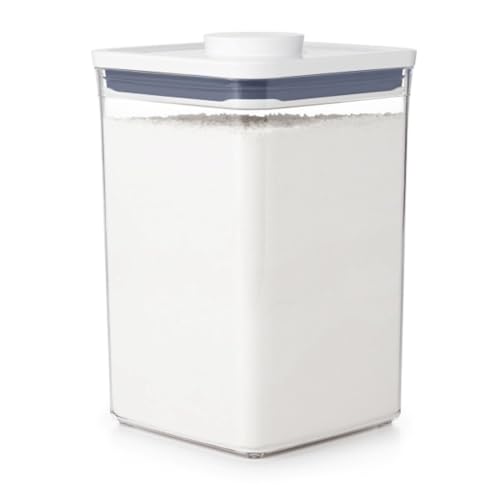
Pantry storage containers are hard-sided, sealable vessels for dry goods — flour, sugar, rice, pasta, grains, cereal, beans, nuts, baking supplies and snacks — decanted out of their shop packaging. That decanting step is the whole point. Shop packaging is designed for transport and shelf display, not for your kitchen: bags slump and spill, boxes tear at the pour corner, and the fold-over closure is a polite fiction. A container gives the food a rigid, sealable, stackable, visible home, and gives you a stock check you can do with your eyes instead of your memory.
The category splits into three families. Matched systems, like the OXO POP and Rubbermaid Brilliance ranges, sell interchangeable lids and tiling footprints so a shelf can grow coherently. Task-specific keepers, led by Progressive’s ProKeeper line, shape the container around one ingredient’s behaviour. Value sets, from brands like Vtopmart, Sistema and Chef’s Path, sell completeness: a wall of containers in one box. All three families are legitimate; they answer different questions, and most of this review is about matching the family to the household rather than crowning a universal winner.
Where do they fit in a kitchen’s wider storage? Containers own the dry staples. They do not replace the basket that corrals packets, the freezer, or the fridge door. Think of the pantry in zones: containers for the decanted staples at the centre, packets and odd shapes at the edges, overflow elsewhere in the home.
Most pantry containers are one of three materials, and each has a genuine personality. Clear plastic — the modern BPA-free copolyesters and polypropylene used by the big pantry brands — is light, survives drops, stacks without fear and lets you read the contents at a glance. Its weaknesses are that it can pick up odours and turmeric-coloured stains over years, and it should not be filled with anything hot. Glass is heavier and breakable, but it is odour-neutral, stain-proof, washes beautifully and looks at home on open shelving; a glass canister with a good gasket is a decades-long purchase. Stainless steel hides its contents, which some people prefer visually, but you lose the at-a-glance stock check that makes a pantry system work, and you cannot see when the rice is running low until the container is already empty in your hand.
The practical answer for most homes is a hybrid: plastic or glass for the high-turnover staples you check constantly, and whatever you like for slow goods. What matters more than the material is consistency within a shelf. Containers from one system share footprints and lid logic, so they stack, line up and open the same way. A shelf of nine different one-off containers, each with its own lid trick, is a shelf you will stop maintaining — and an unmaintained system is just expensive clutter with gaskets.
In this guide
Design, Build and Setup: Pantry Storage Containers Under the Lid
Judge a container in this order: gasket, lid action, body, footprint. The gasket is a ring of silicone or soft rubber that the lid compresses against the rim. Run a fingertip around it; it should sit in a clean channel with no twists. The lid action is how that compression happens — push-button, latch, clip, flip or screw — and it decides whether opening the flour one-handed mid-recipe is a pleasure or a small war. The body should be clear enough to read contents and level at a glance, with corners shaped for either scooping or pouring. The footprint decides whether your shelf stores food or air.
A pantry container earns its keep at the seal. Dry goods go stale because air moves: oxygen reaches oils in flour, nuts and whole grains and turns them rancid, while moisture drifts in and out until crackers soften and brown sugar sets like concrete. A silicone or rubber gasket compressed evenly around the rim is what slows that exchange down. Push-button lids compress the gasket from the centre, latching lids clamp it from the sides, clip lids squeeze it at four points, and screw tops rely on your wrist. None of these is automatically best — what matters is that the gasket meets the rim all the way around, every time, without you having to think about it. Test any new container the same way: close it empty, then try to lift it by the lid. A lid that carries the container’s weight has seated properly; a lid that pops off is telling you exactly how it will treat your flour.
Seals also age. Gaskets pick up flour dust and oil film, and a dirty gasket leaks no matter how good the design was when it left the factory. Every few months, peel the gasket out where the design allows, wash it in warm soapy water, dry it completely — completely, because a damp gasket sealed against dry rice is a small weather system — and press it back into its channel. If a gasket has cracked, warped or gone tacky, that container graduates to holding cotton balls or screws. Keeping one container in the pantry past the death of its seal is how a good system quietly becomes a bad one.
Setup is a ritual worth doing once and doing properly. Wash and fully dry every piece — overnight on a rack, not an hour — because a damp gasket channel sealed against dry goods is a small weather system. Decant using first-in, first-out discipline: old contents out into a bowl, new bag into the container, old contents back on top. Label and date every container the same day, with the use-by date copied from the packet before the packet goes in the recycling. Then arrange by frequency: daily goods at the front at hand height, weekly goods behind, the slow exotica at the back where they can do no harm.
Performance in Real Use
Flour, Sugar and the Baking Staples
Baking staples are the sternest test because they are dusty, heavy and used with measuring cups. A flour container earns its place when a cup can enter, scoop and level without the rim fighting back — this is exactly the problem Progressive’s flour keeper solves with its snap-in leveler, and the reason wide mouths beat tall, narrow ones for flour even though tall looks tidier. Sugar is forgiving except for its weight: a full sugar container tests the lid when you lift it by the top, which you will, whatever you intend. Brown sugar tests the seal itself, drying out in any container whose gasket leaks, and staying spoonable for months in one that does not.
Rice, Grains and Pasta
Grains are the easy win: dense, dry, patient. Almost any sealed container improves on the bag, and the main decision is pour versus scoop. Tall containers with pour-friendly lids suit rice and lentils that flow; wide containers suit grains you measure by the cup. Pasta splits by shape — short shapes decant into anything, while spaghetti demands genuine height and is the first thing to check before buying a set, because a set whose tallest container cannot take spaghetti will leave your most awkward staple in its packet forever, mocking the system from the shelf.
Cereal, Snacks and the Daily Reach
Cereal is where seals prove themselves in public, because stale cereal is unmistakable and children are unforgiving reviewers. A cereal container needs three things: a seal that survives being opened twice a day, a pour that does not scatter, and a size matched to the box you actually buy, because a half-decanted box beside a full container is the system’s white flag. Snack containers live a rougher life — carried to sofas, opened by small hands, closed approximately — and this is where clip and latch lids earn their keep over elegant push-buttons, because a seal that needs a precise press will, in snack service, regularly not get one.
Small Goods: Spices, Seeds and the Long Tail
Below the staples sits the long tail: chia seeds, bicarbonate of soda, cornflour, stock cubes, the packet of yeast. Small containers from the same system keep this layer coherent, and the discipline that matters is labelling, because the long tail is where lookalikes live. Two white powders in unlabelled tubs is not a storage system; it is a future baking incident. Small goods are also where a container habit quietly saves money: decanted and visible, the seeds get used; left in a folded packet at the back, they get bought again.
Strengths and Trade-Offs
Strengths
- Freshness you can taste: a real gasket slows air exchange, so crackers stay crisp and flour stays sweet far longer than in a folded bag.
- Visibility replaces memory: clear bodies turn ‘do we have rice?’ into a glance instead of a cupboard excavation.
- Containment: one pest-infested bag stays one bag, because a sealed container walls it off from the rest of the shelf.
- Space efficiency: square footprints tile a shelf and stack, recovering the corners that bags and boxes waste.
- Calmer cooking: labelled, dated, reachable staples remove a dozen tiny frictions from every recipe.
Trade-offs
- Upfront cost and effort: a real system is a purchase plus a decanting session, not a five-minute fix.
- Lids are the weak point: gaskets, hinges and buttons need washing, drying and occasional replacement.
- Dry goods only: pantry seals are airtight, not liquid-tight, and hot contents have no place in them.
- A system demands upkeep: unlabelled refills and buried old stock quietly undo the benefits from inside.
How the Main Options Compare

OXO Good Grips POP Containers — Best Overall
The OXO Good Grips POP line is the set most pantry organisers reach for when they want one system they can keep adding to for years. Each lid seals with a single push of the button on top, and that same button doubles as a handle, so a container comes off the shelf and opens in one motion. The bodies are clear, the corners are rounded for pouring, and the range runs from small spice-scale tubs up to tall canisters shaped for spaghetti and cereal. Because the lids are interchangeable within the range in many cases, a lost lid is an annoyance rather than the end of the container. The honest limitation is cost and care: this is a premium-tier system, the lids should not be taken apart carelessly or forced through a harsh dishwasher cycle, and the push-button seal is an airtight pantry seal, not a liquid-tight one, so it belongs with dry goods only.
Best for: shoppers who want best overall performance in a system they can extend over time. Not suited for: anyone storing liquids, or anyone who wants the single cheapest way to fill a shelf. This is a premium-tier pick; check price on Amazon.

Rubbermaid Brilliance Pantry Containers — Best Latching Seal
Rubbermaid Brilliance Pantry containers take the opposite approach to a push-button lid: two latches snap down on opposite sides and clamp the lid onto a gasket, which gives a seal that feels mechanical and certain. The bodies are crystal clear, so flour level and pasta shape are readable at a glance, and the range is built around the staples most pantries actually hold — flour, sugar, rice, cereal and snacks. The lids stack flat and the containers are designed to stack on each other without wobbling, which matters on deep shelves. The trade-offs: the latch hinges are one more moving part to keep clean, flour dust loves to settle around the gasket line if you overfill, and the two-handed latch opening is slower than a push-button when you are mid-recipe with messy hands.
Best for: shoppers who want best latching seal performance in a system they can extend over time. Not suited for: anyone storing liquids, or anyone who wants the single cheapest way to fill a shelf. This is a mid-to-premium tier pick; check price on Amazon.
Progressive Prepworks ProKeeper Containers — Best for Bakers
Progressive’s Prepworks ProKeeper line is built around a simple observation: different dry goods misbehave in different ways. The flour keeper includes a leveler that snaps under the lid so a measuring cup comes out level in one swipe, the sugar and brown-sugar keepers are shaped around how those ingredients are actually scooped and kept soft, and the wider range covers coffee, grains and baking staples with the same hinged, silicone-sealed lid language. For a keen baker this task-specific design is worth more than a generic matching set. The limitations are equally specific: the shapes are less uniform, so a ProKeeper shelf looks less like a magazine photo than a matched OXO wall, and the specialist inserts are small parts that need to go back where they belong after washing.
Best for: shoppers who want best for bakers performance in a system they can extend over time. Not suited for: anyone storing liquids, or anyone who wants the single cheapest way to fill a shelf. This is a mid-tier pick; check price on Amazon.
Below those three, the value tier answers a different question — how much pantry can one box organise? Sistema’s clip-lid range is the piecemeal workhorse, Vtopmart’s sets are the fastest full-pantry reset, and Chef’s Path competes on set size and tall canisters. None of them embarrasses itself; all of them trade material weight and long-term lid durability for price and completeness.

Sistema Klip It Containers — Best Clip-Lid Value
Klip It containers lock with a clip on each of the four sides over a flexible seal. Entry-to-mid tier, widely available in many footprints, easy to replace one piece at a time. Four clips are slower than a single latch, and the styling is purely functional.
Best for: shoppers who want best clip-lid value performance in a system they can extend over time. Not suited for: anyone storing liquids, or anyone who wants the single cheapest way to fill a shelf. This is an entry-to-mid tier pick; check price on Amazon.
Vtopmart Airtight Containers — Best Budget Set
Vtopmart sells graduated matching sets with flip-top pouring lids that stack into one tidy block — the fastest route from packet chaos to an organised pantry in a single purchase. Entry tier; lighter plastic and hinges that will not outlive premium brands.
Best for: shoppers who want best budget set performance in a system they can extend over time. Not suited for: anyone storing liquids, or anyone who wants the single cheapest way to fill a shelf. This is an entry-tier pick; check price on Amazon.
Chef’s Path Airtight Containers — Best Large Matching Set
Chef’s Path sells large, complete sets with locking lids and tall canisters for cereal and pasta. Entry-to-mid tier and good for outfitting a whole pantry at once; you accept the set’s size mix, and single replacement lids can be harder to find.
Best for: shoppers who want best large matching set performance in a system they can extend over time. Not suited for: anyone storing liquids, or anyone who wants the single cheapest way to fill a shelf. This is an entry-to-mid tier pick; check price on Amazon.
Who Should Buy Pantry Storage Containers — and Who Should Skip Them
Buy a system if you bake or cook from staples weekly, if you buy flour, rice or cereal in bags larger than a kilo, if your cupboard currently contains three open packets of the same thing, or if you have ever thrown away weevil-dotted flour and sworn ‘never again’ — containers are how ‘never again’ is enforced. Buy the premium tier if your hands will open these lids thousands of times and you want each opening to be easy; buy the value tier if the alternative is buying nothing and living with the bags.
Skip the big matched set if your kitchen is genuinely tiny and your staples list is four items — two good containers beat a system with nowhere to live. Skip decanting altogether for goods you finish within days of opening, and skip the whole category if what you actually need is more shelf: containers organise a shelf, they do not create one. Before buying, run this checklist: measure your shelf height and depth; list your repeat staples and their real bag sizes; confirm the tallest container takes spaghetti; decide plastic or glass by whether the shelf is open or closed; and plan where the labels and marker will live.
Choosing sizes is where most pantry systems go wrong, because people buy the set that photographs well instead of the sizes their shopping actually produces. Work backwards from your bags. A standard bag of flour is a big, heavy pour and wants the largest container in any range, with a mouth wide enough for a measuring cup to scoop and level without a fight. Sugar and rice bags are smaller but dense. Pasta wants height more than width — a short, wide tub that swallows a bag of penne will leave spaghetti folded, broken or still in its packet. Cereal is the opposite problem: a large volume of mostly air, eaten fast, so it wants a tall container with a pour spout and a seal you can work one-handed at breakfast speed.
Buy for the staple, not the shelf. List the eight to twelve dry goods you buy on repeat, note the bag size you actually buy — not the size you bought once — and match containers to that list, leaving the odd-shaped leftovers in their packets inside a basket. A system that covers your real staples perfectly and ignores the exotic bag of amaranth you bought in a moment of ambition will still be working in five years. A system bought to cover everything usually covers nothing well, because two of its sizes turn out to fit nothing you own and become very organised, very empty shelf decoration.
Setup, Care and Maintenance Essentials
Containers do not need much care, but they need the right care. Wash bodies in warm soapy water or on the dishwasher rack the maker allows, and treat lids as the delicate part: gaskets, hinges, latches and push-button mechanisms all prefer hand washing and a patient dry. The single most common way people ruin a good container is refilling it too soon — a container that looks dry can hold a spoonful of water in the gasket channel, and that water goes straight into your dry goods. After washing, stand containers and lids open on a rack overnight. If they still smell of the last contents — cumin and chilli powder are persistent — a paste of bicarbonate of soda and water, left for an hour and rinsed, clears most odours from plastic.
Between refills of the same staple, a full wash every time is more than most containers need and more than most people will sustain. A realistic rhythm: empty, shake and wipe out crumbs, inspect the gasket, refill if the same food is going back in; wash properly when you change contents, when anything looks or smells off, or every few refills regardless. Systems survive on rhythms people actually keep. A care routine so strict that you start skipping it is worse than a modest routine you never skip at all.
First in, first out — FIFO — is the single habit that separates a pantry that works from a pantry that merely looks organised. The rule is simple: new stock goes behind or beneath old stock, and when you refill a container, the remains of the old batch go on top of the new batch, never the other way round. Burying old flour under new flour means the bottom layer can sit for a year, ageing, attracting attention from pantry moths and quietly going rancid, while you congratulate yourself on how fresh everything tastes. Decanting is the moment to enforce it: pour the old contents into a bowl first, add the new bag to the clean, dry container, then return the old contents on top so they are used first.
FIFO also applies across containers. If you keep a working container on the shelf and a backup bag in a cupboard, the backup is not a refill licence — it is a queue. Date labels make the queue visible. A strip of masking tape or a removable label on the bottom or back of each container, marked with the month and year you decanted and the use-by date from the original packet, turns FIFO from a memory test into a glance. When you open a container and cannot remember when its contents arrived, the system has already failed; the label is what stops that moment from happening.
Labelling is the least glamorous and most load-bearing part of pantry storage. Contents are obvious the week you decant them and genuinely ambiguous three months later, when plain flour, bread flour and self-raising flour are three identical white powders in three identical tubs and the recipe cannot tell you which one it wanted. Label every container on the day you fill it: what it is, when it went in, and the use-by date from the packet it came from. Chalk markers on smooth plastic, printed labels, or plain masking tape all work; the best label is the one you will actually update, so choose the method you find least annoying and keep the supplies in the pantry itself.
Date the refill, not just the first fill. When you top up a container using proper FIFO rotation — old contents back on top — add the new date underneath the old one or replace the label and note both. It takes ten seconds and it is the difference between knowing your rice is four months old and hoping it is. Households that cook with children, flatmates or helpful relatives should treat labels as non-negotiable: a label is the only part of your system that still works when someone else puts the shopping away.
Pantry Storage Containers Review — Final Verdict
Pantry storage containers are one of the rare kitchen purchases whose value compounds: the seal protects freshness daily, the labels protect you from your own memory, and the system gets easier the longer it runs. Start with the staples you touch most, choose the lid action your hands like, label and date without exception, and rotate first-in, first-out. Do those things and the brand almost stops mattering — though if you want one recommendation to act on, the OXO POP system is the easiest to live with, the Rubbermaid Brilliance clamps with the most certainty, and the Progressive ProKeeper line is the one bakers will love out of proportion to its size.
A Month-by-Month Ownership Diary
Week one is theatre: everything decanted, labelled, aligned. The review that matters starts when the theatre ends. In week two, the first refill arrives — a new bag of rice while the container still holds a cup of the old — and the system meets its first FIFO test. Households that pass it barely notice; households that fail it have quietly started a sediment layer that will still be there in December. By week four, the lid habits have set: the containers that open with one hand are loved, the ones that need two hands and a clear surface have begun to be left ajar ‘for a minute’ that lasts until the next morning, and an ajar container is just a bowl with ambitions.
Month two exposes the gasket. Flour dust works into every channel, and the first container to be washed teaches the household its drying lesson — refill too soon and the next batch of oats carries a faint dampness that no one can name but everyone can taste. Month three is when the labels either prove themselves or peel into illegibility; the masking-tape households discover why the label method should have been chosen for durability, and the chalk-marker households discover that a label rewritten in five seconds actually gets rewritten. By month six the system has either become invisible infrastructure — the highest praise storage can earn — or it has become a shelf of good intentions with lids. In our judgement the difference is rarely the brand. It is whether the sizes matched the shopping, whether the seal matched the hands, and whether anyone owned the refill habit by name.
What the Spec Sheets Do Not Tell You
Capacity figures are measured to the brim with water or rice by optimistic people. Usable capacity — what fits while still letting a scoop move and a lid seat without compressing the contents — is meaningfully less, and for flour it is less again because flour needs headroom to scoop without a dust event. Treat every stated capacity as a ceiling, not a promise, and size up when a staple’s bag lands near it. Weight is the second hidden spec: a large container of rice or sugar is a genuinely heavy lift, and it will be lifted one-handed, by its lid, at an awkward angle, by whoever in the household has the least grip strength. If that lift fails, the seal fails with it.
The third hidden spec is lid parking. During the ten seconds of measuring, the lid goes somewhere: onto the counter (wet, crumbed), balanced on the container rim (falls in), or held (third hand required). Designs differ quietly here — some lids rest upside-down without their gasket touching the surface, some hang, some are simply awkward — and this ten-second detail, repeated thousands of times, shapes how a system feels more than any capacity figure. When you handle a container before buying, do not just open and close it. Mime the whole job: open, park the lid, scoop, level, close, lift by the lid, put it back. The container that survives the mime without a fumble is the one your kitchen will keep using properly.
Scoring the Field
Scored against the five criteria from our testing — seal, daily ergonomics, size logic, shelf efficiency and ownership — the field separates cleanly. On seal: Rubbermaid Brilliance first for its clamped certainty, OXO and Sistema level behind, the value flip-tops last only because they depend on a final press. On ergonomics: OXO first by a distance, Progressive second for bakers specifically, the rest clustered. On size logic: Progressive for its assigned staples, OXO for range breadth, the sets penalised for their fixed mixes. On shelf efficiency: the matched systems lead, Progressive trails by design. On ownership: the long-established brands win on replacement lids and range continuity, which compounds quietly over a decade of use. No system sweeps the board — which is why the right question was never ‘which is best’ but ‘which is best at the thing my pantry does most’.
Pantry pests — Indian meal moths and the various weevils and flour beetles — do not usually arrive because a pantry is dirty. They arrive inside the food itself, as eggs or larvae in a bag of flour, grain or pet food bought from a perfectly respectable shop, and they spread from packet to packet because folded paper and thin plastic are no obstacle at all. This is the strongest practical argument for hard-sided containers with real seals: a gasket-sealed container does not just keep pests out of your other food, it keeps an infested product contained, so one bad bag stays one bad bag instead of becoming a whole-shelf clear-out.
Two habits complete the defence. First, inspect before you decant: webbing, clumping in flour that should be loose, or tiny dark specks moving at the seams of a packet mean the product goes in the bin, not in a container. Second, some cooks freeze a new bag of flour or grain for a few days before decanting as a precaution; if you do this, let the bag return fully to room temperature and dry out before it goes into a sealed container, or you have sealed the moisture in with it. The often-repeated tip of tucking a bay leaf into the flour is a folk remedy passed down through generations of cooks — plenty of households swear by it, the leaves do no harm, and it costs almost nothing, but treat it as a tradition layered on top of sealed containers and inspection, never as a substitute for them.
Shape decides how much of your shelf is storage and how much is air. Square and rectangular containers tile a shelf with almost no wasted gaps, stack in stable blocks and line up in rows you can read like a bookshelf. Round canisters pour beautifully, are kinder to scoop from, and look right on a counter or open shelf, but every round container on a rectangular shelf rents a little square of nothing in each corner. On deep shelves, shape matters twice: a container you cannot see into or reach will be forgotten, so deep shelves want either containers that slide, a turntable in front of them, or the discipline of keeping only tall staples at the back.
Stacking deserves a sceptical eye. Almost every brand claims its containers stack, and most do — empty, in a photo. Filled, a stack is only as good as its lowest lid, so test stacks with real weight, keep stacks to two or three high, and never stack a heavy container of rice on top of the crackers you open daily. The containers you touch every day should live at the front, at hand height, unstacked. A pantry is a tool you use three times a day, not a warehouse; optimise it for the reach, not the photograph.
Container Care Calendar: The Year in Five Minutes a Month
January: the post-holiday audit — empty containers out, gaskets washed, the surge staples consolidated back into the working set. March: check brown sugar’s seal and the flour container’s gasket channel before spring baking begins in earnest. June: inspect every container of grain and dried fruit as warm weather arrives, because summer is when a hidden infestation announces itself; anything doubtful gets isolated, not debated. September: the back-to-school reset — cereal and snack containers get their deep wash, labels rewritten where hands have blurred them. November: one spare large container confirmed empty and ready before the baking surge, and the backup-bag queue dated and in order. Five small appointments, none longer than a kettle’s boil, and the system this review recommends will still be passing its own tests in five years. Storage is not a purchase; it is a calendar with very few entries.
Reviewer’s Note: The Container We Would Rebuy First
Reviews should end with a confession, so here is ours. If the test shelf burned down to one container, the rebuy would be the flour solution — because flour is where every weakness of packaging and every strength of a container collide daily. The bag slumps, dusts, tears at the corner and hosts risk; the container scoops, seals, stacks and shows its level like a gauge. No other staple repays its container so completely, so fast, so visibly. Second rebuy: the cereal container, for the opposite reason — it is the seal’s public exam, sat twice a day in front of the household’s harshest critics. Third: the brown sugar keeper, quietly, because a spoonable brown sugar in month three feels like a small domestic miracle every single time. Everything after those three is optimisation. Those three are transformation, and a review that cannot tell you the difference has not lived with its subject long enough.
If We Reviewed Only One Thing Again Next Year
It would be the gaskets. Everything else in this category changes slowly — bodies, footprints, fashions in lid colour — but the gasket is where a container’s promise is kept or broken, month after month, wash after wash. A year from now the interesting question will not be which new set launched; it will be which of these six systems still seals like the day it arrived, in a real kitchen, under real hands. Our money, for the record, is on the mechanically simple lids and on whichever brands still sell the gasket as a spare part. Reviews are snapshots; ownership is a film. The gasket is the character who is in every scene.
One Last Practical Word
If you take one action from this review, make it the smallest one that starts the system: choose your most-used staple, buy its container from the system your hands liked best in this roundup, decant it tonight with the date on a label, and put the packet’s use-by date on that label before the packet leaves the kitchen. Everything else — the grid, the matching lids, the shelf that reads like a page — grows from that single, correct, dated beginning.
What a Longer, Slower Check Reveals About This Pantry Storage Containers
A single review session can flatter or condemn a pantry storage containers unfairly, so this section slows the judgement down and looks at what only repeated, ordinary use tends to reveal. Run the pantry storage containers through your least favourite version of its job first, not the easiest demonstration: the awkward corner, the rushed weekday timing, the fuller load, the lower light, or whatever condition in your routine makes this category work hardest. Plan the storage home for the pantry storage containers before it arrives, naming the exact cupboard, corner, shelf, hook or stretch of floor, because a product without a home migrates around the house and slowly becomes the clutter it was bought to reduce. Keep a short note of what you adjusted on the pantry storage containers during the first month, even just a line on your phone, since those notes turn vague impressions into a setup you can repeat, share or troubleshoot months later.
Finally, remember that the best pantry storage containers for your home is the one whose size, habits and upkeep disappear into your routine, leaving only the result behind — a cleaner surface, a better-lit seat, a tidier shelf, an easier job — week after ordinary week. Pay attention to the second and third use rather than the first, because the first use of a pantry storage containers measures your learning curve while the later uses measure the product itself, and confusing those two is the commonest reviewing mistake. For troubleshooting, start with the boring causes first: power, water, fit, blockage, alignment, a full container, a loose connection or a setting changed by the last person who used the pantry storage containers, because boring causes account for most apparent failures. Look at replacement parts and consumables for the pantry storage containers while you are still comparing, confirming that the pieces most likely to wear, clog, tear, fade or get lost can actually be obtained without replacing the whole product.
Think about who else will use the pantry storage containers and what they will do differently: shorter reach, less patience, stronger habits, no interest in the manual, and a tendency to leave things wherever they were last set down. Consider the cleaning rhythm honestly: a pantry storage containers that needs attention after every use suits a household that enjoys small rituals, and frustrates a household that wants to finish a job and walk away, so match the upkeep to the temperament, not the intention. Decide in advance what good enough looks like for the job the pantry storage containers does in your home, because chasing a flawless result usually costs more time than the flaw itself, and most households are happier with a reliable ninety percent they actually repeat. Notice the small recovery moments: how the pantry storage containers behaves when you pause mid-task, change your mind, need to move it, clean it sooner than planned, or hand it to someone in the household who has never used it before.
Read the manual’s warnings page for the pantry storage containers even if you read nothing else, because that page is a compressed list of every way the product has ever been misused, and it tells you exactly which of your own habits needs adjusting. Photograph your setup once the pantry storage containers is working well — the position, settings, arrangement or layout you settled on — so that after a move, a deep clean or a seasonal break you can recreate the arrangement that worked instead of rediscovering it. Finish the longer check by looking at wear points rather than features: the hinge, seam, edge, wheel, latch, surface or joint on a pantry storage containers that moves, flexes or gets handled most is where its second year is decided, whatever its first week felt like. When something about the pantry storage containers disappoints, change one variable at a time — position, setting, timing, load, accessory or technique — and give the change a fair trial, because changing three things at once leaves you with a better or worse result and no idea why.
Frequently Asked Questions
How long do dry goods actually stay fresh in airtight containers?
Longer than in their packets, provided the food went in fresh and the seal is clean. Flour, rice and grains keep their quality for many months in a sealed container stored cool and dry; crackers and cereal stay crisp for weeks after opening instead of days. A container preserves the state the food arrived in — it cannot rescue a bag that was already stale, which is why inspecting and dating at decanting time matters as much as the seal itself.
Should I wash a container every time I refill it?
Not necessarily. If the same staple goes back in, empty the container fully, shake and wipe out the crumbs, check the gasket is clean, and refill using first-in, first-out rotation. Wash properly when you change contents, when anything smells off, or every few refills. When you do wash, dry everything overnight before refilling — a damp gasket channel sealed against dry food undoes the point of the container.
Are pantry storage containers enough to stop pantry moths?
They are the main defence, because moths and weevils usually arrive inside a purchased bag and spread through folded packets. A hard-sided container with a real seal contains an infested product and protects everything else. Pair containers with inspection before decanting — webbing or clumping flour means the bag goes in the bin — and wipe shelves down if you ever find evidence of an outbreak.
Is the bay leaf trick for keeping bugs out of flour worth doing?
It is a long-standing folk remedy that many households swear by, and a bay leaf tucked into the flour does no harm. Treat it as a harmless tradition layered on top of the measures that demonstrably work — sealed containers, inspecting new bags, and rotating stock — rather than as protection on its own. If a leaf gives you confidence, use it; just do not let it replace the gasket.
Plastic or glass: which is better for a pantry?
Plastic is lighter, survives drops and suits closed cupboards where everything is about function. Glass is odour-neutral, stain-proof and better on open shelving where you see the containers all day. Both seal equally well — the gasket does that work. Choose per shelf rather than per kitchen: many good pantries run plastic for high-turnover staples and glass for slow, display-worthy goods.
What size container do I need for a standard bag of flour?
Buy the largest container in whichever range you choose, and prioritise a wide mouth over height: you need to fit a measuring cup in, scoop and level comfortably. Check the maker’s stated capacity against the bag size you actually buy, and when in doubt go one size up — a flour container that is slightly too big is a minor annoyance, while one that is slightly too small leaves a permanent half-bag slumped beside it.
Related Reading
our comparative pantry storage containers reviews
the pantry storage containers buying guide
how to choose pantry storage containers, step by step
the honest pros and cons of pantry storage containers
whether pantry storage containers are worth it for your kitchen
the best storage baskets for corralling packets and odd shapes
vacuum storage bags for bulk overflow and seasonal spares
under-bed storage ideas for the overflow a small kitchen cannot hold