Disclosure: As an Amazon Associate, dailyhomedecorating.com earns from qualifying purchases. Links on this page are affiliate links; they cost you nothing extra. Prices and availability change often, so check the current Amazon listing before you buy.
A pantry storage containers buying guide should save you from the two classic mistakes: buying the set that photographs best, and buying sizes for a fantasy shopping list instead of your real one. This guide works through what pantry storage containers do, the main types, the picks worth shortlisting, and the questions that actually decide the purchase — capacity, seal, shape and material — before finishing with setup, care and the errors that quietly ruin good systems.
Key Takeaways
- Start from your staples list and your shelf measurements, not from a product page. Containers are bought twice when bought by vibes.
- The seal is the specification that matters: a gasket compressed evenly — by button, latch, clip or flip — is what keeps food fresh.
- Square footprints tile shelves; tall containers rescue spaghetti; wide mouths rescue flour. Match shapes to foods, not to photos.
- Shortlist by household: OXO POP for an extendable system, Rubbermaid Brilliance for clamped certainty, Progressive ProKeeper for bakers, Sistema, Vtopmart and Chef’s Path for value.
- Budget a labelling method and a FIFO habit into the purchase. They are free, and they are half the system.
What Pantry Storage Containers Do and the Main Types
Matched Container Systems
Systems like OXO POP and Rubbermaid Brilliance sell a family: shared lid logic, tiling footprints, sizes from spice tub to spaghetti canister, sold piece by piece over years. You pay more per container and get coherence — every lid opens the same way, every stack is stable, and a replacement lid exists when you need one. Systems suit households building a pantry for the long term and anyone whose shelf is measured and planned.
Complete Sets
Vtopmart and Chef’s Path sell the whole wall at once: graduated matching containers in a single box, sometimes with labels included. Sets suit first homes, fresh starts and anyone whose current pantry is bags inside bags. The compromise is that the size mix is the manufacturer’s guess at your life, and the materials sit at the entry tier. A set is a strong first system and a weak forever system — which is fine, because a first system teaches you your real staples list.
Task-Specific Keepers
Progressive’s ProKeeper line designs the container around one ingredient: a flour keeper with a leveler, keepers shaped for sugars, coffee and grains. Specialists suit bakers and anyone whose cooking leans hard on two or three staples. They mix into any shelf as the star pieces while a plainer system handles the supporting cast.
Clip-Lid Workhorses
Sistema’s Klip It range represents the utility school: four clips, a flexible seal, dozens of footprints, sold everywhere for years. Workhorses suit busy family kitchens, second homes, work kitchens and anyone who values replaceability over elegance. If a container will be opened by six different people a day, this is the school to shop in.
In this guide
Top Picks at a Glance

OXO Good Grips POP Containers — Best Overall
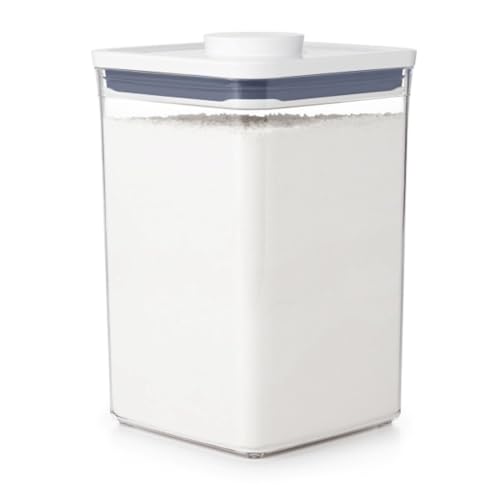
OXO’s POP containers seal with a one-push button that doubles as a handle. Clear bodies, rounded pouring corners and a deep size range make this the easiest system to grow piece by piece. Premium tier; dry goods only, and the lids prefer gentle washing.
Best for: shoppers who want best overall performance in a system they can extend over time. Not suited for: anyone storing liquids, or anyone who wants the single cheapest way to fill a shelf. This is a premium-tier pick; check price on Amazon.

Rubbermaid Brilliance Pantry Containers — Best Latching Seal
Brilliance Pantry containers clamp shut with two latches over a gasket, giving a firm, certain seal and very clear bodies for at-a-glance stock checks. Mid-to-premium tier; latches need a rinse now and then and opening is a two-handed job.
Best for: shoppers who want best latching seal performance in a system they can extend over time. Not suited for: anyone storing liquids, or anyone who wants the single cheapest way to fill a shelf. This is a mid-to-premium tier pick; check price on Amazon.
Progressive Prepworks ProKeeper Containers — Best for Bakers
ProKeeper containers are designed per ingredient — a flour keeper with a snap-in leveler is the headline — with hinged, silicone-sealed lids across the range. Mid tier and ideal for bakers; the mixed shapes stack less uniformly than a matched set.
Best for: shoppers who want best for bakers performance in a system they can extend over time. Not suited for: anyone storing liquids, or anyone who wants the single cheapest way to fill a shelf. This is a mid-tier pick; check price on Amazon.

Sistema Klip It Containers — Best Clip-Lid Value
Klip It containers lock with a clip on each of the four sides over a flexible seal. Entry-to-mid tier, widely available in many footprints, easy to replace one piece at a time. Four clips are slower than a single latch, and the styling is purely functional.
Best for: shoppers who want best clip-lid value performance in a system they can extend over time. Not suited for: anyone storing liquids, or anyone who wants the single cheapest way to fill a shelf. This is an entry-to-mid tier pick; check price on Amazon.
Vtopmart Airtight Containers — Best Budget Set
Vtopmart sells graduated matching sets with flip-top pouring lids that stack into one tidy block — the fastest route from packet chaos to an organised pantry in a single purchase. Entry tier; lighter plastic and hinges that will not outlive premium brands.
Best for: shoppers who want best budget set performance in a system they can extend over time. Not suited for: anyone storing liquids, or anyone who wants the single cheapest way to fill a shelf. This is an entry-tier pick; check price on Amazon.
Chef’s Path Airtight Containers — Best Large Matching Set
Chef’s Path sells large, complete sets with locking lids and tall canisters for cereal and pasta. Entry-to-mid tier and good for outfitting a whole pantry at once; you accept the set’s size mix, and single replacement lids can be harder to find.
Best for: shoppers who want best large matching set performance in a system they can extend over time. Not suited for: anyone storing liquids, or anyone who wants the single cheapest way to fill a shelf. This is an entry-to-mid tier pick; check price on Amazon.
How Much Capacity Do You Actually Need?
Choosing sizes is where most pantry systems go wrong, because people buy the set that photographs well instead of the sizes their shopping actually produces. Work backwards from your bags. A standard bag of flour is a big, heavy pour and wants the largest container in any range, with a mouth wide enough for a measuring cup to scoop and level without a fight. Sugar and rice bags are smaller but dense. Pasta wants height more than width — a short, wide tub that swallows a bag of penne will leave spaghetti folded, broken or still in its packet. Cereal is the opposite problem: a large volume of mostly air, eaten fast, so it wants a tall container with a pour spout and a seal you can work one-handed at breakfast speed.
Buy for the staple, not the shelf. List the eight to twelve dry goods you buy on repeat, note the bag size you actually buy — not the size you bought once — and match containers to that list, leaving the odd-shaped leftovers in their packets inside a basket. A system that covers your real staples perfectly and ignores the exotic bag of amaranth you bought in a moment of ambition will still be working in five years. A system bought to cover everything usually covers nothing well, because two of its sizes turn out to fit nothing you own and become very organised, very empty shelf decoration.
Which Seal Style Suits Your Hands?
A pantry container earns its keep at the seal. Dry goods go stale because air moves: oxygen reaches oils in flour, nuts and whole grains and turns them rancid, while moisture drifts in and out until crackers soften and brown sugar sets like concrete. A silicone or rubber gasket compressed evenly around the rim is what slows that exchange down. Push-button lids compress the gasket from the centre, latching lids clamp it from the sides, clip lids squeeze it at four points, and screw tops rely on your wrist. None of these is automatically best — what matters is that the gasket meets the rim all the way around, every time, without you having to think about it. Test any new container the same way: close it empty, then try to lift it by the lid. A lid that carries the container’s weight has seated properly; a lid that pops off is telling you exactly how it will treat your flour.
Seals also age. Gaskets pick up flour dust and oil film, and a dirty gasket leaks no matter how good the design was when it left the factory. Every few months, peel the gasket out where the design allows, wash it in warm soapy water, dry it completely — completely, because a damp gasket sealed against dry rice is a small weather system — and press it back into its channel. If a gasket has cracked, warped or gone tacky, that container graduates to holding cotton balls or screws. Keeping one container in the pantry past the death of its seal is how a good system quietly becomes a bad one.
Translate the seal styles into your household. Push-buttons reward one-handed, mid-recipe openings. Latches reward certainty and survive being closed by children who slam rather than press. Clips are the most forgiving of a hurried close and the slowest when done properly. Flip-tops pour fastest and ask for a firm final press that some household members will occasionally skip. There is no best seal — there is the seal your household will seat correctly at 7 a.m. on a school day, two thousand times in a row.
Plastic, Glass or Steel — and Does It Matter?
Most pantry containers are one of three materials, and each has a genuine personality. Clear plastic — the modern BPA-free copolyesters and polypropylene used by the big pantry brands — is light, survives drops, stacks without fear and lets you read the contents at a glance. Its weaknesses are that it can pick up odours and turmeric-coloured stains over years, and it should not be filled with anything hot. Glass is heavier and breakable, but it is odour-neutral, stain-proof, washes beautifully and looks at home on open shelving; a glass canister with a good gasket is a decades-long purchase. Stainless steel hides its contents, which some people prefer visually, but you lose the at-a-glance stock check that makes a pantry system work, and you cannot see when the rice is running low until the container is already empty in your hand.
The practical answer for most homes is a hybrid: plastic or glass for the high-turnover staples you check constantly, and whatever you like for slow goods. What matters more than the material is consistency within a shelf. Containers from one system share footprints and lid logic, so they stack, line up and open the same way. A shelf of nine different one-off containers, each with its own lid trick, is a shelf you will stop maintaining — and an unmaintained system is just expensive clutter with gaskets.
Square or Round, Stacked or Lined Up?
Shape decides how much of your shelf is storage and how much is air. Square and rectangular containers tile a shelf with almost no wasted gaps, stack in stable blocks and line up in rows you can read like a bookshelf. Round canisters pour beautifully, are kinder to scoop from, and look right on a counter or open shelf, but every round container on a rectangular shelf rents a little square of nothing in each corner. On deep shelves, shape matters twice: a container you cannot see into or reach will be forgotten, so deep shelves want either containers that slide, a turntable in front of them, or the discipline of keeping only tall staples at the back.
Stacking deserves a sceptical eye. Almost every brand claims its containers stack, and most do — empty, in a photo. Filled, a stack is only as good as its lowest lid, so test stacks with real weight, keep stacks to two or three high, and never stack a heavy container of rice on top of the crackers you open daily. The containers you touch every day should live at the front, at hand height, unstacked. A pantry is a tool you use three times a day, not a warehouse; optimise it for the reach, not the photograph.
How to Prioritise by Use Case
The baker’s pantry prioritises the flour solution first, tight seals for brown sugar second, and small labelled tubs for the long tail of baking extras third. The family cereal front line prioritises pour speed, child-proof reseating and volume matched to the box size the family actually buys. The small flat prioritises footprint discipline: one system, square shapes, nothing that cannot stack or tile, and the courage to leave exotic packets in a basket instead of a container. The bulk buyer prioritises the biggest sizes in the range, FIFO labelling discipline, and a backup-bag queue that is dated like everything else.
First in, first out — FIFO — is the single habit that separates a pantry that works from a pantry that merely looks organised. The rule is simple: new stock goes behind or beneath old stock, and when you refill a container, the remains of the old batch go on top of the new batch, never the other way round. Burying old flour under new flour means the bottom layer can sit for a year, ageing, attracting attention from pantry moths and quietly going rancid, while you congratulate yourself on how fresh everything tastes. Decanting is the moment to enforce it: pour the old contents into a bowl first, add the new bag to the clean, dry container, then return the old contents on top so they are used first.
FIFO also applies across containers. If you keep a working container on the shelf and a backup bag in a cupboard, the backup is not a refill licence — it is a queue. Date labels make the queue visible. A strip of masking tape or a removable label on the bottom or back of each container, marked with the month and year you decanted and the use-by date from the original packet, turns FIFO from a memory test into a glance. When you open a container and cannot remember when its contents arrived, the system has already failed; the label is what stops that moment from happening.
The Shortlist, Reviewed in Miniature
OXO Good Grips POP Containers — Best Overall
The OXO Good Grips POP line is the set most pantry organisers reach for when they want one system they can keep adding to for years. Each lid seals with a single push of the button on top, and that same button doubles as a handle, so a container comes off the shelf and opens in one motion. The bodies are clear, the corners are rounded for pouring, and the range runs from small spice-scale tubs up to tall canisters shaped for spaghetti and cereal. Because the lids are interchangeable within the range in many cases, a lost lid is an annoyance rather than the end of the container. The honest limitation is cost and care: this is a premium-tier system, the lids should not be taken apart carelessly or forced through a harsh dishwasher cycle, and the push-button seal is an airtight pantry seal, not a liquid-tight one, so it belongs with dry goods only.
Best for: shoppers who want best overall performance in a system they can extend over time. Not suited for: anyone storing liquids, or anyone who wants the single cheapest way to fill a shelf. This is a premium-tier pick; check price on Amazon.
Rubbermaid Brilliance Pantry Containers — Best Latching Seal
Rubbermaid Brilliance Pantry containers take the opposite approach to a push-button lid: two latches snap down on opposite sides and clamp the lid onto a gasket, which gives a seal that feels mechanical and certain. The bodies are crystal clear, so flour level and pasta shape are readable at a glance, and the range is built around the staples most pantries actually hold — flour, sugar, rice, cereal and snacks. The lids stack flat and the containers are designed to stack on each other without wobbling, which matters on deep shelves. The trade-offs: the latch hinges are one more moving part to keep clean, flour dust loves to settle around the gasket line if you overfill, and the two-handed latch opening is slower than a push-button when you are mid-recipe with messy hands.
Best for: shoppers who want best latching seal performance in a system they can extend over time. Not suited for: anyone storing liquids, or anyone who wants the single cheapest way to fill a shelf. This is a mid-to-premium tier pick; check price on Amazon.
Progressive Prepworks ProKeeper Containers — Best for Bakers
Progressive’s Prepworks ProKeeper line is built around a simple observation: different dry goods misbehave in different ways. The flour keeper includes a leveler that snaps under the lid so a measuring cup comes out level in one swipe, the sugar and brown-sugar keepers are shaped around how those ingredients are actually scooped and kept soft, and the wider range covers coffee, grains and baking staples with the same hinged, silicone-sealed lid language. For a keen baker this task-specific design is worth more than a generic matching set. The limitations are equally specific: the shapes are less uniform, so a ProKeeper shelf looks less like a magazine photo than a matched OXO wall, and the specialist inserts are small parts that need to go back where they belong after washing.
Best for: shoppers who want best for bakers performance in a system they can extend over time. Not suited for: anyone storing liquids, or anyone who wants the single cheapest way to fill a shelf. This is a mid-tier pick; check price on Amazon.
For the value tier in miniature: Sistema is the choice when containers will be bought one or two at a time over years and must always match; Vtopmart is the choice when the pantry needs to be finished this weekend in one box; Chef’s Path is the choice when the household is large, the staples list is long and the set’s tall canisters will be used from day one. All three keep food fresh perfectly well while their gaskets are clean — the differences are materials, lid feel and how the range ages.
First Setup and Care Essentials
Set up once, properly: wash and dry everything overnight; decant with old stock held aside and returned on top; label and date every container with the use-by date from its packet; place daily goods at the front at hand height. Then keep the rhythm light: wipe and inspect at refill, wash on change of contents, wash gaskets every few months, and let everything dry fully before it seals again.
Labelling is the least glamorous and most load-bearing part of pantry storage. Contents are obvious the week you decant them and genuinely ambiguous three months later, when plain flour, bread flour and self-raising flour are three identical white powders in three identical tubs and the recipe cannot tell you which one it wanted. Label every container on the day you fill it: what it is, when it went in, and the use-by date from the packet it came from. Chalk markers on smooth plastic, printed labels, or plain masking tape all work; the best label is the one you will actually update, so choose the method you find least annoying and keep the supplies in the pantry itself.
Date the refill, not just the first fill. When you top up a container using proper FIFO rotation — old contents back on top — add the new date underneath the old one or replace the label and note both. It takes ten seconds and it is the difference between knowing your rice is four months old and hoping it is. Households that cook with children, flatmates or helpful relatives should treat labels as non-negotiable: a label is the only part of your system that still works when someone else puts the shopping away.
Mistakes to Avoid
- Buying before measuring. Shelf height kills more systems than bad seals do; tall canisters that do not fit become counter clutter by Friday.
- Guessing sizes from the set photo. Match containers to your real bag sizes, especially flour and spaghetti, or live with permanent half-bags.
- Decanting without dating. A sealed container with no date is a freshness rumour. Copy the use-by date onto the label before the packet is recycled.
- Topping up over old stock. New under old buries the oldest food at the bottom indefinitely. Old goes on top, always.
- Sealing damp containers. A washed container refilled too soon traps moisture with the food. Overnight drying is part of the system.
- Expecting containers to store liquids. Pantry seals are airtight, not liquid-tight; soups and oils belong in different vessels entirely.
Pantry Storage Containers Buying Guide — Final Word
Buy the system whose lids your household will seat without thinking, in sizes copied from your own shopping bags, and spend the change on labels. That unglamorous formula — seal, size, label, rotate — is the entire secret of the pantries that still look like the magazine photo in year three.
Reading a Product Listing Like an Engineer
Listings for containers speak a dialect worth translating. ‘Airtight’ means a seal exists; it says nothing about whether the seal seats evenly or survives its five-hundredth close, which is why the lid-lift test and a brand’s replacement-lid policy tell you more than the headline word. Capacity is quoted to the brim; your usable capacity, with scooping headroom, is less — size up when a bag lands near the stated figure. ‘Stackable’ means the empty containers stack in the photograph; what you need is stacked stability under the weight of a full container of rice, which depends on lid rigidity you can only judge in hand. ‘Set of 24’ counts lids and small tubs generously; count instead the containers that match your staples list, and price the set by those.
Two listing details deserve real attention. The first is whether lids and gaskets are sold separately — the clearest signal that a brand expects its containers to be owned for years. The second is the care line: ‘lid hand wash only’ is not a defect, it is honesty about where the delicate engineering lives, and a listing that claims every part is indestructible in every dishwasher is telling you something about its relationship with the truth. Buy from listings that respect you with specifics.
A Worked Budget: Three Ways to Spend
The entry route is one graduated set, bought once, covering the main staples immediately. Its strength is completion: this weekend the pantry works. Its weakness is the fixed size mix and lighter materials, so treat the set as a two-to-four-year system and keep the list of which sizes you wish were different — that list is your upgrade plan. The middle route is a workhorse range bought in two waves: the big five staples now, the long tail later, in clip or latch containers from a long-running line like Sistema or Rubbermaid. Its strength is fit; its weakness is that wave two requires the discipline to happen. The premium route is a matched system built staple by staple — OXO POP is the archetype — costing the most per piece and the least per year, because lids are replaceable and the range will still be there when you need one more tub in five years. None of these routes is the correct one; the correct one is the one whose weakness your household can live with.
Seasonal and Bulk Buying: When the System Gets Tested
A pantry system idles along for most of the year and then meets December: baking season, guests, bulk buys, a second flour, three kinds of sugar, nuts and dried fruit in quantities the shelf never planned for. Systems survive the surge in proportion to their boring virtues — spare capacity in the big sizes, a backup-bag queue that is dated like everything else, and overflow that goes to a basket or a vacuum bag in another room rather than being forced into containers that then cannot close. Plan the surge when you buy: one spare large container, bought in calm months, is the cheapest insurance in this entire guide. The same logic covers harvest gluts, market bargains and the well-meant gift of five kilos of rice — the system that has somewhere honest for overflow to wait is the system still working in January.
Pantry pests — Indian meal moths and the various weevils and flour beetles — do not usually arrive because a pantry is dirty. They arrive inside the food itself, as eggs or larvae in a bag of flour, grain or pet food bought from a perfectly respectable shop, and they spread from packet to packet because folded paper and thin plastic are no obstacle at all. This is the strongest practical argument for hard-sided containers with real seals: a gasket-sealed container does not just keep pests out of your other food, it keeps an infested product contained, so one bad bag stays one bad bag instead of becoming a whole-shelf clear-out.
Two habits complete the defence. First, inspect before you decant: webbing, clumping in flour that should be loose, or tiny dark specks moving at the seams of a packet mean the product goes in the bin, not in a container. Second, some cooks freeze a new bag of flour or grain for a few days before decanting as a precaution; if you do this, let the bag return fully to room temperature and dry out before it goes into a sealed container, or you have sealed the moisture in with it. The often-repeated tip of tucking a bay leaf into the flour is a folk remedy passed down through generations of cooks — plenty of households swear by it, the leaves do no harm, and it costs almost nothing, but treat it as a tradition layered on top of sealed containers and inspection, never as a substitute for them.
Moisture is the quiet enemy in both directions. Too much of it and flour cakes, sugar clumps, salt welds itself into a brick and dried herbs lose their perfume to the damp air. Too little and brown sugar dries to gravel. Airtight containers hold whatever moisture level the food went in with, which is why the state of the food at decanting time matters: never decant a warm bag straight from a hot car boot, never wash a container and refill it while the rim is still damp, and never top up a container whose contents already smell tired — a sealed tub preserves staleness just as faithfully as freshness.
Brown sugar deserves its own sentence because it breaks the general rule. It stays soft by holding onto moisture, so it wants the tightest seal you own, filled with as little headspace air as practical. Some bakers keep a small terracotta softener disc soaked and stored inside the sugar container; if you use one, check it monthly, because a neglected disc dries out and becomes decoration. Everything else in the dry pantry follows the simpler rule: cool, dry food into a cool, dry container, sealed promptly, stored away from the heat plume of the oven and the steam of the kettle.
Containers do not need much care, but they need the right care. Wash bodies in warm soapy water or on the dishwasher rack the maker allows, and treat lids as the delicate part: gaskets, hinges, latches and push-button mechanisms all prefer hand washing and a patient dry. The single most common way people ruin a good container is refilling it too soon — a container that looks dry can hold a spoonful of water in the gasket channel, and that water goes straight into your dry goods. After washing, stand containers and lids open on a rack overnight. If they still smell of the last contents — cumin and chilli powder are persistent — a paste of bicarbonate of soda and water, left for an hour and rinsed, clears most odours from plastic.
Between refills of the same staple, a full wash every time is more than most containers need and more than most people will sustain. A realistic rhythm: empty, shake and wipe out crumbs, inspect the gasket, refill if the same food is going back in; wash properly when you change contents, when anything looks or smells off, or every few refills regardless. Systems survive on rhythms people actually keep. A care routine so strict that you start skipping it is worse than a modest routine you never skip at all.
Where containers live changes which ones you should buy. Inside a closed cupboard, function wins: clear bodies, fast lids, square footprints, labels facing out. On open shelving or a counter, appearance joins the specification and the calculus shifts — glass canisters and matched sets earn their place because you look at them all day, and a uniform row genuinely does make a small kitchen feel calmer. Be honest about which pantry you have. Buying display canisters for a closed cupboard pays for looks nobody sees; buying ugly bulk tubs for open shelves creates a wall of regret you face every morning.
Light and heat belong in the same decision. Clear containers on a sunny counter show you the contents and slowly tire them — oils in nuts, seeds and wholegrain flours dislike light, and herbs fade in it. Keep the light-sensitive staples in the cupboard even if the canisters are beautiful, and let the counter hold the robust, fast-moving goods: the oats, the rice, the pasta that will be eaten long before light can matter. A pantry system is a set of small placements, each one defensible, rather than a single style applied everywhere at once.
Buying for a Household, Not a Person
Every specification in this guide bends when other people enter the kitchen. Lids must survive the least careful closer. Labels must survive being read by someone who did not write them — which means contents and dates in plain words, not household shorthand that means something only to you. Sizes must survive other people’s shopping: the family member who buys the bigger cereal box has just resized your system, so leave one size of headroom on the fastest staples. And the refill rule must survive being performed by someone who thinks FIFO is a type of pasta — which is why the rule belongs on a label at the shelf, not in a conversation nobody remembers. Buy for the household’s real behaviour and the system maintains itself socially, which is the only way systems are ever maintained.
The Buying Guide in One Shopping Trip
Here is the whole guide compressed into one trip, for readers who have scrolled this far with a list in their hand. Before leaving: staples list written, shelf measured, tallest food checked, label method chosen. In the shop or on the listing: find the range whose flour size fits your scoop and your bag; run the lid-lift test on the seal style your household will seat at 7 a.m.; confirm the tallest container takes spaghetti and fits your shelf height with a finger’s clearance; confirm lids are sold separately; then buy the big five staples’ containers and no more. At home: wash, dry overnight, decant with old stock returning on top, label and date everything, place by frequency. In a fortnight: notice which container you love, which you tolerate and which staple is still in a packet — that packet is your next purchase, in the system the fortnight vindicated. That is the entire method. Everything else in this guide is the reasoning underneath it, there when you want it, unnecessary when you do not.
After the Purchase: The First Fortnight
Day one is decanting day, and it deserves an hour of respect: wash, dry, rotate, label, date, place. Days two to fourteen are the audit you did not know you were running. Notice which container you reach for with pleasure and which you approach with a small sigh. Notice which lid gets left ajar, and by whom. Notice the staple still living in a packet — it is telling you the set’s size mix missed your life in one specific, fixable place. At the fortnight’s end, act on the audit while the system is young: swap the sighed-at container’s job to a less-used staple, buy the one missing size, move the daily goods six inches closer to your hands. Systems tuned in their first fortnight run for years; systems left as delivered drift toward the archaeology shelf. The purchase is the down payment. The fortnight is the mortgage.
The Guide’s Last Word on Brands
Brands in this category are best understood as promises about the future rather than descriptions of the present. In the present, a dozen brands can sell you a clear tub with a working gasket. The promise is about year four: whether the lid is still sold, whether the range still exists, whether the size you suddenly need can join the shelf without breaking the grid. That is why this guide keeps returning to range longevity and replacement parts, and why it ranks a boring, established line above a brilliant, brand-new one for any staple you will store for a decade. Buy the present if you must. Buy the promise when you can.
And Finally: Keep the Receipts, Keep the List
Two pieces of paper — or their phone-photo equivalents — complete the purchase. The first is the receipt, kept until the fortnight audit passes, because the honest sizing mistake deserves a return window. The second is your staples list itself, annotated with which container each staple landed in and what size you would buy differently. That annotated list is the most valuable document in your kitchen’s storage life: it is the upgrade plan, the replacement plan and the next house’s starting plan, all in one. Guides end. Lists persist.
A Pre-Purchase Measurement and Compatibility Audit for Your Pantry Storage Containers
Use this audit in the final ten minutes before you order a pantry storage containers, because that is when most buying-guide advice stops being abstract and starts being a tape measure, a doorway and a return label you would rather not need. Write down three numbers for the pantry storage containers you are considering: the footprint where it will sit or be stored, the largest dimension it reaches in normal use, and the clearance it needs so doors, drawers, lids, handles or moving parts can work without catching. Look at replacement parts and consumables for the pantry storage containers while you are still comparing, confirming that the pieces most likely to wear, clog, tear, fade or get lost can actually be obtained without replacing the whole product. Keep the packaging of a larger pantry storage containers until those first ordinary tests are done, flattened if space is tight, because re-boxing an awkward shape from scratch is the hidden difficulty inside many otherwise straightforward returns.
Compatibility is the second audit, and for a pantry storage containers it means checking what it must work alongside: the surfaces, fittings, power or water access, storage and other pieces already in your food storage & organization setup that the new purchase has to cooperate with every day. Photograph your setup once the pantry storage containers is working well — the position, settings, arrangement or layout you settled on — so that after a move, a deep clean or a seasonal break you can recreate the arrangement that worked instead of rediscovering it. If you want a concrete listing check, take a name already shortlisted in this guide, such as OXO Good Grips POP Containers, Rubbermaid Brilliance Pantry Containers and Progressive Prepworks ProKeeper Containers, and verify that exact pantry storage containers listing against the measurements and compatibility questions above, field by field, rather than trusting the headline description alone. For troubleshooting, start with the boring causes first: power, water, fit, blockage, alignment, a full container, a loose connection or a setting changed by the last person who used the pantry storage containers, because boring causes account for most apparent failures.
Think about who else will use the pantry storage containers and what they will do differently: shorter reach, less patience, stronger habits, no interest in the manual, and a tendency to leave things wherever they were last set down. Watch for edge cases in your own home: the pet that investigates everything, the child who treats every new object as furniture, the guest who uses force where you use familiarity, and the weather, light or season that changes how a pantry storage containers behaves. Use a simple decision checklist at the end: the pantry storage containers fits the measured space, suits the real frequency of the job, matches the household’s cleaning temperament, has obtainable parts, and has a named storage home — five yeses make a confident order. Plan the storage home for the pantry storage containers before it arrives, naming the exact cupboard, corner, shelf, hook or stretch of floor, because a product without a home migrates around the house and slowly becomes the clutter it was bought to reduce.
Measure before anything else, and measure the pantry storage containers in its working state rather than its packed or folded state, because handles extend, lids open, cords trail, doors swing and users stand somewhere, and all of that belongs in the measurement. Decide in advance what good enough looks like for the job the pantry storage containers does in your home, because chasing a flawless result usually costs more time than the flaw itself, and most households are happier with a reliable ninety percent they actually repeat. When something about the pantry storage containers disappoints, change one variable at a time — position, setting, timing, load, accessory or technique — and give the change a fair trial, because changing three things at once leaves you with a better or worse result and no idea why.
Frequently Asked Questions
How much should I expect to spend on a pantry container system?
Think in tiers rather than totals. Entry-tier sets organise a whole pantry in one purchase and cost the least per container; matched premium systems cost more per piece but are bought gradually and last for years with replaceable lids. The honest comparison is cost per year of use: a durable system bought once beats a flimsy set replaced twice. Check current listings before deciding, since set compositions and prices change often.
Should I buy a complete set or build piece by piece?
Sets win on speed and price per container; building piece by piece wins on fit, because every size is chosen against your real staples and shelf. A good hybrid: buy a set to get organised now, note which sizes run out and which sit empty for three months, then extend with pieces from a long-running system in exactly the sizes your life uses.
What is the most important feature in a pantry container?
The seal, and specifically whether it seats evenly with the amount of effort your household will actually give it. After that: a mouth wide enough for how the food is used — scooping flour, pouring rice — and a footprint that tiles your shelf. Styling ranks last because a closed cupboard sees none of it and an open shelf mostly sees whether the row is uniform.
Do I need special containers for flour and sugar?
Flour benefits most from special treatment: a wide mouth and, ideally, a leveler like the one in Progressive’s flour keeper make measuring cleaner and faster. Sugar needs only a sound container, while brown sugar needs your tightest seal to hold its moisture. Other staples are well served by general containers in the right sizes.
Can pantry containers go in the dishwasher?
Most bodies can, on the rack the maker specifies; lids are the cautious part, because gaskets, hinges and button mechanisms last longer washed by hand. Whatever the method, the rule that matters is drying: everything must be completely dry — ideally overnight — before dry food is sealed back inside.
Where should containers go — cupboard, counter or open shelves?
Wherever they will be used most and seen honestly. Closed cupboards favour pure function: clear bodies, square shapes, fast lids. Open shelves and counters add appearance to the spec and punish clutter, so keep one uniform system there. Keep light-sensitive staples like nuts, seeds and wholegrain flours out of direct sun regardless of how good the canisters look.
Related Reading
our in-depth pantry storage containers review
our comparative pantry storage containers reviews
how to choose pantry storage containers, step by step
the honest pros and cons of pantry storage containers
whether pantry storage containers are worth it for your kitchen
the best storage baskets for corralling packets and odd shapes
vacuum storage bags for bulk overflow and seasonal spares
under-bed storage ideas for the overflow a small kitchen cannot hold