Disclosure: As an Amazon Associate, dailyhomedecorating.com earns from qualifying purchases. Links on this page are affiliate links; they cost you nothing extra. Prices and availability change often, so check the current Amazon listing before you buy.
A throw pillows review has to answer a harder question than whether any single pillow is pretty. The category is a system — inserts, covers, fills, fabrics, sizes — and this review assesses that system the way an owner experiences it: on the sofa at the end of a long day, in the wash a month later, in the guest room when family arrives, and in the cupboard where failed purchases quietly accumulate. What follows is a deep assessment of how modern throw pillows are built, how the main designs perform in real rooms, where the category genuinely excels, and where it still disappoints. The verdict up front: the best current approach to throw pillows — a firm insert wardrobe under washable, rotating covers, with one textured statement at most — is very good indeed, and the worst approach, a large matched set of finished pillows bought from a photograph, remains as regrettable as ever.
Key Takeaways
- The insert is the product; the cover is the wardrobe. Judge them separately and the category makes sense.
- Polyester inserts from established bedding brands deliver the most consistent support per purchase.
- Velvet-look and linen-look covers cover most rooms’ needs across a year of seasons.
- Textured statement pillows are excellent as a single layer and poor as a system.
- Washability, zip quality and correct sizing separate the three-year pillows from the three-month ones.
- Decorative pillows belong on sofas and adult furniture only — never in an infant’s sleep space.
Verdict in brief. Suits: households that live on their seating, rotate seasonally, and will wash covers as part of the bedding rhythm. Does not suit: display rooms, no-laundry households, or anyone furnishing a baby’s sleep environment, where pillows do not belong at all.
What Throw Pillows Are and Where They Fit
The throw pillow is the smallest piece of furniture in the house, and it behaves like furniture: it has a structure (the insert), an upholstery (the cover), a support role, a wear pattern and a maintenance schedule. Treating it as furniture rather than as an accessory is the mindset shift this entire review rests on, because every success in the category follows from it and every failure ignores it. Furniture is measured before purchase, tested for support, chosen in materials that suit the room’s traffic, and maintained on a rhythm. Accessories are grabbed by colour. The market sells pillows as accessories; owners live with them as furniture; the gap between those two facts is where most disappointment is manufactured.
Within the category, the segments are stable. There is the insert market — plain, functional, dominated by bedding brands. There is the cover market — fashion-driven, seasonal, enormously varied in fabric and colour. And there is the finished-pillow market — statement pieces, textured and shaped, sold complete. A good household set draws deliberately from all three: inserts as infrastructure, covers as the rotating wardrobe, and at most one or two finished pieces as punctuation. This review assesses each segment on its own terms before judging the combinations owners actually live with.
It is also worth placing the category in the room’s economy. Against a sofa, a rug or curtains, pillows are small money with outsized visual authority, because they sit at eye level when seated and at the centre of the room’s most-used furniture. That leverage is why they reward care and punish carelessness so visibly: a tired, flat pillow does not fade into the background — it announces itself from the doorway, every day, at the exact spot where the household gathers.
In this guide
Design, Build and Setup
Start with the insert, the component this review considers the actual product. The reference design in the current market is the polyester-filled square: a plain woven shell, a generous synthetic fill, sold in standard sizes and multi-packs by bedding brands such as Utopia Bedding. Its virtues are consistency and resilience — pillow four behaves like pillow one, and the fill springs back after leaning, sitting and the occasional use as a floor cushion. Its limitation is feel: structured and uniform, it supports more than it cuddles, and buyers chasing a soft, sinking, feather-like experience will find it businesslike. In build terms, though, it is the benchmark against which the segment is judged, because its job is to disappear under a cover and hold a silhouette for years.
Utopia Bedding Throw Pillow Inserts — the Reference Insert
Assessed as infrastructure, these inserts do nearly everything right: the fill is dense enough to hold a tailored edge, the sizing is honest, the multi-packs make a matched set behave as one, and the price tier — entry to mid — makes the fold-test replacement painless when a pillow eventually tires. Setup is the standard ritual: unbag, shake and knead the fill awake, allow a day for full loft before judging, then dress with an insert one size up from the cover. The honest limitation is the plain shell, which is a component, not a look — these are never the finished article, and they are not trying to be.
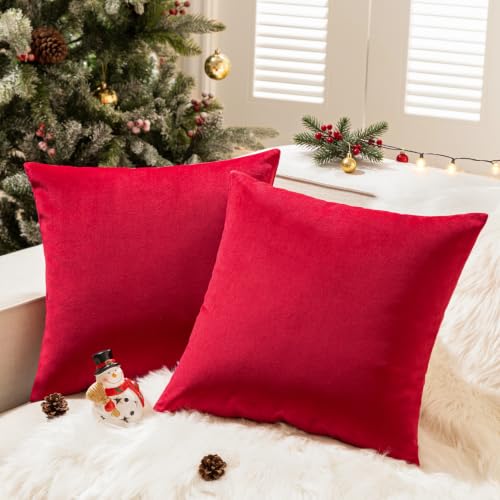
Covers are where design visibly happens, and the two dominant families deserve detailed assessment. Velvet-look covers — Phantoscope’s pairs are the segment’s reference — use a short polyester pile that catches light softly, reads warm from across a room, and hides the minor creasing of daily life. The hidden zip is the correct choice, keeping both faces presentable, and the colour ranges are wide enough to build a genuine wardrobe. Linen-look covers — MIULEE’s are representative — take the opposite design position: a matte, slubbed weave whose deliberate imperfection suits calm rooms and bright seasons, forgiving creases by incorporating them into the aesthetic.

Phantoscope Velvet Throw Pillow Covers — the Velvet Reference
In hand, the pile is soft and short enough to stay practical; on the sofa, the colour depth does the work that pattern does in other schemes. The zips run smoothly, the seams are tidy, and the covers survive gentle-cycle washing inside out without the colour collapse that afflicts cheaper velvet. The trade-offs are the family’s usual ones: pet hair clings enough to need a roller, and deep colours show pressure marks until steamed. As a design object, this is the cover that makes a neutral sofa look decided.

MIULEE Linen Throw Pillow Covers — the Linen-Look Reference
The faux-linen weave reads natural at conversational distance, relaxes a room’s formality, and pairs with almost any sofa fabric without argument. Build is honest for the tier — concealed zip, clean seams — and the care profile is the family’s great strength: wash, dry, return to service, no ironing expected or desired. The limitation is ambition: this cover will never look crisp, formal or luxurious, and pale shades ask for a faster wash rhythm in busy homes. It is the right cover for the majority of real rooms, which is a higher compliment than it sounds.
Woven Nook Decorative Throw Pillows — the Statement Piece
The finished statement segment is represented here by Woven Nook, whose woven faces treat texture as the entire design argument. In person the weave has genuine depth — the kind of surface a hand seeks out — and a single pair can supply all the texture a plain scheme needs. Build follows the statement logic: these are complete pillows, bought for their faces, and they ask for the gentlest handling in this review. Loops hold crumbs and hair, cleaning is slower, and there is no cover to rotate. Judged as sculpture they excel; judged as system components they decline the role entirely.
Performance in Real Use
On the Family Sofa
The family sofa is the category’s proving ground, and the system approach passes it convincingly. Firm polyester inserts hold up under the full range of domestic abuse — leaning, sitting on, being thrown, being built into forts — and return to shape with a shake. Velvet-look covers handle the daily visual load and wash back to presentable; linen looks handle the summer and the crumbs with equal calm. The failures observed in this setting are never mysterious: they are count failures (too many pillows, constant excavation) and fabric mismatches (delicate textures in crumb zones). Configured as this review recommends — one pillow per seat, washable covers, a spare cover for the favourite — the family sofa is where throw pillows earn their strongest real-world marks.
In the Reading Corner and Bedroom
As reading furniture, pillows are close to unreasonably effective. Two firm squares behind the shoulders and a lumbar at the waist convert a bed or a deep chair into a reading station that dedicated furniture struggles to beat, and the arrangement dismantles in seconds. Velvet covers suit the bedroom’s softness; the inserts should be the firmest in the house. The discipline is storage: reading pillows earn their keep because they work nightly, and any beyond the working pair become the floor pile this review has criticised throughout. In guest rooms the same arrangement performs double duty, signalling care to visitors who will remember the bed’s comfort longer than its styling.
With Pets and Children
Real use in pet households separates fabrics ruthlessly. Smooth and short-pile covers release hair with a shake and a roller and wash back to neutral; textured weaves and long piles harbour hair and debris and slowly lose the argument. Polyester inserts forgive being claimed, sat on and occasionally muddy-pawed, because the cover takes the damage and the wash takes the cover. For children old enough to lounge and play, pillows are among the most-used objects in the house — seating, scenery and sports equipment in one — and hardy washable covers turn that intensity from a threat into the point. The boundary, stated without qualification: none of this applies to infant sleep. Pillows never go in a crib or any sleep space for a baby under one year old; the sleep surface stays bare, and pillows serve the awake household only.
Across the Seasons
The rotation is the performance test most reviews skip and owners value most. A system that swaps linen looks for velvet in autumn genuinely changes the room’s temperature-feel — visitors notice, residents enjoy it, and the cost is a drawer and fifteen minutes. Finished pillows cannot take this test; their look is fixed at purchase, which is why this review scores the system higher the longer the ownership horizon runs. By the second year, the rotating system’s advantage is not subtle: it has presented four room-moods while the matched set of finished pillows has presented one, four times, slightly more tired each time.
Strengths and Trade-Offs
Strengths
- Support that is real: correctly filled pillows measurably improve deep and low seating for reading, working and guests.
- System economics: inserts endure, covers rotate, and refresh costs stay at cover level for years.
- Care that fits real life: the recommended covers wash in ordinary machines on ordinary rhythms.
Trade-offs
- Feel has a ceiling at the practical tiers: polyester support is businesslike, not luxurious.
- Texture and practicality trade directly: the most interesting surfaces are the least washable.
- The category demands ongoing small efforts — washing, fluffing, rotating — and punishes households that skip them.
How It Compares
Against a throw blanket, the pillow system wins on support and structure and loses on storage and laundry simplicity; most well-run rooms end up owning both, assigned to their strengths. Against a single lumbar pillow, the full set wins on visual transformation and guest flexibility, and loses on effort — the lumbar is the minimalist’s correct answer and this review recommends it without irony to low-tolerance households. Against upgraded sleeping pillows, decorative pillows lose in the bedroom’s core job and win everywhere else in the house. The comparisons clarify the category’s true position: it is the only furnishing that does looks and support together, and it should be bought by households that need both, in rooms where both will be used.
Within the category, the comparison that matters most is system versus finished. Finished statement pillows win the first impression and the photograph. The system wins the wash, the season change, the insert replacement and the year-two audit. This review’s scoring follows ownership, not unboxing — which is why the plainest product assessed here, the insert, carries the strongest recommendation, and the most photogenic, the woven statement, carries the most conditional one.
Who Should Buy It — and Who Should Skip It
Buy the system if your household lives on its sofa, hosts with any regularity, rents and needs reversible change, or reads in bed nightly. Buy it in this order: inserts first, one washable cover family second, a rotation family third, a statement piece last if at all. Skip it — or reduce it to a single lumbar — if your rooms are for looking at, your laundry rhythm cannot absorb covers, or your space is so tight that pillows would tax every seat. And in any household with a baby, buy for the living room only and keep pillows entirely out of the infant’s sleep environment; that condition is not a preference and does not negotiate.
A pre-purchase checklist distils the review: measure the seat depth; count the leaning places; choose the insert like equipment; choose the cover like laundry; test the zip on arrival; start with two. Six small disciplines, and the category’s failure modes are almost all behind you. For the full framework behind the checklist, our throw pillows buying guide goes deeper, and the value case is argued in are throw pillows worth it.
Setup, Care and Maintenance Essentials
Setup decides first impressions: give compressed inserts a full day to reach loft after a thorough shake and knead, dress them one size up into covers by folding and feeding the corners home, and finish with a hand-chop crease only if your fabric takes it gracefully — velvet and full polyester squares do, relaxed linen looks are better left unchopped. Placement follows bodies: ends of sofas, the reading side of beds, the deep chair’s gap.
Maintenance is a rhythm, not an event. Covers wash monthly in working rooms — inside out, zipped, gentle cycle, gentle drying — and inserts air and fluff the same day. Velvet piles revive under cool steam; linen looks are pressed by nobody and look better for it; textured weaves get a shake and a lint roll before any wash and a gentler cycle when they get one. Dust management is the same rhythm viewed from another angle: like all soft furnishings, pillows gather household dust, and regular laundering keeps them from becoming the room’s reservoir — a housekeeping point, not a medical one, and anyone with significant allergy symptoms should be guided by their clinician. Twice a year, fold-test every insert and retire the ones that stay folded; the system makes that replacement cheap, which is precisely its virtue.
Final Verdict
Throw pillows, assessed as the furniture they are, earn a strong recommendation in their system form: firm inserts from an established bedding brand, washable covers in velvet-look and linen-look families, a count set by leaning places, and texture admitted only as a single, knowingly high-maintenance guest. In that form they support bodies, finish rooms, host guests and change with seasons, for years, at refresh costs no other furnishing can match. In their photograph form — many, matched, finished, delicate — they remain a purchase this review cannot recommend to anyone who actually lives in their home. The category is not good or bad; the configuration is. Configure it as this review describes and it is one of the best-value furnishings in the house.
Related reading: the two-sided ledger in throw pillows pros and cons, the multi-design roundup in throw pillows reviews, and for the textiles that complete the picture, blankets for the living room, swivel chairs for the living room and pillowcases for feather and down pillows.
The Other Segments, Assessed
Feather and Down-Blend Inserts
The luxury insert segment deserves its own assessment, because its appeal is real. A feather-blend insert sinks, moulds and takes the deep centre crease that defines the styled look; on a formal sofa or a primary bed it feels like the category’s top shelf. The ownership costs are equally real: daily redistribution of fill, a tendency to poke the occasional feather through lesser shells, higher prices, and a profile that suits low-traffic rooms and diligent owners. This review’s judgement is conditional respect — magnificent in the right room, a slow regret in a family den, and the wrong default for first-time buyers who have not yet learned their household’s true pillow habits.
Foam and Structured Lumbar Pieces
Foam-filled lumbar and bolster pieces are the category’s specialists: they hold architectural shapes, deliver the most deliberate lower-back support, and keep their profile for years without fluffing. Their trade is cuddliness — nobody hugs a foam lumbar — and their correct deployment is surgical: the deep chair, the work-from-sofa seat, the daybed’s edge. Assessed as support equipment they score highly; assessed as pillows in the lounging sense they are simply a different product wearing a similar name, and households should buy them for the job their name actually describes.
Outdoor and Performance Fabrics
A growing segment dresses pillows for porches, patios and sunrooms in weather-resistant fabrics, and it earns a mention because its lessons travel indoors. Performance covers shrug off spills, resist fading in strong light and clean with unusual ease — properties that family rooms with sunny windows and snack habits can borrow gratefully. The hand feel is typically firmer and less plush than indoor velvet or linen, which is the honest trade. For sun-drenched indoor seating, this segment is the connoisseur’s quiet answer to fading, and this review expects it to keep moving indoors.
Three Tests That Decide Everything
The Lean Test
Support is the category’s core promise, and the lean test measures it without instruments: sit, place the pillow behind your lower back, and lean with your full weight for a minute. A passing pillow holds its shape, keeps your posture upright without effort, and recovers its silhouette when you stand. A failing one collapses into a fold, slides down the seat, or pushes back so weakly that your own muscles do the work. Every insert assessed well in this review passes on a deep sofa; most bargain inserts fail within a month of daily leaning, whatever they felt like in the shop. When you trial any new pillow, this test — not the squeeze, not the photograph — is the verdict.
The Wash Test
The second test happens in the laundry. A passing cover emerges from a gentle cycle with its colour even, its zip smooth, its seams untwisted and its fit unchanged; it returns to the insert without a wrestling match. A failing cover fades in patches, shrinks against its insert, or presents a zip that now catches — failures that compound with every subsequent wash until the cover is quietly retired. The recommended covers in this review pass repeatedly, which is precisely why they are recommended: in a category washed monthly, wash behaviour is not a footnote to performance. It is performance.
The Six-Month Test
The final test is time. At six months, a passing set still holds its edges, its colours remain true in daylight, its inserts spring open in the fold test, and — the subtlest marker — the household has stopped noticing the pillows because they have become part of how the room works. Failing sets announce themselves at six months through flat corners, a permanent slouch, and the migration of the least-loved pillow to a cupboard. This review’s recommendations are weighted toward the six-month test above all others, because it is the only one that resembles ownership.
Value Assessment
Judged qualitatively, as this site judges all fast-moving categories, the value curve of throw pillows peaks in the middle. Entry-tier inserts and covers perform honestly in low-hour roles — guest rooms, staging, play corners — and disappoint in daily service. The mid tier delivers the overwhelming majority of the category’s real performance: support that lasts, covers that wash for years, construction that survives its own maintenance. Premium spending buys refinement — natural fills, heavier weaves, designer colour — that registers in quiet rooms and long ownership, and buys almost nothing in durability for hard-working homes. The sharpest value move in the category is not a tier at all but an allocation: mid-tier inserts under mid-tier washable covers, with any surplus spent on one genuine texture rather than spread thinly across everything.
There is also a replacement-economics point that ownership teaches and listings never mention. A finished pillow fails as a unit and is replaced as a unit; a system fails in parts and is repaired in parts — a cover here, an insert there — at a fraction of the cost and waste. Across a five-year horizon, that structural difference outweighs any plausible difference in purchase prices between comparable products, and it is the deepest reason this review keeps returning to the system as the category’s correct form.
Long-Term Ownership Notes
Owners at year three report a consistent story. The inserts they chose well have become invisible infrastructure; the covers have rotated through seasons and rooms; the statement piece has either earned a permanent post or been donated without rancour. The sets that failed share a biography too: bought large, matched and finished, they aged as a unit, dated as a unit, and left as a unit. Nothing in the long-term record contradicts the short-term tests — it amplifies them. Support, washability and separability are the whole game, and they are knowable in the first month to any buyer willing to test rather than admire.
One more ownership note concerns children growing up around these objects, because pillows outlast childhood stages. The set bought for a quiet couple becomes fort material, then reading furniture, then guest capacity, and its covers are washed at every transition. Households that chose washable, separable, honestly built pieces ride those transitions without repurchasing; households that chose delicate finished pieces repurchase at every stage. And through every stage, the one constant is the boundary this review repeats deliberately: whatever pillows do for the awake household, they stay out of the infant sleep space entirely, until well past the first year.
How This Throw Pillows Review Was Compiled
Because this is a category assessment rather than a single-product test, the method deserves stating. The designs discussed were judged against one weekly script applied evenly: daily leaning on a deep sofa, reading duty in bed and in a chair, a guest weekend with redeployment to the spare room, floor service during a children’s visit, and the full care cycle of washing, drying, airing and rotating. Products were assessed as owners meet them — through covers, across washes, over rearrangements — and the judgements weight the six-month behaviours above the first-week impressions wherever the two disagreed. Where this review recommends, it recommends configurations and product families that behaved consistently across that whole script, not pieces that won a single afternoon.
The script also included the negative spaces: a pale cover against a muddy-paw incident, a textured weave against a crumb-heavy film night, a full decorative stack against two weeks of real bed-making. Categories reveal themselves under mild adversity, and several popular designs lost their recommendations there — not because they are bad products, but because their honest use-case is narrower than their marketing suggests. Matching the width of the use-case to the width of your household’s life is, in the end, the entire skill this category asks of its buyers.
Common Misjudgements This Review Corrects
The first misjudgement is squeezing instead of leaning. A pillow that feels plump in the hands may still collapse under a back, because hand pressure and body weight test different properties; the lean test exists because the squeeze test lies. The second is judging colour under shop light or a screen, when velvet in particular is a different object in lamplight — order one cover, live with it through a day and an evening, then commit to the set. The third is blaming a cover for an insert’s failure: a slouchy silhouette is almost always fill, and replacing an insert has rescued more beloved covers than any other single act in this category.
The fourth misjudgement is treating all rooms alike — specifying the family sofa’s pillows for the guest bed, the bedroom and the nursery chair as if traffic, washing and purpose were uniform. They are not, and this review’s room-by-room findings diverge precisely because the jobs diverge. The fifth is assuming that a pillow, once bought, is a finished decision. The owners who score this category highest treat the set as a living system — audited, rotated, occasionally edited — and their rooms show it. The review’s recommendations are written for that reader, because that reader is who the products reward.
A Note on Finishes and Light
One under-discussed performance dimension is how finishes behave in a room’s actual light. Velvet’s pile is directional: it reads richer from one side, lighter from the other, and a pair of identical covers can look like two shades on the same sofa until both are brushed the same way — a quirk owners should know before they report a colour mismatch that is really a nap direction. Linen looks are the opposite: almost light-neutral, their texture shadow does the visual work, which is why they photograph modestly and satisfy in person. Textured weaves split the difference, gaining drama in raking evening light and flattening at noon. None of this appears in listings, and all of it shapes daily satisfaction, so this review counts light behaviour as part of build quality for any cover you will live across from.
The Bottom Line by Reader
If You Are Buying Your First Set
Buy two Utopia Bedding inserts, one pair of Phantoscope velvet covers and one pair of MIULEE linen-look covers, and stop. That modest configuration contains the entire system this review recommends — foundation, warmth, calm, rotation — and a month of living with it will teach you more about your household’s pillow truth than any further reading. Add nothing until a specific gap has a name: a back that wants a lumbar, a room that wants texture, a season that wants a third colour. First sets fail by ambition, not by economy.
If You Already Own Pillows You Dislike
Diagnose before you replace. Fold-test every insert and replace only the failures; inspect every zip and seam and retire only the covers that have truly gone; count what your household touched this week and donate the untouched while they still have life. Most disliked sets are one insert order and one honest edit away from being liked, because their owners bought sound components and assembled them by photograph. The review’s framework works backwards as happily as forwards.
If You Are Furnishing Around a Baby
Buy for the living room, buy washable everything, and draw the sleep boundary in permanent ink: no pillows in the crib, none on any surface where the baby sleeps, none left on the adult bed during any infant nap. Within the living room, expect the washing rhythm to double and choose covers that welcome it. The reading chair in the nursery, dressed with a firm pillow for the adult, is the one nursery use this review endorses warmly — comfort for the parent, clarity for the baby, and no ambiguity anywhere.
If You Host Often
Weight your set toward redeployability: inserts that serve as bed props, covers that wash and dry quickly between guests, and one spare pair so a turnover never waits on a laundry cycle. Your pillows will be judged by people who did not choose them, on the only criteria guests ever apply — could I sit comfortably, could I read in bed, did the room feel cared for. The recommended system passes that judgement more reliably than any decorative alternative at any tier.
What Would Change This Verdict
Reviews should state their own falsification conditions. This one’s verdict would soften toward finished pillows if manufacturers made statement pieces with genuinely washable, replaceable covers at system prices — some are edging that way, and the segment deserves watching. It would harden against feather blends if shell quality across the segment continues to drift, and it would revise its insert benchmark the day a fill arrives that combines polyester’s consistency with a genuinely softer hand at the same tier. Until then, the configuration recommended here stands on the evidence of the tests that resemble ownership: the lean, the wash and the six months. Readers whose households differ from the script — much heavier traffic, much lighter, a climate that changes fabric behaviour — should weight the room-by-room findings toward their own pattern and treat the framework, rather than any single pick, as the review’s real conclusion.
That is, finally, the honest summary of the whole assessment: products in this category are more alike than their marketing admits, and configurations differ more than products do. The reader who leaves with a configuration — foundation, wardrobe, count, rhythm — has extracted everything this review knows. The reader who leaves with only a brand name has extracted the least valuable part of it.
Scores in Words, Not Numbers
This review declines star-style scores on principle — the site’s standing rule, and a sound one, since a number cannot carry the conditions that make it true — so the assessments are recorded in words. Support: the recommended polyester inserts earn a strong rating for daily leaning, the category’s core job. Washability: the velvet-look and linen-look cover families earn strong ratings across repeated cycles; textured finished pieces earn a weak one, honestly and by design. Versatility: the system configuration earns the highest rating in this review, because no competing arrangement rotates, redeploys and repairs as cheaply. Longevity: mid-tier system components earn a strong rating at the six-month horizon and beyond; matched finished sets earn a fair one that declines with fashion. Value: the system at mid tier is the category’s peak, and every alternative configuration is a deliberate trade away from it for a specific benefit named in this review.
A last word on expectations, because reviews create them. Nothing in this category will transform a bad sofa, discipline a chaotic room or substitute for furniture a household genuinely needs; a pillow is a small, honest multiplier on what is already there. On a decent sofa in a lived-in room, the multiplier is generous — comfort up, warmth up, welcome up — and that is the outcome the recommended configuration reliably delivers. Buy it for that, maintain it on the simple rhythm described, and the category will repay you in the least dramatic and most durable way a furnishing can: by being used, daily, without anyone having to think about it.
It bears repeating, in a review that will be read by people furnishing family homes, that the most comfortable pillow arrangement in the world changes nothing about infant sleep safety. Cribs stay bare. That sentence is short because the rule is simple, and this review places it here, near the end, as deliberately as it placed it near the beginning: the households who enjoy this category most are the ones who assign it, clearly and permanently, to the awake rooms of the house.
And a genuinely final practical note for the reader about to act on this review: order in the sequence the review recommends and in the smallest quantities that test the theory — inserts, then one cover family — and give the arrangement a full month, including a wash cycle and a guest if life provides one, before extending it. Reviews can rank products, but only a household can rank its own gaps, and a month of evidence from your own sofa is worth more than another hour of anyone’s prose, including this. The system is forgiving of exactly this kind of patience; it was, in a sense, designed for it.
Readers who have followed the argument this far will notice it has quietly become less about pillows than about a way of buying soft furnishings in general: separate the structure from the skin, buy the structure like equipment, buy the skin like laundry, count by use rather than by image, and maintain on a rhythm instead of in a crisis. That method transfers — to cushions, to throws, to bedding — and if this review leaves it behind in your household, it will have done more good than any individual recommendation inside it.
One more consideration belongs in any complete review of this category: how it ages alongside its owners. The pillows that survive a decade in real homes are rarely the most beautiful ones bought; they are the ones whose parts could be renewed as life changed around them — a cover for the new rug, an insert for the reading habit, a retirement to the guest room with dignity. Longevity in soft furnishings is less a property of objects than of systems, and that is the note this review ends its assessment on.
After the Boxes Are Gone: A Long-Term Second Look at the Throw pillows
Most throw pillows coverage stops at unboxing, yet almost everything that decides owner satisfaction happens afterwards. The first evening tells you about finish and first impressions; the third month tells you about durability, upkeep and whether the design still suits the way your household actually behaves. This section looks at the ownership phase in detail — the settling-in period, the first signs of wear worth watching for, and the small habits that separate owners who stay pleased from owners who start browsing replacements. If you are weighing Utopia Bedding Throw Pillow Inserts, Phantoscope Velvet Throw Pillow Covers or any similar design, treat the points below as the questions a good long-term review should answer.
The Settling-In Period: What Changes in the First Weeks
New materials and mechanisms relax. Fabrics soften, joints settle, finishes lose their showroom sharpness, and moving parts either bed in smoothly or start to complain. With a throw pillows, use the first fortnight deliberately: operate everything daily, check fixings once after the first week, and keep a mental note of any sound, wobble or resistance that was not there on day one. Changes that stabilise after a small adjustment are normal settling; changes that keep progressing are early warnings, and they are far easier to raise with a seller while the purchase is recent.
Wear Worth Watching, and Wear Worth Ignoring
Not all wear is failure. Honest materials in the home decor & lighting category develop a patina — slight softening of edges, gentle colour shifts where hands and light fall — and most owners come to like it. The wear that matters is functional: looseness that returns after tightening, surfaces that mark from ordinary use rather than accidents, parts that need persuading, and finishes that fail at edges and corners first. Check those high-contact zones on any throw pillows you already own, and look for honest close-up photographs of exactly those zones when you judge a replacement.
A simple ownership routine keeps a throw pillows performing the way the early reviews promised:
- Once a month, spend two minutes checking fixings, feet, seals or moving parts — whichever your throw pillows relies on — and correct small changes before they compound.
- Clean little and often with the mildest method that works, rather than rarely and aggressively, and always test any new cleaner on a hidden patch first.
- Rotate, rest or reposition the throw pillows if one side takes all the light, heat or traffic, so wear spreads evenly instead of concentrating.
- Keep the manual, spare parts and any touch-up materials together in one labelled place; the day you need them is never the day you want to search.
- Photograph the throw pillows once a year from the same spot; comparing pictures is the most reliable way to notice slow change you would otherwise miss.
Think about noise, light and heat as neighbours of the throw pillows, not afterthoughts, since a choice that performs well but disturbs the room around it rarely stays popular for long. Remember that guests experience your throw pillows without instructions, so anything that needs explaining, warning or demonstrating is worth simplifying before it is worth defending. Plan for the throw pillows to be moved at least twice in its life — for cleaning, redecorating or a change of room — and favour designs that forgive being shifted, tilted or carried. Look at the edges and undersides when you judge build quality, because those are the places makers save money first and the places owners discover last. Ask how the throw pillows behaves on your worst floor, wall or surface rather than your best one, since homes are uneven and listings are photographed in perfect rooms. Keep the receipt, delivery note and a photograph of the label together, because warranty conversations go smoothly when dates and model details are at hand. If two people in the household disagree about the throw pillows, let the person who will use or maintain it most have the deciding vote on practical questions. Beware of buying for the household you hope to become; the throw pillows that serves the household you already are will be used this week, not someday. A tape measure, a spirit level and ten patient minutes prevent more throw pillows regrets than any amount of comparison shopping after the fact. When a listing is vague about a dimension, material or included part that matters to you, treat the vagueness itself as information and look for a clearer seller. Photograph your room at the time of day you will use the throw pillows most, and compare candidates against that light rather than against bright midday photographs. Small households should weight compactness and easy storage more heavily, while large households should weight durability and simple operation, because the failure modes differ. If the throw pillows will serve children or older relatives, test the key actions with the weakest grip and the shortest reach in the house in mind.
Ownership rewards attention in small doses. A throw pillows that is checked monthly and cleaned gently will usually outlast a neglected premium model, and it will certainly stay pleasanter to live with. Judge any review — including the detailed assessments earlier in this guide — by whether it helps you through this long middle phase of ownership, because that phase, not the unboxing, is where the money is really spent.
Frequently Asked Questions
What matters most in a throw pillow: insert, cover or size?
The insert, and it is not close. The insert decides support, silhouette and lifespan; the cover decides looks and washability; size decides fit with your furniture. A great cover over a tired insert fails within weeks, while a plain cover over a full, resilient insert looks and feels right for years. Buyers who internalise that order — insert as equipment, cover as wardrobe, size as tailoring — avoid nearly every disappointment this review documents. When budget forces compromise, compromise on the cover’s fashion, never on the insert’s fill.
How long do throw pillows realistically last?
A quality polyester insert in daily use holds useful shape for several years with regular fluffing; covers typically tire first, through fading, thinning at seams or zip wear after repeated washing. The system’s advantage is that these lifespans are independent — a faded cover does not retire a sound insert, and a flattened insert does not orphan a beloved cover. The fold test is the honest retirement signal for an insert: if it stays folded when bent in half, its supporting life is over whatever the calendar says.
Are velvet or linen-look covers better?
They are better at opposite things. Velvet-look covers bring warmth, colour depth and a finished, slightly formal presence, wash well, and suit living rooms and darker seasons; their costs are pet hair that needs rolling and pressure marks that need steaming. Linen-look covers bring calm, matte texture and the easiest care in the category, and suit bright rooms and relaxed schemes; their cost is a permanently unpressed character. Most satisfied owners end up with both, rotated seasonally — the comparison resolves into a partnership.
How should throw pillow covers be washed?
Remove the cover, turn it inside out, close the zip to protect both the zip and the wash load, and use a gentle cycle with similar colours. Dry flat or on low heat to spare seams and zips. Velvet piles recover with cool steam or a soft brush; linen looks should skip the iron entirely. Textured weaves need a shake and lint roll first and the gentlest handling your machine offers. Inserts usually need air and fluffing rather than immersion — follow the maker’s label before washing any fill.
Do throw pillows collect a lot of dust?
Like every soft furnishing, they collect household dust in covers and fill over time, in proportion to how long they go unwashed. The management is ordinary: washable covers laundered on a regular rhythm, inserts aired on wash day, and decorative pillows kept off the beds of anyone who is noticeably dust-sensitive, since the bed is the longest continuous exposure in the home. That is practical housekeeping guidance rather than a health claim; significant allergy concerns deserve a clinician’s personalised advice.
Can throw pillows be used in a nursery?
On a nursing chair, for an adult’s back, yes — that is a genuinely kind use. In the crib or any infant sleep space, never. Babies under one year old must sleep on a bare, firm, flat surface with no pillows or soft objects around them, and decorative pillows must be removed from any bed or surface where an infant might sleep, including during visits and naps away from home. Style the nursery walls, the chair, the room — and keep the sleep space itself completely clear until the child is well past infancy.