Affiliate disclosure: Daily Home Decorating participates in the Amazon Associates program and may earn from qualifying purchases through links in this guide, at no extra cost to you. Product images and listings below were retrieved through Amazon Creators API. We have not physically tested these sofas. Verify the selected model, dimensions, care instructions, delivery, and seller terms on the live listing before ordering.
The best sofas for homes with kids make everyday family life easier without pretending that any upholstery is indestructible. Children may climb, snack, nap, build forts, and use the living room for homework or play. A sofa needs to fit the room, offer comfortable seating, and have care instructions your household can follow. It also helps to choose a design that is easy to inspect and maintain after spills or heavy use.
Start with how your family uses the room. A household that hosts movie nights may need a wide sectional, while a smaller living room may be better served by a straight sofa and a movable ottoman. Think about the children’s ages, the number of regular users, and whether pets share the furniture. This guide covers frame and cushion checks, upholstery, fit, cleaning, room layout, and realistic expectations. Product examples are current marketplace listings to inspect, not tested rankings or guarantees of child safety.
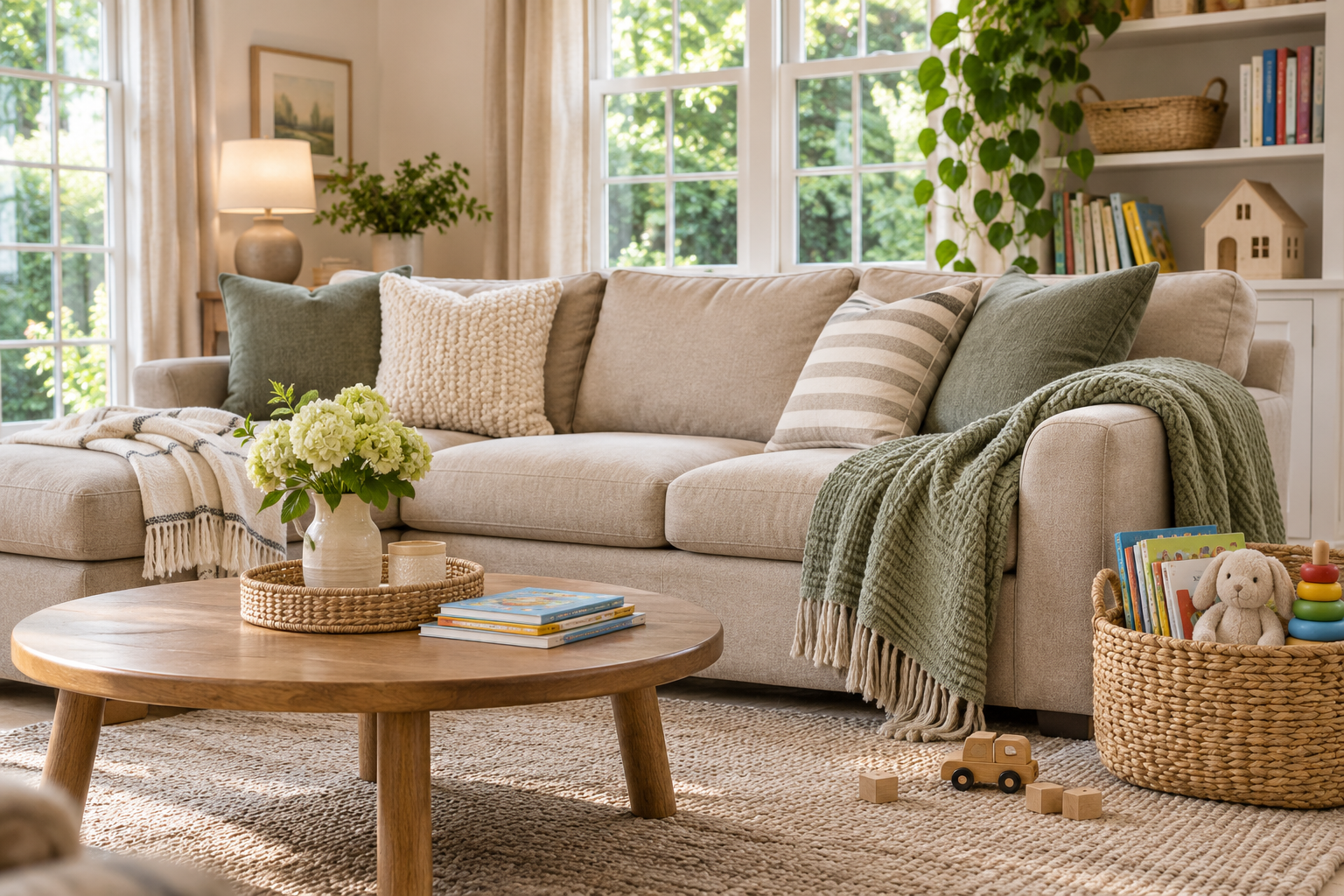
Decide what your family needs from the sofa
List the activities that happen on the sofa. Is it mainly a place to sit together, a reading spot, a guest bed, or the center of the family room? The answer affects seat count, depth, cushion style, and whether a sleeper is worth the extra mechanism. If the room is small, a compact sofa with a movable ottoman may provide more flexible seating than a large sectional.
Consider the ages and habits of the children who use the room. Younger kids may benefit from a layout with a clear path and fewer sharp table corners nearby. Older children may want enough room to stretch out or share the sofa with friends. These are household planning considerations, not product safety guarantees. Supervise children around moving furniture and follow the maker’s instructions for any recliner or sleeper.
Think about how the sofa will be cleaned. A pale textured fabric may look attractive but can be harder to maintain if snacks are common. A smooth, tightly woven fabric may be easier to vacuum, but no surface is immune to stains or wear. Choose a care routine the adults in the household can realistically follow.
Measure the sofa and the room
Measure the living room walls, doorways, hallways, stair turns, and the space available around the sofa. Record where doors swing, where windows open, and where vents or radiators sit. A sofa can fit against a wall but still block a walkway or make a door difficult to use. If you are considering a sectional, mark the full chaise and arm footprint with tape.
Measure the delivery route before placing an order. Ask for the assembled and boxed dimensions and whether legs, arms, or backs detach. Verify the number of packages and delivery service. A large sofa may require room-of-choice service or professional assembly. Read the return policy in case the item cannot pass through the entry route.
Make sure the sofa leaves a clear path for people to move through the room. Avoid placing it where children must squeeze behind a recliner or step over a footrest. A coffee table should be reachable but should not turn the center of the room into an obstacle course. Use a measured floor plan instead of relying on staged photos.
Choose a shape for shared seating
Straight sofa
A straight sofa is often easier to position, clean around, and move than a large sectional. It can work well in a smaller family room or when you plan to add chairs over time. Compare seat width, depth, and cushion count. A sofa with removable seat cushions may be easier to vacuum between cushions, but check how the covers should be cleaned.
Sectional
A sectional can give a family more seats in one area and create a defined lounge zone. It takes more floor space and may be harder to move. Confirm the chaise orientation and whether it can be reversed. Check the full dimensions and access route. If the room is narrow, a sectional may block movement even if it offers plenty of seating.
Loveseat or apartment sofa
A smaller sofa can suit a playroom, den, or compact living room. It may provide enough seating for two adults or children without dominating the space. The product name does not guarantee a particular width, so compare the listing dimensions. A loveseat can be paired with floor cushions or an accent chair if the room needs extra places to sit.
Three API-listed sofa examples to review
These Creator API examples illustrate different seating styles. Listing descriptions may include manufacturer claims about frames, upholstery, or assembly; those claims are not independent tests by our team. Open the selected product page to verify its exact dimensions, materials, color, package contents, and warranty. A title that mentions a material does not establish how it will perform in your home.

This listing describes a four-seat U-shaped sectional with a solid-wood-frame claim. Verify the exact assembled dimensions and configuration. A wide sectional can work for a family that regularly sits together, but measure the room and walking paths before ordering. Check the seller’s care instructions and warranty rather than assuming a frame description guarantees long-term durability.

This product is described as a modular sectional with an ottoman and storage armrests. Check how many modules are included and whether they can be arranged in the way your room needs. Storage can be useful for remotes or blankets, but do not use it for items that should remain out of children’s reach. Confirm whether the selected variant includes every pictured component.

This listing describes a three-seat sofa with a straight back and arms. Compare its width, seat depth, and cushion construction with a sofa your family already finds comfortable. Check upholstery care and whether the seller offers replacement cushions or covers. These details are more useful than relying on a listing’s general comfort language.
Understand upholstery care before buying
Find the upholstery cleaning code and the manufacturer’s care instructions before checkout. Ask whether covers are removable and machine washable, and whether that applies to all cushions or only some pieces. A zipper does not necessarily mean a cover is washable. Use only cleaning methods recommended for the selected fabric.
Tightly woven fabrics can be easier to vacuum than looped or deeply textured materials where crumbs may settle. Smooth surfaces may show lint, while some textured fabrics can hold onto pet hair. These outcomes depend on the fiber, weave, color, and household use. If possible, request a fabric swatch and test it with ordinary household conditions before committing to a large piece.
Stain-resistant claims need careful reading. They do not mean that a sofa is spillproof or that every substance can be removed. Clean fresh spills promptly according to the label and blot rather than aggressively rubbing. Keep a note of the care code for anyone helping with cleaning. For stain response, see our sofa spot-remover guide and follow the upholstery maker’s guidance first.
Color also affects day-to-day upkeep. Dark fabrics may show pale crumbs or pet hair; light fabrics may show dirt or darker marks. A pattern can camouflage small marks but does not replace cleaning. Choose a color that works with your room and that your household is comfortable maintaining.
Check cushions, frame, and support information
Ask what the frame is made from and how the cushions are constructed. Product listings may describe wood, engineered wood, metal, springs, or foam, but detail varies. Look for the manufacturer’s stated weight capacity where available, the warranty terms, and any restrictions on use. Do not assume a “family” or “heavy-duty” label is a performance certification.
Seat cushions may be fixed or removable. Removable cushions can make it easier to clean crumbs and inspect the sofa, but they may shift during active use. Fixed cushions can stay in place but may be harder to clean thoroughly. Compare cushion fill, firmness, and recovery instructions, and consider whether replacement components can be ordered.
Read the warranty for the frame, upholstery, and moving parts separately. Find out who handles claims and whether labor or shipping is covered. Save the model number, order receipt, and care instructions. A useful warranty depends on terms and support, not only its length.
Plan tables and walkways around children
Place tables far enough from the sofa that people can sit and stand without bumping into corners. Rounded edges may be worth considering in a busy room, but no shape removes the need for supervision and a thoughtful layout. Secure tall furniture according to the furniture maker’s directions. Keep cords and lamps outside the route between the sofa and doorway.
Leave open floor space where children play, and avoid placing a sofa where it blocks access to a window or exit. A sectional with a chaise can create a cozy corner but may also reduce the central path. Measure the traffic route with the sofa footprint marked on the floor. Walk through the layout from each entrance before ordering.
If the sofa includes a recliner or sleeper, explain how it works and keep children clear of moving parts. Follow the manual. Do not let a child operate a mechanism without appropriate adult supervision. Stop using a damaged or unstable component until it has been inspected or repaired.
Use washable layers thoughtfully
A removable throw or sofa protector can make routine cleaning easier, especially for a favorite seat. Choose a size that stays in place and can be washed according to its label. A loose cover can bunch, slip, or become a tripping hazard. For pet-specific protection, read our guide to sofa covers for dogs; it focuses on cover fit and care, a different question from choosing a sofa for a family with children.
Do not leave a damp cover on the sofa, as moisture can affect the upholstery below. Wash and dry the cover fully before replacing it. Inspect the seat beneath the cover and vacuum crumbs or dirt. A protective layer is helpful only when it is part of a regular care routine.
Consider a sleeper only if the family needs one
A sleeper sofa can give visiting relatives an extra bed, but it adds weight and a mechanism. Measure the open sleeping surface and room footprint. Confirm whether the mattress is included and how the sofa opens. Decide where bedding will be stored and who will reset the room after guests leave.
Children should be kept clear of hinges and folding sections while a sleeper opens or closes. Follow the manufacturer’s instructions and do not force a stuck mechanism. If your home needs occasional guest capacity, compare a sleeper with a separate daybed or inflatable guest mattress; the right solution depends on storage and room use.
For more options, review our guides to loveseat sleeper sofas and sleeper sofa mattresses. Check the current product dimensions and assembly details before making a decision.
Delivery, assembly, and returns
Large sectionals can arrive in multiple boxes and may require assembly. Confirm package count, weight, delivery service, and whether the carrier brings the pieces to the room. Measure stairs and hallways. Ask whether assembly or packaging removal is available and what it costs. A low product price may not include any of these services.
Read the return policy for oversized furniture. Check the deadline, return shipping charges, restocking fees, and whether the original packaging is needed. Photograph the sofa and boxes on delivery. Keep hardware and instructions until the sofa is assembled and inspected.
If a component is missing or damaged, contact the seller promptly. Do not let children use an unstable sofa while waiting for replacement parts. Keep the product page and order information so you can identify the exact model when contacting support.
Common sofa-buying mistakes for busy households
- Choosing a large sectional without measuring the room and delivery route.
- Assuming “easy-care” or “stain-resistant” means every spill can be cleaned.
- Believing removable cushion covers are automatically machine washable.
- Picking a color without considering lint, hair, crumbs, and natural light.
- Ignoring the cost of delivery, assembly, and return freight.
- Assuming a frame or weight claim is an independent quality test.
- Leaving cords or moving parts where children can trip or get fingers caught.
- Buying a sleeper without measuring the open bed area or planning linens.
A short checklist can prevent many problems: measure, check the care code, confirm delivery, read the warranty, and verify the exact configuration. Think about your real routine, not an idealized product photo.
Related sofa guides
For construction and value, see our guide to affordable built sofas. For a specific fabric, read our guide to chenille sofas. These pages cover different topics; check the exact model and care instructions on the live listing.
Final checklist
Before buying, confirm the room and entry measurements, decide between a straight sofa and sectional, read the upholstery care code, check cushion and frame details, and compare delivery and return terms. If the sofa has a sleeper or recliner, read the operating instructions and plan how children will be supervised around moving parts. Keep records of the model and warranty.
The best sofa for a home with kids is a practical match for the family’s space and routine. Measure carefully, choose a care plan you can maintain, and treat product descriptions as claims to verify. No sofa is immune to wear, but a considered layout and steady cleaning routine can make the living room easier to use day after day.
Make the room easy to reset
Families often use the living room for more than sitting. A sofa that is easy to vacuum around can save time after play. Keep a hand vacuum or upholstery attachment available and check between cushions regularly. If toys collect under the sofa, consider whether the frame height gives enough access to retrieve them safely. Do not reach under a heavy sofa while a child is moving it or climbing nearby.
Use baskets or a nearby cabinet for toys, blankets, and books so they do not end up wedged inside the sofa mechanism. If the sofa has storage compartments, store only appropriate lightweight items and follow the manufacturer’s guidance. Keep small objects, batteries, and cords out of a child’s reach. A tidy setup makes it easier to inspect the sofa for spills and wear.
A weekly routine can include removing cushions, vacuuming seams, checking the floor beneath the sofa, and looking for loose threads or fasteners. The exact frequency depends on your household. Clean spills promptly using the upholstery maker’s instructions. Avoid delaying a stain until it has dried if the care code calls for immediate attention.
Think about stability and placement
Place the sofa on a flat surface and follow the assembly instructions for the legs and frame. If the product includes anti-tip or anchoring directions, follow the manufacturer’s guidance. Do not substitute missing screws or use a damaged frame. If the sofa rocks, shifts, or has a loose leg, stop using it until the issue is corrected.
Keep the sofa away from sources of excessive heat and open flames according to product instructions and local requirements. Do not cover heaters or vents. Place lamps and cords where children cannot pull them down or trip. If the room includes a fireplace, follow its manufacturer clearances and keep furniture arranged as directed.
Consider access to windows and doors. A sofa should not block an exit or make it difficult for an adult to supervise children. Leave enough room to move around the furniture, especially where the household carries food, laundry, or a baby. Use the room plan to check multiple routes rather than focusing only on the sofa wall.
Choose cushions for how the family sits
Seat depth and cushion firmness affect whether adults and children can sit comfortably. Deep seats can be useful for lounging but may be harder for shorter users to sit upright. If the family includes people of different heights, try the sofa in person or compare its seat height and depth with a piece you already own.
Loose back cushions can be rearranged and fluffed, but they may shift when children climb or lean. Fixed cushions stay in place but can be more difficult to clean beneath. Ask whether cushion covers can be replaced and whether the maker sells individual cushions. These details can matter if one seat receives more wear than the rest.
Look at arm height and width as well. Wide arms can serve as a resting surface but are not designed as steps or seats unless the manufacturer says otherwise. Teach children not to stand or jump on furniture. The safest behavior depends on supervision and household rules, not a sofa’s marketing description.
Use household rules that fit the furniture
Decide whether food and drinks are allowed on the sofa and communicate the rule consistently. If snacks are common, use stable trays and clean crumbs promptly. Keep hot liquids away from children and upholstery. A blanket may protect one spot, but it should not become a substitute for supervision or routine care.
Teach children how to use recliners, sleeper sections, and storage lids. Keep fingers away from hinges and moving joints. An adult should supervise any operation that could pinch or trap a hand. If a mechanism is difficult to operate, do not encourage a child to force it.
If guests or babysitters use the room, leave the care code and simple instructions in an accessible place. Tell them which cleaner is approved and how to report a spill. Avoid leaving strong cleaners or sharp tools near children. A clear routine makes it easier for everyone to care for the sofa without damaging the fabric.