Disclosure: As an Amazon Associate, dailyhomedecorating.com earns from qualifying purchases. Links to Amazon on this page are affiliate links; they cost you nothing extra. Prices and availability change often, so check the current Amazon listing before you buy.
There is no single best cleaner for upholstered chairs, and any guide that names one without asking about your fabric is selling, not advising. Velvet, linen, chenille, boucle and polyester each react differently to water, solvents, heat and scrubbing: the cleaner that revives a polyester dining chair can watermark velvet, flatten boucle and leave linen with a permanent tide line. This guide is therefore organised by fabric, using six real chairs from a verified product pool as the working examples — each review covers the chair, its exact upholstery from the verified listing data, and the cleaning approach that fabric demands. A note on scope, stated plainly: the verified pool for this series contains chairs, not cleaning products, so this guide recommends cleaning methods and product types by fabric rather than inventing branded cleaner rankings it cannot verify. For the chairs themselves as furniture, Best Leather Chairs For Living Room covers the wipe-clean end of the upholstery world.
Every specification below comes from verified listing data. Where a manufacturer’s own care guidance is quoted in a listing — spot-clean, removable covers, wipe-clean finishes — the review says so, because the maker’s instructions outrank any general advice, including ours. Read the Quick Picks as a fabric index, the reviews for per-fabric method, and the how-to sections for the testing protocol that prevents the most expensive mistake in upholstery care: the irreversible one.
Where to Buy
All six example chairs are sold on Amazon, and the cleaning supplies described — upholstery shampoos, solvent cleaners, fabric brushes, microfibre cloths — are stocked there by type. Check the current listing for the latest price, colour options, delivery timing and availability before you buy, because all of these change often.
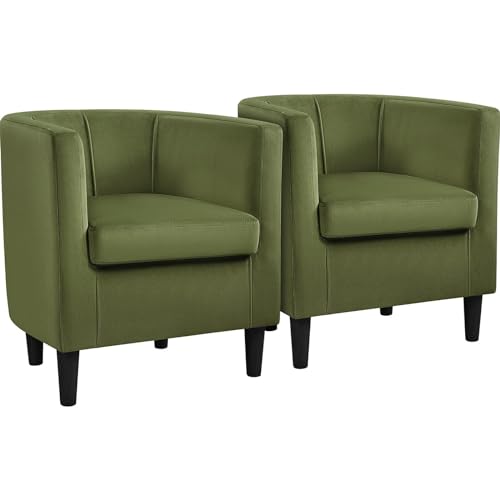
- Yaheetech Barrel Accent Chairs Set of 2 — the velvet example, and our lead case study. Check on Amazon
- Karl home Mid-Century Lounge Accent Chair — Check on Amazon
- VINGLI Mid-Century Modern Accent Chair — Check on Amazon
- LSSPAID Modern Accent Chairs — Check on Amazon
- DaVinci Atlas Upholstered Recliner & Swivel Glider — Check on Amazon
- Yaheetech Dining Chairs Set of 4 Upholstered Kitchen Chair Fabric Dark Gray — Check on Amazon
In this guide
Quick Picks
| Pick | Badge | Why it earns its place |
|---|---|---|
| Yaheetech Barrel Accent Chairs Set of 2 | Best Velvet Example | Velvet over a removable cushion — the fabric that most punishes the wrong cleaner. |
| Karl home Mid-Century Lounge Accent Chair | Best Linen Example | Natural linen: breathable, beautiful, and the fabric most prone to water marks. |
| VINGLI Mid-Century Modern Accent Chair | Best High-Back Linen Example | A second linen case, in a high-back chair where dust settles on broad surfaces. |
| LSSPAID Modern Accent Chairs | Best Chenille Example | Chenille’s soft pile: dust-resistant, gentle-clean territory. |
| DaVinci Atlas Upholstered Recliner & Swivel Glider | Best Boucle Example | Looped boucle in a nursery chair — the highest-stakes cleaning in the guide. |
| Yaheetech Dining Chairs Set of 4 Upholstered Kitchen Chair Fabric Dark Gray | Best Polyester Example | Polyester dining chairs: the most forgiving fabric, cleaned most often. |
Key Takeaways
- Match the cleaner to the fabric and its cleaning code first; the product brand matters far less.
- Velvet and boucle want dry, gentle methods; polyester tolerates proper upholstery shampoo; linen wants minimal, even moisture.
- Always test in a hidden spot and let it dry fully before judging — most upholstery damage is done by the second, bigger application.
- Removable cushions and covers, like the velvet pick’s, are the single biggest cleaning advantage a chair can have.
- Every chair is specified from verified data only; check the Amazon listing for current price and availability.
- For chairs chosen to avoid cleaning problems altogether, see the material comparison in Best Material For Dining Chairs.
How These Picks Were Chosen
The pool for this guide was fixed before writing began: chairs with Amazon listings whose titles, brands and specifications could be verified. Selection for a cleaning guide inverted the usual logic — instead of ranking chairs as furniture, it sampled the pool for upholstery range. The six picks cover the five fabric families households actually own: velvet, linen in two forms, chenille, boucle and polyester. Each review then does double duty: an honest account of the chair, and the cleaning method its verified upholstery requires, including the care statements from its own listing where they exist.
Two scope statements belong here, plainly. First, the pool contains no cleaning products, so no branded cleaner is ranked or linked in this guide; recommendations are given as product types and methods — dry-foam upholstery shampoo, solvent-based cleaner, enzyme spotter, distilled-water rinsing — which is the level at which honest, fabric-first advice operates. Second, manufacturer cleaning codes outrank everything: furniture carries codes (W for water-based cleaning, S for solvent, WS for either, X for vacuum-only) on its labels, and the first step of any real cleaning job is finding yours. Where a pick’s listing states its own care — spot-clean, removable cover — the review treats that as the authority for that chair.
Badges name the fabric case each chair represents, and they follow each chair into its review. The guide’s overall verdict, if one must be extracted, is procedural rather than commercial: the best cleaner for your upholstered chair is the mildest product of the correct type for its code, applied after a hidden test, with moisture controlled and drying unhurried. Everything below is that sentence, expanded by fabric. Households shopping for new chairs with cleaning already in mind will find Best Sofas And Chairs For Small Room a useful reminder that removable, washable elements matter most in the rooms that work hardest.
The 6 Best Cleaner for Upholstered Chairs — Reviewed

Yaheetech Barrel Accent Chairs Set of 2
Our badge: Best Velvet Example
The Yaheetech Barrel Accent Chairs Set of 2 are velvet barrel chairs in olive green, with high-density foam seats and — the detail that defines their cleaning story — a removable cushion secured by hook-and-loop fasteners over a 10-centimetre foam pad. Velvet is the diva of upholstery fabrics: its pile shows every pressure mark, watermarks readily, and punishes scrubbing by crushing. It is also, treated correctly, easier to keep beautiful than its reputation suggests.
Strengths
- Removable cushion lifts out for separate, careful cleaning
- Velvet pile releases dry dust readily with brushing
- Compact chairs are easy to move into good light for inspection
Trade-offs
- Velvet watermarks if wetted unevenly
- Pile crushes under aggressive scrubbing or steam
- Dark olive shows pale dust and lint prominently
| Color | Olive Green |
| Size | Set of 2 |
| Dimensions | 26 x 27 x 28 inches |
| Weight | 23.67 pounds |
| Product Group | Furniture |
The velvet method: dry first, always. A weekly brush with a soft clothes brush, strokes following the pile, lifts dust before it settles into the base, and a vacuum with an upholstery nozzle — never a beater bar — handles the rest. For spills, blot immediately with a dry cloth; velvet’s enemy is the damp ring, so if you must use moisture, use a barely-damp cloth over the whole panel rather than a wet spot in the middle, and dry with cool air from a hairdryer while brushing the pile up. Solvent-based upholstery cleaners (code S products) are the standard recommendation for pile fabrics that watermark; test hidden, apply sparingly, and brush the pile back into direction while it dries. The removable cushion is your practice piece and your pressure valve: clean it separately, let it dry fully off the chair, and the seat — where most incidents happen — never has to be treated in place.
As furniture, the pair are compact, quick to assemble (four legs screwed on by hand, tools included), and shaped for curling into — a waiting-room, bedroom or reading-corner set. Their cleaning lesson generalises to every velvet chair you will ever own: gentle, dry, directional, patient.
Best for: Velvet owners who will brush weekly and blot promptly / Not suited for: Anyone wanting a hose-it-down, zero-ritual fabric
Choose this method for any velvet chair; choose the chair if the barrel shape suits your room. Check on Amazon

Karl home Mid-Century Lounge Accent Chair
Our badge: Best Linen Example
The Karl home Mid-Century Lounge Accent Chair wears breathable linen over high-density sponge, on a solid wood frame rated to 330 pounds, with an included lumbar pillow in matching fabric. Linen is a natural fibre with a relaxed, slubbed texture — and a well-earned reputation for water-marking: wet one patch and let it dry, and the patch boundary can remain visible. Its cleaning method is therefore about evenness and restraint.
Strengths
- Linen releases surface dust easily with vacuuming
- Natural fibre tolerates mild, correctly diluted upholstery shampoo
- Removable lumbar pillow can be cleaned separately
Trade-offs
- Uneven wetting leaves tide lines
- Linen wrinkles, and hard brushing distorts the weave
- Spills wick along the fibres and spread if not blotted fast
| Color | Green |
| Size | 28.3 inches L x 31.5 inches W x 29.5 inches H |
| Dimensions | 39.5 x 36.3 x 37.5 inches |
| Weight | 33.3 pounds |
| Product Group | Furniture |
| Binding | Kitchen |
The linen method: vacuum weekly with an upholstery nozzle to keep grit from working into the weave. For a spill, blot — never rub, which spreads the wick and frays the surface — working from the stain’s edge inward. If shampoo is needed, use a mild upholstery shampoo at its stated dilution, applied as foam rather than liquid (foam carries the cleaning agents with a fraction of the water), worked over the entire panel seam-to-seam so any effect is uniform, then extracted or blotted with a cloth dampened in clean water, again across the whole panel. Dry fast and evenly with moving air; slow, patchy drying is what draws tide lines. The lumbar pillow, being small and removable, is the place to rehearse the method before the chair itself needs it.
As furniture, this is a relaxed lounge chair — reclined back, wide arms, a reading-and-conversation posture — whose green linen suits warm, natural rooms. Its cleaning lesson is the linen universal: less water, evenly applied, dried quickly. Households that love the look and hate the discipline should note the polyester case study at the end of this guide before buying natural fibres for high-traffic seats.
Best for: Linen lovers who will clean whole panels, not spots / Not suited for: Spot-cleaners who dab locally and hope
Choose this method for linen; choose the chair for warm, relaxed rooms. Check on Amazon

VINGLI Mid-Century Modern Accent Chair
Our badge: Best High-Back Linen Example
The VINGLI Mid-Century Modern Accent Chair is the guide’s second linen case, chosen because its form changes the cleaning problem: a high back with broad, flat surfaces over pocket coils and high-density foam, in breathable linen, on a sturdy wooden frame. Broad surfaces collect visible dust films and sunlight-driven fading gradients that compact chairs escape, and the high back’s top edge — where heads and hands rest — concentrates oils exactly where they are most visible.
Strengths
- Flat, broad panels are easy to vacuum and foam-clean evenly
- Linen stays cool and does not hold odours the way pile fabrics can
- Sturdy build tolerates the handling cleaning requires
Trade-offs
- Head-contact zone shows oil darkening over time
- Large panels make uneven drying more likely if rushed
- At over 49 pounds, moving it to clean behind is a two-stage job
| Color | Green |
| Size | Medium (M) |
| Dimensions | 31 x 31.1 x 35.8 inches |
| Weight | 49.27 pounds |
| Product Group | Furniture |
The method extends the linen rules with two additions. First, prevention at the head zone: a washable throw or headrest cover across the top of the back intercepts oils before the linen must, and laundering a throw is always easier than extracting a panel. Second, rhythm: broad flat panels reward a scheduled light clean — vacuum, then a dry-foam pass over the full back and seat every few months — over heroic annual efforts, because dust films left to bake in sunlight become the grey gradient that no single clean fully reverses. Rotate the chair’s position or the room’s arrangement occasionally if one side takes all the sun; fading is a light problem before it is a cleaning problem.
As furniture, this is the high-backed reading chair of the pool — full shoulder support, structured coil comfort, real substance at nearly 50 pounds. Its lesson for cleaners: scale changes method. The bigger the panel, the more evenness matters, and the more prevention outperforms cure.
Best for: Linen chairs in sunny rooms, on a scheduled light-clean rhythm / Not suited for: Anyone who cleans only when a stain forces it
Choose this method for large linen pieces; choose the chair for tall, supported reading. Check on Amazon

LSSPAID Modern Accent Chairs
Our badge: Best Chenille Example
The LSSPAID Modern Accent Chairs wear chenille — a soft, tufted-pile fabric the listing describes as breathable, skin-friendly and dust-resistant — over a seven-inch cushion with a spring base, with a matching lumbar pillow, on a solid wood frame rated to 350 pounds. Chenille sits between velvet and flat weaves in cleaning terms: a pile that wants gentleness, on a fabric generally more forgiving than true velvet.
Strengths
- Chenille’s dust-resistant character slows visible soiling
- Matching lumbar pillow removes for separate care
- Soft pile releases surface dust with gentle vacuuming
Trade-offs
- Pile can shade and flatten in high-contact areas
- Charcoal shows pale lint and pet hair prominently
- Aggressive extraction can distort the tufted surface
| Color | Charcoal |
| Size | Set of 1 |
| Dimensions | 30.5 x 29.5 x 31.5 inches |
| Weight | 33 pounds |
| Product Group | Furniture |
The chenille method: vacuum with an upholstery nozzle on low suction, strokes in one direction, weekly — chenille’s pile traps what it catches, and regular light passes beat occasional deep ones. For spots, start dry (a soft brush and patience lift more than expected), then use a small amount of foam from a mild upholstery shampoo, blotted rather than scrubbed, and finish by brushing the pile back into its direction while damp. Avoid saturating: the seven-inch cushion beneath is a sponge in waiting, and a soaked cushion dries slowly, smells stale and can watermark the fabric from behind. If you use a home extraction machine anywhere in this guide, use it most cautiously here — lowest moisture, most passes of dry extraction.
As furniture, the LSSPAID is a deep, soft lounge seat at a 115-degree angle, with anti-slip foot pads and a raised base a robot vacuum can pass under — meaning the floor beneath it stays cleaner, which quietly keeps the chair cleaner too. Its lesson: pile fabrics reward rhythm and restraint in equal measure.
Best for: Soft-fabric households willing to vacuum little and often / Not suited for: Anyone whose instinct is to soak and scrub
Choose this method for chenille; choose the chair for deep, soft lounging. Check on Amazon

DaVinci Atlas Upholstered Recliner & Swivel Glider
Our badge: Best Boucle Example
The DaVinci Atlas Upholstered Recliner & Swivel Glider is upholstered in Cozy Olive Boucle — a looped, textured fabric — in a nursery chair that reclines, glides and swivels, with a high pillowback and armrest pillows, and GREENGUARD Gold certification for low chemical emissions. Boucle is the most delicate common upholstery to clean: its loops snag, its texture traps debris at multiple levels, and nursery use guarantees the full catalogue of spills.
Strengths
- Textured boucle hides minor marks better than flat fabrics
- Certified low-emission construction suits nursery air-quality priorities
- Armrest pillows concentrate wear on defined, cleanable zones
Trade-offs
- Loops snag on brushes, jewellery and rough cloths
- Texture traps crumbs and dried spills below the surface
- Slowest fabric in this guide to clean properly
| Color | Cozy Olive Boucle |
| Size | 37″L x 39.5″W x 40″H |
| Dimensions | 38.5 x 39.5 x 40 inches |
| Weight | 91.29 pounds |
| Product Group | Furniture |
| Binding | Baby Product |
The boucle method is the gentlest in this guide. Prevention first: a washable throw over the seat and armrest pillows during the feeding months intercepts most incidents at a washable layer. For the fabric itself: lift debris with a vacuum’s hose and crevice tool at low suction — no rotating brushes, which catch loops — and treat spills by blotting with a smooth microfibre cloth, working patiently, because boucle releases slowly and punishes haste by pulling. Mild, correctly diluted upholstery shampoo applied as foam, blotted off, and rinsed by blotting with a clean-water cloth is the ceiling of home intervention; anything set, dried and mysterious in a nursery chair is a case for a professional cleaner told in advance that the fabric is boucle. Never use a stiff brush, never use a lint roller aggressively, and never pull a snagged loop — trim it flush if it bothers you.
As furniture, the Atlas is the premium nursery chair of the pool — full motion, head support, elbow pillows, a wide seat — and its cleaning profile is the honest price of boucle’s beauty. Buy it with a throw strategy from day one and it stays beautiful; buy it expecting dining-chair maintenance and it will teach you otherwise within a month.
Best for: Nurseries where prevention (throws) is an accepted routine / Not suited for: Anyone needing fast, forgiving, scrub-able upholstery
Choose this method for any looped fabric; choose the chair for premium nursery comfort. Check on Amazon

Yaheetech Dining Chairs Set of 4 Upholstered Kitchen Chair Fabric Dark Gray
Our badge: Best Polyester Example
The Yaheetech Dining Chairs Set of 4 Upholstered Kitchen Chair Fabric Dark Gray close the guide with the workhorse fabric: polyester, over high-density foam, on solid wood legs with adjustable footpads, each chair rated to 298 pounds. Polyester is the most forgiving upholstery in this guide — synthetic, colourfast, tolerant of water-based cleaning — and dining chairs are the most frequently soiled chairs in any house, which is why this pairing is where proper upholstery shampoo earns its reputation.
Strengths
- Polyester tolerates water-based upholstery shampoo (code W territory)
- Dark gray hides the evidence between cleans
- Four matching chairs can be batch-cleaned on one routine
Trade-offs
- Foam beneath can be over-wetted by enthusiastic extraction
- Food oils need prompt attention before they set
- Fabric lacks the luxury hand of the natural and pile fabrics here
| Color | Fabric- Dark Gray |
| Size | Set of 4 |
| Dimensions | 22.5 x 18 x 36.5 inches |
| Weight | 55.45 pounds |
| Product Group | Furniture |
| Binding | Kitchen |
The polyester method is the fullest home clean in this guide: vacuum; pre-treat spots with an enzyme spotter for food and drink stains, giving it its stated dwell time; shampoo with a water-based upholstery cleaner applied as foam or by a home extraction machine on a low-moisture setting; extract thoroughly — residue left in the fabric is tomorrow’s dirt magnet, because dried shampoo is itself sticky; and dry fast with moving air before the chairs return to the table. Even here, restraint applies: the foam core should end damp, not soaked. Batch the set on a single morning, assembly-line style, and four chairs take barely longer than one. The adjustable footpads, incidentally, are part of cleaning too — grit ground under chair legs is a floor problem this guide’s sibling, the floor-protection search, deals with from the other side.
As furniture, these are compact, armless Parsons-style chairs for dining rooms and kitchens — efficient in small spaces, stable, and honest. Their lesson is the guide’s relief: choose polyester where life is messiest, and cleaning becomes a routine instead of a research project. New-chair shoppers who take one idea from this entire article should take that one.
Best for: Dining rooms and family kitchens that clean often and thoroughly / Not suited for: Anyone seeking a luxury fabric hand
Choose this method for polyester upholstery anywhere; choose the chairs for everyday dining. Check on Amazon
Comparison Table
| Pick | Dimensions | Weight | Colour | Check price on Amazon |
|---|---|---|---|---|
| Yaheetech Barrel Accent Chairs Set of 2 | 26 x 27 x 28 inches | 23.67 pounds | Olive Green | Check price on Amazon |
| Karl home Mid-Century Lounge Accent Chair | 39.5 x 36.3 x 37.5 inches | 33.3 pounds | Green | Check price on Amazon |
| VINGLI Mid-Century Modern Accent Chair | 31 x 31.1 x 35.8 inches | 49.27 pounds | Green | Check price on Amazon |
| LSSPAID Modern Accent Chairs | 30.5 x 29.5 x 31.5 inches | 33 pounds | Charcoal | Check price on Amazon |
| DaVinci Atlas Upholstered Recliner & Swivel Glider | 38.5 x 39.5 x 40 inches | 91.29 pounds | Cozy Olive Boucle | Check price on Amazon |
| Yaheetech Dining Chairs Set of 4 Upholstered Kitchen Chair Fabric Dark Gray | 22.5 x 18 x 36.5 inches | 55.45 pounds | Fabric- Dark Gray | Check price on Amazon |
Read the table as the fabric index it is: the chair names matter less here than the upholstery each represents. Prices are deliberately not printed — check the current Amazon listing for each chair, and for cleaning supplies by the product types named in the reviews.
How to Choose the Best Cleaner for Upholstered Chairs
Find Your Cleaning Code Before You Buy Anything
Upholstery carries a code, usually on a label under the seat or in the manufacturer’s documentation: W means water-based cleaners are approved; S means solvent-based only; WS means either; X means vacuum and brush only — no liquids at all. The code collapses this entire guide into one letter for your chair. If the label is gone, the fabric identification in these reviews is your fallback: polyester usually behaves as W, velvet and boucle usually want S-leaning gentleness, natural fibres want testing above all. Never let a product’s front label (“safe for all fabrics!”) overrule your chair’s code.
Match Product Type to the Job
Four types cover home upholstery care. Dry-foam upholstery shampoos clean with minimal water and suit most W and WS fabrics. Solvent cleaners handle pile and watermark-prone fabrics where water is the risk. Enzyme spotters digest organic stains — food, drink, the nursery’s greatest hits — and need dwell time, not scrubbing. And plain distilled water, used as a rinsing blot, is the most underrated product in the cupboard: tap water’s minerals are what leave rings on some fabrics. Buy the type your code demands, in the mildest formulation, and resist the strong-smelling promise of industrial strength on domestic furniture.
Moisture Control Is the Whole Skill
Most upholstery disasters are water disasters: too much liquid, unevenly applied, dried too slowly. Foam cushions drink what the fabric is given, then release it slowly, carrying dissolved dirt back to the surface as a new stain — the reason a cleaned patch sometimes looks worse a week later. Work with foam rather than liquid where you can, extract more than feels necessary, and dry actively with fans or cool air. If you remember one ratio from this guide, make it this: for every minute of wetting, spend five on extraction and drying.
Tools Matter More Than Chemicals
A soft upholstery brush, smooth microfibre cloths, a vacuum with a proper upholstery nozzle, and a spray bottle for controlled application will outperform any premium chemical used with a rough cloth and enthusiasm. Brushes lift pile and loosen dry soil; microfibre blots without lint or abrasion; the nozzle’s soft edges protect loops and pile. Retire any tool that snags a test patch. And keep the kit together, labelled, with the codes of your chairs written on a card inside it — future you, facing a red-wine incident at midnight, will be grateful. Households choosing new furniture with this kit in mind often end at the material rankings, which is the correct direction of travel: buy the fabric your cleaning temperament can keep, and the cupboard of products stays small.
Know When to Call a Professional
Set, dried, unknown stains on X-code or delicate fabrics; large areas of boucle; antique or high-value pieces; and any chair where your hidden test patch misbehaves — all belong to a professional, told the fabric and code in advance. Professional extraction controls moisture and temperature in ways home machines cannot. The fee is real, and so is the cost of the alternative: a ruined chair. This guide’s methods cover the honest majority of home incidents; recognising the minority is part of the skill.
How Do You Test a Cleaner on Upholstery Safely?
Choose a hidden area — under the seat, behind a leg, inside a rear seam — and apply the cleaner exactly as you intend to use it: same dilution, same cloth, same dwell time. Then wait for it to dry completely, because most adverse reactions (colour lift, rings, pile distortion, stiffening) declare themselves only in the dried state, and a patch that looks fine wet can dry wrong. Inspect in daylight and by touch. If colour transfers to your cloth beyond loose surface dye, if the pile lies differently, if a ring forms — stop, and change product type, not just brand. One test per product per chair, recorded on the kit card, and you will never repeat a mistake on the visible surfaces.
Test new tools the same way, especially brushes and extraction machines, on the same hidden patch. And re-test when anything changes: a new product batch, a different dilution, a chair that has been in the sun for a year. Upholstery ages, and its tolerances age with it.
Problem: A ring appeared where you spot-cleaned — The moisture boundary dried visibly. Re-dampen the entire panel evenly with a barely-damp cloth or fine mist, blot, and dry the whole panel uniformly with moving air; on pile fabrics, brush the pile in one direction while it dries.
Problem: The cleaned patch looks brighter than the rest — You have cleaned one patch of a uniformly soiled chair. The cure is a full-panel or full-chair clean at the same strength, so the whole surface matches — which is why this guide preaches panels, not spots.
Problem: A stain returned a week after cleaning — Residue or deep soil wicked back during slow drying. Re-clean with less product, extract far more thoroughly, and dry fast with fans; if it returns again, the cushion itself is holding the spill and a professional extraction is the honest next step.
Problem: Pile lies flat and shiny after cleaning — It was scrubbed or steamed too hard. Brush gently against the pile while barely damp, let it dry fully, and accept that severe crush may be permanent — then change the method, not the pressure, next time.
How Often Should You Deep-Clean Upholstered Chairs?
By use, not by calendar guilt. Dining chairs in daily family service earn a deep clean every few months and spot care weekly; a guest-room accent chair may need only vacuuming and an annual refresh. Pile fabrics prefer frequent light attention to rare deep intervention; polyester tolerates the reverse. The trigger signs are consistent across fabrics: a grey film on the arms and head zone, odour that airing does not clear, and spots multiplying faster than you treat them. Clean at the first sign, not the third — soil left in fibres abrades them with every sit, so frequency is a fabric-preservation strategy, not a housekeeping preference. And log what you did on the kit card; upholstery care is a years-long relationship, and memory is not a filing system.
Fabric by Fabric: Velvet, Linen, Chenille, Boucle and Polyester
Step back and the five case studies resolve into one spectrum. At the gentle end sit boucle and velvet: textured, pile-driven fabrics whose beauty is structural and whose cleaning must protect the structure — dry methods, soft tools, minimal moisture, infinite patience. Chenille stands mid-spectrum, a pile fabric with a forgiving streak, cleaned by rhythm. Linen stands apart rather than between: a flat weave with a moisture-behaviour problem, cleaned by evenness. Polyester anchors the robust end: synthetic, colourfast, shampoo-tolerant, the fabric that lets you clean thoroughly and often. Every upholstered chair you will ever own sits somewhere on this spectrum, and placing it correctly — by fibre, by code, by a hidden test — is the entire expertise this guide has to teach.
The purchasing corollary deserves emphasis, because it is the most valuable paragraph here for anyone also shopping: cleaning difficulty is a fabric property you choose at purchase, as surely as colour. The same household that finds polyester dining chairs liberating may happily accept velvet’s rituals in a low-traffic reading chair. Match fabric temperament to room traffic and your own cleaning temperament, and the question this article’s title asks mostly answers itself before the first spill. Readers at that purchasing stage should compare the fabric rankings in Best Spray To Protect Fabric Sofas, where protection products for larger upholstered pieces are the brief, alongside the material guide linked earlier.
Spot Cleaning Versus Full Cleaning
The instinct to attack the spot and only the spot is the source of half the visible cleaning failures: rings, bright patches, tide lines. The professional habit this guide teaches instead is escalation in stages. Stage one, always: dry removal — vacuum, brush, blot — which resolves more incidents than any chemical. Stage two: treat the spot with the mildest correct product, feathering the moisture boundary outward so no hard edge can dry. Stage three, if any trace or boundary remains: clean the full panel, seam to seam, so the surface dries as one field. Stage four, for the heavily soiled: the full chair, cushions separately, on a morning set aside for it.
Full cleaning has its own discipline: work top-down so drips fall on uncleaned fabric, keep cleaned sections’ moisture even, extract in overlapping passes, and dry the whole chair in moving air before cushions return. It is slower than the spot instinct and faster than living with the spot instinct’s results. Between the two sits the maintenance clean — the scheduled light pass that keeps dining chairs and head zones from ever needing heroics — and households that adopt it discover that “deep clean” becomes an annual event rather than a recurring emergency.
Two neighbouring problems deserve a signpost before the mistakes section, because cleaning day is when households notice them. The first is the floor: chairs dragged aside for cleaning grind grit under their feet, and the protection question is answered in Best Hardwood Floor Protectors For Chairs — read it before your next deep clean, not after the arcs appear in the finish. The second is the nursery itself: the boucle case study above sits in a room whose whole furnishing brief — compact, cleanable, calm — is ranked in Best Nursery Chairs For Small Spaces, and parents choosing a nursery chair will make a better decision reading the two guides together, fabric temperament in one hand and footprint in the other. Cleaning, in the end, is not a separate subject from furnishing; it is furnishing, continued by other means, and the households that grasp that buy once and maintain calmly for years.
Keep a small stain log with the cleaning kit: date, fabric, what spilled, what you did, how it dried. Chairs live for years and spill in patterns — the same arm, the same cushion edge — and the log turns the second incident from an experiment into a procedure. It takes twenty seconds to write and saves the twenty minutes of doubt that make people reach for the strongest bottle in the cupboard, which is how most upholstery damage in this guide’s experience actually happens.
Common Buying Mistakes
Buying One Cleaner for Every Chair
The all-fabrics promise on a bottle is marketing, not chemistry. Codes differ, fibres differ, and the product that is safe everywhere is usually effective nowhere. Buy by type, per fabric family, and label the bottles with the chairs they serve.
Scrubbing a Stain
Scrubbing spreads spills, frays fibres, crushes pile and drives soil deeper in a single motion. Blot, dwell, extract — the boring verbs are the effective ones, on every fabric in this guide.
Soaking the Cushion
Liquid that reaches the foam returns as stains, odours and slow damage. Apply foam, not floods; extract more than you apply; dry actively. If the cushion feels heavy with water, you have already gone too far.
Skipping the Hidden Test
Ten minutes and a hidden patch are the cheapest insurance in home care. Every disaster story in upholstery begins with confidence and a full panel; every success story in this guide begins with a test.
Cleaning in Poor Light and Judging Wet
Wet fabric lies — it looks darker, cleaner and more even than it will dry. Clean in daylight where possible, and withhold the verdict until the chair is completely dry, which may be the next morning.
Final Recommendation
For most readers searching for the best cleaner for upholstered chairs, the honest answer is a method, not a bottle: find your chair’s code, choose the mildest product of the correct type for its fabric — dry and gentle for the velvet of the Yaheetech Barrel Accent Chairs Set of 2, foam-and-evenness for linen, full shampoo confidence only for polyester like the dining set — test hidden, control moisture, and dry patiently. If you are buying one workhorse product type first, make it a quality dry-foam upholstery shampoo for your W/WS fabrics plus a solvent cleaner for pile pieces — the pair covers this guide’s whole spectrum; the dining chairs’ own listing is at Check on Amazon for readers whose real conclusion is that the next chairs should be easier to clean. Confirm current prices and availability on Amazon before buying, since they change often and are deliberately not printed here.
Keep a simple log — chair, fabric, code, product used, result — on the kit card mentioned earlier. Upholstery incidents repeat across years and across houses, and the household that writes down what worked owns its own expertise instead of re-buying it. That log, plus the hidden-test habit, is the closest thing this unglamorous subject has to a professional secret.
Frequently Asked Questions
What cleaner is safe on velvet chairs?
Solvent-based upholstery cleaners (code S products) are the standard safe choice for velvet, because water is what watermarks the pile. Apply sparingly after a hidden test, blot rather than scrub, and brush the pile back into direction while it dries. For everyday care, dry methods — brushing and vacuuming — do most of the work and carry none of the risk.
Can I use the same cleaner on linen and polyester?
The same mild upholstery shampoo, sometimes — but not the same method. Polyester tolerates thorough shampooing and extraction; linen needs foam application, whole-panel evenness and fast, uniform drying to avoid tide lines. The product may be shared; the technique must be adapted to the fibre, which is this guide’s central lesson.
How do I clean a chair with a W cleaning code?
W approves water-based cleaning: vacuum first, pre-treat spots, shampoo with a water-based upholstery cleaner applied as foam or by low-moisture extraction, extract thoroughly to remove residue, and dry actively with moving air. Keep the cushion damp rather than soaked, and judge the result only when fully dry.
Will steam cleaning damage chair foam?
It can. Steam drives heat and moisture deep into foam, risks pile crush on velvet and chenille, can distort boucle, and may affect adhesives and backings. Some robust polyester pieces tolerate careful steam; pile and natural fabrics generally should not be steamed at home. When in doubt, the foam-and-extract method in this guide achieves the clean without the thermal risk.
How do I remove odours from an upholstered chair?
Find the source first — odour is usually residue, moisture or a specific spill, and each has its own fix. Vacuum thoroughly, clean the affected area by its fabric method, and dry completely; lingering damp is the most common odour cause and the most curable. Absorbent deodorising powders made for upholstery can help between cleans, vacuumed out fully. Persistent odour after a proper clean and full dry suggests the cushion core is involved, which is professional territory.
What is the best first choice for best cleaner for upholstered chairs?
The first choice is procedural: identify the fabric and its code, then use the mildest correct product type — as the velvet case study of the Yaheetech Barrel Accent Chairs demonstrates in this guide. Check the fabric-by-fabric reviews above for the method that matches your chair, and confirm current prices and availability on Amazon before buying supplies.


