Disclosure: As an Amazon Associate, dailyhomedecorating.com earns from qualifying purchases. Links to Amazon on this page are affiliate links; they cost you nothing extra. Prices and availability change often, so check the current Amazon listing before you buy.
The best material for dining chairs is not a single winner — it is a match between a material’s character and a household’s life: who eats there, what gets spilled, how long people linger, and what the floor underneath can forgive. This guide makes the match properly. Its evidence is the verified product pool: six dining-capable chairs whose listings name their materials exactly — polyester fabric, faux leather over steel, HDPE, polyethylene, polyester over birch, faux leather over rubberwood — each reviewed as its material’s case study, with the material’s strengths, failure modes and care regime argued from a real chair you can buy. The leather family’s own ranking is Best Leather Chairs For Living Room; the cleaning companion is Best Cleaner For Upholstered Chairs.
Every specification below comes from verified listing data — materials as the listings name them, dimensions, weights and capacities exactly as listed, nothing estimated or invented, and no prices printed anywhere, per this site’s standing rule. Where a material class is absent from the pool — solid carved wood sets, genuine leather, metal café chairs — the buying guide discusses it as guidance without inventing a product, and says that is what it is doing.
Where to Buy
All six picks are sold on Amazon. Check the current listing for the exact material description, colour options, delivery timing and availability before you buy.
- Yaheetech Dining Chairs Set of 4 Upholstered Kitchen Chair Fabric Dark Gray — our first case study: fabric done right. Check on Amazon
- Walker Edison Douglas Faux Leather Armless Dining Chairs, Set of 2 — Check on Amazon
- POLYWOOD Modern Adirondack Chair – HDPE — Check on Amazon
- LIFETIME Folding Chairs — Check on Amazon
- Christopher Knight Home Wingback Accent Chair — Check on Amazon
- Yaheetech Mid Century Accent Chair — Check on Amazon
In this guide
Quick Picks
| Pick | Badge | Why it earns its place |
|---|---|---|
| Yaheetech Dining Chairs Set of 4 Upholstered Kitchen Chair Fabric Dark Gray | Best Fabric | Polyester upholstery over foam, on wood legs with adjustable footpads. |
| Walker Edison Douglas Faux Leather Armless Dining Chairs, Set of 2 | Best Faux Leather | Wipe-clean navy faux leather on slim steel legs. |
| POLYWOOD Modern Adirondack Chair – HDPE | Best HDPE | Through-colour HDPE — the outdoor dining material that never ages. |
| LIFETIME Folding Chairs | Best Polyethylene | Contoured, weatherproof, folds away — casual dining’s workhorse. |
| Christopher Knight Home Wingback Accent Chair | Best Fabric-and-Wood Formal | Polyester over birch in a formal wingback for dining corners. |
| Yaheetech Mid Century Accent Chair | Best Faux Leather and Wood | Retro faux leather over springs and rubberwood legs. |
Key Takeaways
- Match material to household: spills argue wipe-clean, lingerers argue upholstery, outdoors argues HDPE.
- Fabric’s case: comfort and warmth — with a spill routine as the price.
- Faux leather’s case: seconds-fast cleaning — with surface ageing as the horizon.
- HDPE and polyethylene are the zero-maintenance materials, indoors and out.
- Every pick is specified from verified data only; check the current price on Amazon.
- Feet and floors are part of the material choice — see Best Hardwood Floor Protectors For Chairs.
How These Picks Were Chosen
The pool for this guide was fixed before writing began: chairs with Amazon listings whose titles, brands and specifications could be verified. Shortlisting for a material brief chose one strong case study per material family the pool honestly contains: woven polyester fabric, faux leather (in two constructions — over steel, and over wood with springs), HDPE, moulded polyethylene, and tailored polyester over birch in a formal silhouette. Each chair is reviewed as its material’s evidence: what the material feels like at a two-hour dinner, how it fails, what care it demands, and which household it serves.
The classes the pool does not contain are handled in the buying guide as pure guidance — solid wood, genuine leather, rattan, metal — with no products invented and no links implied. That boundary matters for this keyword more than most: “best material” is a question, not a product category, and a guide that answered it by pretending its pool contained every material would be lying in the useful direction. The rankings here are the pool’s materials, honestly championed; the framework around them is complete.
Badges name materials, not marketing, and follow each chair into its review. Prices appear nowhere, by standing rule. Dimensions and weights are quoted exactly as listed, because a material’s case includes the furniture built from it — its weight in the hand, its footprint at the table.
The 6 Best Material For Dining Chairs — Reviewed

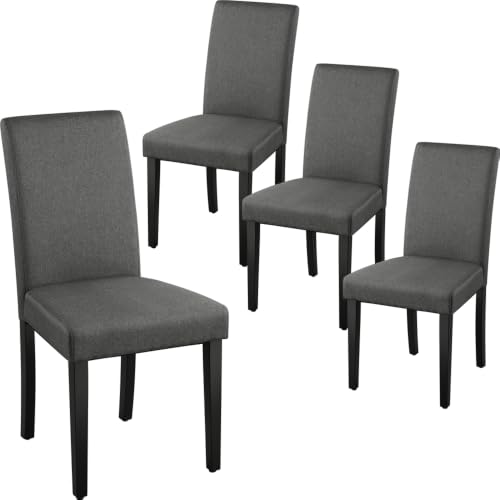
Yaheetech Dining Chairs Set of 4 Upholstered Kitchen Chair Fabric Dark Gray
Our badge: Best Fabric
The Yaheetech Dining Chairs Set of 4 Upholstered Kitchen Chair Fabric Dark Gray make fabric’s case at full strength: polyester upholstery over high-density foam — warm to sit on, quiet against the table, forgiving of long dinners — on solid wood legs with adjustable footpads, each chair rated to 298 pounds, in a set of four. Polyester is the practical fabric: harder-wearing and more stain-tolerant than natural weaves, quick to spot-clean, and in dark gray, honest about hiding the evidence between cleans.
Strengths
- Upholstered comfort suits long, lingering dinners
- Adjustable footpads protect floors and stop wobble
- Dark gray polyester hides everyday marks well
Trade-offs
- Fabric absorbs spills — prompt blotting is the regime
- Not wipe-clean like the faux leathers here
- Sold only as a set of four
| Color | Fabric- Dark Gray |
| Size | Set of 4 |
| Dimensions | 22.5 x 18 x 36.5 inches |
| Weight | 55.45 pounds |
| Product Group | Furniture |
| Binding | Kitchen |
Fabric’s honest ledger: it is the material of the long dinner — the two-hour meal, the board game after, the homework at the table — because it breathes, warms and silences the scrape of chair on floor. Its cost is the spill discipline: blot within the minute, spot-clean by the fabric’s rules, and accept that a dining fabric lives a slightly more careful life than a wipe-clean surface. Households with small children can still choose it — dark polyester is the forgiving end of fabric — but they should choose it knowing the routine is the price.
As the complete dining set in a family home, it is this guide’s first answer and its most conventional one, in the best sense.
Best for: Family dining rooms and long, lingering meals / Not suited for: Households wanting zero spill routine
Choose it for upholstered comfort; keep the blotting cloth near. Check on Amazon

Walker Edison Douglas Faux Leather Armless Dining Chairs, Set of 2
Our badge: Best Faux Leather
The Walker Edison Douglas Faux Leather Armless Dining Chairs, Set of 2 make faux leather’s case in its purest dining form: navy faux leather — wipe-clean in seconds — on slim steel legs, armless to tuck fully under the table, at 13 pounds per chair. This is the material for the household that hosts often and cleans fast: sauce, wine and children’s dinners all leave by cloth, and the chairs look tailored while it happens.
Strengths
- Wipe-clean surface resets the chair in seconds
- Slim steel legs and armless profile suit small dining spaces
- Navy finish is a distinctive, formal colour
Trade-offs
- Steel feet need protectors on hardwood — fit them first
- Faux leather ages by surface wear, not patina
- Armless design gives no lean-back support for lingerers
| Color | Navy Blue |
| Size | 31.12 inches x 22 inches x 18.87 inches |
| Dimensions | 22 x 18.87 x 31.12 inches |
| Weight | 13 pounds |
| Product Group | Furniture |
Faux leather’s honest ledger mirrors fabric’s: the cleaning is effortless and the ageing is not. The surface will, over years, wear at its high points and eventually crack where hide would have deepened — the family’s known horizon, priced into its accessible tier. The steel legs are the other half of this chair’s material story: strong, slim, and hard on floors, which is why this series’ floor guidance follows this chair through every guide it appears in. Fitted with protectors, the combination — wipe-clean top, slim steel base — is the small dining room’s most practical luxury.
Buy the pair, pad the feet, and host without a cleaning plan B.
Best for: Frequent hosts and small dining rooms / Not suited for: Long lingering sits, or unpadded hardwood use
Choose them for wipe-clean tailoring; pad the feet at assembly. Check on Amazon

POLYWOOD Modern Adirondack Chair – HDPE
Our badge: Best HDPE
The POLYWOOD Modern Adirondack Chair – HDPE makes HDPE’s case from the outdoor dining room: high-density polyethylene lumber — colour through the material, not on it — with marine-grade stainless hardware, a contoured seat and a waterfall front. HDPE does not rot, peel, splinter or need painting, ever; it hoses clean after every meal; and for dining that lives on patios, decks and gardens, it is the material with no maintenance column in its ledger at all.
Strengths
- Through-colour HDPE never needs painting or sealing
- Marine-grade hardware shrugs off weather permanently
- Hose-clean after every outdoor meal
Trade-offs
- Adirondack form is lounge dining, not upright formal dining
- At 34 pounds it is placed, not shuffled around a table
- Firm material — cushions are the comfort upgrade
| Color | Black |
| Size | 32.13″D x 29.25″W x 34.68″H |
| Dimensions | 32.13 x 29.25 x 34.68 inches |
| Weight | 34 pounds |
| Product Group | Furniture |
HDPE’s honest ledger is the shortest in this guide: the material’s only real costs are its firmness and its formality ceiling — it will never look like carved wood at a formal table, and it does not try. What it returns is decades: outdoor dining sets in HDPE are bought once, where wood sets are bought, maintained and bought again. For the household whose dining room is a patio for half the year, the material question answers itself, and this chair is its most comfortable expression in the pool.
It is also the sustainability-minded choice within the pool’s logic: one purchase, no refinishing chemistry, no replacement cycle.
Best for: Outdoor and patio dining, coastal and wet climates / Not suited for: Formal indoor dining rooms
Choose it for zero-maintenance outdoor dining; add cushions for softness. Check on Amazon

LIFETIME Folding Chairs
Our badge: Best Polyethylene
The LIFETIME Folding Chairs make moulded polyethylene’s case for casual dining: contoured seats and backs — shaped, unlike flat event plastic — over powder-coated steel, UV-protected and stain-resistant, folding completely away between meals, at 11 pounds per chair in a four-pack. For the dining that expands and contracts — the flat that hosts six twice a month and eats solo otherwise — no other material system stores its chairs in a cupboard.
Strengths
- Folds away entirely — dining capacity without permanent footprint
- Stain-resistant and hose-clean after any meal
- Contoured shape sits better than flat event chairs
Trade-offs
- Plastic reads casual at a formal table
- Firm seat wants a cushion for long dinners
- Black finish absorbs heat outdoors
| Color | Black |
| Size | 18.7 inches x 22.4 inches x 34.9 inches |
| Dimensions | 22.4 x 18.7 x 34.9 inches |
| Weight | 11 pounds |
| Product Group | Furniture |
| Binding | Kitchen |
Polyethylene’s honest ledger: it is the democratic material — inexpensive in spirit, indestructible in practice, and honest about its register. It will not age into beauty; it will simply never age at all, which for the overflow chairs, the kids’ table and the garden-dining set is the better bargain. Its dining role is elasticity: the home that can seat four daily and fourteen on holidays without owning a warehouse of furniture.
Every household needs some of this material somewhere; the dining overflow is its happiest posting.
Best for: Flexible dining, small homes and overflow seating / Not suited for: Formal dining rooms
Choose it for elastic capacity; store it folded and forget it. Check on Amazon

Christopher Knight Home Wingback Accent Chair
Our badge: Best Fabric-and-Wood Formal
The Christopher Knight Home Wingback Accent Chair makes the formal case: camel polyester upholstery in a high wingback silhouette on birch legs — the host chair at the table’s head, the dining corner’s reading seat, the formality anchor of a dining room that doubles as the home’s ceremonial space. Its material story is tailored fabric over light wood: warm, structured, and unmistakably deliberate.
Strengths
- Wingback silhouette gives dining rooms a formal anchor
- High back supports long, ceremonial meals
- Birch legs keep the large form visually light
Trade-offs
- Fabric needs prompt spill care — not a wipe-clean chair
- At about 44 pounds it is placed, not rotated
- Wingback scale overwhelms small dining rooms
| Color | Camel |
| Size | 32.25 x 31.25 x 33.00 inches |
| Dimensions | 32.25 x 31.25 x 33 inches |
| Weight | 44.1 pounds |
| Product Group | Furniture |
Formal fabric’s honest ledger: it buys presence at the price of vigilance. A wingback at the head of the table changes every meal’s register — and asks, in return, that spills be met promptly and that the chair’s dining duty be the ceremonial end of the household’s eating, not the children’s weekday end. Used so, as the host pair or the single statement chair among simpler companions, it is the material-and-form combination that makes a dining room feel finished.
It is the pool’s argument that material questions are also silhouette questions, answered together or not at all.
Best for: Formal dining rooms and host chairs / Not suited for: Messy everyday family dining
Choose it as the statement; seat it at the table’s head. Check on Amazon

Yaheetech Mid Century Accent Chair
Our badge: Best Faux Leather and Wood
The Yaheetech Mid Century Accent Chair closes the material tour with the hybrid: retro-brown faux leather over sinuous springs, on rubberwood legs with plastic foot pads, at a 300-pound stated capacity. As a dining chair it serves the breakfast nook and the mid-century dining corner; as a material case it shows faux leather’s warmer construction — springs beneath, wood below — against the Walker Edison’s steel minimalism.
Strengths
- Sinuous springs keep the seat resilient for years
- Rubberwood legs with pads are kind to floors
- Retro faux leather suits warm dining corners
Trade-offs
- Faux leather surface — gentle cleaning only
- Accent scale, not a full dining set
- Retro styling commits the room’s direction
| Color | Retro Brown |
| Size | 29″D x 28.5″W x 33″H |
| Dimensions | 29 x 28.5 x 33 inches |
| Weight | 38.27 pounds |
| Product Group | Furniture |
The comparison inside the family is the lesson: same surface family, different constructions — and the construction decides the chair’s decade. Springs and rubberwood give this faux leather a longer, kinder life than foam over steel, which is why material questions should always be asked in full: surface, suspension, legs, feet. A dining chair is four materials wearing one name, and the buyer who audits all four buys once.
For mid-century dining corners and breakfast nooks, it is the warmest seat in this guide.
Best for: Mid-century dining corners and breakfast nooks / Not suited for: Full formal dining sets
Choose it for warm hybrid construction; keep cleaning gentle. Check on Amazon
Comparison Table
| Pick | Dimensions | Weight | Colour | Check price on Amazon |
|---|---|---|---|---|
| Yaheetech Dining Chairs Set of 4 Upholstered Kitchen Chair Fabric Dark Gray | 22.5 x 18 x 36.5 inches | 55.45 pounds | Fabric- Dark Gray | Check price on Amazon |
| Walker Edison Douglas Faux Leather Armless Dining Chairs, Set of 2 | 22 x 18.87 x 31.12 inches | 13 pounds | Navy Blue | Check price on Amazon |
| POLYWOOD Modern Adirondack Chair – HDPE | 32.13 x 29.25 x 34.68 inches | 34 pounds | Black | Check price on Amazon |
| LIFETIME Folding Chairs | 22.4 x 18.7 x 34.9 inches | 11 pounds | Black | Check price on Amazon |
| Christopher Knight Home Wingback Accent Chair | 32.25 x 31.25 x 33 inches | 44.1 pounds | Camel | Check price on Amazon |
| Yaheetech Mid Century Accent Chair | 29 x 28.5 x 33 inches | 38.27 pounds | Retro Brown | Check price on Amazon |
Read the table as a materials chart — fabric, faux leather on steel, HDPE, polyethylene, fabric on birch, faux leather on rubberwood — and confirm the current price for each on Amazon.
How to Choose the Best Material For Dining Chairs
Start With Your Spill Reality
Count the household honestly: toddlers, teenagers, red-wine Fridays, dogs under the table. High-spill households belong to the wipe-clean materials — faux leather and the moulded plastics — whatever their hearts say about fabric. Low-spill, linger-long households earn fabric’s comfort honestly. The material that matches your spill reality will look good in year three; the one that flatters your taste will look tired by Easter.
Then Your Lingering Reality
How long do people sit? Twenty-minute breakfasts forgive any material, including the firmest plastic. Two-hour dinners demand upholstery or contour — fabric, pillowed faux leather, or the HDPE contour with cushions added. The dining chair’s true load is duration, not weight, and materials should be chosen against your longest regular meal, not your average one.
Ask the Material’s Failure Question
Every material fails characteristically: fabric stains and wears at edges; faux leather cracks and peels at high points; wood dents and needs refinishing; HDPE and polyethylene essentially refuse to fail within a household horizon but cap the room’s formality. Choose the failure you can live with — or better, the failure your maintenance habits actually prevent. There is no immortal dining chair at accessible tiers; there are only well-matched ones.
Audit All Four Materials in the Chair
Surface, suspension, legs, feet — a dining chair is a system. Springs outlast foam; wood legs are kinder to floors than steel, and steel is slimmer than wood; feet need pads on hardwood regardless. The buyer who audits the system buys once; the buyer who audits only the surface buys the surface twice. The floor half of the system is covered fully in the floor-protectors guide linked in the takeaways.
The Classes Outside This Pool
Guidance only, with no products attached: solid wood is the heirloom material — repairable, refinishable, heavy, and priced like it; genuine leather brings patina and decades at the top tier with a conditioning regime; rattan and cane bring lightness and texture with a fragility at joints; bare metal brings café durability and cold, noisy contact. Any of them may be right for your room. Judge them by the same four questions this guide applies to its pool: spills, lingering, failure mode, and the system beneath the surface.
How Do You Care for Each Dining Material?
Fabric: blot spills within the minute, spot-clean by the maker’s rules, vacuum weekly with an upholstery head, and rotate chairs around the table monthly so wear and sunlight distribute. Faux leather: wipe with a damp cloth, mild soap for marks, never leather conditioners or solvents, and keep from heat sources that dry the surface. HDPE and polyethylene: hose or bucket-wash with mild soap whenever they look tired — that is the entire regime, which is their argument. Wood legs and frames: dust, keep dry at the feet, and check pads quarterly. Across all materials, the weekly constant is grit: sweep under the table, because grit under feet is the floor’s enemy and the chair’s grinding companion.
Keep the care kit with the table’s other servants — cloth, mild soap, spare pads — because care that lives in another room happens late, and in material care, late is the difference between a wipe and a stain.
Problem: A fabric chair has a set-in stain — Work from the stain’s outside inward with the fabric-appropriate cleaner, test on a hidden patch first, and accept that some stains become patina of a different kind. The prevention — prompt blotting — is in the care routine because rescue is genuinely this limited.
Problem: Faux leather is cracking at the seat front — That is the material’s known horizon arriving. Slow it by keeping heat and sun off the surface; plan replacement or reupholstery honestly. The next purchase’s lesson is construction: springs and gentler use extend the surface’s life.
Problem: Chairs are marking the floor — The feet, not the seat material, are the cause: fit protectors matched to each foot, level any rocking chair, and sweep the grit. The full method is in the floor guide linked from this article’s takeaways.
Problem: The dining set looks mismatched as chairs age differently — Rotate positions monthly so light and wear distribute evenly across the set — the host chairs and the window chairs age fastest, and rotation is the only cure that costs nothing.
Allergies and sensitivities add one more honest variable: fabrics hold dust and pet dander in their weave and need the vacuum rhythm to stay innocent; smooth synthetics and moulded materials wipe to a genuinely clean surface in seconds, which for some households ends the material debate before it begins. Neither answer is more virtuous — but the household that knows its own air should let the knowledge rank the shortlist, ahead of colour, ahead of fashion, ahead of everything except the spill reality it lives with daily.
What Material Suits an Open-Plan Kitchen-Diner?
The open-plan room asks the most of materials: dining chairs that face the kitchen’s grease and the living room’s scrutiny simultaneously. The pool’s answer is the wipe-clean family — faux leather first — with fabric reserved for the room’s formal end and the moulded materials for its casual one. Colour consistency matters more in open plans, because everything is visible from everywhere; synthetics’ consistency is a genuine design asset here, letting a set bought across two years sit together without a visible seam in time.
Children’s chairs and high chairs sit just outside this pool, but the material logic reaches them unchanged: at the messiest seat in the house, wipe-clean and moulded materials win outright, and fabric is a choice made by households who enjoy laundry. The same logic, reversed, governs the formal end — the seat used twelve times a year can carry the delicate material the daily seats cannot. Material wisdom is mostly this: spend fragility where life is gentle, and durability where life is not.
How Long Should Dining Chairs Last, by Material?
Judged by condition rather than calendar: moulded plastics and HDPE serve decades of household use with nothing but washing; fabric sets serve years of daily meals before edges and cushions tire, longer with rotation and prompt care; faux leather serves its years at the surface’s pace, extended by springs beneath and shade above; wood-framed chairs outlive their upholstery and can be re-covered, which is the quiet longevity argument for every wood-legged pick in this guide. Buy the horizon your household actually plans in — the five-year flat and the thirty-year house should not buy the same chair, and material is where that difference is decided.
Second-hand dining sets deserve the material audit in its sharpest form, because a used set’s remaining life is written in its materials: check fabric at the seat edges where it thins first, faux leather at the fold lines where cracks begin, wood at the joints where wobble starts, and moulded plastic for the chalking that means the sun has eaten its strength. A sound used set in a durable material is the dining bargain of any season; a tired set in a surface material is a countdown bought at a discount. Two minutes per chair, honestly spent, separates them.
And the mixed-set solution, for households furnishing gradually: buy the durable core first — the everyday chairs in the forgiving material — and let the statement chairs arrive later, in the delicate material, at the table’s head where life is gentlest. Gradual furnishing done by material logic looks intentional from the first month, which is more than can be said for the matched set bought in a panic and aged in a muddle.
Renters and first homes get the material counsel in its most practical form: choose the set whose material forgives the life you are actually living this year — wipe-clean or dark fabric, feet already padded for the landlord’s floor — and let the heirloom materials wait for the house they will be heirlooms in. Material regret is usually horizon regret in disguise: the right material bought for the wrong chapter. The chapters change; the method in this guide does not, and it will still be the right method when the thirty-year house arrives.
Guests test materials in ways owners never do — the chair dragged instead of lifted, the spill left unreported until it sets, the handbag hung on the chair back by its strap. Forgiving materials forgive guests too, which is a real argument for the wipe-clean and moulded families in houses that host often. The host who chooses them is not lowering the room’s standard; they are removing anxiety from it, and a dining room without anxiety about its own chairs is a better room to be a guest in.
One more practical alliance: cushions and covers are the material system’s adjustable layer — a firm chair gains a washable cushion, a delicate chair gains a washable cover for the children’s years, and both return to their true material when the season passes. Households that think in layers rarely need to replace chairs for material reasons at all; they replace the layer, at a fraction of the cost, and the chair beneath continues. It is the cheapest idea in this entire guide and the one most likely to be forgotten by Christmas.
Common Buying Mistakes
Choosing by Photograph Alone
Materials are touched, spilled on and sat in for hours — none of which a photograph reports. Read the listing’s material line, the construction beneath it, and this guide’s failure questions before the colour seduces you.
Ignoring the Spill Reality
The household you have, not the household in the photograph, will eat at this table. Toddlers plus pale fabric is a decision, and it will be re-decided by the first spaghetti night.
Forgetting the Feet
Steel legs unpadded on hardwood will mark the floor under the finest upholstery in this guide. The material audit ends at the floor, or it does not end at all.
Mixing Care Regimes
Leather products on synthetics, solvents on fabric, conditioners on plastics — cross-applied care ruins more chairs than time does. Each material’s regime is in this guide; keep them separate.
Buying the Set Before the Single
Where a design is sold singly, live with one chair for a week of meals before committing to the set. Materials reveal themselves across dinners, not deliveries.
The material question follows the household out of the dining room, and the same four questions — spills, lingering, failure, system — audit every seat it owns. The living room’s version is ranked in Best Orthopedic Sofas for support-first upholstery and Best Sofas For Older Adults for the seat-height and fabric audit applied to older sitters; the desk’s version runs through this series’ office guides. A household that learns to ask material questions once, properly, stops re-learning them at every purchase — which is the deepest economy this guide can offer, deeper than any single chair’s price.
Climate deserves its sentence before the verdict: humid homes punish fabrics that dry slowly and reward the moulded and wipe-clean families; dry, heated homes are gentle to everything except faux leather near radiators, which dries and cracks at the heat’s edge. Read your own climate into the material choice the way you read your spill rate — as a fact about the house, not a preference about the chair — and the ranking reorders itself with a logic no showroom can argue with.
And the sample discipline, for readers who can manage it: where a chair is sold singly or as a pair, live with the smallest unit through a full week of your household’s real meals — the spill, the long Sunday lunch, the homework session — before the set is ordered. Materials confess across a week of dinners what no showroom minute reveals, and the household that buys its set on that evidence almost never buys twice. It is the dining version of this series’ universal rule: trial like you mean it, inside the window, with the real life running.
Professional rooms make the same decision under brighter lights: the therapy office, the consultation room, the studio — anywhere chairs are sat in by strangers all day and cleaned by protocol. The seating logic for those rooms is ranked in Best Chairs For Therapy Office, where wipe-clean surfaces and calm materials win for exactly the reasons this guide gives households. The domestic and professional material questions are one question at two scales, and readers furnishing either will find the other’s answer instructive.
Finally, sustainability, stated plainly because material choice is where it actually lives in furniture: the longest-lived chair is the greenest one, whatever it is made of — which argues for the moulded materials’ decades, for wood frames that can be re-covered, and against any surface whose horizon is a few seasons, in any room, at any tier. Buy the chair your household will keep. Keeping is the environmental strategy; everything else is commentary.
Final Recommendation
For most dining rooms, start with the Yaheetech Dining Chairs Set of 4 Upholstered Kitchen Chair Fabric Dark Gray: polyester fabric over foam, on floor-kind adjustable footpads — the complete family answer. Households that host hard and clean fast should take the runner-up, the Walker Edison Douglas Faux Leather Armless Dining Chairs, Set of 2 — Check on Amazon — and outdoor diners should take the HDPE pick without a second thought. Match the material to your spills, your lingering and your horizon, and confirm the current price on the Amazon listing before you buy.
The evening audit closes this guide as it closes the dining day itself: the chairs are pushed in, the floor beneath them is checked by habit, the spill of the night is blotted while it is still a wipe rather than a stain. Material care is mostly timing, and timing is a household culture, not a product. Build the culture and almost any material in this guide will serve; neglect it and the finest will not.
One more alliance worth naming: table and chairs are a material conversation, not two purchases. Glass tops forgive every chair and chill every room; wood tops argue with wood chairs in tone and welcome contrast; the dining set that looks designed was usually chosen as a system — surface against surface, leg against leg. Buy the chairs against the table you own, in the light the room actually has, and the materials will settle their differences before the first dinner.
The guide’s last word is the note, as always: record what you bought, in what material, and what the first season taught you about it — the stain that lifted, the edge that wore, the chair the guests loved. That note is the brief for every future furniture purchase in the house, because material knowledge compounds only when it is written down. Households that keep it stop repeating material mistakes; households that rely on memory repeat them at retail prices, one dining set at a time.
Postscript for the undecided: if two materials are still tied after the four questions, choose by the failure you would rather explain to a guest in five years — the faded fabric with its stories, or the cracked faux leather with its service record. The tie-break sounds whimsical and is not: it forces the horizon question into the open, where it belongs, and households consistently report that the answer arrives the moment the question is asked honestly. Ask it at the table you already own, looking at the chairs you already have, and let their condition — the real evidence of your household’s material life — cast the deciding vote.
One more household pattern is worth recording before the questions, because it decides more material choices than any showroom visit: watch where your household actually eats across one ordinary week. The breakfast at the counter, the lunch at the desk, the dinner at the table, the Friday sprawled in the living room — the true dining set of a modern home is distributed, and its materials should be chosen for the distribution, not for the photograph of the formal room. Wipe-clean where the children actually eat, upholstery where the adults actually linger, moulded where the garden actually hosts. Households that audit their real eating geography buy materials once; households that furnish the imagined dinner party buy them twice, and the second purchase is always the honest one described in this guide.
And one small scene, offered as this guide’s closing evidence: a Sunday lunch in a house that chose its materials by the four questions — wipe-clean where the grandchildren sit, upholstery where the adults linger, the moulded set waiting in the garden for the crowd that always materialises by pudding. The meal runs long, the spills happen and are forgotten in seconds, the chairs are pushed back and sat in sideways for the conversation that outlasts the food, and nobody — not once — thinks about furniture. That invisibility is what correct material choice buys. It will not appear in any listing, it cannot be photographed for a review, and it is the entire point of every paragraph above: choose the material that disappears beneath the life it serves, and the dining room will take care of everything else.
There is a generational echo worth one final paragraph here too: dining chairs are among the few objects a household’s children grow up inside of — measured against the table’s edge year by year, graduated from cushion to full height, remembered decades later with a clarity that surprises everyone. The material those memories are upholstered in matters less than that the chairs were simply there, sound and unremarked, through all of it. Buy for that service — durable where life is rough, kind where life is long — and the set will earn its place in the family’s story the way it earned its place in this guide: by disappearing, daily, into the life it was chosen to serve.
Frequently Asked Questions
What is the most durable material for dining chairs?
Within this pool, the moulded materials — HDPE and polyethylene — are effectively ageless in household service, needing only washing. Among upholstered options, durability is construction-led: springs and sound frames under fabric or faux leather outlast foam-only builds. Solid wood, outside this pool, remains the repairable heirloom standard.
Is faux leather practical for dining chairs?
Yes — it is the wipe-clean champion of this guide, ideal for households that host often or eat with children. Its honest costs are a surface that ages by wear rather than patina and a need for gentle, synthetic-appropriate care. The full leather-family discussion is in the leather living-room guide linked in the introduction.
Are fabric dining chairs a mistake with children?
Not necessarily — dark, hard-wearing polyester with a prompt blotting routine serves many families well, and fabric’s comfort wins the long meals children grow into. The mistake is pale, delicate fabric bought without the routine. Match the fabric’s forgiveness to your household’s spill rate and the choice is sound.
What material is best for outdoor dining?
HDPE, and it is not close within this pool: through-colour, weatherproof, hose-clean, with marine-grade hardware in the POLYWOOD pick. Polyethylene folders serve as the flexible second. Fabric and faux leather outdoor dining belongs under cover, as session seating.
How do I stop dining chairs damaging my floor?
Fit protectors matched to each foot — cups for steel, pads for wood — level any rocking chair with adjustable footpads where fitted, and sweep grit from under the table weekly. The complete method is in this series’ hardwood floor protectors guide, linked from the takeaways above.
What is the best first choice for best material for dining chairs?
There is no single material winner — but the first chair to consider is the Yaheetech Dining Chairs Set of 4, because its polyester fabric over foam on adjustable footpads is the most complete all-round dining package in the pool. Check its full review above, weigh your household’s spill and lingering reality against the other materials, and confirm the current price on Amazon before buying.


