Disclosure: As an Amazon Associate, dailyhomedecorating.com earns from qualifying purchases. Links to Amazon on this page are affiliate links; they cost you nothing extra. Prices and availability change often, so check the current Amazon listing before you buy.
The best chairs for therapy office use have two jobs that ordinary accent chairs never face. They must keep a client comfortable and settled for a full session — fifty minutes of sitting still while doing emotionally demanding work — and they must do it again for the next client, and the next, all day, all week, while being cleaned between appointments and quietly communicating calm, professionalism and care before a single word is spoken. This guide ranks six chairs from a verified product pool against that exact brief: session-length comfort without distraction, wipeable or maintainable upholstery, stable and quiet construction, and looks that suit a professional room. Practitioners furnishing a calmer, more domestic-feeling space may also browse Best Leather Chairs For Living Room, where several of the same upholstery questions are weighed for living rooms.
Every specification below comes from verified listing data — dimensions, weights, stated capacities and materials, with nothing estimated or invented. Where a beautiful chair has a practical flaw for clinical use — a fabric that drinks spills, a creak waiting to happen — the review says so. Read the Quick Picks for the short answer, the reviews for the reasoning, and the arrangement and cleaning sections for the between-clients routine that keeps a therapy room feeling fresh.
Where to Buy
All six picks are sold on Amazon. Check the current listing for the latest price, colour options, pack sizes, delivery timing and availability before you buy, because all of these change often.
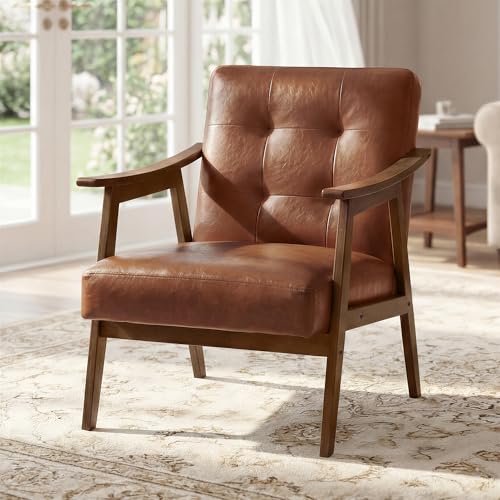
- VASAGLE Accent Chair — our first choice for a professional therapy room. Check on Amazon
- Christopher Knight Home Wingback Accent Chair — Check on Amazon
- Yaheetech Barrel Accent Chairs Set of 2 — Check on Amazon
- Karl home Mid-Century Lounge Accent Chair — Check on Amazon
- Sepnine Modern Accent Chair Mid-Century Faux Leather Armchair for Living Room — Check on Amazon
- LSSPAID Modern Accent Chairs — Check on Amazon
In this guide
Quick Picks
| Pick | Badge | Why it earns its place |
|---|---|---|
| VASAGLE Accent Chair | Best Overall | Wipe-clean PU leather, spring-supported seat and a calm, professional mid-century look. |
| Christopher Knight Home Wingback Accent Chair | Best Classic Presence | A wingback’s enclosed, private feel for traditional rooms and long sessions. |
| Yaheetech Barrel Accent Chairs Set of 2 | Best Matched Pair | Two identical barrel chairs — a ready-made, symmetrical therapy seating arrangement. |
| Karl home Mid-Century Lounge Accent Chair | Best with Lumbar Pillow | Breathable linen and an included lumbar pillow for clients who sit the full hour. |
| Sepnine Modern Accent Chair Mid-Century Faux Leather Armchair for Living Room | Best Leather Look | Tailored club styling in faux leather that wipes clean between clients. |
| LSSPAID Modern Accent Chairs | Best Soft Modern | Deep chenille comfort with a lumbar pillow, for a softer, contemporary room. |
Key Takeaways
- Start with the VASAGLE: it is the only pick combining a spring-supported seat with genuinely wipe-clean upholstery.
- Session comfort is a fifty-minute test — judge cushions by structure and support, not first-sit softness.
- Between-clients cleaning favours PU and faux leather; fabrics need a throw-and-launder routine instead.
- Matched pairs read as intentional and calm; the Yaheetech set solves therapist-and-client symmetry in one order.
- Every pick is specified from verified data only; check the Amazon listing for current price and availability.
- Rooms serving clients with mobility considerations should also read Best Chairs For Stroke Patients for stability-first principles.
How These Picks Were Chosen
The pool for this guide was fixed before writing began: chairs with Amazon listings whose titles, brands and specifications could be verified. Shortlisting for a therapy office applied clinical-room filters. Upholstery had to be cleanable at the pace of practice — wipeable synthetics scored highest, fabrics were admitted only with a credible care routine. The seat had to support a full session without numbing or sagging, which favoured springs and dense foam over soft fill. The chair had to be quiet and stable: no casters, no creaks by design, nothing that shifts when a client leans. And it had to look like furniture chosen by a professional — calm colours, considered shapes, nothing that shouts.
The method is the usual one for this site, stated plainly: verified manufacturer and listing data assessed against the known demands of the setting. No hands-on clinical use is claimed, no prices are printed because they change, and no popularity figures appear. Capacities are quoted exactly as listed. Where general guidance uses numbers — session lengths, chair spacing, angles — those are widely used practice conventions, offered as planning benchmarks rather than product claims.
Badges follow the ranking: Best Overall for the most complete practice chair, then presence, pairing, support, leather-look and soft-modern specialists. One theme runs through every review and is worth naming here: in a therapy room, the chair is part of the frame of the work. Clients notice condition, cleanliness and comfort subconsciously and continuously; a chair that is shabby, stained or distracting taxes the session before it starts. The rankings weight that professional reality as heavily as sitting comfort itself. Small practices furnishing on a footprint budget will find the measurement discipline of Best Nursery Chairs For Small Spaces directly transferable — clearance, door swings and one-room-many-jobs planning are the same craft.
The 6 Best Chairs for Therapy Office — Reviewed

VASAGLE Accent Chair
Our badge: Best Overall
The VASAGLE Accent Chair is the most complete therapy-office chair in the pool. Its seat is a substantial 6.3 inches thick with supportive springs — the construction most likely to feel the same in minute fifty as in minute five — under water-resistant PU leather that wipes clean in the minutes between clients. The button-tufted, mid-century design with splayed legs reads as calm and intentional, the angled backrest and curved armrests support a natural seated posture, and the frame is rated to 300 pounds.
Strengths
- Thick 6.3-inch seat with spring support stays comfortable through long sessions
- PU leather wipes clean in seconds, a real advantage between clients
- Button-tufted mid-century styling looks considered in formal rooms
Trade-offs
- Synthetic leather can feel warm in hot rooms
- Fixed back angle offers no recline or adjustment
- At 22 pounds it is light enough to shift if a client leans hard
| Color | Brown |
| Size | 29.5″D x 24.6″W x 28.7″H |
| Dimensions | 29.5 x 24.6 x 28.7 inches |
| Weight | 22 pounds |
| Product Group | Furniture |
| Binding | Kitchen |
The practice details line up unusually well. Assembly is quick with included hardware, so a room can be furnished in an afternoon. The tan PU leather sits comfortably in the warm, neutral palettes most therapy rooms use, and it will not absorb a spilled coffee the way fabric would — an incident that, mid-morning, would otherwise take a chair out of service for the day. The seat’s firmness deserves emphasis: clients shift, cross and uncross legs, lean forward at intense moments; a spring-supported seat answers all of that without bottoming out or squeaking through the cushion.
The honest limits are temperature and fixity. PU leather warms against the body in a sunlit room, so pair it with breathable throws if your office runs hot. Nothing adjusts, so the chair’s geometry must suit your client population as it stands — its upright, supportive posture suits the conversational norm of therapy well. And at 22 pounds, place it deliberately; it is easy to nudge out of alignment between sessions, and a practised room keeps its geometry identical every time. For most practices, this is the chair to buy first and in pairs.
Best for: Therapy rooms, consulting rooms and reading nooks needing wipe-clean professionalism / Not suited for: Hot, sun-drenched rooms where breathable fabric matters more
Choose it for the complete practice brief; skip it only if your room’s heat makes leather-look surfaces impractical. Check on Amazon

Christopher Knight Home Wingback Accent Chair
Our badge: Best Classic Presence
The Christopher Knight Home Wingback Accent Chair offers something no other pick can: enclosure. The wingback shape wraps the sitter’s head and shoulders, softening sightlines and sound at the edges of vision, and many clients experience that as privacy. Upholstered in camel polyester with a soft cushion seat, on solid birch legs with a teak finish, it brings a traditional, established presence that suits practices whose clients skew toward the classic.
Strengths
- Wingback shape gives the head and shoulders a place to rest against
- Generous 44-pound build feels planted and substantial
- Polyester upholstery is warm to the touch and easy to spot-clean
Trade-offs
- Heaviest accent chair here, so rearranging the room takes effort
- Camel colourway limits palette matching in cool-toned rooms
- Polyester needs spot-cleaning rather than a true wipe-down
| Color | Camel |
| Size | 31.25″Wx32.25″Dx33.00″H |
| Dimensions | 32.25 x 31.25 x 33 inches |
| Weight | 44.1 pounds |
| Product Group | Furniture |
| Binding | Kitchen |
At just over 44 pounds, this chair stays where it is put — a genuine virtue in a room whose arrangement is part of its therapeutic frame. The seat dimensions are generous, and the listing promises soft-cushion comfort for long hours of sitting, which maps to the session use-case honestly. The wingback also gives the therapist a visual anchor: a room arranged around two substantial chairs reads as a place where serious, unhurried conversation happens.
Care is the compromise: polyester spot-cleans rather than wipes, so adopt a throw over the seat for daily protection and a prompt-blot routine for spills. The camel tone is warm and specific; in a cool gray or white room it will argue with the palette. Practices wanting the classic feel with easier care should take the VASAGLE or the Sepnine; practices wanting presence and privacy should take this wingback and accept the laundry discipline.
Best for: Traditional therapy rooms and long, settled sessions / Not suited for: Small rooms or cool-toned schemes
Choose it for presence and enclosure; skip it if wipe-clean speed is non-negotiable. Check on Amazon

Yaheetech Barrel Accent Chairs Set of 2
Our badge: Best Matched Pair
The Yaheetech Barrel Accent Chairs Set of 2 solve the therapy room’s pairing problem in a single order: two identical barrel chairs, in olive-green velvet over high-density foam, whose curved backs run continuously into the arms so the sitter feels held rather than perched. Symmetry is a therapeutic aesthetic — matched chairs tell clients the room was arranged with intention — and this set delivers it without a matching hunt.
Strengths
- Velvet upholstery and high-density foam seat feel soft from the first sit
- Barrel shape wraps the back and arms so you settle in rather than perch
- Removable cushion on hook-and-loop fasteners is simple to lift out and clean
Trade-offs
- Low 28-inch back gives little head or upper-back support
- Velvet needs brushing and gentle care rather than a wipe-down
- Sold as a set of two — no single-chair option in this listing
| Color | Olive Green |
| Size | Set of 2 |
| Dimensions | 26 x 27 x 28 inches |
| Weight | 23.67 pounds |
| Product Group | Furniture |
The seat measures 18.5 by 19.7 inches — ample enough to curl into slightly or sit cross-legged, postures some clients adopt as sessions deepen — and the removable cushion, secured by hook-and-loop fasteners over a 10-centimetre foam pad, lifts out for cleaning, which is the velvet’s saving grace in practice use. Assembly is a five-minute, tool-included job of screwing on four tapered legs per chair, so a matched pair can be installed between morning and afternoon appointments.
The low back is the design’s honest limit: at 28 inches overall, this chair supports the lower and mid back and leaves the head free — fine for conversational therapy, less kind to a client who wants to lean a head back in a reflective pause. Velvet also asks for a brushing routine and prompt attention to spills. Practices drawn to the held, nest-like feel — and to olive green’s calm, botanical tone — will accept both; the pair is also a natural waiting-room solution, where matched, comfortable, compact chairs are exactly the brief. Waiting-room planners comparing commercial seating generally may also look at Best Sofas For Restaurants for how hospitality spaces handle the same durability questions.
Best for: Matched therapist-client pairs, waiting rooms and calm, botanical rooms / Not suited for: Clients who need head support, or practices needing wipe-clean speed
Choose it for symmetry and softness; skip it if your care routine must be a thirty-second wipe. Check on Amazon

Karl home Mid-Century Lounge Accent Chair
Our badge: Best with Lumbar Pillow
The Karl home Mid-Century Lounge Accent Chair brings two therapy-relevant virtues: breathable linen for rooms that run warm, and an included lumbar pillow that supports the lower back through a full session and can be repositioned for each client’s build. Its solid wood frame is rated to 330 pounds, its wide curved arms and reclined back suit reflective conversation, and the green linen against walnut-toned wood gives the room a natural, unhurried character.
Strengths
- Included lumbar pillow supports the lower back curve directly
- Solid wood frame rated to 330 lb feels genuinely sturdy
- Breathable linen suits warm rooms better than leather or velvet
Trade-offs
- Linen wrinkles and shows spills more readily than synthetics
- Seat is lower and more reclined than an upright consulting chair
- Green colourway will not suit every scheme
| Color | Green |
| Size | 28.3 inches L x 31.5 inches W x 29.5 inches H |
| Dimensions | 39.5 x 36.3 x 37.5 inches |
| Weight | 33.3 pounds |
| Product Group | Furniture |
| Binding | Kitchen |
The reclined lounge angle is a clinical choice, not just a style one. A slightly open posture suits listening and reflection; it is less suited to modalities where the client works upright with papers, a laptop or a worksheet. Therapists know their own method — this chair flatters the conversational ones. The lumbar pillow also doubles as a session tool: offered, adjusted or removed, it lets each client tune the chair, and small acts of control over the environment are rarely wasted in therapy.
Linen care is the discipline: spills blot immediately, a throw earns its keep on the seat, and the fabric will show the week’s wrinkles in a way PU never does. The pool lists two dimension sets for this chair; the size field reads as the true footprint, so plan the room against the smaller figures and confirm on the listing. For a warm, natural, conversation-first room, the Karl is a distinctive and genuinely supportive choice.
Best for: Conversational therapy in warm, natural-styled rooms / Not suited for: Paper-and-laptop modalities, or spill-prone waiting areas
Choose it for breathable, pillowed comfort; skip it if wipe-clean maintenance leads. Check on Amazon

Sepnine Modern Accent Chair Mid-Century Faux Leather Armchair for Living Room
Our badge: Best Leather Look
The Sepnine Modern Accent Chair Mid-Century Faux Leather Armchair for Living Room delivers the tailored club-chair look — brown faux leather, decorative rivet trim, structured arms — at the lightest weight in this guide, just under 19 pounds. The seat is high-density foam with a removable back cushion, the frame is rated to 330 pounds (150 kg), and the whole chair wipes clean between clients like the VASAGLE.
Strengths
- Faux leather with rivet trim delivers a tailored, club-chair look
- High-density foam seat and removable back cushion balance comfort and care
- Light 18.7-pound build is easy to reposition
Trade-offs
- Needs 48 to 72 hours to expand fully from compressed packaging
- Light build can shift if a client pushes off the arms hard
- Faux leather warms up in sunny rooms
| Color | 3-brown (Set of 1) |
| Size | 27.6″ x 27.2″ x 29.9″ |
| Dimensions | 27.2 x 27.6 x 29.9 inches |
| Weight | 18.73 pounds |
| Product Group | Furniture |
The removable back cushion is a small feature with practice value: it can be plumped, aired or replaced independently, and removing it changes the seat depth slightly for shorter clients. The rivet detailing reads formal in photographs and in person, suiting practices that want a more established, less domestic atmosphere — executive coaching rooms, for instance, where the VASAGLE’s mid-century softness might under-sell the setting.
Plan for the delivery quirk: the chair arrives compressed and needs 48 to 72 hours to expand fully and shed its wrinkles, so order it ahead of the room’s refresh, not during it. Its lightness cuts both ways — effortless to rearrange for couples or family sessions where seating geometry changes, but place it on a rug or mat so it does not skate on hard floors when a client rises using the arms. For leather-look professionalism at the guide’s most portable weight, it earns its badge.
Best for: Formal consulting and coaching rooms needing wipe-clean tailoring / Not suited for: Rooms where chairs must never shift, or immediate-use deadlines
Choose it for the club look and easy care; skip it if a planted, heavy chair is the priority. Check on Amazon

LSSPAID Modern Accent Chairs
Our badge: Best Soft Modern
The LSSPAID Modern Accent Chairs are the soft option: chenille upholstery, a seven-inch cushion over a spring base, a matching lumbar pillow, and a 115-degree seating angle that sits between upright and reclined. The solid wood frame is rated to 350 pounds, anti-slip foot pads keep it planted, and the charcoal colourway suits contemporary, softer practices — including those where the room is deliberately more living-room than office.
Strengths
- Matching lumbar pillow included for lower-back support
- Seven-inch cushion with spring base balances softness and structure
- Chenille upholstery is breathable, skin-friendly and dust-resistant
Trade-offs
- Chenille is a fabric — spills need prompt blotting, not a wipe
- 115-degree fixed angle cannot be adjusted to the client
- Deep 24.8-inch seat may be too deep for shorter clients
| Color | Charcoal |
| Size | Set of 1 |
| Dimensions | 30.5 x 29.5 x 31.5 inches |
| Weight | 33 pounds |
| Product Group | Furniture |
The seat depth deserves a clinician’s eye: at 24.8 inches it is generous, letting clients curl, tuck feet or sit cross-legged — postures of ease that many therapists welcome — while shorter clients may need the lumbar pillow behind them to sit supported rather than perched at the edge. The spring base keeps the deep cushion honest over a full day of sessions, and the raised hollow base lets a robot vacuum clean underneath between appointment blocks, a small mercy in a room that must always look kept.
Chenille’s care routine is the price of the softness: blot spills at once, brush the pile weekly, and keep a washable throw on the seat during back-to-back days. Practices whose identity is warmth — where the room should feel like a calm home rather than a clinic — will find this chair speaks their language best of the six. Pair it with the VASAGLE as the therapist’s own chair if you want the wipe-clean practicality where coffee is likeliest to spill.
Best for: Warm, contemporary practices and clients who settle deeply / Not suited for: Shorter clients without the pillow, or spill-heavy waiting rooms
Choose it for softness with structure; skip it if your cleaning window between clients is measured in seconds. Check on Amazon
Comparison Table
| Pick | Dimensions | Weight | Colour | Check price on Amazon |
|---|---|---|---|---|
| VASAGLE Accent Chair | 29.5 x 24.6 x 28.7 inches | 22 pounds | Brown | Check price on Amazon |
| Christopher Knight Home Wingback Accent Chair | 32.25 x 31.25 x 33 inches | 44.1 pounds | Camel | Check price on Amazon |
| Yaheetech Barrel Accent Chairs Set of 2 | 26 x 27 x 28 inches | 23.67 pounds | Olive Green | Check price on Amazon |
| Karl home Mid-Century Lounge Accent Chair | 39.5 x 36.3 x 37.5 inches | 33.3 pounds | Green | Check price on Amazon |
| Sepnine Modern Accent Chair Mid-Century Faux Leather Armchair for Living Room | 27.2 x 27.6 x 29.9 inches | 18.73 pounds | 3-brown (Set of 1) | Check price on Amazon |
| LSSPAID Modern Accent Chairs | 30.5 x 29.5 x 31.5 inches | 33 pounds | Charcoal | Check price on Amazon |
Read the table as a filter: weights tell you which chairs stay put and which rearrange easily; dimensions decide whether a pair fits your room with the spacing the next section recommends. Prices are deliberately not printed — check the current Amazon listing for each finalist.
How to Choose the Best Chairs for Therapy Office
Session-Length Comfort Is a Structure Test
Fifty minutes exposes what five minutes hides. Judge seats by construction: springs under foam, as in the VASAGLE and LSSPAID, or dense foam over a solid frame, as in the wingback. Very soft fill feels welcoming and then lets the sitter sink into a posture that aches by the session’s end — and a client managing physical discomfort is not fully present for the work. If you can, sit in any candidate for a full hour of reading before committing the room to it; that single test predicts more than any specification.
Upholstery Is a Cleaning Schedule
Choose the material whose care fits the gap between your appointments. With ten minutes and a cloth, PU and faux leather are perfect — wipe, dry, next client. Fabrics — velvet, linen, chenille, polyester — need a system instead: washable throws on contact areas, a blot-don’t-rub spill rule, and a weekly brush or vacuum. Neither is wrong; a mismatch is. Practitioners who see children, or who serve drinks, should weight wipe-clean heavily; those who do not can buy softness with a clear conscience and a laundry routine. The framework in Best Office Chairs For Support about matching chairs to real routines applies here with the stakes raised.
Arms, Height and the Client’s Body
Clients arrive in every size. Armrests should support forearms without lifting shoulders, and should be firm enough to push against when rising — older clients and those with mobility limits use them as equipment. Seat height near the standard chair range lets most feet rest flat. Where one chair must serve everyone, prefer forgiving, structured shapes over sculpted ones, and keep a cushion and the lumbar pillow in the room as tuning tools. Chairs for the therapist deserve the same care: you sit more hours in yours than any client does in theirs.
What the Chair Says Before You Do
A therapy chair is read instantly: clean or tired, matched or random, solid or flimsy. Matched pairs and deliberate colours signal that the space is held and considered — the physical version of the therapeutic frame. Avoid anything that looks like surplus office furniture or a waiting-room leftover. This is also why condition matters more than novelty: a well-kept classic chair reassures more than a fashionable one with a stain, so buy the chair whose care routine you will actually sustain.
Quiet Is a Feature
Sessions are quiet rooms. A chair that creaks when a client shifts, a base that clicks, casters that rumble — each intrusion lands in a silence that matters. All six picks here are fixed-leg chairs, chosen partly for that reason. When yours arrive, sit, shift, lean and listen before the first client does; tighten anything that talks, and place felt or pads under legs on hard floors. Silence is part of the product you are selling, even if it never appears on an invoice.
How Should Chairs Be Arranged in a Therapy Office?
Arrange for conversation, not confrontation. The classic geometry places therapist and client chairs at a comfortable angle to each other — not directly face-on like an interview, not side-by-side like a cinema — with a small table within reach of both for water, tissues and a clock that the therapist can see without turning. Keep the client’s path to the door unobstructed and their chair’s position consistent from session to session; the room’s sameness is part of its safety. Leave enough space behind chairs for them to be sat in and risen from without shuffling, and check the arrangement from the client’s seat: what do they see — a calm wall, a plant, a window with privacy handled — for the next fifty minutes?
Lighting and temperature complete the arrangement. Chairs should not sit in a sunbeam that moves across the session, nor under the direct blast of heating or cooling. If your room has one good spot, the client’s chair gets it. Test the full setup by sitting in both chairs yourself at the times of day you practise; the room you experience at noon in June is not the room your 5pm January client meets, and the chairs’ placement should survive both.
Problem: A chair creaks when clients shift — Tighten every fixing, add felt pads under the legs, and check for a loose leg joint. If a creak survives tightening, retire that chair to a non-clinical room; silence is non-negotiable.
Problem: A spill happens mid-morning with a full day booked — Blot immediately, clean per the upholstery’s care, and swap in the room’s throw or a spare cushion to keep the chair in service. This is the scenario wipe-clean picks are bought for.
Problem: The room feels like an office, not a therapy space — Soften the geometry and the palette: angle the chairs, add a rug under them to define the conversation area, choose warmer colours, and remove visible paperwork storage from the client’s sightline.
Problem: Shorter clients’ feet dangle — Keep a low footstool or firm cushion in the room as standard equipment, offered without comment. Feet supported, posture settled, session unimpeded.
How Do You Keep Therapy Office Chairs Clean Between Clients?
Build a two-tier routine. Between clients: a visual check, a wipe of leather-look surfaces or a brush of fabrics, cushions plumped and the lumbar pillow reset — ninety seconds that return the room to identical. Weekly: a deeper clean per material, throws laundered, legs and fixings checked, and the space under and behind chairs vacuumed. Monthly: inspect upholstery seams and high-wear points so a small split is repaired before it becomes the thing clients notice. Keep the kit — cloths, a mild cleaner tested on your upholstery, a spare throw — in the room itself, because a routine that requires a trip to a cupboard down the hall is a routine that gets skipped on busy days.
The Client’s Eye View: What a Chair Communicates
Clients form their impression of a practice in the first thirty seconds, and the chairs carry much of it. Matched, clean, solid chairs say: this person is established, attentive, and expects you to be comfortable. A stained or wobbling chair says something else, unfairly but unavoidably, about attention to detail — in a profession that is attention to detail. This is not an argument for luxury; the guide’s top pick is a mid-priced, practical chair. It is an argument for coherence and condition: two chairs that belong together, in a colour that belongs in the room, maintained as if someone cares — because someone is paying you to.
There is a subtler layer: the chair communicates permission. A chair that is comfortable, that has arms to rest on and a back that receives you, permits the client to settle physically, and settling physically is often the first step in the session’s real work. A perch-like chair keeps the body braced and the conversation shallow. When you choose, sit in the chair and ask the only question that matters: could I tell this chair something difficult? Furnish for the answer you want. Practices extending the same thinking to a waiting area will find Best Sofas And Chairs For Small Room helpful on fitting welcoming seating into tight footprints.
Session-Length Comfort Without Distraction
The fifty-minute hour is a specific ergonomic event: long enough for bad cushions to fail, short enough that clients will not complain — they will simply not return, or will spend the session managing their body instead of their material. The enemies are numbness from over-soft seats, heat from unbreathable surfaces in warm rooms, armrests at a height that lifts shoulders, and any noise or movement from the chair itself. The picks here answer them with springs, dense foam, breathable options and fixed legs, in different proportions; your client population tells you the right proportion. Older clients weight arms and seat height; younger, restless clients weight the freedom to shift and curl; everyone weights not being distracted.
Do not forget the therapist’s chair in this analysis — you will sit five or six sessions a day in yours. Many practitioners use the same model for both chairs, which simplifies care and keeps the room symmetrical; others give themselves the more supportive seat and the client the softer one. Either is defensible. What is not defensible is the therapist fidgeting through sessions in a chair that hurts — clients read that too. Budget for two good chairs, not one good and one forgotten.
Accessibility belongs in this guide explicitly, because therapy clients include people with limited mobility, chronic pain, pregnancy and post-surgical restrictions — often undisclosed until they are standing in your room looking at your chair. The defences are simple and mostly already in these picks: arms that bear weight, a seat height that does not demand a deep squat to leave, a chair that does not move when leaned on, and enough clear floor around it for a stick, a frame or a companion’s supporting arm. Walk your own room with that checklist before your next client arrives, and fix what fails it; the cost is an afternoon, and the benefit is that no client ever has to negotiate your furniture before they can begin. Practices that want the fuller stability-first framework behind this checklist will find it set out in the stroke-recovery guide linked earlier in this article, and it transfers to clinical rooms almost without translation.
Finally, plan replacement as part of the purchase. A therapy chair in daily use lives a harder life than any domestic chair: expect to inspect it quarterly, to re-tighten and deep-clean on a schedule, and to retire it when upholstery cracks, foam tires or a leg joint develops play — because clients will notice the decline before you do, in the way people notice everything about a room they sit in quietly for an hour a week. Keeping one spare cushion cover or throw in rotation, and knowing your chair’s model and listing, turns a mid-season failure into a non-event. Professional rooms are maintained, not decorated once; budget and diary for that maintenance now, while the chairs are new and the routine is easy to start.
Group and couples work changes the seating brief in one more way worth planning for: chairs get moved. A room that hosts individuals on Tuesday and a family of four on Thursday needs chairs light enough to rearrange without a workout, plus a practised layout for each format so the room returns to its individual-session geometry exactly. The Sepnine’s sub-19-pound build is the easiest mover in this guide; the wingback, at 44 pounds, is the anchor you arrange around. Photograph each layout that works — individual, couple, group — and keep the photographs with the room’s cleaning kit. Consistency across formats is what makes a multi-use room feel intentional rather than improvised, and clients read that difference the moment they sit down.
Common Buying Mistakes
Buying Domestic Chairs for Clinical Hours
A chair built for an hour of evening reading may not survive six sessions a day. Check stated capacities, frame construction and seat build — springs and dense foam — against your real appointment load.
Choosing Fabric You Cannot Maintain
Velvet and linen are beautiful and demanding. If your between-client gap is ten minutes and your laundry routine is theoretical, buy wipe-clean and add softness with throws you can actually wash.
Mismatched, Borrowed-Looking Seating
One good chair and one random chair undermine the room’s frame. Buy pairs, or at least chairs that clearly belong together in colour and scale.
Forgetting the Therapist’s Chair
You sit the most hours. A painful therapist’s chair leaks into every session as fidgeting and fatigue; furnish yourself as carefully as your clients.
Ignoring Noise
A creak that would be nothing in a café is an event in a silent session. Test chairs by sitting, shifting and leaning before the first client, and tighten or retire anything that talks.
Final Recommendation
For most practices searching for the best chairs for therapy office use, the answer is the VASAGLE Accent Chair: spring-supported, wipe-clean, calm to look at, and ready for back-to-back sessions — ideally bought as a matched pair. For a softer, more domestic room, the runner-up is the LSSPAID Modern Accent Chairs — Check on Amazon — whose chenille depth and lumbar pillow suit clients who settle in. Everyone should confirm the current price, colour and availability on the Amazon listing, since those details change often and are deliberately not printed here. Sit in your finalists for a full hour before the room depends on them; the session is the test, and it cannot be faked.
A closing thought on buying in pairs, since several picks here invite it. A pair bought together ages together, cleans on the same routine and keeps the room’s symmetry exact — and if one chair is ever damaged, its twin defines the replacement search precisely. Where budget forces a sequence, buy the client’s chair first and the therapist’s second, but buy the same model when you can, and photograph the room when it is finished: that photograph is your maintenance benchmark, the standard the weekly reset is restoring. Rooms drift a few centimetres and one cushion at a time; the photograph notices what familiarity stops seeing.
On lifespan, since practices ask: judge a therapy chair by condition rather than calendar. Inspect quarterly, and retire a chair when upholstery cracks or splits, when foam no longer recovers its shape between sessions, or when any joint develops play. A well-built chair maintained on the routine in this guide should give years of service; a chair that looks tired will be read as tired by every client who sits in it, which is reason enough to replace on condition — early, rather than late.
Frequently Asked Questions
Should therapist and client chairs match?
Matching chairs create symmetry and calm, and many practitioners prefer them for exactly that reason. It is not a rule — a deliberately different, more supportive therapist’s chair is common and unproblematic — but avoid accidental mismatch, which reads as indifference. If the chairs differ, let them differ on purpose, in a shared colour family and similar scale.
What fabric is easiest to sanitise between sessions?
Wipeable synthetics — PU leather and faux leather, as on the VASAGLE and Sepnine picks — are the fastest: a cloth and a mild cleaner between clients, dry in moments. Fabrics cannot match that speed; manage them with washable throws on contact areas, prompt spill blotting and weekly deeper cleaning instead.
How firm should a therapy chair be?
Firm enough to support a full session without the sitter sinking or going numb — think structured, not hard. Spring-supported seats and dense foam hold their shape best across fifty minutes and across a day of sessions. Very soft chairs feel welcoming for five minutes and fail the hour; test any candidate by sitting in it for a full session-length before buying for the room.
Do I need armrests on client chairs?
For most practices, yes. Armrests give clients somewhere to rest their arms — a real comfort across an hour — and a firm push point when rising, which older clients and those with limited mobility rely on. Choose arms that are solidly mounted and at a height that does not lift the shoulders; armless chairs suit only very small rooms or specific modalities.
What colours work best in a therapy room?
Calm, warm neutrals and muted natural tones — the tans, browns, olive greens and charcoals these picks come in — because they recede, flatter most skin tones in natural light, and do not date quickly. Avoid stark white, which shows every mark, and very dark colours in small rooms, which can feel enclosing. Whatever you choose, keep both chairs in the same family.
What is the best first choice for best chairs for therapy office?
The VASAGLE Accent Chair is the first choice in this guide, because its spring-supported seat and wipe-clean PU leather meet the demands of back-to-back therapy sessions with the fewest compromises. Check its full review above for the strengths and trade-offs behind that ranking, and confirm current price and availability on Amazon before buying.


