Disclosure: As an Amazon Associate, dailyhomedecorating.com earns from qualifying purchases. Links on this page are affiliate links; they cost you nothing extra. Prices and availability change often, so check the current Amazon listing before you buy.
Every product family has a middle child, and this medify ma 25 review is about Medify’s: a bedroom-class machine sized between the desktop MA-14 and the substantial MA-40, bought by people whose room was too big for a mini and too small to justify a tower. Two searches of this site’s own Amazon API records returned no purchasable MA-25 unit — only replacement filters for the MA-25 series — so the subject is handled here in prose, as its sibling the MA-125 was, and the linked machines are the verified Medify alternatives that bracket it: the MA-40 above, the MA-14 and MA-22 below. Readers who own a 25 should find their machine respected and its upkeep mapped; readers shopping today should find the ladder’s living rungs ready.
The middle of a range is where honest sizing usually lands, which makes the 25’s retail elusiveness a genuine inconvenience rather than a curiosity. Households rarely need the flagship or the miniature; they need the thing in between, and the between is exactly what a catalogue misplaces first. This review therefore spends as much care on the alternatives’ boundaries as on the subject’s memory, because the practical question behind the search — what do I put in a medium bedroom, Medify-style, this season — deserves a complete answer even when its original addressee is out of stock.
The MA-25 as its owners know it
Positioned in the brand’s ladder, the 25 was the bedroom answer for rooms that outgrew the desktop class: the spare room that became a nursery, the main bedroom in a flat where a tower would crowd the wardrobe, the study where a person spends the working day. Its ownership pattern, by every account the filter market reflects, is the family’s standard one — a HEPA machine run continuously at modest speeds, a filter replaced on a household rhythm, a cabinet plain enough to disappear into a bedroom’s furniture. This page will not decorate that outline with invented figures. Where a specification matters to an owner, the machine’s own label and manual remain the authorities, and the alternatives below carry only numbers their verified listings state.
What can be said without invention is the role’s importance. The medium bedroom is the most common purification problem in the developed world: a closed room, a sleeping human or two, a door that shuts at night, and air that must be cleaned quietly enough to forget. A model that served exactly that room, from a brand that treats filtration as a serious trade, earned its following the slow way — and the continuing sale of its series’ filters says the following is still running its machines.
In this guide
For owners: keeping a 25 in service
The owner’s programme is the family’s liturgy, recited here for this rung. Confirm the filter’s exact identity from the cabinet’s documentation, not from a sibling model’s listing, because middle children suffer most from hand-me-down assumptions. Hold one spare while the series’ supply is visibly healthy. Keep the intakes breathing and the placement honest — a bedroom machine belongs where the room’s air circulates past the bed, not sealed behind a wardrobe door of good intentions. And once a year, listen to the machine the way its makers would: an even, unremarkable voice is health, and any new complaint in it is a message to read early.
Owners should also plan the succession without drama. When the 25 eventually retires — by bearing, by filter scarcity, by a room that changes size — its replacement is chosen by the same measurement that chose it, applied to the home as it then stands. The alternatives reviewed next are the current candidates for that succession, and a household that has run a 25 for years will read their boundaries with an expert’s eye.
The verified alternatives, in ladder order

Medify MA-40 — step up to the room’s full answer
Badge: Alternative for medium and large bedrooms
- Coverage stated: 1,793 square feet in one hour
- HEPA filtration, removal to 0.3 microns per listing
- Named for smoke, odours, pollen, pets
- White, single-pack cabinet
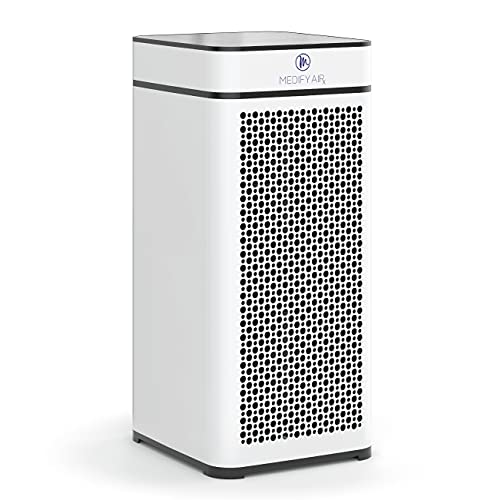
The MA-40 is the succession most 25 owners will choose, because it keeps the family’s character and removes the sizing question. Its hourly figure, turned loose in a medium bedroom, produces air changes at a rate that lets the machine idle at gentle speeds through the night — the precise quality a bedroom machine is bought for. Readers who want its standalone treatment will find it at the MA-40 reviewed on its own, and in this cluster it also serves as the partner machine in the flagship MA-112’s household plan.
Stepping up costs floor presence and filter money, both modestly. What it buys is headroom — for the larger bedroom after a move, for the pollen week that closes the windows, for the guest season when the spare room works double duty. Middle-rung shoppers are, by definition, people whose room defeated a smaller machine’s comfort; the 40 is where that defeat stops recurring.
Strengths
- Headroom that turns night speeds down and sleep up
- Same filtration discipline the 25’s owners trust
- Coverage that survives a house move to larger rooms
Trade-offs
- More cabinet than a small bedroom aesthetically needs
- Filter costs step up with the rung
- No sensor or app layer to automate the routine
Best for: the 25’s owner replacing upward, or a medium-large bedroom bought once. / Not suited for: desks, dorms, or the smallest box rooms.

Medify MA-14 — step down to the personal machine
Badge: Alternative for desks, dorms, and nurseries
- Coverage stated: 470 square feet per hour
- HEPA filtration, removal to 0.3 microns per listing
- Named for smoke, odours, pollen, pets
- Compact white cabinet
Some searchers for the 25 discover, on measuring, that their room was always a 14 room wearing a larger name — a dorm, a box-room study, a nursery corner. For them the step down is the honest purchase: the family’s filtration standard at personal scale, reviewed at length at the MA-14 examined closely. Its hourly rate cycles a genuinely small room’s air several times over, which no badge on a box can improve upon for the person sleeping or studying inside it.
The discipline the 14 demands is attention: its little filter loads on a shorter leash, and its owner must be the kind who notices. Households that know they will not inspect a filter monthly should not buy down; they should buy the headroom of the 40 and let mass forgive them.
Strengths
- Serious filtration in the smallest Medify cabinet
- Rate suits small closed rooms thoroughly
- Travels between rooms and tenancies easily
Trade-offs
- Strictly one small room per machine
- Filter attention required on a short cycle
- Audible at full effort in silent spaces
Best for: the small end of the 25’s audience, honestly measured. / Not suited for: medium bedrooms or set-and-forget owners.

Medify MA-22 — the other downward rung
Badge: Alternative for one compact bedroom
- Coverage stated: 330 square feet
- HEPA filtration, removal to 0.3 microns per listing
- Named for allergens, wildfire smoke, dust, odours, pollen, pet dander
- White, single-pack cabinet
The MA-22 completes the bracket beneath the subject: a small-bedroom machine in the family’s image, with wildfire smoke named in its listing — a telling detail for owners in the west whose 25-class need arrives with the summer sky. Between the 22 and the 14, the choice is a tape measure’s: the room’s dimensions and the current listings’ filter stories decide, and either answer keeps the household inside the brand’s discipline.
As a second machine the 22 has a particular charm — the spare room, the teenager’s den, the room whose door closes against the household’s main life. It asks little, filters seriously, and leaves the larger budget for the room where the family actually gathers.
Strengths
- Bedroom-leaning size with the family standard
- Smoke duty named for small rooms in fire country
- Undemanding footprint and upkeep
Trade-offs
- Lowest stated coverage in this comparison
- Small-filter loading caveats apply
- Overlaps the MA-14 closely enough to require care
Best for: one compact bedroom or a second-zone post. / Not suited for: main bedrooms in larger homes.
Buying guide: the medium bedroom, measured properly
Medium is the slipperiest word in housing, so replace it with arithmetic. Pace the room, multiply by its ceiling height, and note the door’s habits — a bedroom door closed eight hours nightly makes the room a true single zone, the easiest purification problem there is. Against that volume, ask of any candidate the cluster’s standing question: how many air changes per hour at a speed a sleeper can ignore? The MA-40 answers extravagantly, the 25 answered adequately in its day, and the small pair answer only when the room is genuinely small. That single calculation, honestly performed, would have prevented most of the disappointment ever recorded against this entire product family.
Then weigh the sleeper. A bedroom machine’s working voice at pillow distance outranks every other specification after coverage, and headroom is the quietest technology ever sold: a machine loafing cleans silently, a machine striving cleans audibly. Households with a light sleeper should buy one rung above the arithmetic and enjoy the hush the surplus buys. Households with a deep sleeper and a small room can pocket the difference and take the exact rung, with this review’s blessing.
Filter supply is the third leg, and for readers arriving from a model whose supply thinned, it needs no sermon: choose the machine whose cartridge is listed, stocked, and priced for the long run today. The verified trio above passed that audit at the time of writing through this site’s own records — the same audit the subject, through no fault of its engineering, currently cannot.
Running a bedroom Medify: the night routine
Step 1: Clean the room’s air before the sleeper arrives
Run the machine at its working speed through the evening — bedding turned down, door as it will be at night — so the sleeper enters air already cleaned rather than air in progress. Twenty minutes of preparation outperforms a night of compensation.
Step 2: Set the night speed and leave it alone
Choose the gentlest speed that still turns the room’s air over meaningfully, fix it as the household’s default, and resist nightly renegotiation. Consistency is a sleep feature; a machine whose note never changes disappears from consciousness within a week.
Step 3: Keep the reservoirs down
Bedding washed on its rhythm, soft furnishings vacuumed, the floor’s dust denied its weekly accumulation — a bedroom purifier maintains what housekeeping establishes, and the pair together produce the room owners describe, inaccurately but happily, as the machine’s doing alone.
Mistakes in the middle of the range
The middle rung attracts a specific error: buying it for a room that is secretly two rooms — the bedroom with an en-suite door always open, the studio masquerading as a bedroom, the nursery joined to a dressing area. Connected volume defeats middle machines politely and completely. The second error is inheriting a sibling’s filter by assumption, the middle child’s classic injury, cured by reading the cabinet’s own documentation. The third is judging a bedroom machine by its daytime voice at full speed rather than by its night voice at the setting it will actually keep.
Fourth is the scarcity trap in its local form: paying a legend’s price for a used middle-rung unit whose filter is spent and whose generation is uncertain, when the verified rung above it sells new with a warranty for comparable total money. Sentiment is a fine reason to keep a machine you own. It is a poor reason to overpay for a stranger’s.
Final verdict of this Medify Ma 25 Review
The MA-25 occupies the most sympathetic position in this cluster: a sensibly sized bedroom machine, remembered accurately by its owners, currently unverifiable as a purchase through the channel this programme trusts. Owners should run theirs with confidence, a documented filter, and one spare. Shoppers should take the bracket it leaves behind — the MA-40 for the room with ambitions, the MA-14 or MA-22 for the room honestly small — and recognise that the middle of the ladder, though its original rung is missing, is still very well served. Measure the bedroom, mind the night speed, and the machine that takes the 25’s post will earn the same quiet loyalty its predecessor did.
The middle rung, considered as a philosophy
Product ladders are usually read from the top, by people shopping for a flagship’s reassurance, or from the bottom, by people shopping for a bargain’s innocence. The middle is read by measurers — the households that pace a room, do the division, and buy the answer. That temperament explains the 25’s loyal, unglamorous following: its owners were never buying a story, so no story’s absence can disappoint them, and its filter market persists because measurers maintain what they buy. There is a lesson in the model’s afterlife for every appliance category, which is that the customers a maker should most fear losing are the quiet ones in the middle, because they leave without reviewing, return without announcing, and take a decade of filter purchases with them in either direction.
For the brand, the middle rung is also where a range proves its honesty. Flagships can hide behind spectacle and minis behind charm; a medium bedroom machine has only its rate, its voice, and its filter to offer, repeated nightly in the least forgiving room in the house. The 25’s survival in owners’ homes, evidenced by the ecosystem still feeding it, suggests Medify’s middle passed that examination for years. Its verified siblings inherit both the standard and the scrutiny.
Bedrooms that defeat middle machines, and what to do instead
Three bedroom archetypes reliably defeat this class, and naming them saves more money than any discount. The first is the bedroom-bathroom suite with both doors open, whose true volume includes a tiled room full of towels and steam; close the en-suite door at night or size for the sum. The second is the bedroom over an unheated garage or under a roof, whose air changes character with the weather and whose volume behaves larger than its floor; buy the headroom rung. The third is the bedroom that is also a home gym, a craft room, or a dog’s chosen headquarters, whose particle production runs all day rather than merely all night; such a room needs either the 40’s margin or a housekeeping regime that treats its sources as the main event. None of these are arguments against the middle class. They are arguments for reading the room before reading the ladder, which is this cluster’s oldest advice in a new set of clothes.
The night-shift sleeper and the daytime bedroom
One household in five now contains somebody who sleeps against the sun, and the bedroom machine’s job inverts for them: the pre-clean happens in the morning, the blackout hours are the machine’s night, and the rest of the household’s daytime noise becomes the disturbance the purifier’s steady voice must help mask. Middle-class machines serve shift workers particularly well because their whole design brief — thorough cleaning at a forgettable volume — is a description of daytime sleep’s requirements. The practical additions are light discipline for the display, if any, and a household agreement that the bedroom door’s closed hours are sacred in both directions of the clock. Owners of a 25 in such a home will recognise the pattern; shoppers replacing one should weight the night-speed voice of any successor above every other line in its specification.
What the filter market is really telling shoppers
Step back from this one model and the filter listings become a small masterclass in reading appliance ecosystems. A healthy compatible-filter market signals three things at once: an installed base large enough to feed third-party tooling, owners committed enough to keep buying, and dimensions stable enough that a cartridge designed years ago still fits the machines in the field. Shoppers evaluating any ageing appliance — a purifier, a vacuum, a coffee machine — can run the same test in a minute, and it will tell them more about the product’s real-world durability than a page of archived superlatives. The MA-25 passes that test today. The day it stops passing is the day its owners should begin the succession conversation in earnest, and not a season before.
Guests, spare rooms, and the machine’s hospitality
The spare bedroom is where middle-class purifiers go to be judged by strangers, and the judgement is swift: a guest who sleeps well in a strange house credits the bed, the quiet, and — without naming it — the air. Households that host often learn to run the spare room’s machine for a full day before visitors arrive, because a room closed for a month has a month’s worth of stillness to clear, and no purifier performs its best work in the hour before midnight. The 25’s class was the classic spare-room assignment, sized for exactly that room and no grander, and its verified successors inherit the post. Hosts should also leave the machine’s one instruction where a guest can find it — which speed is the night speed — because a visitor wrestling an unfamiliar appliance at midnight will simply switch it off, and an off purifier has a coverage figure of zero in every catalogue ever printed.
Children growing through the machine’s service
A bedroom purifier bought for a nursery may still be running when the nursery’s occupant has opinions, a homework desk, and a door they close for reasons of their own. The machine’s role matures with the child: from the parents’ comfort purchase, to the room’s background infrastructure, to — occasionally — the teenager’s white-noise ally against a household that keeps adult hours. Middle-rung machines suit that long arc because they were never sized to a cot; their room was always the bedroom itself, and bedrooms outlast every stage of the person sleeping in them. Owners planning a decade ahead should therefore buy the room’s machine rather than the moment’s, a principle the 25 embodied and its alternatives continue: the MA-40 for the room a child will grow into, the small pair only where the room itself is permanently small.
The economics of keeping versus replacing, worked plainly
Owners of an unverifiable-to-replace machine face a calculation worth stating without numbers, because the numbers are each household’s own. On the keeping side: a machine already bought, a filter supply currently findable, a room already matched, and a known voice at night. On the replacing side: a warranty beginning today, a current-generation filter pipeline at its thickest, headroom the old machine never had, and the end of scarcity-watching. The balance tips when the keeping side’s entries start expiring — the filter search taking an evening instead of a minute, the machine’s voice acquiring a complaint, the room outgrowing its defender. Until they do, keeping is not inertia; it is the correct economic act, and this review’s alternatives will still be there, verified and current, on the season the balance moves.
A short elegy for the sensible middle, and a practical promise
Appliance ranges lose their middles quietly. A generation is refreshed, the flagship gets the launch, the mini gets the photograph, and the bedroom-sized machine that most households actually needed is renamed, resized, or rested without a press release. Owners discover the change the way this review did — by searching for a thing that was simply there, and finding its shadow in filters instead. There is nothing sinister in it, and nothing to be done about it except what this page has done: record the situation honestly, map the upkeep for the machines in the field, and point the next measurer at the rungs that remain. Ranges are rebuilt constantly; the medium bedroom is forever. Somewhere in a future Medify catalogue there is presumably another sensible middle with another number, and when it can be verified, this programme will review it with the same tape measure.
Until then, the promise the page can make is procedural rather than prophetic: the alternatives above were real when checked, their numbers are their listings’ own, and the advice that surrounds them — measure, mind the night voice, document the filter — will outlast every model name in the cluster. A reader who keeps only that advice has still been well served by a review whose subject could not be sold to them.
How the bracket feels in a real house, rung by rung
Abstractions aside, picture the three verified machines in the three rooms their numbers describe. The MA-40 stands in a main bedroom with a reading chair and an en-suite door it has been sized to forgive, running at a murmur while turning the room’s air over like a tide. The MA-14 sits on a student’s desk between a lamp and a stack of library books, defending twelve square metres with disproportionate seriousness. The MA-22 keeps a spare room ready for whoever life sends next, from a grandparent to a exchange student, asking only to be switched to its night speed by whoever sleeps there. Between those three posts, the territory the 25 once covered alone is, in truth, covered — by a bracket, at two sizes, with the household’s measurement choosing which end of the bracket its bedroom belongs to.
The one-page version, for the reader in a hurry
Everything this review knows fits, at a squeeze, into a single breath. The MA-25 was Medify’s medium-bedroom machine; it cannot currently be verified as a purchase through this site’s trusted channel, though its filters remain widely sold and its owners remain, by that evidence, loyal. Keep yours if you have one, with its filter documented and a spare in the cupboard. If you are buying, measure the bedroom and take the verified bracket: MA-40 for the room with size or ambitions, MA-14 for the desk and dorm, MA-22 for the compact spare. Run whichever you choose before bedtime, fix its gentle night speed, wash the bedding, and let the room do what medium bedrooms, properly defended, have always done — disappear into a good night’s sleep. The long version above exists for readers who want the reasoning; the reasoning, in the end, is only ever in service of that disappearance.
Why this cluster keeps returning to bedrooms
Readers working through these Medify reviews in sequence will notice the gravitational pull of one room. The flagship defends the floor, the minis defend the desk, yet the bedroom is where the arguments converge, because the bedroom is where air quality stops being an abstraction about a house and becomes a fact about a person, repeated for a third of their life. The 25’s whole existence was an acknowledgement of that fact in product form. Its absence from a catalogue does not repeal the fact, and its alternatives are best understood as three different answers to the same nightly question, asked at three sizes of room. Choose by the room you actually sleep in — not the room in the listing photograph, not the room you plan to renovate into existence — and the question answers itself with unusual finality.
Finality deserves one qualification, offered in the spirit of every honest page in this programme: rooms change. The medium bedroom of this decade becomes the teenager’s suite, the guest room, the room a parent moves into when the stairs become a negotiation. A machine bought for the room as it is, from a ladder whose other rungs remain available, adapts to those changes by moving posts rather than by being discarded. That is the deepest argument for staying inside a brand family whose sizes interlock — the household is not buying a machine for a room, but a set of defences its rooms can trade among themselves as life rearranges the furniture. The 25 played that role in its households for years. Its bracket-mates, verified and current, are ready to play it in yours.
And if the day comes when the name returns to the catalogue — refreshed, renumbered, or exactly as remembered — the measurers who kept their filters documented and their rooms measured will be the first to know whether the new middle deserves the old loyalty. Loyalty, in this household economy, is not given to names. It is given to machines that hold a bedroom’s air through a thousand nights, and it transfers, without rancour, to whichever verified cabinet does the holding next.
Hold that thought against the temptation every shopper feels at this point in a search: to keep hunting for the exact name through ever more obscure corners of the internet, as though the name itself were the specification. It is not, and it never was. The specification was always a room, a rate, a voice at night, and a filter that could be bought again. Three verified machines in this review meet that specification at three sizes, with their titles and images recorded from the retailer’s own data. A household that chooses among them has not settled for less than the 25. It has bought the 25’s entire argument, in the present tense, with a warranty that starts this week.
The present tense matters more in appliances than in almost any other purchase, because an appliance is a promise about future consumables. A book can be bought from any year; a purifier must be fed from next year’s catalogue. That single fact explains this programme’s whole discipline — the verification, the prose-only subjects, the alternatives framed as themselves — and it explains why the kindest thing a review can do for a beloved discontinued machine is to maintain its owners honestly while steering its shoppers to the living. Both services are performed above, and the page can now close its file the way the 25 closed its bedroom doors: quietly, and to good effect.
Good effect, in a bedroom, has a recognisable signature the morning after: a room that smells of nothing in particular, bedding that does not release a visible weather when it is shaken, and a sleeper who has stopped keeping a mental list of the night’s interruptions. No single appliance delivers that signature alone — the bedding, the vacuum, the window habits all sign it too — but the machine in the corner is the only contributor that works while everyone sleeps, and the medium bedroom is where its shift is longest. That is why this cluster of reviews, for all its flagships and miniatures, keeps circling back to the rung the 25 occupied, and why its absence was worth several thousand honest words rather than a quiet redirect to a sibling’s page.
Several thousand words for a missing rung may look like excess until the alternative is priced: a shopper misdirected to a wrong-sized machine loses a season, a filter budget, and a measure of faith in the whole category, while an owner misinformed about a filter loses the machine itself. Against those costs, candour is cheap at any length. The questions below now take up the practical residue — availability, succession, filter legitimacy, night noise, and nurseries — in the short form a buyer at a checkout, or an owner at a filter change, actually needs.
Keeping, for a machine like this, is an active verb disguised as a passive one. It looks from outside like doing nothing, and it is in fact a dozen small fidelities — the intake wiped when the room is dusted, the filter’s date known without checking, the spare located in a named cupboard, the night speed defended against every well-meaning visitor who prefers a different setting. Owners who practise those fidelities rarely need reviews at all, which is the deepest compliment this one can pay its subject’s constituency: the 25 selected, by its plainness and its size, for exactly the households most likely to keep it well.
Well-kept machines, in turn, keep their households — through pollen springs and smoke summers, through the nursery years and the teenager years, through the slow rearrangement of a family’s rooms. The exchange is so quiet that it is easy to miss its scale until the machine stops, one ordinary evening, and the room’s air goes back to being weather instead of climate. Every owner of a long-serving purifier knows that evening, and knows the small urgency of the shopping that follows it. This page exists so that the shopping, when it comes, takes an evening rather than a season — with the measurements already understood, the bracket already mapped, and the verified names already waiting.
An evening is the right unit for the decision, and it should be a calm one: the room measured after dinner, the listings of the two plausible rungs read slowly, the filter of the favourite priced across a year, and the order placed before the season makes the decision for the household at surge prices and empty shelves. Calm shopping is a form of air care in itself, because the machine bought calmly is the machine placed carefully, run consistently, and maintained without resentment — the three behaviours on which every specification in this cluster finally depends.
Resentment is the hidden variable in more appliance failures than any bearing ever manufactured. The machine bought in a panic, at a scarcity price, for a room it half fits, is maintained like a debt; the machine bought deliberately, at the measured rung, is maintained like a member of the household. Filters get changed in one of those stories. The whole apparatus of verification and alternatives in this review exists, at bottom, to move its readers from the first story to the second — for the 25’s successors as faithfully as it would have for the 25 itself, had the catalogue allowed the introduction.
The introduction, when it finally happens — whether to a returning 25 in a future catalogue or to the verified successor a household chooses this season — should be made properly. Read the manual before the first night, not during it. Place the cabinet where the room’s air, and not the room’s photography, directs. Run the pre-clean, set the night voice, write the filter’s date on its frame, and put the spare’s identity in the household’s records beside the boiler’s service history. Introductions made that carefully tend to last a decade, which is the timescale on which medium bedrooms, and the machines that defend them, actually live.
A decade is also the honest horizon for judging the advice on this page. Prices will move, names will turn over, and at least one more generation of the ladder will arrive to be verified or not. The room will still be there, with its door and its sleeper and its seasonal sky outside the window, asking the same four questions it asked the 25: how much air, how quietly, through what filter, at what cost per year. Households that learn to ask those questions of any machine, in any catalogue, no longer need a review programme to protect them — which is, the programme freely admits, the outcome it is working toward, one bedroom at a time.
One bedroom at a time is also how the 25 built its reputation, without launches or superlatives — a machine recommended across fences and family threads by people whose only evidence was their own mornings. Reputations built that way decay slowly, which is why a search for the model still hums with intent years into its catalogue absence. This review has tried to honour that intent rather than harvest it, and the distinction, invisible in any single paragraph, is the whole difference between a programme and a funnel.
Honour, in a product page, is a practical thing before it is a noble one: it is the reader leaving with a truer map than they arrived with, whether or not a purchase followed them home. The map here says a good machine is missing from the shelf, its owners are well served by staying, its shoppers are well served by the bracket, and its room — the medium bedroom, the commonest defended space in the housing stock — remains the centre of the category’s real work. Drawn that plainly, the map can be trusted for the next search too, whatever name that search is chasing.
The next search, statistically, will be for a sibling — the 40’s successor, the 14’s replacement, some future middle with a number nobody has typed yet. When it comes, the method travels: verify first, measure the room, read the filter market like a stock report on the installed base’s faith, and let the alternatives be themselves rather than costumes for the missing. A household fluent in that method is never really at a catalogue’s mercy, and fluency, unlike any particular machine, does not get discontinued.
Fluency begins, as most domestic fluencies do, with a single room understood completely — its volume, its door, its sleeper, its sky. Understand the medium bedroom and the whole ladder becomes legible, from the desktop miniature to the floor-defending flagship, because every rung is the same four questions answered at a different scale. The 25 was one such answer, well given. The bracket around its absence gives the same answer now, in the present tense, for any household ready to ask the questions in order.
Ask them in order, then — volume, voice, filter, cost — and let the answers, rather than the search term, choose the machine. That discipline is the review’s whole bequest, and it fits in a pocket beside the tape measure.
The tape measure, the filter calendar, and the closed bedroom door: three instruments, one defended night, and a machine — whichever verified name it carries — doing the quiet work the 25 was loved for.
Quiet work, faithfully done, is the standard its owners set — and the standard by which every successor, on this page and in every future catalogue, will be judged.
Judged, and — if the bracket above is any indication — met, rung by verified rung.
The bedroom, meanwhile, keeps its own counsel and its own hours, indifferent to catalogues — which is precisely why it deserves a machine chosen with this much care.
Care, in this room above all others, is repaid nightly and in kind.
Repaid in sleep, which is the currency every machine in this cluster is ultimately minted in — the flagship buying it for a floor of people, the minis for a single desk-sleeper, and the middle rung, in its day and through its successors now, for the ordinary bedroom where most of the world’s sleep actually happens. Spend the care where the sleep is, and the arithmetic of this entire review resolves into a single, unglamorous, sufficient instruction: measure the room, choose the rung, change the filter, close the door.
Close the door, then, on a room whose air has been honestly arranged — by the veteran in its corner or by the verified successor that takes its place — and let the night make the review’s argument better than the review can.
It will, in the only testimony that has ever settled a purifier argument: the morning.
Trust the morning, verify the listing, and keep the filter honest — the rest is furniture.
Furniture, and one small machine in the corner of it, holding the room’s climate steady while the house sleeps.
Steadiness, across a thousand nights, is the whole biography of the middle rung — and the whole promise of whichever machine inherits it.
Inherit it well, then, and let the questions below settle the last practical details before the choosing is done.
Done, the choosing leaves only the keeping — and the keeping, as this review has argued from its first page, is where medium bedrooms and their machines either justify each other or quietly do not. Keep yours the way its owners kept the 25: documented, filtered, placed with intent, and trusted at the speed the night requires.
Trusted, and largely forgotten by morning — which is, and has always been, the highest praise a bedroom appliance can earn.
Earn it in your own room, at your own measured rung, and the long search that brought you to a missing model will have ended at the right machine after all.
After all, in the end, is where purifiers are judged — not in the catalogue, not in the search results, but in the room, at night, across the years.
Across the years is a long cross-examination, and the machines that survive it — the 25 in its homes, its successors in yours — do so on evidence no catalogue can fabricate.
Evidence, gathered nightly and judged each morning, is the only review that finally counts — this page merely arranges the introduction.
Make the introduction carefully, and the evidence will take care of itself.
It always has, in every bedroom this family of machines has ever quietly served.
Served, and gone on serving long after the search that named it has been forgotten.
Forgotten searches, remembered mornings: the exchange at the heart of the middle rung’s whole career.
A career any successor should be proud to inherit, and any household proud to host.
Host it, then, at the rung the room describes — and let the night begin.
The night, given clean air and a quiet machine, tends to take care of the rest.
Rest, in every sense, follows.
And rest, faithfully repeated, is the whole reason the ladder was built.
Built, rung by rung, for rooms exactly like yours.
Measure yours, and the ladder will do the rest of the talking.
Talking, at the night speed, in a murmur.
A murmur is enough, when the air is clean.
Clean air, quietly kept, closes the case.
Before those answers, one encouragement to the reader who owns the subject and has read this far with a growing unease: nothing in this page is an instruction to act. A healthy 25, in a room it fits, with a filter in date, is a finished answer to a real question, and its owner’s correct next move is to close the tab and let the machine work. Reviews of successors are for the season of succession. This one will keep — bookmarked, undated in its advice, and ready when the bearing, the filter shelf, or the room itself files the request.
Frequently asked questions
Why is the MA-25 so hard to buy at the moment?
Through the retail channel this site verifies, two searches returned only replacement filters for the series and no machine listing. Models drift out of a given catalogue for production and channel reasons that say little about their quality, and the maker’s own channels are the authority on current status. What this page can certify is the alternatives: three same-brand machines whose listings, titles, and images were verified at the time of writing.
I own an MA-25 — should I replace it pre-emptively?
Not while it runs evenly, its filter supply remains findable, and its room still matches its capacity. Replace on evidence — a changing voice, fading performance with a fresh filter, or filter scarcity that turns maintenance into archaeology — and let the succession be the MA-40 class if the room has grown, or a verified sibling if it has not. Pre-emptive replacement of a healthy machine buys anxiety, not air.
Which alternative best matches a typical MA-25 bedroom?
For most medium bedrooms, the MA-40, because its headroom reproduces the experience 25 owners valued — thorough cleaning at gentle night speeds — with margin to spare. Genuinely small rooms should take the MA-14 or MA-22 and the savings with them. The divider is the room’s measured volume and the door’s nightly habits, not the names on the boxes.
Are MA-25 series filters from third parties worth using?
They are how an installed base stays alive, and the standard cautions apply with full force: exact dimensional match, a seal that contacts all the way around, and a seller whose business is filters rather than opportunism. A compatible filter that fits perfectly is a legitimate consumable; one that gaps or whistles is an expensive bypass around the machine’s whole purpose. Fit is the entire question.
How loud should a bedroom Medify be at night?
Quiet enough that its note becomes part of the room’s silence within a week — a standard achieved by sizing up where necessary and fixing a gentle default speed. Any machine in this family, run at its hardest in a small room at midnight, will be heard; that is physics, not failure. Judge candidates by the speed they will actually keep at 2 a.m., and buy the headroom that makes that speed sufficient.
Can one of these alternatives serve a nursery as the 25 did?
Yes, with the usual nursery discipline: stable placement out of reach, cords managed, fragrance-free filtration, and the room’s size matched to the machine’s rate — the MA-14 for a small nursery, the MA-40 where the room doubles as the parents’ bedroom. A purifier supports a nursery’s comfort; specific health questions belong to the child’s clinician. See bedroom purification compared for the wider field.
Related guides
small-room machines for the downward step
apartment purification at this scale