Disclosure: As an Amazon Associate, dailyhomedecorating.com earns from qualifying purchases. Links on this page are affiliate links; they cost you nothing extra. Prices and availability change often, so check the current Amazon listing before you buy.
A levoit vital 200s review has to start with the room it was built for, because this machine makes little sense as a hallway ornament and a great deal of sense beside a bed. The Vital 200S-P is a smart tower purifier aimed at large bedrooms and open living spaces, rated by its maker for rooms up to 1,875 square feet, with a sensor that watches the air and a sleep mode quiet enough for light sleepers. What follows weighs that promise against the realities of filter costs, app dependence, placement rules, and the four smaller or larger Levoit siblings that flank it in the range.
Most buyers arrive here with one of three problems. A partner snores less loudly than the old purifier did. A dog sleeps in the bedroom and the bedding collects hair faster than laundry day arrives. Or wildfire smoke, pollen season, or a nearby road keeps windows shut and indoor air stale for weeks at a stretch. The 200S speaks to all three situations, though not equally well, and the differences matter more than any headline coverage figure.
Where to buy and what the Levoit Vital 200S Review covers
The safest route is the Amazon listing linked throughout this page, sold under the exact title recorded in our sources file. Marketplace listings for popular purifiers attract lookalike filters and occasionally lookalike machines, so the product title, the Vital 200S-P model suffix, and the AHAM Verifide wording deserve a slow read before checkout. Replacement filters should come from the same careful check, since a filter cut a few millimetres short can leak unfiltered air around its edges.
Coverage below runs in a deliberate order. First comes a quick picks table for readers who already know their room size. Then a section explaining how the five machines were chosen and compared. Detailed reviews follow, one per model, each with strengths, trade-offs, and a plain verdict. A buying guide then translates coverage ratings, noise figures, and filter language into decisions, a practical section walks through setup and weekly care, and a mistakes section collects the errors that most often turn a good purifier into furniture.
In this guide
Quick picks at a glance
| Model | Best suited room | Standout trait | Link |
|---|---|---|---|
| Levoit Vital 200S-P | Large bedroom or living room | Air quality monitor plus quiet sleep mode | Check price on Amazon |
| Levoit Vital 100S-P | Medium bedroom with pets | Washable pre-filter for hair and dander | Check price on Amazon |
| Levoit Core 200S-P | Small bedroom or dorm | Compact smart tower with voice control | Check price on Amazon |
| Levoit Core 600S-P | Open-plan living space | Largest coverage in this group | Check price on Amazon |
| Levoit Core 300-P | Guest room or study | Simple controls, no app required | Check price on Amazon |
Read the table as a sizing chart rather than a ranking. A 600S in a small bedroom wastes filter life moving air the room does not need, while a Core 200S asked to clean a smoky open-plan flat will run at full speed for hours and still feel behind. Matching machine to room volume, ceiling height included, does more for real air quality than any single feature on a box.
How these five Levoit models were chosen
Every machine in this line-up was confirmed through the Creators API on this site’s own account, with the exact listing title and an official product image recorded before drafting began. Models without a confirmed listing were left out entirely, however often they appear in older roundups, because a review that sends readers hunting for a discontinued unit helps nobody. The five survivors span the range from a compact dorm tower to a genuinely large-room unit, which makes the comparison useful for households furnishing more than one room.
Comparison criteria were kept deliberately domestic. Coverage claims were read alongside AHAM verification wording, since independently checked ratings carry more weight than marketing arithmetic. Noise was judged by whether a stated sleep mode exists and how the maker describes it, not by invented decibel testing. Filtration was separated into pre-filter, main HEPA stage, and carbon stage, because each layer fails in a different way and costs a different amount to replace. Smart features were treated as a convenience with a cost: app control helps renters who move machines between rooms, and matters far less to someone who sets a purifier once and forgets it.
Running costs received their own pass. A purifier is a subscription disguised as an appliance; the purchase is the cheap part compared with years of replacement filters and electricity at higher fan speeds. Where two models clean similar rooms, the one with a washable pre-filter or a longer main filter interval usually wins the household budget argument, even when its shelf appeal is lower.
Detailed reviews

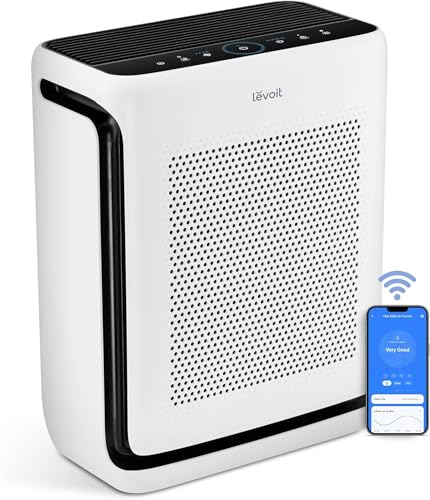
Levoit Vital 200S-P — the subject of this review
Badge: Best for large bedrooms that stay occupied around the clock
- Coverage stated on listing: up to 1,875 square feet
- Sleep mode described at 27 dB
- Air quality monitor with smart display
- AHAM Verifide wording on the listing title
- Filtration aimed at allergens, pet hair, and dander
The 200S earns its place at the top of a bedroom shortlist through balance rather than spectacle. Its sensor-driven automatic running means the machine works harder when cooking smoke drifts down a hallway or a dog shakes off a walk, then settles back when the room clears. That behaviour suits bedrooms especially well, because nobody wants to choose between clean air and sleep at midnight; the quiet sleep setting handles the night shift while higher speeds remain available for a deliberate afternoon clean.
Pet households will notice the intake design first. Hair and dander are named directly in the listing, and the pre-filter layer catches the coarse material that would otherwise clog the expensive HEPA stage within weeks. In a home with two shedding animals, that layering is the difference between a filter lasting its intended season and a filter that smells faintly of kennel by month three. Vacuuming the pre-filter monthly keeps the whole chain honest.
Smart control divides opinion, and fairly so. The app and monitor give a visible air quality readout, which helps households managing asthma-adjacent comfort concerns or simply trying to learn when their air worsens — after vacuuming, during pollen peaks, when the tumble dryer runs. Readers who dislike accounts, Wi-Fi pairing, or phone-based controls for a fan in a box should look at the Core 300-P further down, which keeps its dignity and its buttons.
Size is the honest drawback. A tower rated for very large rooms needs floor space with clearance around its intakes, and in a small bedroom it can crowd a bedside. Measure the corner you intend, leave room on every side the manual asks for, and picture opening the filter door before deciding the spot is permanent.
Strengths
- Sensor-led automatic running suits bedrooms that are used day and night
- Quiet sleep setting is specified rather than vaguely promised
- Layered filtration protects the costly HEPA stage from pet hair
Trade-offs
- Footprint is generous for a tower in a compact room
- Full value depends on using the app and sensor features
- Replacement filters are an ongoing cost to budget for
Best for: a main bedroom or living room with pets, pollen, or smoke concerns and an owner happy to use smart controls. / Not suited for: a tiny box room, or a buyer who wants a purifier with no app involvement at all.
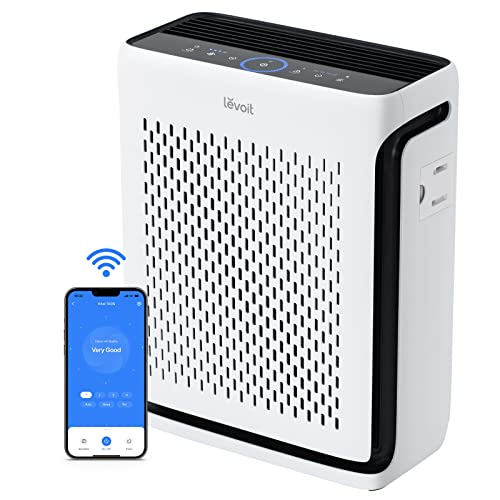
Levoit Vital 100S-P — the pet-focused step down
Badge: Best for medium bedrooms where animals actually sleep
- Coverage stated on listing: up to 1,073 square feet
- Washable pre-filter highlighted for pet households
- Smart monitor and HEPA sleep mode included
- AHAM Verifide wording on the listing title
Think of the 100S as the 200S idea trimmed for a smaller room and a tighter corner. The washable pre-filter is its signature: instead of treating the first layer as disposable, Levoit lets owners rinse or vacuum away the accumulated hair and dust, which suits homes where a cat treats the purifier top as a heated throne. Over a year of ownership that small design choice saves both money and the low-grade guilt of throwing away plastic-framed filters.
Performance expectations should be set by room size, not hope. In a medium bedroom with the door mostly closed, the 100S cycles the air at a pace that keeps dust settling visibly slower on shelves. Move it into a double-height living room and the same machine becomes a background accessory rather than a solution. Buyers between sizes should size up; an oversized purifier on a low setting is quieter than an undersized one straining.
The smart monitor carries over, which makes the 100S a good teacher for first-time purifier owners. Watching the readout spike when bedding is shaken out explains more about indoor air than any brochure, and it helps households time higher-speed runs for when nobody is trying to sleep.
Strengths
- Washable pre-filter lowers running costs in hairy households
- Same sensor-led convenience as its larger sibling
- Fits corners that would reject the 200S
Trade-offs
- Coverage ceiling arrives quickly in open-plan spaces
- Pet positioning means general buyers may overlook it
- Still a smart device, with pairing and app upkeep
Best for: a pet-owning household cleaning one medium bedroom properly. / Not suited for: open-plan living areas or anyone needing whole-flat coverage from a single unit.

Levoit Core 200S-P — compact smart tower for small rooms
Badge: Best for dorms, nurseries, and first flats
- Smart and voice control stated on the listing
- Three-in-one filter with HEPA sleep mode
- Positioned for bedrooms, dorms, and pet dander
- AHAM Verifide wording on the listing title
The Core 200S-P answers a different question: how much purification fits on a square of floor the size of a hardback book? For a student room, a nursery corner, or a first flat where the bedroom doubles as an office, that compactness is the whole argument. It carries smart and voice control, which sounds excessive until a parent holding a sleeping baby asks the room assistant to raise the fan speed without crossing the floorboards that creak.
Its three-in-one filter keeps maintenance simple — one cartridge to track, one interval to remember. The compromise is capacity. Small filters load faster, so in a dusty rental or a home with a large dog, replacement intervals shrink and the bargain fades. Treat it as a personal-space machine and it performs admirably; treat it as a whole-home answer and disappointment follows.
Noise behaviour matters disproportionately at this size because the machine sits close to its audience. The dedicated sleep mode keeps night running plausible, while daytime study sessions can tolerate the middle speeds that do most of the actual cleaning.
Strengths
- Small footprint suits rented and shared rooms
- Voice control is genuinely handy in nurseries
- Single cartridge keeps upkeep uncomplicated
Trade-offs
- Filter capacity is modest under heavy dust loads
- Not a living-room machine despite enthusiastic marketing
- Smart features may outnumber a simple user’s needs
Best for: small bedrooms, dorms, and nurseries needing quiet, connected cleaning. / Not suited for: large rooms, heavy smoke, or multi-pet living spaces.

Levoit Core 600S-P — the open-plan heavyweight
Badge: Best for large shared living spaces
- Coverage stated on listing: up to 2,933 square feet
- Remote control plus app and voice assistant support
- Three-in-one filter with HEPA sleep mode
- AHAM Verifide wording on the listing title
When a kitchen, dining area, and sofa all share one undivided space, bedroom purifiers stop being contenders. The Core 600S-P is the Levoit in this group built for that volume, with a stated reach approaching three thousand square feet and the fan muscle to move air across a room rather than polishing the corner it sits in. Cooking odours, fireplace drift, and the general fug of a family evening are its natural opponents.
Energy efficiency gets a mention in its listing, and the point deserves respect: a large purifier running twelve hours daily becomes a visible line on an electricity bill if it only knows full speed. Sensor-led running and a proper sleep mode let it idle through quiet hours instead of roaring at an empty room. Placement still decides results, though — tuck it behind a sofa and even this capacity is wasted on upholstery.
Households choosing between the 600S and the 200S should think about doors. The 200S is the finer bedroom instrument; the 600S belongs where people gather, cook, and generate most of a home’s airborne mess. Many larger homes end up with one of each rather than a compromise in the middle.
Strengths
- Coverage that genuinely addresses open-plan layouts
- Remote and app control suit a machine placed across a big room
- Sleep mode keeps a powerful unit usable after dark
Trade-offs
- Largest and least discreet cabinet in this group
- Overkill, in cost and filter size, for a single bedroom
- Needs clear floor space to justify its airflow
Best for: open-plan family rooms, kitchen-diners, and smoke-prone living spaces. / Not suited for: bedside use in a small room or minimalists counting every watt.

Levoit Core 300-P — the no-app classic
Badge: Best for guest rooms and technology sceptics
- Coverage stated on listing: up to 1,073 square feet
- Quiet HEPA sleep mode without smart pairing
- Positioned for pet hair, allergens, and odours
- AHAM Verifide wording on the listing title
The Core 300-P is the purifier for the relative who still misses dial telephones, and that is a compliment. It cleans a medium room, offers a quiet mode for the night, and asks for no account, no password, and no firmware conversation. In a guest room it can be switched on by a visitor without a tutorial, which is a feature no app has ever matched.
What it gives up is information. There is no sensor readout telling the household when air quality dips, so owners run it on schedule and instinct rather than evidence. For many homes that trade is perfectly acceptable — a medium speed through the evening and sleep mode overnight covers the hours that matter. Dust-prone households may prefer the feedback of the Vital line, particularly when learning a new home’s patterns.
As a second machine it is hard to argue against. Put a smart, sensored unit in the main bedroom where conditions change nightly, and let a 300-P hold the study or spare room without adding another app tile to anyone’s phone.
Strengths
- Controls a guest can understand instantly
- Proven medium-room coverage for bedrooms
- No network setup or account maintenance
Trade-offs
- No air quality display to guide speed choices
- Fewer automation options for changing conditions
- Design is functional rather than decorative
Best for: spare rooms, studies, and buyers who value buttons over dashboards. / Not suited for: households wanting sensor data or voice control in every room.
Side-by-side comparison of the five models
Numbers on purifier boxes describe ideal rooms with closed doors and standard ceilings, so treat every coverage figure as a ceiling rather than a promise. A room with an open staircase, a vaulted ceiling, or a door that never closes behaves like a larger space. The honest way to compare the Vital 200S against its siblings is by the job each was shaped for: the 200S balances sensing, quiet, and reach for a main bedroom; the 100S trims that formula for pets in a smaller room; the Core 200S shrinks it for personal space; the 600S scales it up for shared living volume; the 300-P removes the electronics and keeps the cleaning.
Filter architecture separates the group more than fan power does. Layered systems with a distinct pre-filter — the Vital approach — let owners intercept hair and lint cheaply, protecting the HEPA stage for the fine particles only it can catch. Combined three-in-one cartridges, as in the Core models, simplify ordering and swapping, yet the whole cartridge retires when any one layer is spent. Neither design is wrong; they suit different tolerances for maintenance. A household that will happily vacuum a pre-filter monthly should buy layered. A household that knows itself, and knows a cartridge swap is the most it will ever do, should buy combined and set a calendar reminder.
Controls follow a similar split. Sensor-driven automatic modes reward owners who leave machines running continuously, adjusting effort to conditions nobody has time to monitor. Manual controls reward predictability: the same speed, the same sound, every night. Sleep quality research in ordinary homes keeps returning to consistency, and a purifier that changes pitch at 3 a.m. because a sensor noticed dust can disturb the very rest it was bought to protect. Several owners of smart models end up fixing a night speed manually, which is a perfectly respectable way to use them.
Buying guide: choosing a bedroom purifier that earns its floor space
Start with the room, measured honestly. Multiply length by width, then think about ceiling height and how the room connects to the rest of the home. A bedroom opening onto a landing behaves like part of that landing. Buy for the connected volume, not the optimistic rectangle on an estate agent’s floor plan. If the result sits between two models, choose the larger and run it slower; slow and large is the quietest combination in domestic purification, and quiet is what bedrooms are for.
Next, name the pollutant that actually bothers the household, because filters specialise. Pollen and dust are particle problems, answered by HEPA filtration and enough air changes. Pet complaints split in two: hair and dander are particles, but pet smell is a gas problem needing a meaningful carbon stage. Cooking and wood smoke mix both. A buyer chasing odour with a particle-only mindset will keep raising the fan speed and wondering why the room still smells of last night’s frying. Read listings for the pollutant named in your own complaint, not for the longest list of airborne villains a marketing team could assemble.
Noise deserves a shopping trip of the imagination. Picture the machine at bedtime distance, not across a showroom. A stated sleep setting, like the 27 dB figure attached to the Vital 200S listing, signals a manufacturer designing for bedrooms rather than borrowing a living-room unit. Even so, placement softens or sharpens sound: a tower on hard flooring near a wall reflects more than the same tower on a rug in open floor. Budget a trial position or two before declaring any purifier too loud.
Then price the second year, not the first day. Add two filter changes, estimate electricity at your realistic speed, and include the small consumables nobody mentions — a spare pre-filter, perhaps a surge protector for a smart model. The cheapest machine in a category often carries the dearest filters, because manufacturers discount hardware and recover margin on the parts owners cannot skip. Levoit’s range is comparatively sane here, yet the spread between a small Core cartridge and a 600S filter is real money across five years.
Smart features should clear a usefulness bar. An air quality display earns its keep when a household is learning its triggers or managing a nursery. Scheduling earns its keep in homes empty during the day, where running hard before arrival home beats running gently all day. Voice control earns its keep exactly twice daily, at lights-out and at waking, and for some households that is enough. Features below the bar are not harmless; each one is another account, another permission, another thing to reconnect after a router change.
Finally, check the physical life of the machine. Filter doors should open without moving furniture. The unit should be liftable by the person who will clean it, when full of a loaded filter and household dust. Displays should dim or extinguish for sleep, because a bright air quality glow at pillow height defeats the purpose of a dark bedroom. These unglamorous details decide whether a purifier is still running in year three or sitting in a cupboard with its cord wrapped neatly around it.
Related reading for households still sizing up the category: quiet purifiers for light sleepers and whole-home purification explained cover neighbouring decisions in more depth.
Setting up the Vital 200S and running it well
Step 1: Unpack, inspect, and free the filter
New purifiers commonly ship with their filter sealed in plastic inside the cabinet, a detail that has generated more one-star confusion than any defect in history. Open the housing, remove every bag and transit film, refit the filter in the orientation the arrows demand, and only then plug in. Run the machine empty of packaging for ten minutes in a ventilated space; new filters can carry a faint manufacturing smell that fades quickly and means nothing sinister.
Step 2: Place for airflow, not for hiding
A purifier cleans the air that reaches it. Give the intakes the clearance the manual specifies, keep the outlet path unobstructed, and resist the decorative urge to box the unit behind curtains or a headboard. In bedrooms, a position between the door and the bed often works well, intercepting incoming dust before it settles on bedding. In pet homes, place the machine near — not inside — the animal’s sleeping zone, close enough to capture hair at source, far enough that a kicked water bowl cannot reach the electrics.
Step 3: Learn the sensor before trusting it
For the first week, watch what the air quality readout does during ordinary life. Note the spike when bedding is changed, the slower climb during a high-pollen afternoon with windows open, the effect of vacuuming — which briefly worsens airborne dust before improving the room. This apprenticeship teaches the household when automatic running helps and when a manual hour at higher speed before bed achieves more. Sensors measure particles near the machine, not virtue, so a calm display in a badly placed unit is a warning about placement, not a certificate for the whole room.
Step 4: Set a night routine and keep it boring
Consistency beats intensity in bedrooms. A workable pattern is a higher-speed clean during the evening routine — bathing, dressing, tidying — followed by sleep mode once lights go out. The room gets its deep clean while nobody is trying to rest, then quiet maintenance through the night. Households with shift workers can mirror the pattern around their own sleep window; the machine does not care which hours are dark, only that the routine repeats.
Step 5: Maintain the layers on different clocks
Pre-filters want monthly attention in pet homes, less often elsewhere: vacuum or wash as the model allows, dry fully, and refit. HEPA stages should never be washed unless the maker explicitly says so; a vacuumed HEPA surface is not a renewed filter, merely a tidier exhausted one. Wipe intakes and the sensor lens area with a dry cloth when dust films appear, because a blinded sensor quietly turns a smart purifier into a guess. Mark filter change dates on the cartridge itself with a pencil — memory is the least reliable component in any appliance.
Common mistakes buyers make with large bedroom purifiers
The classic error is buying by room name instead of room volume, then blaming the machine. A purifier labelled for bedrooms may mean a hotel-sized bedroom or a farmhouse master suite; only the coverage figure and the connected space matter. The second error is closing the loop too tightly: a purifier in a sealed room with a smoking hobby, a litter tray, or a gas appliance needs the source addressed first, because filtration treats symptoms at a rate sources can outpace.
Third comes the turbo habit — running maximum speed for an hour, switching off, and declaring the air handled. Particles resuspend with every movement, every door opening, every dog that stands up and shakes. Continuous gentle running maintains what a blast cannot. Fourth is filter procrastination, stretching a spent HEPA stage for extra months while the machine works harder, louder, and worse. A loaded filter is not a saving; it is a subscription paid in noise.
Fifth, owners forget the rest of the room. Purifiers capture what becomes airborne; they do not lift dust from mattress seams, curtains, or the top of a wardrobe. Washable bedding, a vacuum with decent filtration, and damp dusting multiply a purifier’s effect, while neglecting them leaves the machine fighting a reservoir it can never drain. Sixth, and most avoidable, is scented shortcuts: fragrance sprays and plug-ins add volatile compounds to air the household bought a machine to clean. If a room must smell of something, let it smell of nothing for a month first; most people discover they prefer it.
Final recommendation on the Vital 200S
For its intended room — a large bedroom or a calm living space, occupied by people who value quiet and by animals who shed — the Vital 200S-P is the most rounded machine in this comparison. Its sensor, sleep setting, and layered filtration cooperate rather than compete, and its coverage headroom lets it work gently instead of straining. Households with smaller rooms should save the difference and take the 100S or Core 200S; open-plan homes should look up to the 600S; and anyone allergic to apps should take the 300-P without a moment of shame. The 200S is not the cheapest route to clean air, nor the smallest. It is the one most likely to still be running, quietly and correctly, long after the novelty of a new appliance has worn off.
Before ordering, confirm the listing title matches the Vital 200S-P name recorded in our sources, and browse the wider Levoit range compared if a second room is also on the list. Readers comparing across brands may also find HEPA purifiers for bedrooms useful groundwork.
Living with the Vital 200S across a full year
Week one with any purifier is theatre: the display changes colour, the fan breathes up and down, and everyone in the house develops opinions. The honest test begins in month two, when the machine becomes background. Owners of the 200S tend to report a particular pattern — dust films form more slowly on dark furniture, the bedroom smells neutral on returning from a trip, and the morning congestion some people accept as normal quietly becomes less of a topic. None of that is measurable from an armchair, yet it is exactly the accumulation of small reliefs that keeps a purifier plugged in for years.
Spring tests the pollen side of the design. With windows opening again, particle counts indoors climb every afternoon, and a sensor-led machine visibly works a double shift. Households in tree-lined streets often move the unit nearer the bedroom door during peak weeks, intercepting what drifts in from hallways. Summer reverses the problem: closed windows against heat, air conditioning recirculating indoor dust, and cooking smells lingering in still air. The 200S at a steady medium setting earns its electricity then, because the home has no other fresh-air strategy.
Autumn brings the first filter reckoning. A pre-filter vacuumed monthly through summer usually shows a satisfying grey felt of captured material, proof of work that also warns against complacency — everything on that pre-filter would otherwise be inside the HEPA stage or the room. Winter adds wood smoke in many neighbourhoods, candles, guests, and closed doors. Odour handling becomes the limiting factor, and owners learn the difference between particle-clean air and truly fresh-feeling air. That distinction, learned in a real winter, is the best education a purifier buyer can get.
The Vital 200S in four household scenarios
Consider a couple in a two-bedroom flat with a shedding rescue dog and a bedroom door that stays open for the animal’s sake. Their effective room is really the flat’s sleeping half, and the 200S sized for that connected volume, placed by the bedroom door, handles the through-traffic of hair and hallway dust. The washable habits matter more than the headline coverage: bedding laundered weekly, pre-filter vacuumed monthly, machine never switched off. Within that routine the purifier is the quiet third partner in the arrangement.
Now picture a shift worker sleeping days in a street-facing room. Her priorities invert the usual order: darkness, quiet, and air that does not carry bus-stop dust through a window she must keep shut against noise. The sleep setting and display dimming matter as much as filtration, and the evening pre-clean becomes a morning pre-clean, run while she showers after her shift. The Vital’s automation suits her because it adapts to a timetable no timer programmer would enjoy setting.
A third household: grandparents furnishing a spare room that doubles as a grandchildren’s sleepover base. They need a machine a visitor can operate, air clean enough for a child with a dust sensitivity, and no dependence on a phone they may not have nearby. For them the 200S is arguably the wrong Levoit — the Core 300-P’s plain controls serve the room better — and recognising that is part of an honest review. The best purifier is the one its actual users will run correctly every day.
Finally, a renter in a studio where kitchen, sofa, and bed share forty square metres. One machine must do everything, odours included, and floor space is contested by every object in the home. The 200S fits this life surprisingly well: tall rather than wide, sensor-led through cooking episodes, quiet enough at night two metres from the pillow. Its owner should budget filters carefully and place it between kitchen and bed, the diplomatic frontier of studio living.
What the Vital 200S does not do
A purifier is not a dehumidifier, a heater, a carbon monoxide alarm, or a cure for anything. It will not fix damp walls, silence a snoring partner, remove gases at the rate a proper carbon bed can, or make a smoker’s room healthy. It also cannot clean air in rooms it is not in; particles do not commute through closed doors out of civic duty. Households expecting whole-home results from one bedroom unit will be disappointed in proportion to their optimism, which is why this review keeps returning to zones, doors, and volume.
Nor does it replace ventilation. On a mild day with clean outdoor air, an open window exchanges a room’s air faster than any domestic purifier, and brings the psychological freshness no filter can synthesise. The wise pattern is seasonal: windows when the outside is kind, the Vital when pollen, smoke, heat, or noise closes the house up. Owners who treat the machine as one tool among several — alongside bedding hygiene, vacuuming, and source control — consistently get more from it than owners waiting for a single appliance to redeem an entire indoor climate.
Filter economics and the second-year test
Ask a purifier owner in year two what they think of their machine and the answer is usually about filters: their price, their availability, the small panic when a reminder light appears during a smoke week and the spare cupboard is empty. The Vital line benefits from Levoit’s scale — its cartridges are widely stocked, and the layered design means the cheapest layer takes the most abuse. Still, discipline helps. Buy the replacement when the current filter is half spent, not when the machine demands it. Store the spare sealed and dry. Write the swap date on the cartridge frame.
Electricity is the quieter cost. A sensor-led unit idling through clean hours uses a fraction of its full-speed draw, which is another argument for automatic running in homes occupied irregularly. Owners who fix a high speed around the clock pay for air changes nobody needs at 4 a.m. in an empty, settled room. The meter, like the dust film on a shelf, keeps an honest account even when marketing does not.
Sound, light, and the small hours
Bedroom appliances are judged at 2 a.m., not in the showroom. Sound quality matters as much as sound level: a smooth broadband hush disappears into consciousness within minutes, while a faint whine, a bearing tick, or a fan that hunts up and down in pitch will colonise a light sleeper’s attention all night. The Vital 200S in sleep mode aims at that smooth end of the spectrum, and its sensor behaviour can be tamed by fixing a manual night speed once the household knows its preference. Owners bothered by any machine noise should also experiment with distance — moving a purifier two metres further from the pillow and raising it one speed often produces cleaner air at the same perceived quiet.
Light is the second night-time negotiation. Air quality displays are informative at dinner time and intrusive at midnight, particularly the colour-changing kind that can paint a ceiling amber because a partner opened the bedroom door. Check how completely the display dims or sleeps on any smart purifier before purchase, and position the unit so its glow falls away from the bed. In nurseries the same glow can become a night-light by accident; decide deliberately rather than discovering it during a difficult bedtime.
Vibration is the third, least discussed factor. A tower on a hollow floor or against a hollow partition can transmit a low hum that no decibel figure captures. A rug, a cork mat, or simply four centimetres of clearance from the wall usually ends the problem. These are five-minute fixes, but only for owners who know to look for them — one more reason setup deserves an unhurried evening rather than a rushed unboxing.
Vital line or Core line: which philosophy fits your home?
Levoit’s two families answer the same problem with different temperaments. The Vital models treat air as information: sense it, display it, react to it, and let a washable first layer take the coarse punishment. The Core models treat air as a chore: one cartridge, fewer decisions, a machine that asks little and explains less. Neither temperament is superior in the abstract. A data-curious household in a changeable city climate will use everything the Vital offers. A guest room, a holiday let, or a technophobe’s study will run a Core more faithfully.
Budget follows temperament. Vital running costs lean on the owner’s willingness to maintain the pre-filter; neglected, the advantage evaporates. Core running costs are a metronome — cartridge out, cartridge in — predictable enough to set as a standing order. Households furnishing several rooms often mix the lines without noticing any inconsistency: Vital where people sleep and conditions swing, Core where a door closes on a room that simply needs to stay decent.
The Vital 200S sits at the point where the sensing philosophy justifies itself most clearly, because a main bedroom is where conditions change most across twenty-four hours — showers, dressing, pets arriving, windows opening, heating cycling. That is the room where a blind machine wastes the most effort and a sensing one earns its premium. Which is, in the end, the whole argument of this review in a single sentence.
Questions to settle before you order
Where exactly will it stand, measured, with its filter door able to swing and its intakes breathing freely? Which pollutant is the household actually fighting — hair, pollen, smoke particles, odour, or the settled dust that shows on every sunlit surface? Who will maintain it, and is that person willing to tend a pre-filter monthly in exchange for longer main-filter life? Does the bedroom’s sleeper want a display that reports the air, or a cabinet that keeps its counsel in the dark? And is there a second room quietly expecting a machine of its own, in which case a Vital for the main bedroom and a Core for the spare may cost little more than over-sizing one unit and wheeling it between rooms like a borrowed vacuum?
Answer those five honestly and the choice between the 200S and its siblings mostly makes itself. The households that regret purifier purchases are rarely the ones that chose the second-best model; they are the ones that never decided what job the machine was hired to do. A bedroom purifier is a long-serving, low-drama appliance. Hired for the right room, briefed clearly, and maintained on a dull, regular rhythm, the Vital 200S is precisely that — and dull, in this category, is the highest praise available.
Why the AHAM wording on the listing matters
Four of the five listings in this comparison carry AHAM Verifide language in their titles, and the detail is worth more than its syllables suggest. AHAM’s verification programme tests purifiers against a standard method and publishes clean-air delivery figures that rival brands cannot simply invent for themselves. When a maker submits to that process, a buyer comparing two machines is at last comparing measurements taken the same way, in the same kind of chamber, rather than two advertising departments’ imaginations. It does not make a purifier good — placement, maintenance, and honest sizing still decide that — but it makes the starting numbers trustworthy enough to plan around, which in this category counts as a small luxury.
A short word on returns, warranties, and buying timing
Purifiers are unusually returnable purchases in one respect: their faults announce themselves quickly. A machine that is too loud for its bedroom, too bright for its sleeper, or too large for its corner will declare all of that within the first week, which is why the first nights should be treated as a deliberate trial rather than a honeymoon to be polite about. Keep the packaging until the household has slept beside the unit through a pollen day and a closed-window night. Check the warranty terms on the listing before ordering, note what they require about filter authenticity, and register the purchase if the maker asks — five minutes that owners only ever regret skipping.
Timing purchases around filter promotions can soften the second-year costs discussed earlier, and buying the first spare cartridge alongside the machine, when a bundle is offered, protects against the smoke-week shortage that turns a loyal owner into a frustrated one. None of this changes which model suits the room; it simply makes the right model cheaper to live with.
One last practical habit separates satisfied owners from the rest: a seasonal review, five minutes, four times a year. Check the filter’s remaining life against the season ahead, vacuum the intakes, confirm the sensor window is clean, and ask whether the room’s use has changed — a new pet, a converted nursery, a teenager who now lives behind a permanently closed door. Purifiers fail slowly and silently when a household changes around them; a short review catches the drift while it is still a placement problem rather than a replacement problem.
Frequently asked questions
How large a bedroom can the Vital 200S realistically handle?
The listing states coverage up to 1,875 square feet, a figure best treated as an ideal-conditions ceiling. In ordinary homes with furniture, doors opening, and standard ceilings, it is comfortably a large-bedroom and medium living-room machine. Very open layouts should consider the Core 600S instead, or accept the 200S as one zone within a two-machine plan.
Is the Vital 200S quiet enough for a light sleeper?
Its listing specifies a sleep mode at 27 dB, which places it among the quieter bedroom options in the Levoit line. Individual sensitivity varies, and floor surfaces change perceived sound, so position it on carpet or a mat where possible and use the evening pre-clean routine described earlier so the night speed can stay at its gentlest.
What does the air quality monitor actually change?
The monitor lets the purifier respond to conditions instead of running blind. Cooking drift, vacuuming dust, or a pollen-heavy breeze through a door raises particle levels the sensor can see, prompting faster cleaning until levels settle. Owners can also read the display themselves and learn which household habits worsen their air, which is often the most durable benefit.
How should pet owners maintain the Vital 200S differently?
Give the pre-filter monthly attention at minimum, since hair loading is the fastest route to a struggling machine in an animal household. Keep bedding washed on a regular cycle, place the unit near the pet’s sleeping area without blocking its intakes, and expect the main filter to work closer to its stated interval than in a pet-free home. Our guide to purifiers for homes with pets goes deeper on the animal side of the equation.
Can the Vital 200S deal with wildfire smoke drifting indoors?
Its HEPA stage addresses the fine particles that make smoke a health nuisance, and the sealed-room routine — windows shut, machine running continuously, doors to cleaner rooms kept closed — is the standard household response. Smoke also carries odours that only a substantial carbon stage fully tames, so during prolonged smoke events a larger unit or a second machine in the main living space may serve better. Anyone with respiratory conditions should follow local health guidance first and treat a purifier as support, not protection.
What should I check if the display shows poor air for hours?
Work through placement, filter condition, and sources before suspecting the sensor. A machine wedged behind furniture samples stale air; a loaded filter cannot keep pace; a litter tray, candle, or freshly painted door can feed particles faster than cleaning removes them. Clean the sensor area gently, confirm the filter is within its service life, and give the unit clear space — then judge again after an hour of uninterrupted running.
Related guides
bedroom-sized purifiers compared
the smaller Vital sibling reviewed