Disclosure: As an Amazon Associate, reviewstook.com earns from qualifying purchases. Links to Amazon on this page are affiliate links; they cost you nothing extra. Listing details such as price and availability change often, so check the current Amazon listing before you buy.
When people search for the best whole home air purifiers, they usually mean one of two things. Some want a single large machine that sits in a hallway and serves the main floor. Others want something built into the heating and cooling system, so the filtering happens wherever the central air runs. This guide is about the second idea, and it explains how central, furnace and HVAC options compare so you can ask better questions before you spend anything.
It is a practical guide, not a ranking. We walk through the main approaches, the steps for checking whether your system can take a filter cabinet, and the parts you will meet most often: media air cleaners from Aprilaire and Honeywell and the standard filters that fit common furnace slots. If you are searching for the best furnace air purifiers, the best HVAC whole house systems or a whole house HEPA air purifier, you will find out why those terms do not all describe the same thing.
Product details come from maker listings. Because ductwork, furnace models and fan capacity differ from home to home, a heating and cooling professional should confirm what fits your system.
Quick Comparison
| Product | Approach | Main point | Link |
|---|---|---|---|
| Aprilaire 2410 | Central air cleaner | Built into the duct system | Check on Amazon |
| Aprilaire 2210 | Media filter cabinet | Deep replaceable media filter | Check on Amazon |
| Aprilaire 213 | Replacement media | Filter for compatible Aprilaire cabinets | Check on Amazon |
| Honeywell FC100A1037 | Return-air media cleaner | Cabinet that holds a thick filter | Check on Amazon |
| Filtrete 20x25x1 MPR 1500 | Standard furnace filter | Drop-in slot filter | Check on Amazon |
In this guide
How These Options Were Chosen
We chose well-known parts and systems from maker listings and published specifications. We have not used or installed any of them ourselves. The aim was to cover the three layers a homeowner meets: a full central unit, a media filter cabinet, and the ordinary filter that goes in a furnace slot.
Because these are installed products, fit matters more than features. Cabinet size, duct size and blower capacity decide whether a product works in your home, and only the maker documents and a heating and cooling professional can settle that.
What Whole-House Filtration Actually Means
A whole-house system filters the air that passes through your central heating and cooling. Air is pulled from the rooms through return ducts, passes the filter, and is blown back out through supply ducts. Anything that sits in that path, from a simple furnace filter to a deep media cabinet, treats the whole system rather than a single room.
That is different from a portable room purifier, which cleans the air in the space where it sits. Many households use both: a duct-based filter for general background filtration and a portable unit in the rooms where they spend the most time.
The Main Options Explained
Aprilaire 2410 Whole-House Air Purifier
Aprilaire is a long-established name in duct-based air cleaning, and the 2410 is sold as a whole-house air purifier that installs in the duct system. Read how the maker describes its filtration approach on the listing, because it is positioned as a step beyond the plain media cabinets below. That makes it a more involved product, so the installation and any electrical connection matter.
It suits owners who want a permanent central unit and are willing to have it fitted by a qualified installer. Read the listing and the installation guide for the size of the opening, the duct dimensions it needs and the maintenance parts it uses.
Its drawbacks are the installation work and the ongoing care. You cannot treat it as a drop-in appliance. Skip it if you rent or if your system layout is unusual. Choose it if you own the house and want a fixed system installed by a professional.
Aprilaire 2210 Healthy Home Air Cleaner
The 2210 is a media air cleaner: a cabinet that fits into the duct and holds a deep, pleated replacement filter. Aprilaire sells it as a step up from a thin furnace filter because the media is thicker and has more surface area, which the maker links to longer intervals between changes.
It is the kind of product that a heating and cooling contractor typically installs into the return duct or beside the furnace. Check the listing for the cabinet dimensions and for the replacement filter name, since the filter and the cabinet are sold as a pair.
The trade-off is that a thick filter needs a duct arrangement that can take it, and the system fan must be able to move air through it. Skip it if your furnace is already running close to its limits. Choose it when you want better filtration than a standard slot filter and your installer confirms the fit.
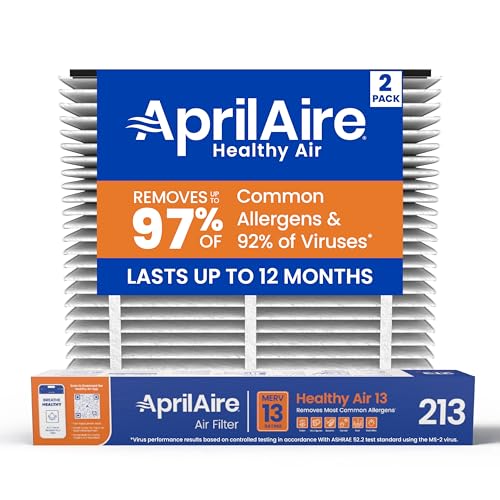
Aprilaire 213 MERV 13 Replacement Filter
The 213 is a replacement media filter for compatible Aprilaire cabinets, and it matters because it is the part you will buy again and again. It carries a MERV 13 designation according to the listing. MERV is an industry rating scale for filters, and a higher number generally means finer filtration and more resistance to airflow.
It belongs in this guide because the cost and availability of the replacement media is part of the true cost of a central system. Check the listing for the cabinet models it fits, and do not assume it matches another brand.
The limit is compatibility. It is not a universal filter, and buying the wrong size wastes time. Skip it if you do not own an Aprilaire cabinet that takes it. Choose it as the planned reorder for a compatible cabinet.
Honeywell FC100A1037 Media Air Cleaner
This Honeywell cabinet is a common return-air media cleaner, designed to hold a thick filter inside the duct path. The maker describes a replacement media filter that fits the cabinet, and the cabinet itself is sized for typical residential returns.
It is a sensible comparison point against the Aprilaire 2210, because both ask the same question of your system: can it handle a deeper filter? Check the listing for the cabinet width, the filter part and the installation notes.
The trade-offs are installation effort and the need to match the cabinet to your return. Skip it if your ductwork has no room for a cabinet. Choose it when an installer recommends a Honeywell-compatible solution or when you prefer its filter ecosystem.
Filtrete 20x25x1 Air Filter MPR 1500
Not every home needs a cabinet. If your furnace or air handler has a standard slot, a Filtrete pleated filter is the simplest way to improve on a basic fiberglass one. Filtrete uses its own MPR scale, so check the listing for the exact size and rating, and do not compare numbers across scales without looking at the maker’s conversion notes.
The advantage is simplicity: no installation, no contractor, and the filters are widely sold. You can change it yourself on a schedule that suits your home.
The limit is that a thin filter has less surface area than a deep media cabinet, and a denser filter can restrict airflow in some systems. Skip it if your system manual warns against high-resistance filters. Choose it as the easiest first step, after confirming the slot size.
Central Duct and Furnace Options
For central duct whole house air purifiers, the choice comes down to cabinet type. A slot filter sits in the furnace itself. A media cabinet sits in the return duct. An in-duct air purifier, such as the Aprilaire 2410, is a dedicated unit that the maker designs to be fitted into the duct path.
For furnace air purifiers, the main question is the blower. A furnace fan is designed for a certain level of resistance, and a denser filter increases that resistance. Look in your furnace manual for the maker’s guidance, or ask the installer.
Is a Whole House HEPA Air Purifier Realistic?
True HEPA media is dense, and standard residential ductwork and blowers are generally not designed to push air through it. For that reason, most central options use a lower-resistance media, and a HEPA-type filter more often appears in portable room units. If a product claims whole house HEPA performance, read the details carefully and ask an HVAC professional whether your system can support it.
Steps to Check Before You Buy
- Find your furnace or air handler model and read the filter notes in the manual.
- Measure the existing filter slot or the return duct opening.
- Note the blower type and ask a professional about the resistance it can handle.
- Look up the replacement filter name and how often the maker suggests changing it.
- Decide whether you also want a portable unit for rooms you use most.
Central Versus Portable: Choosing a Mix
Duct-based filtration works whenever the system fan runs, so it treats the whole house at a gentle, steady pace. What it cannot do is focus on one room. A central cabinet will not know that you spend most evenings in a back bedroom, and it does nothing when the fan is off. That is why many households pair a central filter with a portable unit in the room they use most.
If you go that way, you can treat the two jobs separately. Let the central filter handle general background filtration, and use the room unit for a bedroom or office, where you can pick a model for its sleep mode or footprint. The buying advice for those smaller units differs from the guidance for ducts, so read about them as a separate decision instead of trying to use one product for both.
Working With an HVAC Professional
A visit from a licensed contractor can save you from an expensive mistake. Bring the model numbers of your furnace or air handler, the size of your existing filter and a note of any comfort problems, such as rooms that never seem to get enough airflow. Ask the contractor to measure the static pressure in the system, which tells them how much resistance the blower can handle. Ask what filter depth the return can take, and whether a cabinet can go beside the furnace or on the return drop.
Ask also about service access. A filter you cannot reach is a filter you will not change. A good installation puts the cabinet where you can open it without moving furniture or climbing into a crawl space.
Installation, Safety and Legal Notes
Central systems involve ductwork and sometimes wiring. Have a licensed heating and cooling or electrical professional handle any installation that involves duct modification, wiring or a new power connection, and follow the maker’s instructions exactly. Do not cut into ducts or alter your furnace yourself.
Building rules and permit requirements differ by area, and some work needs a permit. Check your local requirements, and if you rent, ask your landlord before changing any part of the system.
Care and Troubleshooting
Change filters on the maker’s schedule, and keep a spare on hand. A clogged filter restricts airflow, which can affect how your system runs.
| Symptom | What to check |
|---|---|
| Weak airflow from vents | Filter overdue, wrong size or too restrictive |
| Filter slot does not close | Wrong thickness or misaligned frame |
| System runs longer than usual | Ask an HVAC professional to check the filter and blower |
What Particles and Gases Mean for Filter Choice
Indoor air carries more than one kind of pollutant, and different filters handle them differently. Particles include dust, pollen, pet dander, mold spores and the fine particulate matter from cooking or smoke. Gases and odors, such as volatile organic compounds from paint or cleaning products, are a separate category. Standard pleated filters and media cabinets are designed mainly for particles. They trap what they can on the filter fibers as air passes through, and the higher the rating, the finer the particles they can catch.
Gases need a different tool. Activated carbon or similar sorbent media can adsorb some odors and chemicals, but a thin carbon layer in an ordinary furnace filter does limited work because air moves through it quickly. Dedicated carbon filters are thicker and heavier, and they usually need more fan power than a typical residential system can provide. For that reason, if odors or chemical sensitivity are your main concern, a central filter is rarely the whole answer. Source control, such as venting a range hood outdoors and choosing low-emission products, matters more.
- Dust, pollen and dander: pleated or media filters are a good match.
- Smoke and fine particles: a higher-rated filter helps, if the system can handle it.
- Odors and gases: carbon-based media or ventilation, often with a standalone unit.
- Microbes: filtration can capture some, but cleaning and humidity control do much of the work.
Airflow, Static Pressure and Fan Limits
Every filter slows air a little. That resistance is measured as pressure drop, and a dense filter has more of it than a thin one. Your heating and cooling system is designed to move a certain volume of air through the ducts, and the blower can only push so hard. Add too much resistance and airflow falls, which can leave rooms uncomfortable, reduce efficiency and force the blower motor to work harder.
This is why a thicker media cabinet is often a better path than simply buying the densest one-inch filter. A deeper filter has more surface area, so it can capture fine particles with less resistance per square inch. The trade-off is installation: a cabinet takes space, needs ductwork adjustments and should be fitted so no air bypasses the filter around the edges.
Signs of too much resistance include weaker airflow from the vents, a furnace that shuts off on a limit switch, whistling at the return and an air conditioner coil that ices over. If you notice any of these after changing filters, go back to the previous type and ask a technician to check static pressure. Also consider that a variable-speed blower tolerates restriction better than a single-speed unit, though it still has limits.
Running Costs Over Several Years
The purchase price of a filter or cabinet is only part of the total. Replacement media has to be bought on schedule, and that cost recurs for as long as you own the home. A cabinet that uses a large media element changed once or twice a year may cost less over time than a thin filter replaced every month or two, even if the cabinet costs more up front.
Energy use is the quiet cost. A restrictive filter can raise electricity use by making the blower work harder, while a clean, well-sized one has less effect. Running the fan continuously to filter more air also uses power, though modern efficient motors keep that modest. Compare yearly cost by adding the filter price, the installation, any service call and a rough estimate of added fan use.
- List the filter cost per change and the number of changes per year.
- Add installation or modification costs, divided over a reasonable lifespan.
- Consider how reliably you will change filters; a cheap filter left in for a year costs more in lost performance.
- Ask a professional whether your blower is well suited to the filter you are considering.
Special Situations: Allergies, Pets and Wildfire Smoke
Different households need different things. For allergy sufferers, steady filtration and clean ducts help, but bedding, humidity and cleaning habits also matter. Houses with pets tend to build up dander and hair quickly, so more frequent filter changes are usually needed. In smoky regions, a central system with a higher-rated filter, set to run the fan more, can reduce indoor particles, especially when windows stay closed and the filter is fresh.
During a smoke event, set the thermostat fan to on or circulate if your system allows, close the outdoor air dampers if you have them, and check the filter more often than usual. Filters loaded with fine ash clog faster. A portable unit in the bedroom adds a second layer where you spend the most time, so a mix of central and room-level filtration is often practical.
Humidity deserves a mention in all of these cases. Mold spores thrive when indoor relative humidity stays above about 60 percent, and no filter can keep up with a damp house. Keeping humidity in a moderate range, fixing leaks and using bathroom and kitchen exhaust fans reduce the particle load before it reaches the filter at all.
Starting With the House You Have, Not the House in the Brochure
Whole-home air cleaning succeeds or fails on the particulars of one specific building: its ductwork, its fan, its filter slot, its leaks and its habits. Before pricing any system, walk your own house with fresh eyes. Find the filter slot and measure it. Note whether the fan can run independently of heating and cooling. Look at the doors: rooms that are always closed live partly outside the circulation a central system provides, however good that system is. Check the obvious dust sources, an unsealed attic hatch, a dryer venting imperfectly, a garage door that leaks fumes into a hallway, because fixing sources beats filtering their output every time.
That walk usually sorts homes into two honest groups. In the first, the ducted system reaches every room, the fan is capable, and a well-chosen in-duct upgrade plus disciplined filter changes will lift the whole house noticeably. In the second, the layout fights central treatment: additions built off the duct plan, rooms with doors shut all day, a system that runs only when the heating does. Those homes do better with a hybrid, a sensible central filter for the air that does circulate, and portable units in the two or three rooms where people actually sleep and work.
Questions a Good Installer Should Welcome
A competent HVAC professional expects to be asked about airflow and pressure, and a good one answers in plain language. Ask what a higher-efficiency filter will do to airflow in your specific system, whether the fan is strong enough for it, how often filters should be changed in a house like yours, and what the plan is if the first choice proves too restrictive. Ask, too, what the system will not do, because an installer who names the limits of their own proposal is usually the one whose proposal can be trusted.
Get the maintenance story in writing before anything is fitted: which filter, which size, how it is ordered, how often, and what it costs over a year of ordinary use. Whole-home systems fail quietly when their filters become awkward to source or easy to forget, and a house can run for a year on an exhausted central filter while its owners believe the air is being cared for. The best system is the one whose upkeep your household will actually perform, on schedule, without heroics.
Air Changes, Run Time and the Fan’s Real Job
Central filtration only cleans air that moves, so the fan’s schedule matters as much as the filter’s quality. A system that runs only during heating or cooling calls may move very little air in the mild weeks of spring and autumn, exactly when windows are shut against pollen and the house still needs its air tended. Running the fan on a circulation setting for part of each day, where the system allows it, is often the cheapest whole-home improvement available, because it puts the existing filter to work for more hours without buying anything.
Balance that against noise, draughts and running costs, which vary by house. Some fans are whisper-quiet presences; others announce themselves in every vent. Experiment across a week: circulate during the day when the house is active and let the system rest at night if the sound carries to the bedrooms. The aim is a rhythm the household can live with permanently, since a filtration plan abandoned after a month cleans nothing at all, however elegant it looked on paper.
Rooms the Ducts Forgot
Converted lofts, garden rooms, basement studies and additions frequently sit at the end of the duct run or off it entirely, receiving the system’s weakest air or none of it. Temperature usually betrays them first, but air quality follows the same geography. Do not let a whole-home label convince you those rooms are covered. Test them by living in them: if a converted room feels stuffy while the rest of the house feels fresh, it needs its own provision, most simply a well-sized portable unit, and that is not a failure of the central system but a fact about the building.
The same realism applies to rooms behind closed doors. A bedroom with its door shut all night breathes its own air for eight hours, and a central system contributes little through a closed door’s small gap. Households serious about bedroom air often end up with the hybrid answer whether they planned it or not: central filtration for the house’s shared air, and a quiet portable in the bedroom doing the night shift.
Wildfire Smoke, Pollen Seasons and Other Bad Weeks
A whole-home system proves itself during the bad weeks, when the outdoor air turns hostile and the house becomes a refuge. Preparation is what separates a system that helps from one that merely runs. Before smoke or pollen season, fit a fresh filter, check the seals around doors and the attic hatch, and agree the household routine: windows shut, the fan circulating, outdoor shoes and coats left at one door. During the event itself, resist opening the house for a stale-air panic; the filtered circulation you have is better than an exchange with the air you are sheltering from.
After the event, the filter has earned an inspection whatever the calendar says, because a week of heavy loading can consume months of ordinary life. Households in regions with regular smoke or pollen seasons should budget their filter changes around those seasons rather than around the maker’s calm-weather intervals, and should keep a spare on the shelf before the season starts, when everyone else in the region has the same idea at the same time.
Pets, Renovations and the Honest Limits of Filtration
A house with several large dogs, a house mid-renovation, a house where someone sands furniture as a hobby: these are particle factories, and filtration should be planned as one layer of a wider defence. Grooming and vacuuming routines, a mat and a shoe rule at the door, sealing off a work room while it is dusty, and protecting the central system’s intake during building work all matter as much as the filter itself. During renovations, ask your contractor how the system will be protected, because a central filter asked to swallow a week’s plaster dust may never recover, and the ductwork behind it is far harder to clean than a filter is to change.
Equally, know what filtration does not settle. Moisture problems need moisture solutions, mould needs its source found and fixed, and gases from new furnishings fade fastest with ventilation when outdoor air allows. A whole-home system is a powerful servant for particles, and households that keep its role clear, while handling sources, moisture and ventilation on their own terms, are the ones who report that their homes simply feel better to live in.
Keeping Records Like a Building Manager
Your house deserves the simple professionalism that any small building gets: a note of what is fitted, when it was changed and what it should be changed to. Keep it where the filters live. Record the filter size and type, the date of each change, any installer’s advice about airflow, and the fan schedule you settled on. When a new technician visits, or when you sell the house and hand over to the next owner, that single page of notes is worth more than a drawer of manuals.
Review the record once a year with the house’s seasons in mind. Did the filters come out filthy or merely dusty? Did the bad weeks overwhelm the routine? Did a room’s use change, a nursery become a study, a spare room become a workshop? Adjust the plan on that evidence. Whole-home air care is not a purchase to be completed but a small system to be run, and the households that run it deliberately are the ones whose systems quietly justify their cost year after year.
The Decision, Reduced to Its Essentials
If your ducts reach your rooms and your fan can circulate air on its own schedule, a central upgrade with disciplined filter changes is the most invisible air cleaning a house can have. If your home’s layout, doors or system fight that model, spend the same money on a modest central filter plus portable units where life actually happens. Either way, decide from your own floor plan and your own habits rather than from the phrase whole-home itself, because the houses that benefit most are the ones whose owners understood them best before they bought anything.
What Success Looks Like After Six Months
A well-run whole-home system does not announce itself with drama. It shows up as dust that accumulates more slowly on shelves, as bedrooms that feel fresher on waking during the closed-window months, as a bad pollen week that the household weathers in reasonable comfort, and as filters that come out at each change visibly loaded, which is the system’s way of showing its work. Judge your installation by those signs across a couple of seasons rather than by the first fortnight, when any change feels significant.
If the signs are absent, troubleshoot in the order of likelihood: a filter overdue or incorrectly fitted, a fan schedule that barely runs, doors and rooms defeating circulation, or a source problem, damp, dust or fumes, that filtration was never going to solve alone. Each of those has a remedy, and working through them methodically will either restore the system’s value or show you honestly which rooms need their own portable help. Either outcome is progress, because both replace a vague disappointment with a specific plan.
A Final Note for Buyers Comparing Grand Promises
The whole-home category attracts grand language, and the cure for grand language is measurement and maintenance. Measure your filter slot, your rooms and your household’s tolerance for upkeep. Maintain whatever you install as if it mattered, because it does. A modest system, perfectly maintained, will outperform an ambitious one neglected, in this field more reliably than in almost any other purchase a householder makes.
New Builds, Old Houses and the Retrofitting Reality
In a new build, whole-home filtration can be designed rather than improvised: a filter cabinet sized generously, a fan chosen with headroom for denser media, returns placed where rooms actually need them. If you are building or renovating deeply, raise air cleaning at the design stage, when it costs least and achieves most, and ask for the filter arrangement to be accessible without ladders or contortions, because accessibility is what maintenance looks like in practice.
Older houses ask for humility. Their ducts may be narrow, leaky or absent in the rooms that need help most, and their fans were chosen for heating rather than for filtration. In such houses, sealing the worst duct leaks and fitting the best filter the existing fan can honestly handle usually beats an ambitious system that strains the equipment. Pair that with portable units in the main bedroom and the room where the household spends its evenings, and an old house can achieve most of what a new one does, by a route that respects its construction.
Renters and the Whole-Home Question
Tenants cannot rebuild a landlord’s ductwork, and should not try, but they are not powerless. The renter’s version of whole-home thinking is to treat the flat as a system with the tools allowed: keep the existing filter clean and replace it if the agreement permits, run the fan’s circulation setting if there is one, seal the obvious draughts with removable measures, and place portable units by the same logic a homeowner would use, at the sources and in the sleeping rooms. A portable in the bedroom and one in the living space covers most of a small flat’s life, and both move out with you when you do.
What renters should avoid is spending serious money improving a system they will leave behind, or fitting anything that alters the property’s equipment without permission. Spend on the machines that travel with you, maintain the landlord’s filter as a good tenant would, and the air in a rented home can be nearly as well kept as in an owned one.
The Conversation to Have Before Anyone Signs Anything
Whether the work is a filter cabinet, a new fan or a fuller in-duct system, have one conversation in full before agreeing: what exactly will be fitted, what it will and will not do for each room, what the household must do monthly and yearly to keep it honest, and what happens if airflow suffers afterwards. Write the answers down. Houses are long commitments and memories are short, and the note from that conversation will settle questions years later that would otherwise become folklore. A provider who welcomes the conversation is telling you something good about the work that will follow.
How to Tell Whether It Is Working: A Householder’s Evidence
Without instruments, a household still gathers good evidence about its air. Dust behaviour is the first witness: surfaces that once filmed over in days and now take a week are telling you the circulation and filtration are doing real work. The second witness is the filter itself, which should come out at each change looking as if it has been somewhere and done something; a filter that emerges pristine after months suggests air has been bypassing it or barely moving at all, and that is a finding worth chasing. The third witness is the household’s own comfort during the difficult weeks, the smoky spell, the pollen peak, the winter month with every window shut, when a well-run system turns a house into a noticeably kinder place to breathe.
Keep the evidence in the same note as the filter record, a line or two at each change. Over a year those lines become the house’s own data, far more relevant than any general claim, and they make the next decision, a denser filter, a fan adjustment, a portable for the stubborn room, an evidence-based one. Whole-home air care rewards exactly this temperament: unhurried, observant, and willing to let the building itself report on how the plan is going.
The System Behind the System
Finally, remember that filtration sits inside a larger household system of ventilation, cleaning and source control, and it performs best when the others are pulling their weight. Vacuum with the windows strategy that suits the season, keep the kitchen’s cooking fumes vented where they are made, deal with damp at its source, and let the filters handle what remains, which is the fine, ordinary dust of living. A house run that way does not need its air system to perform miracles, and so, reliably, it never has to.
Children, Schools and the Air of a Family House
A family house has an air signature all its own: school bags dropped at the door with the day still on them, sports kit airing where it should not, a dog shaking off the garden, cooking for people with large appetites and variable schedules. Whole-home filtration serves that house best when it is planned around its busiest hours rather than its average ones, with circulation running through the after-school and evening peak and the system’s filter changed on a rhythm set by the family’s real life rather than by a generic calendar. Bedrooms behind closed doors, as ever, may still want their own quiet help overnight, and there is no contradiction in that: the central system carries the shared air of the house, and the small units guard the rooms where the family’s most vulnerable sleepers, the baby, the asthmatic teenager, the grandparent in the back room, spend their longest unbroken hours.
When the Answer Is Simply a Better Filter Habit
It is worth ending where many whole-home stories actually end: not with new machinery, but with the discovery that the existing system, given the right filter, changed on time, with its fan allowed to circulate, was capable all along. Before signing for anything elaborate, give your current setup one honest season of that discipline and keep the simple record described above. If the house feels better and the filters come out loaded, you have bought whole-home air care for the price of a habit. If it does not, you have the evidence, specific and written down, to take to a professional, and every option in this guide will be easier to judge for it.
The Handover: Selling or Letting a House With a System
When a house with a considered filtration setup changes hands, the setup’s value travels only if its knowledge travels with it. Leave the filter record, the installer’s details and one line about the fan routine for the next household, and a system you built with care will keep serving the building instead of being ripped out or neglected by owners who never learned what it was. It is a small courtesy to a house you have lived in, and occasionally a selling point to the buyer who understands exactly what they are inheriting.
Frequently Asked Questions
What is the difference between a whole-house and a room purifier?
A whole-house system works through your ducts, while a room purifier handles the space it sits in. Many homes use a mix.
Can I install a media cabinet myself?
That depends on your skills and local rules. Duct changes and wiring are best left to a licensed professional.
Will a denser filter harm my furnace?
It can if the system is not designed for the extra resistance. Check the manual and ask a professional.
How often should I replace a central filter?
Follow the maker’s interval for your product and your home. The reorder part name is on the listing.
Is a MERV rating the same as MPR?
No. They are different scales from different groups, so check each maker’s notes.
Do I still need a portable unit?
Some people add one for a bedroom or office. It is a choice, not a requirement.
Should I run my HVAC fan all the time to clean the air?
Running the fan continuously moves more air through the filter, which can improve particle removal, but it also uses more electricity and may add humidity in some climates. A variable-speed blower is more efficient at this. Ask your technician whether it suits your system.
Do air purifier filters help with cooking smoke and odors?
A good central filter can catch fine particles from cooking, but odors and gases need carbon media or ventilation. The most effective step is capturing fumes at the source with a range hood that vents outdoors.
How do I know if my furnace filter is too restrictive?
Warning signs include weak airflow from vents, a furnace that cycles off early, whistling at the return and ice on the air conditioner coil. If you see them after changing to a denser filter, switch back and ask a professional to check static pressure.
Do duct cleaning and filtration work together?
They can. Filters protect the system by catching particles before they settle, while duct cleaning removes buildup that has already collected. Cleaning without good filtration lets dust return, and good filtration helps keep ducts clean longer.
Bottom Line
If you want a fixed central system, start by asking an installer about the Aprilaire 2410, the Aprilaire 2210 or the Honeywell FC100A1037 cabinet, and plan the reorder part such as the Aprilaire 213. If you want a simple first step, a Filtrete slot filter is the easiest change. Always confirm size, fit and system capacity with a professional.