Disclosure: As an Amazon Associate, dailyhomedecorating.com earns from qualifying purchases. Links on this page are affiliate links; they cost you nothing extra. Prices and availability change often, so check the current Amazon listing before you buy.
Ask how does an activated carbon filter work and the short answer is that it does not filter at all, in the way a sieve or a HEPA mat filters. It persuades. Air passing through a bed of activated carbon flows over an almost absurd amount of internal surface — a single gram of the material can hold thousands of square feet of it, folded into pores — and gas molecules that touch that surface tend to stay there, held by weak intermolecular forces in a process called adsorption. Dust and pollen sail through a carbon filter almost untouched, which is why carbon always works alongside a particle filter. But the things that make a house smell — cooking vapours, tobacco smoke’s gas phase, the volatile organic compounds exhaled by paints, adhesives, cleaning products and new furniture — are exactly the things carbon catches, and no fibre mat can do that job at all.
This explainer takes the mechanism apart properly: what activation does to a piece of charcoal, why surface area is the whole story, which pollutants carbon handles and which it ignores, why every carbon filter eventually stops working and how to tell, and how to buy and maintain the carbon stage of a home air purifier intelligently. Two products are linked as concrete examples — a genuine replacement carbon filter for a popular purifier, and the purifier itself — both verified through this site’s own Amazon Creators API check before being named here.
The direct answer, in one paragraph
Activated carbon is charcoal that has been treated with steam or chemicals at high temperature to riddling it with microscopic pores. When air flows through it, gas-phase pollutants — odours and VOCs — are adsorbed: their molecules stick to the carbon’s enormous internal surface and are held there instead of continuing into the room. The process is physical, not chemical, in its basic form; the carbon does not destroy the pollutants, it stores them. Storage fills up. A saturated carbon filter is therefore not a dirty filter but a full one, and the remedy is replacement, not washing — a distinction the rest of this article unpacks, because misunderstanding it is the most common and most expensive error households make with these filters.
In this guide
From charcoal to activated carbon: what the activation does
Start with the feedstock, which is usually coconut shell, wood or coal, chosen for the pore structure it can be given. Carbonisation comes first: the material is heated in the absence of air until everything that can leave as gas has left, and what remains is a brittle skeleton of nearly pure carbon. Activation is the second firing, and it is the step that earns the name. The char is exposed to steam or carbon dioxide at temperatures approaching a thousand degrees, and the gases etch the skeleton — burning away carbon atoms in a controlled pattern that opens millions of pores in three size families. Micropores, the smallest, do most of the adsorbing of small gas molecules. Mesopores act as the transport network that lets molecules reach the interior. Macropores are the doorways from the surface. The result is a material that looks like the charcoal in a barbecue bag and behaves like a sponge built at the molecular scale, with internal surface area commonly measured in the hundreds to over a thousand square metres per gram.
That surface is the product. Everything else about a carbon filter — its weight, its bed depth, its granule size — is engineering in service of one goal: give as many gas molecules as possible a chance to meet that surface before the air leaves the filter. It also explains the category’s central trade-off. Loose granular carbon offers deep beds and long contact; carbon bonded into a thin sheet or impregnated into a foam pre-filter offers convenience at a fraction of the capacity. Both are honestly called activated carbon filters, and their working lives differ by an order of magnitude.
Adsorption: the physics of the sticking
The forces involved are van der Waals forces — the same weak attractions that let a gecko’s foot grip glass — acting between the pollutant molecule and the carbon surface. Individually feeble, they become decisive across billions of contact points inside a pore whose walls are never more than a few molecules away. Heavier, larger, less polar molecules are generally held most strongly, which is why carbon excels at the organic vapours of household life: the aldehydes from cooking and pressed wood, the aromatic compounds in paints and fuels, the complex mixture that makes tobacco smoke and fried food announce themselves through a house. Small, light, highly polar gases are held weakly or not at all — a list with practical consequences, taken up below.
Two properties of adsorption govern daily experience. The first is that it is competitive and reversible at the margins: a strongly attracted molecule can displace a weakly held one, and changes in temperature and humidity shift the equilibrium, which is why a nearly spent carbon filter can seem to release odours on a hot, humid day — it is, a little. The second is that water vapour competes for the surface. Very humid air loads a carbon bed with water that occupies sites odour molecules needed, shortening the filter’s useful life in steamy or basement conditions. Neither property makes carbon unreliable; both explain why its performance is a slope rather than a cliff, and why the calendar, the climate and the cooking habits of a household all belong in any honest estimate of filter life.
What activated carbon removes — and what it does not
Carbon’s strengths are the gas-phase pollutants of ordinary homes. Cooking odours, pet smells carried in volatile compounds, tobacco and wood smoke’s gaseous fraction, paint and varnish fumes, the new-carpet and new-furniture off-gassing cocktail, many cleaning-product vapours, and a wide range of industrial VOCs at household concentrations — these are its parish, and within it a sufficient bed of fresh carbon is not a marginal improvement but the difference between a smell that lingers for days and one cleared in hours. Purifiers that take odour seriously advertise carbon by weight for exactly this reason.
The limits deserve equal plainness. Carbon does not meaningfully capture particles — dust, pollen, dander, mould spores and smoke’s solid fraction pass through to be caught by the HEPA stage, which is why the two technologies are married in nearly every serious purifier. It is poor on carbon monoxide, which no household carbon filter should ever be trusted to handle; a CO alarm is the only answer to CO. It is weak on formaldehyde in its plain form — a gas so small and reactive that ordinary carbon holds it badly, which is why filters aimed at formaldehyde use impregnated carbon, treated with catalysts or chemisorptive media that convert the gas rather than merely parking it. And it does nothing at all for humidity, carbon dioxide, or the biological activity of anything; it stores molecules, it does not sterilise, dry or ventilate. A household that buys carbon for the jobs on the second list will conclude that carbon does not work. A household that buys it for the first list will wonder how it lived without it.
Why carbon filters die: saturation and breakthrough
Every adsorption site that fills stays filled under normal conditions, so a carbon filter’s life is a countdown of capacity against load. The load side of the equation is the household’s own: a home that fries fish twice a week, keeps three dogs, burns candles nightly and sits beside a busy road spends its carbon faster than a quiet flat with a steamer and a cat. The capacity side is the filter’s: grams of carbon, bed depth, and the quality of the activation. When the two meet, the symptom is breakthrough — odours begin to pass through a filter that still looks clean, because visually it is clean; saturation is invisible. The smell of the filter itself is the field test: a carbon stage that has begun to smell of the things it was catching, especially on a warm day, is announcing that its storage is spoken for.
This is also where the category’s most persistent myth must be dealt with: you cannot wash, vacuum or sun-bake a household carbon filter back to life. Reactivating carbon requires the same furnace conditions that activated it — temperatures no oven or afternoon of sunlight approaches. Washing a carbon-impregnated foam pre-filter rinses dust from its surface and is worth doing for airflow; it restores none of the adsorption capacity, and a household that believes otherwise will run a full filter for years while wondering why the purifier stopped helping the kitchen smells. Replacement is not a manufacturer’s conspiracy in this case. It is the physics of a storage technology that fills.
The forms carbon takes in home equipment
In a desktop purifier, carbon usually appears as a thin layer bonded into the combined filter cartridge — convenient, light, and the first part of the cartridge to exhaust, which is why small purifiers often lose their odour performance months before their HEPA stage is spent. In larger consoles it appears as a separate pre-filter sheet or a dedicated canister with a bed measured in pounds; the Honeywell-style cut-to-fit carbon pre-filter is the humble version of the same idea, and its cheapness is its virtue, because a carbon stage you can afford to change often beats a noble one you stretch. Standalone carbon canisters and inline duct filters serve workshops, grow rooms and smoking rooms where the load justifies the plumbing. Impregnated carbons — potassium permanganate blends, catalysed media — extend the chemistry to formaldehyde and specific industrial gases, at prices that announce their specialisation. The buying rule that emerges from the whole taxonomy is simple: for odour work, buy carbon by the pound and by the bed depth, and treat any product that will not tell you how much carbon it contains as a product telling you, in its way.
Two verified examples, and what each teaches
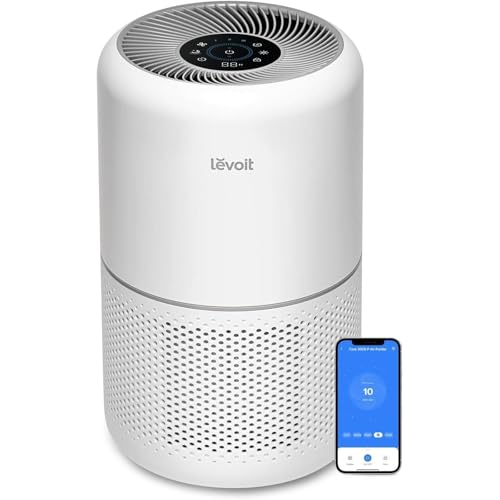
Levoit Core 300S-P — the combined-cartridge mainstream
Best example of carbon inside a modern cartridge purifier
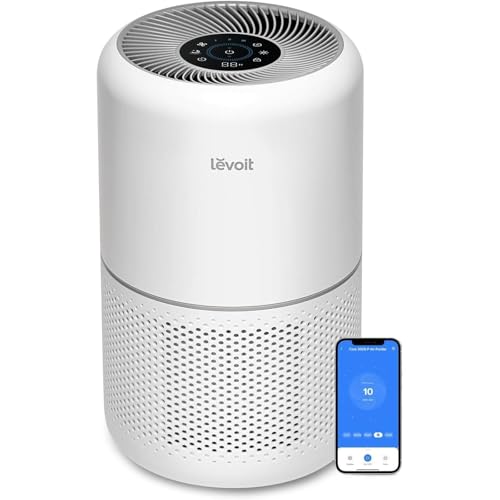
The Core 300S is the kind of machine most households now meet carbon through: a compact smart purifier whose single cartridge combines a pre-filter, a HEPA stage and an activated carbon layer in one cylinder. It is verified here through the API — the listing confirms the model, the smart controls, the sleep mode and the AHAM verification — and it represents the mainstream bargain honestly: real carbon, doing real work on everyday odours, in a quantity sized for a bedroom rather than a smoking room. Owners who cook boldly in an open-plan flat will spend its carbon layer faster than bedroom users will; that is the taxonomy above, lived.
- Filtration: combined cartridge with HEPA and activated carbon stages
- Controls: smart Wi-Fi, app and voice control, auto and sleep modes
- Room brief: bedrooms and home-large-room positioning per its listing
- Carbon lesson: cartridge carbon is sized for everyday odour loads
Strengths
- One cartridge to change keeps the maintenance honest — when it goes, all stages renew together.
- Auto mode spends the filter’s life where the air needs it, resting the carbon when the room is clean.
- The smart platform suits the set-and-forget households that cartridge purifiers are designed for.
Trade-offs
- The carbon layer is the cartridge’s smallest store; heavy odour loads will exhaust it before the HEPA stage is spent.
- Cartridge pricing is the running cost of the convenience — price the replacement before the machine.
- Not the tool for a dedicated smoking room or a workshop; those loads want pounds of carbon, not grams.
Best for: bedrooms and living spaces with ordinary odour loads — pets, cooking drift, city air. Not suited for: heavy smoke, strong chemical fumes, or any job where carbon is the main event rather than a stage.

Levoit Core 300-RF Genuine Replacement Filter — the carbon layer, replaceable
Best example of the cartridge’s carbon stage as a consumable
This genuine replacement cartridge for the Core 300 family is listed here because it makes the article’s central point tangible: its own listing names the activated carbon stage and the smoke-odour work it does, and the cartridge exists as a product precisely because that stage fills. Buying the genuine article guarantees the carbon quantity and the seal the machine was designed around; the compatible-filter market varies on both, and on carbon more than on any other stage, because carbon weight is the easiest specification to quietly shrink.
- Type: genuine replacement cartridge, Core 300-RF
- Stages: pre-filter, HEPA and activated carbon combined
- Fit: Levoit Core 300 family
- Carbon lesson: the replacement cycle is the carbon cycle
Strengths
- Genuine specification: the carbon bed and media area the machine was rated with.
- One part renews every stage, so no stage is stretched past its life to match another’s.
- Availability through the brand’s own channel keeps the consumable chain simple.
Trade-offs
- The whole cartridge is replaced when the carbon alone may be spent — the price of the combined design.
- Third-party versions undercut it, with carbon content that varies in ways a buyer cannot inspect.
- Its life in your home depends on your loads, not the interval printed anywhere.
Best for: Core 300 owners who want the machine’s odour performance restored to as-new. Not suited for: owners hoping to extend a spent cartridge by washing — see the saturation section above for why that cannot work.
How to choose carbon filtration: a buying guide
Begin with the load, stated as a list of smells and sources rather than a room size, because carbon is bought against chemistry, not square footage. A household whose list is “the dog, last night’s dinner, the city” needs the carbon stage of any competent cartridge purifier and should choose the machine on its other merits. A household whose list includes a smoker, a wood stove, a nail desk, a workshop or a new renovation needs carbon in quantity — a machine that names its carbon weight, a separate canister stage, or a pre-filter system cheap enough to change monthly without resentment. Then read listings for the two numbers that matter and are most often withheld: the mass of carbon, and whether the carbon is a stage you can replace independently of the HEPA. A replaceable-independent carbon stage is the connoisseur’s configuration, because the two stages live on different clocks and marrying them wastes whichever dies second.
Finally, budget the replacement rhythm before the machine. Carbon’s cost is not the cartridge’s price but the cartridge’s price divided by the months your household’s load gives it, and a household that fries, burns and sheds should divide honestly. The cheapest carbon strategy in home air cleaning remains the humble cut-to-fit pre-filter sheet in front of a HEPA machine — little carbon, changed often, always fresh — and the most expensive is a premium combined cartridge stretched a year past its odour life because the HEPA still looks white. Spend where your nose tells you the problem is.
Using and maintaining carbon stages: the practical how-to
Install the carbon stage in the order the machine intends — carbon usually sits before the HEPA in the airflow when it is a pre-filter, protecting the expensive stage and meeting the gases first, and after it in some cartridge designs; the manual’s diagram outranks any general rule. Keep the stage dry in storage: a spare carbon filter in a damp garage is spending itself on the garage’s air, so spares live sealed, indoors, with the household’s other consumables. Track life by the nose and the calendar together — note the installation date on the frame with a marker, and when cooking smells begin surviving the purifier’s evening shift, believe them. Vacuum or rinse only the stages the maker designates as washable, which is the particle pre-filter and never the carbon bed itself. And when you replace a spent carbon stage, replace it completely rather than topping up or mixing old and new media; a half-spent bed in series with a fresh one simply spends the fresh one’s capacity on the old one’s breakthrough.
Common mistakes households make with carbon filters
Washing them, first and most expensively, in the belief that clean-looking means restored. Second is judging a cartridge by its HEPA stage — white media, therefore “still good” — while the carbon died months earlier and the kitchen smells have quietly returned to stay. Third is buying a gram-weight carbon stage for a pound-weight problem: a smoking room or a solvent-using workshop overwhelms cartridge carbon in weeks and convinces the household that carbon itself is a fraud. Fourth is storing spares unsealed in the room the purifier serves, where they adsorb the household’s air on the shelf and arrive at installation half-spent. Fifth is expecting carbon to do the particle filter’s job, or the ventilator’s: a carbon stage in a sealed, unventilated room polishes a fixed volume of air while CO2 and humidity climb untouched, and the room feels worse even as it smells better.
Final word
Activated carbon is the rare household technology whose marketing undersells its physics: a gram of the stuff really does unfold into a field of surface, and molecules really do stick to it, in numbers large enough to change what a house smells like. Respect its two rules — it stores rather than destroys, and storage fills — and it is the most satisfying stage in any purifier. Ignore them, and it becomes the stage households blame while washing a full filter under a tap, wondering where the magic went.
A short history: from gas masks to the living room
Activated carbon’s modern career began in catastrophe: the gas attacks of the First World War drove the development of respirator canisters whose carbon — much of it from coconut shells, whose pore structure proved ideal — had to adsorb poison gases at breathing speed. Between the wars the same material colonised water treatment and industrial solvent recovery, and after the Second World War it entered the home quietly, in refrigerator deodorisers, cigarette filters, aquarium boxes and range hoods, long before the standalone air purifier existed as a product category. The through-line of that history is instructive: wherever carbon has been asked to work, it has been asked to work on gases at low concentrations in moving air or water, and it has been replaced on a schedule set by its capacity. The living-room purifier is simply the latest room in a century-old building, and its filters obey the same rules the respirator canisters did — which is why the saturation discipline in this article is not a modern manufacturer’s invention but the technology’s oldest fact.
Coconut shell, wood or coal: does the feedstock matter?
It matters in the pore distribution it produces, and therefore in the gases a carbon prefers. Coconut-shell carbon is rich in micropores and is the connoisseur’s choice for small-molecule gas work and for the low dust and hardness that suit respirators and premium purifiers. Wood-based carbons carry more of the larger transport pores and are often chemically activated for liquid-phase work — the aquarium and water-filter world leans on them. Coal-based carbons sit between, economical and widely used in industrial and HVAC beds. For a household buyer, the feedstock is a second-order detail behind the first-order ones — how much carbon, in what bed depth, changed how often — but it explains why two filters of equal weight can perform differently on a specific gas, and why reputable makers state their carbon’s origin as a point of pride. What should raise a buyer’s eyebrow is not any particular shell or seam; it is a listing that declines to discuss its carbon at all.
The same material, everywhere else in the house
Once the mechanism is understood, the household starts to look full of carbon at work. The fridge deodoriser is a small bed fighting a small, sealed volume — and winning for months because the load is tiny and the air barely moves. The aquarium filter’s carbon polishes water by the identical adsorption, and aquarists replace it on the identical logic, often more religiously than purifier owners because the evidence — yellowing water — is visible. The range hood’s grease-and-carbon cassette is the kitchen’s confession that cooking gas needs catching at the source. Litter-box carbons, bin deodorisers, the charcoal bags sold for cars and closets — all are the same material at different scales of load and airflow, and all obey the saturation rule: the shoe bag that “stops working” after a summer has not failed; it has finished. Households that internalise this stop expecting permanence from any of them and start keeping a replacement rhythm, which is the whole art of owning carbon in any form.
VOCs, taken family by family
“VOC” on a purifier box covers a crowd of chemistries, and carbon’s grip varies across it enough to matter for specific households. The aromatic hydrocarbons — benzene, toluene, xylene, the solvents of paints, fuels and garages — are held strongly and are among carbon’s best work. The aldehydes split: the heavier ones adsorb respectably, while formaldehyde, the smallest, slips through plain carbon and needs the impregnated media discussed earlier — a distinction of real consequence for a household whose concern is a new renovation or pressed-wood furniture. The terpenes of wood, citrus cleaners and scented products are held well, which is why carbon is the answer to the pine-cleaner atmosphere of a freshly mopped house. Cooking’s acrolein and the nitrogen compounds of high-heat frying are caught in proportion to bed depth and freshness. And the sulphur compounds — the drain smell, the boiled-egg note of certain waters and foods — are held variably, with specialised impregnated carbons outperforming plain ones. The practical translation: a household should name its actual gases before choosing its carbon, because “VOC” is a census category, not a chemical.
How carbon performance is tested, and why ratings are scarce
Particle filtration enjoys a tidy public standard — CADR figures let a buyer compare machines across brands. Gas filtration has no equivalent consumer rating in most markets, and the absence explains much of the category’s vagueness: without a number to compete on, makers compete on adjectives. Laboratory methods exist — challenge gases at set concentrations, measured breakthrough curves — and serious manufacturers test to them internally, but the results rarely reach the box. The buyer’s compensating strategy is the one this article has built: shop by carbon mass, bed depth, independent stage replacement and the maker’s willingness to publish any of it. A brand that tells you its carbon weighs pounds and can be changed separately from its HEPA has told you more, in two facts, than a page of odour-eliminating adjectives from a brand that will not.
Carbon and smoke: the hardest household load, examined
Smoke deserves its own section because it is the load households most often buy carbon for and the one where expectations most need setting. Tobacco and wood smoke are two pollutants wearing one name: a particle fraction — the visible haze, the tar-laden solids that yellow walls — which belongs to the HEPA stage, and a gas fraction of hundreds of compounds, which belongs to carbon. A purifier with a token carbon layer will clear the haze from a room while the smell moves into the curtains unbothered, and the household concludes the machine is broken; the machine is merely outmatched in the half of the job nobody weighed. Serious smoke duty wants the deepest carbon bed the budget allows, run continuously in the room where the smoking or the stove is, with the understanding that source materials — upholstery, rugs, the smoker’s own clothes — become secondary sources that re-emit for weeks after the air is clean. Carbon wins that war by persistence, not by a single heroic evening, and households fighting it should also read this site’s guidance on smoke odours in rooms, where the fabric-and-surface half of the battle is laid out.
The carbon stage and the rest of the system
No filter works alone, and carbon’s partnerships explain several otherwise puzzling experiences. Behind a neglected pre-filter, a carbon bed loads with dust that coats its granules’ doorways, spending capacity on housekeeping; the cheapest way to extend carbon life is to keep the particle stages ahead of it clean. In a machine with a strong fan and a thin bed, air transits too fast for equilibrium — molecules need contact time, and a purifier run on turbo through a shallow cartridge can underperform the same cartridge on medium, a rare case of slower being cleaner. In a humid basement, the water competition described earlier can halve a carbon stage’s useful life, which is why basement odour problems are solved in order: dry the space first, then ask carbon to police what remains. And in a home being renovated, carbon is the finishing tool — ventilation during the work, carbon after it, for the long tail of off-gassing that continues at low levels for months. The stage is a specialist, and specialists reward being deployed inside a system that handles the work outside their speciality.
Myths, collected and answered
That sunlight recharges a carbon filter: it warms it, dries it, and may drive off a whisper of the most weakly held surface molecules, which is why a sunned charcoal bag smells fresher for a day — the deep capacity is untouched, and the bag is as full as it was. That a black filter is a carbon filter: colour is not chemistry, and some dark pre-filters carry a dusting of carbon that exhausts in weeks; weight and specification, not shade, are the evidence. That carbon removes allergens: the allergens themselves are particles and proteins, caught by the particle stage; carbon’s contribution is removing the odorous compounds that accompany them. That a carbon filter makes ventilation unnecessary: it recirculates and stores, it does not exchange, and a sealed room’s carbon dioxide is beyond its brief entirely. That all activated carbon is the same: feedstock, activation and impregnation produce materials as different as their applications, which is why a water-filter cartridge is not a substitute for an air-filter stage even when it physically fits. Each myth survives because it contains a photograph of a truth; the corrections above are the truths themselves.
Carbon beyond the purifier: hoods, HVAC and water
The kitchen range hood is where most homes first employ carbon, usually without knowing it. A ductless hood recirculates through a carbon cassette because it has nowhere to send the air, and its performance ceiling — decent on steam’s odour, poor on heat and moisture — is the clearest domestic demonstration that carbon handles gases and nothing else. Households choosing between ducted and ductless during a renovation are choosing, in part, whether carbon will be asked to do a ventilator’s job; the ducted hood wins whenever the building permits it, and the carbon cassette is the respectable second prize. Whole-house HVAC tells a similar story at scale: carbon-impregnated furnace filters exist and do polish a home’s background odour level, but their thin beds and whole-house airflow spend them quickly, and households with a specific odour problem are better served by a dedicated purifier in the room that owns the problem.
Water is carbon’s other kingdom, and the crossover confuses buyers because the cartridges look alike. In water, carbon’s targets are chlorine, taste and odour compounds and a range of organic chemicals, and the contact is liquid-phase — the same adsorption, a different medium, governed by flow rate and bed volume in the same way. The practical warning is against improvisation: an air-stage carbon and a water-stage carbon are specified differently, and substituting one for the other serves neither. The comforting crossover is conceptual — a household that understands why its fridge water filter dies on schedule already understands everything essential about why its purifier’s carbon stage will.
Disposal and the environmental ledger
A spent carbon filter is a concentrated souvenir of your home’s air: the pollutants it holds are bound in the matrix and, in household quantities, the used cartridge is ordinary waste in most jurisdictions — bagged, binned, and not a hazmat event. The larger environmental question is the category’s rhythm of replacement, and here carbon compares honestly with its alternatives: a washable electrostatic machine avoids the cartridge stream at the price of the performance differences covered elsewhere on this site, while a HEPA-and-carbon household accepts a modest, predictable waste stream as the cost of certified particle capture plus gas control. Industrial carbon, by contrast, is genuinely reactivated — spent beds from factories are furnace-regenerated and returned to service — and the household scale simply sits below the threshold where that logistics pays. If the waste stream troubles you, the effective responses are the unglamorous ones: buy carbon in the quantity your load actually needs rather than a premium excess, replace on evidence of breakthrough rather than on a nervous calendar, and keep the particle stages clean so the carbon’s life is spent on gases, which is the work only it can do.
Frequently asked questions
Does an activated carbon filter remove dust and pollen?
No, not meaningfully. Carbon works on gases — odours and VOCs — while particles pass through its open structure. Dust, pollen, dander and spores are the particle filter’s job, which is why purifiers combine a HEPA stage with the carbon stage rather than choosing between them.
Can you wash an activated carbon filter to reuse it?
You cannot restore its adsorption capacity by washing, vacuuming or sun exposure; reactivation requires industrial furnace conditions. Washing is appropriate only for separate washable pre-filters that catch dust, and it cleans their surface without renewing any carbon bonded into them. A saturated carbon stage is replaced, not cleaned.
How long does an activated carbon filter last?
It depends on the carbon quantity and the household’s odour load — weeks under heavy smoke or solvent loads, several months under ordinary pet-and-cooking loads, longer in a quiet home. The reliable indicator is breakthrough: when the smells the filter used to clear begin lingering again, its storage is full regardless of what the calendar says.
Does activated carbon remove formaldehyde?
Plain carbon holds formaldehyde poorly because the molecule is small and reactive. Filters that target it use impregnated or catalytic media that chemically convert the gas. If formaldehyde from new furniture or renovation is your specific concern, shop for that specialisation explicitly rather than assuming any carbon stage covers it.
Is more carbon always better?
For odour and VOC work, capacity is life, so more carbon generally means a longer-working filter — provided the air actually contacts it, which is a matter of bed design and airflow. The costs of excess are size, weight, fan resistance and price. Match the carbon quantity to the load: grams for a bedroom’s everyday smells, pounds for smoke and chemicals.
Why does my carbon filter smell on humid days?
Water vapour competes for adsorption sites and can displace weakly held odour molecules at the margins, so a nearly spent filter may release a ghost of what it captured when the air turns hot and humid. Read it as the saturation announcement it is, and replace the stage rather than blaming the weather twice.
Is activated carbon the same as charcoal?
Activated carbon begins as charcoal (or a similar carbon source) but the activation process — a second, controlled firing with steam or chemicals — multiplies its internal pore surface by orders of magnitude. Ordinary barbecue charcoal has a fraction of the adsorption capacity and is not a substitute in a filter, though the two are cousins in origin and appearance.
Do charcoal bags for closets and cars really work?
Within their scale, yes: a bag of activated carbon in a still, small volume adsorbs odours steadily until it saturates. Their limits are airflow and capacity — they polish a closet, not a kitchen — and their lifespan follows the same saturation rule as any carbon stage, whatever the packaging implies about recharging in sunlight.
Can an activated carbon filter remove cooking smells completely?
It can reduce them dramatically and clear a room’s air of them in hours rather than days, provided the bed is fresh and reasonably deep. “Completely” depends on the soft furnishings, which absorb odours during cooking and re-emit them afterward; the filter wins that exchange over days of running, not minutes. Venting at the source with a hood remains the first line, and carbon the second.
Should the carbon filter go before or after the HEPA filter?
Follow the machine’s design: most systems place carbon ahead of the HEPA in the airflow, as a pre-filter stage that also shields the HEPA from gases and coarse load, while some cartridges integrate the order differently for their own reasons. The arrangement the manufacturer engineered — seals, pressure drops and all — outranks any general preference, and improvising the order usually costs more performance than it could gain.
How can I tell if a purifier has enough carbon?
Ask three questions of any listing. How much carbon, by weight, does the stage contain? Can the carbon be replaced separately from the HEPA stage? And is the carbon granular or a bonded sheet? A maker who answers the first in pounds and the second with yes is building for odour work; a maker who answers none of them is building a particle machine with an odour garnish. Between those poles, match the answer to your load list — the household with a dog and a frying habit needs the first kind of answer, and the quiet bedroom needs only the second.
Does activated carbon help with pet smells?
Yes — pet odour is substantially a gas-phase problem of volatile compounds from skin oils, litter and bedding, and carbon is the correct tool for that fraction, working alongside the particle stage that catches the dander and hair. The partnership has a limit worth naming: the animals keep producing the compounds, so the filter’s job is continuous rather than curative, and source habits — litter discipline, bedding washing, grooming — decide how hard the carbon must work and therefore how long it lives.
Why do some filters combine carbon with other media?
Because some target gases are held badly by carbon alone. Blends with potassium permanganate media, zeolites or catalytic additives chemically convert gases like formaldehyde, ammonia and certain sulphur compounds that plain carbon merely parks or passes. These hybrid beds are the specialist tools of the category — priced accordingly, and worth their premium when the household’s problem gas is named on their specification, and an unnecessary expense when the problem is ordinary cooking and pet odour that plain carbon handles perfectly well.
Can activated carbon make air worse?
A neglected stage can, at the margins: a saturated bed in hot, humid conditions can release weakly held compounds, and a carbon pre-filter left to load with dust becomes a musty neighbour to the airstream. Both are maintenance failures rather than properties of the material, and both are prevented by the same discipline — replace on breakthrough, keep the particle stages ahead of it clean, and never let a stage serve a second year on the strength of looking fine.
What is the difference between granular carbon and a carbon sheet?
Capacity and contact. A granular bed packs a depth of loose media that air must wind through, giving molecules repeated chances to meet a surface — this is the form for serious odour work, and its weight is its specification. A carbon sheet bonds a thin layer of ground carbon onto a fabric or foam, trading capacity for thinness and convenience; it freshens a pre-filter’s contribution to odour control and exhausts in a fraction of the granular bed’s life. Neither is a fraud; they are different quantities of the same material, and the sheet’s honest place is in light-duty machines whose owners understand the trade.
Do I need a carbon filter if I do not notice odours?
Probably only a modest one. Many VOCs are present below the threshold of smell, and a household with no odour complaints and no specific chemical concern — no smoker, no renovation, no workshop — is served by the standard carbon stage of any competent purifier rather than by a deep-bed specialist. The nose is an imperfect instrument, but it is not a useless one: let a specific, nameable problem justify a specific, heavier purchase, and let the absence of a problem justify the standard stage changed on schedule.
How should I store a spare carbon filter?
Sealed, indoors and dry, exactly as it arrived. A carbon stage begins spending itself on whatever air it can reach from the moment its packaging opens, so a spare stored loose in the utility room is quietly adsorbing the utility room. Keep it in its sealed bag in a cupboard away from solvents and strong smells, note the purchase date on the packaging, and rotate stock so the oldest sealed spare is always the next one fitted. Stored that way, a spare keeps for years; stored open, it can arrive at its installation day with a meaningful share of its life already spent on a shelf.
Why does my new carbon filter have a slight smell of its own?
Fresh carbon media and the binders in sheet-style stages can carry a faint, dusty or sweet odour for the first hours of running — the manufacturing and packaging signature burning off the surface, in effect. Run the machine on a higher speed in a ventilated room for the first evening and it should clear entirely. A smell that persists beyond a day, or that resembles the odours the filter was bought to fight, is a different report: check that the stage was unwrapped fully (shipping films left in place are a classic), that it is seated in the correct orientation, and that the machine is not recirculating a saturated older stage elsewhere in its filter stack.
Is activated carbon safe to have in the home?
Yes — it is among the most benign materials in the house, chemically inert in normal conditions, used in water treatment and medicine precisely because the body and the environment tolerate it. The practical cautions are housekeeping ones: loose granular carbon spilled from a damaged canister is a mess that stains and should be vacuumed rather than swept into the air, carbon dust from a crushed sheet stage should not be deliberately inhaled any more than any fine dust should, and spent filters go to ordinary waste rather than to a fire, where their stored load would simply be returned to the air in concentrated form.
Does activated carbon expire if a filter sits unused?
Sealed, it keeps for years. Unsealed, it spends itself on the room it sits in, because adsorption does not distinguish between a filter installed in a purifier and one resting on a shelf — both are carbon exposed to air. This is why manufacturers seal stages individually and why a filter that has been unwrapped “to check it” months before installation begins its service with part of its life already gone.
What is the difference between activated carbon and activated charcoal?
None of substance — the two names describe the same material and are used interchangeably across industries, with “carbon” the more common term in engineering and “charcoal” in consumer packaging. A product labelled either way should be judged by the same evidence: quantity, form and replaceability.
Does temperature affect how well activated carbon works?
Yes, because adsorption is a physical balance rather than a permanent capture. Carbon holds gas molecules on its surfaces most readily in cool, dry conditions, and heat pushes the balance the other way, encouraging weakly held molecules to leave again. That is one reason a purifier left in a hot, closed car or beside a radiator can seem to give back smells it had previously taken away, and why industrial carbon is regenerated with steam or high heat under controlled conditions. At ordinary room temperatures the effect is modest and no household needs to refrigerate a filter. The practical lesson is simpler: keep spare filters somewhere cool and dry, and do not judge a carbon filter’s remaining life by a week spent in an unusually hot, steamy room.
Why is carbon sometimes combined with other filter media?
Because no single material is equally good at every gas. Plain activated carbon is broad and capable, especially for the organic vapours behind most household smells, but certain small, reactive gases are captured better by media treated or chosen for them specifically. Manufacturers therefore blend carbon with substances such as zeolite or impregnated media whose chemistry targets compounds that plain carbon holds only weakly, including some aldehydes from new furniture and pressed-wood products. The blend widens the range of a single cartridge, at the cost of using some of its volume on narrower duties. When a product claims special performance against one named gas, that added medium, rather than extra ordinary carbon, is usually the reason, and it is worth checking which compound the claim actually covers.
Related reading on this site
how to clean an activated carbon air filter
do HEPA filters remove viruses