Disclosure: As an Amazon Associate, dailyhomedecorating.com earns from qualifying purchases. Links on this page are affiliate links; they cost you nothing extra. Prices and availability change often, so check the current Amazon listing before you buy.
The short answer to do hepa filters remove viruses is: a HEPA filter can trap virus-containing particles that pass through it, but a home air purifier does not sterilise a room, does not kill viruses, and cannot guarantee that anyone in the room will not become ill. That sentence contains three ideas that marketing often blurs into one, and separating them is the whole purpose of this explainer. First, filtration is real: HEPA media is exceptionally good at capturing fine airborne particles, including the respiratory droplets and dried droplet residues that carry viruses through indoor air. Second, capture is not destruction: a trapped particle sits in the filter; the filter is not a disinfectant. Third, a room is not a sealed test chamber: air leaks around doors, people move between rooms, and much transmission between people happens at close range, in the direct path between one person’s breath and another’s, before any purifier has a chance to process that air. Hold all three ideas together and you have the honest picture — a HEPA purifier is a useful layer for cleaner indoor air in general, and it should never be bought, sold or relied on as protection against infection.
This page explains the science in plain language: how HEPA filters actually capture particles, why the size most people worry about is not the size that matters most, what happens to particles after they are trapped, what purifiers can and cannot do in a real room, and how to think about cleaner air at home without either panic or false confidence. Where products appear, they appear as examples of ordinary HEPA machines for dust, pollen and everyday freshness — the jobs these appliances are genuinely for — and each was checked against the manufacturer’s own Amazon product information through the Creators programme before being linked. Nothing on this page is medical advice. If illness, vulnerability or infection control is your actual concern, a qualified professional and your local public-health guidance are the right sources, and no appliance purchase should delay consulting them.

Do Hepa Filters Remove Viruses? The Direct Answer, Expanded
Start with what a virus is in the air. Viruses that spread through the air between people do not usually travel naked and alone. They travel inside respiratory particles — droplets and aerosols produced by breathing, talking, coughing and sneezing — which range from visible spray down to residues so fine they float for long periods. Those carrier particles are the things a filter meets. A HEPA filter does not need to catch a bare virus particle in isolation; it needs to catch the droplet or residue the virus is riding in, and those carriers are, in the main, well within the size range HEPA media captures effectively. That is the factual core behind the claim you will see in advertising, and it is true as far as it goes.
Where the claim overreaches is everything after the capture. The filter has removed that particle from the airstream that passed through it — nothing more. It has not treated the air that bypassed the machine, the air in the next room, or the breath exchanged between two people talking across a table. It has not killed anything; filtration is a physical trap, not a chemical or ultraviolet treatment, and a standard HEPA purifier contains no mechanism for disinfecting its own filter. And it operates over time: a purifier cleans a room gradually, cycling its air again and again, which is valuable for the room’s general particle load and very different from intercepting a specific infectious breath in the moment it is exhaled. Anyone who understands those three qualifications understands the topic better than most product pages explain it.
In this guide
How HEPA Filtration Actually Works
HEPA stands for high-efficiency particulate air, and the media is a dense mat of fibres, usually glass or synthetic, pleated to pack a large surface into a small cartridge. Air forced through that mat gives up its particles by three mechanisms working together. Interception: a particle following the airstream passes close enough to a fibre to touch it, and sticks. Impaction: a larger, heavier particle cannot follow the air as it bends around a fibre, so it continues straight and embeds itself. Diffusion: the very smallest particles are buffeted by air molecules into a random, wandering path, which makes them more likely, not less, to blunder into a fibre and be captured. That third mechanism surprises most people, and it overturns the common assumption that a filter is a sieve with holes of one size, through which anything smaller simply falls.
Because diffusion helps at the tiny end and impaction helps at the large end, there is a middle size — conventionally around 0.3 microns — where capture is hardest. That size is called the most penetrating particle size, and it is the size at which HEPA media is rated: the standard is defined by performance at the hardest size, so particles both larger and smaller are typically captured at least as readily. This is why the shorthand you will see in listings — removal down to 0.3 microns, as the Medify listing checked for this site puts it — should be read as ‘rated at the hardest size’, not as ‘everything smaller escapes’. It is also why bare virus particles, which are smaller than 0.3 microns on their own, are not the right unit of analysis: in real rooms they travel inside larger carrier particles, and the filter meets the carrier.
Two practical consequences follow. The first is that the seal matters as much as the media: air takes the easiest path, and a HEPA cartridge in a leaky housing lets a share of the room’s air bypass the fibres entirely, which is why reputable machines emphasise sealed filtration paths and why a mis-seated replacement cartridge quietly undermines performance. The second is that a filter loads up over time: captured particles accumulate in the mat, airflow falls, and an overdue filter processes less and less of the room’s air. Filtration quality is therefore not a property you buy once; it is a routine you maintain, a theme this site returns to in best HEPA air purifiers compared.
Capture Is Not Killing, and a Room Is Not a Laboratory
It is worth dwelling on the distinction between trapping and disinfecting, because it decides what you should do with a used filter. A HEPA filter that has been running in a busy household holds a concentrated sample of everything it caught: dust, pollen, dander, mould spores and, in principle, whatever else was airborne. It does not neutralise that material. The sensible handling follows from that: change filters with the machine off, avoid shaking or beating a used cartridge indoors, bag it straight away, wash your hands afterwards, and never wash and reuse a filter that was not designed to be washed. Some machines add technologies — ultraviolet lamps, ionisation, photocatalytic stages — that claim to act on captured or passing organisms; those claims vary widely in evidence and are separate from HEPA filtration itself, and this explainer neither relies on nor endorses them. The HEPA layer’s job, honestly described, is capture.
The laboratory-versus-room distinction matters just as much. Filtration performance is measured with a sealed unit, a controlled airstream and every particle obliged to pass through the media. Your living room offers the machine none of those courtesies. Doors open, windows leak, people and pets stir settled dust back into the air, and the purifier competes with all of it while processing only the air that actually reaches its intake. That is why placement, sizing and continuous running — the unglamorous trio repeated across this site — decide real-world results. A correctly sized purifier running all day in the room people occupy will steadily lower that room’s airborne particle load. It will never make the room sterile, and no honest reading of the science asks it to.
What This Means for Everyday Decisions at Home
For the ordinary reasons people buy purifiers — dust that settles too fast, pollen seasons, pet dander, cooking smells, traffic fumes, a bedroom that feels fresher for being filtered — the virus question is mostly beside the point, and the machines should be chosen on the ordinary criteria: room size, filter construction, noise and running cost. The Medify MA-40 assessed at Medify MA-40 review is one such large-room example. Where illness is circulating in a household, cleaner air is one reasonable layer among several — alongside ventilation with outdoor air when conditions allow, staying home and resting when unwell, hand hygiene, and following current public-health guidance — and it should be understood as exactly that: one layer, reducing the general particle load in shared air over time, not a shield around any individual. Households caring for someone vulnerable should build their arrangements on professional advice first and treat appliances as, at most, a supporting detail.
It also means reading product claims with a particular scepticism. Claims that a consumer purifier ‘removes viruses’ compress the capture story and omit the room, the timing and the close-range problem entirely. Claims about killing, sanitising or protecting deserve more scepticism still, and any product that promises you will not get sick is promising something no filter can deliver. The balanced position is neither dismissal nor credulity: HEPA filtration is a genuinely effective particle technology with a long history in demanding settings, and a home purifier is a modest, useful appliance — two truths that fit comfortably together once the marketing inflation is stripped away.
Ordinary HEPA Machines, Chosen for Ordinary Jobs
The three machines below are included as concrete examples of the category — what a real HEPA purifier looks like, what its listing actually claims, and how to choose among them for dust, pollen and freshness. None is presented as an infection-control device, and none should be bought on that basis.

Medify MA-40 — large-room HEPA example
Best for big, busy living rooms
At a glance: Tower purifier · Three-in-one cartridge with pre-filter, HEPA layer and activated carbon · Maker’s listing describes coverage up to 1,793 sq ft in one hour and removal down to 0.3 microns · Aimed at smoke, odours, pollen and pet particles
Strengths
- Large cartridge and coverage class suit open-plan rooms
- Carbon layer addresses the smells a plain filter cannot
- Simple, app-free operation for the whole household
Trade-offs
- Tall tower needs a stable, clear placement
- Replacement cartridges are a real recurring cost
- Like every purifier here, it filters air — it does not disinfect a room
Best for: large living spaces with dust, pet and smoke loads. Not suited for: small bedrooms, or any expectation of medical protection. Check price on Amazon

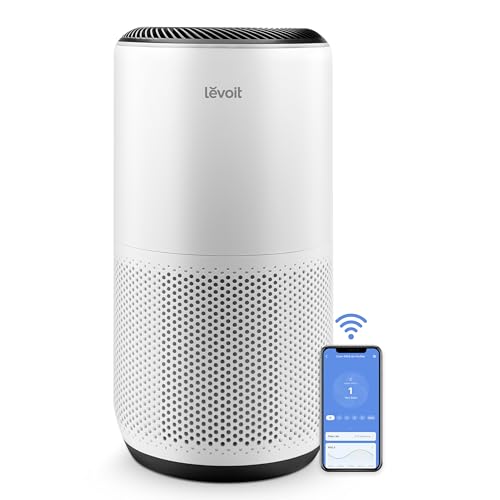
LEVOIT Core 400S — smart HEPA example
Best for set-and-forget large rooms
At a glance: Smart purifier for large rooms up to 1,718 sq ft (maker’s figure) · HEPA filtration in a 3-in-1 filter · Auto mode and air quality monitor named in the listing · Sleep mode
Strengths
- Auto mode responds to the room’s particle load without manual speed changes
- Air quality monitoring makes the invisible visible, which helps people run the machine when it matters
- Sleep mode keeps overnight use realistic
Trade-offs
- Smart features require setup some households will not want
- Its sensor reads particles, not viruses — no home sensor identifies pathogens
- Filter replacements remain a recurring cost
Best for: households that want the machine to manage itself day to day. Not suited for: anyone expecting the display to tell them whether air is ‘safe’ — it cannot. Check price on Amazon

Coway Airmega 150 — bedroom-scale HEPA example
Best for bedrooms and studies
At a glance: Compact purifier for rooms up to 1,035 sq ft (maker’s figure) · HEPA and carbon filters with a washable pre-filter · Air quality monitor and auto mode named in the listing
Strengths
- Right-sized for the room where people spend the longest continuous hours — asleep
- Washable pre-filter reduces consumable hassle at the first stage
- Auto mode keeps it unobtrusive overnight
Trade-offs
- One room at a time — it will not serve an open-plan floor
- Smaller filter volume than large-room towers
- Bedroom filtration improves the room’s air generally; it is not a health guarantee
Best for: a main bedroom, nursery or study. Not suited for: large living areas or whole-home ambitions. Check price on Amazon
How to Use a Purifier Sensibly When Illness Is Going Around
If someone in the household is unwell and you own a purifier, the sensible pattern is simple. Run it continuously in the shared rooms, on the highest speed people can tolerate for long periods rather than a heroic setting everyone switches off. Keep the unwell person’s room ventilated when outdoor conditions allow, because fresh air dilutes indoor air in a way filtration alone does not. Do not crowd around the machine as though it were a campfire of safety; distance, rest, hygiene and current public-health guidance do the heavy lifting, and the purifier is a background contributor to cleaner shared air. Afterwards, treat the filter with the respect described earlier — it has done its job by trapping material, and it should be changed on schedule, handled calmly and bagged without drama. And if anyone’s condition is worrying you, stop researching appliances and contact a healthcare professional; that ordering of priorities is the most important advice on this page.
Buying Guidance, If You Are Shopping Anyway
Choose on the ordinary merits. Size the machine to the room with headroom to spare, because a purifier that must scream to keep up will be switched off. Prefer a genuinely sealed filter path and a real HEPA layer, plus activated carbon if odours are part of your problem. Price the replacement filter before buying the machine. Treat any virus-specific marketing as a reason to read the rest of the listing more carefully, not as a feature to pay extra for; the filtration underneath the claim is the same filtration sold for dust and pollen. The comparisons at best quiet air purifiers and best air purifiers for large rooms apply those criteria across the category, and the versus guide at purifier or humidifier covers the neighbouring decision about moisture.
Common Misunderstandings, Corrected
- ‘HEPA holes are 0.3 microns, so smaller viruses pass straight through.’ Filters are fibre mats, not sieves; diffusion captures the smallest particles readily, and 0.3 microns is the hardest size, not a cut-off.
- ‘The filter kills what it catches.’ A standard HEPA filter traps; it does not disinfect. Handle used filters accordingly.
- ‘A purifier in the room means we cannot catch anything.’ Close-range exchange between people, other rooms and everything outside the airstream are beyond the machine’s reach. No purifier offers that protection.
- ‘If one purifier is good, the biggest industrial unit must be best.’ Oversized machines cost more to buy and feed with filters, and may be too loud to run; correct sizing wins.
- ‘The air quality display proves the air is safe.’ Home sensors estimate particle levels. They cannot detect viruses or certify safety, and a low reading should never override common sense or professional advice.
- ‘A purifier replaces ventilation.’ It does not refresh oxygen or remove moisture and carbon dioxide; opening windows when outdoor air is clean remains valuable.
The Balanced Bottom Line
HEPA filters remove airborne particles from the air that passes through them with remarkable efficiency, including the droplet particles that can carry viruses — and that is the beginning and the end of what the technology promises. A home purifier built around such a filter is a worthwhile appliance for dust, pollen, pet dander and everyday freshness, and a reasonable supporting layer for cleaner shared air in a busy household. It is not a medical device, not a disinfectant and not a guarantee against illness, and it earns its place in a home on the ordinary merits, honestly understood. Buy it for those merits, size it properly, maintain it on schedule, and let professionals and public-health guidance carry the questions that appliances cannot.
A Brief History: Where HEPA Came From
HEPA filtration was not invented for living rooms. It was developed in the middle of the last century for environments where airborne particles were a serious industrial and scientific problem — laboratories, manufacturing cleanrooms and protective equipment — and it migrated into hospitals, aircraft and eventually homes as the media became cheaper to pleat, seal and mass-produce. That history explains both the technology’s credibility and its limits in a domestic setting. In a cleanroom, filtration is one part of an engineered system: sealed spaces, controlled pressure, disciplined clothing and procedures, and air that is obliged to pass through the filters. In a hospital, similar systems are designed, installed and maintained by professionals against defined standards. In a home, you have one appliance, an unsealed room and a household that opens doors. The filter media inside a good home purifier is a genuine descendant of the industrial technology; the system around it is not, and honest expectations follow from that difference. When a product page borrows the aura of operating theatres and laboratories, it is borrowing the system as well as the filter — and only the filter is in the box.
The same history explains why filtration language is so precise among professionals and so loose in marketing. Engineers speak of efficiency at a specified particle size, pressure drop, airflow and leakage, because each of those qualifies the others. Consumer marketing prefers single numbers and single verbs — removes, eliminates, kills — because they fit on a box. Learning to hear the missing qualifications is most of what ‘understanding HEPA’ means for a shopper: efficient at what size, in what airstream, at what speed, in what room, over how long? A claim that cannot answer those questions is not necessarily false, but it is certainly incomplete, and the incompleteness always leans in the seller’s favour.
Labels Decoded: HEPA, True HEPA and HEPA-Type
Shoppers meet a small zoo of labels. ‘HEPA’ on its own, in reputable contexts, refers to media meeting the recognised efficiency standard at the most penetrating particle size. ‘True HEPA’ is the market’s way of insisting the media genuinely meets that standard rather than merely resembling it — the phrase exists because the looser labels below it created doubt. ‘HEPA-type’, ‘HEPA-style’, ‘HEPA-like’ and ’99 percent HEPA’ describe filters that capture a share of fine particles but do not meet the HEPA standard; they are not useless — for coarse dust they may serve — but they should not be priced or trusted as HEPA. There is also a newer tier of higher-grade media, often labelled with grades above the standard HEPA class, used in some machines for finer capture at the cost of more resistance to airflow. The practical shopping rule is unglamorous: prefer machines that state plainly that their media meets the HEPA standard, be suspicious of inventive adjectives, and remember that the seal and the machine’s airflow matter alongside the media — a genuine HEPA cartridge in a leaky, underpowered box is a promise half kept. Listings checked for this site illustrate the honest end of the spectrum: the Medify listing, for instance, describes its cartridge as a HEPA filter with removal down to 0.3 microns, which is a claim about the media’s rating point, neither more nor less.
Air Changes, Room Size and Why Time Is the Hidden Variable
Every purifier conversation eventually becomes a conversation about time. A machine processes a certain volume of air per hour; a room contains a certain volume of air; the ratio tells you how often, in theory, the room’s air passes through the filter. In practice the air is not obliged to queue politely — some of it cycles repeatedly near the machine while corners lag — but the ratio still predicts the experience: generous ratios mean the room’s particle load falls quickly after a disturbance and stays low; meagre ratios mean the machine is always chasing yesterday’s dust. This is the mechanical reason behind the sizing advice repeated across this site, and behind the otherwise puzzling fact that two machines with identical filters can perform completely differently in the same room. It also frames the virus question correctly. Filtration is a rate, not an event. Over an evening, a well-sized purifier processes the shared air of a living room many times, steadily lowering whatever load that air carries. In a single moment — a cough across a sofa — the rate is irrelevant, because the exchange happens faster than any machine can intervene. Both halves of that sentence are the science; quoting only the first half is the marketing.
Placement feeds the same equation. A purifier draws from its immediate surroundings, so a machine sealed behind a curtain or under a table processes a private pocket of air while the room’s main volume waits its turn. Standing in the open, near where people actually sit and sleep, with its intake unobstructed and its outlet free to mix cleaned air back into the room, the same machine serves the whole space. Corners are acceptable; coffins of furniture are not. And because doors decide which air belongs to which room, one purifier per occupied room — or accepting that a single machine serves the room it stands in — is the honest planning assumption, whatever the coverage figure on the box implies about the whole floor.
Filtration Among Its Neighbours: Ventilation, Ionisers and Ultraviolet
Filtration is one of four approaches a household will meet, and confusing them causes real purchasing errors. Ventilation replaces indoor air with outdoor air: it dilutes everything generated indoors — particles, moisture, odours, carbon dioxide — and it is the only approach that refreshes the air itself rather than treating it. Its costs are heat loss in winter, pollen and traffic fumes when outdoor air is dirty, and noise or security limits on open windows. Filtration, by contrast, treats the air already in the room, excels at particles, and does nothing for gases it is not designed to adsorb or for the freshness ventilation provides. The two are complements, not substitutes: many households ventilate when outdoor air is clean and filter continuously in between, and the purifier-versus-humidifier comparison at purifier or humidifier sits inside that same wider routine.
Ionisers charge particles so they deposit on surfaces or collector plates. They can reduce airborne particles without a fan or filter, but deposited particles land in the room — on walls, furniture and lungs’ neighbourhood — rather than being removed from it, and some designs generate ozone as a by-product, which is itself an airway irritant. That combination is why this site does not recommend ionisation as a primary strategy and why shoppers should check any ‘filterless’ claim carefully. Ultraviolet stages, built into some machines, expose passing or captured air to UV light; their real-world effect depends on exposure time and design in ways a shopper cannot verify from a listing, and they should be treated as an unproven extra rather than a reason to buy. The defensible hierarchy for a home is the boring one: source control first, ventilation second, sealed HEPA filtration third, everything else a distant and sceptical fourth.
How to Read a Research Claim Without Being Misled
Sooner or later a shopper meets a headline — a study, a percentage, a laboratory result — attached to a purifier. Four questions domesticate almost any such claim. What was the setting: a sealed chamber, a test duct, a classroom, a home? Results shrink as settings become more like real life. What was measured: particles of a certain size, a tracer gas, a virus substitute, or actual illness in actual people? Each step along that chain is weaker evidence for the next. Over what time, and at what fan speed: a result achieved over hours at maximum speed describes a different product from the one humming quietly in your bedroom. And who is telling you: the manufacturer, a retailer, or an independent body with no machines to sell? None of this requires scientific training; it requires only the habit of asking what a number’s circumstances were before letting it into your decision. This explainer has deliberately avoided decorating itself with percentages and study results for exactly that reason — the durable, decision-relevant facts about HEPA are mechanical and qualitative, and they do not expire when a new headline lands.
Maintaining Filtration So It Stays Filtration
A HEPA system fails quietly. There is no alarm when a cartridge passes its best, only a room that gradually stops improving and a fan working against a clogging mat. The maintenance routine is therefore not housekeeping decoration; it is the difference between owning a filter and owning a ornament. Keep the pre-filter surface clear — vacuum it gently every few weeks, more often with pets — because the coarse load it catches would otherwise migrate into the fine media and shorten its life. Respect the maker’s replacement interval as a maximum rather than a target to stretch, and shorten it honestly if your air is heavy with smoke, traffic dust or shedding animals. When you fit the new cartridge, take the extra minute: seat it evenly, check the seal all the way round, and make sure no packaging remains anywhere in the airflow path — a forgotten film or a pinched gasket can quietly return a share of the room’s air to the room unfiltered, and no display on the machine will tell you it happened.
Keep the machine’s surroundings honest too. A purifier standing in a damp corner can grow musty; a purifier beside a humidifier’s outlet inhales concentrated mist all day; a purifier in a room where candles and incense burn constantly spends its carbon and its media on a load the household chose to create. None of these are faults in the machine. They are the ordinary physics of a device that processes whatever air it is given, and they reward the households that think of filtration as a system — room, habits, machine, maintenance — rather than a purchase. That systems view is also the final answer to the question in this article’s title. A filter is a component. What it can do for a room depends on everything around it, and what it can never do — disinfect, guarantee, protect — no arrangement of components in a consumer appliance will change.
Questions This Explainer Cannot Answer for You
Honesty about limits cuts both ways, so it is worth listing what this page cannot settle. It cannot tell you whether a purifier is appropriate for a specific medical situation in your household; that belongs to the professionals who know the situation. It cannot certify any particular machine’s performance in your particular room; only correct sizing, placement and observation over a few weeks can tell you that. It cannot keep pace with changing public-health guidance during outbreaks; official sources exist for that and should be your first port of call when illness is the live concern. And it cannot rescue a purchase made on a promise no filter can keep — though it may help you reframe that machine sensibly, as a dust and pollen appliance, and get honest value from it on those terms. What it can do, and has tried to do, is give you the mechanical picture clearly enough that no future claim — in an advertisement, a listing or a headline — can blur capture into killing, a room into a laboratory, or a useful appliance into a guarantee.
A Worked Example: One Room, One Evening, One Machine
Abstract principles settle better with a scene, so imagine a winter evening in a family living room. Four people, one dog, a closed window against the cold, dinner just cooked. The air in that room carries a little of everything: fibres from the sofa, dander from the dog, residue from the frying pan, dust stirred up by feet and cushions, and — because one child has the cold that is going around school — respiratory particles from an occasional cough and a lot of ordinary breathing. A correctly sized purifier in the corner, running steadily, spends the evening doing the only thing it knows how to do: pulling that mixed air through its filter, returning it with its particle load reduced, and repeating the cycle until the room’s baseline is measurably cleaner than it would have been. The dusting tomorrow will be lighter. The room will smell less of dinner by bedtime. Those are real, worthwhile effects, and they are the effects the machine was bought for.
Now notice what the machine did not do during that same evening. When the child coughed towards her brother across the sofa, the exchange between them was over before the room’s air had moved a metre. When the dog was let out and in again, a slug of cold outdoor air bypassed every filter in the house. When the family went to bed, the purifier stayed with the living room’s air while the bedrooms made their own. None of that is a criticism; it is a description of a room, and it is why the adults in that house who want to manage the child’s cold reach for tissues, ventilation, rest and a day off school, and let the purifier do its quieter, longer work in the background. The scene contains the whole argument of this explainer in miniature: filtration is genuinely useful, continuously, for the air of the room it serves — and the moment anyone asks it to be a shield, a treatment or a promise, they have left the territory where the machine can follow them.
Carry that scene with you when you shop. If a listing evokes the shield, close it and open one that talks about room sizes, filters and noise instead. If a review — including the reviews on this site — describes a purifier in terms of dust, pollen, smells and comfort, it is describing the machine that actually exists. That is the machine worth your money, bought with open eyes, and it is the only kind this site will recommend.
Glossary: The Words, Used Precisely
Aerosol: the cloud of fine respiratory particles that can remain suspended in indoor air; the vehicle in which airborne viruses usually travel. Carrier particle: the droplet or dried residue carrying virus material — the thing a filter actually meets. Diffusion: the random wandering of the smallest particles, which makes them easier, not harder, for fibres to capture. HEPA: high-efficiency particulate air — filter media meeting a recognised efficiency standard at the most penetrating particle size. Impaction: capture of heavier particles that cannot follow the airstream’s turns around a fibre. Interception: capture of a particle that passes close enough to a fibre to touch it. Most penetrating particle size: the size at which capture is hardest, conventionally around 0.3 microns, and therefore the size at which HEPA media is rated. Sealed filtration: a machine design in which air cannot bypass the filter, so the media’s rating applies to the whole airstream. Keep this glossary beside any product claim and the claim will usually translate itself into something more modest and more true.
One final distinction is worth making explicit, because it resolves most of the confusion readers arrive with. When scientists and engineers say a filter ‘removes’ particles, they mean the particles are no longer in the air that passed through the filter — a statement about an airstream. When shoppers hear ‘removes viruses’, they often understand a statement about a household: that the viruses are gone, the risk is handled, the problem is solved. The first statement is true and provable; the second does not follow from it, because a household is not an airstream. Every section of this explainer — the mechanisms, the seals, the air changes, the worked evening in a family living room — is really an elaboration of that single gap between an airstream and a household. Respect the gap, and you will buy well, use the machine well, and never ask it to do the one class of job it was never built for.
If you remember only three sentences from this page, make them these. A HEPA filter traps the particles that pass through it, including the droplets that can carry viruses, with an efficiency that is highest everywhere except its hardest rated size. Trapping is not killing, and one machine filtering one room over time is not protection for the people in it. Buy a purifier for dust, pollen and freshness, run it continuously and maintain it properly — and let ventilation, hygiene and professional guidance answer the questions about illness.
And if a friend or relative is shopping with the same question, send them here before they buy: ten minutes with the distinction between an airstream and a household will save them from the most expensive misunderstanding in the category, and may redirect their money toward the machine — or the professional advice — that actually matches their need.
What Happens Inside the Filter Over Weeks of Use
A HEPA filter on its first day and the same filter after two months of continuous use are not quite the same device, and understanding why helps set sensible expectations. As particles accumulate in the fibrous mat, the filter often becomes marginally better at capturing the smallest particles, because the collected material narrows the pathways air must thread through. The trade-off is resistance: the fan works harder to push the same volume of air through a loaded filter, airflow falls, and the number of times the room’s air passes through the machine each hour quietly declines. This is why a purifier can seem less effective over time even though its filter, particle for particle, is capturing well. The system-level figure that matters at home is clean air delivered to the room, and that depends on the filter and the airflow together.
Moisture changes this picture further. Filters that regularly draw in damp air, for example in a room where a humidifier runs close by or where condensation is a recurring problem, can develop musty odours as trapped organic material sits in a humid environment. The remedy is mostly positional and practical: keep a reasonable distance between humidifying and filtering appliances, deal with the sources of excess indoor moisture, and replace a filter that smells stale even after the room itself has been aired. Shaking out or vacuuming a filter’s outer surface may remove loose dust from a pre-filter designed for that care, but the deep HEPA layer itself should be treated as a consumable, not a washable component.
None of this makes a used filter dangerous in ordinary household terms, and there is no need for alarm when handling one. It does mean the filter should be treated as what it is: a concentrated collection of everything the machine removed from the air over months, including dust, pollen, fibres and whatever microbes were riding on those particles. Bagging a spent filter before it goes into household waste, and washing hands afterwards, is proportionate hygiene, in the same category as emptying a vacuum cleaner thoughtfully rather than shaking its contents back into the room it just cleaned.
Shared Spaces, Vulnerable People and Proportionate Precautions
Questions about viruses and filters often arise in households where someone is more vulnerable than average: an older parent, a person whose clinician has advised extra care around infections, or a baby whose immune system is still developing. In those homes the balanced position matters even more. Filtration is one layer among several, and it is most useful when the other layers are in place: staying home when unwell where that is possible, ventilating rooms where people gather, ordinary hand hygiene, and following the specific guidance of the professionals involved in that person’s care. A purifier asked to carry the whole burden of protection will disappoint; a purifier contributing to a sensible routine can genuinely reduce the background level of particles in shared air.
Workplaces, classrooms and waiting rooms raise the same questions at a larger scale, and the same principles apply with extra emphasis on volume. A single domestic purifier in a large shared space is a token gesture, because the air changes it can deliver are small relative to the room. Where organisations use filtration seriously, they size multiple units to the space, place them where people actually sit and breathe, and maintain them on a schedule rather than waiting for a warning light during a busy term. If you are responsible for such a space, treat published guidance from public-health and building-services bodies as your starting point, and treat any single product’s marketing as the least reliable document in the room.
Finally, it is worth naming the emotional side of this purchase honestly. Buying a purifier when illness is circulating can be a way of doing something in a situation that feels out of control, and there is nothing foolish about wanting cleaner air at home. The aim of a balanced explainer is not to talk anyone out of a reasonable purchase, but to make sure the purchase is made for what the machine demonstrably does: it filters particles from indoor air, steadily and measurably. Decisions made on that basis tend to age well, whatever the headlines do next.
Frequently Asked Questions
If a filter captures virus particles, is the used filter a hazard in my home?
In ordinary household use, a spent filter is best regarded as dirty rather than hazardous, in the same way a full vacuum bag is dirty. Viruses do not multiply inside a filter, because they need living cells to replicate, and captured material simply stays trapped in the fibres as the filter dries and ages. Sensible handling is enough: remove the filter without shaking it, place it straight into a bag, put it in household waste, and wash your hands. People whose clinicians have given them specific instructions about their environment should follow those instructions over any general guidance, including this.
Does opening windows defeat the point of running a purifier?
No, because the two do different jobs that often complement each other. Ventilation dilutes everything in indoor air, including carbon dioxide and odours that a standard purifier does not remove, and it brings in fresh air from outside. Filtration removes particles from the air already in the room, including particles that arrive through those same open windows, such as pollen. On a high-pollen day or during a period of poor outdoor air quality, shorter, deliberate ventilation followed by steady filtration is a reasonable compromise. The purifier is not wasted effort when windows open; it simply works on a changing volume of air, as it always does.
Can a HEPA filter catch a virus itself, or only droplets?
In real rooms the distinction barely arises, because airborne viruses travel inside respiratory droplets and residues, and those carriers are what the filter meets and traps. The filtration mechanisms — especially diffusion — also capture very fine particles effectively, which is why the rating size is the hardest size rather than the smallest. Either way, capture in a filter is not the same as protection for a person, for the room-and-timing reasons explained above.
Does a HEPA purifier kill viruses in its filter?
No. A standard HEPA filter is a physical trap with no disinfecting mechanism. Material caught in the filter stays in the filter until the cartridge is replaced, which is why used filters should be changed calmly, bagged without shaking, and followed by hand washing. Machines with additional technologies make separate claims that should be judged separately, on their own evidence.
Should I buy a purifier to protect my family from illness?
Not on that basis. If cleaner general air, less dust and an easier pollen season appeal to you, a purifier is a sound purchase. If protection from illness is the goal, spend your attention on ventilation, hygiene, rest, vaccination where recommended, and current public-health and professional advice. A purifier can be one background layer in a sensible household routine; it cannot be the strategy.
How long does a purifier take to clean a room’s air?
Gradually, over repeated cycles of the room’s air through the machine — which is why continuous running matters more than short bursts, and why no purifier can intercept air in the moment and place it is breathed between two people. Think in terms of a room’s baseline improving over hours and days of running, not minutes.
Is a purifier still worth it for allergies and dust?
That is the job it is genuinely for, and where owners most consistently report satisfaction: less settled dust, fresher-feeling rooms and an easier time during pollen season, provided the machine is sized, placed and maintained properly. Comfort is the honest frame — a purifier manages particles in a room’s air; it does not treat any condition, and persistent symptoms deserve professional assessment. See best air purifiers for homes with pets for the dander-heavy version of the question.
What should I do with a used filter?
Switch the machine off, remove the cartridge without shaking it, place it straight into a bag for household waste, wash your hands, and fit the genuine replacement, checking the seal sits evenly. Never wash a filter that is not explicitly designed to be washed, and never run the machine with the filter removed.