Disclosure: As an Amazon Associate, dailyhomedecorating.com earns from qualifying purchases. Links on this page are affiliate links; they cost you nothing extra. Prices and availability change often, so check the current Amazon listing before you buy.
This dyson ph03 air purifier and humidifier review exists because the PH03 asks a genuinely interesting question: what if one elegant tower could purify your air, humidify it and fan-cool the room, instead of two or three appliances competing for the same corner? The Dyson Purifier Humidify+Cool PH03 is that proposition in physical form — a bladeless-look tower that filters the air it draws in, adds moisture to it through an evaporative system designed around hygiene, and projects the treated air across the room. It is also, unmistakably, a premium product in a category where capable separate machines cost considerably less in combination, so the review has to answer two questions at once: does the combination work, and for whom is the combination worth more than the sum of cheaper parts? Below: the quick verdict, what the machine is and is not, the detailed assessment, two checked alternatives — its own formaldehyde-focused sibling, the PH04, and a dedicated Levoit humidifier representing the separates route — a buying guide, the practical how-to of living with a water-carrying purifier, the mistakes owners make, and a full FAQ.
How this review was assembled matters, so here it is plainly: the product was checked against Dyson’s own Amazon product information through the Creators programme on the date recorded in the source notes, and only the confirmed model is linked. We do not claim hands-on laboratory testing we have not performed. Where the machine’s design is described — sealed filtration, evaporative humidification, air projection — the description follows the maker’s own published approach to this model line, and anything uncertain is phrased generally rather than dressed up as a specification. The frame throughout is comfort and freshness at home: purified, sensibly moist air feels better to live in, and that is the promise this machine is allowed to make. It is not medical equipment, and nothing here should be read as a health claim.
Dyson Ph03 Air Purifier And Humidifier Review: The Quick Verdict
Choose the PH03 if you live in a small or tidy home where one footprint must do everything, your air is both particle-laden and dry across the year, you value design and a single app-and-remote ecosystem, and your budget comfortably absorbs premium pricing plus premium consumables. It is a particularly neat answer for a main bedroom or a studio flat, where purifier, humidifier and fan would otherwise be three objects in a room that fits one. Skip it if you want the strongest dedicated purifier and the strongest dedicated humidifier for the same money — separates win that contest — if your home is large and open-plan, where one tower cannot serve every room, or if you know you will neglect the water-tank hygiene that any humidifying machine demands. The sections below make each side of that verdict concrete, and the comparison at purifier versus humidifier — which do you need covers the underlying decision for readers still unsure whether they need both functions at all.
In this guide
What the PH03 Is — and Is Not
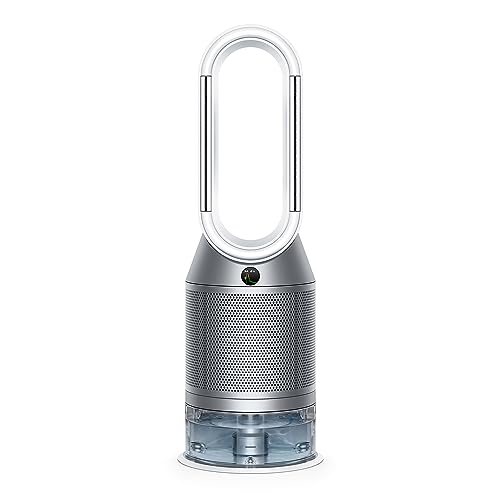
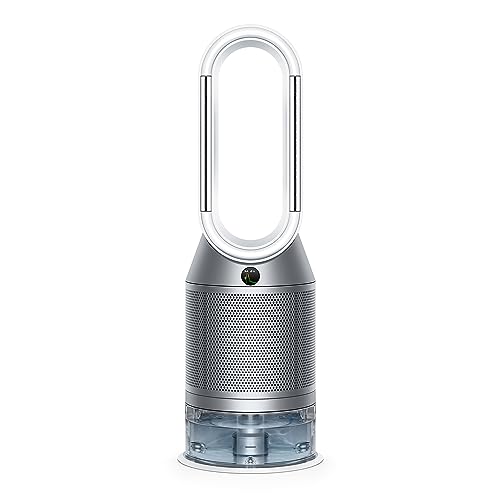
The PH03 is a three-function tower. As a purifier, it draws room air through a sealed filtration system — Dyson’s stated approach for this line is that the whole machine, not just the filter, is sealed to the HEPA standard, so air cannot leak around the media — and the filter combination addresses particles and a range of gases and odours. As a humidifier, it uses evaporative humidification: water from its tank passes over an evaporator, and the projected air picks up moisture as invisible vapour rather than as mist droplets, which is why the machine does not leave the white mineral dust that ultrasonic humidifiers can deposit on furniture. Dyson also builds a water-management routine into the design, using ultraviolet light in the water path with the stated aim of keeping the humidification hygienic, plus a deep-clean cycle for the evaporator system. As a fan, it projects a stream of treated air across the room in the familiar Dyson manner, with oscillation, which is what makes the combination coherent: the same airflow that cools you in summer is the air that has just been filtered and, when needed, moistened.
What it is not: it is not an air conditioner — the fan moves and treats air but does not refrigerate it, so a heatwave still feels like a heatwave, merely a cleaner, better-moistened one. It is not a whole-house system; like every portable purifier, it serves the room it stands in. It is not a dehumidifier, and in a damp home it is the wrong purchase entirely. And its humidifier, however thoughtfully engineered, still asks the owner for the basic disciplines of water hygiene — fresh water, a clean tank, the maker’s deep-clean cycle run when prompted — because no design abolishes the physics of standing water. Understanding those four ‘nots’ is most of what separates delighted PH03 owners from disappointed ones.
Dyson Purifier Humidify+Cool PH03 — the main review
Best for small homes that need both jobs in one footprint
At a glance: Purifier, humidifier and fan in one tower · Dyson’s listing under the Purifier Humidify+Cool PH03 name · Sealed HEPA filtration is the maker’s stated design approach · Evaporative humidification — vapour, not mist · Premium tier positioning
Strengths
- One footprint and one control ecosystem for three functions that usually need three machines
- Evaporative humidification avoids the mineral-dust problem of ultrasonic designs
- Sealed-machine filtration addresses the bypass weakness that undermines lesser purifiers
Trade-offs
- Premium pricing, and filters and parts sit in the premium tier too
- Neither function, alone, out-muscles the best dedicated machines at this money
- Water hygiene discipline is still required — the design reduces the burden, it does not delete it
Best for: space-conscious homes with both dry and dusty air, and owners who will keep up the water routine. Not suited for: large open-plan houses, damp homes, or buyers seeking maximum dedicated performance per unit of money. Check price on Amazon
The Detailed Assessment
Begin with purification, because it is the function that runs all year. The sealed-system design is the headline, and it deserves to be: filtration ratings describe media, but a machine’s real performance is media plus housing, and air that leaks around a filter is air that was never filtered at all. Dyson’s insistence on sealing the whole unit is therefore a substantive engineering position, not a styling claim. In daily terms, expect the PH03 to behave like a capable premium purifier for the room it occupies: steadily reducing dust and pollen load, helping the room recover from cooking, and reporting on air quality through its sensing and display ecosystem. It will not out-process a large, dedicated tower purifier with a much bigger filter volume — physics is physics — and households whose primary problem is heavy smoke or a big open-plan floor should read the large-room guidance at best air purifiers for large rooms before assuming any combination machine is their answer.
Humidification is where the PH03 most clearly differentiates itself from both ordinary purifiers and ordinary humidifiers. Evaporative delivery means the moisture leaves as vapour, so there is no cool mist to condense on nearby surfaces and no white dust from hard water minerals — the two complaints that most often send ultrasonic humidifiers back to the shop. The trade-off is pace and ceiling: evaporation is self-limiting, adding moisture more gently and struggling to push a room’s humidity high even if asked, which most owners will experience as a safety feature rather than a limitation, since over-humid rooms invite condensation and mould. The water system still needs its owner: fill with fresh water, do not let the tank stand stale for days, and run the maker’s deep-clean cycle when the machine asks, because limescale accumulates in any evaporative system in hard-water areas and the cycle exists to deal with it. Dyson’s ultraviolet treatment in the water path is part of the hygiene design, but it is a layer within a routine, not a substitute for one.
The fan function sounds like a bonus and behaves like the glue. Projection and oscillation distribute the treated air across the room instead of letting it pool around the unit, which improves both purification reach and humidification evenness, and in warm weather the moving air is itself the comfort. Noise follows the familiar purifier pattern: gentle at the speeds used overnight, assertive at full projection. Dyson’s night routines and the general quietness of the design at low settings make the PH03 a realistic bedroom machine — which matters, because the bedroom is where the purifier-humidifier combination makes its strongest case: eight hours of breathing filtered, sensibly moist air in the room where dry winter nights do their worst. Readers whose priority is specifically night-time quiet across the category can compare at best quiet air purifiers.
Controls, sensing and the app ecosystem are premium in the expected ways: the machine senses particles and gases, reports humidity and air quality, automates its responses in auto modes, and accepts remote and app control for households that like their appliances managed from the sofa. That polish cuts both ways. It makes the PH03 genuinely pleasant to live with — set targets, glance at readings, let it work — and it means a slice of the price buys software and sensors rather than filtration volume. Buyers who never open appliance apps should price that honestly against the separates route, where the same money buys bigger filters and a bigger humidifier tank. Buyers who love a managed home will consider the ecosystem part of the product, and they are not wrong; they are simply buying a different balance of the same budget.
Design and footprint complete the picture. The tower is furniture-grade in a way most purifiers are not, and in a small home that matters more than reviewers in large houses tend to admit: an appliance you can bear to look at stays in the room, running, while an ugly one migrates to a cupboard. The footprint is one tower’s worth of floor, replacing what could be three. Against that, the machine is a substantial object to move between rooms, its tank and filters are proprietary to the ecosystem, and if any single function fails, the whole combination leaves for repair at once — the structural risk of all convergence products, worth naming plainly in a review that otherwise admires the convergence.
Alternatives: The Sibling and the Separates Route

Dyson Purifier Humidify+Cool Formaldehyde PH04 — the upgraded sibling
Best for buyers who want the combination plus formaldehyde focus
At a glance: Same Purifier Humidify+Cool family in the PH04 listing · Formaldehyde in the model name signals its additional stated focus · Premium tier positioning, above the PH03
Strengths
- Adds a dedicated formaldehyde-oriented stage to the same three-function formula
- Shares the sealed-filtration and evaporative-humidification design approach
- The natural step up for newly renovated or newly furnished homes, where formaldehyde from materials is a live concern
Trade-offs
- Costs more again, for a capability many homes do not specifically need
- Same convergence risk: one machine, three functions, one point of failure
- Same water-hygiene routine as the PH03
Best for: buyers already sold on the combination whose homes are freshly renovated or furnished and who value the extra gas-phase focus. Not suited for: everyone else — the PH03 covers the general case for less. Check price on Amazon

Levoit OasisMist — the separates route, humidifier half
Best for buyers who would rather own two dedicated machines
At a glance: Smart warm and cool mist humidifier · 4.5L top-fill tank, maker-stated run time up to 45 hours · Auto humidity customisation named in the listing · Mid-tier positioning
Strengths
- Paired with a dedicated purifier such as those in this site’s HEPA roundup, delivers stronger single-function performance per unit of money
- Top-fill tank and warm-mist option cover preferences the PH03’s evaporation does not
- If one machine fails, the other function stays in the home
Trade-offs
- Two machines, two footprints, two routines — the clutter the PH03 exists to abolish
- Mist designs need their cleaning discipline and can deposit mineral dust with hard water
- No fan or purification in this unit at all
Best for: larger homes and value-focused buyers happy to run separates. Not suited for: the small, tidy rooms where the PH03’s single footprint is the whole point. Check price on Amazon
A prose-only note completes the alternatives honestly: the purifier half of the separates route is well served by the large-room HEPA machines assessed elsewhere on this site — see Dyson and rival purifiers compared — and a household that discovers it needs only one function should buy only that function, at full strength, rather than a combination at half. The PH03’s case rests entirely on genuinely needing both, in one room, in one footprint.
Comparison Table
| Machine | Functions | Humidification style | Best role | Tier |
|---|---|---|---|---|
| Dyson PH03 | Purify, humidify, fan | Evaporative vapour | One-room combination for small, tidy homes | Premium |
| Dyson PH04 | Purify, humidify, fan | Evaporative vapour | Combination plus formaldehyde focus | Premium, higher |
| Levoit OasisMist + separate purifier | Humidify (plus purifier of choice) | Warm and cool mist | Maximum single-function value, two footprints | Mid |
Read the table as three philosophies rather than three scores. The PH03 buys integration. The PH04 buys integration plus a specific extra concern. The separates route buys performance headroom and resilience at the cost of space and simplicity. None is universally correct; each is correct for a household shape, and the buying guide below is designed to identify yours.
Buying Guide: Deciding Whether the Combination Earns Its Premium
Ask five questions. One: do I genuinely have both problems — particles and dryness — in the same room, across overlapping seasons? If the dryness is a fortnight a year, buy a purifier and a small humidifier. Two: is floor space, or visual calm, a real constraint? In a studio or a small bedroom the integration is worth money; in a large house it is worth little. Three: will I run the water routine? The PH03 reduces humidifier chores but does not abolish them, and a neglected water system undermines the machine’s core selling point. Four: am I comfortable with premium consumables — filters and parts priced in the same tier as the machine — for the machine’s whole life? Five: do I want an app-managed appliance, or will the ecosystem go unused while its cost sits in the purchase price? Five honest answers locate you on the map: mostly yes means the PH03 is a rational luxury; a couple of noes mean separates will serve you better for less.
Two further checks protect any buyer in this tier. Check the current filter and replacement-part prices on the listing before ordering the machine, and add a first year of consumables to the headline price in your head. And measure the room: a combination tower is still one machine in one room, so a large open-plan space needs either acceptance that the PH03 serves its zone, or a different plan entirely — the whole-home discussion at best whole home air purifiers is the honest starting point for that ambition.
How to Set Up and Look After the PH03
Setup: place the tower on a level floor with clear space around its intake and a clear throw for its projected air — not boxed behind a sofa, not under a shelf. Remove all packaging from the filter before first use, fill the tank with fresh water, and let the machine’s own onboarding set its targets. For the first week, run it in the room where you sleep or spend your evenings, on auto, and learn its rhythms: when it raises its speed, what the room’s humidity does overnight, how quickly the tank empties in your heating conditions. Those observations, in your home, are worth more than any generic schedule.
Ongoing care has two tracks. The air track: keep the exterior and intake area dusted, replace filters on the machine’s indication and the maker’s cycle, and never run the unit with a damp or damaged filter. The water track: refill with fresh water rather than endlessly topping up, empty and rinse the tank regularly, and run the deep-clean cycle when prompted — sooner in hard-water areas — because scale in an evaporative system is a when, not an if. Keep a hygrometer in the room as an independent check; the comfortable middle range is the target, and if windows begin to condense, the room is telling you the moisture is enough. Follow those two tracks and the PH03 asks little else of you, which is, in the end, what its premium is buying.
Common Mistakes PH03 Owners Make
- Expecting air conditioning: the fan cools people with moving air; it does not refrigerate the room.
- Letting the tank stand stale between uses, then blaming the design for mustiness the routine would have prevented.
- Skipping the deep-clean cycle in a hard-water area until scale forces the issue.
- Placing the tower where its intake or its projected stream is blocked, then judging its reach unfairly.
- Buying the combination for a damp home, where added moisture is the opposite of the need.
- Forgetting consumables in the budget, then stretching filters past their life to compensate.
Final Recommendation
The Dyson PH03 is the rare combination appliance that makes its combination feel inevitable rather than compromised: sealed filtration, vapour humidification without mineral dust, and projected air that serves both functions, in one object a small home can actually live with. Its premium is real, and so is what the premium buys — integration, design and an ecosystem that makes two chores feel like one appliance. Households with both problems in one valued room should shortlist it without embarrassment. Households with space, larger rooms or a single problem should buy the dedicated machines and keep the change. Either way, decide from your room and your routine, not from the silhouette — although, as silhouettes go, it is a persuasive one. Readers still weighing the underlying choice can continue at purifier versus humidifier, the full comparison and best bedroom humidifiers.
Room by Room: Where the PH03 Makes Its Case
The main bedroom is the PH03’s strongest room, and it is not close. Bedrooms concentrate every argument for the combination: you spend the longest unbroken hours there, breathing whatever the room offers; heating dries bedroom air all night; dust and dander accumulate in bedding and carpets; and floor space beside a bed is usually too precious for two appliances and a fan. One tower in the corner, filtering steadily, holding moisture in the comfortable middle and moving air gently, addresses the whole list at once. If the machine’s price is hard to justify for a living room you pass through, the bedroom arithmetic — a third of your life, every night, for years — is the version of the case most owners eventually make to themselves.
The studio flat is the second strong case, for the simpler reason that there is only one room. Every appliance in a studio is on display and in the way, so a combination that replaces three objects with one designed object changes the feel of the whole home, not just its air. Cooking smells, bathroom moisture swings, dry heating air and summer stuffiness all happen in the same volume of air the PH03 serves, and its oscillation distributes the treatment in a way a static box cannot. The home office or spare room is the middling case: the combination is pleasant, especially for a room that doubles as a guest bedroom, but a dedicated purifier alone usually covers a working room’s needs, and the premium is harder to defend. The large family living room is the weakest case: too much volume, too many sources, too many doors — the PH03 will improve its corner of the room handsomely while the room as a whole asks for a bigger dedicated purifier, with humidification, if needed, handled where people sleep instead.
Season by Season With a Combination Machine
Winter is the PH03’s showcase season, because winter is when both of its main functions are wanted simultaneously: heating dries the air while closed windows trap the particles. Run purification continuously, let humidification hold a moderate target in the sleeping hours, and watch the windows each morning — condensation is the room’s own report that moisture has reached enough. Spring shifts the balance toward purification alone as pollen arrives and heating fades; the tank can be emptied, cleaned and left dry for days at a time when the air no longer needs help, and the machine becomes, in effect, a premium purifier with a fan. Summer reverses the emphasis again: humidification off for most homes, purification continuing for dust, traffic and any smoke, and the fan function earning its keep on warm evenings. Autumn is the maintenance season — a deep clean of the water system before the heating returns, a filter check, a tank inspected rather than assumed — so the machine enters its hardest-working months in full order. That annual rhythm is the honest shape of combination ownership: never all three functions at full stretch, always at least one of them earning the footprint.
Running Costs: The Premium Continues, Plan for It
A premium machine’s costs do not end at purchase, and a review that pretends otherwise sets its readers up for the filter-stretching that quietly ruins performance. Expect three recurring lines. Filters: the sealed combination cartridge system sits in the premium tier, so check its current price on the listing and divide by its expected life to get the monthly figure you are actually committing to. Water-system care: the deep-clean cycle uses the maker’s cleaning approach, and in hard-water areas you may run it more often; the cost is modest but real, in both money and minutes. Electricity: a fan, sensors and a humidification system running many hours a day draw more than a basic purifier and far less than heating or cooling the same room — the honest way to frame it is as a small, continuous load whose size follows your fan speeds. Add those three lines to the purchase price across a realistic ownership span and compare that total with the separates route’s total, including its two sets of consumables. The PH03 sometimes survives that comparison better than its headline price suggests, because two mid-tier machines also eat filters, parts and power — but it survives on arithmetic, not on hope, and the arithmetic is yours to do with current figures before you order.
The Separates Route, Priced in Honesty
Because the PH03’s premium is the crux of the review, the alternative deserves its fullest statement. For the same total outlay, a household can typically buy a large, dedicated HEPA purifier with a bigger filter volume than the PH03’s, plus a well-regarded humidifier with a larger tank, and have money left over. That household gets stronger single-function performance, the freedom to place each machine in a different room, and resilience if one fails. What it gives up is the single footprint, the unified control, the evaporative no-mist delivery in the same object as the filtration, and the design coherence of one tower instead of two boxes. In a large home, that trade is obviously right. In a small one, it can be obviously wrong — two superior machines that do not fit the room will be run less, maintained worse and resented more than one integrated machine that lives gracefully in the corner. Performance per unit of money is a real metric; performance per unit of tolerated clutter is another, and households are entitled to choose which one governs their home.
There is also a middle path worth naming: buy the dedicated purifier now, at full strength, and add the PH03’s humidification half later only if a winter proves the need — or reverse the order if dryness is the proven problem and dust is hypothetical. The combination machine’s strongest competitor is not any single rival product; it is patience. A season of evidence about your own home will tell you whether you are a one-function household, and one-function households should never pay combination prices. The PH03 will still be there, at whatever its current price is, when the evidence is in.
Sensors, Displays and What the Numbers Can Tell You
The PH03 belongs to the generation of appliances that narrate themselves: particle counts, gas readings, humidity percentages, filter-life estimates, all rendered on the machine and in its app. Used well, that narration changes behaviour for the better. A spike when the dog shakes off a wet walk teaches you more about your room’s air than a month of guessing; a humidity trace across a winter night shows exactly when the heating dries the room and whether the machine held its target; a filter-life estimate that falls faster than expected is a prompt to check placement and pre-filter cleanliness rather than a bill arriving by surprise. Used badly, the same numbers become a source of anxiety and false precision. Home sensors estimate categories of particles and gases; they do not identify specific substances, they cannot detect viruses or certify that air is safe, and a green display is a statement about particle levels in one spot, not a verdict on a household’s health. The mature way to live with a sensing appliance is to treat its data as weather, not as law: useful for deciding when to boost, ventilate or investigate, useless as a guarantee. Dyson’s ecosystem is among the more polished presentations of that weather — which is a genuine pleasure, provided the distinction stays clear.
Who Should Skip the PH03, Stated Plainly
Skip it if your home is damp: added moisture is the last thing you need, and the money belongs to ventilation, repairs and possibly dehumidification. Skip it if your rooms are large and numerous: one tower, however capable, is a one-room answer, and a fleet of combination machines is an eccentric way to furnish a house. Skip it if heavy smoke is your primary load — wildfire country, a wood stove, a smoker in the household — because that job rewards maximum filter volume and carbon weight, which dedicated machines provide at this money. Skip it if you hate appliance maintenance in all its forms: the water routine is light but non-negotiable, and a neglected PH03 is a worse purchase than a simple purifier you will actually look after. And skip it, finally, if the premium would strain the budget enough to make you stretch its filters later; a mid-tier purifier with fresh filters will outperform a premium machine running on exhausted ones, every week of the year. None of those households is making a mistake by passing — they are making the correct diagnosis of their own situation, which is what every section of this review has been trying to teach.
A Fortnight With the PH03: What Ownership Actually Feels Like
Reviews of premium appliances often fail at the same place: they describe the unboxing and the specifications, and skip the Tuesday evenings. So consider the ordinary fortnight. In the first days the machine is a novelty — its readings are checked hourly, its oscillation admired, its app explored. By the second week the novelty has burned off and the real product reveals itself: a tower that is simply there, holding the bedroom’s air at a steadier quality than the room managed before, asking for a tank refill when it needs one and otherwise staying out of the household’s attention. The humidification shows itself indirectly — mornings without the dry throat that the heating season used to guarantee, a room that no longer crackles with static when bedding is pulled back. The purification shows itself the same way — dust returning to shelves more slowly, cooking smells from the studio’s kitchen corner clearing by the time a film ends rather than greeting you at breakfast. None of it is dramatic, and that is the point the specifications cannot make: the PH03’s value is cumulative and atmospheric, measured in a room that stays pleasant without being thought about.
The fortnight also reveals the frictions honestly. The tank’s rhythm must be learned — every household’s heating and room size produce a different refill interval, and the first time the machine runs dry overnight is the last time most owners let it. The deep-clean prompt arrives on the machine’s schedule, not yours, and is best obeyed the day it appears. The app’s data tempts over-interpretation until experience teaches which readings matter. And the purchase price, if it was a stretch, echoes at the first filter conversation — which is why this review keeps returning to total cost. Owners who cleared those hurdles in advance tend to become the quietly satisfied kind, the ones who describe the machine, years later, as simply part of how their home works. That unglamorous verdict is the highest praise a working appliance can earn, and it is the verdict the PH03, in the right room and the right household, reliably earns.
The Verdict in One Paragraph, for Readers in a Hurry
If you have read nothing else: the PH03 is a well-conceived combination of a sealed-filtration purifier, an evaporative humidifier that avoids mineral dust, and a projecting fan, in one premium tower that suits small, tidy homes — above all main bedrooms and studios — where both dusty and dry air are real, overlapping problems. It is not the strongest dedicated machine in either role for its money, it will not cool or dehumidify, it serves one room, and it still asks for basic water hygiene. Buy it for integration and design in a home that matches that description, buy separates for everything else, and in both cases budget for the consumables from day one. That is the whole review; everything above it is the evidence.
How This Review Judged the PH03: Criteria and Weighting
For transparency, the criteria behind the verdicts above, in the order they were weighted. First, fitness for the combination job: a three-function machine is judged first on whether the integration itself is coherent — shared airflow, compatible routines, one control logic — because a combination that fights itself fails before its specifications are read. Second, filtration integrity: sealed construction and honest filter specification, because purification is the year-round function and the one where marketing most often outruns engineering. Third, humidification quality: delivery method, evenness, mineral behaviour and the hygiene burden placed on the owner, weighted heavily because humidifiers are where households most often go wrong. Fourth, lived experience: noise at realistic speeds, the refill and cleaning rhythm, the usefulness rather than the novelty of its sensing and app. Fifth, total cost of ownership against the separates route at equivalent outlay. Design and appearance were scored last and deliberately so — they matter, genuinely, in small homes, but they were allowed to break ties rather than win arguments. Readers who weight the criteria differently — a smoke-burdened household will put filtration volume first, a design-led studio the reverse — should reach their own verdict from the same evidence, and the review has tried to present that evidence separately from its conclusions precisely so they can.
One closing observation belongs in any honest review of a machine at this level. Premium appliances are often bought as a substitute for diagnosis — the hope that spending enough will make the questions go away. The PH03 rewards the opposite approach: it is at its best in a home that has already measured its rooms, confirmed its dryness with a hygrometer, named its particle sources and accepted its maintenance routine. In that home the premium buys exactly what it promises. In a home still guessing, the same money buys a very elegant way to keep guessing. Diagnose first; then, if the diagnosis points at one room needing everything, this machine is a genuinely satisfying answer.
Keep the box’s essentials — the filter date, the first deep-clean date and the tank routine — in a single note, and set the reminders the day the machine arrives. Premium engineering does not abolish calendars; it simply makes what the calendar protects more pleasant to live with. Owners who start with that small discipline are, in our reading of this category, the ones still recommending their machine without qualification years later.
And if you are choosing between this machine and doing nothing, weigh the nothing honestly too. A home with mild dust, adequate moisture and good ventilation may need no appliance at all, and the most premium outcome available in this category is sometimes a hygrometer, an open window at the right hour and money kept in the bank. The PH03 earns its place where the problems are real; where they are not, no review — this one included — should talk you into a tower.
That restraint, applied across all four articles in this series, is the through-line: match the machine to the measured problem, maintain what you buy, and let the room — not the brochure — deliver the verdict over the first season of use.
Start there, with the measured room and the honest routine, and the PH03 stops being a gamble on a brand and becomes what it should have been from the first paragraph: a specific, well-made answer to a specific, well-understood set of needs.
Water Quality, Tanks and the Geography of a Refill
Combination machines live or die by water logistics, and the PH03 is no exception. Every humidifying appliance asks the same recurring questions: how often will you refill it, where will you refill it, and what is in your tap water? Homes with hard water should expect mineral behaviour from any evaporative or ultrasonic system, and should read the manufacturer’s guidance on descaling as part of the purchase decision rather than as an afterthought discovered in month two. If your kettle furs up quickly, your humidifier will need attention on a similar rhythm. Households that find descaling a kettle genuinely burdensome should be honest about whether they will sustain the same task, less visibly, inside a premium appliance.
The refill route matters more than it sounds. A tank that must be carried through a hallway, filled at a kitchen sink that it only just fits under, and carried back without dripping is a small daily friction that accumulates into disuse. Before buying any large humidifying machine, walk the route mentally: where will it stand, which tap will fill it, and who in the household will actually do it when the usual person is away? Machines that are easy to live with get used; machines that are awkward get switched to purifier-only mode by February and quietly become expensive fans. The PH03’s design reduces some of this friction with a considered tank arrangement, but it cannot abolish the physics of water being heavy and sinks being fixed.
Storage and pauses deserve a mention too. If the machine will sit unused through a humid summer, emptying, drying and cleaning the water system before the pause prevents the stale start that greets many owners in autumn. A short recommissioning routine when the heating comes back on, fresh water, a clean tank, a check of the evaporator and filters, turns the machine back into an appliance you trust. Owners who build these two small rituals, one in spring and one in autumn, generally report a very different ownership experience from owners who simply switch the machine off in April and on in October.
How the PH03 Fits Households That Already Own Appliances
Few buyers start from an empty room. Many already own a standalone purifier, a basic humidifier, or a fan, and the honest question is what the PH03 replaces, what it duplicates and what it leaves unchanged. If a serviceable purifier already covers the living room, the PH03’s strongest case is usually the bedroom, where the combination of filtration and humidity in a single footprint solves the two-appliance crowding problem on a bedside scale. If the existing humidifier is the weak link, mould-prone, noisy or forever needing attention, the PH03 can be judged mainly as its replacement, with purification as a genuine bonus rather than the headline reason.
Duplication is not automatically waste. Air appliances are room-bound in a way that, say, a vacuum cleaner is not, so a household with real needs in two closed rooms will always need two solutions of some kind. The mistake is duplicating in the same room while leaving another room unserved. Map the home first: which rooms have a particle problem, which have a dryness problem, and which have both? The PH03 belongs where both answers are yes. Where only one answer is yes, a simpler single-purpose machine usually serves better and costs less to run, and the money saved can fund the second room properly.
There is also the question of failure and repair to consider with any premium combination appliance. When two functions share one body, a fault in one can sideline both, and out-of-warranty repair decisions are heavier for a costly machine. Check the warranty terms, the availability of replacement filters and evaporators, and whether the manufacturer sells the consumables directly, before purchase. A machine at this level should be bought as a five-year appliance with a known upkeep path, not as a gadget whose support you discover only when a warning light appears.
Frequently Asked Questions
Can I use tap water in the PH03, or do I need distilled water?
Follow the manufacturer’s guidance for your region first, since recommendations account for the machine’s particular humidifying system. As a general principle, households with very hard tap water should expect more frequent descaling with any humidifying appliance, and some owners choose distilled or demineralised water to lengthen the intervals between cleans, weighing that ongoing errand against the descaling it avoids. What matters most is consistency: whichever water you use, keep the tank rinsed, avoid leaving standing water in the machine during long pauses, and descale on schedule rather than waiting for performance to drop.
What happens to the humidifying function in summer?
In most homes, very little is needed from it. Summer air in many climates carries enough moisture that the sensible routine is to empty and dry the water system, run the machine as a purifier and fan, and recommission the humidifying side when the heating season returns and indoor air dries out. Leaving water sitting in a warm machine through weeks of disuse invites stale smells and extra cleaning later. A short shutdown clean in spring and a fresh start in autumn are the two habits that keep the combination format feeling like a convenience rather than a chore.
Does the PH03 actually cool a room like an air conditioner?
No. Its fan projects treated air that cools people by moving across skin, which feels refreshing, but the room’s temperature is unchanged. In a heatwave it makes filtered, moistened air more pleasant to sit in; it does not replace air conditioning, and buyers in hot climates should budget for it as a complement, not an alternative.
Will the PH03 leave white dust on my furniture?
That problem belongs to ultrasonic mist humidifiers using hard water. The PH03 humidifies evaporatively — moisture leaves as invisible vapour, and minerals stay behind in the system rather than riding droplets onto your shelves. The trade-off is that those minerals accumulate in the machine, which is exactly what its deep-clean cycle exists to manage.
How much maintenance does the water system really need?
Less than a basic mist humidifier, more than zero: fresh water for refills, regular emptying and rinsing of the tank, and the deep-clean cycle run when the machine prompts. Dyson’s water-path design adds hygiene layers, but standing water in any appliance rewards a routine. If you know you will not keep one, buy a purifier-only machine and accept dry air.
PH03 or PH04 — which should I choose?
Choose the PH04 only if its additional formaldehyde focus answers a specific concern in your home — most plausibly a recent renovation or a room full of new furniture and materials. For the general combination job, the PH03 covers the same purify-humidify-cool formula, and the saving is better kept for filters.
Is one PH03 enough for a whole flat?
It serves the room it stands in, and open doorways let it help adjoining space at the margins, but no portable purifier-humidifier treats a whole flat evenly. Small studios are the realistic one-machine case. Larger homes should plan per-room, or accept the PH03 as the flagship of the main room alongside simpler machines elsewhere.
Can the PH03 help with my health?
It can make a room’s air cleaner in particle terms and more comfortable in moisture terms, and many people value that highly in pollen season and dry winters. It is not a medical device, it makes no treatment claims in this review, and symptoms that concern you belong with a qualified professional — with the machine, at most, as background comfort. The careful explainer at what HEPA filtration can and cannot do sets out that boundary in full.