Disclosure: As an Amazon Associate, dailyhomedecorating.com earns from qualifying purchases. Links to Amazon on this page are affiliate links; they cost you nothing extra. Prices and availability change often, so check the current Amazon listing before you buy.
The best office chairs for carpet floors are decided by five small wheels and one honest question: were the casters chosen for carpet, or merely included in the box? Standard hard casters on carpet dig in, demand a shove for every move, chew at the pile and train you to twist at the waist instead of rolling — while proper carpet casters glide, turn and leave the flooring intact. Two chairs in this guide were literally built and titled for carpet floors, and the rest earn their place with bases and caster setups that behave well on pile, plus the ergonomic hardware to make the chair itself worth rolling in.
We will also be honest about the accessory that sometimes matters more than the chair: a good chair mat can rescue a mediocre caster, and the buying guide below explains when a mat is the smarter purchase and when a carpet-specific chair is. Pair this guide with Best Office Chairs For Computer Work for the workstation itself and Best Office Chairs For Comfort And Posture for the sitting position; for the room around the desk, Best Sofas And Chairs For Small Room covers compact layouts.
Where to Buy
Every pick in this guide is sold on Amazon, where you can check the current price, caster configuration and availability — configuration matters here, since some models offer a choice of casters at purchase. Start with the Steelcase Series 1 (Carpet version) — Check on Amazon. The other five picks: Herman Miller Aeron Classic with Carpet Casters — Check on Amazon; HON Ignition 2.0 — Check on Amazon; SIHOO M18 — Check on Amazon; Ticova Ergonomic — Check on Amazon; Hbada P5 — Check on Amazon.
In this guide
Quick Picks
| Pick | Badge | Why it earns its place |
|---|---|---|
| Steelcase Series 1 — Carpet | Best Overall | Sold in an explicit carpet-floors configuration, with weight-activated controls and tool-free assembly in minutes. |
| Herman Miller Aeron Classic — Carpet Casters | Best Premium | The listing names carpet casters outright, on the original suspension work chair with a 12-year warranty. |
| HON Ignition 2.0 | Best for Shared Offices | A durable 300 lb mesh task chair from a contract-furniture brand, built for daily rolling between workstations. |
| SIHOO M18 | Best Budget | Full ergonomic adjustment and a stated 330 lb capacity at a budget-tier position — add a mat and it is complete. |
| Ticova Ergonomic Office Chair | Best for Back Support | Height- and depth-adjustable lumbar and 3D armrests for carpeted home offices where you sit all day. |
| Hbada P5 | Best with Footrest | S-curve mesh back, adjustable headrest and a footrest for carpeted rooms that double as rest space. |
Key Takeaways
- Two picks are carpet-specific by design: the Steelcase Series 1 is sold in a “Carpet Floors” configuration and this Aeron listing names carpet casters — no guessing required.
- Caster diameter and tread decide carpet behavior; any chair can be improved later with replacement carpet casters or a chair mat.
- Deep pile defeats every caster eventually — on plush carpet, budget for a mat from the start rather than fighting physics.
- Rolling resistance is a comfort issue: a chair you can move with a gentle push keeps you turning instead of twisting.
- Weight matters on carpet: heavier chairs sink their casters deeper, so stated capacity and base quality still count.
How These Picks Were Chosen
Selection started with the flooring evidence. Chairs whose listings explicitly name carpet casters or a carpet configuration were ranked first — that is the Steelcase and the Aeron, and their listings say it in so many words. The remaining picks were chosen for bases and builds that perform well on carpet in practice: stable five-star bases, quality mechanisms and ergonomic hardware worth having once the rolling is solved, with the honest note that a mat or a caster swap completes them. Every pick also had to justify itself as a chair — adjustable support, a stated or reputable build — because a carpet-friendly base under a bad seat is still a bad purchase.
Excluded: chairs with unusually small or hard twin-wheel casters as their only option and no reputable build behind them, and any chair whose listing could not confirm basic dimensions or construction. We also declined to invent caster specifications the pool data does not state; where a pick’s carpet behavior rests on general design rather than a named carpet caster, the review says so plainly. The same flooring-first thinking protects hardwood in reverse — readers with mixed flooring should cross-check Best Hardwood Floor Protectors For Chairs before finalizing a setup, and anyone whose real problem is all-day posture should read Best Office Chairs For Long Term Sitting alongside.
The 6 Best Office Chairs for Carpet Floors — Reviewed

Steelcase Series 1 Ergonomic Office Chair — Carpet Version
Our badge: Best Overall
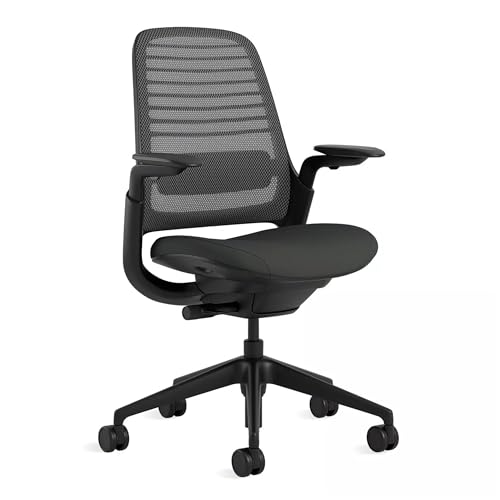
The Steelcase Series 1 is the rare chair that answers this keyword in its own name: this configuration is specified for carpet floors. Around that flooring choice, Steelcase builds its essential-ergonomics work chair — weight-activated controls that adjust recline tension to your body automatically, adaptive bolstering, flexible edges for a pressure-free sit, and optional 4D arm support and headrest in the line. At 29 pounds it is also the lightest full ergonomic chair in this guide, which helps its casters ride on top of pile rather than plowing through it.
Strengths
- Explicit carpet-floors configuration — the caster question is answered by the manufacturer, not by hope.
- Weight-activated controls remove the tension-knob guessing that most users never solve.
- Tool-free assembly in under two minutes, per Steelcase’s own description.
Trade-offs
- The compact frame suits small-to-average builds best; larger users should check the fit notes on the ErgoX-class chairs in our other guides.
- Back and arm support are excellent but less adjustable than the Ticova’s full kit.
- Graphite is the configuration’s color story — décor flexibility is limited.
| Color | Graphite |
| Size | Carpet (Pack of 1) |
| Dimensions | 23.75 x 27 x 41.25 inches |
| Weight | 29 pounds |
The Series 1’s genius is subtraction. Most ergonomic chairs hand you six knobs and a manual; this one senses your weight and sets its recline behavior itself, so the chair you sit in on day thirty feels like the chair from day one without a single adjustment ritual. The flexible seat edges and adaptive bolstering keep the sit pressure-free in the way Steelcase’s research intends, and the space-efficient frame suits the small carpeted spare-room offices where this keyword usually lives.
On carpet specifically, the combination of a carpet-intent configuration and a light overall weight is exactly right: the chair rolls with a push instead of a lunge, turns without dragging, and does not grind a five-point star into the pile over a year of micro-movements. For a home office on carpet where you want the flooring question simply settled by a serious manufacturer, this is the pick to beat.
Best for: Carpeted home offices wanting a manufacturer-specified carpet chair with self-adjusting ergonomics / Not suited for: Large users needing a wide, high-capacity seat
Choose it if you want the carpet answer built in; skip it if you need maximum adjustability or capacity — read on. Check on Amazon

Herman Miller Aeron Classic — Carpet Casters Configuration
Our badge: Best Premium
This Herman Miller Aeron Classic listing pairs the original ergonomic work chair with carpet casters, named outright in its title — the premium way to answer this keyword. The chair itself needs little introduction: a breathable Pellicle suspension seat and back that dissipate heat and distribute pressure, the patented Kinemat tilt that lets neck, shoulders, hips, knees and ankles pivot naturally, a waterfall seat front that keeps thigh pressure low, a lumbar pad, tilt limiter with seat-angle adjustment and fully adjustable vinyl arms, in Size B (Medium).
Strengths
- Carpet casters specified in the listing — the premium chair, in the right configuration, with no aftermarket swap.
- Pellicle suspension eliminates foam compression entirely; the sit in year five matches year one.
- A 12-year Herman Miller warranty with an official born-on date — the strongest support promise in this guide.
Trade-offs
- Premium pricing; this is a decade-scale purchase decision, not a starter chair.
- Size B fits the middle of the population; the very tall or broad should verify fit carefully.
- At 48 pounds it is a substantial chair to unbox and position.
| Color | Graphite Frame / Lead Classic Pellicle |
| Size | Size B (Medium) |
| Dimensions | 17 x 27 x 42 inches |
| Weight | 48 pounds |
The Aeron’s case on carpet is the case everywhere: it replaces the two wear items of ordinary chairs — foam and guesswork — with a suspension membrane and a tilt mechanism engineered around how bodies actually move. On carpet, its specified casters keep that engineering mobile; you glide between desk and credenza instead of wrenching the chair across pile, and the suspension seat means your sitting comfort does not depend on a cushion that the carpet years would have flattened anyway.
Buy it as infrastructure. Households and professionals who have replaced three budget chairs in a decade will recognize the arithmetic immediately, and the warranty converts the premium from a gamble into a plan. If your carpeted office is your long-term workplace, this is the chair the rest of the guide is measured against.
Best for: Long-term home offices on carpet where one premium purchase replaces a cycle of budget chairs / Not suited for: Tight budgets or users far outside Size B’s fit range
Choose it for the decade view; skip it if the budget is real — the SIHOO plus a mat is the honest alternative. Check on Amazon

HON Ignition 2.0 Ergonomic Office Chair
Our badge: Best for Shared Offices
The HON Ignition 2.0 comes from the contract-furniture world, where chairs are bought by the floor and expected to survive everyone. Its mid-back mesh design promotes airflow, its lumbar support encourages alignment, its arms adjust in height and width, and its standard tilt encourages movement through the day. HON states support up to 300 lb and backs the chair with the HON Full Warranty — the kind of plain, durable proposition that makes it a natural for carpeted offices where chairs roll between desks and users all week.
Strengths
- Contract-grade durability thinking: 300 lb stated capacity and a full manufacturer warranty.
- Height- and width-adjustable arms fit more bodies and desk setups in shared spaces.
- Breathable mesh back suits long, warm office days.
Trade-offs
- The listing does not name a carpet-specific caster, so on deep pile a chair mat is the honest completion.
- Mid-back design offers less upper-back coverage than the high-back picks here.
- Utilitarian styling — it looks like office equipment, because it is.
| Color | Black |
| Dimensions | 28.5 x 27 x 44.5 inches |
The Ignition’s carpet story is about the whole duty cycle: a stable rolling base, a build that tolerates being moved, bumped and re-seated daily, and a warranty that assumes real use. In a carpeted home office that doubles as a guest room — where the chair gets rolled aside every weekend — that toughness matters more than a spec-sheet caster claim. Pair it with a mat on plush carpet and it simply works, year after year, for whoever sits down.
HON positions it across computer work, study, meetings and administration, and that breadth is the point: this is the chair a facilities manager would buy for your carpeted office, with the same reasoning. If your home office is really a small business office, start here.
Best for: Shared, carpeted workspaces and small-business offices / Not suited for: Style-led home offices or deep-pile carpet without a mat
Choose it for durability and warranty; skip it if you want a high-back, feature-rich personal chair. Check on Amazon

SIHOO M18 Ergonomic Office Chair
Our badge: Best Budget
The SIHOO M18 is this guide’s value route onto carpet: a full ergonomic chair — adjustable lumbar support, adjustable headrest, breathable mesh back, 2D armrests and a wide cushion — with a stated 330 lb capacity and BIFMA testing in its listing data. Its carpet strategy is the classic one-two: a well-built five-star base that rolls honestly on low-to-medium pile, and a price tier that leaves room in the budget for the chair mat that makes any chair glide on deeper carpet.
Strengths
- The most complete ergonomic kit at its tier — nothing about the chair itself needs upgrading.
- Stated 330 lb capacity gives its base and casters real headroom on resistant carpet.
- Leaves budget room for a quality chair mat, the carpet power move.
Trade-offs
- No carpet-specific caster is named in its data; on plush pile, plan on the mat.
- Sized for users roughly 5’6″ to 6’2″.
- 2D armrests only.
| Color | Charcoal |
| Weight | 31.53 pounds |
Think of the M18 purchase as a system: chair plus mat equals a carpet setup that rivals chairs costing far more, with the ergonomic hardware — real lumbar adjustment, a headrest, a wide cushion — that a mat alone can never provide. On the low-pile carpet typical of home offices and rentals, many owners will find the mat optional; on anything plusher, it transforms rolling from a chore into a glide and protects the carpet from caster wear at the same time.
SIHOO’s three-year parts promise and straightforward eight-step assembly round out a package that treats budget buyers with unusual respect. For a carpeted room where the chair matters as much as the floor, this is the smart-money pick.
Best for: Budget buyers on low-to-medium pile, or any pile with a mat / Not suited for: Anyone wanting a named carpet caster out of the box on deep pile
Choose it for the chair-plus-mat system; skip it if you want the flooring answer built into the chair itself — that is the Steelcase. Check on Amazon

Ticova Ergonomic Office Chair
Our badge: Best for Back Support
The Ticova Ergonomic Office Chair earns its place in a carpet guide the same way the SIHOO does — by being a chair worth solving the floor for — with the most adjustable support kit in this guide: lumbar support in height and depth, a headrest in height and angle, 3D armrests with thick padding, a 3.4-inch W-shaped foam seat with a waterfall edge, and a breathable high-tensile mesh back. For the carpeted home office where you sit ten hours a day, the chair’s fit matters more than any caster, and no pick here fits more precisely.
Strengths
- Lumbar depth adjustment is rare at any tier and decisive for long-day comfort.
- 3D armrests and an angled headrest complete a genuinely personal fit.
- BIFMA testing and a static pressure test are stated in its data.
Trade-offs
- Like the HON and SIHOO, it names no carpet-specific caster — pair with a mat on plush carpet.
- The foam seat runs warmer than full mesh in hot rooms.
- Many adjustments mean a patient first-week fitting.
| Color | Black |
| Weight | 17.5 kilograms |
The Ticova’s carpet advice is simple: put it on a mat and forget the floor exists. What remains is the chair itself — and as a chair, it is the support specialist of this guide, the one whose lumbar pad can be placed in your back’s curve and then fine-tuned for pressure. The rocking range to 130 degrees with adjustable resilience keeps position changes easy, which on carpet also means you will swivel and shift in place rather than rolling constantly — a small, real kindness to the flooring.
If your carpeted office is your career’s home base and your back is the priority, buy the chair for the chair and the mat for the floor. That division of labor is how most professionals actually solve this keyword.
Best for: Long-day sitters on carpet whose priority is precise back support / Not suited for: Buyers who refuse accessories on principle
Choose it for the fit; skip it if you want an all-in-one carpet answer — Steelcase or Aeron. Check on Amazon

Hbada P5 Ergonomic Office Chair
Our badge: Best with Footrest
The Hbada P5 suits the carpeted room that works two jobs — office by day, rest space by evening. Its S-shaped mesh backrest with adjustable lumbar, 2D headrest (3.94 inches of height range, 40 degrees of swivel), adjustable armrests and 135-degree recline cover the work hours, and its pull-out footrest covers the pause between them. Hbada states SGS certification and BIFMA testing, and sizes the chair for users roughly 5′ to 5’10”.
Strengths
- Footrest plus deep recline makes it the break-friendly pick for multi-use carpeted rooms.
- Generous headrest adjustment for the tier.
- Compact footprint suits the spare-room offices where carpet usually lives.
Trade-offs
- No carpet-specific caster named; a mat completes it on deeper pile.
- Stated fit range excludes taller users.
- The footrest mechanism adds a moving part to keep clean of carpet fibers.
| Color | Black |
| Weight | 44 pounds |
Carpeted spare rooms are where home offices actually happen, and they are rarely dedicated: the desk shares floor with a guest bed, a bookshelf, a life. The P5 fits that reality — compact enough to roll aside (on a mat, ideally), supportive enough for the workday, and convertible enough to be the room’s reading chair after hours. Its mesh keeps it cool in the upstairs rooms that run warm, and its support hardware is honest Hbada engineering rather than decoration.
If your carpeted office pulls double duty, the P5 is the pick that acknowledges it. Add the mat, set the headrest once, and the room works both shifts.
Best for: Multi-use carpeted rooms and break-friendly workdays / Not suited for: Tall users or deep-pile carpet without a mat
Choose it for versatility; skip it if you are tall or want a named carpet caster. Check on Amazon
Comparison Table
| Pick | Carpet Answer | Support Highlight | Stated Capacity | Check price on Amazon |
|---|---|---|---|---|
| Steelcase Series 1 | Sold in Carpet configuration | Weight-activated controls | See listing | Check price on Amazon |
| Herman Miller Aeron | Carpet casters in listing | Pellicle suspension, Kinemat tilt | See listing | Check price on Amazon |
| HON Ignition 2.0 | Stable rolling base; mat on plush | Adjustable lumbar, width arms | 300 lb | Check price on Amazon |
| SIHOO M18 | Base + mat system | Adjustable lumbar + headrest | 330 lb | Check price on Amazon |
| Ticova Ergonomic | Mat recommended on plush | Lumbar height + depth | See listing | Check price on Amazon |
| Hbada P5 | Mat recommended on plush | S-curve back, footrest | See listing | Check price on Amazon |
How to Choose an Office Chair for Carpet Floors
Start with your pile height
Run a hand across your carpet. Low, tight commercial pile is forgiving — nearly every chair here rolls acceptably, and the carpet-specific picks glide. Medium pile is the decision zone: carpet casters or a mat separate the pleasant setups from the daily shove. Deep, plush pile defeats casters as a class; plan on a mat from day one and choose the chair purely as a chair.
Prefer chairs that answer the caster question in writing
The Steelcase’s “Carpet” configuration and the Aeron listing’s named carpet casters are what certainty looks like. When a listing is silent about casters, assume standard hard casters — fine on low pile, work on medium, a fight on plush — and budget the mat or a replacement caster set accordingly.
Weigh the chair itself
On carpet, a chair’s own weight presses its casters into the pile. The 29-pound Steelcase rides noticeably lighter than a 48-pound premium chair; heavier chairs are not disqualified — the Aeron’s specified casters handle it — but on marginal pile, lighter is kinder. Match the total system (you plus the chair) to the floor’s forgiveness.
Decide mat or no-mat before you buy
A mat changes the purchase: with one, any excellent chair becomes a carpet chair, which frees you to buy purely for support (the Ticova route). Without one, the chair must do the flooring work itself, which narrows you to carpet-specified models. Neither answer is wrong; drifting between them is.
Protect the investment under the chair
Carpet under a desk chair compresses, traps dust and wears in a five-point pattern over years. Rotating the chair’s position slightly each month, vacuuming the caster area weekly, and using a mat on anything plusher than low pile keep both the floor and the chair’s rolling quality alive. Your landlord, your deposit and your future self all approve.
How Do You Set Up a Chair on Carpet?
Unbox and assemble on a hard surface if one is nearby — small parts vanish into pile with comic reliability. Once assembled, roll the chair to the desk and test the three movements you will make a hundred times a day: pulling in, pushing back, and swiveling to the side. You should manage each with a gentle push. If pulling in is a heave, the casters are losing to the carpet: that is your signal for a mat or a caster swap, not for stronger shoulders. Set the chair’s height and supports with the standard routine — feet flat (on the mat, if you use one), lumbar placed, arms at desk height — and re-check after a week, because carpet and mats settle.
Problem: The chair leaves five dents in the carpet — normal compression under caster points; a mat distributes the load, and rotating the chair’s resting position monthly evens the wear.
Problem: Casters clog with carpet fiber and hair — flip the chair monthly and pick the caster axles clean; clogged casters are the top cause of “my chair stopped rolling.”
Problem: The chair rolls away when you sit down — on very low pile or a mat, lively casters can surprise; sit while holding the desk edge until the habit forms, and check that the floor is level.
Problem: Static shocks at the desk in winter — dry carpeted rooms build static; a mat with anti-static properties and normal room humidity solve what the chair cannot.
Chair Mats: When the Accessory Is the Answer
A chair mat is unglamorous and decisive. On medium pile it converts effort into glide; on deep pile it is the difference between a workstation and a wrestling ring; on any carpet it spreads the chair’s load and stops the five-point wear pattern that ruins rental deposits. Choose a mat sized for your rolling range — measure how far you actually travel from the desk, not how far the catalog photograph travels — with a thickness rated for your pile depth, and a surface texture that lets casters roll without skating. Tempered glass mats are the premium, permanent option; quality polycarbonate is the practical one; thin vinyl is a false economy that cracks at the edges within a year or two.
The honest framing is that a mat is not an admission of defeat for the chair — it is the floor’s half of the system, exactly as a monitor riser is the desk’s half. Professionals on carpet overwhelmingly run chair-plus-mat, and the two carpet-specified chairs in this guide remain excellent on mats too. Buy the floor’s half without resentment and the chair half can be chosen purely for how it treats your back.
Keeping Carpet and Casters Alive Together
Carpet care under a workstation is a small, regular discipline. Vacuum the chair’s zone weekly — grit in the pile is sandpaper under caster wheels, and it is grit, more than weight, that destroys both carpet fibers and caster treads. Keep a small brush by the desk for the monthly caster cleaning. If a drink spills, blot immediately and dry fully; a damp patch under a mat mildews in secret. And when you eventually replace the carpet or move the office, lift — never drag — a loaded chair across pile, because dragging is how bases bend and carpet seams open. Five minutes a week preserves a setup that should last the decade.
Carpet in Rentals and Shared Homes: The Deposit-Friendly Setup
Rental carpet raises the stakes of this keyword: the floor is yours to use and someone else’s to inspect. The deposit-friendly system is boring and complete — a chair mat sized to your rolling range, casters kept clean so they roll instead of grinding, and a monthly rotation of the chair’s resting spot so the pile compresses evenly rather than in one five-point scar. Every element is cheap, and together they return the carpet in the condition the lease imagines. The carpet-specified chairs in this guide help at the margins, but the mat is doing the legal work; if you rent, buy the mat first and let it free you to choose the chair purely as a chair, whether that is the Ticova’s support kit or the SIHOO’s value.
Shared homes add a second user to the equation, and carpet feels it: two people’s rolling doubles the traffic in the same square yard of pile. This is where a durable, warranty-backed chair like the HON Ignition earns its premium over anonymous alternatives, and where the Steelcase’s self-adjusting fit quietly solves the nightly settings war. Households planning the whole room — desk, chair, and the seating guests use — will find the same plan-for-traffic thinking in Best Sofas For Homes With Kids, applied to the living room’s harder duty cycle.
Hard Floor Today, Carpet Tomorrow: Buying for the Next Room
Offices move. The chair bought for this year’s hardwood spare room becomes next year’s carpeted den chair, and the flooring question reverses — which is why this guide’s sibling, Best Hardwood Floor Protectors For Chairs, deserves a skim before you buy, even if your current floor is carpet. The transferable insight is that casters are consumables: a chair with a standard caster stem can be re-shod for its next floor in minutes, so the durable purchase is the chair above the wheels — the base, the mechanism, the support hardware. Buy the chair for the decade and the casters for the room, and a change of flooring becomes a small parts order instead of a new chair. That is also the deepest reason the Aeron and Steelcase anchor this guide: their decades-long service lives assume several rooms, several floors and several chapters, and their makers sell the parts to prove it.
The Physics of Rolling on Carpet, in Plain Terms
A caster on a hard floor rolls because the wheel’s contact point is nearly a point; on carpet, the wheel sinks until the pile’s resistance balances your weight, and every roll begins by climbing out of that small hollow. Three variables decide how deep the hollow is. The first is load per wheel: you plus the chair, divided by five — which is why stated capacity and chair weight both appear in this guide’s reviews, and why a heavier user in a heavier chair feels carpet resistance most. The second is wheel diameter: a larger wheel bridges pile instead of plowing it, the same reason a bicycle rolls over gravel that stops a scooter. The third is tread width and material: a wider, softer tread spreads the load and floats higher in the pile.
Carpet-specific casters are engineered around exactly those variables, which is why the named configurations in this guide — Steelcase’s carpet version, the Aeron’s carpet casters — feel categorically different from standard wheels rather than marginally better. A chair mat, viewed through the same physics, is a way of deleting the hollow entirely: the wheel rolls on a hard surface again, and the pile’s only job becomes holding the mat. Understanding the hollow explains every recommendation in this guide, including why deep pile is a mat-only conversation and why no caster, however clever, fully repeals physics.
Replacing Casters: The Fifteen-Minute Upgrade
If you already own a good chair that fights your carpet, the fix is usually a parts swap rather than a new chair. Most office chairs use a grip-ring caster stem that pulls out of the base with firm, steady pressure — the chair goes on its side, each caster is pulled straight out (a flat screwdriver wrapped in cloth helps with stubborn ones), and the replacements push in until they seat. Fifteen minutes, no tools worth the name, and the chair’s whole personality on carpet changes. Before ordering a set, confirm two things: the stem diameter and type from your chair’s manual or listing, and that the replacement is genuinely intended for your floor — carpet casters for carpet, soft-tread casters for hard floors, because the two are opposite answers to opposite problems.
The same swap is the bridge between this guide and its hardwood sibling: a chair moving from carpet to wood floors should change its shoes at the door, trading carpet casters for soft treads that will not mark or skate. Budget the small cost of the swap into any chair you expect to keep through a move, and prefer chairs — like every pick in this guide — built on standard, serviceable bases rather than sealed proprietary ones. It is one more way that buying a real chair from a real maker pays you back years later, in a currency of fifteen-minute fixes instead of replacement purchases.
Office Layouts on Carpet: Arranging for Rolling, Not Against It
How you arrange a carpeted office decides how much rolling your day actually requires, and therefore how much the carpet matters. The efficient layout clusters the day’s destinations — desk, printer, shelf, door — into a rough triangle you can cover with a swivel and two short rolls, rather than a line that demands a commute for every printout. Place the printer and the most-used shelf on the same side as your dominant hand’s natural turn, keep the chair’s home position on the mat if you use one, and give the recline its clearance behind you so leaning back never means rolling back into a wall. Cable management belongs in this conversation too: a cable nest on carpet is a caster trap and a tripping texture, so route cables along walls and under the desk’s modesty panel, not across the rolling zone.
Lighting and heat complete the layout’s effect on the floor: a desk lamp beats an overhead glare that makes you lean and roll forward all day, and a chair parked permanently over a heating vent cooks its own casters and the carpet beneath them. Small decisions, compounding daily — which is the theme of this entire keyword. Get the layout, the mat decision and the caster configuration right once, and the carpet stops being a topic. That is the real product being sold by the two carpet-specified chairs in this guide: not wheels, but silence on the subject of wheels, for years.
Seasonal Notes: Carpet, Humidity and Static
Carpeted offices change with the calendar, and a setup tuned in spring can misbehave by January. Winter’s dry indoor air is static season: shocks at the keyboard, dust clinging to caster wheels, and pile that holds a charge. A modest room humidifier and an anti-static mat treatment calm most of it, and the monthly caster cleaning matters more in winter, when charged fibers cling hardest. Summer reverses the problem — humidity swells natural-fiber carpets slightly and can make rolling feel heavier for a few weeks, while tracked-in grit from a busy household peaks; the weekly vacuum of the chair’s zone earns its keep in July. None of this requires new purchases beyond patience and the cleaning rhythm this guide has already prescribed, but knowing the seasons are in your wheels stops you from misdiagnosing a January chair as a broken one — or a July carpet as a failed mat.
Common Buying Mistakes
Assuming all casters are the same
Casters are flooring equipment, and the difference between a hard standard wheel and a carpet-intended one is the difference between gliding and plowing. Read the configuration before the color chart.
Buying a great chair and fighting plush carpet anyway
Deep pile defeats casters as a class. On plush carpet, the mat is not optional equipment — it is the purchase that makes every other purchase work.
Judging rolling in the first five minutes
New carpet, new casters and a new mat all settle over the first weeks. Judge the system after a month of real use and one caster cleaning, not on unboxing day.
Ignoring the chair’s own weight
A heavy chair on soft pile sinks its casters and multiplies rolling effort. On marginal carpet, the lighter carpet-specified chairs have a real, physical advantage.
Dragging the chair when moving rooms
Loaded dragging bends bases and tears carpet. Lift it, or roll it empty along the path — your future rolling quality depends on it.
Final Recommendation
For most carpeted home offices, the Steelcase Series 1 in its Carpet configuration is the cleanest answer: the manufacturer settles the caster question, and the chair itself is a light, self-adjusting ergonomic pleasure. For the long-horizon premium route, the runner-up is equally explicit: Check on Amazon for the Aeron with carpet casters. On deep pile, buy the Ticova or SIHOO for the chair and add a proper mat for the floor — and consider the job professionally done.
Frequently Asked Questions
Do I really need special casters for carpet?
On low pile, standard casters are tolerable; on medium pile, carpet-intended casters or a mat make a daily difference; on deep pile, a mat is effectively required regardless of caster.
Will a chair mat work on any carpet?
Choose the mat’s thickness and rigidity for your pile depth — mats rated for low pile curl and crack on plush carpet. Sized and rated correctly, yes, a mat transforms any carpet setup.
Can I replace my chair’s casters later?
Most office chairs use a standard caster stem, so a carpet- or floor-specific replacement set is a common, inexpensive upgrade. Confirm the stem size on your chair’s listing or manual before ordering a set.
Why does my chair keep sinking into one spot?
Caster point-loads compress carpet pile over time. A mat spreads the load; rotating the chair’s resting position monthly also evens the compression.
Is a heavier chair worse on carpet?
It presses casters deeper, which raises rolling effort on soft pile. Quality carpet casters (as on the Aeron configuration) compensate; on marginal carpet, lighter chairs like the Steelcase have an easier time.
What about a chair with no wheels at all?
Four-legged and sled-base chairs are a legitimate answer in carpeted rooms where rolling is more nuisance than help — a fixed workstation against a wall, for instance. They trade mobility for absolute stability and zero caster maintenance, and the operator-style models in our wider chairs coverage show the type at its durable best. Choose one only if your layout truly never asks the chair to move; most desk work asks more often than people expect, and a rolling chair on a mat remains the flexible default.
How do I stop caster wheels clogging with hair and fiber?
Flip the chair monthly and clear the axles by hand. It takes two minutes and restores most “worn-out” chairs to full glide. While the chair is flipped, take the extra minute to check the base for cracks, confirm each caster stem is fully seated, and spin every wheel by hand: a wheel that will not spin freely under no load will certainly not roll under yours, and replacing a single failing caster now is cheaper and kinder to your carpet than letting it drag a groove across the pile for a season. Small maintenance, done on schedule, is what separates a ten-year carpet setup from a two-year one. Put the caster check on the same monthly rhythm as the bolt check every chair deserves, and the two together take less time than one coffee — while quietly protecting the chair, the carpet and your deposit all at once, year after year, without anyone noticing — which is exactly how good maintenance is supposed to feel: invisible, until the day it saves you.


