Where to buy
Check the latest price, availability and delivery on Amazon. Orders are placed on Amazon. We may earn a commission from qualifying purchases.
- Best overall for families: Sauder Palladia Library Bookcase with Doors, Select Cherry — Check on Amazon
- Sauder Beginnings 5-Shelf Bookcase — Check on Amazon
- VASAGLE Custos Collection Bookcase — Check on Amazon
- Sauder 5-Shelf Split Bookcase — Check on Amazon
- Furinno Turn-N-Tube 5-Tier Corner Display Rack, Black — Check on Amazon
- Low cube bookcase for the kids’ zone — prose-only pick, see the review below for what to look for
Read the full guide ↓
Disclosure: As an Amazon Associate, dailyhomedecorating.com earns from qualifying purchases. Links to Amazon on this page are affiliate links; they cost you nothing extra. Listing details such as price and availability change often, so check the current Amazon listing before you buy.
Shopping for the best bookcase for families under $300 is not the same search as shopping for a bookcase, full stop. A family bookcase gets climbed toward, bumped by ride-on toys, loaded with board games and picture books that are wider than they are tall, and asked to hide a surprising amount of household chaos behind something that still looks calm when guests arrive. The best bookcase for families under $300 therefore has to pass tests a bachelor-pad etagere never faces: it must anchor securely, put reachable shelves at child height and precious things well above it, shrug off daily knocks, and conceal at least some of the mess. Every pick in this guide was chosen against that family brief first and furniture fashion second.
The headline pick is the Sauder Palladia, a tall library case whose lower cabinet — hidden behind framed doors — swallows games, craft supplies and the charger drawer, while its open shelves carry the books and objects a family actually wants visible. The Sauder Beginnings brings five tall, adjustable, fully backed shelves for households whose book count grows with every school year. The VASAGLE Custos is the adaptable mid-size case that can start as a nursery-adjacent organizer and graduate to a teen’s room. The Sauder Split adds a second enclosed design with its own layout logic. The Furinno corner rack claims the dead corner for light display. And because young children read picture books face-out, not spine-out, we close the list with an honest prose-only recommendation for a low cube bookcase for the kids’ own zone — the one style no tall case can replace.
A note on safety before any styling talk: every tall case in this guide must be anchored to the wall in a family home. Not “should be, ideally” — must. We return to anchoring in its own section below, because it is the single most important paragraph in this article for any household with a child under six.
In this guide
Quick Picks
| Pick | Best for | Family strength | Check |
|---|---|---|---|
| Sauder Palladia Library with Doors | Best overall for families | Hidden cabinet hides games and clutter | Check on Amazon |
| Sauder Beginnings 5-Shelf | Growing book collections | Enclosed back, 3 adjustable shelves | Check on Amazon |
| VASAGLE Custos | Adaptable rooms, nursery to teen | Adjustable shelves, mid-size footprint | Check on Amazon |
| Sauder 5-Shelf Split | Second enclosed option | Split layout separates zones | Check on Amazon |
| Furinno Corner Rack | Light display in dead corners | Tool-free, tiny footprint, light loads only | Check on Amazon |
| Low cube bookcase (prose-only) | Picture books for young children | Child-height, face-out friendly storage | See review — no verified listing linked |
How These Picks Were Chosen
Family suitability reorganized our usual criteria. Safety came first: every tall pick had to be anchorable, stable in proportion, and free of design choices that invite climbing — open ladder frames that read as playground equipment to a four-year-old were excluded from this list even though they appear in our base guide. Second came concealment: at least the top picks had to hide real household clutter, because a family living room with zero concealed storage is a room that never looks tidy. Third, adjustability: children’s books, binders, games and storage baskets all demand different shelf heights, and those heights change as children grow, so pin-adjustable shelves scored heavily. Fourth, durability of finish: surfaces that wipe clean and tolerate knocks beat delicate showpiece finishes in a house with toddlers and teenagers sharing the same furniture.
We also applied the standing rules of this site: every linked pick is a real, verified model from a known brand, checked against the under-$300 framing; no prices and no star ratings are printed, because both change constantly and neither measures whether a case survives family life. One pick — the low cube bookcase for young children’s picture books — is deliberately prose-only. We could not verify a specific branded model and ASIN for that style to the standard this site requires, and rather than invent one, we describe exactly what to look for so you can shop that style confidently wherever you buy it. That honesty matters more than a complete-looking list.
The Best Bookcases for Families Under $300
Sauder Palladia Library Bookcase with Doors, Select Cherry (412019)
Best for: Family living rooms and shared spaces where the bookcase must display the nice things and hide everything else.
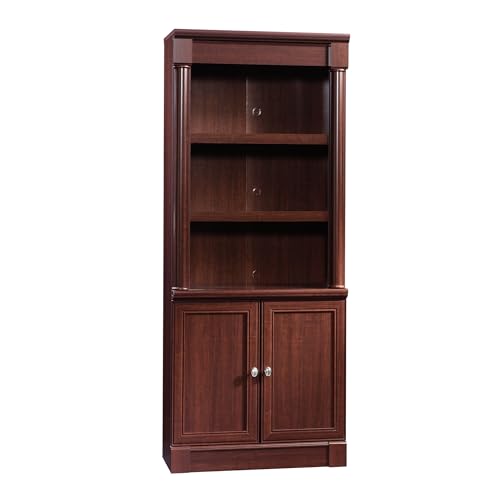
Ask a parent what they want from a bookcase and the honest answer is: a place to put things away that looks like furniture. The Palladia answers better than anything else under $300. Its upper section offers three open shelves — two adjustable — for the family’s books, framed school photos and the pottery-project treasures that deserve daylight. Below, two framed panel doors close over a further adjustable shelf, and that cabinet is where family life actually goes: board games with their battered boxes, craft supplies, the tablet-and-charger tangle (Sauder cuts cord access through the back panel, so devices can charge inside, out of sight and off the kitchen counter), spare batteries, and the remote-control graveyard. Close the doors and the room exhales.
The family details hold up under scrutiny. At about 29.4 inches wide, 13.9 inches deep and 71.9 inches tall, it is a substantial, planted piece — and substantial is what you want once it is anchored, because a case this size does not get knocked askew by a bumped hip or a vacuum cleaner. The enclosed back keeps books from sliding through onto small fingers exploring from behind, the shelf depth around 11.4 inches fits picture-book boxes and game boxes as readily as hardcovers, and the Select Cherry finish with nickel hardware reads as grown-up furniture in the room where adults also live. It is not a children’s product pretending to suit a living room; it is living-room furniture that happens to be excellent at family storage. The Palladia listing on Amazon shows the cabinet layout in detail. Add the Sauder Palladia to your shortlist first if concealment is your pain point.
Pros:
- Doors hide games, crafts and charging clutter — the family superpower
- Adjustable shelves above and inside the cabinet fit changing loads
- Cord access through the back panel for in-cabinet charging
- Enclosed back and deep shelves suit family-sized storage boxes
- Traditional finish looks like furniture, not kids’ storage
Honest limitation: At roughly 91 pounds assembled, this is a build-it-where-it-lives piece, and the doors need swing clearance, so measure the arc before placing it beside a doorway. The warm cherry finish also shows dust readily in bright rooms — a small weekly price for the calm it creates.
Choose it if your living room needs hidden storage more than it needs more open shelves. Skip it if you want an open, airy frame — and read the safety section before choosing any tall case for a home with toddlers. Check the Palladia on Amazon for current availability.
Sauder Beginnings 5-Shelf Bookcase
Best for: Households whose book collection grows every school year and needs tall, adjustable, fully backed shelving that can be re-zoned as kids age.
The Beginnings is the family library in the plainest, best sense. Five shelves — three of them adjustable on pins — inside a tall enclosed case roughly 71 inches high and 24.6 inches wide, with shelves about 11.5 inches deep. In family terms, that adjustability is a decade-long feature: this year the bottom shelves sit low and wide for picture books and board books a small child can pull out independently; in three years the same shelves re-space for chapter books and school binders; later still they take textbooks and the reference shelf nobody expected to own. Few purchases in a family home adapt across that many life stages without being replaced, and a bookcase that avoids replacement is the real budget win under this ceiling.
The enclosed back matters in family service more than in adult-only homes. It stiffens the tall case against the sideways racking that enthusiastic book-pulling produces, stops volumes sliding out the back, and presents a finished face from the side — relevant when the case stands in an open-plan room visible from the kitchen. The traditional finishes coordinate with the Palladia if the family wall eventually grows to two cases, though the Beginnings is plainer: no doors, no framed panels, just honest shelving. That plainness cuts both ways — everything stored is visible, so households drowning in visual clutter should pair it with baskets on the lower shelves, which the depth accommodates well. Assembly is methodical cam-and-dowel work; build it with a partner, anchor it before the first book, and it will quietly serve until the kids argue over who takes it to their first apartment. See the Beginnings listing on Amazon for the current finish options, and note the Sauder Beginnings ships in the line’s standard traditional tones.
Pros:
- Three adjustable shelves re-zone as children grow
- Enclosed back adds stiffness against daily family use
- Deep shelves fit baskets, binders and picture-book boxes
- Tall capacity delays the second-bookcase purchase
- Coordinates with other traditional Sauder cases
Honest limitation: No doors means no concealment — clutter stays visible unless you add baskets. The engineered-wood shelves also ask for sensible loading: full rows of heavy textbooks belong on lower or fixed shelves, not on a top adjustable shelf a child might pull against.
Choose it if books, not clutter, are your main storage problem. Skip it if hiding mess is the priority — that is the Palladia’s job. Check the Beginnings on Amazon before ordering to confirm the finish in stock.
VASAGLE Custos Collection Bookcase
Best for: Rooms that change jobs — a nursery corner today, a homework station in five years, a teen’s room after that.
The Custos earns its family place through adaptability in a smaller footprint. The Custos collection’s enclosed cases run around 23.6 inches wide and 63 inches tall in the six-tier configuration, with adjustable shelves and a shallower depth near 9.4 inches that suits bedrooms, hallways and the ends of living-room walls where a full-depth case would crowd the walkway. For a family, that shallowness is a feature in the rooms where kids actually play: less projection into the room means fewer bumped heads at case-corner height and a walkway that stays a walkway. The adjustable shelves let the case start life holding nappy caddies, folded blankets and board books, then re-space for school files, games and novels without a single new purchase.
The rustic finishes in the Custos line are forgiving in the way family furniture needs to be: mid-tone, textured-look surfaces show fewer fingerprints and minor scuffs than gloss white or piano black, and the enclosed silhouette keeps a child’s bedroom looking calm even when the shelves are working hard. VASAGLE sells the Custos design in several sizes and finishes under related listings, so if this household later needs a matching second case for a sibling’s room, the design language is there to match. Use the included anti-tip hardware — a 63-inch case in a child’s room is anchored, no debate — and put the heaviest storage on the bottom tiers. The Custos listing on Amazon shows this variant’s configuration; the wider VASAGLE Custos family is worth a browse if your wall is broader than your room is deep.
Pros:
- Shallow depth keeps walkways clear in kids’ rooms
- Adjustable shelves adapt from nursery to teen storage
- Forgiving mid-tone finishes hide family wear
- Mid-size footprint fits bedrooms and hallways
- Matching sizes exist for future sibling-room pairs
Honest limitation: The roughly 9.4-inch depth rules out deep storage bins and the largest picture-book boxes — measure the boxes you actually own. It is also an engineered-board case, so standing water from a spilled drink cup left overnight will mark it; coasters are cheaper than regrets.
Choose it if the case will serve a child’s room through several ages. Skip it if you need deep, living-room-scale storage — look at the Palladia or Beginnings. Check the Custos on Amazon for this variant’s availability.
Sauder 5-Shelf Split Bookcase
Best for: Families who like the enclosed-case idea but want a layout that separates display from everyday storage in one unit.
The Split is Sauder’s other long-running answer to family shelving: a five-shelf enclosed bookcase whose split arrangement breaks the usual uniform grid, giving the case distinct zones rather than five identical slots. In family use, zones are quietly powerful. One zone becomes the parents’ shelf — cookbooks, the good novels, the framed photo that should not be within reach of jam-covered hands. Another takes the children’s current rotation at their height. A third absorbs the household overflow: manuals, school paperwork, the board games in active service. Because the case is enclosed and backed like the Beginnings, it carries the same structural virtues — stiffness, no books escaping out the back, a finished look from the side — while the varied layout keeps it from reading as a plain storage block.
As with every Sauder case here, expect engineered wood, traditional-leaning finishes and a cam-and-dowel assembly that rewards a slow, square build. The split layout does ask you to plan before loading: measure your tallest zone-needing items — a standing binder collection, a tall game box — against the shelf gaps your configuration creates, because a split design trades some of the uniform adjustability of the Beginnings for its zoning. Families who think in zones will find that trade easy to accept; families who shelve purely by the linear foot should choose the Beginnings instead. Either way, anchor it: five tall shelves of family books is exactly the load profile wall straps exist for. The current configuration is shown on the Sauder Split listing on Amazon, and the Split bookcase remains one of the line’s longest-running designs for a reason.
Pros:
- Zoned layout separates parents’ shelves from kids’ shelves
- Enclosed back for stiffness and a finished look
- Five shelves of genuine family capacity
- Traditional styling suits shared living spaces
- Long-running Sauder design with proven hardware
Honest limitation: The split layout is less uniformly adjustable than the Beginnings, so very tall items have fewer places to go. Plan your zones against your tallest books and boxes before you load it, not after.
Choose it if your family naturally divides shelves into territories. Skip it if you want maximum identical shelf space — the Beginnings is the straighter tool. Check the Split on Amazon for the current listing details.
Furinno Turn-N-Tube 5-Tier Corner Display Rack, Black (99811)
Best for: Light display in the corners of family rooms — plants, framed photos, a small speaker — never as a child’s bookcase or climbing-adjacent storage.
Every family room has a corner that collects nothing but dust and a charging cable, and this light rack is the honest way to claim it. Five corner-shaped tiers in an 11.6-by-11.6-inch footprint, standing about 57.7 inches, assembled by twisting composite-wood shelves onto PVC tubes with no tools at all, and light enough — about 9 pounds — for one adult to move during a Saturday tidy. In a family home its best jobs are adult-height display: the plant that must live out of toddler reach, framed photos, a small clock, the paperbacks currently being read. Placed in a corner, it also softens the room’s geometry in a way straight furniture cannot.
Now the family honesty, stated as plainly as the maker states the numbers: each shelf is rated at about 10 pounds, 50 pounds total. This is not a bookcase for a child’s collection, not a step, not a surface for heavy storage, and in a home with climbing-age children it belongs in a parent zone — a home-office corner, a living-room display corner — rather than a playroom. Used within those limits it is genuinely handy, and its price leaves nearly all of the $300 budget for the real family case it accompanies. Think of it as the garnish of this guide, not the meal. It is listed as the Furinno corner rack on Amazon, and the Turn-N-Tube corner shelf comes in several finishes if black does not suit your corner.
Pros:
- Claims an 11.6-inch corner no straight case can use
- Tool-free assembly and featherweight to reposition
- Five tiers of adult-height display for plants and photos
- Leaves most of the budget for the main family case
- Simple finish options coordinate with most rooms
Honest limitation: Ten pounds per shelf and a light PVC-tube frame rule it out for children’s books, heavy storage or any household role where it might be climbed on or leaned against. Keep it in adult zones and load it lightly.
Choose it if a dead corner needs light display duty. Skip it if you need any real book capacity — every other pick here out-carries it many times over. Check the Furinno on Amazon for current finishes.
A Low Cube Bookcase for the Kids’ Own Zone (Prose-Only Pick)
Best for: Children roughly ages two to seven, whose books are picture books — wide, thin, and chosen by their covers.
Here is the gap no tall case fills. Young children do not browse spines; they browse covers. A low cube or cubby bookcase — typically 24 to 36 inches tall, divided into open square compartments at toddler and preschooler height — lets a child see, choose and, just as importantly, put away books independently, which is how reading corners actually get used. Cubbies also swallow the odd shapes of early childhood better than shelves do: the oversized board book, the sound book with the battery bump, the basket of soft toys that must live beside the books for story time to work.
We are not linking a specific model here, deliberately: we could not verify a branded cube bookcase and its Amazon listing to the standard this site requires for a linked recommendation, and an invented ASIN would be worse than none. Shop the style with this checklist instead. Height no more than about 36 inches, so the top stays reachable and the tip risk stays low — and anchor it anyway. Rounded or sanded edges, a finish that wipes clean, and cubbies at least 12 inches square for picture-book formats. A solid or panelled back keeps books from vanishing behind the unit, and a plinth or recessed base resists the toe-stubbing and rocking that freestanding frames invite. In budget terms this style is a mid-range purchase that pairs with one tall case from this guide: tall case for the family’s books, low cubes for the children’s own — together they come in comfortably under the $300 framing for most households, and each does the job the other cannot.
Pros:
- Child-height access builds independent reading habits
- Cubbies fit picture books, board books and toy baskets
- Low profile is inherently more stable than tall cases
- Keeps children’s books out of the main family case
Honest limitation: Children outgrow it — expect it to serve the picture-book years and then retire to toy or craft storage. And because we could not verify a specific model, you will need to apply the checklist above to whichever listing you choose, checking dimensions and materials yourself.
Choose it if you have a reader under seven. Skip it if your children are older — put the whole budget into a tall adjustable case instead.
Safety First: Anchoring and Stability in a Family Home
This section is not boilerplate. Tall furniture tip-over is a recognized household hazard, and bookcases are among the most commonly involved items precisely because they are tall, heavy when loaded, and tempting to climb when a wanted book sits on a high shelf. The rules are simple and absolute. Anchor every tall case in this guide to the wall using the included kit at minimum, into a stud where possible, with hardware matched to your wall type. Load heavy books low and light items high — a bottom-heavy case is a stable case. Teach children early that shelves are not ladders, and keep the most-wanted children’s books on the lowest shelves so there is nothing worth climbing for. Keep the case off thick carpet where you can, or check level carefully if you cannot, because a case leaning even slightly is a case working against its anchor. Finally, re-check anchors after any move, any earthquake, and any time the case is emptied and refilled — anchors are a habit, not an event. No styling advice in this guide outranks these five sentences.
Zoning a Shared Case: A Shelf-by-Shelf Plan
When one bookcase serves the whole family, arrangement is not decoration — it is the system that keeps the case working. Here is the zoning plan we recommend for a tall enclosed case like the Palladia or Beginnings. The bottom shelf belongs to the youngest readers: their current books, stored upright with room to pull one out without an avalanche, plus one basket for the soft toys that attend story time. The second shelf is the family’s shared working shelf — library books in transit, the homework folder, the board game in current rotation — because material that lives at adult waist height gets put away instead of piling on the table. Middle shelves carry the household reference layer: cookbooks near the kitchen side of the room, school binders, the manuals worth keeping. The cabinet, if your case has one, takes everything with a cord, a battery or a small part: chargers, game pieces in a lidded box, craft supplies that stain.
The top shelves are adult territory and should be arranged like it: the books you would grieve if a juice box won, framed photographs, anything fragile or irreplaceable. Keeping this zone visibly calm matters more than it sounds — it is the part of the case at adult eye level, and a serene top shelf makes the whole room feel ordered even when the children’s zones are in cheerful disarray below. Review the zones twice a year, at the natural family resets of a new school year and a new year: books the children have outgrown move up or move out, school material graduates a shelf, and the case quietly tracks the family’s life instead of freezing it at the age everyone was when it was assembled. That twice-yearly half hour is the entire maintenance the system asks for, and it is why an adjustable case keeps earning its floor space long after fixed furniture has been outgrown.
Comparison Table
| Bookcase | Format | Concealed storage | Adjustable shelves | Family role |
|---|---|---|---|---|
| Sauder Palladia | Enclosed, ~71.9″ tall | Yes — cabinet with doors | Yes | Main living-room case |
| Sauder Beginnings 5-Shelf | Enclosed, ~71″ tall | No | Yes (3) | Growing family library |
| VASAGLE Custos | Enclosed, ~63″ tall | No | Yes | Kids’ rooms, changing jobs |
| Sauder Split 5-Shelf | Enclosed, split layout | No | Partly | Zoned family storage |
| Furinno Corner Rack | Corner, ~57.7″ tall | No | No | Light adult display only |
| Low cube bookcase | Cubby, ≤36″ tall | No | No | Children’s picture books |
How to Choose the Best Bookcase for Families Under $300
Decide where childhood happens. If the case lives in a shared living room, concealment and looks matter — Palladia first. If it lives in a child’s room, shallow depth, forgiving finishes and adaptability matter more — Custos first. If it is the family’s one growing library, capacity and adjustability lead — Beginnings or Split. Matching the pick to the room’s real job prevents the most common family-furniture regret: the right bookcase in the wrong room.
Plan shelf zones by height. Bottom shelves: children’s current books, at their height, replaceable and robust. Middle shelves: family shared material — games in the cabinet, reference, cookbooks. Top shelves: adult-only and precious — first editions, framed pieces, anything that must survive childhood untouched. Adjustable shelves make this zoning possible now and re-zoning painless later; fixed layouts force the zones to fit the furniture instead of the family.
Budget for baskets. Two or three baskets sized to your case’s shelf depth turn open shelves into family-proof storage for the small, the soft and the chaotic — crayons, remotes, soft toys. The Beginnings and Custos depths suit standard baskets; measure yours before ordering either. For the wider category context, see our base guide to the Best Bookcase Under $300, and for smaller budgets our earlier family coverage at Best Bookcase For Families Under $150.
Think in five-year spans. The cheapest family bookcase is the one bought once. Adjustable, enclosed, anchorable cases in neutral traditional finishes survive the nursery-to-teen journey and the living-room years on either side of it. Novelty shapes and fixed, themed designs serve one age and then become the furniture you are trying to give away.
Common Buying Mistakes
Skipping the anchor “because it’s heavy.” Weight is what makes tip-over dangerous, not what prevents it — anchor every tall case. Putting kids’ favorites up high. That is an engraved invitation to climb; the current top-ten books live on the lowest shelf, always. Buying open ladder frames for toddler rooms. To a three-year-old, a ladder shelf is playground equipment with books on it. Choosing gloss white for a play zone. It will record every crayon and scuff; mid-tone finishes forgive family life. Forgetting door swing. A cabinet case beside a hallway door will collect collisions — measure the arc. Loading the top adjustable shelf with textbooks. Heavy rows go low and on fixed shelves; pins are for flexibility, not for the encyclopedia set.
Setting Up a Family Reading Corner That Actually Gets Used
A bookcase alone does not make readers; a corner does. The formula that works in real family homes is unglamorous: the low shelves of your main case or a cube unit within the child’s easy reach, one soft place to sit that is genuinely comfortable for an adult too — because the youngest readers read on laps — and light that falls on the page rather than in the eyes. Place the reading corner near the family’s evening gravity, the living room or a bedroom corner, not in a room nobody enters; books exiled to a spare room are books in storage, whatever the intention. Keep the children’s selection small and rotating: eight to twelve picture books face-out or spine-out at child height, refreshed weekly from the main collection, outperforms forty books crammed permanently at toddler level, because choice overload is real at age four and a fresh rotation makes old books feel new again.
Two practical additions multiply the corner’s use. A small basket beside the case — the library basket — gives finished books a landing place that is not the floor, and gives you a painless tidy-up routine a preschooler can own. And a rule the whole family can keep: books live in the corner or in hands, nowhere else. It sounds strict; in practice it is what keeps the collection findable, the favorites unlost, and the bookcase a place children visit with pleasure rather than a shelf they are scolded around. As children grow, the corner graduates rather than disappears: the cube unit moves on to craft storage, the main case’s adjustable shelves re-space upward, and the soft chair stays — teenagers read in corners too, they just call it something else.
How a Family Bookcase Earns Its Keep Over a Decade
It is worth doing the quiet arithmetic of family furniture. A bookcase bought for a newborn’s room that cannot adapt will be replaced at the picture-book stage, again at the homework stage, and the “cheap” choices will quietly outspend one good case. The picks in this guide were chosen to break that cycle. An adjustable enclosed case bought under this ceiling can plausibly serve from nursery-adjacent storage through primary school, secondary school and into the living room or a first flat beyond — not because it is indestructible, but because nothing about its job becomes obsolete. The shelves re-space. The finish stays neutral. The cabinet keeps hiding things; only the things change, from nappy supplies to exam files to the household paperwork of adult life.
That longevity argument is also why we steered this list away from novelty. Character-themed children’s bookcases have a two-year window of delight and a decade of embarrassment, and their fixed, themed compartments fit exactly one stage of book. If a child’s room needs personality, put it in the things that are cheap to change — the basket colors, the bookends, the cushion in the reading corner — and let the case itself stay the calm, adaptable background. Families who buy this way end up owning less furniture and liking all of it more, which is the real destination of every guide on this site. For households still deciding between one adaptable case and several cheap ones, our base comparison in the Best Bookcase Under $300 guide lays out the wider field at this budget.
Final Recommendation
For most households, the Sauder Palladia is the best bookcase for families under $300: its doored cabinet is the only design here that truly hides family clutter, and its adjustable open shelves handle the display half of family life with equal ease. Pair it with a low cube bookcase in the children’s own corner and the system is complete — grown-up calm in the living room, independent browsing where the small readers live. Choose the Beginnings if your family’s problem is sheer book volume, the Custos for children’s rooms that will change jobs over the years, and anchor everything before the first book goes in.
Family-Proofing the Finish: Cleaning, Wear and Small Repairs
Family furniture lives a harder life than its product photos suggest, so it is worth knowing what each finish in this guide tolerates before the first juice box incident. Laminate and thermofoil finishes on engineered wood — the world the Sauder and VASAGLE cases live in — wipe clean with a damp cloth and shrug off the daily film of fingerprints, but they fear two things: standing water, which swells the board beneath any chipped edge, and abrasive scouring, which dulls the surface permanently. The family rules are therefore simple: spills get wiped when they happen rather than at the weekend, drinks live on coasters even — especially — on the “temporary” top shelf, and cleaning means a soft cloth and mild soap, never a scouring pad.
Expect wear in predictable places and plan for it rather than mourning it. Shelf front edges take the knocks of books sliding in and out; a clear edge protector strip on the children’s shelves costs almost nothing and saves the finish where small hands work hardest. The bottom shelf and the case’s lower corners will meet toy cars, vacuum cleaners and the occasional ride-on collision — mid-tone finishes like the Palladia’s cherry and the Custos rustic tones hide the evidence far better than white or black gloss, which is one more reason this guide favors them for family duty. Small chips in laminate can be touched in with a furniture marker in a matching tone; it is a five-minute repair that keeps a case looking cared-for through a decade of service. And keep the assembly hardware — the spare cams, pins and the anchor strap — in a labeled bag inside the cabinet or taped to the case back, because the day you re-space shelves or move house is the day you will be glad you did.
Frequently Asked Questions
What is the safest type of bookcase for a home with toddlers?
A low, wide bookcase is inherently the most stable, which is why we recommend a low cube unit for the children’s own zone. For tall cases, safety comes from anchoring to the wall, loading heavy books low, and keeping climb-worthy temptations off high shelves. Enclosed cases with backs are also stiffer and less ladder-like than open frames.
Do bookcase doors really matter for families?
For most families, yes. Doors convert one section of shelving into true concealed storage — games, crafts, chargers, paperwork — and that single feature is the difference between a living room that tidies in two minutes and one that never quite does. If your storage is all display-worthy, open shelves are fine; few family households can honestly say that.
How do I stop children climbing a bookcase?
Anchor the case, keep desired items on the lowest shelves so there is nothing to climb for, place a genuinely climbable alternative (a play structure, a step stool they are allowed to use with you) in their world, and be consistent that shelves are never ladders. Furniture arrangement helps too: a case hemmed by other furniture offers fewer climbing angles than one standing alone.
Are adjustable shelves important for a family bookcase?
They are the feature that lets one case serve a child from board books to textbooks. Shelf gaps that fit picture books today can be re-spaced for binders and novels later, which is why four of our five linked picks offer adjustment or zoned layouts. Fixed shelves can work, but measure your tallest items first.
What size bookcase suits a family living room?
Most family living rooms suit a case 24 to 30 inches wide and 63 to 72 inches tall — substantial enough for real capacity, small enough to leave the room breathing. Depth of 11 to 14 inches handles games and baskets; shallower cases suit bedrooms and hallways better.
Can a bookcase work in a child’s bedroom and a living room at different times?
Yes — that is exactly the Custos use case, and mid-tone traditional cases like the Beginnings also move between rooms gracefully. Neutral finishes and enclosed silhouettes transfer; themed or novelty designs do not. Buying transferable furniture is one of the quietest budget wins available to families.
How much weight can a family bookcase shelf hold?
It varies by design, and makers publish limits for some models — the Furinno corner rack in this guide, for example, is rated at about 10 pounds per shelf and is a display piece only. For enclosed cases without a published figure in our sources, the safe practice is universal: heaviest books low, spread across the shelf, never concentrated on a high adjustable shelf.
When should a child’s bookcase be replaced by a full-size one?
When the books change shape. Once a child’s reading shifts from picture books to chapter books, binders and textbooks — usually somewhere in the later primary years — spine-out shelving on an adjustable full-size case serves them better than cubbies. The low unit rarely goes to waste: it graduates to toy, craft or game storage, which is why we suggest buying it as a complement to a tall case rather than instead of one.
Is it worth spending close to $300 on a family bookcase?
If the case is adjustable, enclosed and neutral enough to move between rooms and life stages, yes — one case serving a decade costs less than three stage-specific purchases. Spend the budget on structure and adjustability rather than decoration, anchor it properly, and the cost per year becomes one of the smallest in the family furniture budget.
Where should a family bookcase go in the house?
Where the family actually spends its evenings — usually the living room for the main case, with the low cube unit in the child’s own room or play corner. A bookcase exiled to a spare room becomes storage; a bookcase in the room’s daily gravity becomes the reading habit’s engine. Place it on the wall the seating faces, anchored, with the children’s zone at the bottom.