Where to buy
Check the latest price, availability and delivery on Amazon. Orders are placed on Amazon. We may earn a commission from qualifying purchases.
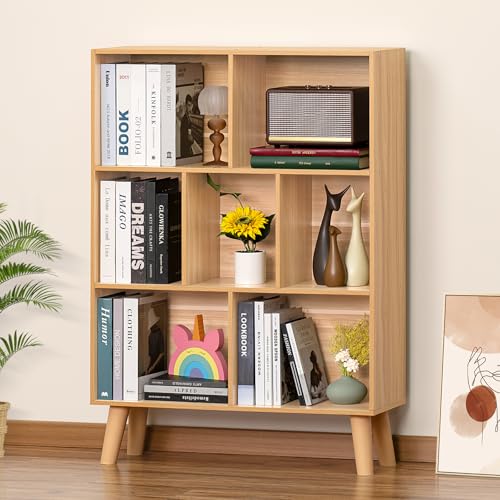
- Best for kids’ reach: LEYAOYAO 7-Cube 3-Tier Bookcase with Legs, Natural — Check on Amazon
- Furinno Luder 5-Tier Bookcase with Door Cabinet, White — Check on Amazon
- Sauder Beginnings 5-Shelf Bookcase, Cinnamon Cherry — Check on Amazon
- VASAGLE Custos Collection 6-Tier Bookcase, Rustic Brown — Check on Amazon
- NUMENN 5-Tier Bookshelf, Vintage Industrial — Check on Amazon
See 1 more Amazon option
- Casual Home 3-Shelf Folding Bookcase, Natural Solid Wood — Check on Amazon
Read the full guide ↓
Disclosure: As an Amazon Associate, dailyhomedecorating.com earns from qualifying purchases. Links to Amazon on this page are affiliate links; they cost you nothing extra. Listing details such as price and availability change often, so check the current Amazon listing before you buy.
The best bookcase for families under $150 has a harder job than any other bookcase in the house. It is climbed on, leaned against, used as a parking garage for toy cars and a stage for stuffed animals. It holds picture books that are wider than they are tall, board games with boxes that fit nothing, school projects that cannot be thrown away, and — somewhere in the middle of it all — the books the adults actually read. A family bookcase has to be safe before it is anything else: anchored, stable, with nothing sharp at toddler head height and nothing precious at toddler hand height. Then it has to be forgiving, because it will be loaded by people who do not read buying guides, in arrangements no designer would choose, and it has to keep standing anyway.
This guide judges bookcases the way family life actually uses them. Safety comes first — every tall pick here must be anchored to a wall stud, and we say so plainly rather than treating the strap as an accessory. Reach comes second: a family bookcase works when the bottom shelves belong to the children (their books, their baskets, their clutter) and the top shelves belong to the adults, so the case has to be useful at both heights. Storage shape comes third, because family storage is not book-shaped: it is cube-shaped, basket-shaped and game-box-shaped, and the picks below were chosen for how they handle the odd geometry of real family stuff. If your family room is also small, pair this guide with our picks for the Best Bookcase For Small Spaces Under $150; if the budget is the binding constraint, start from the main Best Bookcase Under $150 roundup and come back here for the family-specific checks.
Our headline answer: for most families, the low LEYAOYAO cube bookcase is the one to buy first — children can reach every shelf, there is nothing tall to tip, and the cubes swallow toys and picture books as happily as novels. Families who need a tall case for a shared living room should look at the Sauder and the VASAGLE, both adjustable, both enclosed enough to look like furniture, both serious about anchoring. And the Furinno Luder’s little door might be the hardest-working feature in this entire guide, because the fastest way to make a family room look calm is to give the clutter somewhere hidden to go.
In this guide
Quick Picks
| Pick | Bookcase | Best for | Family strength | Amazon |
|---|---|---|---|---|
| Best for kids’ reach | LEYAOYAO 7-Cube 3-Tier, Natural | Playrooms, kids’ corners | Low height, cube storage | Check on Amazon |
| Best for hiding clutter | Furinno Luder 5-Tier with Door | Shared living rooms | Closed cabinet section | Check on Amazon |
| Best tall family case | Sauder Beginnings 5-Shelf | Big mixed collections | Deep, adjustable, enclosed back | Check on Amazon |
| Best adjustable | VASAGLE Custos 6-Tier | Rooms that change as kids grow | Adjustable shelves, 6 tiers | Check on Amazon |
| Toughest frame | NUMENN 5-Tier Industrial | Playrooms, dens, media | Steel frame, 30 lb per shelf | Check on Amazon |
| Best no-assembly | Casual Home 3-Shelf Folding | Renting families, spare rooms | Solid wood, folds flat | Check on Amazon |
How These Picks Were Chosen
Family suitability is not a style; it is a set of tests. We required every pick to pass five. First, anchorability: any case tall enough to tip must accept a wall strap and be built rigidly enough for the strap to matter — panel cases with backs and steel frames pass; wobbly tube systems do not appear in this guide’s tall slots. Second, reach zoning: the case must be genuinely useful at child height and adult height at once, either by being low (LEYAOYAO, Casual Home) or by having enough shelves to zone (Sauder, VASAGLE, NUMENN). Third, cube-and-basket compatibility: family storage runs on fabric bins and game boxes, so shelf depth and spacing had to swallow them. Fourth, cleanability: finishes that wipe down, frames that do not trap crumbs in decorative grooves. Fifth, boring reliability: established brands and models with replaceable parts and instructions a tired parent can follow at 9 p.m. — because that is when family furniture actually gets built.
We left out glass-fronted cases (beautiful, wrong decade of life), open ladder shelves for the main family slot (a ladder profile invites climbing in a way a straight case does not), and anything whose assembly depends on parts that cannot be re-ordered. Prices in this category move weekly, so per site policy we print none — check price on Amazon against the under-$150 family budget these picks were selected for. Families whose budget runs higher will find the reinforced, furniture-grade step-ups in our guide to the Best Bookcase For Families Under $300.
There is also a quieter family test we applied to every pick: the Sunday-afternoon test. Can this case absorb the objects a family actually generates in a week — the library haul, the school art, the gifted toy, the board game with the broken box — without looking defeated by Friday? Cases fail this test in predictable ways: shelves too shallow for the art portfolio, no closed space for the ugly-but-essential, finishes that record every cup ring. The six picks above pass it in different ways — cubes, doors, depth, steel — and the reviews are frank about which kind of family chaos each one handles best. Choose for the chaos you actually have, not the calm you aspire to, and the bookcase will still look good in the photographs.
Best Bookcase for Families Under $150: The 6 Picks
LEYAOYAO 7-Cube 3-Tier Bookcase with Legs, Natural
Who it suits: Families with children under eight, and any household that wants the kids’ storage to be reachable by the kids. This is the bookcase that ends the “Mum, get my book” era.
The LEYAOYAO is built low and wide: three tiers of open cubes — seven cubes in two sizes — on short legs, in a natural wood finish that suits the boho-Scandi direction most family rooms have drifted toward. The format is the safety story. A low case has a low centre of gravity, presents no tall climbing profile, and puts every shelf within a child’s reach, which is not a convenience but a developmental feature: children use, tidy and take pride in storage they can operate themselves. The two cube sizes matter more than they sound — the larger cubes take picture books standing upright (the geometry that defeats most bookshelves), fabric bins and board-game boxes; the smaller ones take chapter books, small toys and the endless craft supplies. Raised on legs, it also lets a vacuum pass underneath, which in a family home is not a detail.
Pros:
- Low profile — every shelf reachable by children, nothing tall to climb or tip
- Seven cubes in two sizes fit picture books, bins and game boxes
- Natural finish and legs give it a furniture look, not a toy-store look
- Works as a room divider between play and living zones in open-plan rooms
Honest limitation: It stores like a low sideboard, not a library — a serious adult collection will outgrow it, and the open cubes display everything, so visual calm depends on bins. Even at this height, anchor it if a determined climber lives with you; low is safer, not invincible.
Choose it if your children’s books and toys are the main storage problem. Skip it if you need tall adult storage — pair it with one of the tall picks below instead of forcing it to be both.
Living with it: The LEYAOYAO quietly becomes the room’s command centre. Picture books stand in the big cubes where a small person can flip through them face-out; the day’s library haul gets its own cube; the bottom row becomes the toy rotation — this week’s blocks and animals at hand, last week’s swapped into a bin on top. Because children can reach and therefore tidy it themselves, the five-minute evening reset actually involves the people who made the mess, which parents consistently describe as the feature they did not know they were buying. Style the top surface lightly — a plant out of reach and the current bedtime-story stack — and the whole thing reads as intentional furniture rather than toy storage.
Furinno Luder 5-Tier Bookcase with Door Cabinet, White
Who it suits: Families whose living room must look like adults live there by 8 p.m., whatever happened at 4 p.m. The door is the feature; everything else supports it.
The Luder splits its roughly 52-inch height between open display tiers and a closed door cabinet, in a compact footprint about 12 inches wide and 9.3 inches deep. In family service that split maps perfectly onto the house rules: open shelves for the books and objects everyone is allowed to touch, door closed over the rest — the game controllers, the craft box, the chargers, the paperwork pile, the toys that are technically “tidied.” Closed storage is also a safety tool in disguise: cleaning products, batteries and small-parts toys that live in a family room can go behind the door and up a level, out of the toddler zone entirely. The white finish brightens small rooms and wipes clean, and the narrow footprint fits the wall sliver beside a sofa or door frame that family rooms always seem to have left over.
Pros:
- Door cabinet hides clutter and keeps small hazards out of reach
- Narrow footprint fits leftover wall spaces
- White finish wipes clean and brightens the room
- Light enough to move when the room gets rearranged — and it will
Honest limitation: The 9.3-inch depth rules out big picture books and atlases, and the light frame is built for everyday loads, not for a shelf of encyclopedias. Treat it as the family’s organizer, not its archive.
Choose it if visual calm and hidden storage top your list. Skip it if your storage is mostly large-format books — the Sauder below is built for those.
Living with it: The Luder’s door develops a household nickname within a month — the “away” place. Homework folders, the good scissors, the tablet charger, the birthday-party invitations awaiting reply: everything that used to live on the kitchen counter migrates behind that door, at adult height, behind a closed front that small visitors do not think to open. The open tiers above take the respectable display — a row of cookbooks, a plant, the family photo — and because the footprint is so narrow, the Luder often ends up in the hallway landing or beside the sofa, the two places family clutter actually accumulates. Wipe the white finish weekly; in family service it earns its brightness honestly.
Sauder Beginnings 5-Shelf Bookcase, Cinnamon Cherry
Who it suits: The family that needs one serious, tall, enclosed case for the whole household collection — adult books up top, kids’ books down low, games and bins in the deep middle.
At 71.1 inches tall, 24.6 inches wide and 11.5 inches deep, the Beginnings is the capacity anchor of this guide, and its family credentials are structural. The enclosed back panel stiffens the case (a strapped, rigid case is a safe case), the depth swallows the big flat picture books and board-game boxes that defeat shallower shelves, and three adjustable shelves let you zone the case by age: toddlers’ board books and baskets at the bottom where small hands belong, chapter books at school-kid height, adult novels and anything fragile or precious on the top shelves that require a step stool and therefore permission. The cinnamon cherry finish is the traditional, forgiving kind — it hides the fingerprints and minor dings of family service better than gloss white or black.
Pros:
- Deepest shelves here — picture books, games and bins fit properly
- Adjustable shelves let the case be re-zoned as children grow
- Enclosed back adds rigidity — and keeps books off the wall
- Warm finish hides everyday family wear
Honest limitation: It is tall, which means the wall anchor is not a suggestion — budget the ten minutes and a stud finder. It is also the biggest build in this guide; assemble it in the room it will live in.
Choose it if one tall case must serve the whole family’s books. Skip it if you cannot anchor to a wall where it will stand, or your ceilings and doorways argue with 71 inches. Open-format alternatives for shared rooms are covered in our Best Bookshelf For Families Under $150 guide.
Living with it: Families tend to load the Beginnings like a layer cake of childhood: board books and a basket of soft toys on the fixed bottom shelf, picture books at preschooler height, chapter books and games in the deep middle where the boxes actually fit, parents’ novels and the good vase up top. The cherry finish proves its worth here — sticky fingerprints and the occasional crayon expedition wipe off without drama, and the enclosed back means dropped bookmarks and puzzle pieces stay in the case instead of vanishing behind it. Re-zone the adjustable shelves each September; it takes fifteen minutes and the case feels new every school year.
VASAGLE Custos Collection 6-Tier Bookcase, Rustic Brown
Who it suits: Families whose storage needs change every school year — which is to say, all of them. The Custos is the pick that adapts instead of being replaced.
Six tiers, 23.6 inches wide, 63.3 inches tall, with adjustable shelves: in family terms, adjustability is a growth plan. This year the bottom two shelves are set wide for picture books and a toy basket; in three years the same shelves tighten down for chapter books and school binders; the top tiers quietly hold the adults’ books throughout. The panel-built, footless design sits flush and solid — no legs to trap toy cars underneath, no gap behind for crayons to vanish into — and the rustic brown finish is the hardest-working colour in family furniture, camouflaging the scuffs that white would announce. At 63 inches it is tall enough to need its wall strap, and the rigid panel construction makes that strap fully effective.
Pros:
- Adjustable shelves re-zone the case as children grow
- Six tiers — room for kids’ and adults’ collections together
- Footless base: nothing rolls underneath, nothing hides
- Rustic finish forgives scuffs and fingerprints
Honest limitation: The 9.4-inch depth is shallower than the Sauder’s, so the very largest picture books and game boxes may sit proud of the edge. And six tiers of family storage will tempt everyone to overfill the top — keep heavy rows low.
Choose it if you want one case that evolves with the family for years. Skip it if maximum depth for oversized books is the priority.
Living with it: The Custos is the diplomat of this guide — the case parents choose when the living room must serve children all day and adults all evening. By day the lower shelves are a working library of picture books and homework; by night the rustic finish and tidy panel lines let the room pass as a grown-up space with the lights low. The footless base is a small daily mercy: no toy cars parked underneath, no archaeological layer of crayons behind it. Families report the adjustable shelves earn their keep at every growth spurt — the case gets re-planned, not replaced, which is the whole economic argument for buying adjustability at this age.
NUMENN 5-Tier Bookshelf, Vintage Industrial
Who it suits: The playroom, den or teenager’s room — anywhere the bookcase will be treated less like furniture and more like infrastructure.
The NUMENN’s steel frame and wood shelves are rated by the manufacturer at up to 30 pounds per shelf, with support bars and adjustable feet. In family service that translates to indifference: it does not care about the shelf of atlases, the console and its games, the crate of building blocks, or the printer parked at working height. The open frame is the easiest design here to clean — crumbs, glitter and the mysterious sticky patch all surrender to a cloth passed straight through — and adjustable feet keep it level on the sloping floors of older family homes. Teenagers, in particular, treat this style as a feature: it reads industrial rather than parental, and it survives the poster-and-LED-strip redecoration era without looking wrong.
Pros:
- Steel frame with a stated 30 lb per-shelf capacity
- Open design — fastest to clean in this guide
- Adjustable feet for uneven floors
- Style survives the journey from playroom to teen room
Honest limitation: Open sides mean books and boxes can be pushed through from behind, and nothing is hidden — in a formal living room it can look utilitarian. Anchor it like any tall case; a steel frame is strong, not tip-proof.
Choose it if durability and easy cleaning beat looks. Skip it if the case will stand in a formal room or you need concealed storage.
Living with it: In playroom service the NUMENN develops a personality: games console and controllers on one shelf, the crate of construction toys on another, art supplies in open boxes where they can be seen and therefore used. Teenagers inherit it gratefully — records, novels, a small speaker, the trophies — and the industrial frame never looks like hand-me-down furniture, which at fourteen is the entire ballgame. The open back means cables pass through freely, making it the natural media shelf of this guide. Dust it with a long duster monthly; the open frame makes that a two-minute job instead of a shelf-by-shelf excavation.
Casual Home 3-Shelf Folding Bookcase, 27.5-Inch, Natural
Who it suits: Renting families, military families, and anyone whose address changes faster than their furniture budget. Also grandparents setting up a grandchildren’s corner without committing to it forever.
The Casual Home is built from solid wood and does something no other pick here can: it folds. The shelves pivot flat for moving or storage and open out for use with no assembly at all — no cam locks, no Allen key, no 9 p.m. build. At 27.5 inches wide with three shelves it is a modest, low case: picture books, a basket of toys, the grandparents’-house collection, a reading corner that can be folded away when the room needs to be a guest room again. The units are also stackable, so a family can start with one and add a second on top when the collection (or the family) grows. Solid wood construction gives it a weight and repairability that flat-pack at this price rarely matches.
Pros:
- Zero assembly — folds open, folds flat for moving or storage
- Solid wood build, repairable and sturdy
- Low three-shelf height is child-friendly
- Stackable — grow the system one unit at a time
Honest limitation: Three shelves is a corner’s worth of storage, not a household’s. Folding hinges are a moving part — they are well proven in this design, but a folding case will never feel quite as monolithic as a fixed, backed case.
Choose it if you move often or need flexible, occasional storage. Skip it if you need one permanent high-capacity case. Smaller-budget families should also compare the picks in our Best Bookcase For Families Under $100 guide.
Living with it: The folding case lives a double life. Most weeks it stands in the children’s corner holding the current rotation of bedtime books and a basket of quiet toys; when grandparents visit or the room must become a guest room, it folds flat against a wall in under a minute and the corner is clear. Families who move for work describe it as the one piece of children’s furniture that has survived every address, because it travels in the car rather than the truck. The solid wood takes the knocks of that life — a scuff sands out, a corner can be glued — in a way laminate simply cannot match.
Setting Up Zones: A Shelf-by-Shelf Plan That Works
If you take one practical idea from this guide, take the zone plan, because it converts any of these cases from storage into a system. Bottom shelf — the toddler constitution: board books, soft toys, one basket of rotating playthings; everything here must be safe for the youngest person in the house, because everything here will be reached by them. Second shelf — the preschool shelf: picture books standing upright, puzzles, the art-supply box with a lid. Middle shelves — school age: chapter books, homework station supplies, board games whose boxes finally fit somewhere. Top shelves — the adult shelf: parents’ books, decor, the plant, anything fragile, heavy-looking or boring enough to be safe from curiosity. The plan works because it respects how children actually behave: they use what they can reach, they ignore what they cannot, and they climb only when something irresistible is visible and just out of reach — so keep the irresistible things invisible, in the Luder’s cabinet or another room entirely.
Two small systems keep the zones alive past the first month. The first is the one-in-one-out basket: the toddler basket holds what it holds, and a new toy entering means an old one rotates to a closet — the bookcase stays a curated shelf instead of a landslide. The second is the Friday reset: five minutes, everyone returns their shelf’s strays, books stand back up, the door closes on the week’s accumulation. Families who keep a family bookcase tidy are not tidier people; they just run these two small loops, and the furniture in this guide was chosen to make the loops easy.
Comparison Table
| Bookcase | Height | Child reach | Hidden storage | Anchor needed | Amazon |
|---|---|---|---|---|---|
| LEYAOYAO 7-Cube 3-Tier | Low | All shelves | No — use bins | Recommended | Check on Amazon |
| Furinno Luder with Door | 52 in | Lower tiers | Yes — door cabinet | Yes | Check on Amazon |
| Sauder Beginnings 5-Shelf | 71.1 in | Bottom shelves | No | Yes — essential | Check on Amazon |
| VASAGLE Custos 6-Tier | 63.3 in | Bottom shelves | No | Yes | Check on Amazon |
| NUMENN 5-Tier | 5 tiers | Bottom shelves | No | Yes | Check on Amazon |
| Casual Home Folding 3-Shelf | Low | All shelves | No | Recommended | Check on Amazon |
How to Choose a Bookcase for a Family Home
Start with the anchor, not the finish. Furniture tip-over is a real and preventable household hazard, and bookcases are a classic profile for it: tall, narrow, and loaded from the front by small climbers. Any case over about four feet in a home with children gets strapped to a wall stud — not into drywall alone, not “later.” Check the pick includes a strap or accepts a universal anti-tip kit, find the stud before assembly day, and treat the ten minutes it takes as part of the purchase price. Low cases like the LEYAOYAO and Casual Home reduce the risk profile dramatically, which is precisely why they headline this guide for younger families.
Zone the shelves by age on day one. The family bookcases that work are zoned: bottom shelves belong to the youngest (board books, baskets they can pull out and — eventually — put back), middle shelves to school-age children, top shelves to adults and to anything fragile, valuable or not-for-small-hands. Zoning only works if shelf heights cooperate, which is the practical argument for adjustable cases (Sauder, VASAGLE) in shared rooms: you set the zones deliberately instead of accepting whatever spacing the factory chose.
Measure the family’s real objects. Picture books are the trap: many are 10 to 12 inches tall and nearly as deep, and they defeat shallow shelves completely. Board-game boxes run large and rectangular. Fabric cubes are usually around 11 inches. Take the three biggest things the case must hold, measure them, and check depth and shelf spacing against those numbers — the Sauder’s 11.5-inch depth exists in this guide precisely because it passes tests the others fail.
Plan for the mess to have a door. Open shelves display; doors forgive. In a shared family room, at least some closed storage — the Luder’s cabinet, a basket system in the LEYAOYAO’s cubes — is the difference between a room that resets in five minutes and one that never does. If you choose an all-open case, budget for matching bins in the same order; they are part of the furniture, not an accessory.
Choose finishes for the decade, not the photo. Mid-tone wood finishes (the Sauder’s cherry, the VASAGLE’s rustic brown) hide the most family wear. White brightens and wipes clean but shows scuffs; natural wood (LEYAOYAO, Casual Home) can be touched up and ages gracefully. Whatever you choose, felt pads under the case and under heavy objects will quietly prevent half the damage family bookcases ever suffer.
Think in a five-year horizon. The cheapest family bookcase is the one you buy once. A case bought for a toddler should still make sense for a school-age child: low cases get repurposed as media or toy storage, adjustable tall cases get re-zoned, steel frames move to the teen room. The picks above were chosen with that second and third life in mind — which is why this guide contains no novelty-shaped children’s furniture at all. A bookcase shaped like a castle is delightful for eighteen months and unusable for a decade; a good plain case is furniture for as long as you own it.
Pick materials that forgive. Family furniture lives a harder life than any other furniture in the house, so judge materials by their worst day, not their best photo. Laminated engineered wood (Sauder, VASAGLE, Furinno) wipes clean of juice, glue-stick and marker — mostly — and shrugs off the daily wipe-down; its weakness is a hard corner impact, which chips the film. Solid wood (Casual Home, and the LEYAOYAO’s wood construction) dents rather than chips and can be sanded and re-oiled back to dignity, which is why it suits the pieces children will physically grow up against. Steel frames (NUMENN) are effectively indifferent to family life and can be repainted in a decade if tastes change. What we would avoid in a family room is glass shelving, mirror backs and high-gloss finishes that publish every fingerprint — beautiful in a showroom, exhausting by Tuesday.
Family Safety Notes That Actually Matter
Beyond anchoring, three habits do most of the safety work. Load heavy low: the bottom shelf takes the atlases and the full baskets, always, because a low centre of gravity forgives climbing attempts that a top-heavy case does not. Keep the climbing invitation low too — a bookcase beside a sofa arm or ottoman is a staircase, so give tall cases a little clear space on both sides where you can. And re-check the strap twice a year when you re-check the smoke alarms; straps loosen, children grow heavier and more inventive, and the check takes one minute. None of this is meant to frighten — bookcases are among the most useful furniture a family owns. It is meant to make the safety step as routine as the assembly step, because in a family home they are the same step.
Where a Family Bookcase Should Stand (and Where It Should Not)
Placement decides half of a family bookcase’s safety and usefulness before a single book is shelved. The best spot is against a long wall, on a stud you can anchor into, out of the room’s main running lane — children move through family rooms at speed and at shin height, and a bookcase corner in the racetrack will be met, eventually, at speed. Keep tall cases out of the toddler’s bedroom unless they are anchored and loaded low; the shared family room, where adults are present, is the natural home for height. Avoid the wall behind a door (the swing will find the case), the wall over a heat vent (books and boards dry and warp), and the tempting spot beside the sofa arm, which turns the case into the top step of a climbing route.
Light matters more than families expect. A bookcase on the wall opposite a window gets its spines washed out by glare all afternoon; a case on a side wall gets raking light that makes books readable and decor look deliberate. If the case will hold a reading corner, put the chair beside it, not in front of it — children sprawl against the bottom shelves while they read, which is exactly the behaviour the low picks in this guide are built to welcome. And leave the case a hand’s width of air on each side if you can: family rooms rearrange seasonally (the tree, the birthday party, the fort phase), and a case that can be slid six inches without a full unload is a case that stays where the family needs it.
Common Buying Mistakes
Buying the tall case for the toddler’s room. Height belongs in the parents’ zone. For under-fives, low and reachable beats tall and forbidden every time — forbidden is just a challenge with a deadline.
Forgetting the picture-book measurement. A bookcase that cannot stand a picture book upright becomes a lying-down pile within a week. Measure the biggest book first.
Skipping the strap because the case “feels heavy.” A loaded case feels heaviest right before it tips. Feelings are not anchors; straps are.
All open shelves in a shared room. Without one closed section or a bin system, family clutter has nowhere to go and the bookcase becomes the mess it was bought to solve.
Assembling in the wrong room. A 71-inch case does not pivot gracefully through doorways. Build tall cases where they will stand.
One last family consideration that rarely appears in buying guides: the bookcase will be photographed at every birthday, first day of school and holiday for a decade, standing behind the people you love. That is not a reason to buy for looks over safety — safety has won every argument in this guide, as it should — but it is a reason to choose the finish and silhouette you will still like in ten years of backgrounds, and to keep the top shelf’s styling simple enough to survive being a backdrop. The families who love their bookcase in year ten are the ones who anchored it in week one, zoned it in month one, and chose it like furniture rather than equipment. This guide’s six picks were selected to make all three of those easy.
Final Recommendation
Start low: the LEYAOYAO 7-Cube is the family bookcase we recommend first, because reachable, cube-shaped, low storage solves the daily problem — children’s books and toys — better than any tall case can. When the household needs one tall shared case, the Sauder Beginnings earns it with depth, adjustability and a rigid backed build — anchored, always. Add the Luder wherever clutter needs a door, the NUMENN wherever life is roughest, and the Casual Home wherever life is most temporary. Zone the shelves, strap the tall ones, and a family bookcase stops being a hazard or a mess and becomes what it should be: the hardest-working wall in the house.
Frequently Asked Questions
What height bookcase is safest for a toddler’s room?
Low cases — roughly waist height or below, like the 3-tier picks in this guide — are the right default for under-fives: every shelf is reachable, the centre of gravity is low, and there is no tall profile to climb. Anchor even a low case if a child might pull up or climb on it, and keep heavy items on the bottom shelf.
How do I stop my child climbing the bookcase?
You cannot supervise a determined climber out of the idea, so remove the opportunity and the reward: anchor the case to a stud, keep tempting items (tablets, treats, favourite toys) off the top shelves, leave clear space beside the case so it does not form a staircase with other furniture, and give the climbing energy a legitimate outlet elsewhere in the room.
Are cube bookcases or traditional bookcases better for kids’ books?
For young children’s books, cubes win: picture books are wide and tall, and cube openings take them upright alongside bins for toys. Traditional tall cases win later, when chapter books, novels and school binders dominate. Many families end up with one of each — the cube in the play zone, the tall case in the shared room — which is exactly the pairing this guide is built around.
What should go on the top shelves of a family bookcase?
Light, adult and rarely used: parents’ books, decor, keepsakes, and anything fragile or small-parted that must stay out of the toddler zone. Never heavy rows — weight belongs low for stability — and never anything a child would climb to reach.
How do I keep a family bookcase looking tidy?
Zone it, bin it, and give the mess a door. Assign each shelf an owner or a category, use matching fabric bins in open cubes for toys and craft supplies, keep one closed section (or one lidded basket) as the five-minute reset valve, and do a two-minute straighten as part of the evening routine. Tidiness in a family room is a system, not a standard.
When should we switch from a low bookcase to a tall one?
When the children can be trusted not to climb — usually well into school age — and when the collection outgrows low storage. Keep the low case for the play zone and add the tall case in the shared room; the adjustable picks in this guide (Sauder, VASAGLE) can then be re-zoned upward as the children grow.
Should kids’ books face out or spine out?
For pre-readers, face-out wins: young children choose books by their covers the way adults choose by title, and a face-out bottom shelf or basket dramatically increases independent “reading.” The cube picks in this guide hold picture books face-out in their bins and baskets beautifully. Once children read chapter books, spine-out takes over and capacity doubles — another reason the zone plan in this guide ages the bottom shelves upward year by year.
How do I protect books from sticky hands and spills?
Keep the most-loved, most-handled books low and accept they will show it — board books are built for exactly this. Put a small lidded basket on the family bookcase for the drink cups and snack bowls that migrate toward reading time, keep wipes in the Luder-style cabinet if you have one, and reserve the top shelves for anything irreplaceable. A bookcase that children are afraid to touch teaches the wrong lesson; zone it so the touching is safe.
Can a family bookcase work in a small living room too?
Yes — choose by the family rules in this guide (anchored, zoned, one closed section) but borrow the small-space discipline from our companion guides: narrow widths, capped depth, vertical yield. The Luder and the LEYAOYAO in this guide were picked with exactly that overlap in mind, and the VASAGLE’s sub-two-foot width makes it the tall case most likely to fit a compact family room without eating it.
Related guides: the full field — Best Bookcase Under $150; tighter budget — Best Bookcase For Families Under $100; step-up budget — Best Bookcase For Families Under $300; open formats — Best Bookshelf For Families Under $150; compact rooms — Best Bookcase For Small Spaces Under $150.


