Where to buy
Check the latest price, availability and delivery on Amazon. Orders are placed on Amazon. We may earn a commission from qualifying purchases.
- Best overall for small spaces: Furinno Turn-N-Tube 5-Tier Corner Display Rack, Black — Check on Amazon
- VASAGLE Narrow Ladder Shelf — Check on Amazon
- Nathan James Theo 6-Shelf Tall Bookcase — Check on Amazon
- VASAGLE Custos Collection Bookcase — Check on Amazon
- VASAGLE 6-Tier Tempered Glass Bookcase, Metallic Gold — Check on Amazon
See 1 more Amazon option
- VASAGLE 4-Tier Ladder Shelf — Check on Amazon
Read the full guide ↓
Disclosure: As an Amazon Associate, dailyhomedecorating.com earns from qualifying purchases. Links to Amazon on this page are affiliate links; they cost you nothing extra. Listing details such as price and availability change often, so check the current Amazon listing before you buy.
Every home, however generous its square footage, has small spaces: the corner the sofa cannot use, the alcove under the stairs, the hallway wall too narrow for a console, the home-office nook that is really a closet with ambitions. The best bookcase for small spaces under $300 is the one that converts those dead zones into storage without stealing from the living zones — and that is a different brief from simply buying a small bookcase. The best bookcase for small spaces under $300 succeeds by shape, not just by size: corner geometry where corners are wasted, ladder profiles where walls are fragments, wall-hung height where floors are full, glass where a solid case would darken the room, and shallow enclosed storage where a walkway must survive.
The six picks map to the six shapes small spaces come in. The Furinno corner rack is the purest answer — five tiers from an 11.6-inch corner footprint. The VASAGLE narrow ladder takes the wall fragments between doors and windows. The Nathan James Theo 6-Shelf goes vertical, stacking six shelves on a 12-inch depth for homes whose only spare dimension is up. The VASAGLE Custos is the shallow enclosed case for hallways and behind-door walls. The VASAGLE glass bookcase stores and displays while letting light pass through, the trick that keeps a small room from feeling smaller. And the VASAGLE ladder shelf warms the reading nook. None of them asks your room to get bigger; all of them ask its wasted angles to start working.
A word on honesty before the reviews: small-space furniture is where marketing most loves to exaggerate, shrinking photos and inflating capacities. We state every pick’s real limits — including one pick rated at just 10 pounds per shelf — because a small space filled with the wrong shelf is worse than a small space left empty.
In this guide
Quick Picks
| Pick | Best for | Space it claims | Check |
|---|---|---|---|
| Furinno Corner Rack | Best overall — dead corners | 11.6″ × 11.6″ corner | Check on Amazon |
| VASAGLE Narrow Ladder | Narrow wall fragments | Slim angled wall strips | Check on Amazon |
| Nathan James Theo 6-Shelf | Going vertical | Height at 12″ depth | Check on Amazon |
| VASAGLE Custos | Hallways, shallow enclosed storage | ~9.4″ deep walls | Check on Amazon |
| VASAGLE Glass 6-Tier Gold | Light-starved small rooms | Visual space, not floor | Check on Amazon |
| VASAGLE Ladder 4-Tier | Reading nooks | Compact angled corners | Check on Amazon |
How These Picks Were Chosen
Small-space suitability was judged on three footprints, not one. The physical footprint — width and depth in inches — is the obvious one, and every pick here is slim, shallow, corner-shaped or wall-mounted. The visual footprint is the second: how much light and sight line the piece consumes, which is why an open frame or a glass case can suit a small room better than a physically smaller solid box. The third is the movement footprint — the clearance the piece demands from door swings, walkways and the tilt-up space of its own assembly. A pick had to respect all three to make this list, and it had to be a real, verified model from a known brand, checked against the under-$300 framing of the guide.
Capacity was judged honestly rather than maximally. Small spaces rarely need a library; they need the right twenty to eighty books, the display objects, the hallway overflow, stored where the space actually is. Where a pick is a light-duty display piece, its rating is printed and its role is stated without inflation. As everywhere on this site, no prices and no star ratings appear in the article — both change constantly, and neither measures a corner.
The Best Bookcases for Small Spaces Under $300
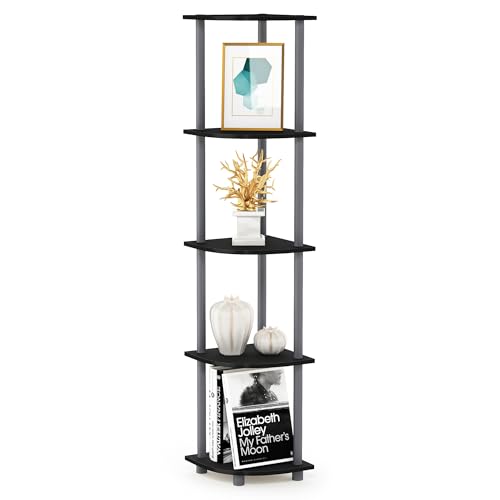
Furinno Turn-N-Tube 5-Tier Corner Display Rack, Black (99811)
Best for: Corners — the one geometry every room has and almost no furniture uses.
Start with the purest small-space idea in the guide. Corners are where rooms leak utility: too angled for straight furniture, too prominent to ignore, they collect a plant on the floor and a sense of unfinished business. This Furinno rack is shaped for exactly that angle — five corner tiers stacked in an 11.6-by-11.6-inch footprint, standing about 57.7 inches tall. The Turn-N-Tube system twists composite-wood shelves onto PVC tubes by hand, no tools, in minutes, and the assembled unit weighs roughly 9 pounds, so the corner experiment costs nothing in commitment: if the first corner disappoints, carry it to another.
What five corner tiers actually hold, loaded honestly: the plant that needed the light, the current reading stack, a small speaker, framed photographs, the attractive storage box for the remotes and chargers that otherwise live on the sofa arm. What they do not hold is defined by the maker’s own numbers — about 10 pounds per shelf, 50 pounds in total — so rows of hardcovers, heavy electronics and anything a climbing child might reach for are all outside the brief. Kept inside it, this is the highest storage-per-square-inch purchase in the guide, and its modest price leaves the bulk of the $300 budget for a second, larger pick elsewhere in the home. Small spaces reward exactly this kind of targeted buying: one piece per dead zone, each shaped to its zone. The Furinno corner rack on Amazon comes in several finishes; black disappears into shadowed corners best.
Pros:
- Claims an 11.6-inch corner no straight case can use
- Tool-free assembly; ~9 lb, repositions in seconds
- Five tiers of light storage and display
- Low cost leaves budget for a second zone
- Several finishes to match the corner’s light
Honest limitation: Ten pounds per shelf is a strict ceiling — this is a display rack, not a bookcase for a collection, and its light tube frame feels as light as it is. Homes needing real book capacity in a small space should pair it with the Custos or Theo below.
Choose it if a corner is your dead zone. Skip it if the space must hold heavy books. Check the Furinno on Amazon for the current listing.
VASAGLE Narrow Ladder Shelf
Best for: The narrow strips of wall between doors, windows and other furniture that standard cases cannot fit.
Measure a typical room’s leftover walls and a pattern emerges: the fragments are narrow — a foot and a half here, two feet there — because doors, windows and radiators take the wide runs. A narrow ladder shelf is the format designed for the fragment. Its angled frame steps the tiers back as they rise, so the piece presents a light, receding profile to the room, and VASAGLE’s steel-frame, wood-finish construction keeps it warm rather than utilitarian. In a small space, that profile matters doubly: the ladder occupies the fragment without visually annexing the wall around it, so the room keeps its breathing room while gaining real shelving.
Load it by its geometry. The deep lower tiers take books and heavier objects — this is a sturdier proposition than the corner rack — while the upper tiers taper toward display: plants, frames, the small ceramics. Fit the anti-tip strap, especially where the fragment sits beside a walkway, because narrow tall pieces earn their stability from the wall, not from their base. Assembly is quick, the finished unit moves easily when the room’s arrangement changes, and in the small-space economy that adaptability is a feature money usually cannot buy: the shelf you can re-place is the shelf that keeps fitting your life. For hallways too narrow for enclosed cases and corners too straight for the Furinno, this is the guide’s default answer, listed as the VASAGLE narrow ladder on Amazon.
Pros:
- Fits wall fragments standard widths cannot use
- Angled profile reads light in small rooms
- Deep lower tiers take genuine book loads
- Quick to assemble, easy to relocate
- Steel-and-wood finish suits most schemes
Honest limitation: Capacity is fragment-sized — a serious collection will outgrow it, and the tapering top tiers are display-only territory. It supplements a home’s main storage; it does not replace it.
Choose it if your spare wall comes in narrow strips. Skip it if you need enclosed storage or maximum capacity. Check the narrow ladder on Amazon for current options.
Nathan James Theo 6-Shelf Tall Bookcase
Best for: Small spaces with one tall wall — trading height for floor when floor is the thing you do not have.
When a small space has no floor and no fragments left, it usually still has height, and the Theo 6-Shelf is how you spend it. The Theo format — wood-finish shelves on a slim metal ladder frame, wall-mounted — stacks six tiers to around 85 inches at only about 12 inches deep and 30 wide. In footprint terms that is a serious library on the floor plan of a hallway runner, and because the frame is open and wall-fixed, the floor beneath stays clear for vacuums, feet and the visual calm small rooms run on. The family rating is the other reason it belongs here: the Theo line’s shelves are rated at 55 pounds each, so this vertical move does not mean retreating to display-only storage — real rows of real books can climb this wall.
The requirements are the tall frame’s usual three. It must be wall-mounted into proper fixings — that mounting is its stability — so drilling rights are a precondition. Its shelf spacing is fixed, so the tall-object inventory (vinyl, atlases, vases) must be measured against the gaps before ordering. And an 85-inch frame needs ceiling diagonal to stand up during assembly, which small rooms with low or sloped ceilings may not offer; measure the tilt path, not just the wall. Where those three conditions are met, no pick in this guide stores more per square foot of floor, and the modular design means a second unit can join it later along the same wall when the collection — or the home — grows. This variant is listed as the Theo 6-Shelf on Amazon.
Pros:
- Six tiers at ~12-inch depth — maximum vertical yield
- 55 lb-class shelves hold real book rows
- Wall-mounted: floor beneath stays clear
- Modular — add a second unit along the wall later
- Open frame keeps small rooms visually light
Honest limitation: Fixed spacing, mandatory wall mounting, and a demanding tilt-up during assembly. Renters who cannot drill and rooms with low sloped ceilings should take the Custos instead.
Choose it if you have one tall, drillable wall. Skip it if you cannot mount or your ceilings are low. Check the Theo 6-Shelf on Amazon for this variant’s finish.
VASAGLE Custos Collection Bookcase
Best for: Hallways, landings and behind-door walls — enclosed storage at a depth that does not punish the walkway.
Small spaces are often not rooms at all but passages, and passages impose the strictest depth discipline in the home: a case that steals four extra inches from a hallway steals them from every shoulder that passes, twice a day, forever. The Custos collection answers with an enclosed case at roughly 9.4 inches deep in its reference configuration — about 23.6 wide and 63.3 tall — a profile that can line a hallway, stand behind a door’s swing radius, or fill the shallow alcove under the stairs while leaving the passage genuinely passable. And because it is enclosed with adjustable shelves, it stores the passage-appropriate load properly: the household’s overflow books, board games, linens in baskets, the toolbox-adjacent clutter that hallways inherit.
The enclosed front is doing double duty in this setting. Visually, a calm flat face is the only kind of storage a narrow passage tolerates — open shelves in a hallway read as clutter at elbow distance, however tidy they are. Practically, doors and backs keep contents in place when the case is brushed past daily, which hallway furniture always is. Fit the anti-tip hardware — a tall shallow case has the least forgiving proportions in this guide, and anchoring is what makes those proportions safe rather than merely slim. Assembly is a manageable solo, in-place build, and the collection’s related sizes let a household repeat the same shallow language in a second passage later. This variant is the Custos bookcase on Amazon.
Pros:
- ~9.4-inch depth preserves hallways and landings
- Adjustable shelves for mixed household overflow
- Enclosed front stays calm at elbow distance
- Fits under-stair alcoves and behind-door walls
- Matching collection sizes for a second passage
Honest limitation: Shallow shelves exclude deep bins and oversized books, and a tall shallow case is the most anchor-dependent design here — the strap is not optional. Laminate surfaces in a hallway also meet bags, keys and shoulders daily, so expect to wipe marks more often than in a living room.
Choose it if your small space is a passage or alcove. Skip it if the space can take a deeper, higher-capacity case. Check the Custos on Amazon for this variant.
VASAGLE 6-Tier Tempered Glass Bookcase, Metallic Gold (ULGT502A01)
Best for: Small rooms that are short on light — storage and display that the eye passes through instead of stopping at.
Some small spaces cannot afford a solid bookcase at any size, because their real shortage is not floor but light. This is the pick for those rooms. Six tiers of tempered glass on a slim metallic gold steel frame — about 31.5 inches wide, 11.8 deep and 70.9 tall — hold books and objects while light from the room’s one window passes straight through the shelving, so the wall behind stays part of the room and the case reads as a glint of structure rather than a block of furniture. In a small room, that transparency is worth more than two extra shelves of solid storage, and the varied tier heights — the tallest gap around 22 inches — suit the mixed display of plants, ceramics and art books that small-space dwellers actually own.
The discipline is load: the maker rates the unit at 88 pounds in total, which makes it a display case that accommodates books, not a library. Keep hardcovers as accents among objects, heavy pieces on the lowest tiers, and the total honest. Use the adjustable feet — small old rooms rarely offer level floors — and the included anti-tip kit, without exception, on a tall narrow frame. Glass in a small space has one more virtue worth naming: it is the easiest surface here to keep clean in rooms where the bookcase stands near a kitchen or entryway, and a weekly wipe returns it to invisible. The glass VASAGLE listing on Amazon shows the tier layout clearly.
Pros:
- Transparent shelves preserve light and sight lines
- Varied tier heights fit the small-space display mix
- Slim depth, tall yield — six tiers up, not out
- Adjustable feet suit uneven small-room floors
- Wipes clean instantly near kitchens and entries
Honest limitation: The 88 lb total capacity is a hard boundary — households needing to shelve a real book collection in a small space should choose the Theo or Custos. Glass also shows dust quickly in bright rooms, so it rewards tidy owners.
Choose it if your small room’s scarcest resource is light. Skip it if it must carry a library. Check the glass bookcase on Amazon for availability.
VASAGLE 4-Tier Ladder Shelf
Best for: Reading nooks and chair-side corners — the small spaces that are small on purpose.
Not every small space is a problem; the reading nook is a small space by design, and it wants a shelf with the nook’s own relaxed geometry. The four-tier ladder — steel frame, wood-finish shelves, angled back against the wall — is that shelf. Four tiers hold the nook’s whole economy: the current book stack and a lamp’s worth of objects on the deep lower tiers, a plant and frames above, nothing so tall or heavy that the corner stops feeling like a retreat. It assembles quickly, moves without ceremony when the nook migrates — and nooks migrate as households change — and its warm rustic-modern finish suits the soft furnishings nooks accumulate.
Its limits are the ladder family’s standing ones: tapering capacity toward the top, display-first intent, and an anti-tip strap that must be fitted because a leaning frame in a lived-in corner will be leaned against in turn. Treat it as the finishing piece of a small space rather than its storage system, and it will be the most-loved shelf in this guide relative to its size. Paired with the corner rack in a second dead zone, it lets a small home feel furnished by intention instead of by accumulation. The VASAGLE ladder shelf on Amazon lists the finish options.
Pros:
- Angled profile made for nooks and chair-side corners
- Warm finish suits soft, lived-in small spaces
- Quick assembly; moves as the room evolves
- Deep lower tiers for the real reading stack
- Small price leaves budget for a second zone
Honest limitation: Four tapering tiers are a nook’s worth of storage, not a room’s — and the strap is mandatory. If the space must work harder, the narrow ladder or Custos carries more.
Choose it if the space is a nook with a chair in it. Skip it if the space is your home’s only storage. Check the ladder shelf on Amazon before ordering.
The Five Dead Zones Every Home Has — and the Shape That Claims Each
Walk any home with a shelf-buyer’s eye and the same five dead zones appear. The corner beside the sofa: claim it with a corner-shaped unit (the Furinno) or a ladder, never with a straight case rotated hopefully. The wall fragment between door and window: the narrow ladder’s native land. The hallway’s long wall: shallow enclosed storage only — the Custos at under 10 inches deep — because depth there is stolen from shoulders. The tall blank wall in a small bedroom: the Theo’s vertical play, provided the mounting and ceiling allow it. And the dark internal wall far from windows: glass, because it is the only storage that returns light instead of consuming it. Matching shape to zone, rather than buying one compromise shelf for all five, is the entire method of this guide — and it is why five modest, well-shaped pieces outperform one large bookcase in almost every small-space home. Readers whose small space is a whole apartment will find the same method applied room-by-room in our guide to the Best Bookcase For Small Apartments Under $300.
Visual Weight: The Other Footprint
Two bookcases can share identical dimensions and opposite effects on a small room. The difference is visual weight: how much light the piece blocks, how much wall it hides, and how solid its silhouette reads from the doorway. Solid enclosed cases carry the most visual weight per inch; open frames carry less; glass carries least of all. Small-space buying is largely the art of spending visual weight only where it buys something — concealment in a hallway, where the Custos earns its solidity — and refusing to spend it where openness would do, which is why the ladders, the Theo and the glass unit dominate this list. A practical test before ordering: tape the case’s outline on the wall with painter’s tape and live with it for a day. The tape has no depth and no solidity, yet it will still tell you whether the room can spare that much wall — and if the tape already feels like too much, the answer is a lighter format, not a smaller hope.
Color is visual weight’s quiet half. A dark case on a pale wall in a small room advances toward the viewer and shrinks the wall it stands on; a pale or transparent case recedes and lets the wall stay large. This is why the small-space palette in this guide leans light — black is used only on the corner rack, where the corner’s own shadow makes darkness the camouflage rather than the statement — and why a small room with a dark-floor, dark-case combination so often feels smaller than its measurements. When the space is tiny and the light is borrowed, buy the lightest finish the format offers and let books and objects supply the color.
Under-Stairs and Alcoves: The Awkward-Space Playbook
The under-stairs alcove is the small-space final boss: sloped ceiling, odd depth, usually no light, and a shape no standard furniture was designed for. The workable approach is to stop trying to fill it and start trying to use its best third. The tall end of the slope takes a mid-height enclosed case like the Custos — its 63-inch class height and shallow depth suit the point where the slope still allows standing storage — while the low end takes baskets, boxes and the household’s seasonal overflow on the floor, where no shelf could fit anyway. Fighting the slope with a tall case guarantees a collision line halfway up the unit; accepting the slope and zoning by height turns the alcove into the home’s most efficient storage per square foot, precisely because it was never going to be living space.
Alcoves beside fireplaces and chimney breasts are the friendlier cousins: straight, vertical, and usually paired. Symmetry is the rule there — matching narrow ladders or a pair of identical slim cases read as architecture, while two different shelves read as accidents. If budget allows only one side this season, buy the design you can repeat later; the Custos collection and the Theo frames both sell in repeatable formats for exactly this reason. In alcoves, also mind the depth relationship with the chimney breast itself: a case slightly shallower than the breast’s projection looks built-in, while one that projects beyond it looks parked. Two inches of restraint is the difference between a renovation effect and a furniture delivery.
Small Spaces Beyond the Living Room: Offices, Entries and Bathrooms
The home-office nook — often a converted closet or a desk’s worth of bedroom corner — runs on the same physics as every zone in this guide, with one addition: paper is heavier than it looks, and files concentrate weight like nothing else in the home. Nook shelving should be the sturdiest format the space allows, which in practice means the Theo’s rated shelves or the enclosed Custos, with binders and files on the lowest tiers and the light, pretty objects exiled upward. Cable behavior matters here too: an enclosed case with a back contains the charger sprawl that open frames display to the whole room, and in a bedroom-office hybrid that containment is the difference between a workspace that closes at night and one that glows at you from the pillow.
Entryways want the shallowest storage in the home and the most forgiving: the Custos-depth class, loaded with baskets for gloves, leads, mail and the household’s small traffic, because an entry shelf’s job is to catch life at the door before it disperses across every other room. Bathrooms and laundry spaces, where some readers do press bookcases into service for towels and supplies, demand the moisture conversation: laminate and engineered board tolerate a steamy room poorly over years, glass and metal tolerate it best — one more honest reason the glass VASAGLE appears in this guide — and any case in a damp room should stand on its adjustable feet with air beneath, never flat on a wet-prone floor. Small spaces reward this kind of room-by-room honesty far more than they reward any single product.
Comparison Table
| Bookcase | Shape | Depth character | Zone it claims |
|---|---|---|---|
| Furinno Corner Rack | Corner tiers, 57.7″ tall | 11.6″ square | Dead corners |
| VASAGLE Narrow Ladder | Angled ladder | Slim, tapering | Wall fragments |
| Nathan James Theo 6-Shelf | Wall-mount frame, ~85″ tall | ~12″ | Tall blank walls |
| VASAGLE Custos | Enclosed case, ~63″ tall | ~9.4″ | Hallways, alcoves |
| VASAGLE Glass Gold | Glass/steel, ~70.9″ tall | ~11.8″ | Dark small rooms |
| VASAGLE Ladder 4-Tier | Angled ladder | Compact | Reading nooks |
How to Choose the Best Bookcase for Small Spaces Under $300
Identify the zone before the shelf. Corner, fragment, passage, tall wall, dark wall, nook — the zone dictates the shape, and the shape dictates the shortlist. Buying the shelf first and hunting for its zone afterward is how small spaces end up with furniture in the walkway.
Measure depth against the passage, not the wall. In living rooms depth is a preference; in hallways and small bedrooms it is a clearance. Keep passages honestly passable — if shoulders brush it daily, it is too deep, whatever the tape measure said about the wall.
Spend visual weight deliberately. Enclosed and solid where you need concealment; open, laddered or glass everywhere else. In the smallest rooms, default to the lightest format that can carry the load.
Anchor for the proportions you bought. Tall, shallow and narrow are the three adjectives of small-space shelving and the three that most need a wall fixing. Fit every strap and kit in this guide before loading a single shelf. For the tier below this budget, our Best Bookcase For Small Spaces Under $150 guide applies the same zone method at lower capacity.
Common Buying Mistakes
Buying a small bookcase instead of the right shape. A shrunken straight case in a corner wastes the corner and the case. Trusting listing photos for scale. Small-space products are photographed in big empty rooms; shop by dimensions only. Ignoring the tilt-up. Tall frames need ceiling diagonal to stand — small rooms fail this test most often. Blocking the light. A solid case across a small room’s only window wall darkens everything behind it. Skipping the anchor on “little” furniture. Tall and shallow is tall and shallow at any price. Filling every tier. In small spaces, the empty shelf is a design feature — it is where the room breathes.
Building a Small-Space System Over Time
Few households solve every dead zone in one order, and small-space storage actually improves when it is bought in sequence. Start with the zone that annoys you daily — usually the hallway overflow or the living-room corner — because a system that begins with the worst pain proves itself and teaches you the home’s real storage patterns. Live with the first piece for a month before choosing the second: collections migrate, and the books you were certain belonged in the bedroom will announce, by their absence, that they live by the sofa. The second purchase then solves a measured problem instead of a guessed one, and the third — often the tall vertical piece, once you know which wall truly is spare — completes a system whose total capacity surprises everyone who watched it arrive one modest box at a time.
Sequence has one more virtue: consistency. Pieces bought across a year can still read as a system if you hold two threads constant — a finish family (the rustic wood tones of the VASAGLE pieces, the oak-and-metal language of the Theo) and a hardware-and-silhouette logic (open frames in living zones, enclosed cases in passages). What breaks systems is not variety of shape — this guide is built on variety of shape — but variety of visual language in adjoining sight lines. Keep the language, vary the geometry, and a small home ends up looking designed rather than accumulated, which is the entire prize.
Measuring a Small Space Properly (It Is Not Just the Wall)
Small spaces punish casual measuring because every dimension is contested. Take five measurements, not two. The wall’s width and height are only the start: add the depth you can spend before the walkway pinches, measured from the wall to the nearest thing a person passes — a sofa arm, a bed corner, the swing of a door. Add the baseboard’s projection, which steals up to an inch of depth and stops tall cases sitting flush, changing where their anchors land. Add the ceiling’s true height at the wall and the diagonal the case needs to stand up, which in sloped or beamed rooms can be the measurement that decides the purchase. And add the route: the doorway widths and stair turns the flat-pack panels must survive to reach the space at all.
Then tape it. Painter’s tape on the floor in the case’s true footprint, lived with for a full day of the room’s real traffic, reveals what numbers hide: the corner that turns out to be the dog’s route, the hallway edge that shoulders brush at exactly shelf height, the fragment that is narrower at baseboard level than at eye level. Small-space veterans tape before they order and consider the day spent the cheapest furniture insurance available. When the tape test fails a favorite pick, believe the tape — the zone method in this guide exists so that another shape, honestly measured, can take the same job.
Final Recommendation
Match the shape to the zone and small spaces stop being a compromise. Start with the Furinno corner rack for the corner every home wastes, the Custos for the hallway, and the Theo 6-Shelf where one tall wall can carry a whole collection vertically. Add glass where light is scarce and a ladder where a nook wants warmth, anchor everything, and leave one shelf in every unit deliberately empty — in a small space, that empty shelf is the most luxurious thing you own.
Frequently Asked Questions
What type of bookcase is best for small spaces?
The one shaped for the specific space: corner units for corners, narrow ladders for wall fragments, shallow enclosed cases for hallways, wall-mounted frames for tall blank walls, and glass where light is scarce. There is no universal small-space bookcase — there are five good answers to five different zones, which is how this guide is organized.
How deep should a bookcase be in a small room?
As shallow as your books allow: 9.5 to 12 inches covers paperbacks and standard hardcovers and preserves walkways. In hallways, stay at the shallow end — around 9.5 inches — because depth there is taken directly from the passage. Oversized art books are the only common load that genuinely needs more.
Can a tall bookcase work in a small space?
Yes — height is the small space’s best friend, provided three conditions hold: the unit is anchored or wall-mounted, the ceiling gives it room to stand up during assembly, and its depth stays slim. The Theo 6-Shelf in this guide stores a full collection on a 12-inch depth precisely by spending height instead of floor.
Are corner shelves worth it?
For light display and everyday objects, absolutely — a corner unit converts the least useful footprint in the room into five tiers. Respect their load limits, which on the Furinno here are about 10 pounds per shelf, and never ask a corner rack to do a library’s job.
How do I make a small room with a bookcase feel bigger?
Choose open or glass formats that pass light, keep top shelves light or empty, leave one shelf deliberately unfilled, and match the case’s height to a line already in the room — a door head or window head. Visual weight, not physical size, is what makes a shelved small room feel cramped.
Is it better to buy several small shelves or one bookcase?
For small spaces, several shaped pieces usually win: a corner rack here, a hallway case there, each converting a different dead zone. One large bookcase concentrates storage but consumes one big, valuable area. The exception is the serious reader with one good tall wall — there, a single vertical case like the Theo is the most efficient purchase in this guide.
What can I put under the stairs if a bookcase does not fit?
Use the slope instead of fighting it: a mid-height shallow case at the tall end, baskets and lidded boxes at the low end, and nothing at all where the slope drops below useful height. If the space is deeper than it is tall, treat it as a closet with a shelf at its opening — the Custos at the tall edge — rather than as a bookcase-shaped problem.
Should small-space shelves be open or enclosed?
Both, in different zones. Open formats — ladders, frames, glass — suit living zones where the contents are display-worthy and the light matters. Enclosed cases suit passages, entries and offices, where contents are mixed, traffic is close, and a calm front is worth more than visibility. The zone method in this guide assigns each format where its strengths are worth its costs.
What is the best bookcase for a narrow hallway?
A shallow enclosed case in the 9-to-10-inch depth class — the Custos in this guide — anchored, with its calmest finish facing the passage. Depth is the whole decision in a hallway: every extra inch is taken from the people passing, twice daily, for as long as the case stands there. Open shelves and deeper cases both fail that test regardless of their other virtues.
How much storage can a small-space bookcase really add?
More than intuition suggests. A corner rack’s five tiers, a hallway case’s six shallow shelves and a tall frame’s six deep ones together convert three dead zones into roughly the book capacity of a full-size living-room library — without any single room losing a usable wall. The trick is distribution: small-space storage works as a system of shaped pieces, not as one heroic purchase.
Do small-space bookcases need anchoring too?
Yes — more than most, because small-space designs are disproportionately tall, narrow and shallow, which is exactly the geometry anchoring exists for. Every pick in this guide ships with or requires a wall fixing; fit it before loading, and treat “it fits snugly in the alcove” as a supplement to the strap, never a substitute.
Can I put a bookcase behind a door?
Only if the depth arithmetic works: the case must be shallower than the gap between the door’s swing and the wall, and it must never become the door’s stop. Shallow enclosed cases in the Custos class are the usual candidates, and the placement suits low-traffic storage — the household overflow that is fetched weekly, not daily. If the door can strike the case, choose another wall; a small space has no room for a daily collision.
What is the smallest useful bookcase?
Usefulness is set by the load, not the tape measure. For display and light everyday objects, a corner rack at under a square foot of floor is genuinely useful. For books, the smallest honest answer is a narrow ladder or a shallow enclosed case — formats that hold standard books at standard depth. Anything narrower or shallower than book depth is a display shelf wearing a bookcase’s name.
Is it worth spending up to $300 on small-space shelving?
Spent by zone, yes. The budget covers two or three shaped pieces — a corner rack, a hallway case, a ladder — and a system of right-shaped shelves returns more usable storage than one expensive compromise piece ever does. Spend first on the zone you use daily, insist on anchoring hardware being included or budgeted, and let the remaining zones wait for the next purchase rather than forcing one product to serve them all badly.


