Where to buy
Check the latest price, availability and delivery on Amazon. Orders are placed on Amazon. We may earn a commission from qualifying purchases.
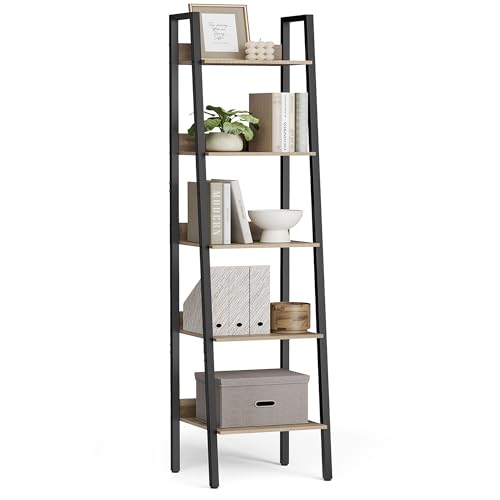
- Best overall for small apartments: VASAGLE Narrow Ladder Shelf — Check on Amazon
- VASAGLE Custos Collection Bookcase — Check on Amazon
- Furinno Turn-N-Tube 5-Tier Corner Display Rack, Black — Check on Amazon
- Nathan James Theo 5-Shelf Bookcase — Check on Amazon
- VASAGLE 4-Tier Ladder Shelf — Check on Amazon
See 1 more Amazon option
- Sauder Beginnings 5-Shelf Bookcase — Check on Amazon
Read the full guide ↓
Disclosure: As an Amazon Associate, dailyhomedecorating.com earns from qualifying purchases. Links to Amazon on this page are affiliate links; they cost you nothing extra. Listing details such as price and availability change often, so check the current Amazon listing before you buy.
Choosing the best bookcase for small apartments under $300 is an exercise in floor economics. In a small apartment, every piece of furniture pays rent: a bookcase that occupies three square feet of floor has to return more than three square feet of value, or it is a liability with shelves. The best bookcase for small apartments under $300 therefore wins on a different scorecard from the one in our main guide — footprint first, vertical yield second, and everything else after. Depth is the silent killer: a 14-inch-deep case in a 10-foot room does not just hold books, it redraws the room’s walkways, door swings and sight lines. The picks below were chosen because each one understands that trade and answers it a different way.
The VASAGLE narrow ladder takes the least-commitment route: a slim, angled frame that slips into the slivers of wall apartments actually leave over. The VASAGLE Custos is the serious small-apartment case — enclosed, adjustable, and shallow at around 9.4 inches deep in its reference configuration, so it stores like furniture and intrudes like a picture frame. The Furinno corner rack monetizes the one space no other furniture wants. The Nathan James Theo 5-Shelf moves storage onto the wall itself, trading floor for height in the most literal way available. The VASAGLE ladder shelf brings display warmth to studio corners, and the Sauder Beginnings closes the list as the tall, narrow, full-capacity option for the small-apartment reader whose collection is not small at all. Between them, every apartment geometry — studio, one-bed, shared hallway walls — has an honest answer under the ceiling.
Two apartment-specific warnings before the reviews. First, measure your elevator, stairwell turns and doorways, not just the wall: tall flat-pack panels travel badly through tight stairwells, and a case you cannot get into the apartment is a return with extra steps. Second, decide your anchoring plan before you buy, because apartment walls — and leases — vary; we cover renter-friendly approaches in their own section below.
In this guide
Quick Picks
| Pick | Best for | Footprint logic | Check |
|---|---|---|---|
| VASAGLE Narrow Ladder | Best overall — slivers of wall | Narrow ladder, shallow tiers | Check on Amazon |
| VASAGLE Custos | Real storage, shallow depth | Enclosed, ~9.4″ deep reference | Check on Amazon |
| Furinno Corner Rack | Dead corners | 11.6″ × 11.6″ corner | Check on Amazon |
| Nathan James Theo 5-Shelf | Wall-mounted vertical storage | Uses wall, not floor | Check on Amazon |
| VASAGLE Ladder 4-Tier | Studio display corners | Angled, compact tiers | Check on Amazon |
| Sauder Beginnings 5-Shelf | Big collections, small flats | Tall and narrow, ~24.6″ wide | Check on Amazon |
How These Picks Were Chosen
Apartment suitability reorganized our criteria around the floor plan. Footprint came first, measured in honest inches: we favored depths under 12 inches and widths that fit the wall fragments apartments offer — beside doors, between windows, at the ends of kitchen runs. Vertical yield came second: shelves per square foot of floor, which is why tall narrow cases and wall-mounted frames outrank wide low ones here. Third came logistics — panel sizes that survive stairwells, assemblies that can happen in the room because there is no other room, and units light or modular enough to leave with you at the next lease. Fourth, renter reality: anchoring options that do not require a landlord negotiation scored ahead of designs that only work screwed deep into studs, though we still recommend proper fixing wherever the lease allows.
As everywhere on this site, every linked pick is a verified model from a known brand checked against the under-$300 framing, and no prices or star ratings are printed — they change too often to be useful, and neither measures a footprint. Where a pick’s apartment virtues come with a genuine compromise — light load limits, fixed shelves, a mounting requirement — the limitation paragraph states it plainly.
The Best Bookcases for Small Apartments Under $300
VASAGLE Narrow Ladder Shelf
Best for: The narrow wall fragments small apartments specialize in — beside the door, between windows, at the end of the sofa.
Small apartments rarely lack wall; they lack wide wall. The usable fragments are 16 to 24 inches wide, and most bookcases simply refuse to fit them. A narrow ladder shelf is designed for exactly that fragment: a slim angled frame whose tiers step back as they rise, so the piece borrows visual lightness from its own geometry and never presents a flat, bulky face to a small room. This VASAGLE narrow ladder puts that format to work with the brand’s steel-frame and wood-finish shelf construction — a combination that reads warm rather than institutional, which matters in a studio where the bookcase is also the living room’s decor, the bedroom’s backdrop and the office’s storage all at once.
Live with a ladder’s physics honestly. Tiers deepen toward the base, so the loading plan writes itself: books and heavier objects low, where the shelves are deepest and the center of gravity belongs; plants, frames and light objects up high. The piece is display-leaning rather than a library vault — a modest personal collection, the current reading stack, and the objects that make a rental feel owned. Fit the anti-tip strap; an angled frame in a walkway-adjacent spot earns it. Assembly is among the quickest in this guide, and the finished unit can be repositioned by one person when the room’s layout inevitably changes — a real apartment virtue that heavy enclosed cases cannot match. The current configuration is listed as the VASAGLE narrow ladder on Amazon, and for studio dwellers it is the easiest yes in this guide.
Pros:
- Fits the narrow wall fragments other cases cannot use
- Angled profile looks light in small rooms
- Quick assembly, easy one-person repositioning
- Steel-and-wood build suits studio multi-duty
- Deep lower tiers take real books, not just decor
Honest limitation: A narrow ladder is a modest-capacity piece — a large collection will outgrow it, and tapering upper tiers are for light objects only. If your books number in the hundreds, treat this as the apartment’s second shelf, not its library.
Choose it if your available wall is a fragment, not a run. Skip it if you need enclosed, high-volume storage — the Custos is next for a reason. Check the narrow ladder on Amazon for current finishes.
VASAGLE Custos Collection Bookcase
Best for: The small apartment’s one serious bookcase — enclosed, adjustable storage that stays shallow against the wall.
If an apartment gets only one real bookcase, this is the shape it should be. The Custos collection’s enclosed cases run about 23.6 inches wide and 63.3 inches tall in the reference configuration, with the figure that matters most to apartment dwellers printed on the depth line: roughly 9.4 inches. A sub-10-inch depth changes what a bookcase does to a room — it can stand in a hallway without becoming an obstacle, sit behind a door’s swing, or line a studio wall while leaving the floor plane visually intact. Yet because the case is enclosed and its shelves adjust, it stores like a grown-up: books at book heights, a shelf dropped for storage boxes, a shelf raised for binders and board games, all behind a calm flat front that keeps a small room from looking like a storage unit.
The apartment logistics are equally considered. At 63 inches, the panels are stairwell-survivable in a way 85-inch frames are not; the assembly is a one-person, in-room job; and the included anti-tip hardware handles the safety requirement with a single discreet fixing. The shallowness does set the terms: deep storage bins and oversized art books will not fit, and this is a books-first case — which, in a small apartment, is exactly the discipline that keeps one case sufficient instead of two cases crowding. VASAGLE sells the Custos design in related sizes and finishes, so a future larger apartment can take a matching wider sibling rather than starting over. This variant is the Custos bookcase on Amazon; check its configuration against your wall before ordering.
Pros:
- ~9.4-inch depth fits hallways and behind door swings
- Adjustable shelves for books, boxes and binders
- Enclosed front keeps small rooms visually calm
- Panels and height are stairwell-friendly
- Matching sizes exist for a future bigger home
Honest limitation: Shallow shelves exclude deep bins and the largest art books, and the laminate finish wants coasters and prompt spill-wiping — in a studio, the bookcase is near the kitchen whether you planned it or not.
Choose it if you are buying one case to do the whole job. Skip it if your storage is mostly deep boxes. Check the Custos on Amazon for this variant’s availability.
Furinno Turn-N-Tube 5-Tier Corner Display Rack, Black (99811)
Best for: The corner beside the sofa, desk or bed that currently holds nothing but a charging cable and good intentions.
Corners are the small apartment’s unclaimed territory, and this rack claims them with almost comic efficiency: five corner-shaped tiers in an 11.6-by-11.6-inch footprint, 57.7 inches tall, weighing about 9 pounds, assembled by twisting composite-wood shelves onto PVC tubes with no tools whatsoever. In a studio, that footprint is smaller than the plant pot it might stand beside — yet it returns five display surfaces for the objects that make a small space feel inhabited: the plant that needs the light corner, the current paperback stack, a small speaker, framed photos. Because it weighs almost nothing, it also moves when the room does, and apartment rooms change layout more than any other kind.
The limits are printed by the maker and repeated here without varnish: about 10 pounds per shelf, 50 pounds total. This is a display rack for light things, not a bookcase for a collection, and it should never be a child’s climbing neighbor or a television’s stand-in. Within its brief, though, it is the highest-yield-per-inch purchase in this guide, and its price leaves nearly the whole $300 budget for the apartment’s main case. Buy it as the Custos’s or the ladder’s partner, not as their replacement, and the pair will make a small apartment feel deliberately furnished rather than squeezed. It is listed as the Furinno corner rack on Amazon in several finishes.
Pros:
- 11.6-inch corner footprint — storage from dead space
- Tool-free assembly in minutes, ~9 lb to move
- Five tiers of display for very little budget
- Repositions freely as the layout changes
- Pairs with a main case to finish a studio
Honest limitation: Ten pounds per shelf is a firm ceiling; heavy books, electronics beyond a small speaker, and any climbing-adjacent use are all out. The light tube construction also feels light — set expectations at display rack, not furniture heirloom.
Choose it if a corner is your only unclaimed space. Skip it if you need book capacity — it has almost none. Check the Furinno on Amazon for current finishes.
Nathan James Theo 5-Shelf Bookcase
Best for: Apartments where the floor is full but the wall is free — storage that hangs its footprint on the wall instead of the room.
The Theo 5-Shelf takes the most literal approach to small-space storage in this guide: it is a wall-mounted ladder bookcase, which means its stability comes from the wall and its visual footprint is a frame, not a block. In the Theo family’s format — wood-finish shelves on a slim metal frame, around 72 inches tall in the five-shelf size — it delivers five open tiers for books and objects while leaving the floor beneath it completely clear. That clear floor is not a styling nicety in a small apartment; it is what lets the robot vacuum pass, what keeps a studio’s single room from fragmenting into furniture islands, and what makes the wall read as one tall gesture instead of clutter at ankle height.
The requirements deserve the same clarity. Wall-mount means drilling into studs or using the maker’s specified anchoring for your wall type, so read your lease before you fall in love; where mounting is allowed, the result is the most stable tall storage in this guide, immune to the bumps and nudges of tight walkways. Shelves are fixed, so measure tall items — vinyl, atlases, vases — against the gaps first. The open format suits apartments because it doubles as display in rooms that cannot spare separate decor space, but it hides nothing, so pair it with one closed basket or box per shelf for the unlovely necessities. The Theo 5-Shelf listing on Amazon shows this variant’s finish, and in a studio it earns its wall every single day.
Pros:
- Wall-mounted — floor beneath stays completely clear
- Five tiers of open book and display storage
- Most bump-proof tall storage once mounted
- Slim frame suits studios and one-bedrooms
- Open display replaces separate decor in small rooms
Honest limitation: Mounting is mandatory and lease-dependent, shelf spacing is fixed, and open shelves conceal nothing. If your landlord forbids fixings or your collection is mostly clutter-shaped, the enclosed Custos is the better apartment answer.
Choose it if your walls are free and your floor is not. Skip it if you cannot drill. Check the Theo 5-Shelf on Amazon for this variant.
VASAGLE 4-Tier Ladder Shelf
Best for: Studio corners and beside-the-sofa spots that need warm, casual display more than maximum capacity.
Where the narrow ladder is the minimalist’s fragment-filler, the four-tier ladder is the warm one: a steel frame with wood-finish shelves in VASAGLE’s rustic-modern palette, angled back against the wall in the relaxed profile that makes ladder shelves the friendliest silhouette in small rooms. Four tiers is a considered scale for an apartment — a reading stack and a plant on the deep lower tiers, objects and frames above — and the piece assembles quickly, moves easily, and asks only for its anti-tip strap to be fitted, which in a small room where everything is within bumping distance is a requirement, not a suggestion.
Its apartment role is specific: this is the shelf for the corner by the reading chair, the wall beside the sofa’s arm, the sunny spot the plants have already claimed. It will not house a library, and its upper tiers taper in depth and capacity, so load it as display — heaviest low, lightest high, nothing precious at the top in a walkway. What it returns for that modesty is disproportionate: small rooms are made by their corners, and a ladder shelf turns the two most awkward ones into the two most photographed. If your apartment needs one piece that is storage and atmosphere in equal measure, this is it. The VASAGLE ladder shelf on Amazon lists the current finish options.
Pros:
- Warm angled profile suits studio living
- Compact four-tier scale fits leftover corners
- Quick assembly, easy to move at lease end
- Deep lower tiers for books, light tiers for display
- Doubles as the room’s decor, saving separate pieces
Honest limitation: Display capacity, not library capacity — and the leaning format absolutely requires its wall strap in a bump-prone small room. Buyers needing enclosed or high-volume storage should look at the Custos or Beginnings instead.
Choose it if a corner needs warmth and light storage. Skip it if it would be your only bookcase for a real collection. Check the ladder shelf on Amazon before ordering.
Sauder Beginnings 5-Shelf Bookcase
Best for: The small-apartment reader whose collection is full-size — tall, narrow, adjustable library capacity on a modest footprint.
Every small-apartment guide needs one pick for the reader who refuses to downsize the library, and the Beginnings is it. Five shelves — three adjustable — in an enclosed case roughly 71 inches tall but only about 24.6 inches wide and 11.5 deep: a footprint of under two square feet returning five full shelves of books. That ratio is the best in this guide, and the enclosed back keeps the tall case stiff and the books contained, which matters when the case stands in a multi-use room and gets viewed from every side, including the back-adjacent angles open-plan studios specialize in.
The apartment compromises are logistical rather than structural. The tall panels need a route into the apartment — check stairwell turns — and the case should be assembled in its room and anchored before loading, because a fully loaded five-shelf library is not a piece you shuffle later. Its traditional styling is plainer than the modern picks here, but in a small apartment a calm, enclosed, neutral case often serves better than a statement piece competing with everything else in the single room. Pair it with the Furinno corner rack for display and the apartment has a complete, honest storage system well within the budget framing. The current finishes are on the Beginnings listing on Amazon.
Pros:
- Best shelf capacity per square foot in this guide
- Three adjustable shelves for a growing collection
- Enclosed back — finished and stiff from all angles
- Narrow 24.6-inch width fits apartment wall runs
- Deep enough shelves for hardcovers and textbooks
Honest limitation: Tall panels challenge tight stairwells, and once loaded and anchored it is effectively permanent for the lease’s duration. The plain traditional styling also will not satisfy buyers furnishing a design-led studio — the Theo serves that eye better.
Choose it if your collection is large and your floor is small. Skip it if you move frequently or cannot anchor. Check the Beginnings on Amazon for the finish in stock.
Apartment Math: Shelves per Square Foot
Run the numbers before you fall for a silhouette. A bookcase’s true apartment cost is its footprint — width times depth — and its true return is usable shelf length. The Beginnings in this guide turns roughly two square feet of floor into five shelves of about two feet each: around ten linear feet of book space. The Custos, at under two square feet, returns six tiers in a shallower format. The corner rack’s arithmetic is unbeatable on paper — five tiers from about one square foot — until its 10-pound shelf limit enters the calculation, which is why yield must always be read with capacity. The wall-mounted Theo cheats the equation entirely by billing its footprint to the wall. Whichever pick you favor, do this sum for your own shortlist; it takes two minutes and it is the most apartment-literate thing a furniture buyer can do. For the broader small-space field beyond apartments specifically, see our guide to the Best Bookcase For Small Spaces Under $300.
Renting? Anchoring Without Losing Your Deposit
Safety and deposits pull in opposite directions, and apartment dwellers deserve an honest map of the middle ground. Best case: your lease allows picture-hanging-style fixings, and a single anti-tip strap into a stud is a smaller hole than most picture hooks — fill it at move-out and no deposit discussion ever happens. If fixings are restricted, talk to the landlord before you buy; many accept anti-tip anchoring when it is framed as the safety measure it is, especially in writing. Where drilling is truly impossible, lower the risk profile instead: choose the lowest, widest case that meets your needs, load it bottom-heavy, place it where it cannot be climbed or bumped, and consider furniture-anchor alternatives rated for your wall type. What you should not do is buy the tallest open frame and simply hope — hope is not an anchoring strategy, and the picks in this guide were sequenced so that a no-drill household still has the Custos and ladder options with modest profiles.
Studio Layouts: Where the Bookcase Actually Goes in One Room
In a studio, placement is half the product, so here is where each format in this guide earns its keep in real one-room layouts. The wall beside the entry door is the most underused in any apartment — too shallow for a console, perfect for a sub-10-inch enclosed case like the Custos, which turns the entry into a landing zone of books, mail baskets and the bag hook’s natural partner. The wall fragment between the living zone and the kitchen run suits the narrow ladder: it marks the boundary between zones without building a wall, and its display tiers face the seating where they will actually be seen. The corner between sofa and window belongs to the Furinno rack or the four-tier ladder — plant light lives there, and a corner shelf stacks the greenery vertically instead of letting pots colonize the floor.
The bed wall is where the Theo 5-Shelf does its quiet best work in studios: mounted above or beside the bed’s headboard line, it holds the night reading, the alarm-adjacent clutter and the morning objects off the nightstand, which in a studio is also the desk, the dining table and the vanity. And the long wall — every studio has exactly one — is the Beginnings’ stage: a single tall narrow case placed centrally reads as the room’s library and anchor, around which the lighter pieces arrange themselves. Notice what none of these placements do: none blocks a window, none narrows the path from bed to bathroom, and none sits where a door’s swing can reach it. In one room, a bookcase that fails any of those three tests will be resented daily, however good its shelves are.
Move-In Tactics: Assembly, Stairs and the Second-Person Problem
Small-apartment furniture is bought twice — once at the store and once at the stairwell — so plan the logistics as part of the purchase. Before ordering, walk your route with a tape: the longest panel of your chosen case must clear the stairwell’s tightest turn and the elevator’s door diagonal, and if the numbers are close, choose the shorter case now rather than negotiating with a landing later. The 63-inch class (Custos, ladders) travels almost anywhere; the 71-inch class (Beginnings) needs a checked route; the 85-inch frames were excluded from this apartment guide partly on exactly this ground. On delivery day, build in the room the case will live in — apartment hallways are not workshops — and lay the packaging flat as your work surface to protect both floor and finish.
Most apartment dwellers assemble alone, so sequence matters: build the carcass loosely, square it against the wall it will stand on, and only then final-tighten and fit the back, because a wall is the best square reference a solo builder has. Standing a tall case up alone is the one genuinely risky moment — tilt it against the wall progressively rather than lifting it free, and never stand up a case you have already loaded. Anchoring comes before books, always, and in a rental it is worth photographing your fixing points before and after: a tidy, documented strap installation is also your deposit evidence at move-out. Finally, keep the hex key and spare hardware taped inside the case’s least-used shelf; in a small apartment, the drawer where such things live is always the drawer that is already full.
Comparison Table
| Bookcase | Footprint character | Shelves | Adjustable | Apartment role |
|---|---|---|---|---|
| VASAGLE Narrow Ladder | Narrow, angled | Ladder tiers | No | Wall fragments |
| VASAGLE Custos | ~23.6″ W × 9.4″ D | 6 tiers | Yes | One serious case |
| Furinno Corner Rack | 11.6″ × 11.6″ | 5 corner tiers | No | Dead corners |
| Nathan James Theo 5-Shelf | Wall-mounted frame | 5 | No | Floor-free storage |
| VASAGLE Ladder 4-Tier | Angled, compact | 4 | No | Studio display |
| Sauder Beginnings | ~24.6″ W × 11.5″ D | 5 | Yes (3) | Full library, small floor |
How to Choose the Best Bookcase for Small Apartments Under $300
Measure the fragments, not the room. Apartments offer wall in pieces — between the door and the window, beside the sofa, behind the door’s swing. Measure each fragment’s width, the depth you can spare before a walkway pinches, and the ceiling height, then shop for the fragment you actually have. Our guide to the Best Bookcase Under $150 covers the fragments at the tier below if the budget tightens.
Count depth twice. Shelf depth decides what fits; case depth decides what the room loses. In small apartments, prefer the shallowest case that fits your books — usually 9.5 to 12 inches — and reserve deep cases for rooms with floor to spare.
Decide about the wall. If you can mount, the Theo converts dead wall into storage and frees the floor entirely. If you cannot, enclosed shallow cases and ladders with anti-tip straps are the honest alternatives. Never let a mounting-required design become a freestanding improvisation.
Plan the exit. Apartment furniture should be leasable-out as easily as it was carried in: note panel lengths, unit weight and whether the design survives disassembly. Light ladders and the corner rack move effortlessly; tall enclosed cases move best emptied, braced, and with a friend.
Common Buying Mistakes
Measuring only the wall. The stairwell, elevator and doorway decide whether the case ever meets the wall. Buying depth you do not need. Every extra inch of case depth is an inch of room, forever. Ignoring door swings. A case behind a swinging door collects collisions and blocks light switches in the dark. Skipping the strap because the case is “in a corner.” Corners do not anchor furniture; straps do. Choosing wide and low. In small apartments, tall and narrow returns more storage per square foot almost every time. Forgetting the vacuum. If the robot or the broom cannot pass, the layout will annoy you daily — wall-mounted and shallow designs exist for this reason.
Light and Sight Lines: Making Shelves Make the Room Bigger
A bookcase in a small apartment is never only storage — it is a major visual surface, and handled well it can return space it never physically occupied. The principles are simple. Keep the top of any case clear or nearly so: a crowded top shelf at eye height presses the ceiling down visually, while a clear top with one tall, light object — a plant, a vase — draws the eye up and borrows height. Prefer lighter finishes and open formats on the walls the room’s light reaches first, because dark enclosed cases absorb the daylight small apartments can least spare; the ladders and the wall-mounted Theo in this guide exist partly for this reason. Leave the shelf nearest the window the emptiest — light falling across a half-empty shelf is the oldest small-room trick in the decorator’s book, and it costs nothing but restraint.
Sight lines matter most from the two places you actually look from: the sofa and the bed. Arrange the shelves those sight lines land on first and best — the current books, the attractive objects, the plant — and let the shelves outside them carry the baskets and the boring. In a studio those two sight lines cover most of the room’s waking life, which is why a small apartment can feel composed with exactly one well-arranged case and chaotic with three unarranged ones. The bookcase did not change; the looking did.
The Small-Apartment Shelf Audit: What Deserves the Space
The last apartment skill is curatorial, because a small home cannot shelve everything it owns and should not try. Before the new case arrives, run the audit: pull every book and object destined for it into one pile, and sort by a single question — would I reach for this in the next six months? The yes pile is smaller than most people expect, and it is the pile the bookcase should be sized and arranged for. The rest has honest destinations: the reference shelf at a family home, the donation box, the one lidded storage bin that lives in the closet for the seasonal and the sentimental. A bookcase arranged for the six-month collection looks calm, holds its arrangement, and leaves the air on the shelves that makes small rooms feel larger; a bookcase arranged for everything looks like the storage problem it was bought to solve.
Arrangement inside the case follows the same discipline. In a studio, the shelves nearest the seating should carry the beautiful and the current — the room looks at them all evening — while the purely functional storage rides in baskets on the shelves the sight lines skip. Keep one shelf, ideally the one at standing eye level near the entry, deliberately light: it is the shelf guests read as the apartment’s character. And revisit the audit at every lease renewal, because apartment collections creep at exactly the rate shelves sag — the household that audits yearly never needs the emergency second bookcase that turns a small home into a furniture warehouse.
When the Apartment Is Shared: A Word on Shelf Diplomacy
Many small apartments are shared apartments, and a bookcase in a shared home is a negotiated territory whether the negotiation happens out loud or not. The arrangements that survive are the explicit ones: a shelf each for personal books and objects, shared shelves for shared things, and one agreed landing shelf near the door for the household’s in-transit clutter, so that clutter has a legal home and stops colonizing every horizontal surface. Adjustable cases like the Custos and Beginnings make the diplomacy physical — a shelf can be raised, split with a basket boundary, or reassigned at a house meeting without new furniture. Open display pieces are the riskier shared purchase: one roommate’s curated minimalism is another’s empty shelf waiting to be filled, and the ladders in this guide will hold whatever the household’s least tidy member hands them. Agree the loading rules when the case is empty and beautiful; they are much harder to invent once it is full.
Final Recommendation
Start with the VASAGLE narrow ladder if your apartment offers only fragments of wall — it is the least-committal, most adaptable first shelf a small home can buy. Step up to the Custos when you need one enclosed case to do the whole job, mount the Theo 5-Shelf when the floor is full but the wall is free, and let the Beginnings carry the big collection on its narrow footprint. Add the corner rack wherever a corner is wasting space, anchor everything you keep, and your small apartment will store like a larger one.
Frequently Asked Questions
What is the best bookcase depth for a small apartment?
Between 9.5 and 12 inches for most collections. Paperbacks and standard hardcovers fit happily at that depth, and the room keeps its walkways. Go deeper only if you shelve oversized art books or deep storage boxes — and accept that the extra depth is a permanent withdrawal from the room.
Is a tall or wide bookcase better for a small apartment?
Tall and narrow, almost always. Vertical storage returns more shelves per square foot of floor, and floor is the scarce resource. The exception is where ceiling height, sloped ceilings or no-anchor rules cap your height — then a mid-height enclosed case like the Custos is the right compromise.
Can I use a bookcase as a room divider in a studio?
An enclosed case with a finished back — the Beginnings is the candidate here — can zone a studio, but it must be anchored or otherwise stabilized far more carefully than a wall-placed case, loaded bottom-heavy, and kept out of the main walkway. Open frames divide light better but store worse as dividers. Treat divider duty as an advanced placement, not a default.
How do I anchor a bookcase in a rental without drilling?
First, check whether the lease actually forbids small fixings — many allow picture-hook-scale holes, and an anti-tip strap is exactly that scale. If drilling is truly out, choose lower, wider, bottom-loaded cases, place them out of bump and climb zones, and use rated no-drill anchor alternatives for your wall type. Never freestanding-improvise a wall-mount design like the Theo.
Will a bookcase fit through my apartment door?
The panels, not the assembled case, are what travel — flat-pack is your friend. Check the longest panel length against stairwell turns and elevator dimensions before ordering tall cases; 63-inch-class cases like the Custos travel far more easily than 85-inch frames. When in doubt, measure the tightest turn with a tape, not optimism.
How many books can a small-apartment bookcase hold?
A two-foot shelf holds roughly 25–30 standard books, so a five- or six-tier apartment case holds on the order of 120–160 books if given over entirely to books. Most apartment shelves share duty with objects and boxes, so plan on the case holding your active collection and let a library habit, not a bigger case, handle the overflow.
Can a bookcase work in a hallway?
Yes, if it is shallow enough to leave the walkway genuinely clear — that means the sub-10-inch class like the Custos, placed where no door swings into it, and anchored, because hallway furniture gets brushed past daily. A hallway case earns its place as the home’s overflow library and landing storage; a deep case in a hallway earns only bruised hips.
What color bookcase makes a small apartment look bigger?
Light finishes and open formats reflect more light and present less visual mass, so white, pale wood and glass-leaning designs enlarge a room’s feel; dark enclosed cases anchor a room and suit larger or deliberately moody spaces. If your apartment is north-facing or window-poor, treat the pale end of this guide — ladders, the Theo’s oak-and-white language — as the default and let textiles carry the darker tones instead.
Where should a bookcase go in a one-bedroom apartment?
The living room’s longest uninterrupted wall is the default for the main case, with a ladder or corner piece serving the bedroom’s smaller fragment. Avoid the wall the television occupies — two focal furniture walls compete — and avoid any placement that narrows the path between the bedroom and bathroom, the route you walk half-asleep every night.
Should I buy one bookcase or several small shelves for an apartment?
One right-sized case plus one specialist piece beats a scatter of small shelves for most apartments: the case (Custos or Beginnings) carries the collection, and a corner rack or ladder handles display where the case cannot fit. Several small shelves fragment the walls, multiply the anchoring jobs, and almost always store less in total than the single case they replaced.
How do I keep a small apartment’s bookcase from looking cluttered?
Fill it to about two-thirds, group objects rather than spacing them evenly, keep one shelf visibly light, and give the unlovely necessities a basket each so they read as one object instead of twelve. In a small apartment the bookcase is always in view, so its tidiness is the room’s tidiness — five minutes of editing a week holds the line better than any storage accessory.
Is it worth spending up to $300 on an apartment bookcase?
Yes, if the money buys the apartment virtues: shallow depth, adjustability, and a format matched to your actual wall fragment. A cheaper case that is two inches too deep costs you walkway every day, while a well-chosen case at this budget can move with you to the next, larger home and keep working — the Custos and Beginnings in this guide are exactly that kind of portable investment, and the ladders and corner pieces cost so little of the budget that the system as a whole stays honest.


