Where to buy
Check the latest price, availability and delivery on Amazon. Orders are placed on Amazon. We may earn a commission from qualifying purchases.
- Best overall: Sauder Barrister Lane Bookcase, Scribed Oak — Check on Amazon
- Tribesigns 75-Inch Double Wide 6-Tier Bookcase — Check on Amazon
- Sauder Select Bookcase with Doors, Chalked Chestnut — Check on Amazon
- Nathan James Theo 5-Shelf Ladder Bookcase, Walnut/Black — Check on Amazon
- Tribesigns 72-Inch 6-Tier Bookcase, White — Check on Amazon
See 1 more Amazon option
- VASAGLE Custos 6-Tier Bookcase, Rustic Brown — Check on Amazon
Read the full guide ↓
Disclosure: As an Amazon Associate, dailyhomedecorating.com earns from qualifying purchases. Links to Amazon on this page are affiliate links; they cost you nothing extra. Listing details such as price and availability change often, so check the current Amazon listing before you buy.
A bookcase is the hardest-working piece of furniture in most living rooms, and it is also the one people most often buy twice — once cheap, and once properly. The best bookcase under $400 sits exactly at the point where that second purchase becomes unnecessary. Below this budget you mostly get thin panels, cardboard backs and shelves that bow under a row of hardcovers within a year. At this level, the construction changes character: backs made of real particleboard instead of folded card, steel frames that carry genuine loads, doors that close on hidden storage, and finishes that survive being dusted, bumped and rearranged. Four hundred dollars is also where the category splits into genuinely different designs — cubby libraries, double-wide industrial shelving, ladder bookcases, door-fronted cabinets — so the real question is not which bookcase is “best” in the abstract, but which design matches the wall you have and the things you actually own.
This guide compares six bookcases that earn their place under the $400 ceiling in different ways. There is a ten-cubby Sauder with a gallery top for readers who organize in baskets and bins. There is a 75-inch double-wide Tribesigns for the household whose book collection has outgrown every previous shelf. There is a door-fronted Sauder for people who want half their storage invisible, a wall-mounted Nathan James ladder for design-led rooms, a tall white Tribesigns library case, and a shallow VASAGLE that delivers six tiers at the value end of the budget. If your budget is tighter, our companion guide to Best Bookcase Under $300 covers the strongest step-down options; this page is about what the extra headroom buys when you can spend it.
Our short answer: for most living rooms, start with the Sauder Barrister Lane. Its cubby format swallows books, baskets, board games and decor without the visual monotony of identical open shelves, and its build quality is a clear class above the budget tier. If sheer capacity is your problem, the double-wide Tribesigns stores roughly two ordinary bookcases’ worth of books in one footprint. If your problem is visual clutter rather than volume, the Sauder with doors hides it. The reviews below explain each pick in detail, the measurements that matter before you order, and the mistakes that lead to the most returned bookcases.
In this guide
Quick Picks
In a hurry? This table matches each bookcase to the household it serves best.
| Buyer type | Pick | Why it stands out | Link |
|---|---|---|---|
| Best overall | Sauder Barrister Lane Bookcase, Scribed Oak | Ten cubbies, gallery display top and label-tag organization from an established furniture maker | Check on Amazon |
| Best for big collections | Tribesigns 75-Inch Double Wide 6-Tier Bookcase | Double-width steel-and-wood shelving with X-braced sides and an anti-tip kit included | Check on Amazon |
| Best hidden storage | Sauder Select Bookcase with Doors, Chalked Chestnut | Doors conceal a full storage section while open shelves display above | Check on Amazon |
| Best modern design | Nathan James Theo 5-Shelf Ladder Bookcase | Wall-mounted ladder profile, 50 lb per shelf, lifetime manufacturer warranty | Check on Amazon |
| Best tall library look | Tribesigns 72-Inch 6-Tier Bookcase, White | Six full tiers with a real particleboard back — no flimsy folded card | Check on Amazon |
| Best value under the cap | VASAGLE Custos 6-Tier Bookcase, Rustic Brown | Six adjustable tiers in a shallow 9.4-inch depth at the budget end of this guide | Check on Amazon |
How These Picks Were Chosen
We began with the budget itself, because “under $400” only means something if the bookcase genuinely lives in that tier once you choose a finish and configuration. Every pick below is a real Amazon listing positioned under this guide’s ceiling — check the current price on Amazon before you buy, because listing prices move. Designer-name bookcases and solid-hardwood library furniture sit far above this tier and were excluded, however handsome they are; so were the ultra-cheap flat-pack shelves whose per-shelf load limits make them unsuitable for actual books.
We did not hands-on test these bookcases. Instead we compared the specifications that decide whether a bookcase succeeds over years rather than weeks: shelf construction and stated load capacity, because a shelf of hardcovers is far heavier than most buyers expect; back panel material, because the back is what stops a tall case racking sideways; overall dimensions against real living-room walls; adjustability, because book heights, storage bins and decor objects are not one standard size; and the safety hardware in the box, because any bookcase over about chest height should be anchored to the wall, and a manufacturer that includes an anti-tip kit is telling you something good about its engineering culture. We also weighed assembly realism — panel counts, hardware quality and whether one person can build the unit without a second pair of hands at the crucial moment.
Finally, we required range. A single “best bookcase” recommendation would be dishonest in a category this varied, so the six picks deliberately cover the main design families a living room might need: cubby storage, double-wide open shelving, door-fronted cabinets, ladder shelving, tall library cases and compact value shelving. Where two picks overlap, we say which household should prefer which, and every review ends with an explicit choose/skip verdict so you can act on the differences rather than admire them.
The 6 Best Bookcases Under $400
Sauder Barrister Lane Bookcase, Scribed Oak
Who it suits: Most living rooms — readers who mix books with baskets, bins, games and decor, and anyone who wants one substantial piece that organizes a whole wall rather than merely lining it.
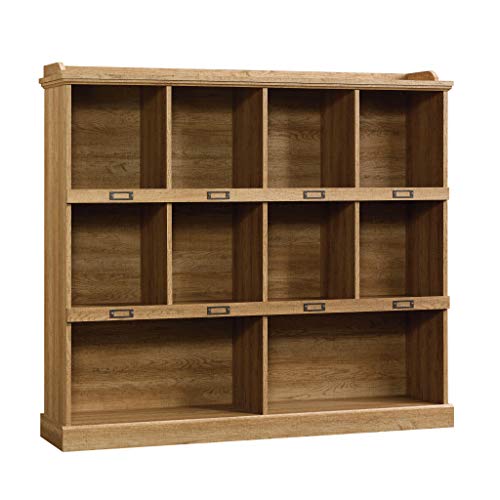
The Barrister Lane takes a different approach from the standard open-shelf bookcase: instead of five identical horizontal shelves, it divides its roughly 75-inch height and 35.6-inch width into ten cubbyholes, topped by a gallery display shelf with a raised edge. That division changes how a living room actually works. Cubbies accept the standard fabric bins and baskets that open shelves handle awkwardly, so the toys, chargers, board games and paperwork that otherwise colonize the coffee table get individual, labeled homes — Sauder even builds in ID label tags for the cubbies, a small feature that turns “tidy” into “findable.” Books stand in shorter, better-supported runs, which matters more than it sounds: a 35-inch uninterrupted shelf of hardcovers sags from the middle, while cubby-length runs stay straight. The gallery top, meanwhile, gives plants and framed photos a stage that reads as intentional design rather than overflow storage.
Construction is the reason this model leads a guide with a $400 ceiling rather than a $150 one. The engineered-wood panels are substantially thicker than budget flat-pack, the Scribed Oak finish has a convincing wood-grain texture rather than a printed sheen, and the assembled unit feels like furniture rather than packaging. It sits comfortably in the upper-middle of this guide’s budget — check the current price on Amazon — and the money is visibly spent on panel thickness and finish quality. Sauder’s US-based support and replacement-part availability also count in this tier: a bookcase is a ten-year purchase, and a maker who will still sell you a shelf pin or a cam lock in year six is worth preferring over an anonymous listing.
The honest trade-offs are size and assembly effort. At about 13.5 inches deep it is a real piece of furniture, not a slimline shelf, so measure your wall run and your walkway before ordering. Assembly is a multi-panel build — set aside a couple of hours and a clear floor, and anchor it to the wall once built, as you should with any 75-inch case. Neither point is a flaw; both are simply the cost of buying a bookcase that will not need replacing.
- Ten cubbyholes that take standard bins and baskets, with built-in ID label tags.
- Gallery display top shelf for plants, photos and collectibles.
- Thick engineered-wood panels in a textured Scribed Oak finish; established US maker with parts support.
Honest limitation: The cubby format fixes your compartment sizes — very tall art books and oversized binders have fewer homes here than on a fully adjustable open-shelf case, and the 13.5-inch depth is too much for narrow hallways.
Choose it if your living room storage is a mix of books and everything else, and you want it organized rather than merely stacked. Skip it if your collection is mostly oversized volumes, or your only wall is in a tight corridor.
Tribesigns 75-Inch Double Wide 6-Tier Bookcase
Who it suits: Serious collectors — the household with a four-figure book count, a vinyl library, or a home office that has outgrown two ordinary bookcases and needs one serious wall of storage.
Most bookcases fail heavy readers in the same way: not dramatically, but arithmetically. A standard 24- to 32-inch case holds perhaps 150 to 200 books per unit once decor takes its share, and collections grow past that quickly. This Tribesigns answers with width. It is a double-wide, six-tier open bookcase standing about 75 inches tall, built on a steel tube frame with E0-grade MDF shelves and distinctive X-shaped side railings that are not just styling — cross-bracing is what stops a wide, heavily loaded case from swaying. Six tiers across a double width gives you the shelf footage of two conventional bookcases while consuming one wall run and one assembly session, and the open format keeps every spine visible, which is how collectors actually live with their libraries.
Two details separate this from the many lookalike industrial shelves on Amazon. First, the manufacturer includes a wall anti-tip kit in the box — essential on a case this tall and this loadable, and too often an afterthought elsewhere. Second, the shelf surfaces are finished to be scratch-resistant and wipe-clean, which matters when the shelves hold not just books but plant pots, vinyl sleeves and the occasional coffee mug. It sits in the middle of this guide’s budget tier — check the current price on Amazon — which, given the capacity, makes its cost per shelf-foot the lowest in this guide.
The limitations follow from the format. Open shelving displays everything, including the clutter you might rather hide; households wanting a calm visual field should look at the door-fronted Sauder below. The footprint is genuinely large, so this is a measure-twice purchase for smaller rooms. And while the steel frame is strong, the shelves are engineered wood, so distribute the heaviest reference sets across lower tiers rather than concentrating them at the top — good practice on any tall case, and doubly so on a wide one.
- Double-wide six-tier capacity — roughly two standard bookcases of shelf footage in one unit.
- Steel frame with X-braced sides and E0-grade MDF shelves; anti-tip kit included.
- Scratch-resistant, wipe-clean shelf surfaces suited to mixed book, vinyl and decor loads.
Honest limitation: Everything is on display, the footprint is the largest in this guide, and engineered-wood shelves still want heavy loads kept low and spread out.
Choose it if capacity is your binding constraint and you have the wall to give it. Skip it if you need concealed storage or your room is small — the VASAGLE below stores respectably in half the width.
Sauder Select Bookcase with Doors, Chalked Chestnut
Who it suits: Anyone whose living room needs storage that does not look like storage — households hiding games consoles, paperwork, craft supplies and general clutter behind calm, closed doors.
Open bookcases are honest, and that is precisely their problem in a shared living room: they display your storage exactly as it is, including the parts that are not display-worthy. This Sauder Select model splits the difference intelligently. The upper section offers open shelving for books and decor — three of its shelves adjust, so tall volumes and short paperbacks each get a right-sized home — while the lower section closes behind doors, creating a hidden storage compartment for the printer paper, the board-game overflow, the tangle of charging cables and everything else a living room accumulates. In a room that doubles as a workspace or a playroom, that concealed third is the difference between a room that looks composed and one that looks occupied by its own supplies.
The Chalked Chestnut finish is the other reason this model earns its place. It is a soft, warm, slightly weathered tone that works with both traditional and transitional decor, and it photographs — and lives — considerably more expensively than the guide’s budget tier suggests. Panel construction is standard Sauder engineered wood, solidly executed, and the unit stands just under 70 inches tall and about 35 inches wide, a footprint that fits the same wall runs as the Barrister Lane while presenting a completely different face to the room. It sits in the middle of this guide’s budget — check the current price on Amazon.
Be clear-eyed about the compromise, though. Doors buy calm at the price of capacity: the concealed section stores less accessibly than open shelves, and you will open those doors daily if you file everyday items behind them. The finish, while attractive, is a laminate over engineered wood, so treat it as good furniture, not heirloom hardwood — coasters under plant pots, and no dragging the unit across floors once loaded. For households whose problem is visual noise rather than volume, those are easy trades to accept.
- Open display shelves above, a full door-concealed storage section below.
- Three adjustable shelves to fit mixed book and object heights.
- Chalked Chestnut finish with a warm, furniture-grade look; about 35 in wide, just under 70 in tall.
Honest limitation: The doored section trades quick access for concealment, and the laminate finish needs normal furniture care — it is not a solid-wood piece.
Choose it if half of what you store should be invisible. Skip it if every item needs to be grabbed daily, or maximum open shelf footage is the priority — take the double-wide Tribesigns instead.
Nathan James Theo 5-Shelf Ladder Bookcase, Walnut/Black
Who it suits: Design-led living rooms, home offices and reading corners — buyers who want the bookcase to be part of the room’s architecture, and who are willing to mount it to the wall for a cleaner, lighter look.
The Theo is the outlier in this guide, and deliberately so. Instead of a freestanding box, it is a ladder bookcase: five walnut-finish shelves carried on a black powder-coated metal frame that mounts to the wall, rising 72 inches in a profile only 24 inches wide and 12 inches deep. Because the frame carries the load into the wall, the whole piece reads as light and open where a conventional case reads as a block — in a modern living room, that difference is the difference between shelving that crowds the room and shelving that composes it. The open sides and back keep sightlines through to the wall, so even fully loaded with books and objects, the Theo looks curated rather than stored.
The engineering backs the aesthetics. Nathan James rates each shelf at 50 lb — a genuinely useful figure, since a shelf of hardcovers typically weighs 20 to 35 lb — with a 250 lb total capacity, and backs the frame with a lifetime manufacturer warranty, a commitment none of the flat-pack competition in this guide matches. Assembly is estimated by the maker at about 25 minutes with a Phillips screwdriver, the fastest build here by a wide margin, and the unit itself weighs only about 30 lb, so one person can position it before mounting. It sits in the middle of this guide’s budget — check the current price on Amazon — and pairs naturally with the low-profile furniture in our Best Media Console Under $400 guide if you are furnishing a whole wall.
The limitations are structural, not incidental. Wall mounting is not optional decoration — it is how the design works — so renters with strict no-screw leases should confirm their position before ordering, and the ladder format’s fixed shelf spacing suits books and display objects better than tall storage bins. The 24-inch width also caps total capacity well below the double-wide Tribesigns. Buy the Theo for how it looks and lives in a designed room, not as a bulk-storage solution.
- Wall-mounted ladder profile: 24 in wide, 12 in deep, 72 in tall — visually light, architecturally clean.
- 50 lb per shelf, 250 lb total, with a lifetime manufacturer warranty.
- Fast, light assembly — about 30 lb unit weight and a roughly 25-minute build per the maker.
Honest limitation: It must be wall-mounted to perform as designed, shelf spacing is fixed, and total capacity is the second-lowest in this guide.
Choose it if the bookcase is a design decision first and storage second. Skip it if you cannot fix to walls, or you need maximum book capacity — the Barrister Lane or double-wide Tribesigns serve you better.

Tribesigns 72-Inch 6-Tier Bookcase, White
Who it suits: Readers building a bright, library-style wall — and anyone burned before by budget bookcases whose backs were folded cardboard held on with hope.
Ask owners of cheap bookcases what failed first and a surprising number give the same answer: the back. The flimsy card panel on budget cases tears at its staples, the case starts to rack sideways, doors and shelves drift out of square, and the whole unit develops a lean. This Tribesigns is built as the corrective. Its back panels are selected particleboard rather than card, and that single upgrade transforms the rigidity of the whole 72-inch, six-tier structure: the case stays square, the shelves stay level, and the unit feels like one object rather than a kit of parts. Across its roughly 35.4-inch width and six full tiers, it offers the most conventional library capacity in this guide — row after row of standard shelving, finished in a clean white that brightens a room and pairs with almost any decor direction.
The depth is a quietly useful 11.8 inches: deep enough for standard hardcovers and storage boxes, shallow enough to sit comfortably along a living-room wall without eating the walkway. The finish is water-resistant per the manufacturer, which makes the shelves forgiving of plant pots and the occasional wipedown with a damp cloth — small things that matter over years of ownership. It sits in the lower-middle of this guide’s budget tier — check the current price on Amazon — undercutting the Barrister Lane while matching its height class, which makes it the value play for buyers who want a traditional tall case rather than cubbies or doors.
The trade-offs: the white finish shows dust and scuffs more readily than wood tones, so it rewards a tidy household; the shelves’ adjustability is more limited than the VASAGLE’s, so very mixed-height storage takes more planning; and at 72 inches tall it needs wall anchoring like every tall case here, with the hardware situation worth confirming on the listing before you plan the install. None of that dents its core proposition — a straight, tall, honest library bookcase with a proper back.
- Real particleboard back panels for rigidity — the anti-cardboard bookcase.
- Six tiers across about 35.4 in of width; 72 in tall, 11.8 in deep.
- Water-resistant white finish that brightens rooms and wipes clean.
Honest limitation: White shows dust and marks sooner than wood finishes, shelf adjustability is limited, and anchoring is on you to arrange.
Choose it if you want the classic tall library wall, bright and square, without paying for cubbies or doors. Skip it if your storage is mostly bins and boxes — the Barrister Lane’s cubbies handle those better.
VASAGLE Custos 6-Tier Bookcase, Rustic Brown
Who it suits: Buyers who want six real tiers and adjustable shelves while spending the least in this guide — smaller living rooms, first homes, and anyone furnishing several rooms on one budget.
Every guide needs its honest value pick, and the Custos earns the role on specifications rather than sentiment. It stands 63.3 inches tall with six tiers in a footprint only 23.6 inches wide and — the figure that matters in real rooms — 9.4 inches deep, the shallowest case in this guide. That shallow depth is a genuine feature: the Custos fits along walls, beside sofas and in alcoves where a 13-inch case would jut into the room, and its shelves adjust, so the same unit can hold paperbacks this year and vinyl or storage boxes next. The Rustic Brown finish and simple frame give it the warm, unfussy look of the wider VASAGLE Custos collection, so it coordinates with matching TV stands and side furniture if you are building a room set over time — our Best Side Table Under $400 guide covers the natural companions.
Position in the budget is the headline: the Custos sits at the value end of this guide — check the current price on Amazon — typically leaving enough of a $400 envelope untouched to buy a second unit, which is exactly how many owners use it, pairing two flanking a window or desk. VASAGLE’s instructions and hardware are consistently among the better-organized in flat-pack furniture, and the assembled case is light enough to reposition as rooms change.
The limitations are the honest price of the price. Engineered panels and shelf load limits are a class below the Sauder and Tribesigns picks, so treat it as a book-and-decor case rather than a reference-library vault, keep the heaviest sets low, and anchor it — six tiers at 63 inches still earns a wall strap. The shallow shelves also exclude the deepest art books and largest storage bins. Within those bounds, it is the most shelf you can buy for the least money in this guide, and for many rooms that is the correct answer.
- Six adjustable tiers in the shallowest footprint here: 23.6 in wide, 9.4 in deep, 63.3 in tall.
- Value-end pricing leaves budget for a matching second unit.
- Coordinates with the wider VASAGLE Custos collection for a matched room set.
Honest limitation: Load limits and panel quality are a tier below the Sauder picks, and the 9.4-inch shelves exclude oversized books and bins.
Choose it if you need good shelving in a shallow space at the lowest spend in this guide. Skip it if your shelves will carry heavy reference sets — step up to the Barrister Lane or the double-wide.
Comparison Table
| Product | Type | Best use | Link |
|---|---|---|---|
| Sauder Barrister Lane Bookcase | Cubby library, 10 compartments | Mixed books, bins and decor on one organized wall | Check on Amazon |
| Tribesigns 75-Inch Double Wide Bookcase | Steel-frame open shelving | Maximum capacity for big collections | Check on Amazon |
| Sauder Select Bookcase with Doors | Open shelves + concealed cabinet | Hiding clutter while displaying books | Check on Amazon |
| Nathan James Theo 5-Shelf Bookcase | Wall-mounted ladder | Modern, visually light shelving | Check on Amazon |
| Tribesigns 72-Inch Bookcase, White | Tall library case | Bright, rigid, classic library wall | Check on Amazon |
| VASAGLE Custos 6-Tier Bookcase | Compact adjustable shelving | Shallow spaces and value buying | Check on Amazon |
How to Choose a Bookcase Under $400
- Count your books honestly, then add a third. Measure your current collection in shelf-feet — a standard bookcase tier holds roughly 2.5 to 3 feet of books — and buy at least a third more capacity than you own today. Collections grow; a case bought exactly full is a case you will replace.
- Match the format to the mess. Pure book collections suit open shelving. Mixed living-room storage suits cubbies with bins. Anything you do not want to see suits doors. Choosing the format is a bigger decision than choosing the brand.
- Check the back panel material. Particleboard or plywood backs keep a tall case square for years. Folded cardboard backs are the first failure point of budget cases and the clearest sign to spend a little more.
- Respect shelf depth. Standard books need 10 to 12 inches. Cases deeper than 13 inches waste room depth; cases shallower than 9.5 inches exclude art books and storage boxes. Match depth to your largest regular item.
- Demand a per-shelf load figure. A full shelf of hardcovers weighs 20 to 35 lb. Any bookcase that will not state a per-shelf capacity is telling you something — prefer makers who publish one, and keep the heaviest sets on the lowest tiers regardless.
- Plan the anchoring before the assembly. Any case over about 60 inches tall should be fixed to the wall. Check whether an anti-tip kit is included, locate your studs or choose proper wall anchors, and treat this as part of the purchase, not an afterthought.
- Measure the route, not just the wall. A 75-inch case must travel through doorways, hallways and possibly stairs as a flat-pack — and be built in a room with enough clear floor to work. Confirm both before ordering.
- Leave visual breathing room. A bookcase filled to 100 percent looks like storage; the same case at 80 percent, with a few objects and horizontal stacks, looks like a library. Capacity headroom is a design feature, not waste.
Will It Fit Your Room?
Run three checks before ordering, because bookcases are the furniture category most often returned for size. The first is the wall check: measure the full run the case will occupy, then subtract skirting boards, radiators, outlets you need to keep accessible and the swing of any nearby door. A case that fits the tape measure but blocks a door’s last ten degrees does not fit. The second is the height check: 72- to 75-inch cases are the tall end of domestic furniture, so confirm ceiling height, coving and any sloping ceilings, and remember you need a few inches of working clearance above the case during assembly if the design requires top-down fastening. The third is the depth check against your walkway: in living rooms, keep at least 30 inches of clear passage in front of the case so the room still flows; if a 13.5-inch-deep case breaks that rule, a shallow model like the VASAGLE is the honest answer.
Flooring matters more than most buyers expect. Tall cases on thick carpet settle and can develop a slight lean over the first weeks — recheck the level after a fortnight and adjust. On hard floors, felt pads under the case protect both the floor and your deposit if you rent. Finally, think about light: a tall bookcase against the room’s only window wall will eat daylight, while the same case on an internal wall costs nothing. Place the biggest piece on the wall that can afford it. Readers working with genuinely tight floor plans should also see Best Bookcase For Small Spaces Under $400, where footprint is the entire selection criterion.
Common Buying Mistakes
- Buying by height alone. A 75-inch case with shallow, weak shelves stores less usefully than a 63-inch case with deep, strong, adjustable ones. Shelf footage and load capacity are the real specifications.
- Ignoring the back panel. Cardboard backs are the leading cause of the sideways lean that makes a two-year-old bookcase look ten years old.
- Skipping the wall anchor. Tall, loaded bookcases are a genuine tip hazard, especially with children or pets in the house. The five minutes anchoring takes is the cheapest safety upgrade in the home.
- Loading the top shelves with the heaviest books. Weight belongs low: reference sets and encyclopedias on the bottom tiers, light decor up high. It improves stability and shelf life at once.
- Choosing open shelves for cluttered storage. If half of what you own is not display-worthy, an open case displays exactly that. Doors and cubbies-with-bins exist for real households.
- Forgetting the assembly footprint. A double-wide case needs a large, clear floor area to build. Measure the room you will assemble in, not just the wall it will stand against.
- Filling every shelf completely. A case at full capacity cannot absorb one new book, one gift, one plant. Buy headroom.
- Matching finishes by screen color alone. Laminate finishes vary between product lines and lighting. If the case must match existing furniture exactly, order with returns in mind and compare in your own light first.
Final Recommendation
- Most living rooms: Sauder Barrister Lane Bookcase, Scribed Oak.
- Biggest collections: Tribesigns 75-Inch Double Wide 6-Tier Bookcase.
- Hidden storage: Sauder Select Bookcase with Doors, Chalked Chestnut.
- Modern rooms: Nathan James Theo 5-Shelf Ladder Bookcase.
- Classic tall library: Tribesigns 72-Inch 6-Tier Bookcase, White.
- Tightest budget in this guide: VASAGLE Custos 6-Tier Bookcase.
Our top two are the Barrister Lane — the most complete all-rounder, whose cubbies organize a real household’s mixture of books and things better than any open shelf — and the double-wide Tribesigns for the readers whose collections have simply outgrown conventional furniture. If your room’s problem is visual clutter rather than volume, the door-fronted Sauder is the pick that changes how the room feels. Measure your wall, your walkway and your collection, anchor whatever you buy, check the live price and finish on the listing, and spend the $400-tier money on panel thickness, backs and frames — the parts that decide whether this is the last bookcase you buy for that wall. Shoppers stepping up beyond this tier can compare the next level in Best Bookcase Under $700.
Assembly and Anchoring, Done Properly
Flat-pack bookcases have an unfair reputation, because most bad outcomes trace back to the same three assembly errors rather than to the furniture itself. The first is tightening every fastener fully as you go. Cam locks and dowels need the case to stay slightly loose until the back panel goes on — the back is what squares the unit — so the correct sequence is snug, square, then final-tighten in a cross pattern. The second error is building the case upright. Tall cases should be assembled face-down or on their backs on a clear floor, with the packaging cardboard under the panels to protect the finish, and only stood up once the back is fixed and the structure is rigid. The third is skipping the level check: a case that is a quarter-inch out of level on carpet will lean visibly once loaded, and the time to shim it is before the books go on, not after.
Anchoring deserves the same care. Locate a stud where you can — a strap into a stud is the gold standard — and where the case’s position falls between studs, use proper hollow-wall anchors rated for the load rather than the lightweight plugs in a miscellaneous drawer. Position the strap or bracket near the top of the case, where leverage works for you rather than against you, and leave just enough slack that the case sits naturally on its own feet; the anchor is a safety line, not a clamp. Households with climbers-in-training should also distribute weight with the anchor in mind: the heaviest tiers at the bottom lower the center of gravity and make the whole installation more forgiving. Finally, keep the spare hardware. Every flat-pack case ships with a small bag of extra cams, pins and screws, and the owners who can still adjust a shelf or replace a pin in year five are the ones who taped that bag inside a rear panel on day one.
Styling the Shelves So the Room Looks Finished
A bookcase at this price is a major visual surface — often the largest single object on its wall — so how you fill it decides whether the room reads as a library or as storage that happens to be vertical. The most reliable approach is to load in layers. Books first, arranged in a mixture of vertical runs and a few horizontal stacks, which breaks the monotony of identical spines and creates natural bookends. Objects second: one or two pieces per shelf at most, chosen for contrast in height and material — a plant against hardcovers, a ceramic piece against paperbacks — and placed off-center rather than in symmetrical pairs, which tends to look staged. Negative space last, and deliberately: one shelf at two-thirds full will make the whole case look more expensive than six shelves at total capacity.
Color discipline helps more than any single object. Grouping books loosely by tone — not a full rainbow, just keeping the loudest spines from scattering everywhere — calms a large case considerably, and turning the occasional stack spine-in is a legitimate stylist’s trick for a restful section. Lighting is the final layer most people skip: a small picture light or a battery puck light on the top shelf transforms a bookcase after dark and costs very little. None of this requires buying anything new; it requires only arranging what you own with the same care you spent choosing the case — which, at this tier, is care the furniture visibly rewards.
Frequently Asked Questions
How many books does a bookcase under $400 typically hold?
It depends on width and tier count more than price. As a working rule, one 3-foot shelf tier holds roughly 25 to 35 standard books depending on thickness. A six-tier case around 35 inches wide therefore holds in the region of 150 to 200 books if given over entirely to books, while a double-wide design roughly doubles that. Most households mix books with decor and bins, so plan on about two-thirds of the theoretical maximum.
Is it worth spending up to $400 instead of buying a budget bookcase?
For a bookcase that will carry real weight for years, yes — the money buys specific, checkable things: thicker panels, a rigid back instead of cardboard, stated load capacities, better hardware and finishes that survive cleaning. Budget cases make sense for light, temporary duty. A main living-room case holding a household’s library is exactly the purchase where the step up pays back.
Do I really need to anchor a bookcase to the wall?
Yes, for any tall case — and doubly so with children, pets or earthquake-prone floors. A loaded 72-inch bookcase has a high center of gravity, and anchoring takes minutes with the straps or brackets many makers include. If your lease forbids screws, use the strongest adhesive-free alternative your landlord accepts and keep heavy loads low, but do not skip stabilization entirely.
What shelf depth do I need for standard books?
Most hardcovers and paperbacks sit comfortably on 10- to 12-inch shelves. Art books, atlases and storage boxes may need the full 12 to 13 inches. Shelves shallower than about 9.5 inches suit paperbacks and decor but will exclude larger volumes, so check your biggest books before choosing a slimline case.
Engineered wood or solid wood at this price?
At under $400, well-made engineered wood with a good laminate is the realistic standard for full-size cases, and it performs well when panels are thick and the back is rigid. Solid wood appears in this tier mainly in smaller or fewer-tier designs. Judge the individual construction — panel thickness, back material, load rating — rather than the material label alone.
Can one person assemble these bookcases?
Mostly yes, with patience — but the tall and double-wide models have a stage where a second pair of hands makes standing the unit up far safer. The ladder-style Theo is the easiest solo build here at roughly 25 minutes per the maker. For the big cases, clear a large floor area, build the case on its back, and only stand it up when you have help or a clear, controlled lift.


