Disclosure: As an Amazon Associate, dailyhomedecorating.com earns from qualifying purchases. Links to Amazon on this page are affiliate links; they cost you nothing extra. Prices and availability change often, so check the current Amazon listing before you buy.
If you are shopping for the best bed frames for tempurpedic mattresses, you have probably already learned the expensive lesson this category teaches: a heavy, dense memory foam mattress is only as good as the surface underneath it. Put a thick foam mattress on widely spaced slats, a tired box spring, or a frame with a sagging center and the mattress will dip, wear unevenly, and feel years older than it is. The foam is not failing — the foundation is. Dense memory foam in the Tempur-Pedic style is heavier than a basic foam bed, it has almost no internal structure of its own, and it depends entirely on the frame to stay flat, level, and fully supported from edge to edge.
One honest note before the picks: the verified product pool for this guide contains mattresses, not standalone frames, and it contains no Tempur-Pedic-branded product. So this guide does something more useful than pretending otherwise. It walks you through exactly what a frame for a heavy memory foam mattress must do — slat spacing, center support, surface solidity, height, and adjustability — and then reviews six pool mattresses whose own listings document the frame types they are verified to work on: platform frames, slatted frames, adjustable bases, bunky boards, and traditional frames. Pair the frame rules in the buying-guide sections with the mattress that fits your sleep style, and you will have a combination that actually lasts. If the mattress itself is also due for replacement, our guides to Best Mattresses For All Sleeping Positions and Best Mattresses For Staying Cool cover the comfort side of the decision, while Best Mattresses For Sleeper Sofas shows how support requirements change on a folding frame.
Where to Buy
Every mattress in this guide is sold on Amazon, where you can check the current price, size availability, trial terms, and delivery options on the listing itself — and where most of the frame styles discussed below are sold alongside them. Start with our top pick, the Lucid 10 Inch Gel Memory Foam Mattress — Check on Amazon. The other five picks are the Serta Perfect Sleeper Ultimate — Check on Amazon; the Signature Design by Ashley Chime 12 Inch Hybrid — Check on Amazon; the Linenspa 8 Inch Hybrid Mattress — Check on Amazon; the Sealy Dreamlife 12” Hybrid — Check on Amazon; and the Zinus 12 Inch Green Tea Memory Foam Mattress — Check on Amazon. Frame and mattress pricing both move with promotions and size, so treat the listings, not any roundup, as the final word.
In this guide
Quick Picks
| Pick | Badge | Why it earns its place |
|---|---|---|
| Lucid 10 Inch Gel Memory Foam Mattress | Best Overall | Its listing explicitly names adjustable bases, platform frames, and slatted frames — the clearest frame guidance in the pool. |
| Serta Perfect Sleeper Ultimate 14.5″ Queen Mattress – Medium Pillow Top | CertiPUR-US cert | Best for Adjustable Bases | Documents compatibility with traditional frames, box springs, platforms, slats, bunky boards, and adjustable frames. |
| Signature Design by Ashley Chime 12 Inch Hybrid Full Size Mattress in a Box | Medium Firm | Best Hybrid Pairing | A coil-and-foam hybrid that is adjustable-base compatible and more forgiving of frame choice than pure foam. |
| Linenspa 8 Inch Hybrid Mattress | Best Low-Profile Option | An 8-inch profile made for bunks, trundles, and daybeds, where frame height limits what you can use. |
| Sealy Dreamlife 12” Hybrid Mattress-in-a-Box | Best Coil Support | Encased coils carry their own structure, so the frame’s job narrows to staying flat, level, and quiet. |
| Zinus 12 Inch Queen Green Tea Memory Foam Mattress | Best Budget Foam Pairing | A full 12-inch foam build that shows exactly why dense foam needs close slat spacing and a rigid center rail. |
Key Takeaways
- Heavy memory foam needs a flat, rigid, fully supported surface — slats should be closely spaced, with a center support rail and legs on larger sizes.
- A worn or flexible box spring is the most common frame mistake with dense foam; a solid platform or bunky board is the safer base.
- The six mattresses reviewed here each document the frame types they work on, from adjustable bases to bunk and trundle frames.
- Frame height is a comfort feature: mattress thickness plus frame height decides how easy the bed is to get into and out of.
- Adjustable bases only work with mattresses whose listings say they are compatible — all-foam and pocketed-coil designs flex; rigid innersprings do not.
- When in doubt, choose the frame that keeps the mattress flattest; comfort problems blamed on foam are often foundation problems.
How These Picks Were Chosen
Because this keyword is about frames, the first filter was documentation: does the product’s own verified listing say what it can sit on? The Lucid and Serta listings name their compatible frame types outright, and the Ashley Chime confirms adjustable-base compatibility, so those three anchor the guide. The Linenspa earned its place for the opposite reason — its low 8-inch profile exists specifically for frames with strict height limits, namely bunks, trundles, and daybeds. The Sealy represents the encased-coil hybrid approach, where the mattress brings much of its own structure, and the Zinus represents the classic all-foam bed-in-a-box, the style most sensitive to what sits underneath it.
What was filtered out: pool mattresses whose listings say nothing at all about foundations and whose builds duplicate a pick already included, because for this particular question a mattress that does not discuss its base adds less than one that does. Also excluded is any claim about Tempur-Pedic-branded frames or mattresses — the pool contains none, and this guide will not invent specifications, weight capacities, or slat measurements for products it cannot verify. Where frame numbers appear below — slat spacing, center support, total bed height — they are general category guidance that applies to heavy foam mattresses as a class, clearly separated from the verified per-product specs in each review’s spec box. The research method is the pool itself: every product claim traces to the verified listing data supplied for this guide.
The 6 Best Bed Frames for Tempurpedic Mattresses — Reviewed

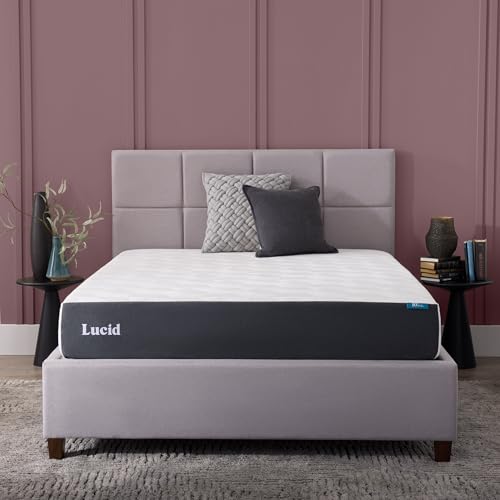
Lucid 10 Inch Gel Memory Foam Mattress
Our badge: Best Overall
The Lucid 10 Inch Gel Memory Foam Mattress leads this guide because its listing answers the frame question directly: it works on adjustable bases, platform frames, and slatted frames right out of the box, with no box spring needed. That single sentence is the shopping shortcut for this whole category. If you own a Tempur-Pedic-style foam mattress — or this Lucid, which follows the same dense-foam logic — those three frame families are your safe list, and anything outside them needs scrutiny.
Strengths
- Frame compatibility is stated in the listing itself: adjustable, platform, and slatted bases all work
- Cooling gel foam with bamboo charcoal addresses the heat build-up dense foam is known for
- Three-layer build — 3 inches of gel foam, a 1.5-inch transition layer, and a 5.5-inch high-density base — keeps the support layer doing the frame’s partner work
Trade-offs
- At 10 inches it is thinner than the 12-inch options here, so total bed height depends more on your frame choice
- No box spring needed also means a box spring adds nothing — if you love a tall bed, raise the frame, not the foundation
- Medium feel will not satisfy sleepers who want a distinctly firm surface
| Color | White |
| Size | Queen |
| Dimensions | 79 x 59 x 10 inches |
| Weight | 57.9 pounds |
On a platform frame, the Lucid is the simplest setup in this guide: unbox, unroll, and let the three layers expand. The high-density base layer is the part that interacts with your frame — it spreads load across the slats, which is why slat spacing still matters even though the listing blesses slatted frames. Keep the gaps narrow and the base foam never gets the chance to press down between slats and form the shallow valleys that sleepers feel as premature sagging. On an adjustable base, the all-foam build flexes without the resistance a coil unit would offer, and the medium feel stays consistent when the head is raised for reading.
For a Tempur-Pedic owner cross-shopping frames, the practical pairing is this: a solid platform or closely slatted frame for everyday sleeping, or an adjustable base if you read, work, or watch in bed. The Lucid’s own weight — under 58 pounds in queen — also makes it the easiest pick here to reposition while you are fitting sheets or rotating the mattress, a small thing that matters twice a year. Care is simple: the frame does the supporting, so your job is keeping the surface level and checking slat screws and center legs during seasonal bedding changes.
Best for: Shoppers who want the frame question answered in the listing itself / Not suited for: Anyone determined to keep a worn, flexible box spring
Choose it if you want a documented, no-guesswork pairing of foam mattress and modern frame. Skip it if you need a taller, plusher profile. Check on Amazon

Serta Perfect Sleeper Ultimate 14.5″ Queen Mattress – Medium Pillow Top | CertiPUR-US cert
Our badge: Best for Adjustable Bases
The Serta Perfect Sleeper Ultimate has the longest compatibility list in this pool: traditional frames, box springs, platform frames, slatted frames, bunky boards, and adjustable frames are all named. For a reader working out what their existing frame can hold, that breadth is genuinely useful — whatever you already own is probably on the list, provided it is in good condition and properly supportive.
Strengths
- The widest documented frame compatibility in the pool, including bunky boards for low-profile setups
- Zoned coil design with targeted support for the lower back and hips
- BestEdge foam encasement extends the usable sleep surface and reduces edge roll-off
Trade-offs
- At 14.5 inches thick plus a pillow top, total bed height on a standard frame can get tall for shorter sleepers
- It is the heaviest style here to maneuver during setup and rotation
- A coil design on a tired frame can telegraph frame squeaks that foam would hide
| Color | Dark Blue |
| Size | Queen |
| Dimensions | 79.5 x 60 x 14.5 inches |
| Weight | 82.26 pounds |
The Serta’s zoned coils change the frame conversation in one important way: coils carry load down to specific points, so the frame surface needs to be even more uniformly flat than with foam. A slatted frame with one warped slat will announce itself through a coil mattress. The bunky board option on its compatibility list is the sleeper insight of this review — a thin, rigid board over an existing frame converts a questionable base into a flat one without replacing furniture you like, and it keeps the total height manageable under a mattress this thick.
On an adjustable base, the coil system is designed to flex, and the pillow top keeps the surface comfortable when the head section is raised. Cool Twist gel memory foam in the comfort layer adds the contouring that Tempur-Pedic-style sleepers expect, while the coils underneath supply the push-back that pure foam lacks. If your frame is a traditional setup with a box spring, the listing blesses it — just be honest about the spring’s age, because a zoned mattress on a sagging spring zones nothing. Pair this mattress with a flat, rigid, quiet base and it is the most conventional, furniture-friendly option in the guide.
Best for: Owners of traditional frames who want one mattress that fits almost any base / Not suited for: Low-profile frames where a 14.5-inch mattress would tower
Choose it if your frame is already bought and you need maximum compatibility. Skip it if your bedroom needs a low, modern profile. Check on Amazon

Signature Design by Ashley Chime 12 Inch Hybrid Full Size Mattress in a Box | Medium Firm
Our badge: Best Hybrid Pairing
The Signature Design by Ashley Chime 12 Inch Hybrid is the pool’s clearest hybrid answer to the frame question: its pocketed coils and gel memory foam are adjustable-base compatible and it works with most bed frames. Hybrids forgive more than all-foam mattresses do, because the coil unit bridges small imperfections in the surface below — but forgiving is not the same as indifferent, and this review explains where the line sits.
Strengths
- Pocketed coils plus gel memory foam, in a build confirmed compatible with adjustable bases
- Two perimeter rows of wrapped coils give real edge support for sitting and dressing
- A gel lumbar layer targets the lower back zone where support matters most
Trade-offs
- The verified size here is Full, so queen and king shoppers must confirm their size on the listing
- Coils need a flat base to stay quiet — a flexing frame will eventually make itself heard
- Medium-firm feel runs firmer than the all-foam picks in this guide
| Color | White |
| Size | Full |
| Dimensions | 74.4 x 53.3 x 12 inches |
| Weight | 62 pounds |
The frame guidance for a hybrid like the Chime is about noise and longevity as much as support. Pocketed coils move independently, which is wonderful for motion isolation, but each coil still lands on the surface below; a platform with a solid or closely supported surface keeps those landing points even. On slats, keep spacing tight and make sure the center rail is doing real work — the two perimeter rows of coils will hold the edges, but the middle of the bed is where two sleepers’ combined weight concentrates, and that is exactly where an unsupported frame flexes first.
In daily use the Chime feels like the compromise candidate between the foam world this keyword comes from and the traditional innerspring world many frames were built for. It arrives compressed, expands on whatever compatible frame you have chosen, and the 12-inch profile keeps total bed height sensible on standard frames. For a guest room built around an existing frame of unknown pedigree, this is the pick that asks the fewest questions — put a flat board under it if the slats look tired, and it will sleep like a much more expensive setup.
Best for: Shoppers pairing a hybrid with an existing frame or adjustable base / Not suited for: Anyone whose frame has wide slat gaps they cannot correct
Choose it if you want hybrid resilience with documented base compatibility. Skip it if you are committed to a pure-foam feel. Check on Amazon
Linenspa 8 Inch Hybrid Mattress
Our badge: Best Low-Profile Option
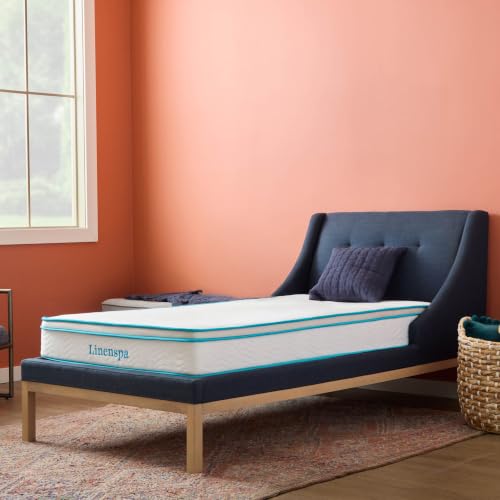
The Linenspa 8 Inch Hybrid Mattress exists for the frames the other picks cannot serve: bunk beds, trundle beds, and daybeds, where guardrail height and clearance under the top bunk cap how thick a mattress may be. If your frame question is really a height question — a foam mattress on a bunk, a trundle that must slide away, a daybed that doubles as a sofa — this is the pool’s direct answer.
Strengths
- 8-inch profile respects bunk guardrail and trundle clearance limits
- Hybrid build pairs a memory foam comfort layer with steel coils for more support than thin foam alone
- Light at 36 pounds in twin, so lifting it onto a top bunk or trundle is realistic for one person
Trade-offs
- The verified size is Twin — family and couple setups need to check other sizes on the listing
- An 8-inch hybrid is a youth, guest, and space-saving solution, not a plush primary-bed experience
- Allow 24 to 72 hours for full expansion after unboxing
| Color | Mattress Only |
| Size | Twin |
| Dimensions | 74 x 39 x 8 inches |
| Weight | 36 pounds |
Frame fit for bunks and trundles is a safety matter as much as a comfort one. On a top bunk, the mattress top must sit below the guardrail’s required height, which is why an 8-inch mattress exists at all; on a trundle, the mattress must clear the main bed’s frame when the trundle rolls underneath. The Linenspa’s medium-firm feel suits the back and stomach sleepers who most often end up in these setups — kids, teens, and guests — and the coil layer keeps a thin mattress from feeling like a pad on a board.
The frame lesson generalizes: measure your frame before you buy the mattress, not after. Check the trundle’s clearance, the daybed’s depth, and the bunk’s rail height, then choose the profile that fits. Dense foam mattresses like the Tempur-Pedic style this keyword is named for almost never work in these frames because they start at 10 to 12 inches; the Linenspa is the reminder that the best frame-and-mattress pairing is sometimes the one that simply fits the furniture you already own.
Best for: Bunks, trundles, daybeds, and youth or guest rooms with height limits / Not suited for: A primary bed for adults who want a thick, plush mattress
Choose it when your frame dictates a low profile. Skip it for a main bedroom upgrade. Check on Amazon

Sealy Dreamlife 12” Hybrid Mattress-in-a-Box
Our badge: Best Coil Support
The Sealy Dreamlife 12” Hybrid brings 7 inches of individually encased coils under gel memory foam and a transition layer, and that architecture changes what the frame must do. The coils supply internal structure that pure foam lacks, so the frame’s job narrows to three things: stay flat, stay level, and stay quiet. Meet those three and this mattress does the rest itself.
Strengths
- Encased coils move independently for targeted support and reduced motion transfer
- SealyComfort gel memory foam adds the contouring surface foam sleepers expect
- Surface-Guard antimicrobial technology helps keep the sleep surface fresher
Trade-offs
- At just over 80 pounds in queen, it is the heaviest pick here to move and rotate
- Coil support still bottoms out on a sagging frame — structure inside cannot fix a dip below
- The feel is a true hybrid balance, neither the deep hug of foam nor the bounce of a classic innerspring
| Color | Dreamlife |
| Size | Queen |
| Dimensions | 80 x 60 x 12 inches |
| Weight | 80.604164 pounds |
Because the Dreamlife’s coils are encased and independent, a platform frame with a solid surface is its happiest home: every coil gets the same flat landing, and the mattress’s own zoning can do its work. On slatted frames, the same close-spacing rule from the foam picks applies, not because foam will squeeze between slats, but because an unsupported span lets a section of coils ride lower than its neighbors. The transition foam layer — 2.25 inches of high-density foam — smooths the hand-off between comfort foam and coils, and it also smooths minor surface irregularities, which is why this pick tolerates an older frame slightly better than the all-foam options.
Practically, this is the pick for shoppers whose frame is a solid, well-built platform and whose complaint about foam mattresses is that they feel dead or hot. The coil core lets air move in a way solid foam cannot, and the gel foam surface keeps the first impression plush. Set it on a level frame, give it a day to expand, and the support story is consistent from edge to edge — which, for anyone researching frames for a heavy foam mattress, is the entire point of the exercise.
Best for: Platform-frame owners who want coil structure with a foam surface / Not suited for: Anyone who needs to move their mattress frequently
Choose it for the most self-supporting build in the guide. Skip it if a light, easily moved mattress matters more. Check on Amazon

Zinus 12 Inch Queen Green Tea Memory Foam Mattress
Our badge: Best Budget Foam Pairing
The Zinus 12 Inch Green Tea Memory Foam Mattress closes the guide as the textbook case this keyword is really about: a full-profile, all-foam, bed-in-a-box mattress with zoned pressure relief and a durable base foam. A mattress like this — and like the Tempur-Pedic-style beds it is compared with — lives or dies by its foundation, which makes it the perfect vehicle for the frame rules that follow this review section.
Strengths
- Patented zoned pressure relief targets cushioning where the body needs it most
- Green tea extract and purified charcoal infusions help keep the sleep surface fresh
- CertiPUR-US certified foams and an OEKO-TEX certified cover, in a fiberglass-free build
Trade-offs
- All-foam construction is the most frame-sensitive style here — wide slats or a soft spring base will undermine it
- A mild off-gassing smell on unboxing typically takes 24 to 48 hours to dissipate
- Medium-firm zoned foam feels different from a uniform slab; allow an adjustment period
| Color | White |
| Size | Queen |
| Dimensions | 80 x 60 x 12 inches |
| Weight | 62.3 pounds |
Here is the Zinus on the wrong frame, because it teaches the lesson fastest: place it on slats spaced like a ladder and within months the base foam begins to memorize the gaps, the zoned relief stops zoning, and the sleeper concludes the mattress wore out early. Now place the same mattress on a solid platform or closely spaced slats with a real center rail: the base foam stays flat, the zones align with the body as designed, and the mattress delivers the full-body support its listing describes. Same mattress, opposite outcomes — the frame was the variable both times.
That is why this guide treats the Zinus as the budget pairing pick rather than a compromise. Its own cost stays accessible, which leaves room in the budget for the thing that actually protects it: a proper platform. If you are furnishing a room around a dense foam mattress — this one, or a premium memory foam bed you already own — spend on the base first and the bedding second. Readers setting up a whole sleep space rather than a single bed may also want our notes on Best Mattresses For Cots for the small-frame end of the spectrum, and Black Friday Bedding Deals 2026 when the frame, mattress, and bedding all need replacing in one order.
Best for: Foam-mattress shoppers who will pair it with a proper platform or close slats / Not suited for: A worn box spring or wide-slat frame you plan to keep
Choose it if you will give foam the flat base it requires. Skip it if your frame cannot be corrected. Check on Amazon
Comparison Table
| Pick | Profile | Verified size | Frame note | Check price on Amazon |
|---|---|---|---|---|
| Lucid 10 Inch Gel Memory Foam Mattress | 10 inches | Queen | Adjustable, platform, and slatted frames named in listing | Check price on Amazon |
| Serta Perfect Sleeper Ultimate | 14.5 inches | Queen | Six base types named, including bunky boards | Check price on Amazon |
| Signature Design by Ashley Chime 12 Inch Hybrid | 12 inches | Full | Adjustable-base compatible, most frames | Check price on Amazon |
| Linenspa 8 Inch Hybrid Mattress | 8 inches | Twin | Built for bunks, trundles, and daybeds | Check price on Amazon |
| Sealy Dreamlife 12” Hybrid | 12 inches | Queen | Encased coils; needs a flat, level platform | Check price on Amazon |
| Zinus 12 Inch Green Tea Memory Foam Mattress | 12 inches | Queen | Most frame-sensitive; close slats or solid surface | Check price on Amazon |
How to Choose the Best Bed Frame for a Heavy Memory Foam Mattress
Start With Slat Spacing and Surface Solidity
The single most important frame specification for dense foam is how much of the mattress bottom is actually supported. Closely spaced slats or a solid platform keep the base foam flat; wide gaps let foam press downward and take a set. As general category guidance, shoppers should look for slats spaced only a few inches apart, slats that are themselves rigid and unwarped, and no long unsupported spans. If a frame you love has wide spacing, a bunky board or a sheet of rigid material rated for foundation use converts it — the Serta in this guide lists bunky boards among its compatible bases for exactly this reason.
Demand a Real Center Support on Queen and King
Two sleepers concentrate load in the middle of the bed, and foam has no springs to redistribute it. A center rail with supporting legs that actually reach the floor is what keeps the middle of the mattress at the same height as the edges. When you inspect a frame, get underneath it: the center legs should be present, vertical, and firm against the floor, not dangling or bent. This is also the first place to look when a foam bed develops a center valley — the fix is often under the bed, not in it, a point our guide to Best Mattresses For Big And Tall also makes for higher-load sleep setups.
Match the Frame Type to the Mattress Build
All-foam mattresses flex and belong on platforms, close slats, or adjustable bases. Hybrids with pocketed coils flex too, but they add a preference for an even, quiet surface. Traditional innersprings were designed for box springs, but a modern foam or hybrid on an old, soft spring base inherits the spring’s sag. Read the mattress listing’s own compatibility language first — as the Lucid and Serta show, manufacturers increasingly print it — and let that list veto frame styles, however attractive they look in a showroom photo.
Get the Total Height Right
Add frame height, foundation height, and mattress thickness together and compare the total with the sleeper’s comfort getting in and out: knees should bend comfortably when sitting on the edge. A 14.5-inch pillow-top mattress on a tall traditional frame can leave shorter sleepers dangling; an 8-inch mattress on a low platform can make standing up a chore for taller or older sleepers. Height is also where bunk and trundle frames impose hard limits, as the Linenspa review explains. Measure before ordering, because height mistakes are the ones you feel twice a day.
Decide Whether Adjustability Is Worth It
An adjustable base is the premium frame answer for foam mattresses: the mattress flexes with the base, and raising the head or feet changes the sleep experience without changing the bed. The requirements are strict, though — the mattress must be adjustable-compatible, the base must support the mattress’s full weight plus sleepers, and the frame surround, if any, must fit the base’s footprint. Three picks in this guide document adjustable compatibility. If you read or work in bed nightly, it is a rational upgrade; if you sleep flat and still, a rigid platform delivers the same support for far less complexity.
How Do You Set Up a Frame and Foam Mattress Correctly?
Assemble the frame first and check it before the mattress ever touches it: tighten every bolt, confirm the center legs touch the floor, lay a long straight edge or your own forearm across the slats to feel for high or low spots, and rock each corner to find wobble. Then position the mattress box on the frame, unroll the mattress in place — never drag an expanding foam mattress across slats — and let it expand fully before judging the feel; the listings here suggest anywhere from a day to 72 hours depending on the model. Finish by checking the mattress edges against the frame rails: the mattress should sit inside or flush on the frame without overhang that leaves its edges unsupported.
Problem: The bed feels saggy in the middle after a few months — Check the center support first: legs that have shifted, a rail that flexes, or a missing leg are the usual cause, and restoring rigid center support restores the mattress.
Problem: The frame squeaks when you change position — Tighten all fasteners, add felt or fabric pads where metal meets metal or wood meets wood, and confirm slats are seated fully in their sockets.
Problem: The mattress slides toward one side — A slick platform surface plus a smooth mattress base will wander; a non-slip mat between mattress and frame, or a frame with a lip or retaining brackets, ends the drift.
Problem: The bed feels too high or too low after setup — Change the foundation layer, not the mattress: remove or add a bunky board, or swap leg heights on the frame where the design allows it.
Problem: One side of the bed feels softer than the other — Inspect for a warped or cracked slat under the softer side; a single failed slat reads exactly like a failing mattress through foam.
Why Dense Memory Foam Punishes Weak Foundations
Traditional innerspring mattresses are partly self-supporting: the coil unit is a structure, and the frame is its stand. Dense memory foam reverses that relationship. The foam block has no frame of its own, so it takes the shape of whatever holds it — flat on a flat base, dipped on a dipped one — and because foam creeps under sustained load, a small dip becomes a permanent one. This is why premium foam brands write foundation requirements into their warranties, and why two sleepers can have opposite experiences with the identical mattress model. Understanding this single idea reframes the whole purchase: you are not buying a mattress and a frame, you are buying one support system in two parts. Shoppers comparing foam builds themselves can go deeper in Best Memory Foam Mattresses Under $500, where the same support logic applies at a tighter budget.
Frame Materials: Steel, Solid Wood, and Upholstered Platforms
Steel frames are the strength-per-dollar champions and the usual choice under heavy foam: look for multiple cross rails and real center legs rather than a perimeter-only design. Solid wood platforms offer rigidity plus the bedroom look most people want, but inspect slat thickness and spacing, because decorative wood frames sometimes space slats for appearance rather than support. Upholstered platforms hide the structure entirely and pair well with pillow-top mattresses like the Serta, though the fabric surround makes under-bed inspection harder — schedule a periodic check of legs and rails anyway. In every material, the hierarchy is the same: flat surface first, center support second, looks third. A beautiful frame that flexes is a mattress warranty claim waiting to happen, while a plain steel platform that stays flat will make even a mid-priced foam mattress feel like a considered purchase.
What About the Frame You Already Own?
Most readers of this guide are not starting from an empty room — they have a frame, and the real question is whether it can stay. Run this five-minute audit before you spend anything. First, strip the bed and press down firmly along the center line of the foundation: any give, bounce, or visible dip means the surface is already shaping your next mattress. Second, get underneath with a flashlight and count the center legs and check that each one stands vertical and touches the floor; legs that were knocked sideways during a move are astonishingly common. Third, lay the longest straight object you own — a broom handle works — across the slats in three places and look for gaps of light that reveal a warped or sagging slat. Fourth, sit on each corner of the bare frame and listen: squeaks at this stage become nightly noise once a mattress and two sleepers add load. Fifth, measure the slat gaps honestly rather than estimating them from memory.
The audit ends in one of three verdicts. Keep the frame as-is if the surface is flat, rigid, quiet, and closely supported — in that case any pick in this guide will perform as its listing promises. Correct the frame if the structure is sound but the surface is wrong: a bunky board over wide slats, replacement slats for one or two warped boards, replacement center legs, and tightened hardware can rehabilitate a good frame for a fraction of replacement cost. Replace the frame if the rails themselves flex, the joinery is cracked, or the center support was never part of the design — no board fixes a frame that bends as a whole. This sequence matters because it spends money in the right order: surface first, structure second, and only then a new mattress, whose comfort you will finally be able to judge on a base that is not quietly sabotaging it.
Common Buying Mistakes
Reusing a Worn Box Spring Under Dense Foam
A spring base that has softened with age passes its sag straight into the foam above it. The mattress gets blamed, the warranty gets questioned, and the real culprit stays under the bed. Replace or bypass the spring with a rigid platform or bunky board.
Buying a Frame by Looks Without Checking Slat Spacing
Wide, decorative slat gaps are the silent killer of foam mattresses. Photograph the frame’s base, count the slats, and measure the gaps before you buy — or plan on a bunky board from day one.
Ignoring the Center Rail on Larger Sizes
Perimeter-only frames look sturdy and flex exactly where two sleepers lie. On queen and king sizes, no center support means a center valley; it is a design flaw for foam, not a preference.
Forgetting to Add Up the Heights
Frame, foundation, and a thick modern mattress stack higher than most people expect. Do the arithmetic before ordering, especially with pillow-top mattresses or for shorter sleepers and older adults.
Putting an Incompatible Mattress on an Adjustable Base
Not every mattress flexes safely. Check the listing’s compatibility language — the picks in this guide that support adjustable bases say so explicitly — before pairing any mattress with a powered base.
Final Recommendation
For most readers, the Lucid 10 Inch Gel Memory Foam Mattress is the right anchor for this decision because it names its frame partners — adjustable bases, platform frames, and slatted frames — and asks for no box spring at all. Pair it with a rigid platform or close slats and the frame question is simply settled. The runner-up is the Serta Perfect Sleeper Ultimate — Check on Amazon — whose six-way compatibility list makes it the safest choice when you are keeping an existing traditional frame, box spring, or bunky board setup. Whichever mattress you choose, spend your diligence underneath it: flat, rigid, center-supported, and the right height. That is the whole secret this keyword is searching for.
Frequently Asked Questions
Can a memory foam mattress go on a regular bed frame?
Yes, if the frame gives it a flat, rigid, fully supported surface. A platform frame or closely spaced slats work; a frame designed to hold only a box spring needs the spring replaced with a solid foundation or bunky board, because foam should not rest on widely spaced rails alone.
Does a Tempur-Pedic-style mattress need a box spring?
Generally no — dense foam mattresses are designed for solid or closely slatted support, and several picks in this guide state that no box spring is needed. A firm, flat foundation supports foam better than a spring unit, especially as the spring ages and softens.
How far apart should slats be under memory foam?
As general guidance, shoppers should look for gaps of only a few inches — close enough that the foam base cannot press down between slats. If your frame’s gaps are wider, a bunky board laid over the slats creates the continuous surface foam needs.
Will the wrong frame void a mattress warranty?
Many foam mattress warranties require an appropriate foundation, and a sagging or widely slatted base is a common reason support claims are disputed. Keep your frame flat and documented as compatible, and photograph the setup — it protects both the mattress and your claim.
Can I use an adjustable base with a hybrid mattress?
Yes, when the listing says so. The Ashley Chime and Serta in this guide both document adjustable compatibility, thanks to flexible pocketed coils and foam. Rigid traditional innersprings are the designs to avoid on powered bases.
What is a bunky board and when do I need one?
A bunky board is a thin, rigid board that sits between frame and mattress to create a flat surface without adding much height. Use one over wide slats, over an aging frame you are keeping, or on bunks and trundles where a full foundation will not fit.


