Disclosure: As an Amazon Associate, dailyhomedecorating.com earns from qualifying purchases. Links on this page are affiliate links; they cost you nothing extra. Prices and availability change often, so check the current Amazon listing before you buy.
Reading wall shelves reviews should shorten your shortlist, not lengthen it, so this roundup is built differently from a single-product review: six widely available wall shelf sets, assessed side by side on the things that actually separate them — mounting system, board and finish, room fit, and how honestly each one handles real life once the styling photographs are forgotten. If our companion wall shelves review explains the category, these wall shelves reviews rank the contenders within it. Every pick below is presented prose-first with a pick slot, so you can judge the reasoning now and check the current listing when you are ready to buy. No invented specifications, no load numbers a wall cannot promise, and no pretending that one shelf wins every room.
Key Takeaways
- For warm, styled living spaces, rustic wood sets such as BAYKA and Love-KANKEI lead on looks; for working kitchens and bathrooms, Wallniture’s rail-equipped sets lead on function.
- AMADA’s storage-minded designs are the clutter-hider’s pick; SRIWATANA and Mkono serve light display and small walls best.
- Every set here is light-to-medium duty. Installation into studs, or with correct anchors for your wall type, matters more than which badge you choose.
- Buy for your room’s moisture, light and traffic first, and its colour scheme second.

How These Wall Shelves Reviews Were Assessed
Each set was judged on five criteria, weighted the way owners actually experience shelves. Mounting confidence came first: what the fixing system is, how rigid it feels, and whether the included hardware respects different wall types. Board and finish came second: material honesty, edge finishing, and whether the surface suits the rooms the set is marketed for. Third came everyday usability — whether real objects sit securely and the shelf invites daily use. Fourth, ageing: whether the finish can be wiped, refreshed or repaired, or whether it fails all at once. Fifth, value for tier, judged qualitatively: entry, mid and premium positioning rather than any printed price, because prices move and value should not depend on the day you read this.
One deliberate omission runs through all of these wall shelves reviews: no per-product load figures. A shelf’s safe load is a property of your wall, your fixings and your installation at least as much as of the product, so these reviews describe loads the honest way — light display, everyday storage, book-modest — and insist on the universal rules: studs first, correct anchors otherwise, nothing heavy on bare plasterboard, and nothing mounted above a bed or a cot.
In this guide
Wall Shelves Reviews: The Six Picks at a Glance
| Pick | Character | Best room | Tier |
|---|---|---|---|
| BAYKA Wall Shelves | Rustic wood, visible brackets | Living room, entryway | Mid |
| Wallniture Wall Shelves | Practical wood, towel-bar options | Kitchen, bathroom | Mid |
| SRIWATANA Wall Shelves | Light, clean floating profile | Small rooms, nooks | Entry |
| AMADA Wall Shelves | Floating, storage-minded variants | Entryway, bathroom | Mid |
| Love-KANKEI Wall Shelves | Torched rustic floating wood | Living room, bedroom | Entry |
| Mkono Wall Shelves | Decorative, plant-friendly | Bedroom, reading nook | Entry |
Read the table as a map, not a league table. The right pick is the one whose character matches your room; the mini-reviews below explain each personality in enough detail to choose between them.
The Six Sets, Reviewed One by One
BAYKA Wall Shelves
The BAYKA Wall Shelves are rustic wood wall shelves with a warm, farmhouse-leaning finish and visible bracket styling. In daily use they behave the way this style of shelf should: the board gives you a true, flat display surface, the mounting system decides how confident the shelf feels once loaded, and the finish decides how well it survives the room it lives in. Treat it as a mid-tier option and judge it on bracket quality, board feel and the hardware in the box rather than on styling photos alone.
Best for: living rooms, bedrooms and entryways where the shelf itself is part of the decor. Not suited for: bathrooms with heavy steam unless the finish is sealed and the room is ventilated well. As with every shelf in this guide, mount it into studs wherever you can, or use the correct anchors for your wall type, and keep the load sensible and qualitative — display and everyday storage, not a warehouse.
What separates BAYKA in this roundup is the honesty of the visible-bracket format: nothing hides, so nothing pretends. The brackets become part of the farmhouse look, the boards read as real wood at conversational distance, and the whole set suits the deliberate, layered styling of living rooms — books lying in short stacks, a trailing plant, framed prints leaning behind ceramics. Choose it when the shelf is meant to be seen, not when you want it to vanish.

Wallniture Wall Shelves
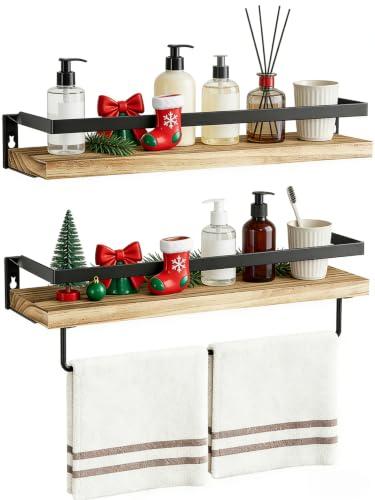
The Wallniture Wall Shelves are practical solid-feel wood shelves, including kitchen and bathroom sets with a towel bar underneath. In daily use they behave the way this style of shelf should: the board gives you a true, flat display surface, the mounting system decides how confident the shelf feels once loaded, and the finish decides how well it survives the room it lives in. Treat it as a mid-tier option and judge it on bracket quality, board feel and the hardware in the box rather than on styling photos alone.
Best for: kitchens, bathrooms and laundry rooms that need storage and a hanging rail in one footprint. Not suited for: anyone chasing a completely invisible, hardware-free floating look. As with every shelf in this guide, mount it into studs wherever you can, or use the correct anchors for your wall type, and keep the load sensible and qualitative — display and everyday storage, not a warehouse.
Wallniture is the worker of this group. The towel-bar variants solve two problems with one set of fixings — shelf storage above, hanging storage below — which is exactly the efficiency small bathrooms and busy kitchens need. In a kitchen the bar takes tea towels and utensils; in a bathroom it takes hand towels while bottles line up above. If your rooms need to earn their keep, this is the shortlist’s most practical personality.

SRIWATANA Wall Shelves
The SRIWATANA Wall Shelves are lightweight wood floating shelves with a simple, clean profile that suits small walls. In daily use they behave the way this style of shelf should: the board gives you a true, flat display surface, the mounting system decides how confident the shelf feels once loaded, and the finish decides how well it survives the room it lives in. Treat it as a entry-tier option and judge it on bracket quality, board feel and the hardware in the box rather than on styling photos alone.
Best for: small rooms, renters styling a nook, and light display such as plants and paperbacks. Not suited for: heavy hardback runs or stoneware, which belong on stud-mounted shelving or furniture. As with every shelf in this guide, mount it into studs wherever you can, or use the correct anchors for your wall type, and keep the load sensible and qualitative — display and everyday storage, not a warehouse.
SRIWATANA’s case is lightness in every sense: a clean floating profile that does not bully a small wall, an entry-tier position that suits renters and first homes, and a visual quietness that lets objects speak. Keep its loads genuinely light — plants, paperbacks, small frames — and it is the kind of shelf you can hang in an afternoon and enjoy for years. Ask it to be a bookcase and you are shopping in the wrong review.
AMADA Wall Shelves
The AMADA Wall Shelves are floating shelves that include storage-minded variants such as a small drawer for clutter control. In daily use they behave the way this style of shelf should: the board gives you a true, flat display surface, the mounting system decides how confident the shelf feels once loaded, and the finish decides how well it survives the room it lives in. Treat it as a mid-tier option and judge it on bracket quality, board feel and the hardware in the box rather than on styling photos alone.
Best for: entryways and bathrooms where small loose items need to disappear, not just display. Not suited for: open, gallery-style display where a drawer front breaks the line you want. As with every shelf in this guide, mount it into studs wherever you can, or use the correct anchors for your wall type, and keep the load sensible and qualitative — display and everyday storage, not a warehouse.
AMADA answers the objection most people raise against open shelving: not everything deserves to be displayed. Chargers, keys, medication, hair ties, the small archaeology of an entryway — a drawer variant swallows them while the top surface stays composed. In bathrooms the same trick hides the clutter and shows the calm. If your household’s surfaces mysteriously refill overnight, this is the personality in the roundup designed for you.

Love-KANKEI Wall Shelves
The Love-KANKEI Wall Shelves are rustic floating shelves with a torched-wood look that reads warm against white and grey walls. In daily use they behave the way this style of shelf should: the board gives you a true, flat display surface, the mounting system decides how confident the shelf feels once loaded, and the finish decides how well it survives the room it lives in. Treat it as a entry-tier option and judge it on bracket quality, board feel and the hardware in the box rather than on styling photos alone.
Best for: farmhouse, rustic and warm-modern rooms, and plant-and-frame styling. Not suited for: sleek minimalist rooms where a heavily grained finish fights the scheme. As with every shelf in this guide, mount it into studs wherever you can, or use the correct anchors for your wall type, and keep the load sensible and qualitative — display and everyday storage, not a warehouse.
Love-KANKEI is the warmth pick. The torched, grain-forward finish does the decorative work that plainer shelves leave to your objects, which makes these sets forgiving for people who own more enthusiasm than ornaments: a couple of plants and frames already look like a composition. Against pale walls the contrast is the point. In a cool, minimal scheme the same grain can shout, so choose it for rooms that want a rustic heartbeat.
Mkono Wall Shelves
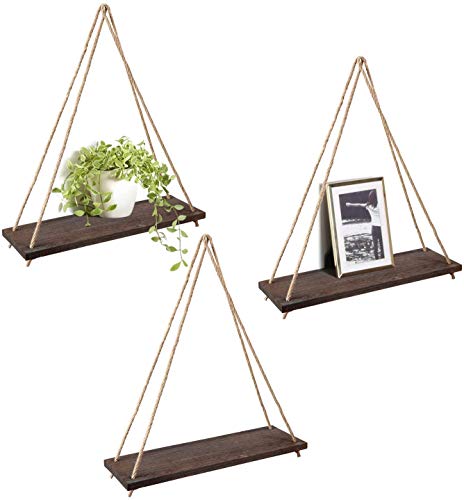
The Mkono Wall Shelves are wall-mounted wood shelves with a decorative, slightly boho feel, often styled with plants. In daily use they behave the way this style of shelf should: the board gives you a true, flat display surface, the mounting system decides how confident the shelf feels once loaded, and the finish decides how well it survives the room it lives in. Treat it as a entry-tier option and judge it on bracket quality, board feel and the hardware in the box rather than on styling photos alone.
Best for: plant shelves, bedroom corners and reading nooks that need charm as much as storage. Not suited for: utility storage in garages or workshops, where plainer heavy-duty shelving fits better. As with every shelf in this guide, mount it into studs wherever you can, or use the correct anchors for your wall type, and keep the load sensible and qualitative — display and everyday storage, not a warehouse.
Mkono closes the roundup as the decorator’s shelf: the set you choose when the wall is a corner that needs life — a plant shelf above a reading chair, a bedroom nook with candles and paperbacks, a hallway moment that turns passing space into a small event. It is not the pick for jars and tools, and it does not pretend to be. Charm is a legitimate specification, and this set delivers it at an entry tier.
Head to Head: Where Each Pick Actually Wins
Comparisons only help when they are specific, so here is the honest spread. On looks in a styled living room, BAYKA and Love-KANKEI lead: one through visible rustic hardware, the other through grain and warmth, and the choice between them is whether you want the bracket to be part of the show. On working function, Wallniture stands alone, because the towel-bar format adds a second kind of storage to the same fixings and no other pick here does that. On hiding clutter, AMADA stands alone for the mirror-image reason: it is the only personality in the group that closes a drawer on the mess.
On small walls and light duty, SRIWATANA and Mkono divide the territory by mood: SRIWATANA when you want the shelf to disappear under your objects, Mkono when you want the shelf to participate in the decoration. On tier, the group splits cleanly — BAYKA, Wallniture and AMADA in the mid tier, where brackets, boards and hardware generally feel a step more substantial; SRIWATANA, Love-KANKEI and Mkono at the entry tier, where the value is style and lightness and the loads should stay correspondingly modest.
What no pick wins is the heavy-load contest, because that contest is rigged: it is decided by studs, anchors and wall construction, not by brands. Any of these sets, fixed into studs and loaded sensibly, will feel solid. Any of them, screwed hopefully into bare plasterboard and stacked with stoneware, will eventually make the news in your household. These wall shelves reviews therefore end every comparison at the same place: choose the personality, then earn the strength with the installation.
Which Shelf for Which Room
Living rooms reward the display personalities: BAYKA for rustic layering, Love-KANKEI for warmth, SRIWATANA for a quiet modern line. Kitchens reward Wallniture’s working format and, where steam and grease are modest, BAYKA’s wipeable rustic boards — with the standing kitchen rule that everyday items live on the shelf and the heavy crockery archive stays in cupboards. Bathrooms reward Wallniture’s towel-bar sets and AMADA’s drawer variants, in sealed or bathroom-appropriate finishes, with ventilation doing quiet hero work in the background.
Bedrooms reward restraint: SRIWATANA or Mkono beside — never above — the bed, holding the lamp, the current book and the small things that make a room feel finished. Entryways reward AMADA’s clutter control and BAYKA’s landing-strip runs with hooks beneath. Home offices reward any of the six, provided the lowest shelf clears your head when you stand and the book load stays modest and spread. Children’s rooms reward high, out-of-reach placement, light soft loads, and the discipline of never shelving above the bed or the cot.
Strengths and Trade-Offs Across the Roundup
Strengths
- Real variety of character: rustic, working, hiding, quiet, warm and decorative personalities mean most rooms find a genuine match rather than a compromise.
- Every pick is an afternoon-scale project with basic tools, which keeps the whole category accessible to first-time installers.
- The sets scale gracefully — start with one wall, learn your habits, and extend the same personality to the next room.
Trade-offs
- Entry-tier sets ask for lighter loads and gentler rooms; the savings are real, and so is the discipline they require.
- Rustic finishes are a commitment of taste: wonderful in the right scheme, noisy in the wrong one, and hard to mute later.
- None of these shelves hides dust, and the working picks in kitchens will ask for a regular wipe-down as the price of open, fast storage.
Before You Buy: The Roundup Checklist
Walk the wall first. Know its construction, find the studs, and check for the hidden pipes and cables that our installation guide teaches you to respect. Measure the objects, not just the gap: the tallest book, the widest plant pot, the tray that will corral the bathroom bottles. Match the finish to the room’s moisture and sunlight, not just its palette. Confirm the box includes hardware appropriate to your wall, or plan to buy the correct anchors separately — toggle-style anchors for hollow plasterboard, proper plugs for masonry, screws into studs wherever the layout allows.
Then buy the personality, not the photograph. Every set in these wall shelves reviews looks good holding three objects in daylight; what you are actually choosing is a bracket, a board and a finish that must survive your household’s Tuesdays. Read the current listing carefully before you buy, confirm what is in the box, and if a detail that matters to you is not stated, treat that silence as information.
Care and Keeping These Shelves Looking Reviewed-Well
Dust is the tax on open storage, so pay it in small instalments: a quick pass with a dry cloth whenever you tidy the room keeps shelves and objects bright together. Kitchen sets need a degreasing wipe on a rhythm set by how close they sit to the hob. Bathroom sets need dry bottles returned to dry shelves and a ventilated room after showers. Once or twice a year, check every fixing for movement, snug the set screws on floating brackets, and deal with finish marks while they are still small.
Restyle seasonally rather than adding shelves reactively. Most households that think they need another shelf actually need a stricter edit of the existing ones: rotate objects, retire the tired, and let empty space do its quiet work. When you genuinely do outgrow a wall, extend the same set’s personality rather than introducing a rival — continuity is what turns shelves into a scheme.
Final Verdict
These wall shelves reviews end with a podium that depends on your room, which is the only honest podium this category allows. BAYKA for rustic living spaces, Wallniture for working kitchens and bathrooms, AMADA for households at war with clutter, SRIWATANA for quiet small walls, Love-KANKEI for warmth, Mkono for charm. Choose by room and load, install stud-first with correct anchors, and any of the six will repay the afternoon you spend hanging it. Choose by photograph alone, and the best shelf in this roundup cannot help you.
One last encouragement, because roundups can make choosing feel heavier than it is: every pick here is a good shelf when it is matched to its room and hung with care. The differences that matter are personality and conditions, not worthiness. Pick the one whose character sounds like your home, read its current listing carefully, plan the fixing before the parcel arrives, and hang it on a unhurried afternoon. That is the whole secret, and it works for all six.
Room-by-Room Deep Dive
The Living Room Test
Living rooms judge shelves on composition. The sets that thrive here — BAYKA, Love-KANKEI, SRIWATANA — share one trait: they look deliberate even before you style them, because in a living room the shelf is furniture, not infrastructure. Composition habits matter more than the badge: group objects in clusters with air between them, vary heights with a lying stack of books and something tall, and repeat one material across the run so separate shelves read as one idea. Keep book loads in short runs and modest stacks; the living room is where guests admire your shelves, and a shelf that visibly strains ruins the effect it was bought for. Above a sofa, leave comfortable head clearance, and keep anything fragile back from the front edge — beauty and prudence are compatible.
The Kitchen Test
Kitchens judge shelves on Tuesday mornings. Can you grab the everyday bowl without moving two jars? Does the surface wipe clean after a week of cooking vapour? Does the format keep jars from migrating toward the edge? Wallniture’s rail-and-bar thinking wins here because kitchens are workplaces: towels, utensils and daily dishes cycle constantly, and a shelf that organises the cycle earns its fixings. The kitchen rules from these wall shelves reviews are blunt: daily rotation only, heavy stoneware stays low in cupboards, nothing precious above the hob’s grease plume, and a wipe-down rhythm you actually keep. Meet those rules and open kitchen shelving is faster and pleasanter than cupboards; break them and it becomes a display of dusty regret.
The Bathroom Test
Bathrooms judge shelves on survival. Steam finds every weakness in a board and finish, so the bathroom test is really a materials test: sealed surfaces, bathroom-designed sets, and ventilation as a silent partner. Wallniture’s towel-bar sets and AMADA’s drawer variants lead this room for complementary reasons — one doubles the function of the fixings, the other hides the visual noise of a dozen small bottles. Use a tray to corral what stays on display, dry containers before they go back, and never store anything on a bathroom shelf that water would ruin, because in a bathroom, eventually, everything meets water.
The Small-Room Test
Small rooms judge shelves on restraint. Depth is the trap: a deep shelf in a narrow room crowds the eye line and shrinks the space it was meant to free, so shallow profiles — SRIWATANA’s quiet line, Mkono’s decorative lightness — outperform grander sets here. Colour is the second trap: shelves that match or sit close to the wall colour keep a small room calm, while high-contrast runs fragment it. The small-room pattern that works is one wall, done completely: a landing strip in the hallway, a nightstand replacement beside the bed, a plant moment in the corner. Small rooms do not need more storage objects; they need the right one, hung level and loaded lightly.
Materials and Finishes, Compared Honestly
Across these six picks, three material stories repeat. The first is real-feel wood: warm, repairable, characterful, and the safest long-term buy for dry rooms — the story behind the rustic personalities in this roundup. Wood forgives small knocks, can be refreshed with oil or wax where the finish allows, and ages into a room rather than out of it. Its enemies are steam and neglect, in that order.
The second story is the engineered board with a veneer or printed finish: lighter, flatter, colour-consistent across a set, and the reason multi-shelf sets can hold an entry tier at all. Bought knowingly, it is good value for dry rooms and light loads. Its weakness is finality — a chipped edge or a swollen corner does not repair, it announces. Keep engineered sets out of unventilated bathrooms and away from the hob, and they will serve quietly for years.
The third story is finish as function. Painted and lacquered surfaces are the wipe-clean workers; torched and oiled woods are the warm decorators; pale finishes brighten dark hallways and show dust less, while dark finishes ground pale rooms and show every speck — choose with your cleaning temperament in mind. None of these stories is the correct one. The correct one is the story your room’s conditions tell, and these wall shelves reviews keep returning to that sentence because it is where good purchases are actually made.
Installation Notes From the Roundup
Every pick in this roundup installs the same way at heart: find the studs, mark level, fix the system, seat the board, load gradually. The differences are in forgiveness. Visible-bracket sets forgive most, because you can see and adjust every fixing. Floating sets forgive least, because the bracket must be level and fully seated before the board hides your work — measure twice there, literally. Towel-bar and drawer variants add one step of assembly and one habit: check moving parts and bar fixings at the same twice-yearly review where you snug set screws and look for movement.
The safety rules are identical for all six and are not optional garnish. Screw into studs wherever the layout allows. Where it does not, use anchors genuinely matched to the wall — toggle-style anchors for hollow plasterboard, proper plugs for masonry — and never hang anything heavy on bare plasterboard alone. Check for hidden cables and pipes before every hole. Never mount a shelf above a bed or a cot, and keep shelves in children’s rooms high, light and out of climbing reach. If any of that sounds beyond your confidence, a competent handyperson for one visit is cheaper than a failed shelf — that advice is part of these reviews, not an escape from them.
What Buyers Commonly Get Wrong
The most common mistake in this category is buying the set before meeting the wall: the shelf arrives, the studs are in the wrong places for its bracket holes, and the project becomes improvisation. Meet the wall first — construction, stud positions, hidden services — and let that evidence filter the shortlist. The second mistake is uniform buying: one personality for the whole home, chosen from one photograph, leaving the bathroom with a dry-room finish and the kitchen with a display shelf where a worker was needed.
The third mistake is loading by hope. Shelves get stacked on day one with everything the household owns, front edges crowded, heavy items high. Load gradually, keep weight toward the wall, keep the heaviest things low or on furniture, and let the first fortnight prove the fixing before the full arrangement moves in. The fourth mistake is ignoring the edit: shelves filled to overflow within a month, then blamed for looking cluttered. The shelf held what it was given; the curation is the owner’s job, and it is the cheapest upgrade in this entire guide.
Sets, Singles and Building a Whole-Home Scheme
Most picks in this roundup are sold as sets, and sets are the right unit for one wall: matched boards, one finish, a composed run. The trap is the oversized bundle bought for the whole home in one gesture. Finishes that match under a kitchen’s light diverge in a bedroom’s, and a personality chosen for the living room rarely suits the bathroom. Buy per room, in the order you will actually finish them, and let each completed wall teach you what the next one needs — households consistently report that the second wall goes better than the first because the first wall was a teacher.
Singles have their place: one ledge in a hallway, one shelf above a desk, one plant shelf in a corner that needs life. A single is also the honest way to test a personality before committing a room to it. Hang one BAYKA shelf where you are considering a run; live with the grain and the brackets for a month; then decide with evidence instead of imagination. Reviews can rank and compare, but your own wall, light and objects cast the deciding vote.
When a scheme spans rooms, hold the quality bar constant and let the style breathe. The through-line of a good home is not identical shelves everywhere; it is identical standards everywhere — honest brackets, stud-first fixings, finishes matched to conditions, loads kept sensible. Visitors will never notice that consistency consciously, but they will feel it as a home that seems considered, which is precisely the effect shelves are bought to create.
A Year With These Shelves: Long-Term Ownership Notes
Month one is the honeymoon and the test in one: fixings prove themselves, the arrangement gets edited twice, and the shelf either becomes furniture or becomes a worry. The sets in this roundup that age best share a pattern — their owners loaded them gradually, kept heavy things toward the wall, and treated the first fortnight as a probation the shelf had to pass. Shelves that were stacked to the edge on day one are the ones that develop the tilt, the creak and the household mythology.
By month six, the real differences in this roundup have declared themselves, and they are the unglamorous ones: whose finish still wipes clean in the kitchen, whose bathroom board still has crisp edges, whose brackets still feel rigid when a book is pulled. This is why these wall shelves reviews weighted ageing so heavily — a shelf is a semi-permanent fixture judged in years, and the photograph that sold it was taken in minutes.
By year one, the twice-yearly habit has either formed or it has not: a minute per shelf to check movement, snug a set screw, wipe the top edge nobody sees and dust gathers on. Owners who keep that habit describe their shelves the way people describe good shoes — bought once, used daily, never thought about. That is the destination every pick in this roundup is capable of reaching, provided the choosing and the hanging were done with the care these reviews keep insisting on.
How to Read Any Wall Shelf Listing Before You Buy
Reviews narrow the field; the listing closes the sale, so read it like an auditor. Find the mounting system first — a diagram or photograph of the bracket or frame is the single most informative thing on the page, and its absence is information too. Find the hardware list second: a set that names its plugs and screws and acknowledges different wall types expects to be installed properly. Find the material description third, and separate genuine material language from adjectives; a board described by its wood or its core is a product, while a board described only by moods is a photograph with a parcel attached.
Then read the buyer questions and the critical feedback for patterns rather than verdicts: recurring mentions of tilt point at brackets, recurring mentions of finish mismatch point at photography, recurring mentions of missing hardware point at packing. One complaint is an anecdote; a theme is a specification. Finally, confirm the set’s contents against your wall plan — if your studs cannot meet its bracket holes, the correct anchors are a planned purchase, not an afterthought discovered with a drill in your hand.
The Dust Question, Answered Properly
Every roundup of open shelving owes readers a straight answer on dust, because it is the objection that decides real purchases. Yes, open shelves gather dust, and yes, objects on them gather it too. The honest scale of the problem is smaller than its reputation: a shelf that is used daily — kitchen dishes, bathroom bottles, hallway keys — barely dusts at all, because use is a cleaning programme in itself. Dust settles on the forgotten, so display shelves in spare rooms are the ones that need a rhythm: a dry-cloth pass when you clean the room, objects lifted and replaced in the same motion.
Two habits keep the tax trivial. Keep a small number of larger objects rather than a crowd of small ones, because wiping around twenty trinkets is a chore and wiping around five pieces is a gesture. And keep one shelf in each run deliberately spare — empty space shows dust least and rests the eye most. Households that follow both habits stop mentioning dust within a month, which is the closest thing to a verdict this question ever gets.
Renters and First Homes: A Note From the Roundup
Renters ask these wall shelves reviews a fair question: is any of this for me, given a landlord, a deposit and walls I must hand back? The answer is yes, with a method. Get permission where your agreement requires it. Favour modest runs fixed into studs, because few, purposeful holes fill invisibly while a scatter of exploratory holes tells a story. Photograph each wall before and after, keep a small pot of the matching paint, and fill with care at the end — a shelf removed thoughtfully leaves almost no evidence it was ever there, which is more than can be said for most furniture’s dents and scuffs.
First-home buyers face the opposite temptation: every wall at once, in the first month, at entry tier, before the house has taught them anything. Resist it. A new home reveals its storage truth slowly — which hallway actually collects the post, which bathroom wall the steam really hits, where the afternoon sun lands. Hang one room’s shelves, live a season, and let that evidence spend the rest of the budget. The picks in this roundup will still be here, and your second and third walls will be better than your first because your first was allowed to be a lesson.
Both groups share one advantage worth naming: shelves are reversible storage. Unlike built-ins or heavy furniture, a shelf can move rooms, move homes or move on entirely with an hour’s work and a tube of filler. For households whose lives are still changing shape, that reversibility is not a compromise — it is the feature.
A Final Word on Value
Value in this category is not the lowest tier; it is the longest service. A mid-tier set that hangs level for a decade, wipes clean in the kitchen and moves house with you has cost you less — in money, holes and patience — than an entry set replaced twice. That said, entry-tier picks bought knowingly, for light duty in dry rooms, are genuinely good value, and several in this roundup earn their place exactly there. The false economy is only ever the mismatch: premium hopes on an entry bracket, or a working kitchen asked of a decorator’s shelf. Match the pick to the room and the load, and every tier in these reviews can be the right buy.
Judge value over the shelf’s whole life and the calculation changes again: the afternoon of careful installation is part of the price, the twice-yearly minute of maintenance is part of the rent, and the years of daily, unconsidered use are the dividend. Bought and hung well, even the simplest set in this roundup pays that dividend for a very long time.
Reading Wall Shelves Reviews Against Your Own Space and Routine
A single review session can flatter or condemn a wall shelves unfairly, so this section slows the judgement down and looks at what only repeated, ordinary use tends to reveal. Run the wall shelves through your least favourite version of its job first, not the easiest demonstration: the awkward corner, the rushed weekday timing, the fuller load, the lower light, or whatever condition in your routine makes this category work hardest. Look at replacement parts and consumables for the wall shelves while you are still comparing, confirming that the pieces most likely to wear, clog, tear, fade or get lost can actually be obtained without replacing the whole product. Notice the small recovery moments: how the wall shelves behaves when you pause mid-task, change your mind, need to move it, clean it sooner than planned, or hand it to someone in the household who has never used it before.
Finish the longer check by looking at wear points rather than features: the hinge, seam, edge, wheel, latch, surface or joint on a wall shelves that moves, flexes or gets handled most is where its second year is decided, whatever its first week felt like. For troubleshooting, start with the boring causes first: power, water, fit, blockage, alignment, a full container, a loose connection or a setting changed by the last person who used the wall shelves, because boring causes account for most apparent failures. When something about the wall shelves disappoints, change one variable at a time — position, setting, timing, load, accessory or technique — and give the change a fair trial, because changing three things at once leaves you with a better or worse result and no idea why. Use a simple decision checklist at the end: the wall shelves fits the measured space, suits the real frequency of the job, matches the household’s cleaning temperament, has obtainable parts, and has a named storage home — five yeses make a confident order.
Photograph your setup once the wall shelves is working well — the position, settings, arrangement or layout you settled on — so that after a move, a deep clean or a seasonal break you can recreate the arrangement that worked instead of rediscovering it. Check the floor, wall, ground or surface the wall shelves will meet, since level, texture, moisture and finish decide more about everyday performance in home decor & lighting settings than most shoppers expect when they are comparing listings on a screen. Keep a short note of what you adjusted on the wall shelves during the first month, even just a line on your phone, since those notes turn vague impressions into a setup you can repeat, share or troubleshoot months later. Seasonal thinking helps more than expected: a wall shelves bought in one season will meet different light, humidity, mud, heat, guests and routines in another, so judge its size, storage and upkeep against the hardest season it will face.
Share the checklist result with anyone who shares the space, since a wall shelves chosen by one person and resented by another rarely survives, however sensible the purchase looked on paper. Decide in advance what good enough looks like for the job the wall shelves does in your home, because chasing a flawless result usually costs more time than the flaw itself, and most households are happier with a reliable ninety percent they actually repeat. If you want a concrete listing check, take a name already shortlisted in this guide, such as BAYKA Wall Shelves, Wallniture Wall Shelves and SRIWATANA Wall Shelves, and verify that exact wall shelves listing against the measurements and compatibility questions above, field by field, rather than trusting the headline description alone. Plan the storage home for the wall shelves before it arrives, naming the exact cupboard, corner, shelf, hook or stretch of floor, because a product without a home migrates around the house and slowly becomes the clutter it was bought to reduce.
If a problem with the wall shelves repeats in the same spot or the same stage of the job, treat the pattern as the clue — patterns point to setup, surface or technique, while random problems point more often to the individual unit. Consider the cleaning rhythm honestly: a wall shelves that needs attention after every use suits a household that enjoys small rituals, and frustrates a household that wants to finish a job and walk away, so match the upkeep to the temperament, not the intention. Read the manual’s warnings page for the wall shelves even if you read nothing else, because that page is a compressed list of every way the product has ever been misused, and it tells you exactly which of your own habits needs adjusting.
Frequently Asked Questions
Which wall shelves are best overall?
There is no room-independent winner, and reviews that crown one are selling certainty, not shelves. For most living rooms, a rustic mid-tier set such as BAYKA is the safest all-round recommendation because the visible-bracket format is forgiving to install and the look suits layered styling. For kitchens and bathrooms, Wallniture’s working formats are the better default. Start from your room and load, then pick the personality — the roundup above is organised exactly that way.
Are floating shelves as strong as bracket shelves?
Both styles succeed or fail at the fixing, not at the label. A floating shelf on a rigid frame, fixed into studs, feels rock solid under sensible loads; a bracket shelf screwed into bare plasterboard does not. Bracket shelves are generally more forgiving for beginners because the load path is visible and the fixings are easy to place on studs. Floating shelves demand more precision in levelling and seating the board. Choose by look and room, then earn the strength with installation.
What should I check first in wall shelves reviews?
Check what the review is actually judging. Useful reviews talk about mounting systems, board materials, edge finishing, hardware in the box and room fit. Weak reviews repeat listing adjectives and printed numbers. Also check whether the review admits limits — every shelf has them, and a review without trade-offs is an advertisement. Finally, confirm the review treats load qualitatively and insists on studs or correct anchors; that insistence is the mark of advice written by someone who has hung a shelf.
Can one set of shelves work in every room?
A single personality across a whole home usually means some rooms get the wrong tool: the rustic set that charms the living room sulks in a steamy bathroom, and the working kitchen shelf looks lost above a bed. It is better to keep a consistent quality bar and let style vary by room — floating where looks lead, bracketed where work leads, drawer variants where clutter leads. Continuity of finish within each room matters far more than uniformity across the front door.
How many shelves should I buy for one wall?
Buy for the arrangement, not the wall’s full capacity. Most single walls compose best with a run of two or three shelves, staggered or aligned with intent, and with one shelf deliberately under-filled. Mock the layout up with painter’s tape at full size, live with it for a day, and count how many shelves the objects you actually own can justify. It is easier to add a shelf later than to un-drill a wall that feels crowded.
When should I choose a bookcase instead of wall shelves?
Choose a bookcase when the load is the point: long runs of books, heavy collections, or storage that must move house with you. Choose wall shelves when space and display are the point: small rooms, dead walls, bathrooms without cupboards, and any surface-level clutter that needs a composed home. Many rooms honestly need both — the bookcase carrying the archive, the shelves carrying the current rotation — and our related guides below compare those floor-standing options directly.
Related Guides and Picks
These wall shelves reviews are one voice in a wider conversation. The guides below cover the deep single review, the buying framework, installation, value and the honest pros and cons — plus the floor-standing alternatives for loads shelves should not carry.
- wall shelves review
- wall shelves buying guide
- how to choose wall shelves
- how to install wall shelves
- are wall shelves worth it
- wall shelves pros and cons
- our main wall shelves picks by budget
- wall sconce picks for shelf lighting
- bookcases for small spaces, compared
- bookshelf picks for heavier book storage