Disclosure: As an Amazon Associate, dailyhomedecorating.com earns from qualifying purchases. Links on this page are affiliate links; they cost you nothing extra. Prices and availability change often, so check the current Amazon listing before you buy.
So, are wall shelves worth it? The short answer is yes — for the right household, in the right rooms, at the right loads — and this article exists to make those qualifiers precise rather than to dodge the question. Asked plainly, are wall shelves worth it for a small home short on surfaces, a renter who needs storage that feels intentional, a cook who wants the daily dishes within reach, or a reader who wants the current books beside the chair? Emphatically yes. Are wall shelves worth it as a substitute for a bookcase, a pantry or a wardrobe, hung hopefully on weak walls and loaded like furniture? No — and no shelf at any tier can make that answer change. What follows is the full accounting: what you actually get, what it really costs beyond money, who it pays off for, who should skip it, what to choose instead, and how to extract full value if you buy.
Key Takeaways
- Worth it if: your rooms lack surfaces, your walls are sound, your loads are light-to-medium, and you will install stud-first or with correct anchors.
- Not worth it if: the real job is heavy storage, hidden storage, or storage on walls that cannot take fixings.
- The value is mostly space and daily ease, bought once and repaid every day; the costs are dust, permanence and honest load limits.
- Alternatives — bookcases, cupboards, ledges — are not rivals but neighbours; many homes need shelves plus one of them.
- Value is decided less by the shelf you buy than by the match between shelf, wall, room and load.
What You Actually Get When You Buy Wall Shelves
You get floor space back. That is the headline benefit and it is not trivial: in a small home, the area a bookcase or side table would occupy is often the difference between a room that breathes and a room that negotiates. Wall shelves move storage into the one dimension furniture cannot use, and the reclaimed floor changes how the whole room feels and functions — easier to clean, easier to move through, visually calmer at the level where eyes and feet actually live.
You get speed. Open shelves put the daily things — dishes, jars, towels, keys, the current book — visible and grabbable, with no doors, no drawers and no archaeology. Households consistently underestimate this benefit before installation and cite it most afterward, because it compounds: a few seconds saved and a small frustration removed, several times a day, in the rooms where life is densest. Kitchens and bathrooms, the two most time-pressured rooms in the home, are where the speed dividend pays out largest.
You get composition. A shelf run gives a room a designed horizontal — a place where books, plants and objects arrange into something that looks intentional — and it gives you a surface that can be restyled in minutes as seasons, hobbies and households change. You get adaptability of a particular kind: the hardware stays, the arrangement evolves. And you get reversibility, the underrated benefit: shelves unbolt, holes fill, and the whole decision can be undone or moved to the next home in an afternoon, which is more than can be said for most storage furniture.
What you do not get is equally definite, and this article will keep returning to it: you do not get heavy capacity, hidden storage, dust protection or a substitute for furniture. The worth-it question is really the question of whether the first list is what your home needs and the second list is what it can live without.
In this guide
The Real Costs Beyond Money
The first real cost is dust, the famous one. Open storage displays its contents and its maintenance equally; shelves in working rooms barely dust because use cleans them, but display shelves in quiet rooms need a regular pass with a cloth, objects included. Households that hate dusting on principle will experience this cost daily and should weigh it honestly — it is small per week and permanent per year.
The second cost is permanence-ish commitment. Shelves mean holes, and holes mean a small act of faith in the layout. Tape-testing and choosing carefully shrink the risk, and filling is easy, but a shelf is not a cushion you can move on a whim; households in rapid flux should count the commitment as a real cost. The third cost is the installation afternoon itself, plus the tools and anchors it wants — modest, but real, and doubled if the first attempt is rushed and must be redone properly.
The fourth cost is discipline. A shelf imposes a load limit and an editing limit for its entire life: heavy things must keep going elsewhere, and the arrangement must be curated or it becomes visible overflow. Some households experience that discipline as a pleasure — the shelf as editor — and some as a nag. The fifth cost is opportunity: a wall given to shelves cannot hold art, a mirror or nothing at all, and in a beautiful room, nothing at all is sometimes the right answer. Worth-it calculations that ignore these five costs are marketing; this article’s verdict depends on counting them.
Who Wall Shelves Pay Off For
The small-home household is the clearest winner. When floor area is the binding constraint on comfort, storage that spends none of it is not a nice extra but the enabling decision — the hallway landing strip, the bathroom’s only storage, the bedroom’s nightstand without the nightstand. For this household the question are wall shelves worth it answers itself the first morning the floor is clear and everything has a place.
The renter with a reasonable landlord is the second winner, because shelves offer the best ratio of transformation to reversibility in the category: a home that feels owned, storage that reads as architecture, and an exit that costs a tube of filler and an hour. The cook and the busy family form the third winning profile: open kitchen and bathroom shelving pays its speed dividend at the exact hours — breakfast, bath time, the weekday evening — when seconds and tempers are both scarce. A fourth profile deserves naming: the curator, the person who owns beautiful things and enjoys arranging them. For the curator, shelves are not storage with a styling bonus; they are the hobby itself, installed.
Who Should Skip Wall Shelves
Skip them if your storage problem is genuinely heavy: the real library, the stoneware archive, the tool collection. Shelves asked to do furniture’s work will sag, strain or fail, and the household will conclude wrongly that shelves are bad rather than that the match was. Skip them if your walls cannot take fixings — crumbling, damp, forbidden by tenancy — because no anchor converts an unsound wall into a sound one, and the honest product in that house is furniture. Skip them if you require hidden storage: open shelves cannot un-show their contents, and a household that finds visible objects stressful will not be argued out of it by an article.
Skip them, finally, above beds and cots and anywhere people sleep — not a profile but a placement, and an absolute one. And consider skipping them in the one room where the wall itself is the feature: some rooms are finished by emptiness, and recognising that is taste, not failure.
The Strengths and Trade-Offs of Owning Wall Shelves
Strengths
- Space efficiency that no floor-standing alternative can match, decisive in small and rented homes.
- Daily speed: the most-used objects in the house become the most reachable, in the rooms where time matters most.
- Reversibility and longevity: unbolt, fill, rehang elsewhere — a storage decision that can move house with you for years.
Trade-offs
- Honest load limits for life: the heavy and the dense must always live elsewhere.
- Visible everything, including dust and clutter, with a light but permanent maintenance rhythm.
- Installation commitment: holes, an afternoon, and a layout decision you should expect to live with.
Alternatives to Consider
The bookcase is the first alternative and the right answer whenever the load is the point — books in real quantity, heavy collections, storage that must be movable at a moment’s notice. It costs floor space and returns capacity and forgiveness; many households correctly own both, the bookcase carrying the archive and the shelves carrying the current rotation. Three prose-first alternatives from the cluster illustrate the shelf-side options for households still deciding.
BAYKA Wall Shelves
The BAYKA Wall Shelves are rustic wood wall shelves with a warm, farmhouse-leaning finish and visible bracket styling. In daily use they behave the way this style of shelf should: the board gives you a true, flat display surface, the mounting system decides how confident the shelf feels once loaded, and the finish decides how well it survives the room it lives in. Treat it as a mid-tier option and judge it on bracket quality, board feel and the hardware in the box rather than on styling photos alone.
Best for: living rooms, bedrooms and entryways where the shelf itself is part of the decor. Not suited for: bathrooms with heavy steam unless the finish is sealed and the room is ventilated well. As with every shelf in this guide, mount it into studs wherever you can, or use the correct anchors for your wall type, and keep the load sensible and qualitative — display and everyday storage, not a warehouse.

Wallniture Wall Shelves
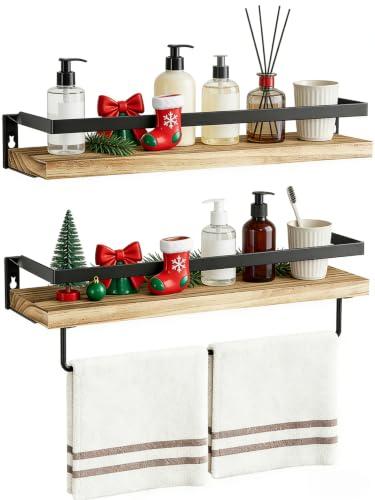
The Wallniture Wall Shelves are practical solid-feel wood shelves, including kitchen and bathroom sets with a towel bar underneath. In daily use they behave the way this style of shelf should: the board gives you a true, flat display surface, the mounting system decides how confident the shelf feels once loaded, and the finish decides how well it survives the room it lives in. Treat it as a mid-tier option and judge it on bracket quality, board feel and the hardware in the box rather than on styling photos alone.
Best for: kitchens, bathrooms and laundry rooms that need storage and a hanging rail in one footprint. Not suited for: anyone chasing a completely invisible, hardware-free floating look. As with every shelf in this guide, mount it into studs wherever you can, or use the correct anchors for your wall type, and keep the load sensible and qualitative — display and everyday storage, not a warehouse.
AMADA Wall Shelves
The AMADA Wall Shelves are floating shelves that include storage-minded variants such as a small drawer for clutter control. In daily use they behave the way this style of shelf should: the board gives you a true, flat display surface, the mounting system decides how confident the shelf feels once loaded, and the finish decides how well it survives the room it lives in. Treat it as a mid-tier option and judge it on bracket quality, board feel and the hardware in the box rather than on styling photos alone.
Best for: entryways and bathrooms where small loose items need to disappear, not just display. Not suited for: open, gallery-style display where a drawer front breaks the line you want. As with every shelf in this guide, mount it into studs wherever you can, or use the correct anchors for your wall type, and keep the load sensible and qualitative — display and everyday storage, not a warehouse.
The wall cupboard is the second alternative, for clutter that must vanish and items that must be dust-free; it returns calm and protection at the price of access speed and visual weight. The picture ledge is the third, a specialist that outperforms general shelves for art and frames while doing nothing else. Choosing among these is not a defeat for shelves — it is the worth-it method working as intended, matching each job to its proper tool.
How to Get the Most Value If You Buy
Value is extracted in the installation and the first month, not at the checkout. Install stud-first with correct anchors and a detector check before every hole, because a shelf that never moves never needs replacing, apologising for or working around. Load gradually and qualitatively, keeping the heavy elsewhere from day one, so the shelf’s whole life is spent inside its honest band. Style with restraint and one deliberately under-filled shelf, because the composed look is most of what visitors will call the shelf’s quality.
Then keep the tiny rhythm: dust with the room, snug the fixings twice a year, restyle seasonally instead of buying more shelves reactively. Photograph the stud map before the first installation and keep the hardware bag; the household that treats shelves as a system gets a decade of service from a modest purchase, while the household that treats them as decor gets a season. Same shelf, same wall — the value was in the method all along.
One value habit deserves emphasis because it is free: review the arrangement, not the shelf, whenever satisfaction dips. Nine times in ten, the shelf is fine and the edit has drifted — objects accumulated, the tray overflowed, the under-filled shelf filled. A ten-minute re-edit restores the entire benefit at zero cost, and households that learn this stop shopping for storage they already own. Value, in this category, is a practice disguised as a purchase.
The Decision Checklist
Answer honestly, and count. Is floor space a real constraint in the room? Are the walls sound and drillable, with studs or anchor options you trust? Is the intended load light-to-medium — display and daily things, not archives? Will you enjoy the objects being visible, and dusting them lightly as a rhythm? Can the shelf avoid beds, cots and sleeping places entirely? Will you install properly, or happily pay someone who will? Is there one clear wall whose job you can name in a sentence?
Mostly yes: wall shelves are worth it for you, and the remaining guides in this cluster will help you choose and hang them well. Several no answers, especially on walls or load: they are not worth it in that room, and the alternatives above will serve you better. One no on placement above a bed is absolute and outranks every yes. That is the whole decision, and it takes less time than the parcel would.
Notice what the checklist never asks: it never asks about colour, brand or trend. Those questions matter later and less. The worth-it decision is structural — walls, loads, visibility, commitment — and households that settle it structurally find the remaining questions almost relaxing to answer, because they are finally shopping inside a decision that has already been made correctly. That calm, as much as any shelf, is what this article was trying to sell you.
Are Wall Shelves Worth It? A Room-by-Room Verdict
Verdicts sharpen when they are given room by room, so here is the article’s answer at full resolution. In the living room: worth it, strongly, for display and the current book rotation — the room gains composition and loses clutter in the same afternoon. In the kitchen: worth it for the daily rotation on bracket or rail formats, with the standing condition that heavy crockery stays in cupboards and the wipe-down rhythm is kept; households unwilling to wipe should hear that condition as a no. In the bathroom: worth it, often transformatively, because the alternative for most bathrooms is no storage at all — with bathroom-appropriate finishes and ventilation as the price of admission.
In the bedroom: worth it beside the bed, never above it — the nightstand replacement is one of the best small-room trades in the home, and the placement rule is absolute rather than a preference. In the hallway: worth it, quietly, as the landing strip that ends the daily keys-and-post negotiation. In the home office: worth it, with ergonomics as the condition — head clearance below the lowest shelf is a design requirement, not a detail. In the child’s room: worth it only in the high, light, out-of-reach configuration, with low furniture doing the child’s own storage; anywhere else in that room, the answer tilts to no.
And in the garage, workshop or utility room with genuinely heavy contents: not worth it, because purpose-built racking exists and walls there deserve fixings engineered as construction. The pattern across all eight verdicts is the article in miniature — the same product, eight different answers, each decided by room, load and wall rather than by the shelf itself.
The Money Question, Answered Without Invented Numbers
Readers reasonably ask what worth-it means in money, and this article answers in the only honest currency available without a live listing in front of us: tiers and service years. An entry-tier set that serves a gentle room for years is excellent value. A mid-tier set that anchors a kitchen’s daily life for a decade is better value still, because the cost is divided by thousands of mornings. The expensive outcomes in this category are never the shelf prices; they are the mismatches — the set replaced twice, the failed fixing and its objects, the bathroom board swelling its way to the bin. Worth-it, financially, is mostly the art of buying once.
There is also the counterfactual to price: the furniture not bought, the floor not occupied, the storage unit not rented, the larger home not needed quite yet. Small homes especially should run that side of the ledger, because a few well-placed shelves can postpone or cancel purchases many times their size. Counted whole — purchase, installation, alternatives avoided, years of service — wall shelves are among the cheapest storage a household can buy per year of use, provided the match was right. Provided the match was right is doing heavy work in that sentence, and it should: it is the article’s thesis.
The Time Horizon: A Season, a Year, a Decade
Worth-it changes with the clock, and honest advice should say so. In the first season, shelves repay in novelty and organisation: the room looks finished, the surfaces clear, the household congratulates itself. This is the horizon at which styling photographs are taken, and it is the least informative one. By a year, the true ledger has declared itself — the finish in the kitchen, the board edges in the bathroom, the fixings under daily cycling, the dust rhythm either kept or resented. Shelves that were matched to their rooms pass the year mark invisibly; mismatches announce themselves precisely here.
By a decade, the survivors share a profile: sound brackets, stud-first fixings, finishes that could be refreshed, and households that kept the twice-yearly minute of maintenance. Those shelves have repaid their cost so many times over that the purchase feels less like spending than like infrastructure. The decade test is the one this article recommends imagining before buying: picture the shelf in ten years, in that room’s real light and traffic, and ask whether the board, bracket and finish in front of you will still be plausible. If yes, the worth-it answer is probably yes too.
Two Households, Two True Stories
Consider the household that swears by its shelves: a small flat, a stud wall in the living room, a bathroom with no cupboard. They installed modestly — one living-room run for books-in-play and plants, one towel-bar shelf in the bathroom — fixed into studs, loaded gradually, edited ruthlessly. Five years on, the shelves are furniture in their minds: unconsidered, daily, essential. Nothing about their sets is special; everything about the match is.
Consider the household that swears at its shelves: a long floating run bought from a photograph for a plasterboard wall, installed with the included screws between studs because the wall felt solid, loaded on day one with the full book collection. The tilt arrived in a month, the distrust in two, the removal in six — and the conclusion drawn was that wall shelves are flimsy. Both stories are true, and the difference between them is not luck, budget or brand. It is the sequence of decisions this cluster’s guides exist to teach: wall first, load honestly, fixings properly, patience throughout.
Worth It With Children, Pets and Busy Lives
Busy households ask a sharper version of the question, because their shelves will be knocked, loaded one-handed and styled by events. The answer stays yes, with the configuration changed: bracket formats over floating where traffic is heavy, lips and rails where objects migrate, finishes that wipe, placements that respect swing doors, climbing toddlers and the arc of a dog’s tail. In children’s rooms the configuration is strictest — high, light, soft, checked often, never above bed or cot — and within that strictness, shelves genuinely help, holding the parents’ rotation and the room’s calm out of small hands’ reach.
Pets add one clause: nothing breakable or chewable at animal height on an open shelf, because an open shelf is an invitation written in a language animals read fluently. Meet these conditions and the busy household is not a hard case for shelves; it is the case they were made for, since no household needs reachable, organised, floor-free storage more than the one with no time to look for anything.
Regret Patterns: What Owners Wish They Had Known
Regret in this category is remarkably consistent, and consistency is useful — it means the lessons are learnable in advance. The first regret is size: shelves bought too deep for their objects and rooms, crowding eye lines and inviting the overload that followed. The second is uniformity: one personality imposed on every room, leaving the bathroom with a dry-room finish quietly failing and the kitchen with a display shelf where a worker was needed. The third is the skipped detector — the hole that found a cable’s neighbourhood and turned an afternoon into a tradesperson’s invoice.
The fourth regret is load optimism about books, the category’s eternal trap, where the planned paperback shelf became the overflow library and began its slow tilt. The fifth is styling by accumulation: shelves filled within a month to a state their owners then described as cluttered, blaming the product for an editing decision. Notice what is absent from the regret list: almost nobody regrets the shelf they tape-tested, stud-fixed and loaded gradually, and almost nobody regrets choosing the bookcase for the genuinely heavy job. Regret follows skipped steps with near-perfect fidelity, which is the most encouraging fact in this article — the worth-it outcome is largely within the buyer’s control.
If You Only Have One Wall
Many homes asking are wall shelves worth it really have one candidate wall, which concentrates the decision usefully. Give that wall the household’s densest daily job — the entryway landing strip or the kitchen’s daily rotation — rather than its prettiest one, because worth is repaid in use, not in admiration. Choose the format that doubles function where possible: hooks beneath, a bar, a drawer. Fix it impeccably, since a single wall carries the whole experiment’s reputation, and live with it a season before judging the category.
One wall done completely — planned, installed, loaded, edited — teaches a household its true shelf appetite better than any article. If the season ends in daily gratitude, the second wall has earned its holes. If it ends in indifference, you have bought the answer cheaply. Either way, the one-wall trial is the lowest-risk form of the worth-it question, and this article recommends it to every hesitant household.
The Environmental Ledger
A brief word on the footprint of the decision, because worth-it increasingly includes it. A shelf is a small, long-lived object: modest material, no energy in use, a service life measured in decades when it is bought and hung well, and a second life in the next home or the next room when it is not. The wasteful version of shelving is the disposable version — flimsy sets replaced in cycles, failed fixings and damaged goods — which is one more reason the match matters more than the tier. Bought once and kept, wall shelves sit comfortably on the right side of the environmental ledger; bought carelessly and repeatedly, nothing does.
The same logic extends to the objects shelves save. A fixing done properly the first time does not drop the vase, crack the crockery or write off the book collection in a single bad night. Durability is an environmental quality as much as an economic one, and in this category it is manufactured almost entirely by the installer’s care — stud by stud, anchor by anchor, check by check.
The Verdict, Revisited After All the Evidence
So: are wall shelves worth it? For the household with sound walls, light-to-medium loads, a surface shortage and the willingness to install properly — yes, decisively, and the repayment starts the first morning. For the household whose real need is heavy, hidden or wall-free storage — no, and the alternatives will repay the same money better. For everyone between, the answer is one wall, installed impeccably, judged after a season. The question was never really about shelves. It was about whether a home’s storage matches its life, and shelves — matched well — are one of the cheapest ways to make it true.
That is also why this article refuses to end with a product. Products are the last and least interesting part of the worth-it equation; the verdict was decided by your walls, your rooms, your objects and your habits long before a brand entered it. Get those four right and almost any sound shelf repays you. Get them wrong and no shelf can. The guides linked below exist to help you get them right, in order, the first time.
How the Answer Changes by Tier
At the entry tier, worth-it is a bargain with conditions: style and light duty now, in exchange for gentle rooms, dry conditions and disciplined loads. Households that keep the bargain get years of service and no complaints; households that quietly upgrade the load get the tilt and the disappointment. At the mid tier, the bargain relaxes — brackets, boards and hardware with real substance forgive daily working use, and this is where most households’ worth-it answer is most robustly yes, because the shelf stops requiring thought. At the premium end, worth-it becomes a longevity argument: materials that refinish, hardware that does not fatigue, a look that survives redecoration. Premium is worth it on the walls that anchor a home and wasted on the wall behind the spare-room door.
The tier mistake that poisons the question is judging the whole category by one tier’s behaviour — condemning shelves because an entry set was over-loaded, or overspending everywhere because one premium wall delighted. Each tier is a different product wearing the same name, and the worth-it verdict must be pronounced per tier, per room, per load. That sounds like hard work; in practice it is one honest sentence per purchase: this shelf, in this room, for these things, at this tier. Households that write that sentence rarely ask the worth-it question twice.
The Benefit Nobody Lists: Shelves Change Behaviour
The least discussed return on wall shelves is behavioural. A home with a landing strip stops losing keys. A kitchen with the daily dishes visible and reachable stops generating the cupboard archaeology that makes cooking feel heavier than it is. A bathroom with a shelf and a tray stops colonising the bath’s edge. These are not storage improvements; they are friction removals, repeated daily, and their cumulative effect on a household’s temper is out of all proportion to the shelf’s size.
There is a subtler behavioural dividend: shelves make ownership visible, and visible ownership gets edited. The book you see is the book you read or release; the object on display justifies itself or migrates. Households often report, a year after installing shelves, owning fewer and better things in the rooms that have them — not because shelves store more, but because they store honestly. Any worth-it accounting that omits this effect understates the case, and it is available at every tier.
A Sceptic’s Cross-Examination
Fairness demands the strongest case against, put properly. Sceptic: shelves are a trend’s furniture, and trends date. Answer: the trend is in finishes, not in the form — boards on walls predate photography — and a neutral shelf outlives its styling by decades because the objects carry the fashion. Sceptic: the capacity is poor value against a bookcase. Answer: agreed, for capacity; but the comparison is rigged, because the shelf is buying floor space and speed, which the bookcase does not sell at any price. Sceptic: dust. Answer: real, small, and priced into this article’s verdict from the first section.
Sceptic, finally: most shelves end as clutter ledges. Answer: some do, and the cause is traceable — no job sentence, no load discipline, no edit — which is why this cluster’s guides spend so many words on decisions rather than products. The sceptic’s cases are genuine, and every one of them is a case against a mismatch, not against the shelf. A verdict that survives cross-examination is worth more than a verdict that was never questioned, and this article is content to rest on that.
Worth It, Object by Object
Sometimes the fastest route to a verdict is through the objects themselves. Books in current rotation: worth it, on stud-fixed shelves, in modest runs. Plants: worth it almost unconditionally — shelves give plants the light and the stage that floors cannot, and a trailing plant is the single most reliable beautifier in this entire cluster of guides. Kitchen jars and daily dishes: worth it, with the wipe rhythm accepted. Bathroom bottles: worth it, corralled in a tray, in bathroom-appropriate finishes. Children’s treasures: worth it only high and out of reach, with the child’s own things on low furniture.
Now the other column. The full encyclopedia, the stoneware archive, the cast-iron collection: not worth it — furniture’s job, and attempting it on shelves converts a good product into a bad story. The television and heavy electronics: not a shelf’s job at all, requiring their own mounts and fixings engineered for the purpose. The heirloom that could not be replaced: think carefully before it lives at height over a hard floor, whatever the shelf’s quality; some objects’ worth-it calculation includes the fall that never happens until it does. Objects vote clearly when they are consulted individually, and a shelf whose objects all voted yes is a shelf that will be loved.
Moving House: The Portability Dividend
One more entry on the value side of the ledger deserves its own paragraph, because it only becomes visible at moving time. Shelves are among the very few storage purchases that reliably move house with their owners: unbolted in minutes, flat in the van, rehung in the new home within the first week, when storage is scarcest and most needed. Bookcases move too, at the cost of volume and stairs; built-ins and fitted storage do not move at all, their value abandoned to the next occupant. For households whose lives involve moves — renters, young families, anyone not yet in the forever home — portability is not a footnote to worth-it. It is a multiplier on every other benefit in this article, because it lets the same purchase repay in two, three, four homes.
Portability has a quieter domestic form too: the shelf that migrates from nursery to study to hallway across a decade, following the household’s changing needs around a single home. A purchase that can be re-decided without being re-bought is worth more than its first installation ever suggests, and it rewards the households that kept the hardware, the instructions and the habit of installing properly.
Keep the moving hardware together, labelled, with the shelf it belongs to, and the dividend survives every move intact. Lose it, and even the most portable shelf becomes a riddle at the far end. Small habits, again — this category runs on them, and the households that collect the small habits collect, in time, the entire value this article has been counting, one quiet, well-organised morning after another, for years, in room after room, home after home, without ever asking to be thought about again — which is the definition of worth it.
When in Life Shelves Pay Most
Worth-it also has a biography. In first homes and early rentals, shelves pay in transformation per unit of money and commitment — no other purchase reorganises so many rooms so reversibly, which is why this cluster’s guides keep returning to young households. In the family years, they pay in friction removal: landing strips, bathroom order, kitchen speed, and the calm of everything having a visible place during the hours when calm is scarcest. The configuration tightens around safety in these years, and tightens gladly, because the payoff is at its peak.
In later years and smaller downsized homes, shelves pay in reach and lightness: daily things at comfortable heights, floors clear for safe movement, storage that does not require wrestling furniture to rearrange. The through-line is that the product stays the same while the dividend changes costume — space, then speed, then ease. A purchase that can change its benefit as your life changes its needs is a rarer and more valuable thing than a purchase with one fixed virtue, and it is the deepest reason this article’s verdict, properly qualified, is yes.
The Earn-Its-Place Test: When a Wall Shelves Repays the Space It Takes
Worth-it questions about a wall shelves are really questions about frequency, so start by honestly counting how often the job it does actually arises in your household in a normal month, not in the motivated week when you decided to shop for one. Multiply that frequency by the friction it removes each time — minutes saved, mess avoided, a workaround retired, a room made usable for longer each day — and the value of a wall shelves stops being a feeling and becomes a rough but usable number. Test the wall shelves in the first week under deliberately ordinary conditions rather than saving it for a special occasion, so that any problem surfaces while returning, exchanging or adjusting your setup is still simple. Keep the packaging of a larger wall shelves until those first ordinary tests are done, flattened if space is tight, because re-boxing an awkward shape from scratch is the hidden difficulty inside many otherwise straightforward returns.
Finally, remember that the best wall shelves for your home is the one whose size, habits and upkeep disappear into your routine, leaving only the result behind — a cleaner surface, a better-lit seat, a tidier shelf, an easier job — week after ordinary week. Watch for edge cases in your own home: the pet that investigates everything, the child who treats every new object as furniture, the guest who uses force where you use familiarity, and the weather, light or season that changes how a wall shelves behaves. Keep a short note of what you adjusted on the wall shelves during the first month, even just a line on your phone, since those notes turn vague impressions into a setup you can repeat, share or troubleshoot months later. If you want a concrete listing check, take a name already shortlisted in this guide, such as BAYKA Wall Shelves, Wallniture Wall Shelves and AMADA Wall Shelves, and verify that exact wall shelves listing against the measurements and compatibility questions above, field by field, rather than trusting the headline description alone.
Decide in advance what good enough looks like for the job the wall shelves does in your home, because chasing a flawless result usually costs more time than the flaw itself, and most households are happier with a reliable ninety percent they actually repeat. Consider the cleaning rhythm honestly: a wall shelves that needs attention after every use suits a household that enjoys small rituals, and frustrates a household that wants to finish a job and walk away, so match the upkeep to the temperament, not the intention. When something about the wall shelves disappoints, change one variable at a time — position, setting, timing, load, accessory or technique — and give the change a fair trial, because changing three things at once leaves you with a better or worse result and no idea why. The deciding experiment is to live one ordinary week noticing every moment the wall shelves would have been used, marking each one down, because a week of real tally marks settles the worth-it question better than another evening of comparison shopping.
Measure before anything else, and measure the wall shelves in its working state rather than its packed or folded state, because handles extend, lids open, cords trail, doors swing and users stand somewhere, and all of that belongs in the measurement. Share the checklist result with anyone who shares the space, since a wall shelves chosen by one person and resented by another rarely survives, however sensible the purchase looked on paper. Use a simple decision checklist at the end: the wall shelves fits the measured space, suits the real frequency of the job, matches the household’s cleaning temperament, has obtainable parts, and has a named storage home — five yeses make a confident order. Read the manual’s warnings page for the wall shelves even if you read nothing else, because that page is a compressed list of every way the product has ever been misused, and it tells you exactly which of your own habits needs adjusting.
Photograph your setup once the wall shelves is working well — the position, settings, arrangement or layout you settled on — so that after a move, a deep clean or a seasonal break you can recreate the arrangement that worked instead of rediscovering it. Look at replacement parts and consumables for the wall shelves while you are still comparing, confirming that the pieces most likely to wear, clog, tear, fade or get lost can actually be obtained without replacing the whole product. Check the floor, wall, ground or surface the wall shelves will meet, since level, texture, moisture and finish decide more about everyday performance in home decor & lighting settings than most shoppers expect when they are comparing listings on a screen.
Frequently Asked Questions
Are wall shelves worth it for a small apartment?
Yes — small apartments are the strongest case in this entire article. Floor space is the scarcest resource in a small home, and shelves are the only storage that spends none of it. A hallway landing strip, a bathroom shelf where no cupboard fits, a nightstand’s job done by a shelf beside the bed: each converts dead wall into working storage. Keep loads light, fix into studs or with correct anchors, and the value is immediate and daily.
Are wall shelves worth it for books?
For the current rotation, yes; for the library, no. A modest stack and a short run of everyday books is exactly the load shelves handle happily, especially fixed into studs. A full collection is heavy in a way walls dislike, and it belongs on a bookcase that carries the weight to the floor. Most reading households land on both: shelves for the books in play, a bookcase for the archive — and that combination is worth more than either alone.
Are wall shelves worth it in a rental?
Usually, provided the tenancy allows drilling and you install with the exit in mind. Few, purposeful holes into studs fill invisibly; the transformation in daily life is large; and the shelves themselves move to the next home with you. Check the agreement, photograph the walls, keep the paint matched, and the rental case is strong. Where drilling is forbidden, the honest answer flips — choose furniture, and keep the deposit and the peace.
Do wall shelves add value to a home?
They add lived value reliably and resale value only sometimes. Buyers touring a home respond to rooms that feel organised and spacious, and well-kept shelving contributes to that feeling, but shelves are not a renovation and should never be bought as an investment. Buy them for the years of daily use your household will extract — that return is certain, compounding and entirely within your control, which is more than most home purchases can promise.
Are cheap wall shelves worth it?
Entry-tier shelves are worth it for light display in dry, gentle rooms, bought knowingly: the value is style and lightness, and the condition is load discipline. They are not worth it as a false economy in working rooms, where a mid-tier bracket, board and hardware set will out-serve and out-last them. The tier is rarely the mistake; the mismatch between tier, room and load almost always is.
When are wall shelves definitely not worth it?
When the load is heavy, the wall is unsound or undrillable, the clutter must be hidden, or the only placement is above a bed or a cot. In those four situations no brand, tier or installation heroics changes the answer, and the money belongs in a bookcase, a cupboard or a different wall. Recognising the not-worth-it cases quickly is worth as much as every yes in this article, because it spends the budget where it will actually be repaid.
Related Guides and Picks
Worth-it is the verdict; the companions below supply the evidence and the execution — the deep reviews, the choosing method, the installation sequence and the honest pros and cons, plus floor-standing options for the loads shelves should refuse.
- wall shelves pros and cons
- wall shelves review
- wall shelves reviews
- wall shelves buying guide
- how to choose wall shelves
- how to install wall shelves
- our main wall shelves picks by budget
- wall mirror ideas that pair well above shelves
- bookcases for small spaces, compared
- bookshelf picks for heavier book storage