Disclosure: As an Amazon Associate, dailyhomedecorating.com earns from qualifying purchases. Links on this page are affiliate links; they cost you nothing extra. Prices and availability change often, so check the current Amazon listing before you buy.
These stainless steel food containers reviews take the comparative view: not one product judged in isolation, but the field of real families — PlanetBox, LunchBots, Ecozoi, Klean Kanteen, U Konserve and Bentgo Stainless — judged against each other across the situations households actually buy them for. The singular review asks whether the category deserves your money; this companion asks where, within the category, your money should land, and the answer turns out to depend less on build quality — which is high across the reputable field — than on the match between each family’s philosophy and your household’s menu, carry and washing-up character.
Two category rules frame every comparison that follows, and no family escapes them. Stainless steel food containers must never go in the microwave — metal reflects microwave energy and can spark — so every product below assumes food is decanted onto a plate or into a microwave-safe bowl for reheating. And every lid with a silicone gasket or snap-lock mechanism hides a seam that grows mould if it is stored damp, so every sealed design below is judged partly on how gracefully it accepts being washed and dried. With those constants fixed, the differences that remain are the interesting ones: compartments versus plain space, seals versus simplicity, sets versus singles, and polish versus plainness.
Key Takeaways
- Across the field, lids — not bodies — create nearly all the difference between families.
- PlanetBox and Bentgo own organisation; LunchBots owns simplicity; Klean Kanteen owns wet lunches; Ecozoi owns the whole-cupboard set; U Konserve owns the edges.
- No family is best at everything, and the honest reviews below score each against its own promise.
- Steel never microwaves, and gaskets must be dried — the two constants behind every verdict.
- Most households end up owning two families: a main system plus U Konserve-style small pots.
Stainless Steel Food Containers Reviews: How the Field Divides
The field divides along one axis: what the lid is trying to do. At one end sit the organisers — compartment trays that present lunch as a single arranged spread. In the middle sit the generalists — plain-lidded boxes that hold whatever the day requires and ask nothing in return. At the far end sit the sealers — gasketed designs built to move liquid through the world without incident. Every family in these reviews is a bet placed somewhere on that axis, and every disappointment this article has catalogued comes from a household buying one end of the axis for a job at the other. Read the reviews that follow as axis positions with build quality attached, and the right shortlist for your kitchen will assemble itself.
A second, quieter division runs through the field: sets versus singles. Ecozoi’s graduated sets sell the whole system in one decision; LunchBots and U Konserve sell pieces a household composes itself; PlanetBox and Bentgo sell a centrepiece around which pieces gather. Neither approach is superior in the abstract — sets win on footprints and nesting, singles win on precision — but the choice interacts with the buyer’s homework. Households that have measured their portions can exploit a set’s pattern; households that have not should compose from singles until their pattern reveals itself, then let a set, if ever, merely formalise what experience already chose.
There is also a generational pattern in the field worth a reviewer’s note. The older families built their names on plain, repairable simplicity — a body, a lid, a promise kept for years — while the newer entrants compete on systems: compartments, fitted extras, ecosystems of matching pots. Neither generation is simply better. The system generation genuinely serves the organised lunch better than plain boxes ever did, and the simplicity generation genuinely serves the washing up better than any ecosystem has managed. Households choosing today are really choosing which generation’s philosophy matches their bottleneck — the packing or the washing, the menu or the maintenance — and these reviews have tried to keep that choice visible in every verdict, because a family bought for the wrong bottleneck will be resented at the right one, daily, for years.
In this guide
The Reviews, Family by Family

PlanetBox Rover — the organiser, reviewed
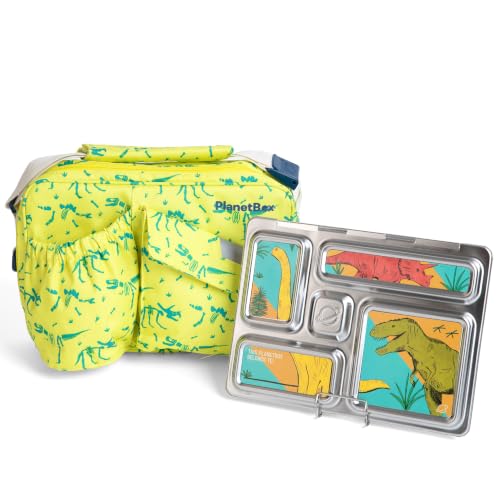
The Rover remains the reference design for compartment steel: a sectioned tray, a confidently latched lid, and a lunch that presents itself. Reviewed against its own promise — organisation without pots, endured daily — it scores at the top of this field. The sections genuinely change behaviour: packers fill the tray rather than assemble a fleet, children open one lid rather than negotiate three, and the morning routine shortens measurably. Its costs are the axis’s costs: fixed portions that frustrate improvisers, runny food that must be kept to the thicker end of the menu, a premium tier that only daily use justifies, and a packed weight that the smallest children feel. Verdict: the best school and grazer system in these reviews, and a poor answer to any other question. Best for: children and committed grazers. Not suited for: soups, stews and portion freedom.
LunchBots Large — the generalist, reviewed
If the Rover is a bet on organisation, the LunchBots Large is a bet on nothing — one space, one plain lid, no mechanism — and it is remarkable how often nothing wins. Reviewed across the widest range of duties in this article, it never tops a specialised test and never fails a general one: leftovers, salads, sandwiches, prep portions, all handled with the same uneventful competence, washed in seconds, stacked without thought. Its plain lid defines its one hard boundary — liquids in transit belong elsewhere — and its mid-tier position defines its appeal. Verdict: the default recommendation of these reviews for a first purchase, against which every feature elsewhere must argue its case. Best for: general households. Not suited for: wet commutes.
Ecozoi Container Set — the system, reviewed
Ecozoi’s graduated sets review as a duet between product and purchaser. The product’s half is strong: nesting bodies that store into a fraction of their spread, footprints that behave in fridge and cupboard, coverage from lunch to leftover in one purchase. The purchaser’s half decides the review’s final mark — households that measured portions first report a system that feels designed; households that guessed report a museum of almost-right sizes. That dependence is not a flaw unique to Ecozoi, but Ecozoi’s set format concentrates it. Verdict: the best whole-cupboard answer in the field for households willing to do a week of homework first. Best for: organised family kitchens. Not suited for: impulsive set buyers.
Klean Kanteen Food Box — the sealer, reviewed
Klean Kanteen’s food boxes carry a bottle-maker’s understanding of silicone seals into food storage, and reviewed on liquid duty they lead this field: soups and stews cross town, upright in a bag, without incident, week after week. The review’s condition is the category’s condition, applied with emphasis — the gasket must come out, be washed in hot soapy water, and dry completely before reassembly, because the seal that grants the confidence is the seam that punishes neglect. Owners who keep the routine describe the product as flawless; owners who do not describe the smell. Both reviews are accurate, which is why this one prints the routine inside the verdict. Best for: disciplined soup and stew carriers. Not suited for: wash-and-seal-damp households.
U Konserve Round Container — the supporting act, reviewed
Reviewing small pots beside centrepieces risks absurdity, until usage is counted — at which point the U Konserve rounds embarrass their larger colleagues. Dressings, dips, nuts, berries, the separated garnish, the sauce that would ruin the salad by lunchtime: the rounds carry the small wet and fiddly cargo that decides whether a packed lunch eats well. Their flexible lids make them the forgiving container of the field, lent and grabbed without ceremony. Verdict: not a system, and the first addition to every system in these reviews. Best for: everyone, in pairs. Not suited for: being bought alone and expected to be a lunch strategy.
Bentgo Stainless — the familiar upgrade, reviewed
Bentgo’s stainless box is reviewed, fairly, as a translation: a compartment layout a generation of households already knows from plastic, rendered in a material that deletes the old complaints — staining, warping, tired lids — while keeping the habit’s shape. That continuity is a genuine feature for upgrading households, and its mid-tier position makes it the lowest-risk way to test whether compartments suit a family’s packers before premium money is discussed. Its limits are the compartment limits: portions set by the tray, liquids kept thick or elsewhere. Verdict: the sensible first compartment box, and for many households the last one they will need. Best for: upgraders and new compartment users. Not suited for: wet menus.
Head-to-Head: The Comparisons Shoppers Actually Make
PlanetBox Rover vs Bentgo Stainless
The compartment duel is polish versus familiarity. The Rover offers the more resolved system — latching, layout and an ecosystem of fitted extras — at a premium tier; the Bentgo offers the same idea in a more accessible, mainstream form. Households certain about compartments and committed to daily use should let the Rover’s polish argue; households testing the format should start with the Bentgo and let a term of lunches decide whether polish is worth pursuing. Neither is the wrong answer; buying the premium one to test the format is the only wrong sequence.
LunchBots Large vs Ecozoi Set
The generalist duel is composition versus coverage. The LunchBots path assembles a system piece by piece, precisely fitted, slowly; the Ecozoi path installs coverage in one decision, fitted as well as the buyer’s homework allows. Small kitchens with measured portions gain most from the set’s nesting; everyone else gains most from composition’s precision. The reviews’ tie-breaker is the empty cupboard test: if you can picture exactly which sizes your week needs, compose; if you cannot, measure for a week, then decide with the tally in hand.
Klean Kanteen Food Box vs everything plain-lidded
The seal duel is really a menu referendum. If the wettest regular cargo is a salad with the dressing in a small pot, plain lids win on simplicity and the gasket’s routine is a tax on nothing. If soup travels weekly, the sealed design wins outright and the routine is the price of the only product that does the job. These reviews refuse to score this duel in the abstract, because the menu always breaks the tie — which is the most useful sentence in this section. It is worth adding that the duel is re-fought every season in real households: autumn promotes the sealer, summer the plain box, and the households that own both — one of each, chosen by cargo rather than by loyalty — are not indecisive but correctly equipped. A duel with a seasonal winner is not a duel a review should settle once; it is a roster a kitchen should hold.
What Owners Praise, and What They Complain About
Across families, the praise converges with unusual consistency. Owners praise the disappearance of stains and smells — the curry that leaves no forwarding address is mentioned in some form by nearly every bold-cooking household. They praise stacking: fridges and cupboards that behave like grids. They praise the wash — a container that comes completely clean — and, after a year or more, they praise the simple fact that the set looks and works as it did at the start, a sentence almost no other kitchen category earns. Children’s households add a specific praise for compartment trays: the lunch that organises itself, opened without rescue, eaten without negotiation.
Read comparatively, the praise also reveals what owners stop valuing. Finish, so prominent in first impressions, nearly vanishes from twelve-month accounts, replaced by latch behaviour and gasket manners. Capacity, the specification shoppers measure most carefully, is mentioned less than footprint — owners discover that how a box stacks matters more than how much it holds, because the holding happens once a day and the stacking happens every time the fridge opens. And brand loyalty, where it exists, attaches to service rather than product: the maker who sold a replacement seal in year three owns the household’s next decade. Reviewers weighing the field should weight their criteria the way owners end up weighting them — closure, footprint, service, then everything else — because a review is a prediction of ownership, and ownership has already voted on what matters.
The complaints converge just as consistently, and these reviews print them at full size. The microwave rule heads the list — not from owners who misunderstood it, but from owners whose routines changed after purchase: a new job, a new kitchen, a new dependence on reheating in the box. Opacity follows, almost always in unlabelled households, and almost always cured by the households that finally install the tape and marker. Seal complaints form the third cluster, and they divide cleanly into owners who were never told about the wash-and-dry routine and owners who were told and declined it; the first group deserves the category’s sympathy and better labelling on the box, the second group has met the fair price of leak confidence and found it fair but unwelcome. Weight complaints, by contrast, are rare and specific — long carries, small children — exactly as the axis predicts.
That first complaint cluster — routines changing after purchase — deserves a forward-looking sentence, because it is the one complaint a buyer can insure against. If a move, a new job or a new school is visible on your horizon, buy for the routine on the far side of it, or buy the minimum until it arrives. Steel’s longevity, its great virtue, is also its exposure: a container bought for a life you are about to leave will serve the new life only if the new life’s reheating and carrying still suit it. The households in these reviews that changed routines and stayed happy are the ones that bought federations — a little steel for transport, a little glass for reheating — whose proportions could shift as life did. Permanence rewards the buyer who plans for change, which is a paradox the category’s fans rarely mention and its reviewers should.
Which Family for Which Household: The Reviews’ Shortlist
For the school-lunch household: a compartment system — PlanetBox Rover if the budget and the daily use justify its polish, Bentgo Stainless as the sensible first step — plus U Konserve rounds for the dips and extras. For the commuting household with a dry-to-saucy menu: LunchBots-style plain containers in the sizes the portions demand, two per packer so one can always be drying. For the soup-commuting household: Klean Kanteen-style sealed designs, bought with the gasket routine fully understood, plus a designated bowl at the destination. For the family replacing a whole drawer: an Ecozoi-style graduated set, chosen after a week of portion measuring, or a composed LunchBots system if the measurements come back eccentric. For the meal prepper: identical plain containers in one or two sizes, labels treated as part of the product, and the best storage baskets for corralling the overflow for everything the grid cannot hold. Every shortlist above assumes the material itself has already passed the household’s reheating test; readers still deciding that question belong in are stainless steel food containers worth it first.
Two composite households deserve naming because they describe so many real kitchens. The first is the mixed household — one grazer child, one sandwich adult, one soup adult — whose correct answer is not a family but a federation: a compartment box, a plain workhorse and a sealed design, sharing small pots and a labelling habit. Federations look untidy in a catalogue and work beautifully in a kitchen, because each member was chosen by a menu rather than by a brand’s completeness. The second is the growing household, whose portions and packers change yearly; its correct answer is composition over sets, singles added as the family changes, footprints kept compatible so the system absorbs growth without a restart. Both composites point the same way as every review in this article: in this category, the household is the designer, the families are the materials, and the reviews are only here to keep the two honest with each other.
Care and Keeping, as the Reviews Apply It
Every family’s score in these reviews assumes the same care floor, so it is stated once, completely. Wash bodies with a normal sponge and hot soapy water; treat stubborn marks with a bicarbonate paste; avoid scourers that scratch. Remove gaskets and wash them as separate parts; brush lid grooves; dry everything completely in open air before reassembly, and store lids ajar or separate. Inspect seals weekly and replace them when tired rather than replacing containers. Label on filling day, run the fridge oldest-first, and keep the decanting plate where the boxes are unpacked. On food safety these reviews stay qualitative as a matter of policy: steel is a non-porous, food-contact material that does not absorb odours or flavours, and the household’s real protection is ordinary hygiene — prompt cooling and refrigeration, thorough reheating, and no long room-temperature storage in any container. The families above differ in lids and shapes; none differs in deserving that floor of care, and none survives its absence with its score intact. That last clause is the care section’s whole argument, and it doubles as these reviews’ scoring policy: a family’s mark is the mark of the family as maintained, because that is the only version of it any owner will ever actually live with.
The Reviews’ Overall Verdict
The field, taken whole, is strong in a way that makes brand choice less important than fit. Buy the organiser if your lunches are buffets, the generalist if they are not, the sealer if they are wet, the set if your homework is done, and the small pots regardless. Cross-check any finalist against the stainless steel food containers buying guide, weigh the material itself in stainless steel food containers pros and cons, run the method in how to choose stainless steel food containers, and read the deep single-category treatment in our stainless steel food containers review. The households that love their steel, across every family in these reviews, share one trait that no manufacturer sells: they matched the lid to the menu before they matched the box to the budget.
One last comparative observation, offered as the article’s distilled experience. In most kitchen categories, the premium product and the mid-tier product diverge over time — the cheaper one fades, warps or tires until the difference is undeniable. In this category the divergence runs along a different seam: not between price tiers but between matched and mismatched purchases. A mid-tier box matched to its household’s menu is, at the six-month mark, indistinguishable in owner satisfaction from a premium one; a premium box mismatched to its menu is a daily, gleaming reminder of the error. That is why these reviews spend their length on axes, scenarios and homework rather than on rankings. The field is good. The fitting is everything. Fit the lid to the wettest food, the size to the measured portion, the routine to the washer, and the material to the reheating — and whichever family’s name is on the box, the review your household writes, a year from now, will read like the best one on this page.
Durability and Wear, Family by Family
Long-run wear is where a comparative review earns its existence, because the field’s bodies age alike while its closures age very differently. Plain-lidded families — LunchBots above all — wear the slowest of all: with no gasket to tire and no hinge to foul, their year-three condition is essentially their month-three condition, plus dings. Compartment systems wear at the latch: PlanetBox’s hardware is built for the school-run thousands, and Bentgo’s mainstream hardware asks only to be treated as the mid-tier mechanism it is. Sealed families wear at the gasket, entirely predictably, and their reviews therefore hinge on replacement availability — a Klean Kanteen-style seal that can be renewed restores the product to as-new performance, which is the strongest durability story in the field wearing a maintenance costume. Graduated sets wear as systems: the Ecozoi pattern’s risk is not breakage but drift, sizes slowly migrating to other duties, which the twice-yearly audit exists to correct. The comparative conclusion is unfashionable and firm: durability in this category is a property of closure design and owner routine far more than of the steel, and shoppers should interrogate lids with the seriousness they usually reserve for bodies.
Six Months On: The Reviews Revisited
Reviews written at unboxing are weather reports; this article’s judgements are climate. Six months into ownership, the field’s early impressions have sorted themselves in instructive ways. The compartment systems’ novelty has worn off entirely — and been replaced, in the households that matched them correctly, by something better than novelty: routine so settled that lunch packs itself. The plain generalists have gained ground in every household’s esteem, because uneventful competence compounds in memory while features fade. The sealed designs have produced the widest spread of six-month verdicts in the field, from evangelical to faintly musty, and the spread tracks the gasket routine with embarrassing precision. The sets have polarised exactly as predicted by homework: measured households call them systems, guessing households call them storage. And across every family, the microwave rule has completed its journey from objection to reflex in plate-equipped households, while remaining — in the households without plates — precisely the objection it always was. Six months does not change these reviews’ rankings; it reveals that the rankings were never really about products. They were about matches, and time is simply how matches declare themselves.
Value Across the Field, Without a Single Price
Prices move too fast for a comparative review to print responsibly, so value here is argued in the currency the category actually uses: uses. The premium compartment system, opened twice a day across school years, delivers its polish at a per-use cost that rounds to nothing; the same system opened twice a month is the field’s worst value, and no build quality can rescue the arithmetic. The mid-tier generalist is the field’s value anchor precisely because its use count is the easiest to maximise — it fits the most menus, the most bags, the most households. The sealed designs price their value in avoided disasters: one soup spill in a work bag can cost more, in laundry, documents and dignity, than the gasket routine costs in a year of minutes. The small pots are the field’s value champions by ratio — the cheapest items in these reviews and, by usage count in most households, among the most opened. The comparative lesson generalises beyond steel: in durable categories, value is a forecast about your own behaviour wearing a product’s clothes, and the most valuable review is the one that makes you forecast honestly.
How to Use These Reviews With a Tape Measure and a Week
Comparative reviews are only as good as the homework they provoke, so this article ends its evidence with an assignment. For one week, measure what your household actually packs and stores: the volume of a typical lunch, the shape of a typical leftover, the wettest cargo of the week, the longest carry, and the reheating method used at the far end. Write the five numbers and facts on one card. Then re-read the family reviews above with the card in hand, and notice what happens: the field stops being a crowd of similar boxes and sorts itself, almost audibly, into the one or two families your card describes. The compartment review reads differently to a household whose card says buffet lunches for two children; the sealed review reads differently when the card’s wettest line says soup, Tuesdays, by bicycle. This is not a rhetorical trick. It is the mechanism by which good reviews work — they supply the product knowledge, you supply the household knowledge, and the match happens where the two meet. A reader who does the week will find these reviews suddenly short, because most of the field will have eliminated itself. A reader who skips it will find them long and strangely indecisive. Both readers are right about the article; only one of them is ready to buy.
The Complaints, Revisited as Buying Instructions
It is worth converting the complaint record into instructions explicitly, because complaints are just reviews written by experience. When owners complain about the microwave, the instruction is to decide reheating before material — and if a routine change is on your horizon, a new job or a new kitchen, to weight that future honestly. When owners complain about mystery boxes, the instruction is to buy the tape and marker with the containers, not after the third wrong opening. When owners complain about seals, the instruction is double: makers should print the routine on the box, and buyers should rehearse it before choosing a gasketed design — five minutes of honest imagination at the sink is worth a season of mustiness. When owners complain about weight, the instruction is to test the packed box in the real bag, with the real carrier, during the return window. And when owners complain that a set’s sizes miss their portions, the instruction is the tape measure and the week. Every complaint in this category is preventable, and the prevention is always cheaper than the complaint — which is, in the end, the most encouraging verdict a comparative review can deliver about a field.
The Field, Tested by Scenario
Scenario one: the rainy bicycle commute, soup included
The harshest common test in these reviews combines liquid, motion, weather and a bag full of things that must stay dry. The sealed family wins it outright — this is the journey the gasket exists for — with the container upright, the seal fresh from its drying rack, and the rider’s mind entirely elsewhere. The plain-lidded families fail it predictably and should not be entered for it; the compartment trays fail it creatively, distributing the soup among the sections. Scenario verdicts matter because households buy for their hardest regular journey, not their average one, and a container that passes the rainy Tuesday can be trusted with the easy Friday.
Scenario two: the Sunday batch session
Five portions, one sauce, a fridge that must close. Identical plain containers win this scenario on geometry — a grid of matching boxes, labels out, oldest forward — with the graduated set a close second when its sizes happen to match the batch. Compartment trays sit it out; their talents are presentational, not archival. The scenario’s real winner, veterans of these reviews note, is the labelling habit, which no family sells and every family rewards.
Scenario three: the school morning, two children, one missing lid
The chaos scenario tests systems rather than products. Compartment families win the morning itself — one tray, one lid, no assembly — while the missing lid tests the household’s spares policy, which is why these reviews keep recommending two-per-user rotation for daily packers. Steel’s contribution is that the surviving equipment is indifferent to the morning’s violence; the household’s contribution is a lid stored where lids live. Scenario verdict: buy the organiser, keep a spare, and let the material absorb the rest.
Scenario four: the dinner-party leftover transfer
Guests leaving with food is the category’s social examination. Steel passes it with a particular grace: a container lent is a container that will survive the lending, return without stains or smells, and — because it is unmistakably a system piece rather than a disposable tub — actually come back. The large generalist sizes win this scenario, and more than one household in these reviews dates its conversion to a borrowed box that returned, weeks later, still looking like equipment. The scenario is trivial until it is not, and it quietly explains the hand-me-down culture that surrounds this category.
What These Reviews Deliberately Do Not Do
A comparative review should confess its limits, and these are this article’s. It does not print prices, because prices move and a verdict lashed to a moving number rots; tiers stand still, so tiers are what it prints. It does not quote laboratory figures about health or materials, because the defensible claims in this category are qualitative — non-porous, flavour-neutral, easy to clean — and precision borrowed from nowhere helps no buyer. It does not crown a single winner, because the field’s families are answers to different questions and a crown would be a lie of tidiness. And it does not pretend that a review, however comparative, can substitute for the reader’s week of measuring — the card with five facts on it that sorts the field faster than any prose. What it does do is narrower and, it hopes, more useful: it tells you what each family is for, what each costs in habits, what owners praise and regret once the novelty has worn off, and where the category’s two hard rules — no microwaves, dry the seals — will meet your particular life. The rest is your kitchen’s business, and these reviews respect it too much to pretend otherwise.
After the Boxes Are Gone: Long-Term Ownership Notes From Stainless steel food containers Reviews
Most stainless steel food containers coverage stops at unboxing, yet almost everything that decides owner satisfaction happens afterwards. The first evening tells you about finish and first impressions; the third month tells you about durability, upkeep and whether the design still suits the way your household actually behaves. This section looks at the ownership phase in detail — the settling-in period, the first signs of wear worth watching for, and the small habits that separate owners who stay pleased from owners who start browsing replacements. If you are weighing PlanetBox Rover, LunchBots Large or any similar design, treat the points below as the questions a good long-term review should answer.
The Settling-In Period: What Changes in the First Weeks
New materials and mechanisms relax. Fabrics soften, joints settle, finishes lose their showroom sharpness, and moving parts either bed in smoothly or start to complain. With a stainless steel food containers, use the first fortnight deliberately: operate everything daily, check fixings once after the first week, and keep a mental note of any sound, wobble or resistance that was not there on day one. Changes that stabilise after a small adjustment are normal settling; changes that keep progressing are early warnings, and they are far easier to raise with a seller while the purchase is recent.
Wear Worth Watching, and Wear Worth Ignoring
Not all wear is failure. Honest materials in the food storage & organization category develop a patina — slight softening of edges, gentle colour shifts where hands and light fall — and most owners come to like it. The wear that matters is functional: looseness that returns after tightening, surfaces that mark from ordinary use rather than accidents, parts that need persuading, and finishes that fail at edges and corners first. Check those high-contact zones on any stainless steel food containers you already own, and look for honest close-up photographs of exactly those zones when you judge a replacement.
A simple ownership routine keeps a stainless steel food containers performing the way the early reviews promised:
- Once a month, spend two minutes checking fixings, feet, seals or moving parts — whichever your stainless steel food containers relies on — and correct small changes before they compound.
- Clean little and often with the mildest method that works, rather than rarely and aggressively, and always test any new cleaner on a hidden patch first.
- Rotate, rest or reposition the stainless steel food containers if one side takes all the light, heat or traffic, so wear spreads evenly instead of concentrating.
- Keep the manual, spare parts and any touch-up materials together in one labelled place; the day you need them is never the day you want to search.
- Photograph the stainless steel food containers once a year from the same spot; comparing pictures is the most reliable way to notice slow change you would otherwise miss.
Beware of buying for the household you hope to become; the stainless steel food containers that serves the household you already are will be used this week, not someday. A tape measure, a spirit level and ten patient minutes prevent more stainless steel food containers regrets than any amount of comparison shopping after the fact. When a listing is vague about a dimension, material or included part that matters to you, treat the vagueness itself as information and look for a clearer seller. Photograph your room at the time of day you will use the stainless steel food containers most, and compare candidates against that light rather than against bright midday photographs. Small households should weight compactness and easy storage more heavily, while large households should weight durability and simple operation, because the failure modes differ. If the stainless steel food containers will serve children or older relatives, test the key actions with the weakest grip and the shortest reach in the house in mind. Leave a little capacity unused — in size, storage or power — because a stainless steel food containers run permanently at its limit ages faster and annoys sooner than one with headroom. Notice which parts are replaceable and which are not; a stainless steel food containers whose wear parts can be swapped cheaply often outlasts a sealed design twice its price in spirit, if not in years.
Ownership rewards attention in small doses. A stainless steel food containers that is checked monthly and cleaned gently will usually outlast a neglected premium model, and it will certainly stay pleasanter to live with. Judge any review — including the detailed assessments earlier in this guide — by whether it helps you through this long middle phase of ownership, because that phase, not the unboxing, is where the money is really spent.
Frequently Asked Questions
Which stainless steel food container brand is best overall?
There is no honest overall winner, because the families are bets on different lunches. LunchBots earns this article’s default recommendation for general households on simplicity and range; PlanetBox leads for school and grazer organisation; Klean Kanteen leads for wet commutes; Ecozoi leads for whole-cupboard sets; Bentgo leads as the accessible compartment entry; U Konserve leads the supporting cast. The best brand is the one whose bet matches your menu — a sentence these reviews would rather repeat than replace with a league table. If the repetition frustrates, consider what a league table would actually claim: that one lid philosophy, one size pattern and one tier is best for the soup cyclist, the school-run parent, the batch cook and the salad commuter simultaneously. No reviewer who has watched those four households work believes that sentence, and a review that prints it anyway has chosen tidiness over truth. The table of contents of your own week — portions, cargo, carry, reheat — is the only ranking that will still look right in a year.
Are expensive stainless steel containers worth it over mid-tier ones?
Premium tiers buy polish, systems and longevity of support — refined latches, fitted extras, replacement parts guaranteed for years — rather than a different material. For daily users, especially school-lunch households, that polish compounds across hundreds of uses and can be worth it. For occasional users and format-testers, mid-tier families deliver the same steel with less ceremony, and the sensible sequence is to prove the format at mid-tier before paying for its premium expression. The reviews’ own test is a question about the carrier, not the container: how many times will this box be opened this year? A box opened most days earns its polish the way a daily-driven car earns its tyres; a box opened monthly cannot, and no reviewer should pretend the arithmetic changes because the latch is beautiful. Buy the tier your opening count justifies, and let the count — counted honestly, on the card, during the measuring week — make a decision that pride and marketing both have opinions about.
Which containers in these reviews are best for soup?
Only the silicone-sealed designs — Klean Kanteen’s food boxes are this article’s example — should be trusted with soup in a moving bag, and even they should travel upright and be tested with water first. Plain-lidded containers and compartment trays are splash-resistant at best, and every wet bag in the complaint record of this category traces back to a plain lid asked to do a gasket’s job. Match the lid to the liquid; the steel body is never the deciding part. One refinement from the scenario testing deserves emphasis: soup is not one cargo but two — the thick stew that barely moves, which a careful carrier can sometimes risk in lesser lids, and the thin broth that behaves like water and forgives nothing. Households should classify their own soups honestly before bending the rule, because the rule’s exceptions are written by viscosity, and wishful thinking has a noticeably lower viscosity than stew.
How long do the reviewed containers last?
The bodies, treated normally, last for years — typically far beyond the household routines around them. The lifespan question really concerns lids: gaskets tire, hinges gather grime, plain lids can dent. Families whose makers sell replacement seals convert that wear into maintenance instead of replacement, which is why parts availability features in these reviews as a quality signal. Expect pan-like longevity from the steel and a consumable’s lifecycle from the soft parts, and the purchase will meet its expectations exactly. A useful way to hold the idea: you are not buying a container with a lifespan, you are buying a body with a service schedule. Households that understand the purchase that way — gasket as a service item, like a kettle’s filter or a car’s wiper — report no durability disappointments at all, while households that expected the whole object, seal included, to be immortal are the ones writing the field’s few longevity complaints. The steel keeps its promise perfectly; it is the promise that needs reading carefully.
Can any of these containers go in the microwave?
None of them — not the premium systems, not the plainest box, not for a minute. Steel reflects microwave energy and can spark, damaging the oven and the container. Every family in these reviews assumes reheating by decanting onto a plate or into a microwave-safe bowl, or by warming in a pan. Households whose routine cannot accommodate that step should choose glass instead, and these reviews say so without ranking it as a failure of steel: it is a property of the material, identical in every product on this page. Comparative reviews have a duty here that single-product reviews sometimes dodge: because the rule is uniform across the field, it cannot be used to rank the families, but it can and must be used to rank the material against your routine before any family is discussed. A household that skips that first ranking will find every subsequent comparison in this article strangely academic — excellent boxes, wrongly bought — and the reviews would rather lose that reader to glass at this paragraph than to disappointment at the first reheated lunch.
What do owners most often buy after their first container?
Small pots — the U Konserve pattern — followed closely by a second main container in the size the first month proved was missing. The pattern is so consistent that these reviews treat it as advice: whatever family you start with, budget the small pots early, keep the gap note for a month, and let the second purchase be written by evidence. Households that shop in that order end up with systems; households that buy everything at once end up with cupboards. There is a third frequent purchase worth naming, because it reveals the category’s centre of gravity: a replacement gasket, bought by a sealed-design owner in year two or three, fitted in a minute, restoring a container to full service. That small transaction — soft part renewed, steel body untouched — is the whole durability argument of this article compressed into a single parcel, and households that have made it tend to become the category’s most credible reviewers of all.
Related Guides and Next Steps
Pair these reviews with our stainless steel food containers review for the single deep treatment, the stainless steel food containers buying guide for shortlists, and stainless steel food containers vs glass food storage containers for the material decision. For the surrounding system, closet organiser shelves that use the same stacking logic and waffle kitchen towels for the drying routine complete the kitchen these containers live in. And take the assignment with you: one week, one card, five facts — portions, cargo, carry, wettest load, reheat method. The reviews above were written to be read twice, once before the card and once after, and the second reading is the one that chooses. Choose then, choose lean, and let the first month’s gap note do what it has done for every satisfied household in this article: turn a good container into the right system.


