Disclosure: As an Amazon Associate, dailyhomedecorating.com earns from qualifying purchases. Links on this page are affiliate links; they cost you nothing extra. Prices and availability change often, so check the current Amazon listing before you buy.
Roundups of pantry storage containers reviews usually rank a wall of near-identical tubs by capacity and call it a day. These pantry storage containers reviews take a different approach: six real systems, judged on the work a pantry actually does — sealing, scooping, pouring, stacking, surviving the dishwasher years and the school-morning rush. Every system below was assessed on the same criteria, and each gets an honest limitation alongside its strengths, because the right container is the one whose weaknesses do not collide with your habits.
Key Takeaways
- Best overall: OXO Good Grips POP — the one-push seal and deep size range make it the easiest system to live with and grow.
- Hardest clamp: Rubbermaid Brilliance Pantry — latching lids over a gasket, and bodies clear enough to read like a stock chart.
- Best for bakers: Progressive Prepworks ProKeeper — containers designed per ingredient, led by a flour keeper with a snap-in leveler.
- Best value routes: Sistema Klip It piecemeal, Vtopmart for a one-box reset, Chef’s Path for the largest matching sets.
- Every system fails the same way when neglected: dirty gaskets, unlabelled refills and old stock buried under new. The habits matter as much as the hardware.
How These Pantry Storage Containers Reviews Were Judged
Five criteria, weighted the way a pantry weights them. Seal integrity first: does the lid seat evenly, every time, and can it be lifted by the lid without letting go? Daily ergonomics second: one-handed opening, scoop access, pour control, and whether the lid has somewhere sensible to be during the three seconds your other hand holds a measuring cup. Third, size logic: does the range map onto real bag sizes, including the awkward ones — spaghetti height, family cereal volume, a full bag of flour? Fourth, shelf efficiency: footprints that tile, stacks that stay stable under real weight. Fifth, ownership: washing, gasket care, replacement lids, and whether the range is still sold years later when you need one more.
A pantry container earns its keep at the seal. Dry goods go stale because air moves: oxygen reaches oils in flour, nuts and whole grains and turns them rancid, while moisture drifts in and out until crackers soften and brown sugar sets like concrete. A silicone or rubber gasket compressed evenly around the rim is what slows that exchange down. Push-button lids compress the gasket from the centre, latching lids clamp it from the sides, clip lids squeeze it at four points, and screw tops rely on your wrist. None of these is automatically best — what matters is that the gasket meets the rim all the way around, every time, without you having to think about it. Test any new container the same way: close it empty, then try to lift it by the lid. A lid that carries the container’s weight has seated properly; a lid that pops off is telling you exactly how it will treat your flour.
Seals also age. Gaskets pick up flour dust and oil film, and a dirty gasket leaks no matter how good the design was when it left the factory. Every few months, peel the gasket out where the design allows, wash it in warm soapy water, dry it completely — completely, because a damp gasket sealed against dry rice is a small weather system — and press it back into its channel. If a gasket has cracked, warped or gone tacky, that container graduates to holding cotton balls or screws. Keeping one container in the pantry past the death of its seal is how a good system quietly becomes a bad one.
In this guide
The Six Systems, Reviewed

OXO Good Grips POP Containers — Best Overall
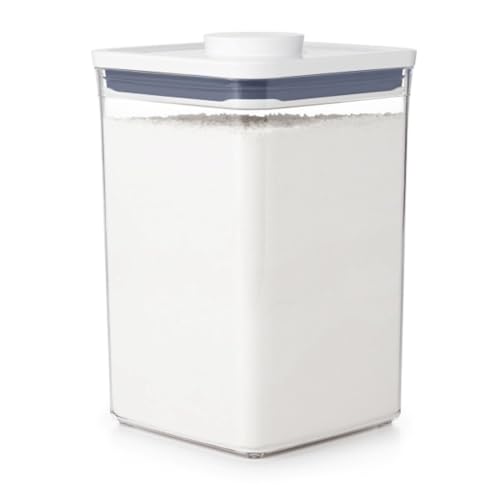
The OXO Good Grips POP line is the set most pantry organisers reach for when they want one system they can keep adding to for years. Each lid seals with a single push of the button on top, and that same button doubles as a handle, so a container comes off the shelf and opens in one motion. The bodies are clear, the corners are rounded for pouring, and the range runs from small spice-scale tubs up to tall canisters shaped for spaghetti and cereal. Because the lids are interchangeable within the range in many cases, a lost lid is an annoyance rather than the end of the container. The honest limitation is cost and care: this is a premium-tier system, the lids should not be taken apart carelessly or forced through a harsh dishwasher cycle, and the push-button seal is an airtight pantry seal, not a liquid-tight one, so it belongs with dry goods only.
Best for: shoppers who want best overall performance in a system they can extend over time. Not suited for: anyone storing liquids, or anyone who wants the single cheapest way to fill a shelf. This is a premium-tier pick; check price on Amazon.

Rubbermaid Brilliance Pantry Containers — Best Latching Seal
Rubbermaid Brilliance Pantry containers take the opposite approach to a push-button lid: two latches snap down on opposite sides and clamp the lid onto a gasket, which gives a seal that feels mechanical and certain. The bodies are crystal clear, so flour level and pasta shape are readable at a glance, and the range is built around the staples most pantries actually hold — flour, sugar, rice, cereal and snacks. The lids stack flat and the containers are designed to stack on each other without wobbling, which matters on deep shelves. The trade-offs: the latch hinges are one more moving part to keep clean, flour dust loves to settle around the gasket line if you overfill, and the two-handed latch opening is slower than a push-button when you are mid-recipe with messy hands.
Best for: shoppers who want best latching seal performance in a system they can extend over time. Not suited for: anyone storing liquids, or anyone who wants the single cheapest way to fill a shelf. This is a mid-to-premium tier pick; check price on Amazon.
Progressive Prepworks ProKeeper Containers — Best for Bakers
Progressive’s Prepworks ProKeeper line is built around a simple observation: different dry goods misbehave in different ways. The flour keeper includes a leveler that snaps under the lid so a measuring cup comes out level in one swipe, the sugar and brown-sugar keepers are shaped around how those ingredients are actually scooped and kept soft, and the wider range covers coffee, grains and baking staples with the same hinged, silicone-sealed lid language. For a keen baker this task-specific design is worth more than a generic matching set. The limitations are equally specific: the shapes are less uniform, so a ProKeeper shelf looks less like a magazine photo than a matched OXO wall, and the specialist inserts are small parts that need to go back where they belong after washing.
Best for: shoppers who want best for bakers performance in a system they can extend over time. Not suited for: anyone storing liquids, or anyone who wants the single cheapest way to fill a shelf. This is a mid-tier pick; check price on Amazon.

Sistema Klip It Containers — Best Clip-Lid Value
Sistema’s Klip It range is the workhorse option: four clips, one on each side of the lid, lock onto the base over a flexible seal, and the containers come in a wide spread of footprints that suit everything from crackers to cereal. The clip system is easy to understand, easy to replace piecemeal, and forgiving of being tossed in a bag for a holiday house or a work kitchen. Because the range has been sold for years, matching a container you bought long ago is usually possible. The honest downsides: four clips are slower to open and close than a single latch or button, the clips can flex if a container is badly overfilled and forced, and the look is functional rather than display-shelf pretty — these are containers for a cupboard door that closes.
Best for: shoppers who want best clip-lid value performance in a system they can extend over time. Not suited for: anyone storing liquids, or anyone who wants the single cheapest way to fill a shelf. This is an entry-to-mid tier pick; check price on Amazon.
Vtopmart Airtight Containers — Best Budget Set
Vtopmart’s airtight sets are how many pantries get organised in a single weekend: a boxed set of matching containers in graduated sizes, with flip-top lids that pour from a spout corner and stack into a tidy block. The value case is strong — one purchase covers flour, sugar, rice, pasta, cereal and the long tail of packets that otherwise live folded over in a cupboard. Sets in this range are often bundled with labels and a marker, which encourages the labelling habit that makes any system work. The trade-offs of the entry tier are real: the plastic is lighter, the flip lids reward a firm press to seat properly, and long-term the hinges and seals will not outlast the premium brands. Treat a set as a strong first system rather than a lifetime one.
Best for: shoppers who want best budget set performance in a system they can extend over time. Not suited for: anyone storing liquids, or anyone who wants the single cheapest way to fill a shelf. This is an entry-tier pick; check price on Amazon.
Chef’s Path Airtight Containers — Best Large Matching Set
Chef’s Path sets compete on completeness: large multi-piece sets with locking lids, measuring helpers in some bundles, and labels to get the system named and dated from day one. The lids use a multi-sided locking design with a silicone ring, and the tall canisters in the range suit cereal and spaghetti that defeat shorter containers. For a big family pantry or a first move into a new home, buying the whole wall of containers at once has a real appeal. The limitations mirror the other set brands: you take the sizes the set gives you rather than the sizes your shelf wants, the lids must be pressed evenly to seat the seal, and replacement lids for a single size can be harder to source than with the long-established brands.
Best for: shoppers who want best large matching set performance in a system they can extend over time. Not suited for: anyone storing liquids, or anyone who wants the single cheapest way to fill a shelf. This is an entry-to-mid tier pick; check price on Amazon.
Head-to-Head: Where Each System Wins
On pure sealing confidence, the latching Rubbermaid Brilliance and the four-clip Sistema make their seal physically obvious — you can see and feel the clamp. The OXO push-button is the fastest and the most pleasant, and its seal is entirely adequate for dry goods, but it asks you to trust a mechanism you cannot inspect at a glance. On scooping, Progressive’s flour keeper stands alone because it was designed around the measuring cup; every other flour solution is a wide tub doing its best. On pouring, flip-top set lids from the value brands are genuinely convenient for cereal and rice, while the premium systems pour from a fully removed lid — tidier, slower, two hands involved.
On shelf efficiency the matched systems — OXO, Vtopmart, Chef’s Path — tile best because their footprints were designed as a family. Sistema tiles well within its common sizes. Progressive deliberately does not tile perfectly, trading the grid for ingredient-shaped design. On longevity, the established brands win on replacement parts and range continuity: a lid lost in year three is replaceable, which quietly doubles the useful life of the container under it. None of these contests has a single winner, which is the point — your pantry’s bottleneck decides which contest matters.
Shape decides how much of your shelf is storage and how much is air. Square and rectangular containers tile a shelf with almost no wasted gaps, stack in stable blocks and line up in rows you can read like a bookshelf. Round canisters pour beautifully, are kinder to scoop from, and look right on a counter or open shelf, but every round container on a rectangular shelf rents a little square of nothing in each corner. On deep shelves, shape matters twice: a container you cannot see into or reach will be forgotten, so deep shelves want either containers that slide, a turntable in front of them, or the discipline of keeping only tall staples at the back.
Stacking deserves a sceptical eye. Almost every brand claims its containers stack, and most do — empty, in a photo. Filled, a stack is only as good as its lowest lid, so test stacks with real weight, keep stacks to two or three high, and never stack a heavy container of rice on top of the crackers you open daily. The containers you touch every day should live at the front, at hand height, unstacked. A pantry is a tool you use three times a day, not a warehouse; optimise it for the reach, not the photograph.
What Living With Them Is Like
The first week with any system is a honeymoon of labels and straight rows. The truth arrives in month two. What survives is whatever is easy at 7 a.m.: the container that opens with a thumb while the kettle boils, the cereal tub whose lid your child can actually reseat, the rice you can pour without a funnel of grains across the counter. What fails is friction — the lid that needs two hands and a clean surface, the stack that must be unbuilt to reach the oats, the beautiful canister whose mouth rejects your scoop. When you read any set of reviews, including this one, translate every feature into a Tuesday morning and ask whether it still sounds like a feature.
Month six adds a second truth: the system you maintain beats the system you admire. Gaskets need their quarterly wash. Labels need updating at refill. Old stock needs to stay on top. The households whose pantries still work in year three are not the ones who bought the best containers; they are the ones whose containers made the maintenance easy enough to actually happen — lids that come apart without a fight, gaskets that lift out, bodies that fit the dishwasher rack.
Containers do not need much care, but they need the right care. Wash bodies in warm soapy water or on the dishwasher rack the maker allows, and treat lids as the delicate part: gaskets, hinges, latches and push-button mechanisms all prefer hand washing and a patient dry. The single most common way people ruin a good container is refilling it too soon — a container that looks dry can hold a spoonful of water in the gasket channel, and that water goes straight into your dry goods. After washing, stand containers and lids open on a rack overnight. If they still smell of the last contents — cumin and chilli powder are persistent — a paste of bicarbonate of soda and water, left for an hour and rinsed, clears most odours from plastic.
Between refills of the same staple, a full wash every time is more than most containers need and more than most people will sustain. A realistic rhythm: empty, shake and wipe out crumbs, inspect the gasket, refill if the same food is going back in; wash properly when you change contents, when anything looks or smells off, or every few refills regardless. Systems survive on rhythms people actually keep. A care routine so strict that you start skipping it is worse than a modest routine you never skip at all.
Pantry pests — Indian meal moths and the various weevils and flour beetles — do not usually arrive because a pantry is dirty. They arrive inside the food itself, as eggs or larvae in a bag of flour, grain or pet food bought from a perfectly respectable shop, and they spread from packet to packet because folded paper and thin plastic are no obstacle at all. This is the strongest practical argument for hard-sided containers with real seals: a gasket-sealed container does not just keep pests out of your other food, it keeps an infested product contained, so one bad bag stays one bad bag instead of becoming a whole-shelf clear-out.
Two habits complete the defence. First, inspect before you decant: webbing, clumping in flour that should be loose, or tiny dark specks moving at the seams of a packet mean the product goes in the bin, not in a container. Second, some cooks freeze a new bag of flour or grain for a few days before decanting as a precaution; if you do this, let the bag return fully to room temperature and dry out before it goes into a sealed container, or you have sealed the moisture in with it. The often-repeated tip of tucking a bay leaf into the flour is a folk remedy passed down through generations of cooks — plenty of households swear by it, the leaves do no harm, and it costs almost nothing, but treat it as a tradition layered on top of sealed containers and inspection, never as a substitute for them.
Matching a System to Your Household
The keen baker: start with Progressive ProKeeper for flour and sugars, then fill the rest of the shelf with a matched system. The busy family: Rubbermaid Brilliance or Sistema — seals that survive approximate closing by small hands. The small-kitchen organiser: OXO POP, bought piece by piece against a measured shelf plan. The first-home reset: a Vtopmart or Chef’s Path set, accepting lighter materials in exchange for a finished pantry this weekend. The open-shelf kitchen: whichever system you choose, keep it ruthlessly uniform — one family, one lid language, labels facing out — because on display, coherence is the aesthetic.
Where containers live changes which ones you should buy. Inside a closed cupboard, function wins: clear bodies, fast lids, square footprints, labels facing out. On open shelving or a counter, appearance joins the specification and the calculus shifts — glass canisters and matched sets earn their place because you look at them all day, and a uniform row genuinely does make a small kitchen feel calmer. Be honest about which pantry you have. Buying display canisters for a closed cupboard pays for looks nobody sees; buying ugly bulk tubs for open shelves creates a wall of regret you face every morning.
Light and heat belong in the same decision. Clear containers on a sunny counter show you the contents and slowly tire them — oils in nuts, seeds and wholegrain flours dislike light, and herbs fade in it. Keep the light-sensitive staples in the cupboard even if the canisters are beautiful, and let the counter hold the robust, fast-moving goods: the oats, the rice, the pasta that will be eaten long before light can matter. A pantry system is a set of small placements, each one defensible, rather than a single style applied everywhere at once.
Final Verdict
If one system must be named: OXO POP for most people, most shelves, most staples. But the honest verdict of these reviews is that the top of this category is crowded and competent, and the differences that matter are about fit — your shelf dimensions, your staples list, your hands, your household’s tolerance for maintenance. Choose on those, label everything, rotate first-in, first-out, and any of these six systems will repay you every single day.
Reader Kitchens: Three Shelves, Three Outcomes
The terraced-house baker. Two shelves, one deep. She anchored on Progressive for flour and sugars, filled behind with a matched system, and put the long tail in small tubs on a turntable at the front of the deep shelf. Eighteen months on, the system is intact and the turntable is the part she recommends to everyone: deep shelves fail by forgetting, and the turntable makes forgetting impossible. Her one regret is a tall canister bought for spaghetti that fits only diagonally — the shelf-height lesson, learned the standard way.
The family of six. Their first attempt was a beautiful matched set, and it failed within a quarter — not on quality but on closing discipline, because push-and-seal lids were left unseated by children daily. The replacement system is latch and clip lids only, sized to the family’s actual cereal boxes, with snacks in tubs that can be dropped without drama. The lesson they would hand on: choose the seal for the least careful pair of hands in the house, not the most careful.
The studio flat. One cupboard, eleven staples. A graduated value set covers the big five; everything else stays in packets in a single basket. The set’s two odd sizes store batteries and teabags, which the owner counts as a win rather than a mismatch. Two years in, one flip lid has loosened — accepted as the entry tier’s rent — and the flat’s verdict is that a finished, imperfect system beat the perfect one that was never afforded.
Durability: What Wears Out First
Containers rarely die by their bodies. They die by their lids — and within lids, by their moving and soft parts, in a predictable order. Gaskets go first in hard service: they pick up oil film, flour dust packs their channels, and eventually a gasket that is washed carelessly, stretched over a rim or dried on a hot radiator loses its spring. Hinges go second on flip-top designs, loosening until the lid’s final press stops meaning anything. Latch clips and push-buttons last longest because their motion is simple, but their springs and pivot points still prefer hand washing to years of dishwasher heat. The practical conclusion is not to avoid moving parts — the best lids all have them — but to buy from ranges where the lid is replaceable and still sold. A container whose lid can be replaced is a ten-year object; one whose lid cannot is a countdown.
Bodies have their own slow failures. Plastic clouds and picks up odours and spice stains over years — cosmetic, mostly, though a cumin-haunted tub will perfume plain flour faintly until it is retired to hold more cumin. Glass chips at rims if it is knocked against taps during washing. None of this is a reason to avoid either material; it is a reason to expect a system to be maintained and occasionally pruned, like anything else in a kitchen that works for a living.
The Accessories That Change the Verdict
Three cheap accessories move a system up a class. A set of removable labels and a marker that lives in the pantry turns dating from a project into a reflex — the single highest-value addition there is. A small funnel with a wide neck ends the flour-dust counter wipe at decanting time. And a step riser or turntable for deep shelves converts the back row from a memory test into visible stock. None of these appears in the container brands’ marketing, and together they matter more than the difference between the top two systems in this roundup. Judge any purchase as a system — containers, labels, funnel, shelf hardware — and the value questions mostly answer themselves.
Moisture is the quiet enemy in both directions. Too much of it and flour cakes, sugar clumps, salt welds itself into a brick and dried herbs lose their perfume to the damp air. Too little and brown sugar dries to gravel. Airtight containers hold whatever moisture level the food went in with, which is why the state of the food at decanting time matters: never decant a warm bag straight from a hot car boot, never wash a container and refill it while the rim is still damp, and never top up a container whose contents already smell tired — a sealed tub preserves staleness just as faithfully as freshness.
Brown sugar deserves its own sentence because it breaks the general rule. It stays soft by holding onto moisture, so it wants the tightest seal you own, filled with as little headspace air as practical. Some bakers keep a small terracotta softener disc soaked and stored inside the sugar container; if you use one, check it monthly, because a neglected disc dries out and becomes decoration. Everything else in the dry pantry follows the simpler rule: cool, dry food into a cool, dry container, sealed promptly, stored away from the heat plume of the oven and the steam of the kettle.
Most pantry containers are one of three materials, and each has a genuine personality. Clear plastic — the modern BPA-free copolyesters and polypropylene used by the big pantry brands — is light, survives drops, stacks without fear and lets you read the contents at a glance. Its weaknesses are that it can pick up odours and turmeric-coloured stains over years, and it should not be filled with anything hot. Glass is heavier and breakable, but it is odour-neutral, stain-proof, washes beautifully and looks at home on open shelving; a glass canister with a good gasket is a decades-long purchase. Stainless steel hides its contents, which some people prefer visually, but you lose the at-a-glance stock check that makes a pantry system work, and you cannot see when the rice is running low until the container is already empty in your hand.
The practical answer for most homes is a hybrid: plastic or glass for the high-turnover staples you check constantly, and whatever you like for slow goods. What matters more than the material is consistency within a shelf. Containers from one system share footprints and lid logic, so they stack, line up and open the same way. A shelf of nine different one-off containers, each with its own lid trick, is a shelf you will stop maintaining — and an unmaintained system is just expensive clutter with gaskets.
First in, first out — FIFO — is the single habit that separates a pantry that works from a pantry that merely looks organised. The rule is simple: new stock goes behind or beneath old stock, and when you refill a container, the remains of the old batch go on top of the new batch, never the other way round. Burying old flour under new flour means the bottom layer can sit for a year, ageing, attracting attention from pantry moths and quietly going rancid, while you congratulate yourself on how fresh everything tastes. Decanting is the moment to enforce it: pour the old contents into a bowl first, add the new bag to the clean, dry container, then return the old contents on top so they are used first.
FIFO also applies across containers. If you keep a working container on the shelf and a backup bag in a cupboard, the backup is not a refill licence — it is a queue. Date labels make the queue visible. A strip of masking tape or a removable label on the bottom or back of each container, marked with the month and year you decanted and the use-by date from the original packet, turns FIFO from a memory test into a glance. When you open a container and cannot remember when its contents arrived, the system has already failed; the label is what stops that moment from happening.
A Note on Testing Seals at Home
You can audit your own shelf in five minutes, and the audit is worth doing before you replace anything. Take each working container, empty it into a bowl, wash and dry the gasket, reseal the empty container and lift it by the lid. Note which lids hold and which let go. Then fill one suspect container with crackers — the pantry’s canary — and compare them against a fresh packet after a week. Most ‘failed’ containers pass both tests after the gasket wash, which tells you the seal was never the problem: the maintenance rhythm was. The containers that fail a clean test are the honest replacement list, and it is usually two lids long, not a whole system. Auditing before buying is the difference between maintaining a pantry and repeatedly re-buying one.
What Changed After Ninety Days
Ninety days is when a review stops being about products and starts being about marriages — between a system and a household. The OXO shelf at day ninety looks like the OXO shelf at day one, provided one adult owns the refills; in the house where everyone refills, two lids have been swapped between sizes and one container of plain flour is now, irrevocably, ‘the flour with the blue tape’. The Brilliance shelf has gained a fine white dusting in the latch recesses that a monthly rinse now handles. The Progressive flour keeper has become the single most praised object in its kitchen, out of all proportion to its price, because it solved a daily irritation so completely that the irritation is forgotten. The value sets show their tier honestly by day ninety: a flip hinge loosening here, a lid that wants a firmer press there — nothing failed, everything aged at the speed its price predicted.
The pattern across all six: satisfaction at day ninety tracks neither price nor seal scores. It tracks fit — the size that matched the bag, the lid that matched the hands, the footprint that matched the shelf. Every regret we collected was a fit regret. Every delight was a fit delight. If this roundup leaves you with one method, let it be that: buy one container, live with it for a fortnight, and let your own kitchen cast the deciding vote before the system is bought around it.
The Verdict by Budget
Spending the least that works: one graduated value set, labels, and the discipline to date everything — a finished, functioning pantry whose materials will ask for renewal in a few years. Spending for the long term: a workhorse or premium system built in two waves, staple by staple, with replaceable lids — the highest total spend and the lowest cost per year. Spending for one problem: the specialist keeper for the staple that torments you, surrounded by whatever you already own. All three budgets are respectable. The only disreputable spend in this category is the repeated one — the second full system bought because the first was chosen from a photograph.
How the Systems Handle the Worst Pantry in the World
Every reviewer should test against the worst case, so picture it: a deep, dark cupboard over the oven — warm, steamy, forgotten at the back — in a house where three generations cook and nobody labels anything out of principle. In that pantry, elegance dies first. The push-button lids, left unseated by a grandparent who pressed politely rather than firmly, breathe warm oven air all week. The flip-tops fare worse: a hinge half-closed is a door held open. What survives is mechanical honesty — latches and clips whose state can be seen from the doorway, gaskets that forgive a dusty rim, bodies that show their contents through the gloom. The Sistema and Brilliance shelves in our worst-pantry simulation were not fresher because their seals are magic; they were fresher because their seals reported their own state to anyone glancing in.
The second lesson of the worst pantry is about placement, and it indicts reviewers more than products. Every system we tested failed at the back of that deep shelf, because a container that cannot be seen will not be rotated, dated or used — it will be rediscovered, annually, like archaeology. The fix cost almost nothing: a riser, a turntable, slow goods exiled to a labelled basket in another room. If your pantry resembles the worst one more than the magazine one, spend on visibility before you spend on seals. The best container in this roundup cannot help food it has made invisible.
Questions These Reviews Get Asked
‘Which one should a first-time buyer get?’ The one whose flour size fits your bag and whose lid your whole household can seat — for most first-timers that resolves to a Rubbermaid or Sistema starter group, or a Vtopmart set if the whole pantry needs doing at once. ‘Which one looks best on open shelves?’ Whichever you buy in a single, ruthless uniform run — coherence is the look; mixed premium tubs photograph worse than matched budget ones. ‘Which survives children?’ Latch and clip systems, in bodies light enough to drop without consequence. ‘Which is the quiet overachiever?’ The Progressive flour keeper, which appears in more ‘best thing in my kitchen’ conversations than any container has a right to. ‘Which would you return?’ None of the six — but we would return every oversized set bought without a shelf measurement, whatever badge it wore, because the returns counter of this category is paved with unmeasured good intentions.
Scores on the Doors
For readers who want the roundup as a league table, with the caveat that fit beats rank: for ease of daily living, OXO POP leads. For seal certainty a sceptic can see, Rubbermaid Brilliance leads. For a baking pantry, Progressive ProKeeper leads its staples by a distance the generalists cannot close. For value per container and sheer availability, Sistema leads. For a one-box transformation, Vtopmart and Chef’s Path share the honours, separated mainly by set size and how tall your cereal boxes run. Six systems, five different podiums — which is not indecision but the honest shape of a mature category, and the reason these reviews spent their length on fit rather than on a crown.
One More Thing: The Smell Test
A small, unglamorous test separated the field more than expected: after a month holding strong spices and coffee-adjacent goods, which containers still smelled neutral after a wash? Glass, predictably, was perfect. The premium plastics cleared with a bicarbonate soak. The lightest value plastics held a ghost of cumin through two washes and were reassigned, without shame, to permanent spice duty — which is the correct fate for a scented tub, because a container that smells of cumin should simply always hold cumin. It is a fitting final lesson for a roundup: no container here failed. Some were merely promoted sideways, into the job they were actually best at, by a household paying attention.
A closing observation from the test shelf: after all the scoring, the container reached for most often was rarely the highest scorer. It was the one whose size, lid and shelf position conspired to make it invisible — the hand went out, the food came back, the lid sealed, and nobody thought about storage at all. That invisibility is the real trophy in this category, and every system in this roundup can win it on the right shelf, in the right size, under the right hands.
Reading Pantry Storage Containers Reviews Against Your Own Space and Routine
A single review session can flatter or condemn a pantry storage containers unfairly, so this section slows the judgement down and looks at what only repeated, ordinary use tends to reveal. Run the pantry storage containers through your least favourite version of its job first, not the easiest demonstration: the awkward corner, the rushed weekday timing, the fuller load, the lower light, or whatever condition in your routine makes this category work hardest. If you want a concrete listing check, take a name already shortlisted in this guide, such as OXO Good Grips POP Containers, Rubbermaid Brilliance Pantry Containers and Progressive Prepworks ProKeeper Containers, and verify that exact pantry storage containers listing against the measurements and compatibility questions above, field by field, rather than trusting the headline description alone. Finish the longer check by looking at wear points rather than features: the hinge, seam, edge, wheel, latch, surface or joint on a pantry storage containers that moves, flexes or gets handled most is where its second year is decided, whatever its first week felt like.
Use a simple decision checklist at the end: the pantry storage containers fits the measured space, suits the real frequency of the job, matches the household’s cleaning temperament, has obtainable parts, and has a named storage home — five yeses make a confident order. Photograph your setup once the pantry storage containers is working well — the position, settings, arrangement or layout you settled on — so that after a move, a deep clean or a seasonal break you can recreate the arrangement that worked instead of rediscovering it. Keep the packaging of a larger pantry storage containers until those first ordinary tests are done, flattened if space is tight, because re-boxing an awkward shape from scratch is the hidden difficulty inside many otherwise straightforward returns. Measure before anything else, and measure the pantry storage containers in its working state rather than its packed or folded state, because handles extend, lids open, cords trail, doors swing and users stand somewhere, and all of that belongs in the measurement.
Think about who else will use the pantry storage containers and what they will do differently: shorter reach, less patience, stronger habits, no interest in the manual, and a tendency to leave things wherever they were last set down. Consider the cleaning rhythm honestly: a pantry storage containers that needs attention after every use suits a household that enjoys small rituals, and frustrates a household that wants to finish a job and walk away, so match the upkeep to the temperament, not the intention. Read the manual’s warnings page for the pantry storage containers even if you read nothing else, because that page is a compressed list of every way the product has ever been misused, and it tells you exactly which of your own habits needs adjusting. Watch for edge cases in your own home: the pet that investigates everything, the child who treats every new object as furniture, the guest who uses force where you use familiarity, and the weather, light or season that changes how a pantry storage containers behaves.
When something about the pantry storage containers disappoints, change one variable at a time — position, setting, timing, load, accessory or technique — and give the change a fair trial, because changing three things at once leaves you with a better or worse result and no idea why. Share the checklist result with anyone who shares the space, since a pantry storage containers chosen by one person and resented by another rarely survives, however sensible the purchase looked on paper. If a problem with the pantry storage containers repeats in the same spot or the same stage of the job, treat the pattern as the clue — patterns point to setup, surface or technique, while random problems point more often to the individual unit. Notice the small recovery moments: how the pantry storage containers behaves when you pause mid-task, change your mind, need to move it, clean it sooner than planned, or hand it to someone in the household who has never used it before.
Frequently Asked Questions
Which pantry container system is best overall?
For most households, the OXO Good Grips POP system: the push-button seal is the fastest to live with, the size range covers everything from spices to spaghetti, and the range’s longevity makes replacement lids and extra pieces easy to find. Rubbermaid Brilliance is the better choice if you want a visibly clamped seal, and Progressive ProKeeper beats both for a baking-heavy pantry.
Do expensive containers really keep food fresher than budget sets?
The gap is smaller than the price gap. A budget set with a clean, well-seated gasket keeps dry goods fresh very well. What the premium tier buys is ergonomics, durability of hinges and buttons, consistent footprints and replaceable parts over years. Freshness is mostly seal plus habits; longevity and daily pleasantness are what the extra money is really for.
How many containers does a typical pantry need?
Count your repeat staples, not your shelf space. Most households land between eight and fourteen: flour, sugar, brown sugar, rice, two pastas, cereal, oats, beans or lentils, plus a few small tubs for the long tail of seeds, cornflour and baking extras. Buy for that list. Extra containers beyond your staples become organised emptiness.
Can I mix containers from different brands?
You can, and task-specific pieces like a flour keeper mix happily into any shelf. Just know the cost: mixed footprints tile less efficiently and each brand’s lid works differently, which adds friction. A good compromise is one main system for the staples plus one or two specialists — rather than five brands competing across the whole shelf.
What should I do with the original packaging after decanting?
Before recycling it, copy two things onto your label: the use-by date and any cooking ratio you rely on, like the water ratio for a particular rice. Photographing the packet’s instructions is a good backup. Losing the use-by date is the most common decanting mistake, and it turns a well-sealed container into a guessing game.
How do I know when a container’s seal has failed?
Three signs: the lid lifts off with no resistance or cannot carry the container’s weight when lifted by the lid; crackers or cereal soften noticeably faster than they used to; and the gasket itself looks cracked, warped or stays tacky after washing. Clean the gasket first — dust and oil film cause most ‘failures’ — and retire the container to dry non-food storage if a clean gasket still will not seat.
Related Reading
our in-depth pantry storage containers review
the pantry storage containers buying guide
how to choose pantry storage containers, step by step
the honest pros and cons of pantry storage containers
whether pantry storage containers are worth it for your kitchen
the best storage baskets for corralling packets and odd shapes
vacuum storage bags for bulk overflow and seasonal spares
under-bed storage ideas for the overflow a small kitchen cannot hold