Disclosure: As an Amazon Associate, dailyhomedecorating.com earns from qualifying purchases. Links on this page are affiliate links; they cost you nothing extra. Prices and availability change often, so check the current Amazon listing before you buy.
Pantry storage containers pros and cons lists usually read like adverts with a token downside (‘you will want more of them!’). This one is written for people deciding whether to decant their dry goods at all, and then how far to take it. The quick verdict: pantry storage containers suit households that cook from staples and hate waste; they do not suit anyone hoping a purchase will substitute for the two habits — labelling and rotation — that make them work. Here are both sides, argued honestly.
Key Takeaways
- The biggest pro is freshness with containment: food lasts longer, and one infested bag cannot take the whole shelf with it.
- The biggest con is that containers are a system, not a product — they demand labelling, dating and first-in, first-out refills forever.
- Visibility is an underrated pro: a glance replaces the shopping-list guesswork that causes duplicate buying.
- The honest costs: upfront money, cupboard space for the containers themselves, lid maintenance, and dry-goods-only limits.
- Verdict by household: worth it for staple-cooking families and bakers; optional for small, fast-turnover kitchens.
The Pros
Pro: Food Genuinely Stays Fresher
A gasket-sealed container slows the air exchange that stales dry food. Crackers stay crisp for weeks instead of days, cereal survives the box being opened twice daily, wholegrain flours keep their sweetness instead of drifting rancid in a folded bag. This is not a marginal effect — it is the difference between finishing a bag and throwing the last third away, repeated across every staple you own, all year.
Pro: One Bad Bag Cannot Ruin the Shelf
Pantry pests — Indian meal moths and the various weevils and flour beetles — do not usually arrive because a pantry is dirty. They arrive inside the food itself, as eggs or larvae in a bag of flour, grain or pet food bought from a perfectly respectable shop, and they spread from packet to packet because folded paper and thin plastic are no obstacle at all. This is the strongest practical argument for hard-sided containers with real seals: a gasket-sealed container does not just keep pests out of your other food, it keeps an infested product contained, so one bad bag stays one bad bag instead of becoming a whole-shelf clear-out.
Two habits complete the defence. First, inspect before you decant: webbing, clumping in flour that should be loose, or tiny dark specks moving at the seams of a packet mean the product goes in the bin, not in a container. Second, some cooks freeze a new bag of flour or grain for a few days before decanting as a precaution; if you do this, let the bag return fully to room temperature and dry out before it goes into a sealed container, or you have sealed the moisture in with it. The often-repeated tip of tucking a bay leaf into the flour is a folk remedy passed down through generations of cooks — plenty of households swear by it, the leaves do no harm, and it costs almost nothing, but treat it as a tradition layered on top of sealed containers and inspection, never as a substitute for them.
Pro: You Can See Your Stock at a Glance
Clear containers turn inventory into eyesight. You stop buying rice you already own, stop discovering empty flour mid-recipe, and start cooking from what is visibly there. Duplicate buying is one of the quietest drains in a kitchen budget, and it survives on opacity — bags and boxes hide their levels. A visible pantry ends the guesswork, and a labelled, dated one ends the archaeology too.
Pro: Shelves Hold More, Neatly
Shape decides how much of your shelf is storage and how much is air. Square and rectangular containers tile a shelf with almost no wasted gaps, stack in stable blocks and line up in rows you can read like a bookshelf. Round canisters pour beautifully, are kinder to scoop from, and look right on a counter or open shelf, but every round container on a rectangular shelf rents a little square of nothing in each corner. On deep shelves, shape matters twice: a container you cannot see into or reach will be forgotten, so deep shelves want either containers that slide, a turntable in front of them, or the discipline of keeping only tall staples at the back.
Stacking deserves a sceptical eye. Almost every brand claims its containers stack, and most do — empty, in a photo. Filled, a stack is only as good as its lowest lid, so test stacks with real weight, keep stacks to two or three high, and never stack a heavy container of rice on top of the crackers you open daily. The containers you touch every day should live at the front, at hand height, unstacked. A pantry is a tool you use three times a day, not a warehouse; optimise it for the reach, not the photograph.
Pro: Measuring and Pouring Get Easier
A wide-mouth flour container with room for a cup, a rice tub that pours without scattering, a cereal container that opens with one hand — these are small ergonomic gifts delivered three times a day. Shop packaging is designed to be opened once and endured; containers are designed to be opened forever. The accumulated calm of a pantry that cooperates is a real, if unglamorous, quality-of-life gain.
Pro: Less Packaging Waste at Home
Decanting does not remove packaging from the world, but it changes your relationship with it: bulk and larger bags become practical because you have somewhere proper to put them, and larger bags usually mean less packaging per kilo and fewer emergency small purchases. The pantry also stops generating the confetti of torn corners, split seams and half-folded bags that makes a cupboard feel dirty even when it is clean.
In this guide
The Cons
Con: The Upfront Cost Is Real
A proper system — especially a premium matched one like OXO POP bought piece by piece — is a genuine purchase, and it lands all at once, in a category of spending nobody dreams about. Value sets soften this, but the honest ledger still shows money spent on boxes to hold food you already owned. The cost is defensible — weighed against food not thrown away — but it is not imaginary, and households on a tight month should phase the purchase staple by staple rather than pretend otherwise.
Con: Containers Themselves Take Space
A container is bigger than the food inside it: walls, lid, headspace. A full decanted pantry needs more shelf than the same food in slumped bags, and empty spare containers need a home too. In a small kitchen this tax is paid in the scarcest currency there is. The mitigation is discipline — decant staples only, keep the long tail in packets — but the tax itself is real and should be admitted before measuring, not discovered after.
Con: Lids Need Maintenance
Containers do not need much care, but they need the right care. Wash bodies in warm soapy water or on the dishwasher rack the maker allows, and treat lids as the delicate part: gaskets, hinges, latches and push-button mechanisms all prefer hand washing and a patient dry. The single most common way people ruin a good container is refilling it too soon — a container that looks dry can hold a spoonful of water in the gasket channel, and that water goes straight into your dry goods. After washing, stand containers and lids open on a rack overnight. If they still smell of the last contents — cumin and chilli powder are persistent — a paste of bicarbonate of soda and water, left for an hour and rinsed, clears most odours from plastic.
Between refills of the same staple, a full wash every time is more than most containers need and more than most people will sustain. A realistic rhythm: empty, shake and wipe out crumbs, inspect the gasket, refill if the same food is going back in; wash properly when you change contents, when anything looks or smells off, or every few refills regardless. Systems survive on rhythms people actually keep. A care routine so strict that you start skipping it is worse than a modest routine you never skip at all.
Con: The System Fails Silently When Habits Slip
A bag fails loudly — it splits, it spills. A container system fails silently: the refill that buried old flour under new, the label nobody updated, the gasket that stopped seating in March and was noticed in October. The food looks organised while it quietly ages. This is the deepest con in the category: containers convert obvious chaos into tidy risk unless the two habits — date everything, rotate first-in, first-out — are kept. Households that know they will not keep them should buy fewer, simpler containers.
First in, first out — FIFO — is the single habit that separates a pantry that works from a pantry that merely looks organised. The rule is simple: new stock goes behind or beneath old stock, and when you refill a container, the remains of the old batch go on top of the new batch, never the other way round. Burying old flour under new flour means the bottom layer can sit for a year, ageing, attracting attention from pantry moths and quietly going rancid, while you congratulate yourself on how fresh everything tastes. Decanting is the moment to enforce it: pour the old contents into a bowl first, add the new bag to the clean, dry container, then return the old contents on top so they are used first.
FIFO also applies across containers. If you keep a working container on the shelf and a backup bag in a cupboard, the backup is not a refill licence — it is a queue. Date labels make the queue visible. A strip of masking tape or a removable label on the bottom or back of each container, marked with the month and year you decanted and the use-by date from the original packet, turns FIFO from a memory test into a glance. When you open a container and cannot remember when its contents arrived, the system has already failed; the label is what stops that moment from happening.
Con: Dry Goods Only, and No Heat
Pantry seals are airtight, not liquid-tight: oils weep, soups escape, and a container tipped in a bag will prove it. Hot food warps plastic and stresses seals. The category also excludes the fridge and freezer jobs entirely. Anyone imagining one container system for the whole kitchen will own the wrong vessels for a third of their food — containers are specialists, and specialists have borders.
Con: Sets Rarely Match Your Life Exactly
A boxed set is a manufacturer’s guess at your staples. Most households find two sizes perfect, most useful, and one or two that fit nothing they buy — too tall for the shelf, too small for the flour, destined to store cotton wool in the bathroom. Piece-by-piece systems avoid this at a higher price. Either way, some mismatch is the category’s entry fee, and planning for it beats being surprised by it.
What the Trade-Offs Mean for You
If you bake weekly: the pros dominate. Flour freshness, a leveler-friendly flour keeper and labelled baking extras repay the cost and the habits quickly. If you run a family kitchen: containment and visibility dominate — buy seals small hands can close, and accept the lid-washing rota as the price. If you live small and shop often: the cons close in. Two or three containers for your true staples capture most of the benefit without the space tax of a full system. If you buy in bulk: containers are close to compulsory — bulk bags without sealed, dated, rotated storage are just larger quantities of food ageing at the same speed.
How the Alternatives Compare
Against keeping food in its packaging with a bag clip: clips cost almost nothing and work for a week, then the fold loosens and the staling resumes — fine for fast goods, poor for staples. Against glass jars repurposed from preserves: charming, free, and genuinely good for small quantities, but the lids rarely seal to gasket standard and sizes are chaos. Against vacuum sealing: excellent for long freezer storage, overkill and slow for daily pantry access. Containers win their niche — daily-use dry staples — and lose outside it, which is exactly what a specialist should do.

OXO Good Grips POP Containers — Best Overall
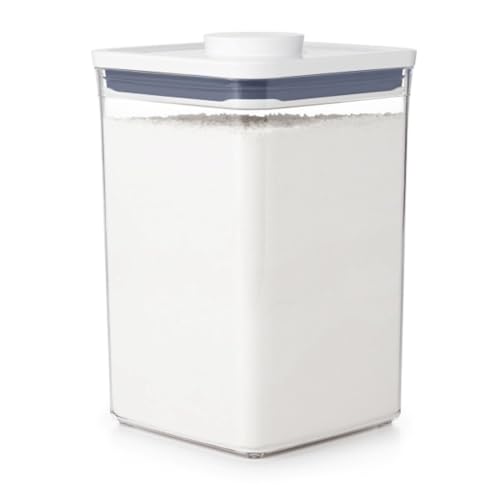
OXO’s POP containers seal with a one-push button that doubles as a handle. Clear bodies, rounded pouring corners and a deep size range make this the easiest system to grow piece by piece. Premium tier; dry goods only, and the lids prefer gentle washing.
Best for: shoppers who want best overall performance in a system they can extend over time. Not suited for: anyone storing liquids, or anyone who wants the single cheapest way to fill a shelf. This is a premium-tier pick; check price on Amazon.

Sistema Klip It Containers — Best Clip-Lid Value
Klip It containers lock with a clip on each of the four sides over a flexible seal. Entry-to-mid tier, widely available in many footprints, easy to replace one piece at a time. Four clips are slower than a single latch, and the styling is purely functional.
Best for: shoppers who want best clip-lid value performance in a system they can extend over time. Not suited for: anyone storing liquids, or anyone who wants the single cheapest way to fill a shelf. This is an entry-to-mid tier pick; check price on Amazon.
Vtopmart Airtight Containers — Best Budget Set
Vtopmart sells graduated matching sets with flip-top pouring lids that stack into one tidy block — the fastest route from packet chaos to an organised pantry in a single purchase. Entry tier; lighter plastic and hinges that will not outlive premium brands.
Best for: shoppers who want best budget set performance in a system they can extend over time. Not suited for: anyone storing liquids, or anyone who wants the single cheapest way to fill a shelf. This is an entry-tier pick; check price on Amazon.
How to Buy Smart
Buy the workhorse staple first and live with it for two weeks before extending. Prefer ranges with replaceable lids and a long sales history — a container is a ten-year object and its brand should expect to exist in ten years. Check the tallest size against spaghetti and your shelf height, the flour size against your scoop, and the seal by lifting the empty container by its lid. Decide your labelling method in the same purchase, even if it is only masking tape and a marker kept in the pantry drawer.
Setup and Care That Reduce the Cons
Labelling is the least glamorous and most load-bearing part of pantry storage. Contents are obvious the week you decant them and genuinely ambiguous three months later, when plain flour, bread flour and self-raising flour are three identical white powders in three identical tubs and the recipe cannot tell you which one it wanted. Label every container on the day you fill it: what it is, when it went in, and the use-by date from the packet it came from. Chalk markers on smooth plastic, printed labels, or plain masking tape all work; the best label is the one you will actually update, so choose the method you find least annoying and keep the supplies in the pantry itself.
Date the refill, not just the first fill. When you top up a container using proper FIFO rotation — old contents back on top — add the new date underneath the old one or replace the label and note both. It takes ten seconds and it is the difference between knowing your rice is four months old and hoping it is. Households that cook with children, flatmates or helpful relatives should treat labels as non-negotiable: a label is the only part of your system that still works when someone else puts the shopping away.
Moisture is the quiet enemy in both directions. Too much of it and flour cakes, sugar clumps, salt welds itself into a brick and dried herbs lose their perfume to the damp air. Too little and brown sugar dries to gravel. Airtight containers hold whatever moisture level the food went in with, which is why the state of the food at decanting time matters: never decant a warm bag straight from a hot car boot, never wash a container and refill it while the rim is still damp, and never top up a container whose contents already smell tired — a sealed tub preserves staleness just as faithfully as freshness.
Brown sugar deserves its own sentence because it breaks the general rule. It stays soft by holding onto moisture, so it wants the tightest seal you own, filled with as little headspace air as practical. Some bakers keep a small terracotta softener disc soaked and stored inside the sugar container; if you use one, check it monthly, because a neglected disc dries out and becomes decoration. Everything else in the dry pantry follows the simpler rule: cool, dry food into a cool, dry container, sealed promptly, stored away from the heat plume of the oven and the steam of the kettle.
Pantry Storage Containers Pros and Cons — The Bottom Line
The pros of pantry storage containers are about food; the cons are about you — your money, your space and your habits. If your household cooks from staples and can keep two small habits, the pros win decisively and the only real question is tier. If your kitchen turns over food fast and your staples list fits on one hand, take the small version of the win: a few good containers, honestly labelled, and no guilt about the rest.
The Pro Nobody Lists: Cooking Gets Better
There is a benefit that never appears in pros-and-cons lists because it is hard to photograph: ingredients that are findable, dated and fresh make you a measurably better cook. You use the wholegrain flour while it is still sweet, so the bread works. You see the lentils, so they enter the week’s cooking instead of expiring as a good intention. You stop substituting the wrong white powder. Pantries are the mise en place of home cooking, and a container system is how a home pantry gets mise en place at all. Households consistently report the same surprise a month in: they cook more from scratch, not because the containers inspired them, but because the friction between deciding and starting dropped below the threshold where ordering in wins.
The Con Nobody Lists: Decision Weight and System Guilt
Balance demands the opposite confession. A container system is one more domestic system to own, and systems charge a small tax in attention and self-judgement. The unlabelled tub reproaches you. The gasket awaiting its wash sits in the sink as a tiny accusation. For some households — new parents, carers, anyone whose bandwidth is genuinely spent — this tax is the deciding con, and the honest recommendation is the minimum viable version: three containers, tape labels, no aesthetic ambitions. A small system kept without guilt beats a grand one maintained as a source of low-grade shame. Storage should lower the noise in a kitchen, never add a new channel of it.
Environmental Ledger, Argued Both Ways
The case for: durable containers displace a stream of torn bags and boxes, make bulk buying practical — and bulk formats generally carry less packaging per kilo — and, above all, cut food waste, which dwarfs packaging in any honest environmental accounting. Food grown, shipped and binned is the real cost; a tub that prevents it pays its footprint back quickly. The case against: a container system is a pile of manufactured plastic or glass bought all at once, and a system abandoned within a year is that pile wasted, plus the food it failed to save. The ledger therefore turns entirely on longevity and use. Buy once, buy repairable, use for a decade — clearly positive. Buy fashionably, abandon, rebuy — clearly not. The environment, like the pantry, rewards the household that keeps its systems.
Long-Term Ownership: Years Three to Ten
Most reviews end at the honeymoon. Ownership does not. In years three to five, a good system asks for its first replacement lids and gaskets, and this is where brand choice cashes out: ranges still on sale make the repair a small errand, discontinued ranges make it a slow death. In years five to ten, households change around the system — children arrive or leave, diets shift, a staple vanishes and a new one appears — and the systems that survive are the ones that can be pruned and extended a piece at a time without breaking the grid. Judge the con of ‘lock-in’ accordingly: being locked into a living, supported range is a feature wearing a scary name, while a bargain set from a vanished brand is freedom that ends at the first lost lid.
Choosing sizes is where most pantry systems go wrong, because people buy the set that photographs well instead of the sizes their shopping actually produces. Work backwards from your bags. A standard bag of flour is a big, heavy pour and wants the largest container in any range, with a mouth wide enough for a measuring cup to scoop and level without a fight. Sugar and rice bags are smaller but dense. Pasta wants height more than width — a short, wide tub that swallows a bag of penne will leave spaghetti folded, broken or still in its packet. Cereal is the opposite problem: a large volume of mostly air, eaten fast, so it wants a tall container with a pour spout and a seal you can work one-handed at breakfast speed.
Buy for the staple, not the shelf. List the eight to twelve dry goods you buy on repeat, note the bag size you actually buy — not the size you bought once — and match containers to that list, leaving the odd-shaped leftovers in their packets inside a basket. A system that covers your real staples perfectly and ignores the exotic bag of amaranth you bought in a moment of ambition will still be working in five years. A system bought to cover everything usually covers nothing well, because two of its sizes turn out to fit nothing you own and become very organised, very empty shelf decoration.
Where containers live changes which ones you should buy. Inside a closed cupboard, function wins: clear bodies, fast lids, square footprints, labels facing out. On open shelving or a counter, appearance joins the specification and the calculus shifts — glass canisters and matched sets earn their place because you look at them all day, and a uniform row genuinely does make a small kitchen feel calmer. Be honest about which pantry you have. Buying display canisters for a closed cupboard pays for looks nobody sees; buying ugly bulk tubs for open shelves creates a wall of regret you face every morning.
Light and heat belong in the same decision. Clear containers on a sunny counter show you the contents and slowly tire them — oils in nuts, seeds and wholegrain flours dislike light, and herbs fade in it. Keep the light-sensitive staples in the cupboard even if the canisters are beautiful, and let the counter hold the robust, fast-moving goods: the oats, the rice, the pasta that will be eaten long before light can matter. A pantry system is a set of small placements, each one defensible, rather than a single style applied everywhere at once.
The Middle Path Most Households Land On
After the arguments settle, most households land in the same place: a partial system. The big five staples live in proper containers; the next tier lives in jars and tubs accumulated over time; the long tail stays in packets in a basket. This is not a failed version of the full system — it is the pros and cons, weighed by a real household, expressed as a shelf. The freshness and containment pros concentrate exactly where volume and waste concentrate, while the space, cost and maintenance cons shrink to a size the household happily pays. If this page has a practical conclusion, it is that the all-or-nothing framing is the enemy: decant where it pays, clip where it does not, and let the boundary move as your cooking does.
Pro and Con, Staple by Staple
Flour: the strongest case in the pantry. Pro — freshness, scoop access, pest containment, an end to dust. Con — the container is bulky and its gasket channel collects the very dust it manages. Verdict: decant, always. Cereal: pro — crispness measured in weeks and a pour that behaves. Con — the container must match the box size your household actually buys, and that box changes. Verdict: decant, sized generously. Rice and grains: pro — pouring, visibility, containment. Con — weight; a full large container is a serious lift. Verdict: decant, in a size your weakest household member can lift one-handed by the body, not the lid. Sugar: pro — no more welded bricks of granulated, brown sugar that stays spoonable. Con — minimal; sugar is the easiest tenant in the pantry. Verdict: decant. Snacks: pro — freshness and portion visibility. Con — containers of snacks invite grazing in a way a folded packet somehow does not, a household-management fact worth admitting. Verdict: decant, and place deliberately. Spices and small goods: pro — labels end the lookalike-powder lottery. Con — decanting tiny quantities into tubs can multiply clutter. Verdict: decant the top five you use weekly; basket the rest.
The Scorecard
Weighed across a typical staple-cooking household, the ledger lands like this. Freshness: strongly pro. Containment: strongly pro. Visibility and duplicate-buying: pro. Daily ergonomics: pro. Cost: con, once, recoverable. Space: con, permanent, manageable by decanting staples only. Maintenance: con, small, rhythmic. Habit dependence: the swing factor — pro for households that date and rotate, con for those that will not, and the only line on the card that the buyer, not the product, controls. Four strong pros against three manageable cons and one mirror. That is an unusually honest shape for a kitchen purchase, and it is why this category keeps converting sceptics one flour container at a time.
What the Neighbours’ Pantries Taught Us
Ask around any street and the pros and cons stop being theoretical. There is the neighbour whose containers are a decade old, lids replaced twice, labels in a hand that has changed as the children grew — the system’s pros, compounded annually, in a cupboard that smells of nothing but food. There is the neighbour with the beautiful canister set bought for a kitchen renovation photograph, three of which now hold batteries, ribbon and a phone charger from two phones ago — the cons of buying for the picture, in their purest form. There is the neighbour who decants exactly four things and clips the rest, whose pantry works better than both of the others on a quarter of the spend, and who is insufferable about it at barbecues, correctly.
The street’s verdict, if streets gave verdicts, would be that the containers were never the variable. The variable was the match between the system’s demands and the household’s nature — its patience for labels, its honesty about shelf space, its willingness to wash a gasket in March. Pros and cons lists like this one can price the hardware. Only you can price your household, and the households that price themselves honestly are the ones whose pantries still work when the reviewers have gone home.
A Final Pair of Honest Sentences
The pro, in one sentence: a sealed, labelled, visible pantry quietly returns money, freshness and calm every day for years. The con, in one sentence: it asks for money, space and two small habits up front and forever, and it keeps the receipts if you stop paying. Everything else in this article is commentary on those two sentences — and both of them are true, which is exactly why the decision was worth an article rather than an advertisement.
The Pros and Cons of Going All In Versus Dipping a Toe
Going all in — the full matched system, bought in one decisive sweep — has its own ledger beyond the general one. Pro: coherence from day one, every footprint tiling, every lid behaving identically, and the psychological completeness that makes a household actually adopt the system rather than negotiate with it weekly. Con: the size mix is a stranger’s guess, the cost lands in one month, and a wrong system choice is wrong everywhere at once. Dipping a toe — staple by staple, container by container — inverts the ledger. Pro: every size is proven against your real life before the next is bought, the cost spreads itself, and a mistake is one tub retired to the garage. Con: the shelf spends months in transition, footprints may never quite tile, and some households lose momentum halfway and live forever in the in-between, half decanted, wholly annoyed.
The tiebreaker is temperament. Decisive households with measured shelves should go all in and enjoy the grid. Experimental households, renters and anyone whose staples list is still changing should dip the toe and let the system grow at the speed of proof. Both routes arrive at the same shelf eventually. The only route that never arrives is the third one — researching the perfect system while the bags slump — and it is, by a distance, the most popular route of all. If this article moves you one step off that route, it has earned its length.
For the Record: Three Households, Revisited a Year Later
The all-in household reports a grid intact, two lids replaced under a range that still exists, and a baking habit that grew because the ingredients started behaving — the pros, compounded. The toe-dipping household reports seven containers, each earned, a basket of packets beside them, and no regrets except the three months spent in the half-decanted in-between before momentum returned — the cons, paid once and finished. The researching household reports, with great expertise, that it has nearly decided — and a cupboard of slumped bags beneath the expertise. A year of evidence from three kitchens says what this article has argued from its first page: the pros and cons of the containers are knowable, finite and mostly small. The pros and cons of deciding are where the real weight sits. Decide at the scale your household can keep, keep it with two habits, and the ledger — on this street, in these kitchens — comes out in favour of the tubs.
Weighing It for the Last Time
Set the two piles side by side one final time. In the pro pile: freshness that saves real food, containment that saves whole shelves, visibility that saves real money, ergonomics that save small daily irritations, and a calmer kitchen that saves something harder to invoice. In the con pile: one honest purchase, a permanent slice of shelf, a rhythm of gasket washing, and two habits that must outlive your enthusiasm. The piles are not equal, but they are not supposed to be weighed in the abstract — they are weighed per household, and the scales are your own cooking life. If your kitchen cooks from staples, the pro pile wins on weight and keeps winning every week the system runs. If it does not, the con pile is lighter than it looks, because a two-container version of this idea keeps most of the pro pile’s top items at a fraction of its costs. Either way, the weighing is now yours to finish — and a decision made from both piles, honestly stacked, is the only kind this article ever wanted you to reach.
The Small Print, Both Ways
Pro, small print: the benefits compound quietly and are easy to underestimate in advance, because each one is small — a packet not duplicated, a bag finished rather than binned, a recipe started without an excavation — and small benefits repeated three times a day for years are not small. Con, small print: the costs also compound quietly, in the other direction, if the habits lapse — a gasket unwashed here, a date unwritten there — until the system is a tidy museum of ageing food. Both piles of small print point to the same conclusion the big print reached: the containers are the easy half of this decision. The habits are the half that decides. Buy accordingly — the size of system your habits can honestly carry, no larger, and preferably no smaller either, because a system slightly too small teaches its household that decanting is a sometimes thing, and sometimes is where freshness goes to die.
One Sentence Each, for the Fence-Sitters
If you cook from staples and your cupboard currently avalanches, the pros are not close: buy the containers, write the dates, and enjoy the quiet. If your kitchen is small, your staples are few and your turnover is fast, the cons have a point: take the two-container version and spend the difference on ingredients. If you are genuinely between the two — and most readers of a pros-and-cons page are — let the flour decide: decant that one staple into a container chosen with this article’s care, live with it for a month, and count how many of the pros showed up uninvited. In our experience of pantries and the people who keep them, the flour container is the thin end of a wedge that almost always goes in — because once one staple lives properly, the bags beside it start to look less like a system and more like an apology.
Before You Decide, Walk to Your Own Cupboard
Stand there for one honest minute. Count the open bags. Count the duplicates you can see and suspect the ones you cannot. Read a use-by date, if you can find one, on something you opened a while ago. That minute is the truest pros-and-cons list ever written about your kitchen, and it outranks this article, the scorecard, the neighbours and the neighbours’ neighbours. If the cupboard argues for containers, believe it and buy at the scale your habits can carry. If it argues against — if everything is fresh, dated, visible and finished young — believe that too, and close the door on a pantry that needs nothing from anyone. The decision was always in the cupboard. This page just taught you how to read it.
One practical footnote for anyone still weighing it on the walk back to the kitchen chair: start with the staple you open most, give it thirty days in a properly chosen container, and let that single, lived experience cast the deciding vote between the two piles. Evidence gathered at your own shelf, with your own hands and your own shopping, will always outweigh any argument — including every argument in this article.
Living With the Trade-Offs: A Week-by-Week Reality Check for a Pantry Storage Containers
A pros-and-cons list is a snapshot, but living with a pantry storage containers is a film, and this section follows the trade-offs across the first weeks when novelty fades and routine takes over. In week one, most owners notice the headline advantage of a pantry storage containers constantly, because every use is a comparison with whatever came before it, while the headline drawback feels minor simply because it is still new. Decide in advance what good enough looks like for the job the pantry storage containers does in your home, because chasing a flawless result usually costs more time than the flaw itself, and most households are happier with a reliable ninety percent they actually repeat. Measure before anything else, and measure the pantry storage containers in its working state rather than its packed or folded state, because handles extend, lids open, cords trail, doors swing and users stand somewhere, and all of that belongs in the measurement.
Use a simple decision checklist at the end: the pantry storage containers fits the measured space, suits the real frequency of the job, matches the household’s cleaning temperament, has obtainable parts, and has a named storage home — five yeses make a confident order. Seasonal thinking helps more than expected: a pantry storage containers bought in one season will meet different light, humidity, mud, heat, guests and routines in another, so judge its size, storage and upkeep against the hardest season it will face. One-time costs forgive easily, so a pantry storage containers that is slow to assemble, heavy to position once, or demanding on its first deep clean can still be the right long-term choice if daily use afterwards is effortless. Keep the packaging of a larger pantry storage containers until those first ordinary tests are done, flattened if space is tight, because re-boxing an awkward shape from scratch is the hidden difficulty inside many otherwise straightforward returns.
Think about who else will use the pantry storage containers and what they will do differently: shorter reach, less patience, stronger habits, no interest in the manual, and a tendency to leave things wherever they were last set down. Plan the storage home for the pantry storage containers before it arrives, naming the exact cupboard, corner, shelf, hook or stretch of floor, because a product without a home migrates around the house and slowly becomes the clutter it was bought to reduce. Check the floor, wall, ground or surface the pantry storage containers will meet, since level, texture, moisture and finish decide more about everyday performance in food storage & organization settings than most shoppers expect when they are comparing listings on a screen. That reversal is the real test for a pantry storage containers: ask whether the drawback you are weighing is a one-time cost, paid at setup or purchase, or a per-use cost that you will pay hundreds of times a year without ever getting used to it.
Finally, remember that the best pantry storage containers for your home is the one whose size, habits and upkeep disappear into your routine, leaving only the result behind — a cleaner surface, a better-lit seat, a tidier shelf, an easier job — week after ordinary week. If a problem with the pantry storage containers repeats in the same spot or the same stage of the job, treat the pattern as the clue — patterns point to setup, surface or technique, while random problems point more often to the individual unit. If you already own a pantry storage containers, run the same week-by-week check backwards and note which drawback you have genuinely stopped noticing and which one still earns a small sigh, because that sigh is the most honest review you will ever read.
Frequently Asked Questions
What is the single biggest advantage of pantry containers?
Freshness with containment. Food keeps its quality far longer than in opened packaging, and because each staple is walled off in its own sealed vessel, a pest-infested bag — which arrives from the shop more often than people think — damages one container’s contents instead of spreading across the shelf. Those two benefits together are why the category exists.
What is the biggest disadvantage nobody mentions?
Silent failure. A container system with a dirty gasket, an unlabelled refill or old stock buried under new looks exactly as tidy as a working system while the food inside quietly ages. Bags fail loudly; systems fail politely. The defence is boring and total: date every fill, rotate first-in, first-out, and wash gaskets on a rhythm.
Do containers save money overall?
For staple-cooking households, usually yes: less food thrown away stale, fewer duplicate purchases because stock is visible, and bulk sizes become practical. The saving is slow and unglamorous rather than dramatic, and it depends on the habits being kept. A premium system abandoned in a year saves nothing; a modest set used for five years saves steadily.
Are containers better than just using bag clips?
For anything you keep longer than a week or two, yes — a clip slows staling, a gasket mostly stops it, and only a container contains pests and stacks. For fast-turnover snacks eaten in days, a clip is honestly sufficient. Many good pantries run both: containers for staples, clips for the quick and the temporary.
How do I stop the pros from being undone by my own habits?
Shrink the habits until they are effortless. Keep labels and a marker inside the pantry so dating takes ten seconds at refill. Refill only when you can do the full rotation — old contents out, new in, old back on top. Wash gaskets when you wash the container anyway. Systems survive on friction-free routines, not on willpower.
Is glass or plastic the better side of this trade-off?
Plastic wins on weight, drops and price; glass wins on odours, staining and decades-long durability, and looks better on open shelves. Sealing is equal — the gasket does that work in both. Choose per shelf: plastic for the working cupboard, glass where the containers are part of the room.
Related Reading
our in-depth pantry storage containers review
our comparative pantry storage containers reviews
the pantry storage containers buying guide
how to choose pantry storage containers, step by step
whether pantry storage containers are worth it for your kitchen
the best storage baskets for corralling packets and odd shapes
vacuum storage bags for bulk overflow and seasonal spares
under-bed storage ideas for the overflow a small kitchen cannot hold