Disclosure: As an Amazon Associate, dailyhomedecorating.com earns from qualifying purchases. Links on this page are affiliate links; they cost you nothing extra. Prices and availability change often, so check the current Amazon listing before you buy.
So — are pantry storage containers worth it? Short answer: worth it if you cook from dry staples, buy flour, rice or cereal in bags, and have thrown away stale or pest-damaged food in the last year; not worth it if your kitchen turns over small quantities quickly, your shelf space is genuinely scarce, or you know the labels and refills would be abandoned by March. This page argues both sides properly — what you actually get, what it really costs beyond money, who it pays off for, and the checklist that settles it for your kitchen.
Key Takeaways
- The value is waste avoided: staples that stay fresh to the last cup instead of being binned at two-thirds.
- The real costs are space, lid maintenance and two permanent habits — dating fills and rotating first-in, first-out.
- Pays off fastest for bakers, families and bulk buyers; slowest for small, fast-turnover, shop-often kitchens.
- A phased start — three staples, one fortnight — tells you your own answer for the price of a few containers.
- Tier matters less than fit: a budget set used properly beats a premium system used carelessly, every time.
What You Actually Get
You get time. Not convenience in the abstract — literal weeks of extra life for opened food. Cereal that is still crisp when the box would have gone soft, flour that reaches the bottom of the bag still sweet, crackers that survive being the second packet opened. You get containment: the bag of grain that arrives with unwelcome passengers damages itself, not the shelf. You get visibility, which quietly rewires your shopping — you buy what the shelf shows you need, once. And you get a small daily dividend of ease: scooping from a wide mouth instead of a collapsing bag, pouring rice that lands in the pan, lids that close with a sound like a decision.
Pantry pests — Indian meal moths and the various weevils and flour beetles — do not usually arrive because a pantry is dirty. They arrive inside the food itself, as eggs or larvae in a bag of flour, grain or pet food bought from a perfectly respectable shop, and they spread from packet to packet because folded paper and thin plastic are no obstacle at all. This is the strongest practical argument for hard-sided containers with real seals: a gasket-sealed container does not just keep pests out of your other food, it keeps an infested product contained, so one bad bag stays one bad bag instead of becoming a whole-shelf clear-out.
Two habits complete the defence. First, inspect before you decant: webbing, clumping in flour that should be loose, or tiny dark specks moving at the seams of a packet mean the product goes in the bin, not in a container. Second, some cooks freeze a new bag of flour or grain for a few days before decanting as a precaution; if you do this, let the bag return fully to room temperature and dry out before it goes into a sealed container, or you have sealed the moisture in with it. The often-repeated tip of tucking a bay leaf into the flour is a folk remedy passed down through generations of cooks — plenty of households swear by it, the leaves do no harm, and it costs almost nothing, but treat it as a tradition layered on top of sealed containers and inspection, never as a substitute for them.
Put a rough shape on the return. A household that bins the tail of a few staple bags a month — the stale cereal third, the flour that sat too long, the duplicate rice bought because the first bag was invisible — is losing the value of those bags entirely. Containers convert most of that loss into food eaten. Against that, even a premium system bought piece by piece is usually the cheaper side of the ledger within its first couple of years, and a budget set gets there far sooner. The maths is not heroic; it is just steady, which is what kitchen value usually looks like.
In this guide
The Real Costs Beyond Money
Space is the first cost: a container is larger than its contents, and a decanted pantry needs more shelf than the same food in bags. The second cost is maintenance — gaskets washed and dried, lids treated as the delicate parts they are. The third is attention: every refill is a small ceremony of rotation and dating, forever. The fourth is the learning curve of sizes — almost everyone buys one wrong size first, and the honest budget includes that mistake. None of these costs is large. Together they explain why containers delight organised households and quietly gather dust in others: the product is a system, and systems charge rent in habits.
Containers do not need much care, but they need the right care. Wash bodies in warm soapy water or on the dishwasher rack the maker allows, and treat lids as the delicate part: gaskets, hinges, latches and push-button mechanisms all prefer hand washing and a patient dry. The single most common way people ruin a good container is refilling it too soon — a container that looks dry can hold a spoonful of water in the gasket channel, and that water goes straight into your dry goods. After washing, stand containers and lids open on a rack overnight. If they still smell of the last contents — cumin and chilli powder are persistent — a paste of bicarbonate of soda and water, left for an hour and rinsed, clears most odours from plastic.
Between refills of the same staple, a full wash every time is more than most containers need and more than most people will sustain. A realistic rhythm: empty, shake and wipe out crumbs, inspect the gasket, refill if the same food is going back in; wash properly when you change contents, when anything looks or smells off, or every few refills regardless. Systems survive on rhythms people actually keep. A care routine so strict that you start skipping it is worse than a modest routine you never skip at all.
Who It Pays Off For
The baker. Flour, sugars and a dozen baking extras are the highest-value, highest-waste corner of most pantries. A flour keeper with a leveler, a tight seal for brown sugar and labelled small tubs pay back in successful bakes and ingredients that are alive when reached for. The family. Volume changes everything: cereal by the family box, snacks by the multipack, rice by the sack. Seals that children can reseat and stock you can see at a glance are worth real money at that throughput. The bulk buyer and the batch cook. If you buy staples in quantity, containers are not an upgrade — they are the infrastructure that makes bulk buying rational instead of optimistic.
Progressive Prepworks ProKeeper Containers — Best for Bakers
ProKeeper containers are designed per ingredient — a flour keeper with a snap-in leveler is the headline — with hinged, silicone-sealed lids across the range. Mid tier and ideal for bakers; the mixed shapes stack less uniformly than a matched set.
Best for: shoppers who want best for bakers performance in a system they can extend over time. Not suited for: anyone storing liquids, or anyone who wants the single cheapest way to fill a shelf. This is a mid-tier pick; check price on Amazon.

Rubbermaid Brilliance Pantry Containers — Best Latching Seal
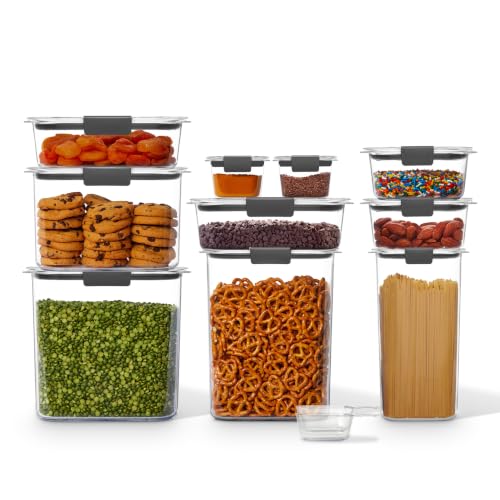
Brilliance Pantry containers clamp shut with two latches over a gasket, giving a firm, certain seal and very clear bodies for at-a-glance stock checks. Mid-to-premium tier; latches need a rinse now and then and opening is a two-handed job.
Best for: shoppers who want best latching seal performance in a system they can extend over time. Not suited for: anyone storing liquids, or anyone who wants the single cheapest way to fill a shelf. This is a mid-to-premium tier pick; check price on Amazon.
Who Should Skip It
The small, fast kitchen. If your staples list is pasta, rice and oats, bought small and finished within weeks, two decent containers capture nearly all the value; a fourteen-piece system is furniture. The reluctant maintainer. If labels will not be written and old stock will be buried, containers convert loud chaos into tidy staleness — you are better off with clips and small bags bought often. The liquid-and-leftovers cook. If your storage pain is soups, oils and fridge leftovers, pantry containers solve a problem you do not have; spend on vessels made for liquids instead.
Strengths and Trade-Offs of Owning a System
Strengths of owning
- Staples stay fresh to the last portion, so the food you buy is the food you eat.
- Stock is visible, ending duplicate purchases and mid-recipe surprises.
- Pests are contained per-container instead of spreading shelf-wide.
- Shelves tile and stack, and daily cooking gets measurably calmer.
Trade-offs of owning
- Shelf space is spent on container walls and headspace, not just food.
- Lids and gaskets need washing, full drying and eventual replacement.
- The system silently depends on your dating and rotation habits, permanently.
- It solves dry goods only — liquids, heat and leftovers need other vessels.
Alternatives to Consider
Before committing, price the honest alternatives. Bag clips plus discipline: near-free, adequate for fast-turnover goods, weak beyond a fortnight. Repurposed glass jars: free and charming for small quantities, limited by lid seals and chaotic sizes. A single anchor container: many households discover that decanting only flour — the staple that suffers most in a bag — captures a surprising share of the total benefit. And the phased system: three containers now, extend only when a staple proves it needs one. Each alternative is a legitimate resting point, not a failure to commit.
Vtopmart Airtight Containers — Best Budget Set
Vtopmart sells graduated matching sets with flip-top pouring lids that stack into one tidy block — the fastest route from packet chaos to an organised pantry in a single purchase. Entry tier; lighter plastic and hinges that will not outlive premium brands.
Best for: shoppers who want best budget set performance in a system they can extend over time. Not suited for: anyone storing liquids, or anyone who wants the single cheapest way to fill a shelf. This is an entry-tier pick; check price on Amazon.

OXO Good Grips POP Containers — Best Overall
OXO’s POP containers seal with a one-push button that doubles as a handle. Clear bodies, rounded pouring corners and a deep size range make this the easiest system to grow piece by piece. Premium tier; dry goods only, and the lids prefer gentle washing.
Best for: shoppers who want best overall performance in a system they can extend over time. Not suited for: anyone storing liquids, or anyone who wants the single cheapest way to fill a shelf. This is a premium-tier pick; check price on Amazon.
Chef’s Path Airtight Containers — Best Large Matching Set
Chef’s Path sells large, complete sets with locking lids and tall canisters for cereal and pasta. Entry-to-mid tier and good for outfitting a whole pantry at once; you accept the set’s size mix, and single replacement lids can be harder to find.
Best for: shoppers who want best large matching set performance in a system they can extend over time. Not suited for: anyone storing liquids, or anyone who wants the single cheapest way to fill a shelf. This is an entry-to-mid tier pick; check price on Amazon.
How to Get the Most Value If You Buy
First in, first out — FIFO — is the single habit that separates a pantry that works from a pantry that merely looks organised. The rule is simple: new stock goes behind or beneath old stock, and when you refill a container, the remains of the old batch go on top of the new batch, never the other way round. Burying old flour under new flour means the bottom layer can sit for a year, ageing, attracting attention from pantry moths and quietly going rancid, while you congratulate yourself on how fresh everything tastes. Decanting is the moment to enforce it: pour the old contents into a bowl first, add the new bag to the clean, dry container, then return the old contents on top so they are used first.
FIFO also applies across containers. If you keep a working container on the shelf and a backup bag in a cupboard, the backup is not a refill licence — it is a queue. Date labels make the queue visible. A strip of masking tape or a removable label on the bottom or back of each container, marked with the month and year you decanted and the use-by date from the original packet, turns FIFO from a memory test into a glance. When you open a container and cannot remember when its contents arrived, the system has already failed; the label is what stops that moment from happening.
Labelling is the least glamorous and most load-bearing part of pantry storage. Contents are obvious the week you decant them and genuinely ambiguous three months later, when plain flour, bread flour and self-raising flour are three identical white powders in three identical tubs and the recipe cannot tell you which one it wanted. Label every container on the day you fill it: what it is, when it went in, and the use-by date from the packet it came from. Chalk markers on smooth plastic, printed labels, or plain masking tape all work; the best label is the one you will actually update, so choose the method you find least annoying and keep the supplies in the pantry itself.
Date the refill, not just the first fill. When you top up a container using proper FIFO rotation — old contents back on top — add the new date underneath the old one or replace the label and note both. It takes ten seconds and it is the difference between knowing your rice is four months old and hoping it is. Households that cook with children, flatmates or helpful relatives should treat labels as non-negotiable: a label is the only part of your system that still works when someone else puts the shopping away.
Moisture is the quiet enemy in both directions. Too much of it and flour cakes, sugar clumps, salt welds itself into a brick and dried herbs lose their perfume to the damp air. Too little and brown sugar dries to gravel. Airtight containers hold whatever moisture level the food went in with, which is why the state of the food at decanting time matters: never decant a warm bag straight from a hot car boot, never wash a container and refill it while the rim is still damp, and never top up a container whose contents already smell tired — a sealed tub preserves staleness just as faithfully as freshness.
Brown sugar deserves its own sentence because it breaks the general rule. It stays soft by holding onto moisture, so it wants the tightest seal you own, filled with as little headspace air as practical. Some bakers keep a small terracotta softener disc soaked and stored inside the sugar container; if you use one, check it monthly, because a neglected disc dries out and becomes decoration. Everything else in the dry pantry follows the simpler rule: cool, dry food into a cool, dry container, sealed promptly, stored away from the heat plume of the oven and the steam of the kettle.
Finally, place for use, not for display — unless display is your use. Daily staples at the front at hand height, slow goods at the back, light-sensitive foods out of the sun. Review the system twice a year: empty containers leave, missing sizes get noted, gaskets get their deep clean. Fifteen minutes, twice a year, is the entire management overhead of a pantry that keeps paying you back.
Where containers live changes which ones you should buy. Inside a closed cupboard, function wins: clear bodies, fast lids, square footprints, labels facing out. On open shelving or a counter, appearance joins the specification and the calculus shifts — glass canisters and matched sets earn their place because you look at them all day, and a uniform row genuinely does make a small kitchen feel calmer. Be honest about which pantry you have. Buying display canisters for a closed cupboard pays for looks nobody sees; buying ugly bulk tubs for open shelves creates a wall of regret you face every morning.
Light and heat belong in the same decision. Clear containers on a sunny counter show you the contents and slowly tire them — oils in nuts, seeds and wholegrain flours dislike light, and herbs fade in it. Keep the light-sensitive staples in the cupboard even if the canisters are beautiful, and let the counter hold the robust, fast-moving goods: the oats, the rice, the pasta that will be eaten long before light can matter. A pantry system is a set of small placements, each one defensible, rather than a single style applied everywhere at once.
Are Pantry Storage Containers Worth It? The Decision Checklist
- Do you buy at least five dry staples in bags or boxes larger than you finish in a week?
- Have you thrown away stale, caked or pest-damaged dry food in the past year?
- Do you ever buy a staple you already own because you could not see it?
- Can your shelves give up the extra space that container walls and headspace take?
- Will someone in this household date labels and rotate stock at every refill — honestly?
- Do you bake, batch-cook or buy in bulk at least monthly?
Four or more yes answers: buy the system, at the tier your budget prefers, starting with your three most-used staples. Two or three: buy the phased version — an anchor container for flour, one for your fastest staple, and reassess in a month. Fewer than two: clips and small bags are your honest system, and the money is better spent elsewhere in the kitchen.
The One-Bag Test: Measuring Your Own Waste
If the checklist left you on the fence, run the measurement instead of debating. For one month, keep every dry-goods package you finish or throw away, and note honestly what left the house uneaten: the stale third of the cereal, the flour tail that smelled tired, the rice duplicated into existence. At month’s end you hold your personal answer in physical form. Households are consistently surprised in one direction or the other — either the waste pile is embarrassingly real, and the container question answers itself, or it is nearly empty, and you have just saved yourself a system you never needed. Either outcome is a win; the only losing move is buying the system on a guess.
Run the companion test on the shelf: photograph your pantry today, then again in a month without tidying first. The drift between the two photographs — the slumped bags, the duplicates, the packet exiled to the counter — is the disorder tax you currently pay. Containers are worth it precisely to the extent that the second photograph bothers you.
Worth It at Each Life Stage
First home: worth it in the entry tier, immediately, because habits set now compound for decades and a graduated set is the cheapest teacher of your own staples list. Family years: worth it at the highest confidence of any stage — volume, pests, duplicates and small hands all argue the same way, and the mid-tier workhorse ranges were designed for exactly this kitchen. Downsizing and later life: worth it selectively — fewer, lighter containers, lids that open with a palm rather than a grip, labels in large clear writing, and nothing stored above shoulder height. The system’s job changes from capacity to kindness. Shared houses: worth it with the labelling turned up to maximum, because in a house of five shoppers the label is the only staff member the pantry has.
What ‘Worth It’ Looks Like After a Year
The households that call it worth it describe the same scene, a year on: a shelf they can read like a page. Flour at a known level with a date on it. Rice that pours. Cereal that crunches at the bottom of the container as it did at the top. A shopping list written from a glance. Nothing in that scene is dramatic, and that is the point — the value of pantry containers is not an event but an absence: the absence of waste, duplicates, doubt and the small daily friction of fighting your own ingredients. Purchases that remove friction forever are rare in a kitchen. This is one of them, provided the household keeps the two small habits that power it — and the checklist above exists to tell you, honestly, whether yours will.
Choosing sizes is where most pantry systems go wrong, because people buy the set that photographs well instead of the sizes their shopping actually produces. Work backwards from your bags. A standard bag of flour is a big, heavy pour and wants the largest container in any range, with a mouth wide enough for a measuring cup to scoop and level without a fight. Sugar and rice bags are smaller but dense. Pasta wants height more than width — a short, wide tub that swallows a bag of penne will leave spaghetti folded, broken or still in its packet. Cereal is the opposite problem: a large volume of mostly air, eaten fast, so it wants a tall container with a pour spout and a seal you can work one-handed at breakfast speed.
Buy for the staple, not the shelf. List the eight to twelve dry goods you buy on repeat, note the bag size you actually buy — not the size you bought once — and match containers to that list, leaving the odd-shaped leftovers in their packets inside a basket. A system that covers your real staples perfectly and ignores the exotic bag of amaranth you bought in a moment of ambition will still be working in five years. A system bought to cover everything usually covers nothing well, because two of its sizes turn out to fit nothing you own and become very organised, very empty shelf decoration.
Most pantry containers are one of three materials, and each has a genuine personality. Clear plastic — the modern BPA-free copolyesters and polypropylene used by the big pantry brands — is light, survives drops, stacks without fear and lets you read the contents at a glance. Its weaknesses are that it can pick up odours and turmeric-coloured stains over years, and it should not be filled with anything hot. Glass is heavier and breakable, but it is odour-neutral, stain-proof, washes beautifully and looks at home on open shelving; a glass canister with a good gasket is a decades-long purchase. Stainless steel hides its contents, which some people prefer visually, but you lose the at-a-glance stock check that makes a pantry system work, and you cannot see when the rice is running low until the container is already empty in your hand.
The practical answer for most homes is a hybrid: plastic or glass for the high-turnover staples you check constantly, and whatever you like for slow goods. What matters more than the material is consistency within a shelf. Containers from one system share footprints and lid logic, so they stack, line up and open the same way. A shelf of nine different one-off containers, each with its own lid trick, is a shelf you will stop maintaining — and an unmaintained system is just expensive clutter with gaskets.
Shape decides how much of your shelf is storage and how much is air. Square and rectangular containers tile a shelf with almost no wasted gaps, stack in stable blocks and line up in rows you can read like a bookshelf. Round canisters pour beautifully, are kinder to scoop from, and look right on a counter or open shelf, but every round container on a rectangular shelf rents a little square of nothing in each corner. On deep shelves, shape matters twice: a container you cannot see into or reach will be forgotten, so deep shelves want either containers that slide, a turntable in front of them, or the discipline of keeping only tall staples at the back.
Stacking deserves a sceptical eye. Almost every brand claims its containers stack, and most do — empty, in a photo. Filled, a stack is only as good as its lowest lid, so test stacks with real weight, keep stacks to two or three high, and never stack a heavy container of rice on top of the crackers you open daily. The containers you touch every day should live at the front, at hand height, unstacked. A pantry is a tool you use three times a day, not a warehouse; optimise it for the reach, not the photograph.
If You Buy Only One Container
Strip the question to its minimum and it still has an answer: buy one container, for flour. Flour is the staple that suffers most in its bag — it cakes, it picks up cupboard smells, it dusts every surface it touches, it hosts the pantry’s least welcome guests, and it is measured in a way that fights its packaging every single time. A wide-mouth, well-sealed flour container removes all five annoyances at once, which is why it is the purchase most often described, unprompted, as ‘worth it’ by people who own exactly one container and a shelf of bags. If the one-container experiment converts you, extend staple by staple in order of suffering: brown sugar next for its seal, cereal for its staling speed, rice for its pouring. Worth-it, in this category, is not a verdict you reach. It is a queue you work down.
The Rental Test and the Forever-Home Test
Worth-it changes with how long the kitchen is yours. In a rental or a first flat with a two-year horizon, the calculus favours the entry tier and the phased start: value that arrives immediately, nothing so fitted to this shelf that it cannot move with you, and a system light enough to be a habit you carry to the next kitchen rather than an installation you abandon. In a long-term home, the calculus inverts: you will open these lids tens of thousands of times, across decades, so ergonomics and replaceable parts dominate, and the premium system’s higher price dissolves into the lowest cost per year of anything in the kitchen. Neither answer is the other’s compromise. They are the same question — how many openings, over how many years — asked at different scales, and your honest horizon is the input that decides it.
There is a third horizon worth naming: the household in flux. New baby, new diet, new housemates, a cook learning to bake — in flux, staples lists rewrite themselves quarterly, and the worth-it move is the flexible one: workhorse containers bought a few at a time, sizes following the life rather than predicting it. Buy certainty when your life is certain. Buy adaptability when it is not. The containers will keep up either way; it is the plan that has to match the season.
The Answer, Restated for Three Readers
For the reader with a trolley full of bags and a bin full of evidence: yes, worth it, and start this weekend with a set or the big three staples; your waste pile has already made the argument better than this page can. For the reader with a small kitchen and a short staples list: worth it in miniature — flour, your fastest staple, one more if the fortnight test converts you — and anyone who sells you fourteen pieces is selling you furniture. For the reader deciding between tiers: the worth does not live in the tier. It lives in the fit and the habits, and a budget set in a household that labels and rotates will outperform a premium system in a household that does not, on freshness, on waste and on every measure except how the lids feel — and how the lids feel matters only because it decides whether they get closed. Choose the tier whose lids your household will close properly a thousand times, and you have chosen correctly at any price point in this category.
That is the whole of it. Pantry storage containers are worth it when they are bought as a system, sized from your own shopping, sealed by lids your own hands approve of, and run on two habits small enough to survive real life. Bought any other way, they are worth considerably less — and the difference was never in the plastic.
The Counterfactual Kitchen
Imagine the same kitchen, five years from now, in the world where you did not buy the containers. The bags are still slumped in the cupboard, because bags do not improve with time. Somewhere at the back is a bag of flour whose age is a family legend. The cereal still goes soft in its box, and the household still buys rice it already owns, because the shelf cannot be read at a glance and nobody is going to excavate it on a Tuesday. Nothing terrible has happened — that is the honest counterfactual, and it is why the worth-it question is genuinely arguable. The no-container kitchen is not a disaster. It is a small, daily, compounding untidiness: a little waste, a little doubt, a little friction, three times a day, for five years.
Now the other world. The shelf reads like a page. The flour is dated. The cereal crunches at the bottom of the tub. The shopping list writes itself. Nothing dramatic has happened there either — and that, in the end, is the entire case. Worth-it purchases in a kitchen are rarely dramatic. They are the ones that remove a small friction so completely that, five years on, you cannot remember it was ever there. Pantry containers, bought as a system and run on two small habits, are that kind of purchase. Bought as a photograph, they are not. The difference is yours to choose, and now you have the checklist, the tests and the queue to choose it with.
A Note on the Word ‘Worth’
Worth is doing quiet work in this article’s title, so let it be defined before the page ends. A thing is worth it here if, across its life, it returns more — in food eaten rather than binned, in duplicates not bought, in minutes and small irritations removed — than it costs in money, space and attention. By that definition the answer was never going to be a slogan. It is a measurement each kitchen takes of itself: its waste, its habits, its horizon. This page has given you the tests — the one-bag month, the two photographs, the checklist, the queue of staples in order of suffering. Run any one of them and the title’s question answers itself in your own numbers, which are the only numbers that were ever going to settle it.
If This Page Had to Fit on a Fridge Door
It would say this. Worth it if bags of staples die in your cupboard: buy the system, date everything, rotate old on top. Worth it in miniature if your kitchen is small: flour first, then let a fortnight decide. Not worth it if the labels would stop by March — take the clips and the small bags and spend the money on dinner. And underneath, in smaller writing: the worth was never in the plastic. It is in the shelf you can read at a glance, five years from now, on an ordinary Tuesday — and in the food that is still, quietly, exactly as good as the day you sealed it in.
Postscript: The Container on the Counter
There is a flour container on the counter of the kitchen where this page was drafted — not as a prop, but because it lives there, at the point of use, opened most days of the week. It is not the most expensive model in this article’s world, nor the prettiest. Its label is tape. Its date is current. Its contents are exactly as good as the day they were sealed, and the bag it replaced has not been thought about in a very long time. If you ask whether it was worth it, the honest answer is that the question stopped occurring — which, for a kitchen purchase, is the highest verdict there is. May your own containers reach the same invisibility, at whatever tier your checklist chose.
The Receipt Test
One last way to see it, for the reader who trusts paper over arguments. Keep, for one ordinary month, the receipts of everything your kitchen throws away uneaten — not the peelings and bones, just the bought food that died in storage: the stale, the caked, the duplicated, the forgotten. Then keep, beside them, the thought of what a container system for your staples would have cost, in money and in the shelf it takes. If the month’s waste pile would have paid a meaningful share of the system — and for most staple-cooking households it would — the question in this article’s title has been answered by your own kitchen, in your own handwriting. If the pile is pitifully small, frame it: you are one of the rare households whose habits already do what containers promise, and you may spend the money elsewhere with this page’s blessing.
The Last Word Belongs to the Staples
Flour does not care about marketing. Rice does not read reviews. The staples in your cupboard know only two states: sealed, dated and visible, or folded, forgotten and slowly fading. Everything in this article — the checklists, the tests, the tiers, the counterfactuals — is an attempt to price the distance between those two states for one particular kitchen: yours. If the distance is wide, the containers are worth it, and no tier argument should delay you. If the distance is narrow, they are not, and no review should persuade you. Measure the distance honestly, buy exactly what closes it, and then go and cook something with the staples you can suddenly see. That meal, more than any verdict printed here, is what the system was for.
And if the distance turns out to be somewhere in the middle — as it honestly is for most kitchens — remember the phased answer this page keeps returning to: three containers, three staples, one month of labels and rotation. It costs little, it risks less, and it converts an abstract debate about worth into a small, finished experiment whose result you can hold in your hands every time you open the flour.
The Earn-Its-Place Test: When a Pantry Storage Containers Repays the Space It Takes
Worth-it questions about a pantry storage containers are really questions about frequency, so start by honestly counting how often the job it does actually arises in your household in a normal month, not in the motivated week when you decided to shop for one. Multiply that frequency by the friction it removes each time — minutes saved, mess avoided, a workaround retired, a room made usable for longer each day — and the value of a pantry storage containers stops being a feeling and becomes a rough but usable number. Think about who else will use the pantry storage containers and what they will do differently: shorter reach, less patience, stronger habits, no interest in the manual, and a tendency to leave things wherever they were last set down. Use a simple decision checklist at the end: the pantry storage containers fits the measured space, suits the real frequency of the job, matches the household’s cleaning temperament, has obtainable parts, and has a named storage home — five yeses make a confident order.
Share the checklist result with anyone who shares the space, since a pantry storage containers chosen by one person and resented by another rarely survives, however sensible the purchase looked on paper. Keep the packaging of a larger pantry storage containers until those first ordinary tests are done, flattened if space is tight, because re-boxing an awkward shape from scratch is the hidden difficulty inside many otherwise straightforward returns. Read the manual’s warnings page for the pantry storage containers even if you read nothing else, because that page is a compressed list of every way the product has ever been misused, and it tells you exactly which of your own habits needs adjusting. For troubleshooting, start with the boring causes first: power, water, fit, blockage, alignment, a full container, a loose connection or a setting changed by the last person who used the pantry storage containers, because boring causes account for most apparent failures.
If you want a concrete listing check, take a name already shortlisted in this guide, such as Progressive Prepworks ProKeeper Containers, Rubbermaid Brilliance Pantry Containers and Vtopmart Airtight Containers, and verify that exact pantry storage containers listing against the measurements and compatibility questions above, field by field, rather than trusting the headline description alone. Borrowed enthusiasm is the trap here: a pantry storage containers can be excellent and still not be worth it for you, if your neighbours, your feed or your guests use theirs weekly while your own routine would reach for it a handful of times a year. Watch for edge cases in your own home: the pet that investigates everything, the child who treats every new object as furniture, the guest who uses force where you use familiarity, and the weather, light or season that changes how a pantry storage containers behaves. Look at replacement parts and consumables for the pantry storage containers while you are still comparing, confirming that the pieces most likely to wear, clog, tear, fade or get lost can actually be obtained without replacing the whole product.
Keep a short note of what you adjusted on the pantry storage containers during the first month, even just a line on your phone, since those notes turn vague impressions into a setup you can repeat, share or troubleshoot months later. Finally, remember that the best pantry storage containers for your home is the one whose size, habits and upkeep disappear into your routine, leaving only the result behind — a cleaner surface, a better-lit seat, a tidier shelf, an easier job — week after ordinary week. Measure before anything else, and measure the pantry storage containers in its working state rather than its packed or folded state, because handles extend, lids open, cords trail, doors swing and users stand somewhere, and all of that belongs in the measurement. When something about the pantry storage containers disappoints, change one variable at a time — position, setting, timing, load, accessory or technique — and give the change a fair trial, because changing three things at once leaves you with a better or worse result and no idea why.
Frequently Asked Questions
Are pantry storage containers worth it for a small kitchen?
A full system, usually not — the space tax is too high where shelves are scarcest. A small version, yes: two or three containers for the staples you buy in quantity, chosen square to tile tightly, capture most of the freshness and visibility benefit. Let the long tail of rarely used packets live in a basket rather than demanding containers of their own.
How long before containers pay for themselves?
It depends on tier and on how much food you currently lose. Households that regularly bin stale tails of bags typically recover an entry-tier set’s cost within months through food actually eaten and duplicates not bought; a premium piece-by-piece system takes longer but lasts years with replaceable lids. The payback is real but gradual — this is infrastructure, not a jackpot.
Is it worth decanting everything, or just some foods?
Just some. Decant the repeat staples — flour, sugars, rice, pasta, cereal, oats, grains — where freshness, pests and visibility matter daily. Leave one-off and rarely used items in their packets inside a basket. Decanting everything is the fastest route to a shelf of labelled clutter and a system you stop maintaining.
Do I need the expensive brands for it to be worth it?
No. Freshness comes from a clean, well-seated gasket, which budget sets provide. Premium brands buy better lid ergonomics, tougher hinges, consistent footprints and replacement parts over years — worth it for daily-use staples in a long-term home, unnecessary for a first system or a rental kitchen. Fit and habits outrank tier.
What if my household will not keep up the labelling?
Then shrink the system until the habit is trivial: fewer containers, masking-tape labels, a marker stored in the pantry itself so dating takes seconds. If even that will not happen, be honest and choose clips and small, frequently bought bags instead — a simple system kept beats an elaborate one abandoned.
Are containers worth it if I have never had pantry pests?
Pests are only one of three returns; freshness and visibility pay even in a pest-free life. That said, pests usually arrive inside a purchased bag without asking permission, and most households meet them eventually. Containers are the difference between that day being a one-bag problem and a whole-shelf clear-out — insurance that also happens to keep cereal crisp.
Related Reading
our in-depth pantry storage containers review
our comparative pantry storage containers reviews
the pantry storage containers buying guide
how to choose pantry storage containers, step by step
the honest pros and cons of pantry storage containers
the best storage baskets for corralling packets and odd shapes
vacuum storage bags for bulk overflow and seasonal spares
under-bed storage ideas for the overflow a small kitchen cannot hold