Disclosure: As an Amazon Associate, dailyhomedecorating.com earns from qualifying purchases. Links on this page are affiliate links; they cost you nothing extra. Prices and availability change often, so check the current Amazon listing before you buy.
A ceiling fan with light buying guide should really start with a confession: this is the one home purchase where the prettiest option in the showroom is very often the wrong option for the room you actually live in. A fan that looks perfect above a display floor can hang too low over your bed, push too little air across a long living room, or throw a flat, cold light over a dining table that deserved better. The good news is that every one of those failures is predictable, and therefore avoidable. Ceiling fans are one of the most honestly specified products in the home: size, mount type, motor, blade pitch and light output are all knowable before you buy, and the room itself tells you most of what you need. This guide works through those decisions in the order they actually matter, then introduces a shortlist of real models that cover the main situations, so that by the end you can match a fan to a room with confidence instead of hope.
One thing this guide will not do is rank fans by a single score, because rooms differ more than fans do. A compact flush-mount fan that is a triumph in a low-ceilinged bedroom would be a disappointment in a vaulted great room, and the statement holds in reverse. What you will find instead is a framework: how to size a fan to a room, how to choose between flush and downrod mounting, what separates an integrated LED light from a bulb-based light kit, how motors and controls change daily life with the fan, and which mistakes send the most fans back to the store. Readers weighing the basic value question may also want our companion piece, is a ceiling fan with light worth it, while readers who want the balanced ledger before anything else can start with ceiling fan with light pros and cons.
Key Takeaways
- Size the fan to the room first: blade span is the single decision that most determines whether a fan feels effective or decorative.
- Ceiling height chooses the mount. Flush mounts suit low ceilings; downrods bring the fan to the right working height in tall rooms.
- Integrated LED lights are brighter, slimmer and longer-lived, but bulb-based light kits let you choose and replace the light itself.
- A reversible motor matters more than an extra speed: it lets the fan help with heating in winter as well as cooling in summer.
- Controls shape daily satisfaction. A remote or smart control you actually use beats a technically superior fan you leave off.
- Every fan in this guide is a real, current market model; treat each as a pattern for its category even if your final choice is a close cousin.
In this guide
What a Ceiling Fan with Light Does and the Main Types
A ceiling fan with a light is really two appliances sharing one ceiling position, one electrical box and one set of controls. The fan half does not cool a room the way an air conditioner does; it moves air across skin, which makes occupants feel cooler, and it evens out the temperature differences between the floor and the ceiling that make rooms feel patchy. The light half replaces or supplements whatever fixture previously occupied the centre of the ceiling, which in most rooms is the main overhead light. Combining the two is efficient — one installation, one switch run, one ceiling footprint — but it also means a compromise in either half shows up twice: a weak light is now your main light, and a wobbling, noisy fan hangs directly over the room’s most used space. Understanding the main types is how you avoid buying a compromise you did not choose.
Flush-Mount Fans for Low Ceilings
Flush-mount fans, often called hugger fans, bolt the motor housing almost directly to the ceiling with no downrod at all. They exist for one reason: headroom. Building practice in most places wants the fan blades at least seven feet above the floor, and in a room with an eight-foot ceiling a standard downrod fan can push the blades uncomfortably close to tall occupants, bunk beds and raised arms. A flush mount keeps the whole unit tight to the ceiling, which makes it the default choice for bedrooms, hallways and older homes with modest ceiling heights. The trade-off is airflow efficiency: a fan hugging the ceiling has less room to draw air from above, so flush mounts often move air a little less freely than the same motor on a short downrod. In a small or medium room that difference is rarely noticeable; in a large room with a low ceiling, it argues for choosing a flush mount with a generous blade span and a strong motor rather than the smallest unit that fits.
Downrod Fans for Standard and Tall Ceilings
Downrod fans hang from a metal rod that drops the motor and blades below the ceiling, and they are the classic form of the product. The rod is not decoration: a fan works best with its blades roughly eight to nine feet above the floor, low enough to move air where people are, high enough to be safe and to spread the breeze widely. In rooms with nine- or ten-foot ceilings a short downrod achieves that; in vaulted or cathedral ceilings, longer rods — and sometimes a sloped-ceiling adapter — keep the fan level and at working height while the ceiling soars above it. Downrod fans also suit sloped ceilings in a way flush mounts cannot, because the rod hangs vertically by gravity while the ceiling plate sits at an angle. If your ceiling is high or pitched, the downrod family is where your shortlist should live, and the main decisions become rod length and whether the fan’s canopy accepts an adapter for your ceiling’s angle.
Dual-Mount and Convertible Fans
Many modern fans are dual-mount: the box includes both a short downrod and the parts to mount the fan flush, and you choose during installation. This flexibility is genuinely useful if you are buying for a home you have not finished measuring, furnishing a rental, or choosing a fan whose eventual room might change. It also simplifies shopping, because a dual-mount model stays on your list whether the ceiling turns out to be eight feet or nine. The caution is that convertible designs sometimes compromise slightly at both jobs — the flush configuration may sit a touch lower than a dedicated hugger, and the downrod included may be shorter than a tall room wants, with longer rods sold separately. None of that disqualifies the type; it simply means you should confirm the finished blade height in the configuration you will actually use, rather than trusting the headline photograph, which almost always shows the fan at its most flattering.
Integrated LED Versus Bulb-Based Light Kits
The light half of the fan comes in two broad forms. Integrated LED models build the light into the fan as a sealed or semi-sealed module, usually behind a frosted dome or a flat panel. They tend to be slimmer, brighter for their size, dimmable through the fan’s own remote, and free of bulb changes for many years; when the module eventually fails, however, replacement means a proprietary part rather than a bulb from a drawer. Bulb-based light kits — the classic glass bowl or shade holding one or more standard bulbs — are the opposite bargain: the light is whatever bulb you choose, replacements are trivial, and you can change colour temperature by swapping bulbs, but the fixture is bulkier and the bulbs add a small recurring errand. Neither is simply better. Buyers who want set-and-forget brightness and a low profile lean integrated; buyers who care about exact light quality, or who keep a home with many matching bulbs, lean toward kits. What matters is deciding consciously, because the light is the half of the fan you will notice every single evening.
Top Picks at a Glance
The six models below were chosen to represent the main branches of the category rather than to crown a single winner: a mainstream all-rounder, a flush mount for low ceilings, an entry-tier value pattern, a bedroom-friendly mid-size fan, a premium modern design, and a compact fan for small rooms. All are real models from established fan makers. Because this guide is written to be checked against live listings before purchase, each pick is described in prose with its tier positioning; use the current listing to confirm the exact configuration, finish and control package, and check price on Amazon at the moment you buy. The detailed mini-reviews later in this guide explain who each fan suits and who should skip it, and our hands-on companion piece, ceiling fan with light review, looks at the category’s reference patterns in more depth.
| Pick | Badge | Pattern it represents | Tier |
|---|---|---|---|
| Hunter Kenbridge | Best Overall | Large-room downrod fan with classic styling and a reversible motor | Mid |
| Harbor Breeze Mazon | Best for Low Ceilings | Compact flush mount with integrated LED for modest rooms | Entry to mid |
| Prominence Home Robyn | Best Value Pattern | Full-size fan with remote and dimmable LED at an accessible tier | Entry |
| Honeywell Carmel | Best for Bedrooms | Mid-size bowl-light fan with quiet, sleep-friendly operation | Mid |
| Minka-Aire Concept II | Best Premium Design | Minimalist hugger with refined controls and finishes | Premium |
| Hunter Low Profile IV | Best for Small Rooms | Compact flush mount sized for bedrooms, offices and nurseries | Entry to mid |
Read the table as a map, not a ranking. If your ceiling is low, the Mazon and Low Profile IV rows matter more to you than the Best Overall badge does. If your room is large and your ceiling tall, the Kenbridge pattern is your starting point and the compact fans should fall off your list entirely, however appealing their simplicity looks. Tier language here is deliberately qualitative: the fan market re-prices constantly, finishes and control bundles shift the cost of the same model, and a number printed in a guide would be stale before it helped anyone. What does not change is the fit between a fan’s type and a room’s demands, and that fit is what the rest of this guide teaches you to judge.
Ceiling Fan with Light Buying Guide: The Criteria That Actually Decide
How Big Should the Fan Be for Your Room?
Blade span — the diameter of the circle the blades sweep — is the closest thing this category has to a master specification. The working rule used across the industry matches span to room size in bands: small rooms up to about 75 square feet suit compact fans in the 29- to 36-inch range; rooms up to about 144 square feet suit 42-inch fans; rooms up to about 225 square feet are the natural home of 52-inch fans, the market’s standard size; and genuinely large or open-plan spaces beyond that want 56 inches and up, or in very long rooms, two fans working together. These bands are guidance, not law, and two adjustments matter. First, ceiling height: a tall room dilutes a fan’s effect, so err one size up. Second, room shape: a long, narrow room is served better by a fan placed over the main seating zone at the larger end of its band than by a small fan centred geometrically where nobody sits. Undersizing is the most common buying error in the category, and it is unforgiving — a too-small fan on its highest speed still feels like a gesture, while a correctly sized fan on medium feels like weather. When you are between sizes, choose the larger span; you can always run a big fan slowly, but you cannot run a small fan bigger.
How Much Airflow Do You Need, and What Do the Numbers Mean?
Airflow is commonly expressed in cubic feet per minute, and listings and energy labels publish figures that let you compare models within a size class. Treat those numbers as a comparison tool rather than a promise: test conditions are standardised, but your room’s height, furnishings and door positions all bend the result. The more useful everyday insight is that airflow at the speeds you will actually use matters more than the maximum. Most people live on low and medium; a fan that feels strong and sounds calm on medium will serve you better than a fan with a heroic top speed that rattles. Blade pitch and blade shape contribute as much as raw motor power — steeper, well-formed blades move more air per revolution, which is how good fans deliver a breeze at modest, quiet speeds. If a listing gives efficiency figures alongside airflow, prefer the fan that moves more air per unit of energy at comparable size; it is usually the better-engineered machine, and it will typically be the quieter one too, because efficiency and refinement tend to arrive together.
Which Light Do You Actually Want to Live Under?
Because the fan’s light usually becomes the room’s main light, judge it as lighting first and as a fan accessory second. Three qualities decide satisfaction. Brightness: a living room or kitchen wants a clearly brighter light than a bedroom, and dimmability is what lets one fixture serve both moods, so treat a dimmable light — and a control that actually dims it smoothly — as close to essential. Colour temperature: warm light flatters living spaces and bedrooms and matches most home décor; cooler, daylight-leaning light suits workspaces, laundry rooms and kitchens where task clarity matters. If you are sensitive to this, a bulb-based kit or a model with selectable colour temperature removes the gamble. Quality of spread: domes and frosted covers diffuse light softly and hide the source, which most people prefer overhead; exposed-bulb and open designs look striking but can glare when you are lying in bed looking up. Finally, consider the switching: a fan whose light and fan speeds are controlled independently — by remote, by separate wall switches, or by smart controls — is far more liveable than one where a single chain or switch forces compromises. Decide how the light will be controlled before you fall for a finish.
Flush Mount or Downrod — and What About Sloped Ceilings?
Measure your ceiling height before you look at a single fan photograph, because height quietly eliminates half the catalogue. As a working guide: at eight feet, plan on a flush mount or the flush configuration of a dual-mount fan. At nine feet, a short downrod or dual-mount in either configuration works, with the downrod usually giving slightly freer airflow. At ten feet and above, a downrod is the right tool, lengthening as the ceiling rises so the blades settle around eight to nine feet above the floor. Sloped ceilings add one requirement: the fan must either be a downrod model, which self-levels, or be paired with a slope adapter rated for your ceiling’s angle, and the blades need clearance from the rising ceiling on the uphill side — a point installers check by measuring from the ceiling’s low side. Outdoor and damp-rated fans are a separate branch: if the fan is destined for a covered porch or a bathroom, confirm the listing’s damp or wet rating explicitly rather than assuming a indoor fan will tolerate the moisture. Our installation companion walks through the mounting hardware itself in how to install ceiling fan with light.
Which Motor and Controls Will You Be Happy With in Year Three?
Two motor families dominate. Traditional AC motors are the proven, widely available option, usually paired with three speeds and a reversing switch or remote command. DC motors are the newer pattern: typically quieter, more energy-frugal, and able to offer many more speed steps, often with the remote as the primary control. Neither is a wrong answer; DC suits light sleepers and heavy users who will feel the refinement daily, while AC suits buyers who value simplicity and the deepest model choice. Reversibility is the feature to insist on in either family: in winter, running the fan slowly in reverse draws warm air down from the ceiling without a downdraft, which can make a heated room feel noticeably more even. Controls deserve equal weight. Pull chains are simple and fail-safe but awkward over beds and in tall rooms. Wall controls keep everything in one predictable place. Remotes are the most flexible and the most losable. Smart fans add app and voice control and scheduling, which heavy users genuinely enjoy, at the cost of setup complexity. Choose the control you will reach for without thinking, because a fan that is easy to adjust gets adjusted, and a fan that gets adjusted gets used.
How to Prioritise by Use Case
Frameworks help, but most buyers are really shopping for one room with one job. The four profiles below cover the majority of purchases; find yours and let it reorder the criteria above.
The Bedroom Fan
For a bedroom, the priorities invert: quietness and light control outrank maximum airflow. You want a fan that is calm on low, because low is where it will spend its nights; a light that dims genuinely low or switches off independently of the fan, because nobody wants full overhead brightness at midnight; and a remote, because adjusting a pull chain from bed defeats the purpose. Mid-size spans suit most bedrooms, flush or low-profile mounts suit typical bedroom ceilings, and warm light colour flatters the room and is kinder before sleep. The Honeywell Carmel pattern below is built around exactly this profile.
The Living Room Fan
Living rooms are usually the largest single rooms in the home and the most socially used, so airflow coverage and light quality share top billing. Size generously, especially in open-plan spaces where the fan serves a seating zone rather than a neat rectangle. The light will anchor the room’s evening ambience, so dimmability and a warm-to-neutral colour matter, and the fan’s finish becomes part of the décor whether you planned it or not — choose it with the room’s hardware and furniture tones in view. If the room has a tall or vaulted ceiling, budget the decision around the downrod and adapter the ceiling needs, and see the worked sizing discussion in how to choose a ceiling fan with light.
The Small Room, Nursery or Home Office Fan
Compact rooms punish oversizing less than undersizing but reward proportion: a 42-inch fan in a small bedroom or office circulates the whole space without the visual weight of a full-size unit, and flush mounting keeps modest ceilings feeling open. In nurseries, quiet low-speed operation and a soft, dimmable light matter most, along with the obvious safety point that everything is far above reach. In home offices, a slightly cooler light option and a fan that stays silent under video calls earn their keep. The Hunter Low Profile IV pattern is the reference here.
The Covered Porch Fan
Porches change the rules in one decisive way: the fan must carry a damp or wet location rating appropriate to its exposure, full stop. Beyond that, prioritise corrosion-resistant finishes and blades that will not sag in humidity — moulded and all-weather blade materials exist precisely for this — and size for open air, which usually means one span larger than the same footprint would want indoors. Light needs are usually simpler outside, but a dimmable integrated LED remains welcome for evening use. None of the indoor picks in this guide should be assumed porch-safe; treat the porch as its own shortlist.
Blades, Pitch and Materials: The Quiet Engineering
Blades look like the simplest part of the fan and behave like the most engineered. Three properties decide how a blade performs. Pitch is the angle at which the blade meets the air: a steeper pitch bites more air per revolution, which is how well-designed fans move a room’s worth of air at calm speeds, while a nearly flat blade must spin faster — and usually louder — to do the same work. Shape matters alongside pitch: blades that are shaped, tapered or subtly curved hold their bite more consistently across their length than simple flat paddles. Count matters least, despite marketing: three, four and five blades can all perform well, because manufacturers balance count against pitch and motor strength as a system; a five-blade fan is not automatically stronger than a three-blade fan, and in many lines the three-blade version is the sportier performer while the five-blade version is tuned for quiet breadth. Judge the system by its published airflow and efficiency at a given size, not by counting blades in a photograph.
Materials decide how the fan ages. Traditional wood and wood-veneer blades are handsome, stable and quiet, and remain the default indoors. Engineered and moulded blades trade some of that furniture feel for consistency and moisture tolerance, which is why they dominate damp-rated and porch designs where a wood blade could eventually sag. Metal blades appear on industrial-look fans and move air assertively, but they can be less forgiving of imbalance and are rarely the quietest choice for a bedroom. Whatever the material, the practical checks are the same: blades should be matched and balanced from the factory, the finish should match the motor housing honestly rather than approximately, and replacement blades should be obtainable from the maker — a small point that separates supported products from disposable ones when a blade is damaged years later by a ladder or an over-enthusiastic bunk-bed project.
Noise, Energy Labels and Reading a Listing Like an Engineer
Noise is the specification this category publishes worst and owners care about most. Few listings give a trustworthy sound figure, so buy by proxy: DC motors and well-balanced blade systems are the quiet patterns; owner feedback about the specific model at low speed is worth more than any headline claim; and a fan destined for a bedroom should be treated as guilty until proven quiet, because a sound that is nothing in a showroom becomes the loudest thing in a sleeping house. Mechanical noise — clicks, ticks, hums that change with speed — usually traces to installation: a housing screw not fully seated, a blade bracket slightly loose, a canopy touching the ceiling. That is good news, because it means most noise complaints are fixable in the first week with a screwdriver and patience, and the balancing routine in our installation guide covers the method.
Energy information, by contrast, is published well and worth using. Fans and their light kits carry standardised efficiency information in many markets, and the habit to build is comparing airflow per unit of energy within the same size class rather than chasing the largest airflow number in the catalogue. An efficient fan is not merely cheaper to run — the differences are small in absolute terms — it is usually the better-built machine, with a motor and blade system that waste less of their effort as heat, vibration and noise. Read listings for the configuration details that photographs hide: whether the remote is included or an accessory, whether the downrod in the box is the length your ceiling needs or merely the shortest version, whether the light is dimmable and by what method, and whether the warranty distinguishes the motor from the rest of the fan, as many do. Ten minutes of that reading prevents most of the returns this category sees.
The Picks in Detail

Hunter Kenbridge — Best Overall Pattern
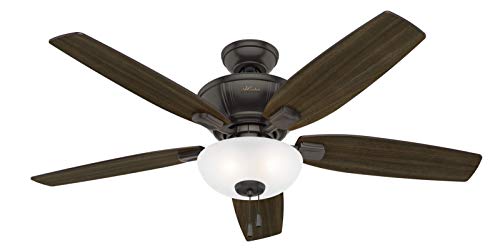
The Kenbridge represents the mainstream large-room fan at its most dependable: a full-size downrod design from one of the category’s founding makers, with traditional styling that disappears into most décors, a reversible motor for winter use, and a light kit in the classic bowl tradition that takes standard bulbs. That last point defines its character — you choose the bulbs, so you choose the brightness and colour, and replacements forever after are a drawer errand rather than a parts order. It suits living rooms and large bedrooms with ceilings that give a downrod room to work, and owners who prefer proven, serviceable designs over sealed modern ones. Best for: large rooms, traditional interiors, buyers who want bulb choice. Not suited for: low ceilings, or anyone wanting the slim profile of an integrated LED. Strengths: broad parts and support ecosystem, reversible operation, flexible lighting. Trade-offs: the classic look will not satisfy a minimalist, and bulb-based light means bulbs to choose well in the first place. Check price on Amazon in the configuration and finish you need.

Harbor Breeze Mazon — Best for Low Ceilings
The Mazon is the compact flush-mount pattern done sensibly: a 44-inch hugger with an integrated LED, a remote in the box, and a low-slung profile that keeps eight-foot ceilings feeling open. It is the fan this guide points to when the room is a modest bedroom, a hallway-adjacent living space, or an older home where headroom is the binding constraint. The integrated light removes bulb decisions entirely and dims through the remote, which suits the rooms this fan serves. Best for: low ceilings, small-to-medium rooms, renters-turned-owners doing a first fan. Not suited for: large or tall rooms, where its span and flush position run out of reach. Strengths: genuinely low profile, simple controls, set-and-forget light. Trade-offs: the sealed LED means a module replacement if the light ever fails, and flush mounting caps its airflow ceiling. Check price on Amazon and confirm the finish against your room’s hardware.
Prominence Home Robyn — Best Value Pattern
The Robyn shows what the entry tier can now do: a full-size fan with a remote, a dimmable integrated LED, and contemporary-casual styling that works across bedrooms and living rooms, positioned at the accessible end of the market. It is the pattern to study if the budget is real but the room is not small — the mistake at this tier is usually shrinking the fan to save money, and the Robyn’s existence proves you do not have to. Best for: full-size rooms on a disciplined budget, first homes, guest rooms that deserve better than a bare bulb. Not suited for: buyers chasing premium finishes or the quietest DC-motor refinement. Strengths: size and features per tier, modern light control, versatile looks. Trade-offs: materials and finish options are a step below the premium branch, and long-term parts depth is thinner than the heritage brands. Check price on Amazon, where this model’s bundles and finishes rotate frequently.
Honeywell Carmel — Best for Bedrooms
The Carmel is a mid-size fan built around a bowl light and a calm demeanour: the sort of fan that disappears into a bedroom ceiling and does its two jobs — gentle air movement and soft, dimmable-feeling light — without announcing itself. Its scale suits the typical bedroom better than a full living-room span, and its traditional-casual styling matches the furniture-first décor of most sleeping spaces. Best for: bedrooms and guest rooms where quiet and soft light lead. Not suited for: big open-plan spaces, or stark modern interiors. Strengths: room-appropriate size, forgiving light quality, unobtrusive design. Trade-offs: it will not move enough air for a great room, and its styling is deliberately conventional. Check price on Amazon and pair it with the remote or wall control arrangement your room’s wiring supports.
Minka-Aire Concept II — Best Premium Design
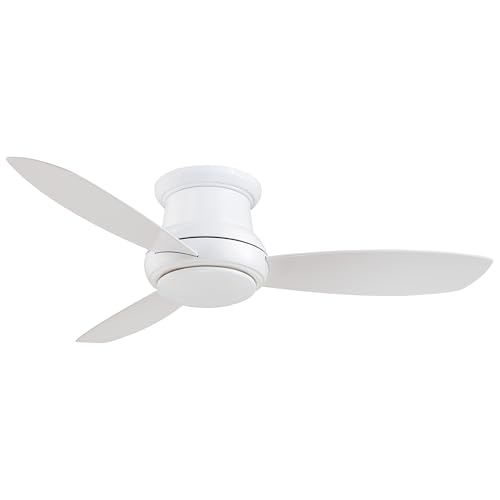
The Concept II is the minimalist’s answer to the ceiling fan: a compact hugger whose blades tuck close to a smooth, sculptural housing, offered in finishes that read as deliberate design rather than appliance. It demonstrates the premium branch’s real product — not more air, but refinement: tighter tolerances, quieter manners, considered controls, and looks that survive scrutiny in a styled room. Best for: design-led interiors, low-to-standard ceilings, buyers who see the fan daily and care how it looks at rest. Not suited for: very large rooms, or budgets where the premium would crowd out correct sizing elsewhere. Strengths: distinctive low-profile design, finish quality, quiet operation. Trade-offs: premium tier positioning, and a compact span that must be matched honestly to room size. Check price on Amazon in your chosen finish, as finishes move this model between tiers.

Hunter Low Profile IV — Best for Small Rooms
The Low Profile IV is the small-room specialist from a heritage maker: a 42-inch flush mount designed for bedrooms, offices and nurseries with standard or low ceilings, with a simple light kit and an uncomplicated control scheme. Its virtue is proportion — enough fan for the room, no more visual or physical bulk than the room wants — backed by the support depth of a major brand. Best for: small bedrooms, nurseries, home offices, hallways with the ceiling height to allow it. Not suited for: family rooms or any space at the top of its size band with a tall ceiling. Strengths: honest sizing, low profile, brand support. Trade-offs: basic feature set, and a light kit that rewards a careful bulb choice. Check price on Amazon, and if your room sits between sizes, revisit the sizing section above before defaulting to this compact pattern.
First Setup and Care Essentials
A ceiling fan rewards a careful first hour. Before installation day, confirm the ceiling electrical box is fan-rated — fans are heavier and vibrate more than light fixtures, and the box must be braced for both — and plan the control arrangement while the wiring is open, not after. After mounting, run the fan through every speed and listen: a gentle hum is normal, clicking or wobble is information, usually about blade balance or a loose housing screw, and the balancing kits included with many fans exist to solve exactly that. Set the light up deliberately too: choose bulb colour temperature before the fan goes up if yours takes bulbs, and programme the remote’s dimming range while you are thinking about it. Ongoing care is light work: dust the blades from above with a pillowcase or extendable duster often enough that dust never becomes a project, wipe the light cover so output does not dull, and check the reversing direction with the seasons — down-and-breeze for summer, slow reverse for winter. The full step-by-step, including the electrical safety sequence, is in how to install ceiling fan with light.
Mistakes to Avoid
The category’s failures are repetitive, which makes them easy to dodge once named. The first is undersizing: choosing by the photograph or the price tier instead of the room’s square footage, then running the fan at full speed forever and calling the category disappointing. The second is ignoring ceiling height until installation day, when the downrod fan meets the eight-foot ceiling — measure first, and let height pick the mount family. The third is treating the light as an afterthought, then living for years under a too-dim dome or a colour temperature that fights the room; the light is half the product. The fourth is mounting to a standard light-fixture box that is not fan-rated, a false economy with a heavy, moving object overhead. The fifth is forgetting controls: a fan over a bed with only a pull chain, or a smart fan bought for a household that will never open the app. Finally, there is the quiet mistake of buying for the room you wish you had — the vaulted showpiece — instead of the room on your tape measure. Every one of these is avoided by the same habit: measure the room, name its job, then shop. Readers who want the argument in decision form can continue to ceiling fan with light reviews for the category assessed as a whole.
Finishes and Style: The Part You Look at Every Day
It is easy to treat finish as the trivial last step, and a mistake to do so, because the fan is the one object in the room that hangs at eye level whenever you look up, sits in the centre of the ceiling’s composition, and stays in place for a decade or more. The reliable method is coordination rather than matching: pick up the metal tone of the room’s existing hardware — door handles, curtain rods, light fixtures — and let the fan’s finish rhyme with it, while the blade finish answers the room’s wood tones or its painted palette. In practice, the market’s main families cover most homes: white and low-contrast finishes that disappear into the ceiling for bedrooms and rentals; dark bronze and black finishes that anchor traditional and industrial rooms; brushed nickel and chrome-leaning finishes for kitchens, bathrooms and contemporary spaces; and wood-tone blades for rooms where warmth is the point. Two cautions complete the picture. First, mixed-finish fans — dark housing, pale blades, or the reverse — are a deliberate design statement; make it deliberately. Second, the light cover is part of the finish: a frosted dome reads soft and traditional, a clear or seeded glass reads decorative, and an integrated flat panel reads modern, and each throws a different quality of light as well as a different look. Choose the whole object, not just the colour swatch.
A Pre-Purchase Measurement and Compatibility Audit for Your Ceiling Fan with Light
Use this audit in the final ten minutes before you order a ceiling fan with light, because that is when most buying-guide advice stops being abstract and starts being a tape measure, a doorway and a return label you would rather not need. Write down three numbers for the ceiling fan with light you are considering: the footprint where it will sit or be stored, the largest dimension it reaches in normal use, and the clearance it needs so doors, drawers, lids, handles or moving parts can work without catching. Shortlist discipline helps here: keep two ceiling fan with light options that pass the audit and let one fail on paper, because comparing a clear pass against a clear fail teaches you more about your real priorities than comparing three near-identical maybes. Plan the storage home for the ceiling fan with light before it arrives, naming the exact cupboard, corner, shelf, hook or stretch of floor, because a product without a home migrates around the house and slowly becomes the clutter it was bought to reduce.
Keep the packaging of a larger ceiling fan with light until those first ordinary tests are done, flattened if space is tight, because re-boxing an awkward shape from scratch is the hidden difficulty inside many otherwise straightforward returns. Read the manual’s warnings page for the ceiling fan with light even if you read nothing else, because that page is a compressed list of every way the product has ever been misused, and it tells you exactly which of your own habits needs adjusting. Check the floor, wall, ground or surface the ceiling fan with light will meet, since level, texture, moisture and finish decide more about everyday performance in home decor & lighting settings than most shoppers expect when they are comparing listings on a screen. Compatibility is the second audit, and for a ceiling fan with light it means checking what it must work alongside: the surfaces, fittings, power or water access, storage and other pieces already in your home decor & lighting setup that the new purchase has to cooperate with every day.
Seasonal thinking helps more than expected: a ceiling fan with light bought in one season will meet different light, humidity, mud, heat, guests and routines in another, so judge its size, storage and upkeep against the hardest season it will face. Think about who else will use the ceiling fan with light and what they will do differently: shorter reach, less patience, stronger habits, no interest in the manual, and a tendency to leave things wherever they were last set down. Keep a short note of what you adjusted on the ceiling fan with light during the first month, even just a line on your phone, since those notes turn vague impressions into a setup you can repeat, share or troubleshoot months later. When something about the ceiling fan with light disappoints, change one variable at a time — position, setting, timing, load, accessory or technique — and give the change a fair trial, because changing three things at once leaves you with a better or worse result and no idea why.
Test the ceiling fan with light in the first week under deliberately ordinary conditions rather than saving it for a special occasion, so that any problem surfaces while returning, exchanging or adjusting your setup is still simple. Use a simple decision checklist at the end: the ceiling fan with light fits the measured space, suits the real frequency of the job, matches the household’s cleaning temperament, has obtainable parts, and has a named storage home — five yeses make a confident order. Then measure the route, not just the destination, since a ceiling fan with light that fits its final spot perfectly can still fail at a narrow hallway, a tight turn, a low doorway or a cupboard mouth that is smaller than the space behind it. Finally, remember that the best ceiling fan with light for your home is the one whose size, habits and upkeep disappear into your routine, leaving only the result behind — a cleaner surface, a better-lit seat, a tidier shelf, an easier job — week after ordinary week.
If a listing for a ceiling fan with light leaves one of those compatibility questions unanswered, treat the gap itself as information and look for the answer in the manual, the dimension diagram or the question section rather than assuming the generous interpretation. If a problem with the ceiling fan with light repeats in the same spot or the same stage of the job, treat the pattern as the clue — patterns point to setup, surface or technique, while random problems point more often to the individual unit. Share the checklist result with anyone who shares the space, since a ceiling fan with light chosen by one person and resented by another rarely survives, however sensible the purchase looked on paper.
Frequently Asked Questions
What size ceiling fan with light do I need for a bedroom?
Most bedrooms fall in the 42- to 52-inch span range. A small bedroom under roughly 144 square feet is well served by a 42-inch fan, while a larger primary bedroom usually wants the full 52 inches. Ceiling height can push you a size up, and a remote control with a dimmable light matters more in a bedroom than squeezing out extra airflow. When in doubt, choose the larger span and run it slower.
Is an integrated LED or a bulb light kit better?
Neither wins outright. Integrated LEDs are slimmer, typically brighter for their size, dim through the fan’s remote, and remove bulb changes for years, but a failed module needs a proprietary part. Bulb kits let you choose brightness and colour temperature freely and replace bulbs in seconds, at the cost of a bulkier fixture. Choose integrated for set-and-forget convenience, and a kit if you are particular about light quality.
Can a ceiling fan with light replace my room’s main light?
Yes, and in most rooms that is exactly what it does, since it occupies the central ceiling position. The condition is choosing the light as carefully as the fan: sufficient brightness for the room’s job, dimmability for evenings, and a colour temperature that suits the space. Kitchens and workspaces may still want supplementary task lighting, but for bedrooms and living rooms a well-chosen fan light comfortably serves as the main source.
Do ceiling fans with lights use a lot of electricity?
They are among the most frugal comfort appliances in the home. A fan motor draws a fraction of what air conditioning draws, and LED lighting is similarly modest, so running a fan to feel cooler — and easing the thermostat accordingly — is one of the cheapest comfort strategies available. DC-motor models sip even less. The meaningful cost is the purchase and installation, not the running, which is why sizing and choosing well matters more than chasing small efficiency differences. The winter direction deserves a mention too: a reversible fan that evens out heated air can make the heating you already pay for feel more effective, which is value no specification sheet captures.
Can I install a ceiling fan with light where a light fixture is now?
Usually yes, provided the existing electrical box is fan-rated or is replaced with one that is, since fans are heavier and move. The wiring is typically already in place. The work is well within a confident home electrician’s scope, but the safety sequence — power off at the breaker and verified with a tester — is non-negotiable, and anything beyond a like-for-like swap, such as new wiring runs, belongs to a licensed electrician.
Should I choose a remote, wall control or smart fan?
Choose by room and habit. Remotes suit bedrooms and tall rooms where switches and chains are awkward. Wall controls suit households that like everything in one predictable place and lose remotes on principle. Smart control earns its complexity if you will genuinely use scheduling, scenes or voice control. The wrong choice is the one that makes adjusting the fan a small chore, because that fan will sit unused.
Related Guides
Continue within this cluster: the balanced ledger in ceiling fan with light pros and cons, the step-by-step selection method in how to choose a ceiling fan with light, and the in-depth assessment in ceiling fan with light review. For model roundups already live on this site, see best ceiling fans with lights, the room-specific shortlist at best ceiling fan with light for bedrooms, and the compact-room options at best ceiling fan with light for small rooms.


