Disclosure: As an Amazon Associate, dailyhomedecorating.com earns from qualifying purchases. Links on this page are affiliate links; they cost you nothing extra. Prices and availability change often, so check the current Amazon listing before you buy.
This ceiling fan with light review takes the category seriously as a piece of household machinery rather than a décor accessory with a motor attached. The approach is simple: take the design that defines the mainstream of the category — the full-size, reversible, bulb-lit downrod fan, represented here by the Hunter Kenbridge — and examine it the way an owner actually experiences it: the installation afternoon, the first summer evening, the winter morning when the reverse switch earns its keep, and the ordinary Tuesdays in between. Rivals enter the discussion where they genuinely differ: the flush-mount pattern, the premium minimalist pattern, the entry-tier pattern. If you read only one section before buying any fan in this class, read Performance in Real Use, because that is where the category’s reputation is either earned or exposed.
The short verdict first. A well-made ceiling fan with a light, correctly sized and properly mounted, is one of the most satisfying appliances in the home: silent infrastructure that makes a room feel right in every season and asks almost nothing in return. It suits owners of daily-use rooms with adequate ceilings who value even temperatures, good central light and low running costs. It does not suit anyone expecting air-conditioning from a fan, anyone whose ceiling cannot give the blades safe clearance, or anyone who will skip the fan-rated box and the balancing routine and then blame the product for the wobble. Everything below exists to test and qualify that verdict. The buying framework around it lives in ceiling fan with light buying guide, and the value argument is made separately in is a ceiling fan with light worth it.
Key Takeaways
- The reference design — full-size span, reversible motor, replaceable-bulb light — remains the benchmark because it balances airflow, light quality and serviceability better than any single rival pattern.
- Performance is a system: correct size, correct mount height and balanced blades matter more than the motor’s headline numbers.
- On low and medium, where life is actually lived, a good fan is calm, even and forgettable — the highest praise available.
- The light half deserves half your attention: it becomes the room’s main light, used every day of the year.
- Rivals win specific rooms — flush mounts win low ceilings, premium huggers win styled interiors, entry models win disciplined budgets — without displacing the benchmark.
- Installation quality is destiny. A fan-rated box, seated hardware and ten minutes of balancing separate the silent fans from the notorious ones.
In this guide
What a Ceiling Fan with Light Is and Where It Fits
Start with what the appliance actually is, because the category is widely misunderstood in one specific way. A ceiling fan does not lower a room’s temperature. It moves air across the people in the room, which makes them feel cooler, and it stirs the room’s layered air — warm at the ceiling, cool at the floor — into something more uniform. Paired with a light in the same housing, it occupies the ceiling’s central position and performs the two jobs that position does best. That is the whole concept, and its honesty is part of its appeal: there is no refrigerant, no filter subscription, no app dependency, just a motor, a set of pitched blades and a light, doing physics in plain sight.
Where it fits is equally clear once stated. The natural homes of this appliance are the rooms a household lives in daily — the living room where evenings gather, the bedroom where sleep quality is a nightly referendum on air movement, the kitchen where cooking heat needs somewhere to go, the home office where an afternoon’s stillness saps concentration. In those rooms the fan-light is not an accessory but infrastructure, as assumed and as used as the lighting itself. Where it fits poorly is just as definite: rooms with ceilings too low for safe blade clearance, rooms used so rarely that the installation never amortises, and formal spaces where the ceiling’s centre belongs to a statement fixture and the climate is handled by other means. The category also has a clear relationship with air conditioning: the two are complements, not rivals. The fan makes cooled air feel cooler and more evenly distributed, which lets the thermostat sit a little higher; the air conditioner does the actual refrigeration the fan cannot. Households that understand that partnership get the best of both, and households that expect the fan to replace the refrigerator of the house will be disappointed by physics, not by any particular model.
Within the category, the reference design examined here — the full-size downrod fan with a reversible motor and a bulb-based light kit — is the pattern against which the variations define themselves. Flush mounts trade a little airflow freedom for headroom. Integrated-LED designs trade bulb freedom for slimness and simplicity. Premium designs trade money for refinement and looks. Entry designs trade refinement for accessibility while keeping the core concept intact. A review that understands the benchmark can place each variation in a sentence; a review that starts from a variation tends to mistake its compromises for the category’s.

Design, Build and Setup: The Hunter Kenbridge as Reference
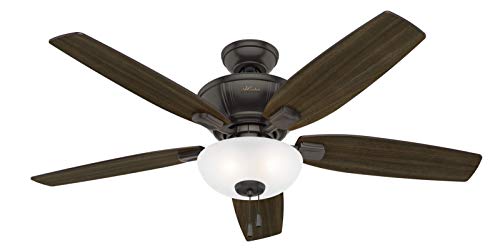
The Kenbridge represents the mainstream of the category from one of its founding makers, and its design makes no attempt to be anything other than what it is: a full-size fan in the traditional idiom, with a reversible motor, a downrod mount for standard-to-tall ceilings, and a classic bowl-style light kit that accepts standard bulbs. Every element of that description is a deliberate trade worth understanding. The traditional styling — the turned details, the furniture-leaning finishes, the glass bowl — is chosen to disappear into the majority of real rooms rather than to star in a showroom. In a living room with wood furniture and warm tones, it reads as part of the room’s furniture; the fan’s visual job is to be unremarkable for a decade, and this design understands the assignment.
The bulb-based light is the design’s most consequential choice, and this review counts it as the reference pattern’s chief virtue. Because the light is whatever bulbs you install, the owner — not the factory — sets the room’s brightness and colour temperature, and can change both in minutes, years later, for the price of bulbs. A failed bulb is a thirty-second errand; there is no module to order, no proprietary part, no electrician. Against that, the bowl adds visual and physical bulk that integrated designs avoid, and the owner inherits the responsibility of choosing bulbs well: mismatched or feeble bulbs will make a good fan look like a bad light, and the fan will be blamed. The mature view is that this design trusts the owner, and rewards the trust.
Build quality in this class is judged by tolerances rather than materials lists. What you are feeling for, in the metal and the assembly, is whether blade brackets align without persuasion, whether the housing closes without gaps, whether the motor turns by hand with smooth, even resistance and no gritty spots. The reference design’s maker has built fans for generations, and the practical consequence is not romance but logistics: documentation that matches the product, hardware that is complete, replacement blades and parts that remain obtainable, and a support channel that has seen your problem before. In a wired-in appliance expected to serve for a decade, that ecosystem is a build-quality feature in its own right.
Setup follows the category’s standard shape, and the reference design neither simplifies nor complicates it. The sequence that matters: power off at the breaker and verified with a tester; a fan-rated, braced box confirmed or installed; the mounting bracket secured; the motor hung and wired; blades attached with every screw fully seated; the light kit fitted; then power restored and the fan run through its speeds while the ladder is still out. The full safety-first walkthrough is in how to install ceiling fan with light, and this review endorses its central rule without qualification: anything beyond a like-for-like replacement — new wiring, a doubtful box, a ceiling you cannot assess — goes to a licensed electrician. The reference design’s contribution to setup is predictability: standard wiring conventions, standard hardware, no proprietary surprises, which is exactly what you want at the top of a ladder.
One design note deserves its own paragraph because owners discover it late: control architecture. The reference pattern traditionally spans pull chains, wall controls and remote options depending on configuration, and the right choice is room-dependent — a remote over a bed, a wall control where remotes go to die, chains where simplicity rules and the fan is within easy reach. Decide before installation, while the wiring is open and the options are cheap. A fan whose controls fight the room’s habits will be left at one setting forever, and a fan at one setting is half an appliance.
Performance in Real Use
Summer Evenings: The Breeze Itself
The fan’s headline job is moving air on warm evenings, and the reference design performs it the way the category’s reputation promises: not as a blast but as a climate. On medium — the setting this reviewer considers the honest test — a correctly sized fan of this pattern makes a living room feel uniformly pleasant rather than windy in one chair and still in another. The air movement reaches the corners because the span is matched to the room and the blades sit at a working height with room to draw from above. On high, the effect is assertive, useful for the half hour after a hot day has soaked the room or after cooking has loaded a kitchen with heat. On low, the movement is a suggestion, enough to keep air from feeling dead without disturbing papers, candles or conversation. The failure mode to watch for is not weakness but mismatch: this same fan, undersized in a great room or strangled against a low ceiling it was not designed for, would feel decorative. Performance in this category is a property of the installation as much as the product, and the reference design rewards correct pairing with genuinely room-changing comfort.
Night: Noise, Low Speed and the Light Turned Low
Bedrooms conduct the category’s strictest examination, because night strips away every distraction that masks a fan’s flaws. The reference pattern’s manners at low speed are the point: a smooth, even air sound with no cyclical tick, no hum that swells and fades, no light-cover rattle. Mechanical honesty matters here — most fan noise in the field traces to installation details, a bracket screw a quarter-turn shy, a blade slightly out of plane, and the reference design’s standard hardware and balancing provision make those corrections straightforward. The light’s night behaviour matters equally. With dimmable bulbs fitted and a control that dims smoothly, the bowl light goes low enough for a bedroom’s last hour without the stepped, flickery dimming that cheap pairings produce; and because the bulbs are the owner’s choice, a household that wants genuinely warm, low light can simply buy it. Sleepers who run the fan all night — a large and loyal constituency — ask for exactly three things: calm air, calm sound, and a light that can be fully dark while the fan turns. A correctly configured example of this pattern delivers all three, which is why the bedroom remains the category’s most persuasive showroom.
Winter: The Reverse Direction, Judged
Winter performance is where casual fans and serious ones separate, and where the reference design’s reversible motor stops being a specification and becomes a routine. In reverse at low speed, the fan draws cool air up and pushes the warm layer pooled at the ceiling down along the walls, evening the room without a perceptible draft on occupants. The effect is most obvious in rooms with tall ceilings and in the shoulder seasons, when the heating runs in the morning and the room’s corners lag. It is subtle — no one has ever gasped at destratified air — but it is the difference between a room that heats evenly and one with a warm ceiling and cold ankles, and it costs almost nothing to run. This reviewer regards reversibility as the category’s most under-bought feature: shoppers compare speeds and spans, install the fan in June, and never learn what the little switch does in January. The reference design includes it as a matter of course; the owner’s part is remembering to use it, ideally as a fixed seasonal habit alongside the thermostat change.
Light Quality Across a Day
Because the fan’s light becomes the room’s main light, this review judges it across a full day rather than at a single switch-on. In the morning it is utility light: bright enough to dress, clean and find things by, and here the bulb-based design’s freedom shows — fit brighter bulbs and the room complies. Through the evening it is the room’s ambience, and dimming range becomes the quality that matters: the reference bowl diffuses light softly, without the glare points of exposed-bulb designs, and with warm bulbs fitted the room’s wood and fabric tones are flattered rather than interrogated. For reading and tasks, an overhead centred light is a good generalist and an honest limitation: it will not replace a reading lamp at a chair or task lighting over a counter, and this review does not pretend otherwise. As the main light of a bedroom or living room, though, the pattern is thoroughly proven — with the standing reminder that its quality is, by design, exactly the quality of the bulbs the owner chose for it.
Strengths and Trade-Offs
- Strength — Airflow with composure: the full-size pattern moves a room’s worth of air at speeds that stay calm and conversational.
- Strength — The light is yours: standard bulbs mean owner-chosen brightness and colour, instant replacement, and no proprietary module in your future.
- Strength — Year-round working life: the reversible motor makes the fan a heating-season appliance as well as a cooling-season one.
- Trade-off — Visual bulk: a bowl light and traditional housing will never read as minimalist; styled modern rooms may prefer the premium hugger pattern.
- Trade-off — Bulb responsibility: the freedom to choose bulbs is also the duty to choose them well; poor bulbs make a good fan look like a poor light.
- Trade-off — Height requirements: the downrod reference design needs a ceiling that can use it; low rooms belong to the flush-mount branch of the family.
How It Compares
The reference design earns its benchmark status by balance, not by winning every column. The rivals below each beat it somewhere specific, and this review says where, because a comparison that the benchmark always wins is advertising rather than reviewing. All are real models, described in prose; check price on Amazon for the configuration you need, and read the collected category verdicts in ceiling fan with light reviews alongside this single-design review.

Harbor Breeze Mazon — Where the Flush Mount Wins
Against the reference, the Mazon’s case is headroom and simplicity. Its compact flush-mount body with an integrated LED serves the low-ceilinged rooms the downrod reference cannot enter, and its sealed light removes bulb decisions entirely. It gives back airflow freedom, span and the owner’s control over light quality. In an eight-foot bedroom it is the better fan; in a tall living room it is not a contender. Best for: low ceilings, smaller rooms. Check price on Amazon.
Prominence Home Robyn — Where the Entry Tier Wins
The Robyn’s argument is that the category’s core experience — full size, remote control, dimmable integrated light — is available at the accessible end of the market. Against the reference it trades finish depth, parts ecosystem and bulb freedom for a lower tier and modern convenience. For a first home or a guest room, that trade is often correct; for a forever living room, the reference’s serviceability argues back. Best for: full-size rooms on a disciplined budget. Check price on Amazon.
Honeywell Carmel — Where the Bedroom Specialist Wins
The Carmel competes by focus: a mid-size bowl-light fan tuned for the bedroom’s priorities of quiet and soft light, at a scale that suits sleeping rooms better than a living-room span. Against the reference it gives up large-room authority and gains room-appropriate proportion. Households buying specifically for a bedroom should weigh it seriously; households buying for a great room should not mistake its focus for a flaw. Best for: bedrooms and guest rooms. Check price on Amazon.
Minka-Aire Concept II — Where the Premium Design Wins
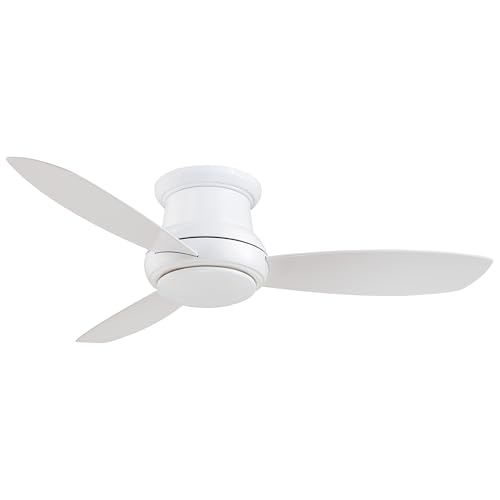
The Concept II wins the column the reference does not contest: design. Its sculptural low-profile form and refined finishes make the fan a deliberate object in a styled room, with quiet manners to match. Against the reference it trades span, bulb freedom and money for looks and refinement. In a design-led interior with a suitable ceiling, that is a rational exchange; in a room that needs maximum air per purchase, it is not. Best for: styled interiors, low-to-standard ceilings. Check price on Amazon.
| Pattern | Wins on | Gives up | Room it owns |
|---|---|---|---|
| Reference downrod (Kenbridge) | Balance, serviceability, light freedom | Minimalist looks, low-ceiling use | Living rooms, large bedrooms |
| Flush mount (Mazon) | Headroom, simplicity | Span, airflow freedom | Low-ceiling bedrooms |
| Entry full-size (Robyn) | Features per tier | Finish and parts depth | First homes, guest rooms |
| Bedroom bowl (Carmel) | Quiet, proportion | Large-room authority | Bedrooms |
| Premium hugger (Concept II) | Design, refinement | Span, bulb freedom | Styled interiors |
Who Should Buy It — and Who Should Skip It
Buy the reference pattern — the full-size, reversible, bulb-lit fan — if your room is a living room or large bedroom with a ceiling that suits a downrod, if you expect to keep the fan for many years and value being able to maintain its light with bulbs from a drawer, and if your décor is traditional, transitional or simply unbothered by a classic ceiling presence. Buy it, specifically, if winter evenness matters to you: the reversible motor is this pattern’s quiet superpower, and households in heated homes feel it for half the year. The pre-purchase checklist is short: measure the room and confirm the span band; measure the ceiling and confirm the mount; confirm a fan-rated box or book the electrician; choose the control architecture for the room’s habits; and choose the bulbs with the same care as the fan, because they are half the product you are buying.
Skip it — in favour of a sibling pattern, not the category — if your ceiling is low, where the flush-mount branch serves you better; if your room is small, where a compact fan is the honest size; if your interior is a deliberate design statement, where the premium huggers earn their tier; or if you know you will never choose or change a bulb thoughtfully, in which case an integrated LED removes a responsibility you do not want. Skip the category entirely if the room is rarely used, if you rent without permission to alter the fixture, or if what you actually need is refrigeration — in which case the honest purchase is cooling, with a fan as its later complement. The balanced ledger behind these judgements is laid out in ceiling fan with light pros and cons.
Setup, Care and Maintenance Essentials
The review’s findings condense into a short ownership discipline. At setup, the non-negotiables are the fan-rated box, fully seated hardware, and a test run at every speed before the ladder goes away, with balancing addressed on day one if the fan sways. Choose and fit the bulbs before the fan goes up, while the choice is a bench decision rather than a ladder decision, and set the control scheme — remote paired, dimming range checked — while the manual is still open. In ongoing care, dust is the main enemy and rhythm the main weapon: a pillowcase drawn along each blade traps the dust that would otherwise be redistributed, a wiped light bowl keeps output honest, and a seasonal direction check keeps the winter benefit real rather than theoretical. Listen to the fan occasionally with intent; new sounds are information, usually about a screw that wants a quarter-turn, and early attention is the difference between maintenance and complaint. Treated this way, the reference design’s service life is measured in many years, and its maintenance in minutes per season — the ownership profile that built the category’s reputation.
A Season With the Reference Design
Abstract criteria land differently when followed through a calendar, so consider the reference fan’s year in an ordinary living room. In spring, it is mostly a light: the heating is off, the windows open when they can, and the fan turns on mild evenings when the house holds the day’s warmth a little too long. This is the season owners rediscover the remote, replace a bulb that failed unnoticed in February, and — if they are wise — dust the blades before the heavy season, while the dust is still a light film rather than a fleece. In summer the fan becomes the room’s main climate instrument. It runs daily, mostly on medium, and its work is best measured negatively: the arguments about the thermostat stop, the far sofa becomes usable again, the air conditioner cycles less desperately in the late afternoon. Guests notice the room is comfortable without identifying why, which is the precise definition of infrastructure working. In autumn the fan’s shifts shorten; the light’s share of the appliance’s value rises as evenings lengthen, and the dimming range earns its keep across dinners and films. Someone, in a well-run household, flips the direction switch as the heating comes on. In winter the fan works its quietest job: slow reverse on heating mornings, evening light, long still stretches in between. The year’s total demand on the owner has been perhaps twenty minutes of dusting, one bulb, and two flips of a switch. Set against a year of rooms that felt right, that is the exchange the category offers, and the reference design — unglamorous, serviceable, correctly sized — delivers it without drama. Reviews that test a fan for a weekend can miss this entirely, because the product’s virtue is not intensity but accumulation.
The same calendar, run in a bedroom, sharpens every point. The fan that was calm in the living room must now be silent at arm’s length from a pillow; the light that was pleasant at dinner must now go genuinely low at midnight and stay dark while the fan turns through the night. This is why this review insists the bedroom is the category’s strictest examination, and why households so often buy their second fan — for the bedroom — with more care than their first. The reference pattern passes the bedroom examination when it is configured for it: quiet speeds used honestly, bulbs chosen for warmth and dimming, a remote within reach. It fails, as any pattern fails, when it is bought as a living-room fan and merely hung in a bedroom. The appliance does not know what room it is in; the buyer’s configuration tells it.
How These Judgements Were Reached
A review of a product class owes its readers a method, so here is this one’s. The judgements above rest on the category’s accumulated ownership record — the patterns that recur across years of owner reports, installer experience and maker documentation — organised around the situations that actually decide satisfaction. Four tests structured the assessment. The evening test asks what the fan does to a lived-in room at the hour it is used most: does the air feel even at the seats people choose, and does the light flatter the room or interrogate it? The night test moves the same questions into a bedroom at low speed, where noise and light control stop being specifications and become sleep. The season test checks the appliance across the calendar rather than across a weekend: summer breeze, winter reverse, the shoulder-season mornings when heating and stillness collide. And the year test asks what ownership demands and returns over time — dust, bulbs, sounds that develop, parts that might be needed — because a wired-in appliance is a decade-long decision reviewed, too often, on a first impression. Models and patterns in this review are described in prose from their documented designs and market positions; readers should confirm the exact configuration of any specific purchase against its current listing, since finishes, control bundles and included hardware vary. That method explains the review’s recurring theme: in this category, the installation and the pairing of fan to room are part of the product, and a review that ignores them is reviewing a photograph.
The Details That Separate Good From Great
Beyond the headline criteria, a handful of small details reliably separate the fans owners praise for a decade from the ones they tolerate, and the reference design’s handling of them is instructive. The first is blade balance as delivered: a fan whose blades are matched closely enough to run true without heroics from the balancing kit starts life ahead, because every later sound and sway is measured against that baseline. The second is the quality of the dimming partnership between light and control — smooth, flicker-free travel from bright to low, with no dead zone at the bottom of the range where the light simply gives up. The third is memory: a fan that returns to its last setting when the wall switch is flipped respects the household’s habits, while one that resets to full brightness and high speed at every switch-on teaches the household to dread the switch. The fourth is the canopy and hardware finish — the small metalwork at the ceiling that the eye actually reaches — which on well-made fans matches the housing honestly instead of approximating it in a cheaper tone. The fifth is documentation written by someone who has performed the installation: steps in the order hands need them, wiring described for the configurations real houses have, and a troubleshooting table that names sounds and their causes. None of these details appears in a headline specification, and together they are most of what people mean, years later, when they say a fan is a good one. When you compare listings, you are partly comparing the likelihood of these details being right — and that likelihood is what an established maker’s reputation actually consists of.
One more detail deserves naming because it decides more bedroom purchases than any other: the lowest light level. A fan light that dims to a genuinely low glow serves the last hour of the evening and the first minutes of the morning with grace; one whose dimming stops at a still-bright floor forces the household to choose between darkness and glare, and they will choose darkness — leaving the fan’s light unused for exactly the hours it was bought for. With bulb-based designs the owner holds some of this power, since bulb choice shapes the dimming range; with integrated designs it is fixed at the factory and worth investigating before purchase with the same seriousness as the fan’s size. It is a small specification with an outsized effect on whether the appliance is loved.
What This Review Did Not Love
A benchmark review that finds nothing to criticise has stopped reviewing, so here is the reference design’s honest charge sheet. The styling, first: traditional is a polite word for a design language that has not moved in a generation, and in a contemporary interior the bowl light and turned details can look like they wandered in from a different house. The category’s premium branch exists because this criticism is fair. Second, the light’s quality is a lottery the owner must rig personally: the fan ships as a promise, and households that fit whatever bulbs are in the drawer — mismatched, feeble, cold — will live under a poor main light and blame the fixture. A design that depends on the owner this heavily should say so on the box in larger print. Third, the control story in traditional configurations can feel dated beside modern rivals: chains and basic remotes do their job, but scheduling, scenes and the finer speed gradations of DC-motor designs are genuinely pleasant, and the reference pattern’s world is largely innocent of them. Fourth, the downrod form factor, for all its airflow virtue, is simply unavailable to the low-ceilinged rooms that make up a large share of real homes; the benchmark of the category cannot enter the category’s most constrained rooms, which is a strange and true limitation. Fifth, weight and installation: this is a substantial object that demands a braced box and a careful hour at height, and no amount of standardisation makes that trivial for a first-timer.
None of these criticisms overturns the verdict, and it is worth being precise about why. The styling criticism is answered by the maker’s own catalogue and the category’s other branches — the reference is a benchmark, not a monopoly. The bulb lottery is the price of the bulb freedom this review praised, and an informed owner rigs it in their favour once, at installation, for years. The control gap matters to households that will use smart features and is invisible to those that will not. The ceiling limitation is real but categorical — it defines the flush-mount branch rather than shaming this design. And the installation weight is the honest cost of a decade of service from a wired-in appliance. A review’s job is to place criticisms at their true weight: these are the reference design’s genuine costs, known in advance, and for the rooms it suits they remain worth paying. What would change this review’s mind is not any of the above but a failure of the basics — a motor that grew loud, parts that vanished, a light kit that fought standard bulbs — because the benchmark’s entire claim rests on the basics being boringly, permanently right.
Ceiling Fan with Light Review: Final Verdict
Ceiling Fan with Light Review conclusions rarely surprise, and this one is content to be typical in the best way: the reference design — full-size, reversible, honestly built, lit by bulbs the owner chooses — remains the benchmark of its category because it balances the things owners actually live with: air that evens a room, light that serves it daily, noise that stays out of the night, and parts that remain obtainable when years have passed. Its rivals beat it in the rooms they were designed for, and this review has said which those are. For the common case — a lived-in room, a workable ceiling, an owner who wants the problem solved for a decade — it is the pattern to buy, and the rest is sizing, mounting and bulbs. If this review leaves you with a single working rule, let it be this: in a category this mature, greatness is not a feature you buy but a fit you achieve — between fan and room, between light and life, between the appliance’s quiet competence and the household’s daily habits — and the reference design achieves that fit for more rooms, more honestly, than any rival yet reviewed alongside it.
A Note on Value, Since Every Review Owes One
The reference design sits in the market’s mid tier, and this review regards that position as the category’s centre of gravity: enough money for a quiet, reversible motor, honest materials and a support ecosystem, without paying the premium branch’s toll for design refinement. The calculation that matters is not the purchase tier but the cost of the alternatives — a decade of a room that feels slightly wrong, or a cheaper fan replaced in year four, or an electrician recalled to fix a wobble that a better-balanced fan never had. Against those, the mid-tier reference is the economical choice in the only sense that survives contact with time. Buyers whose budgets force the entry tier should protect size and reversibility and surrender finish and features instead; buyers tempted by the premium tier should be honest that they are purchasing design, which is a legitimate thing to purchase with open eyes. What no tier excuses is the wrong size or the wrong mount for the room — the two errors that no amount of money, spent afterwards, fully repairs.
What a Longer, Slower Check Reveals About This Ceiling Fan with Light
A single review session can flatter or condemn a ceiling fan with light unfairly, so this section slows the judgement down and looks at what only repeated, ordinary use tends to reveal. Run the ceiling fan with light through your least favourite version of its job first, not the easiest demonstration: the awkward corner, the rushed weekday timing, the fuller load, the lower light, or whatever condition in your routine makes this category work hardest. When something about the ceiling fan with light disappoints, change one variable at a time — position, setting, timing, load, accessory or technique — and give the change a fair trial, because changing three things at once leaves you with a better or worse result and no idea why. Pay attention to the second and third use rather than the first, because the first use of a ceiling fan with light measures your learning curve while the later uses measure the product itself, and confusing those two is the commonest reviewing mistake.
Read the manual’s warnings page for the ceiling fan with light even if you read nothing else, because that page is a compressed list of every way the product has ever been misused, and it tells you exactly which of your own habits needs adjusting. Watch for edge cases in your own home: the pet that investigates everything, the child who treats every new object as furniture, the guest who uses force where you use familiarity, and the weather, light or season that changes how a ceiling fan with light behaves. Check the floor, wall, ground or surface the ceiling fan with light will meet, since level, texture, moisture and finish decide more about everyday performance in home decor & lighting settings than most shoppers expect when they are comparing listings on a screen. If a problem with the ceiling fan with light repeats in the same spot or the same stage of the job, treat the pattern as the clue — patterns point to setup, surface or technique, while random problems point more often to the individual unit.
Seasonal thinking helps more than expected: a ceiling fan with light bought in one season will meet different light, humidity, mud, heat, guests and routines in another, so judge its size, storage and upkeep against the hardest season it will face. Plan the storage home for the ceiling fan with light before it arrives, naming the exact cupboard, corner, shelf, hook or stretch of floor, because a product without a home migrates around the house and slowly becomes the clutter it was bought to reduce. Finish the longer check by looking at wear points rather than features: the hinge, seam, edge, wheel, latch, surface or joint on a ceiling fan with light that moves, flexes or gets handled most is where its second year is decided, whatever its first week felt like. A well-judged ceiling fan with light explains itself to that second person without a lecture, with controls, grips, openings or adjustments that make sense on contact, and that intuitiveness is worth recording because guests, partners and teenagers will all test it.
Share the checklist result with anyone who shares the space, since a ceiling fan with light chosen by one person and resented by another rarely survives, however sensible the purchase looked on paper. Photograph your setup once the ceiling fan with light is working well — the position, settings, arrangement or layout you settled on — so that after a move, a deep clean or a seasonal break you can recreate the arrangement that worked instead of rediscovering it. Keep a short note of what you adjusted on the ceiling fan with light during the first month, even just a line on your phone, since those notes turn vague impressions into a setup you can repeat, share or troubleshoot months later. Think about who else will use the ceiling fan with light and what they will do differently: shorter reach, less patience, stronger habits, no interest in the manual, and a tendency to leave things wherever they were last set down.
If you want a concrete listing check, take a name already shortlisted in this guide, such as Hunter Kenbridge, Harbor Breeze Mazon and Prominence Home Robyn, and verify that exact ceiling fan with light listing against the measurements and compatibility questions above, field by field, rather than trusting the headline description alone. Consider the cleaning rhythm honestly: a ceiling fan with light that needs attention after every use suits a household that enjoys small rituals, and frustrates a household that wants to finish a job and walk away, so match the upkeep to the temperament, not the intention. Keep the packaging of a larger ceiling fan with light until those first ordinary tests are done, flattened if space is tight, because re-boxing an awkward shape from scratch is the hidden difficulty inside many otherwise straightforward returns. Use a simple decision checklist at the end: the ceiling fan with light fits the measured space, suits the real frequency of the job, matches the household’s cleaning temperament, has obtainable parts, and has a named storage home — five yeses make a confident order.
Finally, remember that the best ceiling fan with light for your home is the one whose size, habits and upkeep disappear into your routine, leaving only the result behind — a cleaner surface, a better-lit seat, a tidier shelf, an easier job — week after ordinary week. Measure before anything else, and measure the ceiling fan with light in its working state rather than its packed or folded state, because handles extend, lids open, cords trail, doors swing and users stand somewhere, and all of that belongs in the measurement.
Frequently Asked Questions
What makes a ceiling fan with light good, in one sentence?
Correct size for the room, mounted at the right height on a fan-rated box, with a reversible motor, calm low-speed manners and a light you would have chosen as a standalone fixture. Every element of that sentence is checkable before purchase, which is why the category rewards homework so reliably and punishes guessing so consistently. It is also why this review could be written at all: a product class whose excellence is this legible — measurable in advance, verifiable in use, and stable across years — is a pleasure to assess and, for the rooms it suits, a safe place to put a household’s money.
Is a bulb light kit better than an integrated LED?
For owners who care about light quality and long-term serviceability, this review says yes: bulbs put brightness and colour in your hands and make every future light repair a thirty-second job. Integrated LEDs win on slimness and set-and-forget simplicity. The honest answer is that the bulb kit is the more owner-friendly design over a decade, and the integrated light is the more convenient one in year one.
How noticeable is fan noise in a bedroom?
A well-installed fan of this class is a soft air sound, most present on high and barely there on low. Noise complaints usually trace to installation — loose hardware, imbalance — rather than the motor itself, which is why the day-one test run matters. Light sleepers should prioritise established makers, balance the blades carefully, and treat any tick or hum as a fixable defect, not a personality trait.
Does the reverse mode actually help in winter?
Yes, measurably in feel if not in drama. Running slowly in reverse draws the warm air pooled at the ceiling down the walls and evens the room’s temperature without a draft, which is most noticeable in tall rooms and on heating-season mornings. It costs very little to run. The feature only fails when owners never switch it — make it a seasonal habit alongside the thermostat change.
How long should a ceiling fan with light last?
Expect many years from the motor and structure of an established maker’s fan; the design has few wear points and a long service tradition. The light determines the maintenance story: bulbs are replaced in seconds indefinitely, while remotes and controls are the parts most likely to need attention first. Buying from a maker with obtainable parts is the single best longevity decision. Treat the fan kindly — dust it, listen to it, correct small sounds early — and there is no reason it should not outlast the décor around it, possibly more than once.
Can one fan serve a large open-plan room?
One fan serves a zone of an open-plan room — the seating area it hangs over — rather than the whole volume. Size for that zone, hang the fan over it, and treat its light as one layer of the space’s lighting. In long spaces, two correctly sized fans outperform one oversized one. The mistake is centring a single fan geometrically in a room whose life happens at one end.
Related Guides
Continue within this cluster: the purchasing framework in ceiling fan with light buying guide, the step-by-step selection method in how to choose a ceiling fan with light, and the collected category verdicts in ceiling fan with light reviews. For live roundups on this site, see best ceiling fans with lights, the bedroom shortlist at best ceiling fan with light for bedrooms, and the small-room options at best ceiling fan with light for small rooms.


