Disclosure: As an Amazon Associate, dailyhomedecorating.com earns from qualifying purchases. Links on this page are affiliate links; they cost you nothing extra. Prices and availability change often, so check the current Amazon listing before you buy.
Plural matters. These ceiling fan with light reviews are not one review repeated — they are the category assessed pattern by pattern, because a ceiling fan is not one product but a family of designs that happen to share a ceiling: the classic downrod fan, the flush-mount hugger, the entry-tier full-size fan, the bedroom bowl-light specialist, the premium minimalist, the compact small-room fan. Each pattern makes a different bargain among airflow, headroom, light quality, looks and money, and each owns a set of rooms the others serve badly. This article reviews all six patterns on the same criteria — air performance, noise, light, controls, build and ownership — then gathers the verdicts into one place, so you can find the pattern your room belongs to and read its review with the rivals’ verdicts in view. The single-design deep dive lives in ceiling fan with light review; the purchasing framework lives in ceiling fan with light buying guide.
The collective verdict, up front: the category is in strong health. Every pattern reviewed here contains real models from established makers that perform their intended job well, and the differences between patterns are larger and more important than the differences between models within a pattern. That single fact should reorganise how you shop: choose the pattern by your room first — its size, its ceiling, its job — and only then compare models inside the pattern, where the stakes are smaller and the mistakes are cheaper. The reviews below follow that order deliberately.
Key Takeaways
- Pattern first, model second: the six designs in this category differ more from each other than the models within any one of them.
- The classic downrod pattern remains the best all-rounder; the flush mount is the best answer the category has to low ceilings.
- The entry tier has matured: full-size fans with remotes and dimmable LED lights now hold the category’s core promise at accessible tiers.
- The premium tier buys design and refinement, not fundamentally more air — a legitimate purchase, made honestly.
- Across all patterns, the same three things decide owner satisfaction: correct size, sound installation, and a light chosen on purpose.
- Noise and wobble complaints cluster around installation and undersizing, not around any pattern’s inherent character.
In this guide
The Category at a Glance: Six Patterns, Six Bargains
Before the individual reviews, the map. The downrod pattern — motor hung below the ceiling on a rod — is the original form, built for standard and tall ceilings, with the freest airflow and the deepest model choice. The flush-mount pattern bolts the fan to the ceiling to survive low rooms, trading a little airflow freedom for headroom. The entry full-size pattern keeps the downrod or dual-mount form and the modern feature set while engineering the cost down. The bedroom pattern tunes a mid-size fan and a soft bowl light for quiet nights. The premium pattern spends on design, finishes and motor refinement. The compact pattern shrinks the whole concept honestly for small rooms. None of these is the category’s future or its past; they are contemporaries, each answering a different room’s question. The reviews that follow take them in that order, and each ends with the same three lines: who it suits, who should skip it, and the verdict in a sentence.
Review Criteria: How Every Pattern Was Judged
Consistent criteria keep plural reviews honest. Air performance asks whether the pattern, correctly sized, evens a room’s air at the speeds people actually use — low and medium — rather than merely posting a heroic maximum. Noise asks about manners at those same speeds, with bedroom standards applied where the pattern claims bedroom duty. Light asks three things: is it bright enough to be the room’s main light, does it dim with grace, and who controls its colour and its future replacements — the owner, through bulbs, or the factory, through a sealed module? Controls ask whether adjusting the fan is effortless in the room’s real life: from a bed, from a doorway, with hands full, in the dark. Build asks about tolerances, documentation, and the maker’s parts ecosystem, because a fan is a decade-long commitment. Ownership asks what the pattern demands across years — dust, bulbs, balancing, module risk — and what it returns. Every pattern below is strong somewhere and compromised somewhere; the reviews name both, because a roundup in which everything is wonderful is a catalogue, not a review.

Ceiling Fan with Light Reviews: The Classic Downrod Pattern — Hunter Kenbridge
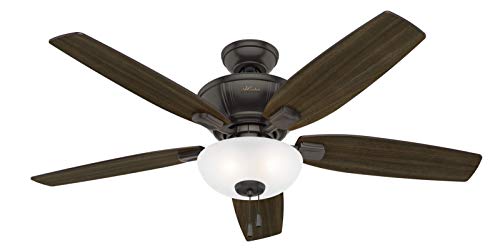
The Kenbridge represents the pattern that built the category, and reviewing it first sets the scale for everything after. Air performance is the pattern’s home ground: hung at working height with room to breathe, a full-size downrod fan moves air with an authority the ceiling-hugging patterns cannot quite match, and it does so at composed, conversational speeds. The reversible motor extends that authority across the calendar, evening heated rooms in winter as convincingly as it cools occupants in summer. The light, in this pattern’s classic bowl-and-bulbs form, is the most owner-friendly in the category: brightness and colour are the owner’s choice at installation and forever after, and every future repair is a bulb. Build and ownership follow the same philosophy — standard hardware, deep parts support, nothing proprietary between the owner and a decade of service. The pattern’s compromises are equally clear. It cannot enter low-ceilinged rooms. Its traditional styling is a guest that some interiors did not invite. And its light quality is a responsibility handed to the owner along with the freedom. Suits: living rooms and large bedrooms with standard-to-tall ceilings, owners who value serviceability. Skip if: your ceiling is low or your interior demands minimalism. Verdict: the benchmark pattern — not the best at everything, but the best balanced across everything a fan is for. Check price on Amazon in your finish.

The Flush-Mount Pattern — Harbor Breeze Mazon
The Mazon represents the hugger pattern, and its review begins with the constraint that creates it: in a room with an eight-foot ceiling, the classic pattern’s virtues are irrelevant because the fan cannot safely hang there. The flush mount answers by pulling the whole appliance tight to the ceiling, and the Mazon’s execution — compact span, integrated LED, remote control — is the pattern in its modern form. Air performance is good within its honest limits: in the small-to-medium rooms it is sized for, it evens the air and delivers a real breeze, though it cannot match a downrod fan’s freedom in a large volume, and buyers should not ask it to. The integrated light is bright, dimmable through the remote, and entirely maintenance-free until the module’s distant end of life — at which point the repair is a part, not a bulb, the pattern’s standing trade. Noise manners are bedroom-appropriate in this size class, and the remote suits the rooms — bedrooms, nurseries, compact living spaces — where this pattern lives. Suits: low ceilings, small-to-medium rooms, first-time fan owners. Skip if: your room is large, your ceiling tall, or you want lifetime control of the light’s character. Verdict: the category’s necessary pattern, executed the way it should be — honestly sized, simply controlled, and content within its limits. Check price on Amazon.
The Entry Full-Size Pattern — Prominence Home Robyn
The Robyn represents the pattern that has changed most in recent years: the full-size fan, with the modern feature set, at the market’s accessible tier. A generation ago this review would have been a warning — small spans, tinny motors, lights like interrogation cells. The current pattern deserves a fairer hearing. The Robyn’s pattern delivers the category’s core promise intact: a full-size span so the room is actually served, a remote so the fan is actually adjusted, a dimmable integrated LED so the light actually works as a main light, and styling that reads as contemporary rather than apologetic. Air performance at this tier is honest mid-pack — sufficient for its size class, less composed at the top speed than the heritage patterns. Build is where the tier shows: finishes are thinner, the documentation and parts ecosystem shallower, and the long decade of ownership is a less certain proposition than with the founding makers. The light’s sealed module carries the same standing trade as every integrated design. None of this disqualifies the pattern; it prices it. Suits: first homes, guest rooms, full-size rooms on disciplined budgets, landlords furnishing properly. Skip if: this is a forever room and the budget can reach the mid tier’s serviceability. Verdict: the value pattern, and a genuinely respectable one — the correct response to a tight budget is this pattern at full size, never a smaller fan. Check price on Amazon, where its configurations rotate often.
The Bedroom Pattern — Honeywell Carmel
The Carmel represents the specialist pattern: a fan designed around a room rather than around a specification sheet. Its mid-size span matches the typical bedroom’s footprint instead of a living room’s; its bowl light throws the soft, diffused illumination a sleeping room wants; and its whole demeanour — quiet, unobtrusive, traditionally styled to blend with bedroom furniture — is aimed at disappearing. Reviewed on living-room criteria it would look unambitious, and that is precisely the point the plural format exists to make: patterns must be judged on their intended ground. On bedroom ground the Carmel pattern scores where it matters. Low-speed manners are the design’s priority rather than its accident. The light is kind at both ends of the evening — bright enough to dress by, soft enough to wind down under, especially with warm bulbs fitted, since this pattern keeps the owner’s bulb freedom. Its compromises are the shadow of its focus: it will not command a great room, its styling will not excite a design-led household, and buyers who need a statement should look to the premium pattern. Suits: bedrooms and guest rooms, light sleepers, traditional interiors. Skip if: the room is large, open-plan or design-led. Verdict: the pattern that understands its room best — proof that in this category, focus is a feature. Check price on Amazon.
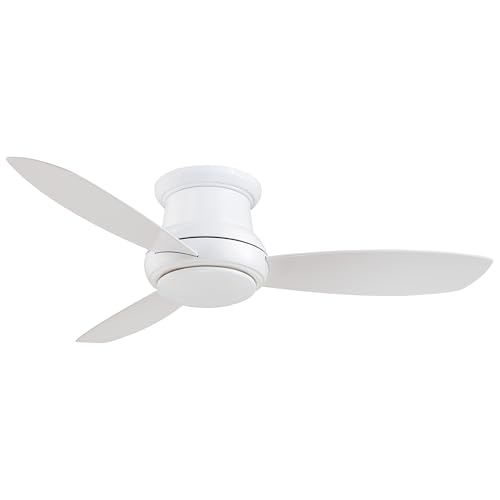
The Premium Pattern — Minka-Aire Concept II
The Concept II represents the design-led pattern, and its review must answer the question the whole tier provokes: what does the premium actually buy? Not fundamentally more air — physics and span govern that, and this compact hugger is honestly sized for modest rooms. What it buys is refinement in every direction the eye and ear can reach: a sculptural, low-profile form that reads as an intentional object; finishes executed to a standard the mid tier approximates; motor manners at the quiet end of the category; and controls that feel considered rather than included. In a styled interior — the room where the ceiling’s centre is part of the composition — those qualities are not decoration on the product; they are the product, because a fan you dislike looking at is a fan you regret daily at eye level. The pattern’s compromises are price, obviously, and scope: the compact span confines it to smaller rooms, and the integrated approach to light fixes decisions the bulb patterns leave open. Buyers should also be clear-eyed that refinement ages differently from function: a beautiful fan in a room being restyled around it is an asset, while the same fan in a purely functional room is money that size or a second fan would have spent better. Suits: design-led interiors, low-to-standard ceilings, smaller rooms owned by people who look up. Skip if: the room is large, or the budget would stretch by compromising size elsewhere. Verdict: the category’s design summit — a rational purchase when looks are a real criterion, an irrational one when they are not. Check price on Amazon in your finish.

The Compact Pattern — Hunter Low Profile IV
The Low Profile IV represents the small-room pattern from a heritage maker, and its review is the shortest because its proposition is the simplest: a 42-inch flush mount, honestly sized for the rooms most fans are actually bought for — the second bedroom, the nursery, the home office, the spare room that became a study. Air performance within those rooms is complete rather than partial: a compact fan in a compact room evens the whole volume, and the pattern’s restraint becomes a virtue, since an oversized fan in a small room adds turbulence and visual weight without adding comfort. The light kit keeps the bulb freedom of the classic pattern in miniature, with the same owner responsibility attached. Build carries the heritage maker’s ecosystem — the pattern’s quiet advantage over no-name compact rivals is that parts, documentation and support exist and persist. The compromises are scope and features: this pattern will not grow with a room, its feature set is deliberately basic, and in a room at the top of its size band with a tall ceiling it will feel like a compromise rather than a fit. Suits: small bedrooms, nurseries, offices, hallways with adequate height. Skip if: the room is medium-large or the ceiling tall. Verdict: proportion as a philosophy — the right fan for the rooms it claims, from a maker who will still answer for it in a decade. Check price on Amazon.
The Patterns Side by Side
| Pattern | Air | Noise manners | Light character | Owns these rooms |
|---|---|---|---|---|
| Classic downrod | Strongest, freest | Calm when balanced | Owner-chosen bulbs | Living rooms, large bedrooms |
| Flush mount | Good within size | Bedroom-appropriate | Integrated, dimmable | Low-ceiling rooms |
| Entry full-size | Honest mid-pack | Adequate, improves yearly | Integrated, dimmable | First homes, guest rooms |
| Bedroom bowl | Room-matched | Quiet by design | Soft, bulb-based | Bedrooms |
| Premium hugger | Refined, compact | Quietest class | Integrated, considered | Styled interiors |
| Compact | Complete in small rooms | Calm | Bulb-based kit | Small rooms, nurseries |
Read across the row of your room, not down the column of your favourite specification. The table’s real message is how little any pattern dominates: each owns its rooms outright and yields the others without shame. That is the sign of a mature category, and it is why the shopping method in how to choose a ceiling fan with light begins with the room and only later arrives at products.
Installation, Reviewed Across the Patterns
Every pattern in this roundup shares the same installation fundamentals, and the reviews would be negligent not to grade the experience honestly. The work divides into three acts. The first is electrical and structural: power off at the breaker, verified dead with a tester, and a ceiling box confirmed as fan-rated and braced — the step that separates this appliance from every plug-in purchase and the step where the category’s few serious accidents have their roots. The second act is mechanical: bracket, mount, motor, blades, light, each pattern differing slightly in sequence and hardware but none departing from the standard choreography that any experienced installer knows by heart. The third act is commissioning, the one owners skip and reviewers insist on: run every speed, listen, balance if needed, set the light and the controls, and only then put the ladder away. Pattern by pattern, the flush mounts are the most forgiving installations — compact, light, close to the ceiling — while the full-size downrod fans are the most demanding simply by weight and reach, and the premium patterns the most exacting in their finish tolerances. None requires more than the standard safety discipline; all punish its absence. The step-by-step, including the full electrical safety sequence, is in how to install ceiling fan with light, and this roundup’s collective advice is blunt: if any part of the first act is beyond you, the electrician’s visit is not an optional extra but part of the product’s price, and a fair one for a decade of service.
Finishes and Style, Reviewed Across the Patterns
A fan hangs at the centre of the ceiling for a decade, in the sightline of every person who looks up, and the patterns divide interestingly on how they handle that responsibility. The classic pattern treats style as camouflage: traditional forms and furniture finishes designed to be unremarkable in the majority of rooms, succeeding precisely when nobody comments on the fan at all. The bedroom and compact patterns share that philosophy at smaller scales. The flush-mount and entry patterns treat style as neutrality — smooth, contemporary-casual forms in the market’s safest finishes, designed to offend no décor and anchor none. The premium pattern alone treats style as the point, and earns its tier when the room is composed enough for the fan to be one of its deliberate objects. Reviewed as a class, the finishes themselves have converged on competence: the market’s main families — ceiling-disappearing whites, dark bronzes and blacks, brushed metallics, warm wood tones — are available across most patterns, and durability at the mid tier and above is generally honest. The style failures in owner feedback are rarely about quality; they are about commitment — a fashionable finish chosen for a decade-long fixture, a statement fan hung in a room that wanted camouflage, a camouflage fan hung in a room that wanted a statement. The patterns cannot make that decision for you, but this roundup can name the rule: choose the fan’s visual ambition to match the room’s, and its finish to rhyme with the hardware and woods already there.
The Light, Reviewed Separately
Because the light is half the appliance and most of its daily use, it earns its own review across the patterns. The bulb-based patterns — classic, bedroom, compact — hand the owner the three decisions that define a main light: how bright, what colour, and how the dimming behaves with the chosen bulbs and control. Done well, this produces the best main-room lighting in the category, tailored to the room by the person who lives under it, and maintainable forever with pocket change and thirty seconds. Done carelessly — the drawer bulbs, mismatched and feeble — it produces the category’s worst lighting and its most unfair reviews. The integrated patterns — flush mount, entry, premium — remove the lottery by fixing the light at the factory: consistently competent brightness, dimming engineered to match the module, and a slimness the bulb patterns cannot reach. Their weakness is the mirror of their strength: the light you get is the light you keep, its colour chosen by a product manager, its eventual failure a parts conversation rather than a bulb. Across a decade, this roundup’s position is that main rooms reward the owner’s hand and secondary rooms reward the factory’s convenience — but it records, fairly, that plenty of owners reverse that judgement and are right for their own houses. What no pattern excuses is a light that cannot dim properly in a room used at night; check that behaviour, in whichever pattern you choose, with the seriousness you would give the fan’s size.
Controls, Reviewed Separately
Controls are the category’s quiet differentiator, because they decide whether the fan’s capabilities are used or merely owned. The pull chain, oldest of the schemes, is honest and fail-safe and increasingly hard to defend over a bed or under a tall ceiling. Wall controls concentrate everything at the doorway — predictable, losable-proof, and the choice of households that think in switches. Remotes, now standard across most patterns, free the fan from the wall entirely and suit bedrooms and living rooms best, at the cost of being small, losable objects that run on batteries. Smart controls, concentrated in the newer patterns, add scheduling, scenes and voice operation; households that build routines around them use their fans more and better, while households that do not have bought complexity that will spend a decade being ignored. Reviewed as a class, the control schemes rank by room rather than by sophistication: the best control is the one the room’s occupants will operate without thinking, at the moment they want the air or the light changed. Every pattern in this roundup offers at least one defensible scheme; the buyer’s job is matching it to the room before installation, when the choice is still cheap. A fan stranded at one setting by an awkward control is the category’s most preventable disappointment, and it appears in owner feedback with a regularity that no motor improvement will ever fix.
Ownership Over Years: What Time Does to Each Pattern
Reviews are snapshots; ownership is a film. Across the patterns, time treats the shared elements alike — motors endure, blades gather dust, screws occasionally want attention — and treats the differing elements differently, in ways a buyer should weigh now. The bulb patterns age most gracefully in their light: a bulb is always available, always cheap, and each replacement is a chance to improve the light as bulb technology improves. The integrated patterns age most gracefully in their appearance: nothing to unscrew, nothing to mismatch, a sealed calm — until the module’s eventual failure converts a light problem into a parts problem, at an age when the maker’s support depth decides whether that is an errand or an obituary. The heritage patterns — classic and compact — hold the strongest long-term position overall, because their makers’ parts ecosystems are measured in decades. The entry pattern’s ownership is the honest gamble of its tier: most examples will serve long and well, but the support behind the exceptions is thinner. The premium pattern’s ownership is protected by its makers’ positioning — refinement brands defend their reputations — and by finishes that age slowly when they are chosen in timeless rather than fashionable tones. None of this argues for anxiety; it argues for the standing advice of this whole cluster: buy the pattern for the room, the maker for the decade, and the light for your evenings.
Seasonal Performance Across the Patterns
A fan is bought in one season and judged in four, and the patterns’ reviews shift interestingly across the calendar. In summer, the ranking follows airflow freedom: the classic downrod pattern leads, the entry full-size follows respectably, and the flush, compact and premium patterns serve their smaller rooms completely without pretending to more. The bedroom pattern’s summer is a night story — its value is measured at 2 a.m., in calm air over a bed, rather than at noon. In winter, the differentiator is reversibility and the discipline to use it: patterns with accessible reverse controls — a button on the remote rather than a switch on the housing that requires a ladder and a stretch — deliver their winter benefit to real households, while patterns that hide the switch deliver it mainly to conscientious ones. This is a small design detail with an outsized seasonal consequence, and buyers in heated homes should ask the ladder question before purchase: how, exactly, will I reverse this fan in November? In the shoulder seasons, the light takes over as the appliance’s main contribution, and the patterns divide by their light philosophies as reviewed above. Across the whole year, the patterns’ total value converges more than their summer reputations suggest — which is why this roundup resists crowning a single winner and insists, one final time, on the room as the unit of judgement.
Second Fans: What Owners Buy Next, and Why It Matters
The most revealing reviews in any category are the second purchases, and this category’s are instructive. Owners who buy a second fan overwhelmingly buy the same pattern again when the room matches, and switch patterns — not makers — when it does not: the classic in the living room begets a flush mount in the low bedroom, a compact in the nursery, a bedroom pattern where sleep proved the point. Dissatisfied second purchases, by contrast, usually repeat a first mistake rather than correct it: another undersized fan, another light chosen by photograph. Two lessons follow for first-time buyers. The category inspires pattern loyalty rather than brand obsession, which confirms that fit, not badge, is what owners experience. And the commonest upgrade path is not to a more expensive fan but to a more correctly chosen one — a fact worth remembering when a salesperson, or a review, tries to move you up a tier instead of into your pattern. Buy the pattern your room belongs to, from a maker who will support it, and your second purchase — if the house grows — will be a pleasure rather than a correction.
What the Reviews Agree On
Six patterns, reviewed separately, converge on a handful of findings that deserve to be stated as the category’s collective wisdom. First: size is destiny. Every pattern performs well at its correct size and disappoints outside it, and no feature — not the premium motor, not the smartest control — compensates for a fan mismatched to its room. Second: installation is part of the product. The same model is a silent servant on a braced, fan-rated box with seated hardware and balanced blades, and a rattling grievance on a loose fixture box; the reviews cannot separate the appliance from its mounting because owners never experience them separately. Third: the light is half the purchase and most of the daily experience, used in every season at every hour the room is occupied, and the patterns divide honestly on how they handle it — owner-controlled bulbs versus sealed convenience — with neither side entitled to claim the argument is settled. Fourth: reversibility is the most under-valued feature across all patterns, the one owners most often discover a winter late. Fifth: controls shape use more than specifications shape satisfaction; the fan that is effortless to adjust is the fan that gets adjusted, and a fan at one setting is half an appliance regardless of pattern. A buyer who internalises those five findings can shop any pattern in this category with confidence, which is a more useful outcome than any ranking this article could impose.
Who Each Pattern Suits — the Short Version
For the reader who has scrolled to the end for the answer: match the room, then read that pattern’s full review above. Standard or tall ceiling over a living room or large bedroom — the classic downrod pattern, and the argument is not close. Low ceiling anywhere — the flush-mount pattern, sized honestly for the room. A real budget and a full-size room — the entry pattern, at full size, without apology. A bedroom where sleep is the point — the bedroom pattern, or the classic configured quietly. A room whose design you care about daily — the premium pattern, if the span fits. A genuinely small room — the compact pattern, and resist the urge to oversize. Two situations fall outside the patterns entirely: ceilings too low for any safe mount, where the answer is a light fixture and a different cooling plan; and houses whose problem is heat rather than stillness, where the answer begins with cooling and the fan joins later as its complement. The balanced case for and against the whole category is in ceiling fan with light pros and cons.
One refinement for households buying two fans at once — a common and sensible project when a home is being settled: resist the tidiness of buying two identical fans for two different rooms. The patterns exist because rooms differ, and the household that puts the classic over the living room and the bedroom pattern over the bed will be better served than the one that standardises for the pleasure of matching receipts. Consistency of maker, where support and parts are concerned, is a virtue; consistency of pattern, where rooms differ, is a category error. Buy the pair as a system — same support ecosystem, different patterns, each sized and mounted for its own ceiling — and the two installations, done on the same day with the same safety discipline, will read in a decade’s time as one of the household’s better decisions.
Edge Cases the Patterns Handle Differently
Three recurring edge cases separate the patterns in ways the main reviews only touch, and buyers in these situations should weight them heavily. The first is the sloped ceiling, common in attic bedrooms and vaulted living spaces: downrod patterns handle slopes naturally, hanging vertical by gravity, subject to an adapter for steeper angles and blade clearance on the uphill side; flush patterns cannot follow a slope at all and are simply disqualified, however perfect their other virtues. The second is the damp location — the covered porch, the bathroom — where the governing fact is the listing’s location rating rather than the pattern: no indoor pattern, however excellent, should be assumed safe in moisture, and the correct move is to shop within the damp-rated branch of whichever pattern your space resembles. The third is the very tall ceiling, where the classic pattern’s downrod extends gracefully and the compact patterns reach their honest limit; a fan hung too high above its room is a sculpture, not an appliance, and the reviews’ sizing discipline applies to vertical distance as much as to floor area. A fourth, quieter edge case deserves mention: the room with no ceiling electrical position at all, where every pattern equally requires new wiring, and the honest comparison is not among fans but between the electrician’s quote and the alternatives. Edge cases are where pattern choice stops being preference and becomes physics, and the buyers who identify theirs early save themselves the category’s most expensive returns.
Reading Owner Feedback Without Being Misled
Since these reviews will send many readers to owner feedback on listings, a short field guide to reading it is worth the space. Owner comments in this category cluster into stories, and the stories decode reliably. Complaints about wobble and clicking decode, almost always, to installation: read them as evidence about mounting discipline, not about the model’s character — unless the same complaint names a specific part repeatedly, which is a genuine signal. Complaints about weak air decode to sizing: check the room the reviewer describes against the fan’s span before letting the comment move you. Complaints about the light decode in two directions — bulb patterns blamed for their owners’ bulbs, integrated patterns blamed for a colour the listing stated plainly — and both teach the same lesson about choosing the light deliberately. Praise, meanwhile, is most informative when it is specific and seasonal: the reviewer who mentions winter reverse, or the bedroom at low speed, or the third summer without a sound, is reporting the ownership this roundup has tried to describe. Finally, treat the extremes with the scepticism they have earned in every category: the furious one-line verdict and the breathless five-paragraph rave both tell you more about their authors’ afternoons than about the fan. The middle of the distribution — specific, room-described, season-aware — is where the truth of this mature category lives, and it is broadly the truth these reviews have reported: well-chosen, well-mounted fans satisfy their owners for years, in every pattern, at every tier.
Final Verdict on the Category
Reviewed as a whole, the ceiling fan with light category earns its place in the home as thoroughly as any appliance class this site covers. Its patterns are mature, its makers established, its running costs trivial, its working life long, and its failure modes — wrong size, wrong mount, wrong light, wrong box — are known, named and avoidable. The reviews above disagree about rooms, not about worth: there is a pattern here for nearly every ceiling that can safely hold one, and the buyer’s task is the pleasant one of matching rather than the anxious one of gambling. Choose the pattern by the room, the model by the maker’s support, the light by your evenings, and the installation by the safety rules — and the category will do the rest, quietly, for years. If these reviews have a single sentence to leave behind, it is the one the six patterns kept agreeing on from their different corners of the market: a ceiling fan is not bought, it is matched — to a room’s size, a ceiling’s height, a household’s habits and a decade’s worth of evenings — and a matched fan, in any pattern, is one of the surest satisfactions the home offers.
Reading Ceiling Fan with Light Reviews Against Your Own Space and Routine
A single review session can flatter or condemn a ceiling fan with light unfairly, so this section slows the judgement down and looks at what only repeated, ordinary use tends to reveal. Run the ceiling fan with light through your least favourite version of its job first, not the easiest demonstration: the awkward corner, the rushed weekday timing, the fuller load, the lower light, or whatever condition in your routine makes this category work hardest. Consider the cleaning rhythm honestly: a ceiling fan with light that needs attention after every use suits a household that enjoys small rituals, and frustrates a household that wants to finish a job and walk away, so match the upkeep to the temperament, not the intention. Measure before anything else, and measure the ceiling fan with light in its working state rather than its packed or folded state, because handles extend, lids open, cords trail, doors swing and users stand somewhere, and all of that belongs in the measurement.
Plan the storage home for the ceiling fan with light before it arrives, naming the exact cupboard, corner, shelf, hook or stretch of floor, because a product without a home migrates around the house and slowly becomes the clutter it was bought to reduce. Share the checklist result with anyone who shares the space, since a ceiling fan with light chosen by one person and resented by another rarely survives, however sensible the purchase looked on paper. Seasonal thinking helps more than expected: a ceiling fan with light bought in one season will meet different light, humidity, mud, heat, guests and routines in another, so judge its size, storage and upkeep against the hardest season it will face. Watch for edge cases in your own home: the pet that investigates everything, the child who treats every new object as furniture, the guest who uses force where you use familiarity, and the weather, light or season that changes how a ceiling fan with light behaves.
Use a simple decision checklist at the end: the ceiling fan with light fits the measured space, suits the real frequency of the job, matches the household’s cleaning temperament, has obtainable parts, and has a named storage home — five yeses make a confident order. For troubleshooting, start with the boring causes first: power, water, fit, blockage, alignment, a full container, a loose connection or a setting changed by the last person who used the ceiling fan with light, because boring causes account for most apparent failures. Finish the longer check by looking at wear points rather than features: the hinge, seam, edge, wheel, latch, surface or joint on a ceiling fan with light that moves, flexes or gets handled most is where its second year is decided, whatever its first week felt like. Decide in advance what good enough looks like for the job the ceiling fan with light does in your home, because chasing a flawless result usually costs more time than the flaw itself, and most households are happier with a reliable ninety percent they actually repeat.
Think about who else will use the ceiling fan with light and what they will do differently: shorter reach, less patience, stronger habits, no interest in the manual, and a tendency to leave things wherever they were last set down. Look at replacement parts and consumables for the ceiling fan with light while you are still comparing, confirming that the pieces most likely to wear, clog, tear, fade or get lost can actually be obtained without replacing the whole product. Test the ceiling fan with light in the first week under deliberately ordinary conditions rather than saving it for a special occasion, so that any problem surfaces while returning, exchanging or adjusting your setup is still simple. Read the manual’s warnings page for the ceiling fan with light even if you read nothing else, because that page is a compressed list of every way the product has ever been misused, and it tells you exactly which of your own habits needs adjusting.
Finally, remember that the best ceiling fan with light for your home is the one whose size, habits and upkeep disappear into your routine, leaving only the result behind — a cleaner surface, a better-lit seat, a tidier shelf, an easier job — week after ordinary week. A well-judged ceiling fan with light explains itself to that second person without a lecture, with controls, grips, openings or adjustments that make sense on contact, and that intuitiveness is worth recording because guests, partners and teenagers will all test it. If you want a concrete listing check, take a name already shortlisted in this guide, such as Hunter Kenbridge, Harbor Breeze Mazon and Prominence Home Robyn, and verify that exact ceiling fan with light listing against the measurements and compatibility questions above, field by field, rather than trusting the headline description alone. Keep the packaging of a larger ceiling fan with light until those first ordinary tests are done, flattened if space is tight, because re-boxing an awkward shape from scratch is the hidden difficulty inside many otherwise straightforward returns.
Pay attention to the second and third use rather than the first, because the first use of a ceiling fan with light measures your learning curve while the later uses measure the product itself, and confusing those two is the commonest reviewing mistake. Check the floor, wall, ground or surface the ceiling fan with light will meet, since level, texture, moisture and finish decide more about everyday performance in home decor & lighting settings than most shoppers expect when they are comparing listings on a screen. If a problem with the ceiling fan with light repeats in the same spot or the same stage of the job, treat the pattern as the clue — patterns point to setup, surface or technique, while random problems point more often to the individual unit.
Frequently Asked Questions
Which ceiling fan with light pattern is best overall?
The classic downrod pattern is the best all-rounder: freest airflow, deepest model choice, the most owner-friendly light, and year-round reversible operation. But overall is a property of rooms, not products — in a low-ceilinged bedroom the flush mount is better, and in a styled small room the premium hugger is better. Choose the pattern by the room first; the best overall fan is the one whose pattern matches your ceiling and your life. Readers who start from the room and work toward the product almost never end up in the disappointed minority these reviews keep describing.
Are budget ceiling fans with lights worth buying now?
Yes, with clear eyes. The entry full-size pattern now delivers the category’s core promise — correct size, remote control, dimmable integrated light — at accessible tiers. What you surrender is refinement and depth: thinner finishes, less composed top speeds, shallower parts support. For guest rooms, first homes and rentals you own, that is often the right trade. For a forever living room, the mid tier’s serviceability usually repays its premium. The budget question, in other words, is not whether the cheap fan works — it does — but whether its particular surrenders are the ones your room will notice, and in a guest room the honest answer is usually that they are not.
Which pattern is quietest for a bedroom?
The bedroom specialist pattern is designed for exactly this, and the premium pattern’s refined motors are the quiet class generally. But installation decides more than pattern: a balanced, correctly mounted fan of any reputable pattern is a soft air sound, while a loose or undersized fan of the finest pattern will tick and hum. Prioritise maker, mount and balance together, and treat any developing noise as a fixable defect.
Integrated LED or bulbs — which do reviewers prefer?
Reviewers split, honestly. Bulb-based lights win on owner control: brightness, colour and every future replacement are yours. Integrated LEDs win on slimness, simplicity and years without a thought. Over a decade, this roundup leans bulb-based for main rooms because light quality is a daily experience and bulbs keep it yours; for secondary rooms, integrated convenience is a perfectly rational choice. The only indefensible position is not choosing at all — accepting whichever light a fan happens to carry into the room where you will live under it every evening.
How do I choose between two patterns that both fit my room?
Use the room’s second job as the tiebreaker. A living room that hosts films wants the light’s dimming floor; a bedroom that hosts reading wants the light’s quality; a room being styled wants the premium pattern’s looks; a room being furnished on a budget wants the entry pattern’s honesty. When the patterns tie on the room’s main job, the secondary job, the control scheme and the maker’s support decide in that order.
Do all these patterns need an electrician to install?
All patterns share the same installation fundamentals: power off at the breaker and verified, a fan-rated braced box, secure mounting and correct wiring. A confident home electrician replacing an existing fan or fixture can usually manage it following the safety sequence; anything involving new wiring, a doubtful box or a ceiling that cannot be assessed belongs to a licensed electrician, whatever the pattern.
Related Guides
Continue within this cluster: the deep single-design review in ceiling fan with light review, the purchasing framework in ceiling fan with light buying guide, and the installation walkthrough in how to install ceiling fan with light. For live model roundups on this site, see best ceiling fans with lights, the apartment shortlist at best ceiling fan with light for apartments, and the modern-home picks at best ceiling fan with light for modern homes.