Disclosure: As an Amazon Associate, dailyhomedecorating.com earns from qualifying purchases. Links on this page are affiliate links; they cost you nothing extra. Prices and availability change often, so check the current Amazon listing before you buy.
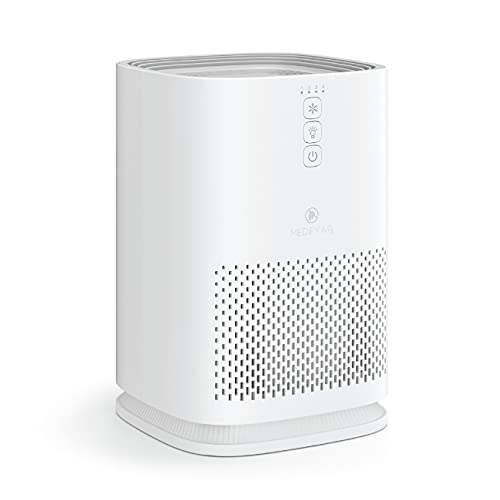
Small rooms deserve a serious machine too, and the medify ma 14 is Medify’s smallest argument that filtration standards should not shrink with square footage. Its listing claims 470 square feet of coverage per hour — a modest figure beside its flagship siblings, and exactly the point: this is a purifier for the desk corner, the dorm room, the nursery shelf’s neighbourhood, and the studio flat’s sleeping end, built by a brand whose reputation was made at the opposite end of the size chart. This page examines what the little Medify does well, where its ceiling honestly sits, and how it compares with the MA-22 beside it and Levoit’s Core Mini across the aisle.
The temptation with small purifiers is to treat them as toys — scented fans with a filter’s costume. The MA-14 resists that reading because its maker does not know how to build down to it: the listing promises the family standard of removal to 0.3 microns through a HEPA filter, aimed at smoke, odours, pollen, and pets. Whether a desktop-class machine can honour a flagship’s promise at a desktop’s scale is the real question of this review, and the answer turns out to be a careful yes, inside a carefully drawn boundary.
In this guide
Quick picks for small spaces
| Model | Coverage claimed on listing | Best small-space job | Link |
|---|---|---|---|
| Medify MA-14 | 470 sq. ft. per hour | Desk, dorm, nursery corner | Check price on Amazon |
| Medify MA-22 | 330 sq. ft. | Single-person bedroom or office nook | Check price on Amazon |
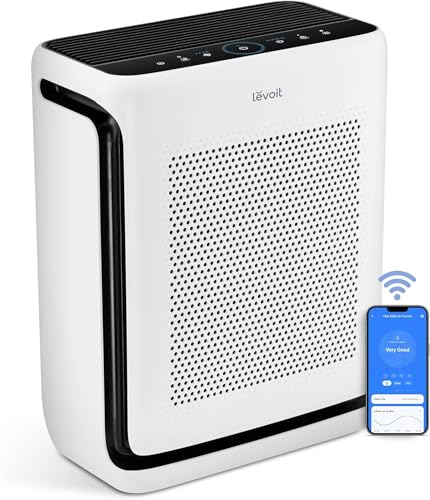
| Levoit Core Mini-P | Small-room positioning | Bedside table and desktop with fragrance option | Check price on Amazon |
Read those hourly figures the way this cluster has taught: a rating of 470 square feet per hour in a real dorm room of perhaps 120 square feet means the little machine cycles that room’s air several times an hour, which is a genuinely useful regime. Small purifiers fail when their claims are read as room sizes rather than rates. Read as rates, the MA-14’s number is respectable, and its honest ceiling — a single modest room, door mostly closed — becomes a feature of the arithmetic rather than a disappointment discovered later.
How these three were chosen
Each model was verified through this site’s Creators API records before drafting, exact title and official image included. The two Medify units show the brand’s small end at two sizes, which is the comparison most MA-14 shoppers are actually making in a shop’s aisle or a search tab. The Levoit Core Mini represents the design-led alternative the Medify pair will be cross-shopped against: similar territory, different temperament, with a fragrance sponge feature the Medify philosophy pointedly omits. Judgement criteria were scaled to the territory — filtration standard, hourly rate against realistic room sizes, sound at pillow and desk distance, filter cost relative to the machine’s station in life, and the discipline of not asking a desktop unit to be a living-room one.
Detailed reviews

Medify MA-14 — the flagship’s little sibling
Badge: Best small Medify for a desk or dorm
- Coverage stated: 470 square feet per hour
- HEPA filtration, removal to 0.3 microns per listing
- Named for smoke, odours, pollen, pets
- White, single-pack compact cabinet
The MA-14’s charm is seriousness at small scale. Put it on a student’s desk in a hall of residence and it addresses the actual pollutants of that life — the corridor’s cooking drift, the laundry’s lint, pollen through a window that opens onto a quad of plane trees — with a filter standard its novelty rivals rarely match. Its hourly rate, applied to a small closed room, produces the multiple air changes that separate purification from decoration.
Its limits are geometric, not moral. The filter is small, so it loads faster than its siblings’ estates; a dusty room or a shedding pet will shorten its comfortable intervals, and owners should expect to inspect it more often than a flagship’s calendar suggests. The fan, moving its rated air through a compact cabinet, will be audible at full effort in a silent room — the universal small-machine bargain, mitigated by running it harder while the room is empty and gentler while it is occupied.
As a nursery neighbour it deserves a specific word: placed out of reach, on a stable surface, with its cord managed, it handles the nursery’s dust and the household’s pollen without the fragrance features some parents prefer to avoid near infants. The Medify plainness that looks clinical in a living room reads as reassurance in a room whose occupant cannot yet report a headache.
Strengths
- Flagship filtration standard at desktop scale
- Hourly rate suits real small rooms thoroughly
- No fragrance gimmicks; a serious appliance’s plainness
Trade-offs
- Small filter loads quickly in dusty or pet-heavy rooms
- Full speed is audible in a quiet space
- Strictly one modest room per machine
Best for: dorms, desks, nurseries, and studio sleeping corners. / Not suited for: living rooms, open plans, or multi-room hopes.

Medify MA-22 — the other small Medify
Badge: Best for a single small bedroom on the brand’s ladder
- Coverage stated: 330 square feet
- HEPA filtration, removal to 0.3 microns per listing
- Named for allergens, wildfire smoke, dust, odours, pollen, pet dander
- White, single-pack cabinet
The MA-22 invites the obvious question — why does the brand sell two small machines, and which desk deserves which? Its stated coverage sits below the 14’s hourly figure, and its positioning leans toward the small bedroom rather than the work surface. In practice the pair divide by placement and by the listings’ current availability and filter pricing at the moment of purchase, those unglamorous variables that decide real-world twins. A shopper choosing between them should compare the exact current listings, confirm which filter each machine eats, and let the room’s dimensions arbitrate: the 14’s rate flatters the smallest closed rooms run at multiple changes per hour, while the 22 suits a compact bedroom treated as its whole world.
Owners of either machine gain the brand’s ecosystem advantage in miniature — documentation, filter supply, and a support culture built around filtration rather than features. For a household already running a larger Medify, adding the small sibling in its own image is the low-friction path to a second zone.
Strengths
- Same filtration promise in a bedroom-leaning size
- Brand consistency for existing Medify households
- Named wildfire smoke duty for small rooms
Trade-offs
- Lower stated coverage than the MA-14
- Overlaps its sibling enough to require care
- Small-filter economics apply in full
Best for: a compact single bedroom within a Medify home. / Not suited for: anyone expecting living-room reach.

Levoit Core Mini-P — the design-led alternative
Badge: Best for bedside tables and desktop gifting
- Positioned for bedrooms, dorms, offices, desktops
- Filter cleaner with fragrance sponge feature
- Named for smoke, allergens, pet dander, odour, dust
- Core Mini-P in white
Levoit’s Mini takes the opposite road to the same small room: where Medify miniaturises a philosophy, Levoit designs a companion. It is the machine most likely to be given as a present, to sit visibly on a desk without apology, and to introduce a sceptical household to purification through sheer unobtrusiveness. The fragrance sponge is its signature divergence — a feature some owners adore and purists, including most of the Medify audience, regard as scenting air they paid to clean. Both reactions are coherent; the household’s own nose should arbitrate.
As a gateway purifier it has genuine merit. A student or a first-flat renter who will actually run a Mini daily gains more than a theoretical owner of a serious machine that never leaves its box. But its territory is the personal zone — the air around a desk, a pillow, a reading chair — and households should not promote it, in their expectations, to whole-room duty in anything larger than a small bedroom.
Strengths
- Compact, giftable, and easy to place anywhere
- Gentle introduction to purification for sceptics
- Fragrance option for households that want it
Trade-offs
- Personal-zone scale, not whole-room ambition
- Fragrance feature divides purist opinion
- Small filter, with the usual loading caveat
Best for: bedside tables, desks, and first-time owners. / Not suited for: nurseries wanting no fragrance near the cot, or dusty workshops.
Buying guide: small purifiers without the toy-store mistakes
Begin by refusing the category’s favourite lie, which is that a small machine in a big room is better than nothing in a way that matters. Below a certain rate of air changes, a purifier becomes a talisman: it reassures while the room’s dust follows its own schedule. The honest small-room purchase starts with the room’s actual dimensions and the machine’s hourly rate, and insists on several changes per hour at a speed the occupant can live beside. The MA-14 in a dorm passes that test with room to spare; the same machine in a family living room fails it regardless of brand loyalty.
Next, price the filter before the machine, because at this scale the cartridge can rival the cabinet’s cost within a couple of changes. A small purifier is a lease disguised as a purchase, and the households that stay happy are the ones that read the lease. Check the exact filter the model consumes, its current availability, and whether the maker’s own supply looks steadier than a third party’s promise.
Sound deserves a pillow test in the imagination. Desktop machines sit close to ears — a metre from a student’s head, less from a sleeper’s — so their working voice matters more than a living-room unit’s. Plan the pattern that every small-machine veteran learns: higher speeds while the room is empty or the occupant is awake and active, the gentle setting for sleep and study. A machine whose gentle setting still cleans at a meaningful rate, as the hourly figures here allow in small rooms, is worth more than a louder bargain.
Finally, place honestly. Small purifiers belong where the person is — the desk, the bedside, the nursery’s breathing zone — not centred in a room out of symmetry. Their gift is proximity: cleaned air delivered to the few cubic feet a human actually occupies for hours. Buy them as personal infrastructure and they delight; buy them as miniature flagships and they disappoint. Further reading for the small end of the category sits at desktop purifiers compared and portable purifiers for personal zones.
Running a small Medify well
Step 1: Give it the person’s corner, with clearance
Set the MA-14 where its owner breathes longest — beside the desk chair, near the head of the bed without blowing directly at the sleeper, on a stable nursery surface out of reach. Keep the intakes the clearance the manual asks, because small cabinets forgive obstruction least of all.
Step 2: Run the room’s rhythm, not the machine’s maximum
Blast the empty room before occupancy, settle to the gentle speed for the occupied hours, and let consistency do what intensity cannot. A small room’s air, once cleaned, is maintained cheaply; the expensive mistake is letting it reload all day and demanding a rescue at bedtime.
Step 3: Inspect the little filter often
Small media, short leash: check monthly in dusty or pet-sharing rooms, note the loading honestly, and keep the replacement’s identity written down. A small filter changed on time outperforms a large one neglected, which is the small machine’s quiet revenge on its flagship siblings.
Mistakes at the small end of the market
Promoting a desktop unit to living-room duty leads the list, followed by its cousin, expecting one mini to serve a studio’s sleeping and cooking ends simultaneously across an open space. Third is scented thinking — masking a small room’s odour problem with fragrance features while the source, a bin or a litter tray or a damp corner, continues its work unaddressed. Fourth is forgetting that small rooms concentrate: a candle, a spray, a craft hobby’s fumes fill a dorm faster than any mini can clear, and source control matters more, not less, as rooms shrink.
Fifth, owners of small machines neglect them socially — the mini is unplugged for a phone charger, moved for a party, lent to a friend — and a purifier’s first requirement is presence. Give the little machine a dedicated socket and a permanent post, and it will repay the respect in the only currency it has: the air around its person, cleaned hourly, without being asked twice.
Final word on the Medify Ma 14
The MA-14 is the Medify for a person rather than a floor plan: a student, a night-shift sleeper in a small room, a baby in a nursery, a writer in a box-room study. Its filtration standard honours the family name, its hourly rate honours the arithmetic of small rooms, and its limits — one modest room, a filter that asks regular attention — are the honest price of its size. Households that respect those terms get a serious little machine. Households with a larger problem should climb the ladder this cluster maps, from the MA-22’s bedroom to the flagships reviewed at the MA-112 in full, rather than asking a desktop cabinet to perform a flagship’s work.
Life in a dorm room, hour by hour
The MA-14’s natural habitat deserves a portrait. A student room accumulates the air of a whole life in twelve square metres: sleep, study, laundry drying on a rack, a kettle, a neighbour’s cooking through the wall vent, and the dust of a building cleaned on an institutional schedule. A small serious purifier changes that room’s terms in specific ways. The morning air stops tasting of last night. The laundry dries into a room whose machine is quietly removing the humidity’s accompanying mustiness of particles, if not the moisture itself. Visitors remark, without knowing why, that the room feels calmer than the corridor. None of this requires the machine to be large; it requires it to be present, running, and honestly filtered — the three virtues the MA-14 was built to supply at a desk’s scale.
Term time also teaches the machine’s social etiquette. A purifier in a shared corridor building should be quiet at the hours neighbours sleep, modest in the electricity it draws from a meter somebody else may pay, and robust enough to survive being knocked by a vacuum cleaner wielded by a cleaner who does not love it. Compact Medify ownership in student housing is therefore partly a diplomatic practice, and the households — if a dorm room can be called that — that thrive with it are the ones that treat the machine as a good lodger: unobtrusive, useful, and never the loudest presence in the building.
The nursery case, examined without sentimentality
Parents buy nursery purifiers in a state of heightened hope, and the market knows it. Strip the hope down to mechanics and the purchase still makes sense on plain grounds: a nursery is a small closed room whose occupant breathes its air for twelve or more hours a day, whose soft furnishings shed fibres, and whose changing station generates its own local atmosphere. A fragrance-free HEPA machine of the MA-14’s class, placed safely and run continuously at a gentle speed, keeps that room’s particle count low with no scent, no ionising novelty, and no features a tired parent must configure at 3 a.m.
The cautions are equally plain. The machine is an electrical appliance in a room that will, in a geological instant, contain a mobile toddler: stable placement, cords entirely out of the expedition zone, and a cabinet that will not be pulled down by a cruising infant are non-negotiable, and they argue for a low, heavy post rather than a shelf’s edge. Its cleaning is maintenance, not medicine; it supports a healthy room the way washed bedding does, and parents with specific medical questions belong in a clinician’s office, not in a review’s comments. Within those honest borders, the little Medify is one of the saner purchases a nursery budget can make.
Studio flats: one room, several lives
The studio is the small purifier’s hardest exam, because a studio is several rooms pretending. Cooking happens where sleeping happens; the machine must handle a fry-up’s aftermath at one end and a pillow’s requirements at the other, across a space that may exceed its comfortable rate when read as a whole. The workable studio strategy treats the MA-14 as a zoned ally rather than a whole-flat answer: it lives at the sleeping end, the doorless divide is managed with a curtain or a bookcase’s psychology, cooking gets the window and the extractor first and the purifier second, and the machine runs through the evening transition so the bed’s zone is clean by the time its owner migrates there.
Studios that outgrow that arrangement — larger footprints, two occupants with different schedules, a pet added to the cast — should hear the review’s recurring advice without resistance: the correct response to a room that defeats a mini is a larger machine, not a second mini at the other end competing in whispers. Climb one rung, to the MA-40 class, and let the studio be one room with one adequate defender.
Travel, spare rooms, and other second duties
A compact purifier accumulates second careers. It travels to the relative’s spare room during a long visit in pollen season, rides to a holiday rental whose air cannot be vetted in advance, and stands duty in the guest room at home during the weeks a visitor with a dust sensitivity is expected. Portability at this scale is real — one hand, a tote bag, a socket at the destination — and households that travel to the same places repeatedly often conclude that the little machine has quietly become part of the luggage, like the good pillow some travellers refuse to sleep without.
Second duty also suits the economics. A mini that spends part of its year in a guest room and part at a student’s desk is amortising its filter across two households’ gratitude, and its small cabinet asks little of either. The only discipline travel imposes is filter awareness: a machine returning from a smoky rental or a dusty spare room has spent some of its media on the trip, and its calendar should be adjusted by an owner who was paying attention.
The home office nook and the eight-hour argument
Exposure is a product of concentration and time, and the home worker’s nook wins on time: eight to ten hours a day in the same few cubic metres, breathing whatever a converted corner accumulates — printer dust, the household’s cooking migrating at lunch, the street’s contribution through the window that must open because the corner has no other air. A desktop purifier’s case in that setting is not about the room at all; it is about the shift. The MA-14 beside a monitor, running at a voice a microphone tolerates, cleans the air of the person who spends the household’s longest continuous stretch in one place. Employers once provided this by accident, through building ventilation; the home worker provides it deliberately, and a small serious machine is the proportionate tool.
Call etiquette refines the placement: the machine should sit where its gentle speed is inaudible to the far end of a video call, which usually means below desk level or a metre to the side rather than beside the microphone. Run it harder between calls, during lunch, and overnight if the nook doubles as a bedroom, and the corner’s air stays ahead of its occupant’s schedule.
Allergy season in a small room, honestly framed
Pollen season is when small purifiers earn their testimonials, and the mechanism is unglamorous: a closed small room is the easiest volume in a home to defend, and a machine cycling its air several times an hour through HEPA media keeps the sleeper’s exposure low through the night hours when the body does its recovering. The supporting habits matter as much as the machine — outdoor clothes exiled from the bed, hair rinsed or covered after a high-count day, windows shut when the count peaks and opened when it falls. This review makes no medical claims, because comfort is the honest currency here: many owners simply report sleeping better in a defended small room during the worst weeks, and a machine of this class is how the defence is built.
The same logic explains why the small Medify disappoints when misassigned to a whole flat during pollen season. The pollutant arrives through every door opening in every room; a desktop rate cannot hold a home. Match the defence to the sleeper’s room, close its door, and let the flagship arguments happen in the flagship reviews elsewhere in this cluster.
Filter economics at the smallest scale
Small machines invert the usual appliance arithmetic: the cabinet is the cheap part, and the years are bought in cartridges. A wise MA-14 buyer therefore performs one calculation before checkout — the cost of the machine plus a realistic two years of its filters at the household’s loading rate — and compares that total, not the sticker, against stepping up a class. Sometimes the mini still wins easily, particularly where its size is the entire point. Sometimes the arithmetic exposes a false economy, and the household climbs a rung with its eyes open. Either outcome is a success for the calculation, which is why this review insists on it for every small purifier, its own subject included.
Loading rate is the variable nobody can sell you certainty about. A mini beside a smoker’s window, a crafter’s desk, or a cat’s favourite chair lives a harder life than the same machine in a spare room, and its filter calendar should be set by inspection — the media’s colour and the machine’s effort — rather than by a date printed for an average household that does not exist.
What the MA-14 teaches about the whole category
Spend a season with a small serious purifier and the category’s truths arrive in miniature, each one easier to see at this scale. Placement is destiny: move the little machine two metres and its effect on its person changes completely, a lesson owners of flagships learn more slowly because their machines forgive geography. Maintenance is the product: a mini neglected for a season is visibly, measurably a fan again, while the same attention that keeps it honest takes four minutes a month. And expectations are the specification that matters most, because the identical machine is a triumph in the dorm and a failure in the family room, with nothing changed but the assignment.
Graduates of the MA-14 therefore tend to become the best buyers of larger machines when their lives grow into larger rooms. They already know their loading rates, their sound tolerance, their filter discipline, and their room’s arithmetic. The little Medify is, among its other virtues, an education that cleans air while it teaches — and educations, unlike appliances, never need replacement filters.
A short defence of plain appliances
The MA-14 will never be the most photographed object in a room, and this review counts that among its merits. Small purifiers increasingly arrive dressed as lifestyle accessories — scented, glowing, app-connected, eager to be noticed — while the work they exist for is the opposite of noticeable: air quietly cycling through honest media while a person studies, sleeps, or feeds a baby at an hour when nobody should have to think about appliances at all. Medify’s small machine keeps the older faith. It has a job, a filter, and a rate it can defend, and it leaves the room’s personality to the room. Households that share that faith will recognise the MA-14 immediately. Households that want the machine to be a feature should buy the Levoit in this comparison and be equally happy, for opposite reasons — which is what a comparison is for.
Gifting, lending, and the machine’s social life
Small purifiers are among the most gifted appliances in the modern catalogue — sent to students in September, to new parents in the first fog of nights, to relatives whose coughs worry the family group chat. The MA-14 gifts well when the giver does the unglamorous part: include the first spare filter or the money for it, write the recipient a three-line card with the machine’s one rule (run it always, gently, in the room where you sleep), and resist gifting it as a medical gesture. A purifier given as care lands; a purifier given as a diagnosis starts an argument. Lending follows the same etiquette, with the filter’s remaining life stated honestly, because a borrowed machine with an exhausted cartridge is a fan with a famous surname.
The second-hand market for little machines
Minis circulate cheaply when students graduate and nurseries become children’s rooms, and a used MA-14 can be a sound purchase under the discipline this cluster applies everywhere: price it as though its filter were spent, because it effectively is; run every speed and listen for the bearing complaints small fans develop; and confirm the exact replacement filter’s current availability before the bargain is struck, since a small machine without a living filter supply is a paperweight with a cord. Sellers, symmetrically, should state the filter’s age as plainly as the cabinet’s, because the buyer is purchasing the pair whether the listing admits it or not.
Sound, sleep, and the metre that matters
Every purifier review eventually becomes a review of a sound, and at desktop scale the sound is personal. The MA-14 at its gentle setting produces the kind of steady hush that many sleepers adopt as a masking noise in its own right, particularly in dorms and flats where the alternative soundtrack is a corridor or a street. At working speeds it is plainly a fan, and the honest household choreographs around that fact — the pre-clean while the room is empty, the settle-down as its person returns. What a small machine cannot do is be silent and swift at once, and shoppers should distrust any mini, from any maker, whose marketing implies otherwise. Physics sells no such product; it merely rents the claim until the first night.
Students discover a second acoustic virtue: consistency. A purifier’s even note covers the irregular noises — doors, pipes, a roommate’s late return — that fragment light sleep, and more than one owner reports keeping the machine for its sound after its filtration had already won them. There is no shame in that ordering of affections. Sleep is the product; the filter is how the product happens to be delivered in a room that also needed cleaning.
When the little machine should be retired upward
The MA-14’s success contains its own ending, and owners should recognise the signs with gratitude rather than resistance. The room grows — a move from dorm to flat, a nursery becoming a shared children’s room, a partner and a pet joining the studio. The filter calendar shortens as the household’s life gets dustier, until the cartridge’s cost per month quietly exceeds a larger machine’s. Or the owner’s standards, educated by the mini itself, rise to ask for sensing, automation, or whole-room authority the little cabinet was never built to give. Each of those is a graduation, and the mini’s next post — guest room, desk, a younger sibling’s dorm — is usually waiting in the same family. Appliances that retire upward, into easier duties, are the ones a household remembers fondly; the MA-14 was designed, whether its maker intended the poetry or not, to be remembered exactly that way.
Before the questions, one last scenario deserves the little machine’s defence: the rented room in a shared house, where the tenant controls nothing but a door and a few square metres. The boiler is ancient, the windows are painted into their frames, a housemate’s cat has diplomatic immunity, and the landlord’s idea of ventilation is a leaflet. In that room, a personal purifier is not a lifestyle accessory; it is the only environmental decision entirely within the tenant’s power, and a serious small machine like the MA-14 — bought once, carried between tenancies, filtered on schedule — becomes a piece of personal infrastructure as real as a good mattress. Whole industries of advice address homeowners; this small cabinet, and this review of it, are content to serve the renter, whose room is small and whose standards need not be.
That renter should also know the machine travels well between tenancies precisely because its demands are so modest: a socket, a stable surface, a filter budget. It asks no landlord’s permission, leaves no mark on any wall, and improves the one environment its owner fully controls. In a housing market that gives young households very little agency over their air, those are not small virtues. They are, arguably, the entire point of the product category — and the MA-14 states them in their plainest, most Medify form.
And a closing observation for the household furnishing several small rooms at once — a student house, a children’s floor, a row of spare rooms in a family home that hosts often. The temptation is a fleet of minis, identical and charming. Resist it until the arithmetic has been done room by room, because a floor of small closed rooms sometimes adds up to one larger machine’s territory served through open doors, and sometimes to three minis genuinely earning their separate posts. The decider is the doors’ behaviour at night: closed doors vote for minis, open plans vote for scale, and the household that listens to its own doors will furnish its air correctly the first time — which, at any size of machine, is the cheapest outcome available.
One more duty suits the little machine better than any other in this cluster: the sickroom, in its ordinary domestic sense. When a household member is laid up in a spare room for a week of recovery, the air of that room becomes a large part of their world, and a quiet purifier keeping it fresh — alongside opened windows when weather allows, clean bedding, and visitors who wash their hands — is a comfort with no medical claims attached and none needed. Families often discover the mini’s existence is most appreciated in exactly those weeks, and more than one machine has been promoted from desk to permanent spare-room duty on the strength of a single well-aired convalescence.
It is also the machine to lend without anxiety, which is a social specification no datasheet records. A flagship lent is a favour with a liability attached; a mini lent is a kindness that fits in a tote bag, survives a friend’s house party of a weekend, and comes home with nothing worse than a filter slightly older than it left. Households that own the MA-14 often find it has visited more rooms than they have — a small ambassador for the idea that air, like soup, can be shared without being diminished, provided somebody remembers to change the filter when it returns.
Let the last word before the questions belong to proportion, because proportion is the MA-14’s whole philosophy and the quality its buyers are really purchasing. Not every problem wants the largest solution; some want the correct one, placed close, run constantly, and maintained without resentment. A student asleep in cleaned air, a baby in a fragrance-free nursery, a writer in a defended corner — none of them needed a flagship, and all of them are better served than the household that bought a flagship for a room it could not fit and a budget that could not feed it. Small, serious, and sufficient is a complete sentence in this category, and the little Medify is its clearest example.
Proportion has a budgetary echo worth stating once, plainly: the money a household does not spend oversizing a small room’s purifier remains available for the things that multiply a purifier’s work — the vacuum with decent filtration, the bedding that washes well, the spare filter bought before it is needed. Air care is a system of small correct purchases, and the MA-14’s restraint at the centre of that system is a feature its price tag only half explains. Buy it for the room it fits, feed it filters on time, and spend the difference on the rest of the system; the room will be cleaner than a flagship’s room bought at the expense of everything around it.
And when the household’s sceptic asks why the smallest machine in the cluster received one of its longest reviews, the answer is the one the whole category keeps relearning: most people, most nights, sleep in small rooms. The flagship defends the floor where the family gathers for hours; the mini defends the eight hours nobody is awake to appreciate, in the room where a human being is most defenceless and most restored. That is not a small job. It only has a small cabinet.
So place it well, tonight if it is already in the house: beside the bed or the desk, clear of curtains and clutter, filter dated, speed set for the night rather than the brochure. The smallest machine in the Medify family asks the least of any purifier in this cluster and, in the right small room, quietly returns the most per square foot of floor it occupies.
That ratio — return per square foot, per socket, per unit of attention — is the metric small rooms live by, and it is why the review closes where the buyer’s tape measure begins: measure the little room, honour the little machine’s rate, and let the two agree before any money moves. When they agree, the MA-14 is not the compromise at the bottom of a ladder. It is the answer at the top of its own.
One more consideration belongs to households choosing between one mini and one mid-sized machine for a small flat with a single occupant. The mini wins on placement freedom and price of entry; the mid-sized machine wins on headroom, quieter working speeds, and a filter that ages in years rather than seasons. Occupants who expect to move within a year should take the mini and its portability. Occupants settled for years, whose flat is their long-term home, often find the mid-sized machine the calmer companion — and the mini, in that story, becomes the second purchase for the bedroom rather than the first purchase for the flat. Sequence matters as much as selection, and honest households plan the sequence before the first box arrives.
Sequence, in fact, is the kindest lens for the whole small-purifier question. First the room you sleep in, defended properly. Then, if life expands, the room you live in, defended at its own scale. The MA-14 was built to be a first step that never becomes a wasted one, because its second duties are always waiting. Few appliances at any price can promise that; fewer still, at this size, deliver it with a straight face and a HEPA filter.
Buy the first step, then, without apologising for its size — and keep the receipt, the filter’s name, and the room’s measurements together, because the household that documents its small decisions makes its large ones almost effortlessly when the time comes.
Time, in a small room with a good little machine running, is measured in undisturbed nights — and by that measure the MA-14 pays its rent from the first week.
Rent paid, lessons taught, and a filter quietly filling with the evidence — that is the little machine’s whole biography, and it is a better one than most appliances twice its size ever earn. Households shopping at this end of the ladder are not buying less purification. They are buying purification at the scale their lives actually happen, which is the only scale at which any of it was ever going to work.
Scale is destiny in this category, and destiny, for once, is something a buyer can measure with a tape and a doorway — no expertise required, only honesty about the room in front of them.
Honesty about the room, a filter changed on time, and a machine allowed to stay where it was put — the smallest purifier in this cluster asks for nothing else, and gives a defended night’s air in exchange.
That exchange, repeated nightly in dorms and nurseries and box-room studies, is the quiet success story of the small end of the market — and the reason this little cabinet earned its long review.
Long reviews for small machines are this programme’s way of insisting that the rooms people actually sleep in deserve the same rigour as the rooms they show to guests — a principle the MA-14’s owners, asleep in defended air, are in no position to argue with.
Nor would they want to: the argument was settled, in their favour, on the first quiet night.
Everything since has been the same verdict, repeated at the scale of a single room: right machine, right place, right routine.
The routine, repeated until it is invisible, is the product — the cabinet is merely where the routine lives.
Give the routine a home by the bed or the desk, and the little Medify will do the rest without being asked again.
Asked once, correctly, is the whole secret — at this size of machine, and at every other size in this cluster besides.
The cluster’s larger machines will handle the larger rooms; this one has already handled its argument.
What remains is only the choosing, and the choosing, for once in this category, is genuinely simple.
Simple, that is, for the household willing to measure one small room and believe the result.
Believe it, place the machine, and let the small room keep its side of the bargain.
It will — small rooms, honestly served, are the most reliable rooms in the house.
And reliability, at bedtime, outranks every specification ever printed.
Print that on the box, and the little machine would still undersell itself.
Underselling, in a loud category, is its own kind of honesty.
The questions below gather the practical residue — sizing, sound, filters, siblings, smells, and nurseries — into the short answers a buyer standing in a shop, or a parent standing in a doorway at midnight, actually needs.
Frequently asked questions
What size room does the MA-14 actually suit?
Its listing claims 470 square feet per hour, which translates into several air changes hourly in the small rooms it was built for — dorms, box-room studies, nurseries, compact bedrooms. In a room approaching the claim’s full figure it would manage roughly one change an hour, a maintenance rate rather than a cleaning regime. Measure the room, divide the claim by its area, and the resulting changes per hour tell the truth.
Is the MA-14 loud on a desk?
At its hardest-working speeds, a compact cabinet moving its rated air will be heard in a silent room; that is the physics of the format, not a defect of this model. The workable pattern is to run it harder while the room is empty and drop to the gentle setting for study or sleep, when the already-cleaned air needs only maintenance. Owners who need silence and cleaning simultaneously in a larger space should buy a bigger machine and run it slowly.
How often will the MA-14’s filter need attention?
More often than its flagship siblings’ filters, because small media loads faster — especially with a pet in the room or a dusty street outside. Inspect it monthly until the household knows its own loading rate, and treat the maker’s interval as a ceiling rather than a promise. The filter’s exact identity should be confirmed from the listing or manual at purchase, and a spare kept once the machine has earned its post.
MA-14 or MA-22: how should I choose?
Compare the current listings’ stated coverage, filter identity, and availability, then match to the room: the MA-14’s hourly rate flatters the smallest closed rooms, while the MA-22 is positioned for the compact bedroom. Households already owning a larger Medify often choose whichever sibling’s filter supply looks healthiest at the time. Either way, the decision is about fit, not hierarchy — both carry the family’s filtration standard.
Can a small purifier like this help with a roommate’s cooking smells?
It will reduce the particle side of the problem and soften lingering odours in a small closed room, but a desktop HEPA machine is not a range hood, and carbon capacity at this scale is modest. Shut the door, run the machine through the cooking and for an hour after, and address the source with ventilation where the building allows. For a studio where cooking and sleeping share air, stepping up a size usually serves better than any mini.
Is the MA-14 a good choice for a baby’s room?
Its plain, fragrance-free filtration and serious standard suit nurseries well, provided the unit stands stable and out of reach with its cord managed, and the room’s size matches its rate. Parents should still treat it as one layer among several — washed bedding, dusted surfaces, ventilated hours when outdoor air is kind — and follow their clinician’s guidance for any specific health concern rather than a review page’s. See also small-room purifiers compared.
Related guides
the MA-25’s alternatives for a step up