Disclosure: As an Amazon Associate, dailyhomedecorating.com earns from qualifying purchases. Links on this page are affiliate links; they cost you nothing extra. Prices and availability change often, so check the current Amazon listing before you buy.
The search for a portable ac without exhaust begins with a reasonable hope and runs into a law of physics. A true air conditioner does not create cold; it moves heat from inside a room to outside it, and the exhaust hose is the road that heat travels. Remove the road and the heat has nowhere to go, which is why every genuine compressor portable, without exception, vents through a hose. What the market sells to the ventless hope is a different technology wearing similar clothes: the evaporative cooler, which cools air by passing it through water-soaked pads and works beautifully in dry climates while doing something much more modest in humid ones. This guide explains the physics honestly, maps the situations where ventless cooling genuinely works, and reviews the two verified evaporative machines in this article — Hessaire’s MC37M and MC18M — for the households whose climate and rooms suit them.
Both machines were verified against current Amazon listings with exact titles and official images confirmed. Neither is an air conditioner, and this article will not call them one. They are the best answer available to a real question — how do I cool a space I cannot vent — provided the space and the climate cooperate, and the sections below exist to help you judge whether yours do.
Portable AC Without Exhaust: Why the Hose Is Not Optional
Follow the heat and the whole question resolves. Inside a portable air conditioner, a refrigerant cycle absorbs heat from the room’s air at one coil and concentrates it at another, and that second coil’s heat must leave the building or the machine becomes a device that cools its front vent while warming the room by exactly the heat of its own motor — a net heater with a cold breath. The exhaust hose is not an accessory or an installation preference; it is half the machine, the half that finishes the job. This is also why the workarounds sold online deserve suspicion. A hose vented into a ceiling void, a bucket, or another room has not removed the heat from the home; it has relocated the problem to a place that will leak it back. And the small desktop devices marketed with air-conditioner language, which cool by evaporation or by a frozen bottle, are evaporative coolers or fans with a reservoir — legitimate products in their category, misdescribed in another’s. The honest taxonomy is short: if it has a compressor, it has an exhaust; if it has no exhaust, it cools by evaporation or by moving air, and its performance obeys the rules of those technologies instead.
In this guide
Key Takeaways
- No true compressor air conditioner works without an exhaust; the hose is how the room’s heat leaves the building.
- Ventless cooling means evaporative cooling, a different technology that trades refrigerant for water and climate dependence.
- Evaporative coolers excel in hot, dry air and fade as humidity rises, because humid air cannot absorb much more water.
- Hessaire’s MC37M and MC18M are verified evaporative machines for spaces up to roughly 950 and 500 square feet respectively, per their listings.
- Households that cannot vent and live in humid climates should consider whether a window, a different room, or a venting workaround solves the actual problem.
The Ventless Alternatives at a Glance
| Machine | Technology | Coverage per its listing | Character |
|---|---|---|---|
| Hessaire MC37M | Evaporative (swamp) cooler | 950 square feet of space | Oscillating, indoor or outdoor, larger reservoir class |
| Hessaire MC18M | Evaporative (swamp) cooler | 500 square feet | 1,300 CFM airflow, two speeds, portable |
Notice what the table does not contain: a cooling capacity in BTU, a refrigerant, or a thermostat promising a set temperature. Evaporative machines are rated by airflow and by the space they can serve in suitable conditions, and their output is a temperature reduction relative to the air’s humidity rather than a fixed target. Reading their listings with air-conditioner expectations manufactures disappointment; reading them as what they are reveals two well-regarded machines from a maker that specialises in exactly this technology.
How These Machines Were Chosen
The selection followed this series’ evidence rule and an additional honesty rule specific to this topic. Each machine needed a current listing retrieved through the retailer’s own product data, with an exact title and an official image. And each had to be a genuine evaporative cooler from a maker whose business is evaporative cooling — Hessaire is one of the category’s established names — rather than a novelty device trading on air-conditioner language. Machines that blur the taxonomy were excluded however well they sell, because an article explaining that taxonomy cannot recommend its violators.

Hessaire MC37M: The Larger Ventless Option
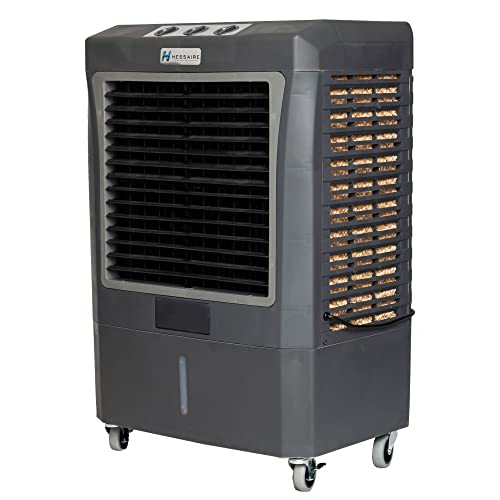
Badge: evaporative cooling at room scale. The MC37M is Hessaire’s substantial portable evaporative cooler, listed for spaces up to 950 square feet, with oscillation and a water reservoir, and rated by its maker for indoor or outdoor use. That last phrase reveals the technology’s natural habitat: an evaporative cooler is at its best where air can move through a space — a workshop with the door open, a patio’s edge, a garage, a warehouse corner — because its process adds moisture to the air it cools, and a through-flow of air carries that moisture away instead of letting it accumulate.
Technology: portable evaporative air cooler per the listing. Coverage: 950 square feet of space per the listing. Features: oscillation and water reservoir per the listing. Use: indoor or outdoor per the listing.
Strengths
- Genuine room-scale airflow for the ventless category, from a specialist maker.
- Oscillation spreads its cooled air across a space rather than down a single corridor.
- Running costs are a fan’s and a pump’s, a fraction of a compressor machine’s appetite.
Trade-offs
- Its cooling power is set by the climate: strong in dry heat, modest in humid heat, negligible in saturated air.
- It adds humidity to the space, which closed rooms tolerate poorly and open ones shrug off.
- It is a substantial unit that needs water refills on a working rhythm.
Picture the MC37M in its element: a dry-climate workshop in July, the door open to the yard, a bench where someone works all afternoon. The cooler draws the hot, dry air through its wet pads and delivers a stream measurably cooler and perceptibly fresher, and the open door completes the circuit by letting the moistened air leave. That scene is the technology’s promise kept completely. Move the same machine to a humid climate’s closed bedroom and the promise collapses, not because the machine changed but because the air did — it arrived already carrying its water, and evaporation, politely, declines. Buy this machine for the first scene and it will seem miraculous. Buy it for the second and it will seem broken. The climate decides, and this review’s job is to make sure the decision is made before the purchase rather than after it.
Best for: dry climates, workshops, garages, patios, and ventilated spaces. Not suited for: humid climates or sealed bedrooms anywhere. Check price on Amazon

Hessaire MC18M: The Compact Ventless Option
Badge: the smaller machine for a single workspace. The MC18M is the MC37M’s smaller sibling, listed at 1,300 CFM of airflow with two fan speeds and coverage up to 500 square feet. It is the personal-scale version of the same proposition: park it where one or two people work or sit, in air dry enough to accept evaporation, and it will hold that territory noticeably cooler than the room around it for the cost of a fan’s electricity and a reservoir’s water.
Technology: portable evaporative air cooler per the listing. Airflow: 1,300 CFM per the listing. Speeds: two-speed fan per the listing. Coverage: 500 square feet per the listing. Noise note: 53.4 dB figure in the listing title.
Strengths
- A focused airflow that suits a workstation, a bench, or a seating area precisely.
- Two speeds and a compact footprint make it the easiest ventless machine to place and to store.
- The same specialist maker and the same low running costs as its larger sibling.
Trade-offs
- Its territory is a zone rather than a whole large room, and expecting more repeats the category’s classic error.
- Every evaporative caveat about humidity applies to it undiluted.
- A smaller reservoir means a shorter interval between refills in hard-working conditions.
The MC18M is the right first evaporative purchase for a household testing the technology, because its scale matches the way the cooling is actually experienced: personally, in a stream of treated air, in the place a person spends the hot hours. A renter in a dry city with a desk by a window, a hobbyist at a garage bench, a grandparent on a shaded porch — these are its people, and for them its modest proposition is not a compromise but an exact fit. Households that discover, through it, that evaporative cooling suits their climate can graduate to the larger machine with evidence rather than hope.
Best for: personal workspaces and seating zones in dry climates. Not suited for: whole-room cooling in humidity or sealed spaces. Check price on Amazon
The Climate Test: Will Evaporative Cooling Work Where You Live?
One measurement decides whether the machines above are your answer, and it is not temperature — it is humidity. Evaporation cools because dry air accepts water eagerly, and the energy for that acceptance comes from the air’s own heat. The drier the air, the greater the temperature drop a cooler can deliver; desert air can surrender a dramatic share of its heat to a wet pad. As relative humidity climbs, the air’s appetite fades, and with it the cooling: in genuinely humid conditions, an evaporative cooler becomes a fan that humidifies, which is worse than a fan alone for comfort in a closed room. The practical test is local knowledge rather than instrumentation. If your summers are the kind where sweat evaporates and laundry dries on a line by afternoon, evaporative cooling is a technology your climate endorses. If your summers are the kind where sweat sits on the skin and towels never quite dry, your climate has already answered, and the honest alternatives are the venting workarounds and different architectures discussed below. Households in the borderlands — dry heat with humid weeks — should expect a machine that is excellent in its season and modest in its off-weeks, and buy it, if they buy it, for the season.
When You Cannot Vent: The Legitimate Workarounds
Before settling for evaporative cooling, a household that cannot vent in the obvious way should exhaust the honest alternatives, because a true air conditioner’s cooling is worth some ingenuity. Windows that do not suit a standard kit often suit an adapted one: casement and sliding windows take sealing panels made for their geometry, and a panel cut to fit a awkward opening converts an impossible vent into a Saturday project. A dryer vent, a fireplace flue in a home where it is genuinely disused and safe, or a drop-ceiling route in a commercial space can each serve as the heat’s road in the right circumstances, with the caveat that any route must carry the air fully outside the building’s envelope. Rooms with no exterior wall at all are the hard core of the problem, and for them the architectural answers — a split system with its outdoor unit elsewhere, or cooling an adjacent ventable room and sharing its air — outperform any portable compromise. Only after those routes are honestly closed does the evaporative machine become the answer, and in dry climates it becomes, as the reviews above argue, a genuinely good one rather than a consolation.
How to Use an Evaporative Cooler Well
The technology rewards a technique that air-conditioner habits actively contradict. Give the cooler an air path: a window or door open on the far side of the space, so the moistened air leaves instead of accumulating, because an evaporative cooler in a sealed room humidifies itself out of a job within the hour. Keep the pads wet and the reservoir filled on a rhythm, since a dry pad reduces the machine to a fan with unusual styling. Position the machine where its stream crosses the occupants rather than where it cools an empty corner, because evaporative cooling is experienced personally and directionally more than ambiently. Maintain the pads and the tank against the mineral scale and the biology that standing water invites, on the maker’s schedule, because a neglected reservoir announces itself to the nose before it affects the cooling. And run the machine ahead of the heat where you can — starting it while the space is still tolerable lets it hold a line that it cannot always recover once the room has fully heated. Households that learn that technique describe their coolers as transformative in dry heat. Households that seal them in a room and wait describe them as scams, and both are reporting the same machine under different physics.
Mistakes in the Ventless Market
The first is believing any listing that promises air conditioning without a hose, a compressor’s output without a compressor’s exhaust; the taxonomy in this article exists because that promise is the market’s most reliable falsehood. The second is buying an evaporative cooler for a humid climate on the strength of reviews written in a dry one, a mismatch no return window quite forgives. The third is sealing the room, in air-conditioner habit, and suffocating the technology’s one requirement. The fourth is expecting a set temperature: evaporative machines deliver a reduction relative to conditions, and a household that needs a guaranteed number on a thermostat needs a compressor and a vent. The fifth is neglecting the water, letting a reservoir become a science project whose output the household then breathes. Each mistake is a sentence long and a summer expensive, which is the usual exchange rate in this category.
Final Recommendation
If you cannot vent and your climate is dry, buy the evaporative machine without apology: the Hessaire MC37M for room-scale and ventilated spaces, the MC18M for a personal workspace or seating zone, and use them with an air path open and the pads kept wet. If you cannot vent and your climate is humid, let this article talk you out of the ventless purchase and into the workaround hunt — an adapted window panel, a legitimate vent route, or a different cooling architecture — because no evaporative machine will keep a humid promise. And if you can vent after all, vent: a true portable with its hose properly installed will out-cool every machine in this article in every climate, which is not a criticism of the evaporative machines but a statement of the physics that created both categories.
Where Evaporative Cooling Shines: A Tour of Its Natural Habitats
The workshop and garage. These are the technology’s ancestral rooms: large doors, moving air, occupants who are working rather than sleeping, and a climate inside that tracks the climate outside. A cooler stationed to blow across the bench transforms a dry summer’s work from endurance into comfort, and its water and pad maintenance fits a workshop’s existing relationship with tools.
The patio and the covered porch. Outdoor and semi-outdoor living is where the indoor-outdoor rating on machines like the MC37M earns its wording. Evaporative cooling cannot air-condition the outdoors, but it can hold a seating zone in a stream of treated air that makes a dry evening’s heat negotiable, and generations of desert households have arranged their summers around exactly that stream.
The warehouse, studio, and commercial corner. Workspaces with volume, ventilation, and a heat problem that full air conditioning would answer at industrial cost are evaporative cooling’s economic heartland. The running-cost difference, trivial in a bedroom, becomes decisive across a working floor and a working summer.
The dry-climate rental. Renters who cannot install window units and cannot modify vents are the technology’s most grateful constituency, provided their city’s air is dry. For them the cooler is not a compromise at all but the only serious cooling their tenancy allows, and in the right climate it is serious enough.
The Desktop Devices, Addressed Plainly
A word is owed about the smallest members of this market, the desktop cubes and personal chillers advertised with language borrowed from air conditioning. These devices evaporate water or melt ice across a small fan’s path, and within a foot or two of their output, a user can feel a genuinely cooler breath of air. As personal spot-coolers in dry air, honestly described, some are harmless pleasures. The dishonesty enters with scale: a device that treats a cubic metre cannot cool a room, and a household that buys one as a room’s air conditioner has been sold a category error. This article’s recommendations begin at the Hessaire scale — real airflow, real pads, a specialist maker — precisely because below that scale the ventless promise stops being a technology and becomes a wording. Readers tempted by a desktop device should apply the climate test and the airflow question from these pages, and buy it, if at all, as a fan with benefits rather than as the answer to a hot room.
Frequently Asked Questions
Is there a portable air conditioner that does not need to be vented?
No, if the words are used precisely. Every compressor air conditioner moves heat out of the room, and the exhaust hose is the mechanism; a unit without one would return its heat, plus its motor’s heat, to the room it claims to cool. Products sold as ventless air conditioners are evaporative coolers, which cool by passing air through wet pads, or fans with reservoirs. Evaporative cooling is a real and useful technology in dry climates, and the two Hessaire machines in this article are its verified representatives — but they obey evaporation’s rules, not refrigeration’s, and they should be bought with those rules understood.
How much cooler does an evaporative cooler make a room?
The honest answer is a range set by your air. In hot, dry conditions, the air leaving a well-run evaporative cooler can be dramatically cooler than the air entering it, and a ventilated space can feel transformed. As humidity rises, the drop shrinks steadily, and in saturated air it approaches zero. This is why the technology is beloved in desert regions and regretted in humid ones, and why any seller quoting you a single fixed temperature drop, without asking about your climate, is selling rather than informing.
Can I use an evaporative cooler in a bedroom?
Only with the room’s cooperation, which most bedrooms cannot offer. The cooler needs an exit path for moistened air — an open window or door — and a bedroom sealed for the night defeats it while accumulating humidity against bedding and walls. In dry climates, a bedroom with a window cracked and a door ajar can work, and some households sleep happily in that arrangement. In humid climates, or in any bedroom that must be sealed, a vented portable or a window unit is the honest tool, and the evaporative machine belongs in the home’s ventilated daytime spaces instead.
Why does my evaporative cooler make the room feel muggy?
Because it is doing its job in a room that cannot complete the circuit. The machine cools by adding water to the air; if that air cannot leave, the room’s humidity climbs until evaporation stalls, and the household is left with warm, wet air and a fan. Open a window or door on the far side of the space to give the treated air an exit, confirm the pads are wet and clean, and the mugginess usually resolves into the cooling the machine promised. If the outdoor air itself is already humid, no arrangement of windows will rescue the physics, and the day belongs to a different technology.
What maintenance does an evaporative cooler need?
Water discipline, mostly. Keep the reservoir filled during use and emptied when the machine will sit, because standing water grows things no household wants aerosolised. Clean or replace the pads on the maker’s schedule, since mineral scale from hard water crusts them and strangles both airflow and evaporation. Wipe the tank, check the pump’s operation at the season’s start, and store the machine dry. The rhythm is lighter than an air conditioner’s filter discipline but less forgiving of neglect, because its medium is water rather than air.
Is an evaporative cooler cheaper to run than a portable AC?
Substantially, yes, and the difference is structural. An evaporative cooler runs a fan and a small pump, drawing a fraction of the electricity a compressor system draws to move the same air. Its costs are water, pads, and the owner’s maintenance rhythm. That economy is the technology’s enduring appeal in the climates that suit it: near-fan running costs for a genuine temperature reduction. The comparison only holds where the climate cooperates, since the cheapest cooling in the world is expensive if it does not cool.
Water, Pads, and the Seasonal Calendar
An evaporative cooler’s year has a rhythm its owners should set in spring. Before the season, the machine gets its inspection: reservoir cleaned, pads examined for scale and damage and replaced if their surface has crusted, pump tested with the first fill, and the unit run briefly so any winter storage surprise announces itself in mild weather. Through the season, the rhythm is water and watching — the reservoir kept ahead of the pump’s thirst on working days, the pads rinsed or treated as the maker directs where water is hard, and the tank emptied whenever the machine will stand idle for more than a few days. At the season’s end, the machine is drained completely, the pads dried, and the whole unit stored dry, because an evaporative cooler put away wet begins its next season as a cleaning project rather than as an appliance. Hard-water households should expect to be the calendar’s strictest keepers, since mineral scale is their tax on the technology, and a household that knows its water is hard can soften the tax with the maker’s recommended treatments from the first fill rather than the first failure.
Combining Technologies: The Household That Uses Both
Many dry-climate households end up, rationally, with a foot in each technology, and the combination deserves describing because it is often the true optimum. The vented compressor machine governs the bedroom, where sealed, guaranteed, thermostat-controlled cooling matters most and where its exhaust can be installed once and properly. The evaporative cooler governs the home’s ventilated daytime territories — the workshop, the kitchen’s working hours, the patio’s evenings — where its running costs are a rounding error and its air-path requirement is the room’s natural state. Each machine works where its physics is strongest, neither is asked to perform the other’s miracle, and the household’s total cooling bill is a fraction of what either technology would cost attempting the whole home alone. Households shopping this article’s question from a whole-home perspective should consider that division of labour before concluding that one machine must win, because in the right climate the answer to ventless versus vented is frequently: both, in their places.
The Energy and Environment Ledger
Ventless cooling’s running-cost advantage has an environmental shadow that deserves a fair paragraph. A compressor machine’s electricity draw is its dominant footprint, and in a home cooled all summer that draw is a serious line in the household’s energy account. An evaporative cooler substitutes water for most of that electricity, which in a dry climate — where water itself may be the scarcer resource — is a trade rather than a triumph, and honest households in arid regions weigh both sides of it. The balanced view is that evaporative cooling, used in its proper habitats and maintained so its water is not wasted on scale and neglect, is among the most efficient comfort technologies available, and that its efficiency is one more reason the climate test matters: a machine run where it cannot cool spends water and electricity to produce humidity, which is the worst entry in either ledger. Buy it for the climate that endorses it and the ledger, in both currencies, comes out strongly in its favour.
Buying the Evaporative Machine Itself: A Checklist
For the household that has passed the climate test and chosen the technology, the purchase itself reduces to a short list of verifications. Confirm the machine’s airflow rating and stated coverage from its listing, and match them to the space with the zone thinking this article has taught — evaporative cooling is experienced where its stream lands. Confirm the reservoir’s size against your tolerance for refills, since a hard-working machine in dry air drinks steadily. Confirm that replacement pads for the exact model are sold openly, because pads are this technology’s filter and the same consumable rule governs both. Confirm the maker’s identity and history in the category, as with the Hessaire machines here, whose specialisation is the point. And confirm, one final time, the air path in the room where the machine will live, because the finest evaporative cooler ever built will still fail in a sealed box. A purchase that survives that checklist is very unlikely to be regretted in a dry summer.
A History in One Paragraph: Why Swamp Coolers Predate the Hose
Evaporative cooling is the older technology by millennia, and its nickname — the swamp cooler — carries its American history in the desert Southwest, where households cooled themselves with wet pads and fans generations before refrigerant machines became ordinary. That history matters to a modern buyer for one practical reason: the technology is mature, understood, and unpatentable in its essentials, which is why its honest practitioners, Hessaire among them, compete on airflow, build, and pads rather than on miracles. When a category’s fundamentals have been stable for a century, any listing that promises a revolution within it is describing its marketing rather than its machine. Buy the mature version of the technology, from a maker that treats it as mature, and the century’s accumulated competence comes with it.
Troubleshooting an Evaporative Cooler That Disappoints
When a ventless machine underperforms, the diagnosis is short and almost always environmental. Check the air path first, because a closed room is the cause in the majority of cases and the cure is a window opened on the far side. Check the pads second: dry pads mean a fan, scaled pads mean a shadow of the machine’s rating, and either is visible to the eye and fixable in minutes. Check the water third, for level, for the pump’s delivery, and for the smell that announces a reservoir overdue for cleaning. Check the climate last and most honestly, by noting the day’s humidity rather than its temperature, because a machine that thrilled in a dry June and sulks in a humid August is reporting the air, not a fault. Work that list and the cooler’s mystery usually dissolves; the residue of cases is mechanical — a pump, a fan — and belongs to the maker’s support, with the machine’s age and the part’s price arbitrating repair against replacement as in every category in this series.
A closing word for the reader whose climate failed the test and who feels this article has taken something from them. It has taken a purchase that would have disappointed, and left in its place the two routes that actually cool a humid, unventable room: the ingenious vent, pursued through the workarounds above, or the architectural answer, chosen with the room’s measurements in hand. Either route ends in a cool room. The evaporative route, in the wrong climate, ends in a humid one — and an article that lets a reader buy their way into that ending has failed at the only job it had.
Safety and Water Hygiene, Stated Plainly
A machine that aerosolises its room’s air through a water system carries one responsibility that compressor machines do not, and it should be stated without drama. The reservoir and pads must be kept clean, the water fresh, and the machine dried when idle, because any standing-water appliance can cultivate what its owners would least like distributed around a room. The disciplines in this article’s seasonal calendar — regular cleaning, complete drying, pad replacement on schedule — are therefore hygiene as much as maintenance, and households with vulnerable members should be especially faithful to them and should follow the maker’s cleaning guidance exactly. None of this is a reason to fear a well-kept evaporative cooler, a technology with a century of household service behind it. It is a reason to keep it well, which the households that love these machines have always done as a matter of routine.
The Renter’s Playbook, Collected
Because renters are this question’s most frequent askers, collect their playbook in one place. First, read the lease’s actual words about window units and modifications, since many households assume prohibitions that their documents do not contain, and a vented portable with a removable panel is frequently permitted where a window unit is not. Second, if venting is truly barred, apply the climate test with complete honesty, because a renter’s budget forgives fewer mistakes than an owner’s. Third, in a dry climate, buy the evaporative machine sized to the room where the hot hours are actually spent, and run it with the air path the technique section describes, using windows and doors the lease certainly allows you to open. Fourth, in a humid climate, spend the money on the room instead — shading, a serious fan’s air movement, bedding and curtains that lower the room’s heat load — while the longer-term answer is negotiated with the landlord or deferred to the next home. That sequence respects both the physics and the tenancy, and it is the closest thing to a universal answer this stubborn question admits.
What the First Week With a Cooler Teaches
New evaporative owners learn their machine in a predictable arc, and previewing it prevents the commonest early return. The first afternoon usually delights, because a dry room and a fresh machine produce the technology’s best hour. The first closed-room evening often disappoints, as humidity accumulates and the cooling fades, and that disappointment is the curriculum rather than the verdict: it teaches the air path, which the owner then provides, and the machine’s performance reorganises itself around the lesson. By the end of the first week, the household has found the machine’s true station — the room, the window arrangement, the hours — and its output has stabilised into the honest service it will render for years. Owners who return these machines most often return them on the second day, at the bottom of the arc, having met the lesson and mistaken it for the machine. Give the technology its week, in a climate that suits it, before letting it be judged.
One more distinction is worth handing to the reader before the links, because it organises every buying decision in this space. Ask of any cooling product a single question: where does the heat go? If the answer is outside, through a hose or a wall, you are looking at air conditioning. If the answer is into water, and then into the room’s air as humidity that must leave by a window, you are looking at evaporation. If the answer is nowhere — if the product merely moves air or melts ice in place — you are looking at a fan with a story. The question takes five seconds, requires no expertise, and has never yet failed to classify a machine correctly.
Gifting and Specifying for Dry-Climate Households
Evaporative coolers are frequently bought for someone else — a parent in a desert town, a student in a dry city’s rental, a relative whose workshop is their kingdom — and the gift succeeds or fails on the same climate test, applied to their sky rather than to yours. Verify the recipient’s humidity with the same honesty you would apply at home, confirm the room has the air path the technique requires, and include the first set of replacement pads in the gift, since a cooler, like every machine in this series, is a system whose consumable decides its lifespan. A cooler given that way arrives as a working answer. A cooler given on the assumption that all hot places are alike arrives, in the wrong climate, as a handsome fan and a small family misunderstanding.
The Long View: Living in a Dry Climate Well
Step back from the machines and the ventless question turns out to be one chapter in a larger dry-climate craft that its long-term residents practise without naming it. Shade is treated as infrastructure, with trees, awnings, and curtains doing the first shift of every hot day. Air movement is arranged rather than suffered, with windows and doors opened and closed on a daily choreography that flushes the house at night and seals it by day. Water is spent deliberately, on the garden’s roots and the cooler’s pads, where each litre does the most work. The evaporative cooler belongs in that craft as its mechanical citizen, neither a miracle nor a compromise but a tool whose century of service in exactly those regions was earned inside exactly that system. A household new to a dry climate could do worse than adopt the whole craft at once, cooler included, and let its first summer be the apprenticeship rather than the emergency.
To close: the hose is physics, the pads are climate, and the choice between them is a measurement rather than a preference. Make the measurement honestly, buy the technology it selects, and the room that began this search — unventable, overheated, and seemingly out of options — will turn out to have had an answer all along. It was simply wearing a different name than the one you searched for.
A Note on Noise, Sleep, and Placing the Stream
One practical quality decides where an evaporative cooler can live in a home, and it is neither cooling nor cost but sound. These are fan machines, and their voice is a fan’s voice — a broadband rush that many people find easier to live with than a compressor’s cycling hum, and that some light sleepers find impossible at any volume. The listings’ figures should be read as comparisons within the category rather than as promises about a bedroom, and the household that intends to sleep beside a cooler should treat the first nights as an audition, with the machine placed as far from the pillow as its stream allows and its lowest effective speed doing the work. In the daytime territories this article recommends — workshops, kitchens, porches, desks — the voice is rarely an issue at all, which is one more reason the technology’s natural map and its acoustic map coincide so neatly.
When the Household Moves: Portability as a Real Feature
The word portable in this category is often marketing, but for evaporative machines it describes a genuine property that compressor units only approximate. A cooler has no installation to undo, no panel fitted to a specific window, no hose run to preserve; it is filled, wheeled to the room that needs it, and put to work, and at a move it travels as furniture rather than as a project. Households whose lives are mobile — renters between leases, seasonal workers, families whose hot room changes with the year — extract real value from that property, and it belongs in the purchase arithmetic beside the climate test. A machine that will serve three homes in five years, in three different rooms, justifies a different price than a machine bought for one room forever, and the evaporative class’s freedom from installation is the quiet reason so many of its owners describe themselves as loyal to the technology rather than merely satisfied with a model.
And a final encouragement, addressed to the reader who arrived here hoping the first paragraph would be different. The physics that closed one door — the compressor’s hose — opened another that is older, cheaper to run, and in the right climate genuinely delightful, and the households that cool with evaporation in the desert are not settling for anything. They are using the technology their sky recommends. Measure your sky, and if it recommends the same, buy the Hessaire that fits your space and join them without a backward glance.
Measuring Your Own Climate Without Instruments
The climate test in this article can be run with household evidence, and the reader without a hygrometer should know the signs. Laundry is the first witness: clothes that dry crisp on an indoor line within hours live in evaporative country, while clothes that stay damp into the next day are reporting air that cannot accept more water. Skin is the second: sweat that disappears as it forms means the air is thirsty, while sweat that pools means the air is full. Bread and towels cast smaller votes — the loaf that stales hard, the towel that dries between showers — and the household that reads its own evidence across a week of summer will know its classification more reliably than a single instrument reading on a single afternoon. Run the test across the season’s humid spells as well as its dry ones, because the machine must serve the whole summer, and a classification drawn from the driest week will be betrayed by the wettest.
Keep the evidence habit after the purchase, too, because a household that knows its own humidity calendar owns its cooling decisions for every future summer. Note the weeks when the cooler works hardest and the weeks when it rests, and the second year’s decisions — a second machine, a vented unit for the bedroom, a shading project — will make themselves from the record rather than from another season of guessing.
Ice, Cold Packs, and the Reservoir Tricks Worth Knowing
Owners of evaporative coolers eventually discover the reservoir tricks, and they deserve an honest assessment rather than either hype or dismissal. Chilling the reservoir’s water, or adding ice where the maker permits it, deepens the cooling of the air leaving the pads for as long as the cold lasts, because the pads then work with water colder than the room. The effect is real, temporary, and bounded by the household’s freezer capacity, and it is best understood as a booster for the worst hour of the afternoon rather than as a transformation of the machine. It does not change the climate test, rescue a humid room, or convert the cooler into an air conditioner, and a household that finds itself freezing water daily to survive its summers is receiving a message about its technology choice that it should eventually heed. Used occasionally and knowingly, though, the cold reservoir is a legitimate pleasure of the category — one more small way the evaporative household collaborates with its machine instead of merely switching it on.
There the survey ends, with the question answered at the length it deserves. Ventless air conditioning does not exist; ventless cooling does, and in the climates and rooms this article has mapped, it is not the lesser technology but the local one — the answer the air itself suggests. Trust the measurement over the marketing, and summer becomes a solvable problem again.
A postscript for landlords and property managers, who meet this question from the other side of the lease. A tenant asking for ventless cooling is usually a tenant whose room is genuinely hot and whose options the building controls, and the evaporative answer, in a dry region, costs the property nothing in modifications while costing the tenant little to run. Properties in dry climates that permit and even suggest the technology tend to field fewer heat complaints and fewer unauthorised window units than properties that simply prohibit, which is worth knowing on both sides of the conversation.
Finally, a word of respect for the question itself, which is better than its reputation. Asking for cooling without a hose is asking whether the home’s constraints can be negotiated rather than merely obeyed, and that instinct — applied to the climate honestly, and to the physics without flinching — is the same instinct that fills this site’s pages on every other appliance. The answer here happened to be an older technology with a reservoir. The instinct deserves to survive the answer.
Children, Pets, and a Reservoir of Open Water
One household consideration belongs in this article because the technology introduces an object the compressor home does not have: a tank of standing water at floor level, in a machine with a fan. Toddlers find reservoirs fascinating, cats find them drinkable, and dogs find them splashable, none of which harms the machine’s feelings but all of which argue for placing the cooler where its tank is not the room’s most interesting feature, and for keeping the water fresh enough that a pet’s investigation is a hygiene footnote rather than a worry. The pads and the airflow deserve the same household realism — a cooler stationed in a shedding pet’s favourite corridor will load its pads with hair at a pace the maker’s schedule never imagined, and a rinse added to the weekly rhythm answers it. None of this is a reason to avoid the technology in a family home; generations of desert households raised children and animals around these machines. It is a reason to site the machine with the household it actually serves in view, which is the closing form of the advice this whole article has given: the cooler rewards the owner who thinks about where it stands.
Related Guides
when a portable stops cooling, diagnosed how portable units work must a portable vent out a window portable versus window units LG portable machines reviewed air purifiers for the rooms you cool office air for the workspace you cool