Disclosure: As an Amazon Associate, dailyhomedecorating.com earns from qualifying purchases. Links on this page are affiliate links; they cost you nothing extra. Prices and availability change often, so check the current Amazon listing before you buy.
To understand how portable ac units work, start with the thing that makes them look impossible: a box that sits inside the room it cools, with a fat hose to the window, somehow making cold air out of the warm air it is standing in. The trick is that a portable air conditioner is a complete split system folded into one cabinet. It contains the same refrigeration circuit as a window unit or a central system — compressor, two coils, two fans, refrigerant — and it divides its own airflow in two: one stream cools the room and returns to it, the other stream carries the room’s heat out through the exhaust hose and is discarded outside. Everything people find confusing or disappointing about these machines — the hose, the noise, the water, the gap between the BTU on the box and the cooling in the chair — follows from that single design decision, and this article follows each consequence in turn.
Three real machines are linked as reference points, all from one manufacturer’s long-running range and all verified through this site’s own Amazon Creators API check: a 10,000 BTU class unit, a smart 12,000 BTU class unit, and a smart 14,000 BTU class unit. They are not here as a shopping list so much as a scale — the three sizes a household actually chooses among — and the buying guidance at the end uses them to show how the sizing decision should be made.
The refrigeration cycle, in one honest pass
Refrigerant circulates in a sealed loop, changing state as it goes, and the state changes are where the cooling happens. The compressor squeezes the refrigerant gas, raising its pressure and temperature. The hot, high-pressure gas flows through the condenser coil — the hot coil — where a fan blows air across it and the refrigerant gives up its heat and condenses into a liquid. The liquid passes through a narrow expansion device, its pressure collapses, and it enters the evaporator coil — the cold coil — cold enough to drink heat from any air that touches it. Room air blown across the evaporator leaves cooler and drier, because the coil is cold enough to condense moisture out of the air as a bonus. The refrigerant, now a cool gas full of the room’s heat, returns to the compressor to be squeezed again. Nothing is created or destroyed in this loop except comfort: heat is carried, molecule by molecule, from the room air to the exhaust air, and the electricity pays the compressor for the carrying.
A window unit performs this cycle with the hot coil physically outside the house, which is why it is efficient and why it needs a window to straddle. A portable unit performs it with both coils indoors, separated by insulation and by airflow design, and pays for its portability with the exhaust hose: the hot coil’s air must be ducted out of the room, or the machine would simply move heat from one side of itself to the other and warm the room with its motor into the bargain. Understanding that the hose is not an accessory but the machine’s other half — its outdoors, delivered by duct — is the key to everything that follows.
In this guide
Single hose versus dual hose: the design’s great divide
Most portable units use a single hose: the exhaust stream is drawn from the room itself. That air, having carried the heat out, must be replaced, and it is — by warm outdoor air infiltrating through every gap in the building: under doors, through keyholes, down chimneys. The machine thus cools with one hand and imports warmth with the other, and its real efficiency drops accordingly. Dual-hose designs give the hot side its own intake hose, so the condenser breathes outdoor air and returns it outdoors, and the room’s cooled air is never used as exhaust. The room stays closer to sealed, efficiency rises, and the machine stops creating the negative pressure that single-hose units impose on a house — pressure that can pull radon from a basement slab in susceptible homes, back-draft a water heater’s flue in the worst case, and always pulls dust and pollen through the building’s cracks.
Why, then, is single-hose the mainstream? Cost, simplicity, and the fact that in the small rooms and short runtimes of typical use — a bedroom through a heatwave night, an office through a working week — the penalty is tolerable and the purchase price is not. The honest buyer’s translation: a single-hose machine should be sized generously to cover its own inefficiency, a dual-hose machine is worth its premium in large rooms, long seasons and homes where negative pressure is a real concern, and the BTU figure on either box is a laboratory number whose translation into a room is the subject of the next section.
BTU, SACC, and what the numbers on the box actually promise
Portable air conditioners carry two ratings in the United States, and the gap between them is the most useful number in this article. The headline BTU — the 10,000, 12,000, 14,000 of the linked machines — is the traditional ASHRAE rating, a measure of the machine’s raw heat-moving capacity in test conditions. The smaller figure, the SACC rating, is a Department of Energy measure of seasonally adjusted capacity that accounts for the infiltration penalty, the hose’s heat leaking back into the room, and the realities of installation. Look at the verified listings below and the pattern is plain: the 10,000 BTU machine carries a SACC of about 5,500, the 12,000 about 8,000, the 14,000 about 10,200. That is not fraud; it is two honest measurements of different things, and the SACC is the one that describes your room. Size by SACC, or by the room-area guidance the manufacturer derives from it, and the machine will meet its promise. Size by the headline and you have bought a number, not a temperature.
Where the water comes from, and where it goes
A portable unit is also a dehumidifier whether it wants to be or not, because its cold coil condenses the room’s moisture continuously. The condensate’s fate divides designs. Better machines evaporate most of it into the exhaust stream and blow it out of the hose as vapour — self-evaporative designs that need emptying only in humid weather, when condensation outruns evaporation. All of them keep a small internal tank or tray as the overflow of last resort, with a float switch that stops the machine rather than flood the floor, and many offer a drain port for a hose to a floor drain or a pump for households who want the water handled permanently. The practical lesson matches the dehumidifier logic elsewhere on this site: in a humid climate, plan the water’s route before the first muggy night plans it for you, and treat a machine that stops at 3 a.m. with a full tank as a drainage problem wearing a cooling problem’s clothes.
The three reference machines, and what each size is for

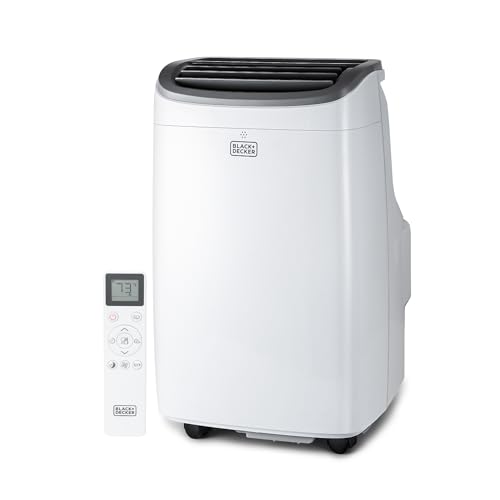
BLACK+DECKER 10,000 BTU (BPACT10WT) — the small-room size
Best reference for bedrooms and small offices
The smallest of the three verified listings, rated by its manufacturer for rooms up to about 450 square feet by the traditional measure and carrying the SACC figure described above — translate that, in practice, to a bedroom, a small office or a studio corner, honestly cooled. It is a 3-in-1 design — cooling, fan and dehumidifying modes — with a remote that includes the follow-me sensing this range is known for, where the remote acts as the thermostat’s outpost so the machine answers the temperature where you sit rather than where it stands.
- Traditional rating: 10,000 BTU; SACC about 5,500 BTU per its listing
- Modes: cool, fan, dehumidify
- Exhaust: single hose with window kit
- Room brief: small rooms, bedrooms, offices
Strengths
- The size most bedrooms actually need, in the most manageable cabinet of the three.
- Follow-me remote sensing corrects the classic portable-AC error of thermostatting the cold corner by the window.
- Three modes let it earn its floor space outside heatwaves, as a fan and a dehumidifier.
Trade-offs
- Single-hose infiltration penalty applies, as with the whole mainstream class.
- Sized honestly, it will not rescue a large living room in a heatwave — that is the next size’s job.
- Like all portables, it is louder in the room than a window unit whose compressor sits outside.
Best for: a bedroom through a hot season, a home office, a rental where a window unit is not permitted. Not suited for: open-plan living spaces or anyone sizing by the headline number for a big room.

BLACK+DECKER Smart 12,000 BTU (BPACT12WT) — the middle size
Best reference for larger bedrooms and modest living rooms
The middle listing adds smart control — app and voice operation — to the same 3-in-1 architecture, and steps the capacity to a SACC of about 8,000, which its listing translates to rooms around 550 square feet in traditional terms. In lived terms this is the size for a primary bedroom with an en-suite’s heat load, a studio flat’s main space, or a living room that is a room rather than a floor of a house.
- Traditional rating: 12,000 BTU; SACC about 8,000 BTU per its listing
- Modes: cool, fan, dehumidify, with smart app and voice control
- Exhaust: single hose with window kit
- Room brief: larger bedrooms, studios, modest living rooms
Strengths
- Smart scheduling suits the dominant real use — pre-cooling a bedroom before bed, resting while the house is empty.
- The capacity step is real in SACC terms, not just in headline terms.
- Same follow-me remote logic, so control stays where the people are.
Trade-offs
- Smart features add setup and an app dependency that the smaller unit’s buyers skip happily.
- Still a single-hose design with its infiltration arithmetic.
- A larger cabinet and hose to place — measure the window wall before it arrives.
Best for: households that will actually use scheduling, and rooms a size up from the small unit’s parish. Not suited for: anyone whose “living room” is an open-plan floor, or who dislikes app-mediated appliances.
BLACK+DECKER Smart 14,000 BTU (BPACT14WT) — the large-room size
Best reference for living rooms and open spaces
The largest of the three carries a SACC around 10,200 and a traditional room claim around 700 square feet — the size a household buys when the room is a genuine living space and the smaller units’ honest translations fall short. It shares the smart platform and the 3-in-1 modes, and it illustrates the class’s ceiling: beyond this size, the portable format’s penalties grow faster than its capacity, and the conversation properly turns to window units, dual-hose designs or split systems.
- Traditional rating: 14,000 BTU; SACC about 10,200 BTU per its listing
- Modes: cool, fan, dehumidify, with smart app and voice control
- Exhaust: single hose with window kit
- Room brief: living rooms and larger open spaces
Strengths
- The only one of the three sized to hold a living room through an afternoon’s heat gain.
- Capacity headroom means it cycles rather than straining, which is quieter and kinder to the machine.
- Smart control and follow-me sensing scale with the room’s importance in the house.
Trade-offs
- The largest footprint, weight and hose of the three — portability becomes a two-person claim.
- Single-hose penalty at this capacity imports a great deal of replacement air; a dual-hose rival deserves comparison at this size.
- Running costs follow capacity; this is a machine to schedule, not to leave amusing itself.
Best for: living rooms, open spaces and households whose heat problem is real and central. Not suited for: bedrooms, where its size and sound are wasted, or homes where a window or split solution is permitted and would serve better.
Installation: the window kit and the hose, done properly
A portable unit’s performance is decided in the twenty minutes of its installation more than in any specification. The window kit — a sliding panel that fills the window’s opening and accepts the hose — must seal as completely as the household can manage, because every gap around it is a doorway for the warm air the machine is paying to exclude; foam tape and a towel of last resort across the remaining cracks are not embarrassments but engineering. The hose itself should run as short, as straight and as un-kinked as the room allows: it is a duct full of hot air radiating into the room it crosses, and every extra foot and bend returns heat and resistance to the system. Insulated hose covers exist for exactly this reason and earn their keep in long runs. The unit needs clearance at its intakes, a socket that can carry a compressor’s appetite without sharing a tired extension lead, and a condensate plan — tank, hose or pump — settled before the first humid night. Do those four things and the machine you bought is the machine the SACC rating described; skip them and you have installed a smaller, louder unit than the one on the box.
How to choose and use one well: the buying guide
Choose the room first and be honest about its boundaries: a portable cools the space its air can circulate in, and an open door to a hot hallway is a second room joining the first without paying. Size by SACC and the manufacturer’s room guidance derived from it, stepping up when the room has west sun, a kitchen’s heat, a crowd of occupants or a ceiling over a hot roof. Prefer dual-hose where the season is long or the room is large, and single-hose where the use is a bedroom’s nights and the budget is real. Then use the machine the way its physics prefers: start it before the room is unbearable, because a portable’s strength is holding a temperature rather than rescuing one; keep doors and the room’s other windows closed while it works; run the fan on its own in the shoulder hours instead of cooling out of habit; and clean the intake filters monthly, because a portable breathing through dust loses capacity exactly as its stationary cousins do.
Noise, energy and the honest costs
A portable air conditioner keeps its compressor in the room with you, and its sound — typically in the range of a loud fan or a quiet dishwasher’s more insistent moments, varying by model and speed — is the class’s permanent tax. Light sleepers should audition the bedroom plan before the heatwave does: many households run the machine hard in the evening, then let the room coast through the night on the fan or a low setting, a rhythm the smart models’ scheduling exists to automate. Energy follows capacity and hours: these are among the hungrier appliances a home owns, their efficiency below that of window units of similar output for the infiltration reasons explained above, and the household that runs one all season should expect the bill to say so. None of this makes the category a mistake — for renters, for rooms windows cannot serve, for the heatwave that arrives before any installation could, the portable is often the only cooling that exists — but it should be bought as what it is: the flexible, compromised, genuinely effective third option behind the window unit and the split system.
Common mistakes with portable air conditioners
Sizing by the headline BTU is the first, and the SACC section of this article is its correction. The second is installing the hose long and looping for tidiness, heating the room with the exhaust’s own duct. Third is leaving the window kit’s gaps unsealed and then reviewing the machine’s power. Fourth is expecting a portable to cool an open-plan floor through an open doorway — a geography error, not a product error. Fifth is ignoring the condensate until the float switch teaches the lesson at 3 a.m. Sixth is storing the machine wet and dusty in autumn, so spring’s first heatwave begins with a musty machine and a clogged filter; a cleaned, dried, covered unit starts its season as the machine you bought.
Final word
A portable air conditioner is a refrigerator’s engine taught to live indoors and breathe through a hose, and everything about it — its real capacity, its noise, its water, its appetite — is that arrangement working itself out. Buy it by its honest rating, install its hose like you mean it, give its condensate somewhere to go, and it will hold a room through a summer with a competence that surprises people who only read its compromises. Ask it to be a window unit or a central system and it will disappoint you in ways that were printed, in the smaller of its two numbers, on the box all along.
Portable versus window versus split: the honest comparison
| Type | Where the hot side lives | Efficiency | Installation | Choose it when |
|---|---|---|---|---|
| Portable, single hose | Indoors, exhausting room air | Lowest of the three | Window kit, minutes | Rentals, odd windows, temporary need |
| Portable, dual hose | Indoors, breathing outdoor air | Middle | Two hoses, minutes | Long seasons, large rooms, pressure-sensitive homes |
| Window unit | Straddling the window, hot side out | Higher | The window, seasonally | The window allows it and the room is permanent |
| Mini-split | Outside the building entirely | Highest, and quietest indoors | Professional, permanent | Ownership, whole-room comfort, long horizon |
The table’s lesson is that the portable’s compromises are the price of its one unmatched virtue: it asks nothing of the building. No permission from a landlord, no window geometry, no installer, no permanence — it can cool a room the day it arrives and leave with you when you go. Households should buy it when that virtue is the deciding one, and should graduate past it without bitterness when a home becomes permanent enough for the better machines, because the portable will have done exactly the job it was designed for in the years when nothing else could.
Heat-pump portables and the four-season question
Some portable units add a reversing valve and become heat pumps in winter, extracting heat from outdoor air and delivering it indoors through the same hose arrangement run in reverse. The appeal is obvious — one appliance, two seasons — and the reality deserves the same translation discipline as the cooling ratings. A portable heat pump works respectably in the shoulder seasons, when outdoor air is cool rather than cold, and fades as winter deepens, exactly as its full-size cousins do, with the portable’s own penalties applied on top. For a mild-climate room that needs occasional warmth — a studio, a workshop, a granny flat — the dual-purpose machine can be the rational single purchase. For a cold-climate household pricing it as a primary heat source, it is the wrong tool wearing a promising badge, and the money belongs in the heating system instead.
Thermostat placement and the follow-me idea
A portable unit’s thermostat lives in the machine, which lives by the window, which is the coldest and draughtiest corner of the room it serves. Left to its own sensor, the machine satisfies itself — the corner is lovely — while the bed across the room remains warm. The follow-me remote on the linked range is the manufacturer’s acknowledgement of the geometry: the remote carries a sensor and reports the temperature where it sits, on the nightstand or the desk, so the machine works until the occupied zone is right rather than until its own corner is. Households without the feature can imitate it imperfectly — set the target a degree or two lower than the comfort actually wanted, and let the room’s gradient do the rest — but the principle generalises beyond this brand: in any room cooled by a machine in a corner, judge the temperature where the people are, and expect to negotiate the difference.
Refrigerants and the environmental footnote
Modern portables use refrigerants with far lower global-warming potential than the generation they replaced — the current household standard in this class is R32 in many markets — sealed inside a circuit that should never need opening in the machine’s life. The environmental ledger of a portable is therefore dominated not by its refrigerant but by its electricity and its efficiency penalty: a machine that imports warm air works its compressor longer for the same comfort, and the greenest portable is the one sized and installed so that it cycles contentedly rather than straining. At end of life the unit belongs in appliance recycling, where the refrigerant is recovered rather than vented — a small errand that is the owner’s one real environmental duty in the whole ownership.
Four rooms, four verdicts
The rented bedroom with a horizontal-sliding window
The portable’s founding scenario. A window unit cannot mount, the lease forbids alterations, and the room faces west. A 10,000-class machine, hose short and kit sealed with foam tape, run from late afternoon and scheduled off in the small hours, turns an uninhabitable room into a merely warm one and a warm one into sleep. This is the purchase the category exists for, and its owner will forgive it every compromise on the list.
The home office over a garage
Garage-roof heat makes this room the house’s oven by two in the afternoon, and its occupant is present exactly when the load peaks. The middle size earns its place here, with the follow-me logic answering the desk’s temperature rather than the window’s, and the dehumidify mode covering the muggy days when the air is heavy but not hot. The office worker should budget for the sound — calls and compressors negotiate — and schedule the deep cooling for the hour before the working day, not during it.
The open-plan living room in a heatwave
The honest verdict is triage. The largest portable will hold the seating zone at a bearable temperature while the room’s far corners stay warm, and in a genuine heatwave that zoning is a success rather than a failure — heat safety is about the people, not the floor plan. Households that need the whole plan cooled need a different technology, and the heatwave is the wrong week to discover it; buy the split system in spring, and let the portable be the bridge and the backup it is good at being.
The server cupboard and the workshop
Small, hot, enclosed and unoccupied: the portable’s penalties shrink here because nobody hears it and the room’s smallness flatters its capacity. Workshops add dust, which makes the filter routine weekly rather than monthly, and garages add the question of where the hose can honestly go. For equipment rooms, remember the condensate plan with special care — the float switch’s 3 a.m. opinion matters more where the floor holds things that dislike water.
Maintenance that keeps the rating honest
Wash or vacuum the intake filters monthly in season — the dust film on them is capacity subtracted in plain sight. Wipe the coils’ accessible surfaces at the season’s start, check the hose and its window seal for the cracks and slumps that winter storage produces, and run the machine for twenty minutes before the first heatwave rather than during it, so any complaint it has is heard while the weather is still negotiable. At the season’s end, run the fan alone for an hour to dry the internals, empty and rinse the tank, clean the filters, and store the unit upright and covered with its hose loosely coiled rather than kinked flat. A portable stored wet grows the musty smell its first spring evening will be blamed for; a portable stored dry starts its second season as the machine the SACC rating described, which is all any owner can ask of a box that breathes for a living.
The window kit is not packaging — it is half the machine
New owners routinely treat the window slider kit as an installation accessory and leave its gaps stuffed with a towel, and the physics covered earlier in this article explains why that decision quietly taxes everything else the machine does. Every unsealed centimetre around the panel is a leak through which the room’s cooled air is drawn out and warm outside air pulled in, and on a hot afternoon the leak can return a meaningful share of the unit’s entire output to the outdoors. The ten minutes spent sealing the panel’s edges with the foam tape most kits include — and checking the hose connection’s collar is fully seated — is the highest-value maintenance the machine ever receives, worth more than any later intervention. Treat the kit as part of the appliance, store it with the appliance, and refit it properly each season rather than improvising around its absence.
Where the condensate actually goes
Cooling humid air wrings water out of it, and first-time owners are often surprised by how much. Most modern portable units evaporate the majority of that condensate into their own exhaust stream, which is why they can run for days in moderate humidity without intervention. In sustained high humidity the evaporation cannot keep pace, an internal tank fills, and the machine stops on a float switch — usually at the least convenient hour. The practical responses are the ones the manual lists and owners postpone: route the continuous drain hose to a floor drain or a low bucket you will actually empty, learn where your unit’s tank-full indicator is before the first humid week, and treat a unit that stops on a full tank as working correctly, not failing. The water is the process made visible; a machine producing none on a muggy day is the one to wonder about.
Frequently asked questions
Why does a portable air conditioner need a hose to the window?
Because the machine’s hot coil must dump the room’s heat somewhere, and the hose is its route outdoors. Without it, the unit would return the heat to the same room it collected it from, plus its motor’s own warmth. The hose is not an accessory; it is the half of the split system that a window unit places outside by design.
What is the difference between BTU and SACC ratings?
The traditional BTU figure measures raw capacity under laboratory conditions. The SACC rating adjusts for real installation — hose heat, infiltration of warm replacement air, seasonal conditions — and is consistently much lower, often near half to two-thirds of the headline. The SACC is the number that predicts your room; size by it.
Are dual-hose portable air conditioners better?
For efficiency and for avoiding negative pressure in the house, yes: the hot side breathes outdoor air through its own hose instead of spending the room’s cooled air. The costs are price, a second hose to install, and a narrower range of models. In small rooms and short seasons the single-hose penalty is tolerable; in large rooms and long ones, dual-hose earns its premium.
Do portable air conditioners need to be drained?
Most evaporate the majority of their condensate into the exhaust stream and need attention only in humid weather, when a tank fills or a drain hose earns its place. Plan the water’s route — tank discipline, a hose to a drain, or a pump — rather than discovering the float switch’s opinion in the middle of a hot night.
Can a portable air conditioner cool a whole apartment?
It cools the room it can circulate air in, and open doorways dilute that into disappointment. A large unit in an open-plan studio is a legitimate whole-home answer for that floor plan; the same unit asked to serve a multi-room flat through doorways will cool its own room and be blamed for the rest. Match the machine to enclosed geography.
Why is my portable air conditioner not cooling well?
Work the installation list before blaming the machine: hose long, kinked or radiating across the room; window kit gaps importing warm air; filters clogged; room larger than the SACC translation promised; doors open to hot spaces. Portable units fail by installation more often than by manufacture, and most rescues are foam tape, a shorter hose run and a cleaned filter away.
Can a portable air conditioner run all day?
Yes — it is built for continuous duty, and in a heatwave it may need to. The costs are the electricity and the condensate discipline, and the machine should be given its monthly filter cleaning on schedule rather than at the season’s end if it is working that hard. A unit that short-cycles — starting and stopping every few minutes — is usually oversized for a small room or is thermostatting its own cold corner; the follow-me arrangement or a lower fan setting addresses the second cause.
Why does my portable air conditioner make the room feel humid sometimes?
Because cooling and dehumidifying share one coil, and the balance shifts with the weather and the settings. On a mild, damp day the machine may reach its temperature target before it has wrung much water out, leaving the air cool and clammy; the dedicated dehumidify mode exists for exactly those days, running the coil cold without chasing a temperature. In genuinely humid climates, expect the condensate system to work at its full rate and plan its drainage accordingly.
Is it safe to run a portable air conditioner on an extension cord?
Prefer a wall socket, always: a compressor’s draw is heavy and continuous, and light extension leads are the classic weak point — heating at the plug, voltage sag that strains the compressor. If a lead is unavoidable for a short period, it should be a heavy-duty, short, fully uncoiled one rated for appliance loads, checked warm-to-the-touch during the first hour. The manual’s instruction to plug directly into the wall is not boilerplate; it is the voice of experience.
How long do portable air conditioners last?
Kept clean, dried before storage and not run through clogged filters, the class commonly serves the better part of a decade of seasons. The compressor is rarely the first casualty; fans, casters, hose plastics and the condensate system age first, and the machine’s decline announces itself as noise and smell before it announces itself as failure. Seasonal care, as described in this article, is the entire longevity programme.
Does a portable air conditioner use a lot of electricity?
By small-appliance standards, yes — a mid-size unit draws roughly what a small electric heater draws while its compressor runs, and a season of daily use is a visible line on a household bill. The levers are the ones this article keeps returning to: honest sizing so the machine cycles instead of straining, sealed installation so the cooled air is not spent on the hallway, scheduling so the machine rests in an empty house, and shade and insulation doing their share before the compressor is asked for its own. Households comparing running costs across types should remember the window unit’s structural advantage — the same cooling for fewer hours of compressor work.
Can I vent a portable air conditioner through a fireplace or a dryer vent?
Households improvise both, and both deserve caution. A fireplace flue can accept the hose physically, but the negative pressure a single-hose unit creates and the flue’s own draught behaviour make it a poor marriage, with soot and downdraught in the list of possible souvenirs. A dryer vent is closer to legitimate — it is a hole of roughly the right size — provided the hose seals to it and the run stays short; the machine must never share the vent with the dryer itself. Purpose-made through-wall and window kits remain the reliable answer, and any improvisation should be checked for the two failures that matter: hot air leaking back, and the building’s other systems objecting.
Why does the room get warm again so fast after the unit stops?
Because a room is a heat battery being charged all day by sun, roof, appliances and bodies, and the portable was paying that charge down continuously rather than storing cold anywhere. Rooms differ in how fast they reload — a shaded, insulated room coasts for hours; a west-facing room over a hot garage reloads in minutes — and the practical responses are the unglamorous ones: curtains on the sun side, the door kept closed, the machine scheduled to restart before the room is uncomfortable rather than after. Households that understand the reload rate stop expecting the machine to perform rescues and start asking it to hold a line, which is the work it is good at.
What size portable air conditioner do I need for a 400-square-foot room?
Read the SACC column, not the headline: a room of that size, with ordinary sun and occupancy, generally wants a machine whose SACC sits in the range the middle linked unit offers — its listing translates to roughly that geography — stepping up to the largest if the room is west-facing, kitchen-adjacent or open to other spaces. The manufacturers’ room claims in the listings were derived from the same arithmetic, so let them arbitrate: if your room sits at the top of one size’s claim and the bottom of the next, and your summers are serious, buy the next.
Should I buy a portable air conditioner or a window unit?
Decide by the building, then by the room. If the window accepts a unit, the lease and the household’s horizon allow it, and the room is a permanent one, the window unit cools better per dollar and per decibel, and it should win. The portable wins when any of those conditions fails — sliding or casement windows, a landlord’s rule, a room whose cooling need is temporary or migratory, a household that will move within the machine’s life. Many homes end up owning both across the years, in the order the buildings dictated, and neither purchase makes the other a mistake.
How can I make a portable air conditioner quieter?
You cannot silence a compressor in the room, but you can stop adding to its voice: stand it on a rug or mat rather than a bare hard floor that acts as a sounding board, keep the hose run short so the fan works less hard, clean the filters so the machine is not straining for air, and use the evening-pre-cool rhythm so the night itself is spent on the fan or the lowest setting. A machine that seems to have grown louder across a season is usually reporting a clogged filter or a hose that has slumped into a kink — maintenance items wearing an acoustic disguise.
Do portable air conditioners work in humid climates?
They work, and they work harder: a humid climate loads the coil with condensate, spends a share of the machine’s capacity on dehumidification, and fills tanks that a dry climate never troubles. The purchase adjustments are to size generously, to settle the drainage as a hose or pump arrangement from the first day rather than as a midnight discovery, and to value the dehumidify mode as a feature rather than a garnish. Households in the humid South and along the coasts are among the category’s most satisfied owners precisely because the machine’s second job — drying — is half the comfort they were missing.
What does “self-evaporative” mean, and is it true?
It means the machine blows most of its collected condensate out through the exhaust as vapour, and it is true within limits the weather sets. In moderate humidity the system keeps pace and the tank stays a formality; in a muggy spell the coil produces water faster than the exhaust can carry it, the tank fills, and the float switch stops the machine to protect the floor. Read “self-evaporative” as “rarely needs draining in ordinary weather”, plan the drain anyway, and the feature will never lie to you.
Can a portable air conditioner cool a room with a high or vaulted ceiling?
With a discount applied to every rating: the machine cools a volume, and a vaulted room may hold twice the air of its floor area’s flat-ceilinged twin, with the warmest layer collecting exactly where the machine cannot reach it. A ceiling fan turning slowly in the correct direction is the portable’s necessary partner in such rooms, pushing the stratified warmth down into the machine’s working zone and distributing the cooled air the machine returns. Size by the volume’s behaviour rather than the floor’s measurement, expect the seating zone to succeed before the room’s upper air does, and judge the result where the people sit.
Is it worth insulating the exhaust hose?
In any run longer than the minimum, yes. The hose is a duct of hot air crossing the room it just cooled, radiating a share of the machine’s work back into the space; a fitted insulating sleeve — sold for the purpose, or improvised from duct insulation by a careful hand — returns that share to the outdoors where it belongs. The improvement is not theatrical, but it is real, it is cheap, and in a bedroom where the hose must cross behind the bed it is the difference between a warm stripe in the room’s climate and none.
Why do portable air conditioners get such mixed reviews?
Because the gap between the two numbers on the box sets an expectation the machine then spends its life being blamed for, and because installation quality — which no reviewer can control and every owner controls completely — swings the result more than the model does. Read across the complaints and the pattern is consistent: the disappointments cluster around headline-sized rooms, long hoses and open doors, while the satisfactions cluster around honest sizing and sealed windows. The machine is the constant; the installation is the variable; the reviews are measuring both and attributing everything to the first.
What should I do with a portable air conditioner during a power outage or a brownout?
Switch it off or unplug it until power is stable: compressors dislike the low-voltage strain of a brownout and the surge of a restoration, and the machine’s own electronics share the opinion. Most modern units include delay circuits that protect the compressor on restart, which is why a unit may wait several minutes before cooling after power returns — that pause is the protection working, not a fault. In outage-prone areas during a heatwave, the household plan should treat the portable as the load to shed first and restore last, behind refrigeration and medical equipment, and should remember that a closed, shaded room holds its temperature for hours without any machine at all.
Can a portable air conditioner be used in a room without a window?
Only if the exhaust has somewhere honest to go — a drop-ceiling plenum in commercial spaces, a purpose-made vent, a dryer-style wall port installed for it. A portable exhausting into the same windowless room is a heater with extra steps, since every watt it consumes and every unit of heat it moves returns to the space. Windowless interior rooms are the category’s true hard case, and their real answers are building-level: a split system with its lines run to an exterior unit, or cooled air shared from an adjacent served room. Do not let a salesperson’s hose optimism talk you past the thermodynamics.
How cold can a portable air conditioner make a room?
Realistically, a well-installed unit holds a room in the low-to-mid twenties Celsius — the high sixties to mid seventies Fahrenheit — against a hot day, with the exact floor set by the room’s heat gain rather than by the machine’s thermostat dial. Asking for an icy room in a heatwave asks the machine to fight the building’s entire solar income at its least efficient moment, and the result is a compressor that never rests and a room that never quite arrives. Set the target at the edge of comfort rather than at the edge of the dial, let curtains and closed doors do their share, and the machine will hold a temperature that sleep and work both approve of.
Why does the window kit seal matter as much as the machine?
Because a portable unit is in a quiet contest with the gaps around its own exhaust. Every opening left beside the window panel lets hot outdoor air be drawn back in, and the machine must then cool that incoming air as well as the room, which shows up as longer running, higher bills, and a temperature that stalls a few degrees above the setting. Measure the window before buying, cut or adjust the panel carefully, and seal the remaining edges with the foam strips supplied or with removable weatherstripping. Check the seal again after the first week, since the hose shifts the panel slightly each time the unit is moved for draining or cleaning, and a small reopened gap is easy to miss.
How should I store a portable air conditioner over winter?
Dry it thoroughly before it goes away, or it will greet you in spring with a musty smell. Run the fan-only or dry mode until the inside no longer feels damp, drain any remaining condensate completely, wash and fully dry the filters, and wipe the intake and exhaust openings. Store the machine upright, never on its side, in a dry indoor space with the hose and window kit kept together in one bag so nothing is hunted for in the first heatwave. Leave it standing upright for a good while before switching it on again after storage or transport, giving the compressor oil time to settle back where it belongs, and test it on a mild day rather than during the hottest afternoon of the year.
Related reading on this site
Honeywell TP30WKN dehumidifier review