Disclosure: As an Amazon Associate, dailyhomedecorating.com earns from qualifying purchases. Links on this page are affiliate links; they cost you nothing extra. Prices and availability change often, so check the current Amazon listing before you buy.
Learning how to insulate windows is the highest-return afternoon in winter home care, because windows are where a house leaks its heat in every way physics allows: through the glass itself, around the sash, under the sill, and by the cold air that slides down a cold pane and pools at ankle height to convince the household the whole room is freezing. The good news is that the defences are layered, cheap and mostly reversible, and the best-known of them — the interior shrink-film kit — turns a single-glazed or tired double-glazed window into a still-air sandwich that behaves like an extra pane. This article walks the whole system in the order a cold room actually needs it: diagnose where your window is losing the fight, seal the frame’s leaks, film the glass with one of four verified kits matched to window sizes and households below, then add the soft layers — curtains, draft snakes, cellular shades — that finish the job. Renters can do nearly all of it and remove it in spring without a trace.
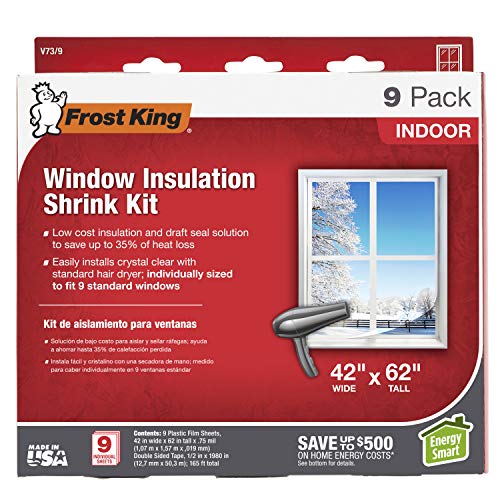
First, diagnose: where is this window actually failing?
Stand at the window on a windy day and read it with your hand and, better, with a lit incense stick or a candle held safely near the seams. Air moving at the meeting rail, the sill’s corners or the frame’s edge means the seals and the building’s joints are the problem, and film alone will not fix a leak it does not cover. A pane that is simply cold — no draft, just a radiant chill and condensation running by morning — is the glass itself losing heat, and that is film’s home ground, with curtains as its partner. Condensation deserves its own sentence: water on the inside of the glass is the room’s humidity meeting a cold surface, and while insulation warms the surface and reduces it, a bathroom or a drying-rack household may also need the moisture conversation this site has with its dehumidifier readers. Diagnose first because the layers are cheap but not free, and a household that films a window whose real failure is a perished seal has bought the wrong layer.
Layer one: seal the frame before you dress the glass
Wipe the frame and the wall joint clean, then run a bead of paintable caulk along any cracked or gapped joint between frame and wall — this is the leak the incense found, and it is permanent, invisible and nearly free. Removable rope caulk or sealant strip serves renters and windows that must open: pressed into the meeting rail’s gap and the sash’s channels, it kills the whistle for the season and peels away in April. Weatherstripping that has gone flat — the foam or V-strip in the sash’s tracks — is replaced in an hour with a utility knife and patience, and a window whose sash rattles in its frame is telling you its stripping died years ago. Lock the window, too, and check the latch actually pulls the sashes together; a surprising share of “window drafts” are an unlatched meeting rail holding a millimetre of winter open all season. Only when the frame is honest does the film go on — over a sealed window, where it can do its real work.
Layer two: shrink film, the extra pane you tape on
The principle is a trapped layer of still air. A clear film is taped around the frame’s face, over the whole window, then shrunk drum-tight and transparent with a hairdryer’s heat, and the air pocket between film and glass insulates exactly as a double-glazing unit’s gap does. Done well, it is nearly invisible, it stops the cold cascade off the glass, it cuts condensation by keeping the room-side surface warmer, and it comes off in spring with the tape. Done badly — dusty frame, rushed tape, film shrunk before it is sealed — it peels by January and teaches the household to hate the method rather than the workmanship. The kits below divide by format: pre-cut sheets in a multi-pack, a five-pack from 3M, a rolled film that cuts to size for many windows, and a single large sheet for a patio door. Measure your windows before choosing; the film must reach the frame’s face with margin on every side.
In this guide
Quick picks: four verified insulation kits
- For most houses: Frost King V73/9H 9-pack — pre-cut sheets for standard windows, the household name of the category.
- For a big winterisation: Duck Brand rolled kit — one roll covering up to ten windows, cut to size.
- For the careful finish: 3M Indoor Window Insulator Kit, five pack — the tidy installer with a condensation brief.
- For patio doors: Frost King V76H — the single large sheet a sliding door demands.
How these kits were chosen
Each kit’s ASIN was confirmed through this site’s Amazon catalogue check on 2026-11-24, and the descriptions follow the returned listings: sheet sizes, counts and stated purposes. The selection covers the four real formats a household meets — standard windows in quantity, many windows from a roll, a premium five-pack, and one oversize sheet — rather than four versions of the same box. Everything beyond the listings — the taping order, the hairdryer technique, the renter’s removal notes — is method, and it is labelled as such by being in the guide sections rather than the spec boxes.
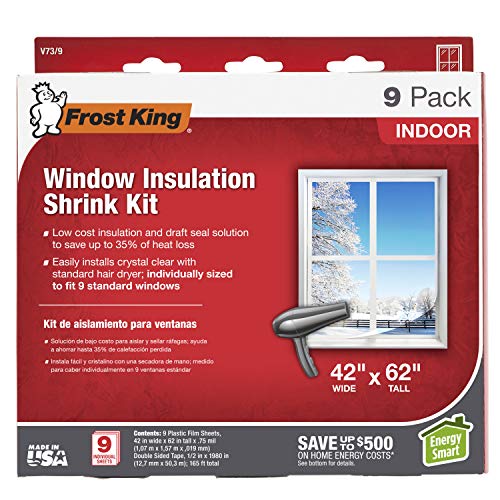
Frost King V73/9H Indoor Shrink Window Kit, 9-Pack — the default
Best for a houseful of standard windows
Frost King’s name is close to generic for this category, and the V73/9H is why: nine pre-cut clear sheets sized 42 by 62 inches in its listing, aimed at standard painted windows, with the tape the method needs. Pre-cut is the convenience that matters at scale — no measuring a roll against each window on a ladder of patience — and nine sheets cover the typical house’s worth of bedrooms and living spaces in one purchase. The film shrinks clear and tight with ordinary hairdryer work, and the brand’s tape has the season-long adhesion the method depends on when the frame has been cleaned as the guide insists.
- Contents: 9 pre-cut shrink-film sheets
- Sheet size: 42 × 62 in per its listing
- Application: indoor, tape-mounted to the frame
- Season: installed for winter, removed in spring
Strengths
- Pre-cut sheets remove the measuring-and-cutting stage from every window.
- Nine windows’ worth matches a whole house rather than a trial room.
- The category’s most practised instructions — the method’s quirks are all documented by its user base.
Trade-offs
- Oversize or unusually shaped windows outgrow the sheet and need the rolled format instead.
- Like all film, it seals the window shut for the season — ventilation habits must adapt.
- Tape on delicate or freshly painted frames should be tested in a corner first.
Best for: the standard house winterising in one weekend. Not suited for: patio doors and picture windows, which are the next two picks’ territories.

Duck Brand Window Insulation Kit, rolled film — the big job
Best for many windows, odd sizes and the whole-house pass
Duck’s answer is a roll: 62 inches by 420 inches of crystal-clear shrink film in its listing, rated for up to ten windows, with the tape included, cut to size as each window demands. The roll format is the flexible one — a tall narrow hall window, a wide squat basement one, and the standard bedrooms all come off the same stock with nothing wasted but the trimmings — and households with a dozen varied windows will finish with film left rather than a sheet short. The discipline the roll asks is measuring: add margin on every side before the scissors, because film cannot be stretched to apologise for a short cut.
- Contents: rolled shrink film, 62 × 420 in per its listing
- Coverage: up to 10 windows, cut to size
- Tape: included
- Application: indoor, tape-mounted
Strengths
- One stock serves every window shape in the house.
- Generous total coverage suits the whole-house winterisation.
- Leftovers keep for next season’s replacements and this season’s accidents.
Trade-offs
- Cutting to size adds a stage the pre-cut packs skip — and a miscut wastes a window’s worth.
- A roll stores less neatly than flat sheets between seasons.
- The first window is a learning exercise; start with the least-seen one.
Best for: many-windowed and odd-windowed houses, and anyone winterising for the first time who wants margin for error. Not suited for: the single patio door, whose sheet must be taller than the roll is wide in one piece — see below.

3M Indoor Window Insulator Kit, Five Pack — the careful finish
Best for visible rooms and condensation-prone windows
3M’s five-pack states its brief in the listing: keep cold drafts out and warm air in, and reduce the condensation and frost that build on the glass. That second clause is why this kit earns its place for the rooms where the window is looked at all winter — the film and tape are made to disappear, and 3M’s adhesives pedigree shows in tape that holds the season and releases in spring with less residue drama than the category’s average. Five windows is a flat’s worth or a house’s worst offenders, and households often run this kit on the living rooms and the Frost King across the bedrooms, which is a rational allocation of a premium.
- Contents: film and tape for 5 windows per its listing
- Stated brief: drafts, warmth retention, condensation and frost reduction
- Application: indoor, tape-mounted
- Finish: made to shrink clear and stay inconspicuous
Strengths
- The condensation brief is explicit — the right kit for windows that weep.
- Adhesive quality shows at removal time, the moment cheap tape is remembered by.
- A tidy, near-invisible result for rooms where the window is on display.
Trade-offs
- Five windows is a selective pass, not a whole big house.
- The premium over the value packs is real and buys finish, not more insulation physics.
- Standard window sizes only, as with the pre-cut formats.
Best for: main living spaces, condensation sufferers and anyone who has been hurt by tape residue before. Not suited for: the twelve-window whole-house job on a budget.

Frost King V76H Shrink Kit — the patio door sheet
Best for sliding doors and oversize glass
A patio door is the largest single sheet of cold in most houses, and it defeats standard kits by simple geography. The V76H answers with one sheet of 84 by 110 inches in its listing, made for the door’s full height. The installation is the two-person version of the method — one pair of hands holds and aligns while the other tapes — and the shrinking pass over that area is a slow, patient sweep rather than a window’s quick circuit. The reward is proportional: sealing the house’s biggest glass converts the room it serves, and households routinely report the patio room becoming usable in winter for the first time. The honest caution is access: a filmed patio door is a door out of service, so film the slider you use least, or accept the season’s arrangement with the garden.
- Contents: single shrink sheet, 84 × 110 in per its listing
- Application: patio and sliding doors, indoor
- Install: two people recommended
- Season: winter install, spring removal
Strengths
- The only format here that covers a full door in one piece.
- The largest single comfort gain available in this article, by area.
- Same tape-and-shrink method as the window kits — no new skill to learn.
Trade-offs
- The filmed door does not open — choose the household’s least-used slider.
- A big sheet is unforgiving of a dusty frame or a rushed alignment.
- Two-person installation, realistically, and a longer shrinking pass.
Best for: houses whose coldest room is the patio-door room. Not suited for: the door the dog, the bins and the household use twenty times a day.
How to install shrink film so it survives the season
Clean the frame’s face — the flat the tape will grip — with a degreasing wipe and let it dry fully; tape on dust or cooking film is tape on a countdown. Apply the tape around the frame’s outer face in one continuous run, corners pressed firmly, and leave the backing on until the film is cut and ready. Offer the film up with its margin even on all sides, peel the backing in stages, and press the film to the tape working from the top down, smoothing outward, accepting wrinkles at this stage because the shrinking will remove them — what it will not remove is a gap in the seal, so the perimeter’s completeness outranks the surface’s beauty. Then the hairdryer: highest heat, held a few inches away, moving in a slow circuit from the centre outward, watching the wrinkles walk off the film and the sheet go drum-tight and clear. Keep the dryer moving — a parked dryer melts a hole with impressive speed — and work the corners last. Trim the excess film beyond the tape with a sharp blade if you wish, gently. The window is now sealed for the season: plan the room’s fresh air accordingly, and put a note in the household’s shared memory that the pretty window in the spare room is not to be forced open in February by a guest.
Layer three: the soft defences — curtains, shades and snakes
Film stops the glass’s losses; fabric manages the room’s. Thermal curtains — heavy, lined, hung wide enough to overlap the wall and long enough to meet the sill or the floor — trap a second still layer against the window and break the cold cascade that slides off even filmed glass. Their discipline is daily: opened to any sun the day offers, because a winter sun through glass is free heating, and closed at dusk when the glass turns from asset to liability. Cellular (honeycomb) shades earn their mention as the permanent version of the same idea, their cells trapping air in the shade itself, and they suit windows that must stay usable. At the door and the draughty sill, the humble draft snake — a fabric tube of fill laid against the gap — remains the zero-technology answer to the under-door river of cold, and a house with filmed windows, drawn curtains and a snake at the door has addressed every route by which a window makes a room cold. Radiators under windows deserve their own sentence: keep the curtains from tucking behind them, or the heat warms the window’s pocket instead of the room, and consider a shelf or foil behind the radiator to push its heat inward.
Renters, listed buildings and the no-damage brief
Nearly everything in this article is reversible, which is its kindness to renters: film and tape remove in spring, rope caulk peels out, curtains hang on existing or tension rods, and the draft snake is furniture. The cautions are adhesive and paint — test tape on an inconspicuous corner, prefer the premium kits’ tape on delicate paint, and warm stubborn tape with the hairdryer at removal so it releases rather than lifting the finish. Caulk is the one permanent act here; renters skip it in favour of the removable seals, and owners of listed or historic windows keep everything interior and reversible as a matter of both law and respect for old glass. Nothing in the method touches the window’s exterior, its structure or its warranty, which is precisely why it is the standard advice for households that cannot renovate their way out of a cold room.
Common mistakes when insulating windows
Filming over an unsealed frame is the classic — the draft keeps its route and the film gets the blame. The second is tape on a dirty frame, discovered in January. Third is shrinking before the perimeter is fully sealed, which locks the gaps in beautifully. Fourth is parking the hairdryer and melting the demonstration hole. Fifth is filming every window in a house that then never gets fresh air — seal the bedrooms’ worst, keep a ventilation habit, and let the bathroom’s moisture have its exit. Sixth is forgetting the curtains’ daily rhythm, leaving them closed against a sunny day’s free heat or open against the night’s cold glass. Each mistake is a stage skipped, and the method is short enough that none of them needs to happen twice.
Final word
A cold window is not a renovation sentence; it is a layered problem with layered, inexpensive answers. Seal the frame, film the glass, dress it with fabric, and the room’s character changes by evening — the chair by the window becomes sittable, the condensation dries up, and the heating stops paying rent to the weather. Do the worst window first and sit beside it with a cup of something hot: the method will have its next volunteer before the cup is empty.
Room by room: where the layers earn most
The bedroom
Sleep is where cold announces itself — a filmed window and drawn thermal curtains change a bedroom’s night more than any other room’s, because the sleeper lies still for hours in the cold cascade’s path. Prioritise the window nearest the bed’s head, seal its frame with the removable layers so the window can still be cracked on mild nights by removing only the rope caulk, and expect the morning condensation on that window to be the household’s report card: less water, warmer glass, better method.
The living room
The living room is where the window is looked through, so finish matters: the 3M kit or a carefully shrunk Frost King, curtains with genuine lining rather than decorative sheers, and the radiator discipline — curtains clear of the radiator, heat directed into the room. This is also the room where the patio door lives, and the door sheet, for all its access cost, is the single largest comfort purchase in this article for a household that winters in that room.
The bathroom and kitchen
Moisture rooms complicate the brief: their windows are ventilation as much as glass, and sealing them shut for a season trades a cold problem for a mould problem. Film a bathroom window only if the room has an extractor that genuinely works, prefer seals and a cellular shade for a kitchen window that must open for steam, and treat persistent condensation in these rooms as a moisture question first — the dehumidifier and ventilation conversation — with insulation as its partner rather than its substitute.
The home office and the child’s room
A desk placed against an external wall under a window is the cold cascade’s favourite workstation; film and curtains are the difference between a desk that is used in January and one that migrates to the kitchen table. Children’s rooms take the same layers with one addition — check that cords for shades and curtains follow the safety guidance for young children, because the soft layer’s hardware, not its fabric, is where the hazard lives.
Measuring and ordering: the unglamorous accuracy
Measure each window’s frame face — the flat surface the tape will occupy — and record height and width per window before ordering anything. Pre-cut sheets must exceed the frame’s face on all sides; a sheet that fits the glass but not the frame is a return waiting to happen. For the rolled film, sum the windows with margins and compare honestly against the roll’s stated coverage, remembering that the first window’s learning curve consumes film the way first pancakes consume batter. Order before the cold arrives if the household can manage it: the kits are seasonal stock in much of the world, the first frost empties shelves, and a window filmed in October works all winter while one filmed in January has missed the season’s worst and the method’s point.
The physics, briefly — why still air is the whole trick
Air is an excellent insulator when it is not allowed to move, and a poor one the moment it circulates. A double-glazing unit, a shrink-film pocket, a cellular shade and a lined curtain are all the same invention at different prices: a layer of air held still between the cold surface and the room, so heat must conduct slowly across it instead of being carried by a current. This is why the film pocket’s depth matters less than its sealedness — a shallow, fully sealed pocket outperforms a deep one with a gap at the corner, because the gap restarts the circulation the pocket exists to stop. It is also why the cold cascade happens at all: air touching cold glass cools, grows denser, and slides downward in a sheet, arriving at the floor as a draught with no hole anywhere in the building. Every layer in this article is either sealing a true hole or interrupting that sheet of falling cold — and a household that understands the distinction can improvise correctly in any room, with any materials, for any window shape the kits never anticipated.
A worked weekend: the whole house in two days
Saturday morning is diagnosis and shopping: the incense walk, the latch checks, the measurements, and one trip for kits, caulk, rope caulk and a spare tape roll, ordered against the list rather than memory. Saturday afternoon is the frame work — caulk where it is owned, rope caulk where it is rented, weatherstrip where it has died — done room by room while the light is good, finishing with every frame’s face cleaned and dried for tomorrow’s tape. Sunday is film day, worst window first while concentration is fresh, two people for the patio door before lunch, the standard windows through the afternoon in a rhythm that gets visibly faster by the fourth. Sunday evening is the soft layer: curtains rehung at their winter width, the snake at the door, and the household’s first evening in the insulated house, which is when the chair by the window gets tested and the method gets its verdict. Nothing in the weekend requires a tool beyond a hairdryer, a blade, a tape measure and a step stool — and the entire programme reverses in an April hour, leaving the house exactly as it was, minus one winter’s worth of cold.
Frequently asked questions
Does window insulation film really work?
Yes — it creates a trapped still-air layer over the glass, which is the same insulating principle as a double-glazing gap, and its effects are the ones physics predicts: less cold radiating and cascading off the pane, warmer room-side surfaces, and reduced condensation. It does not fix a leaking frame, which is why this article seals the frame first and films second.
Can I still open a window that has film on it?
No — the film seals the window for the season, which is the genuine cost of the method. Households plan around it: film the worst windows, leave one openable window per room or rely on doors and other rooms for airing, and remove the film in spring. If a window must open all winter — a kitchen’s steam escape, a bedroom’s fresh-air habit — insulate it with seals and curtains instead and film its neighbour.
Will the tape damage my paint or frames?
Quality kit tape is made for a season’s hold and a clean release, but delicate, old or freshly cured paint deserves respect: test in a corner, choose the premium kits for precious frames, and at removal warm the tape with a hairdryer and peel slowly at a low angle. Renters in doubt can mount the film to the frame’s least visible face or use the removable-seal layers only.
How much warmer will the room actually feel?
The honest answer is in comfort rather than a promised number: the cold cascade off the glass stops, the radiant chill at the window seat largely goes, and the room’s cold corner becomes ordinary. Thermostats often come down a notch because the household stops compensating for one freezing wall — but this article promises the chair by the window back, and lets the fuel bill be a pleasant surprise rather than a quoted figure.
Does film stop condensation?
It reduces it substantially on filmed windows, because the room-side film surface is warmer than the glass was, and condensation forms on cold surfaces. It does not remove the room’s moisture, so a household generating a great deal of it — indoor laundry, long showers, many houseplants — may still need ventilation or dehumidification for the remaining surfaces. 3M’s kit states the condensation brief explicitly, which is why it is recommended for weeping windows.
What about insulating from outside, or bubble wrap?
Exterior storm solutions belong to owners and professionals and outperform interior film where they are permitted, at renovation prices. Bubble wrap pressed to the glass with a mist of water is the folk version of film — it does insulate, at the cost of the view and the light, and it suits a utility room or a basement window where those do not matter. For living spaces, shrink film’s transparency is worth its small premium over the bubble wrap’s honest service.
When should I install and remove window film?
Install on a dry day before the heating season settles in — the frame must be clean and dry for the tape, and a mild day lets you work with the window open while you prepare it. Remove when the heating goes off for the year, peeling the tape slowly with warmth if it resists. Film left on into summer costs the window’s opening and the film’s clarity; the method is a season’s garment, put on and taken off with the coats.
Can I insulate a window that already has double glazing?
Yes, and tired double glazing is one of film’s best cases: a sealed unit whose spacer has failed or whose seals have aged loses much of its gap’s benefit, and a filmed interior layer restores a still-air pocket the unit no longer provides. If the unit is misted between its panes, that failure is inside the unit and film will not cure the view — but it will still cut the heat loss while the household saves for the unit’s replacement.
How do I insulate a window air-conditioner opening or a louvred window?
Louvres and jalousies defeat film — too many moving edges — and their honest answers are seals at every slat’s meeting, a fitted interior panel of clear rigid sheet cut to the frame for the season, or replacement, which is the landlord conversation. A window AC unit removed for winter leaves a hole that wants an insulated panel, not film: rigid foam board cut to the opening, edges sealed, does the structural work film cannot. Match the layer to the geometry; the article’s principles — seal the gaps, trap still air — survive every translation.
Is it worth insulating windows in a mild climate?
For the few cold weeks, often yes at the film’s price — the comfort at the window seat is immediate and the kits keep for next year. The calculus changes only where winter is a rumour: a household with two cold nights a year should buy curtains and a draft snake and let the film go. Insulation advice, like clothing advice, is local; this article’s layers are listed cheapest-commitment first so a mild household can stop at the layer its winter justifies.
My film keeps peeling at one corner. What is wrong?
That corner’s tape is gripping something other than clean frame — dust, grease, a flake of old paint, or a section where the backing was touched during application. The repair is local: warm the area, lift the film’s edge, clean the frame spot properly, apply fresh tape over the old run, and re-press and re-shrink that corner. If peeling is general rather than local, the frame was not clean anywhere and the honest fix is a full redo on a properly prepared surface; the method’s adhesion is excellent on a clean frame and theatrical on a dirty one.
Can I reuse the film next winter?
The tape, no — it is a single season’s adhesive. The film itself sometimes survives removal intact, and households do refit the same sheets with fresh tape, accepting a slightly less perfect clarity. Given the kits’ price, most households treat film as an annual consumable and keep a spare pack for mid-season accidents — a torn sheet in January is replaced from stock rather than mourned until spring.
How do I insulate windows without blocking the light?
Shrink film, properly installed, is the answer — it goes on slightly hazy and shrinks to a clarity that most visitors never notice, and it costs the window nothing in daylight worth measuring. The layers that do cost light are the folk ones (bubble wrap) and heavy curtains kept closed by day, which is why the article’s rhythm opens curtains to the sun: insulation should manage the night and the storm, and get out of the daylight’s way.
What is the cheapest effective order to do all this in?
Latch and seal first — caulk and rope caulk cost almost nothing and fix the leaks film cannot. Film second, on the worst windows before the merely cold ones, because the kits are the next-cheapest layer and the comfort return is immediate. Curtains and shades third, as budget and rooms demand, since they are the layer with furniture prices. A household that does the stages in that order across a season spends the least money for the most warmth at every point — and can stop at any stage with a house that is already better than it was.
Does insulating windows help in summer too?
The frame seals help in every season — a gap leaks cooled air out in July as happily as it leaks cold in during January — and the habit of closing curtains against a hot afternoon’s sun on the sun-struck side is the summer twin of this article’s winter rhythm. The film itself usually comes off for the opening season, since summer wants the windows’ ventilation more than their still-air pocket; households in severe heat with fixed windows sometimes keep it, and the physics does not object.
How do I know which window to do first?
The one the household lives against: the window over the sofa, the desk or the bed’s head, in the room occupied longest in the evening. Comfort is local — a degree at the occupied chair outweighs three in the spare room — and the first window’s success is also the method’s advertisement to the rest of the household. Do that one window completely — seals, film, curtains — live with it for a week, and the remaining windows will be requested by name.
Will insulating help with outside noise?
Modestly, and honestly reported: sealed gaps remove the whistle paths, and a filmed window’s extra layer dulls a little of the street’s higher register. It is a side benefit, not a solution — serious noise wants mass and sealed units designed for it. Households whose real problem is the road should not let this article’s layers be sold to them as acoustics; they are thermal tools with a quiet footnote.
What if my windows are draughty because the house itself moves?
Older houses breathe through their joinery, and their windows’ gaps reopen as the building shifts with the seasons — which is why the removable seals, renewed each autumn, suit old houses better than any permanent filler that cracks by spring. Insulating an old window is an annual ritual rather than a repair, and households in period homes make their peace with the rhythm: seals and film each October, everything off each April, and the house’s character — which includes its drafts’ manageability — accepted as the price of its virtues.
Can I film a window with blinds mounted inside the frame?
Only if the film can mount to a surface beyond the blinds’ hardware — usually the wall or the frame’s outer face — with the blinds left in their recess, and even then the shrinking pass needs clearance so the hairdryer’s heat does not meet the blind’s cords and slats at close range. Many households remove interior-mounted blinds for the season, film the window, and use curtains as the winter’s light control instead; the blinds return in spring with the film’s removal, and the room gains the curtain layer it may keep.
How long does each window take, realistically?
The first window takes the better part of an hour, including the learning, the miscut risk and the admiration breaks. By the fourth window, a practised pair of hands films a standard window in fifteen to twenty minutes, most of it taping and shrinking. The patio door is its own appointment — allow an hour and a second person. Budget the weekend by the worked plan in this article rather than by optimism, and the job finishes on Sunday with morale intact.
What do I do if a filmed window’s room starts to feel stuffy?
Open a door to the hall, run the bathroom or kitchen extractor for a spell, or crack a window in a less-used room for ten minutes — a house needs air changes, and a sealed set of bedroom windows does not seal the house. If stuffiness is chronic, film one fewer window per room next season and lean on the seals and curtains for it instead; comfort is the brief, and air quality outranks the last increment of insulation.
Can pets damage the film?
A cat with a window seat and opinions can, yes — one claw through the sheet ends that window’s pocket, though the repair is a fresh sheet rather than a disaster. Households with climbers place a perch that does not require film contact, or accept the cat’s window as the one insulated by curtains and seals alone. Dogs are gentler on film but enthusiastic at patio doors; the door sheet and a dog door habit cannot coexist, which settles that choice for many houses.
Is there a permanent version of all this?
Yes — it is called secondary glazing, and then replacement windows, and they are the same physics at building prices with building permanence. The honest path for owners is to let a winter of film prove which windows actually matter — the ones whose filming changed the room — and spend the permanent money on those, in that order, when renovation is due. Film is not the enemy of the permanent fix; it is the survey that tells you where the fix belongs.
Should I insulate windows in a house I am about to sell?
The seals and a latch tune-up, yes — they are maintenance, and they show. A full film programme in a house being photographed and viewed is a judgement call: film reads as a winter expedient to a buyer’s eye, and an unheated viewing on a cold day may be better served by the heating run early and the curtains managed well. Spend the effort on the frame leaks a surveyor’s hand can find, and let the new owners choose their own layers.
What is the difference between the Frost King, Duck and 3M kits, really?
Format and finish, not physics — every kit in this article is clear film, tape and a trapped air pocket. Frost King’s nine-pack is pre-cut convenience at household scale; Duck’s roll is coverage and flexibility for many or odd windows; 3M’s five-pack is the finish and adhesive quality for visible rooms and weeping glass; and Frost King’s large sheet exists because a patio door cannot be covered by any of the others. Choose by the windows in front of you, and the physics will be identical whichever box arrives.
Can I put film on the outside of the window instead?
The kits in this article are interior systems, and exterior film faces weather, wind and ultraviolet that the tape and sheet are not made for — an exterior sheet’s season is measured in storms, not months. Exterior work belongs to storm windows and professional secondary systems. The interior placement is also the method’s comfort secret: the warm side is where the condensation forms and where the occupant sits, and a pocket on the room side defends both at once.
How do I handle a window with a radiator directly beneath it?
Film it as usual, then manage the heat’s path: curtains that stop at the sill rather than draping over the radiator, or curtains drawn to the radiator’s sides, so the rising warmth enters the room instead of the pocket between curtain and glass. A radiator shelf helps deflect the flow inward. The filmed window above a radiator is actually the house’s most efficient arrangement once the curtain discipline is right — the glass stops leaking the heat the radiator is making.
What should I do about a window that sweats between the film and the glass?
Moisture trapped in the pocket at installation — a humid room on fitting day, a frame not fully dry — will condense inside the sandwich where you cannot wipe it. The cure is to redo that window on a dry day with the room aired and the frame dried, which is why the worked weekend in this article schedules film after a day of open-window frame work. A pocket fitted dry stays clear; the water has to be invited in at the start to be a problem later.
Are there windows I should not insulate?
Windows that are a room’s only ventilation and serve a gas appliance’s air supply must never be sealed without professional advice — combustion appliances have air requirements that outrank insulation entirely. Fire-escape windows should keep their opening function or be filmed only with the household’s explicit, practised removal plan. And a window whose frame is rotten wants a carpenter before it wants a kit; film over decay is decoration on a structural problem.
How do I remove the film and tape in spring without a mess?
Peel the film away first, then warm each run of tape with the hairdryer on low and lift it slowly at a shallow angle, rolling it back on itself. Residue that remains yields to a cloth with a little cooking oil or a citrus adhesive remover, followed by a normal wash — test any remover on a hidden corner first. Frames done this way come out of the season unmarked, which is the method’s whole promise to renters and the reason the removal technique deserves the same care as the installation.
What is the one tool people forget?
A sharp blade for trimming and for lifting tape corners, and a step stool that lets the tape run be pressed at standing height rather than reached for. The hairdryer everyone remembers; the stool is what separates the window taped at a stretch — with the gaps to prove it — from the window taped in comfort, sealed all the way around.
Does the order of windows within a room matter?
Slightly: do the largest and the one nearest the seating first, since area and proximity are where comfort is decided, and leave any window the room needs for air until the household has lived with the others sealed and chosen knowingly. A room insulated in that order can stop at any point with the best result its budget has bought so far.
How do I find which window in a room is leaking most?
Test on a cold, reasonably still day, when the contrast is easiest to feel. Move a hand slowly around each frame, staying a short distance from the surface, and note where a cool thread of air crosses your skin, especially at the meeting rails and the corners of the sill. For a finer test, hold a strip of tissue or a length of thread beside the closed edges and watch where it stirs while no one is moving around the room. Work through the room window by window and write the ranking down, because the worst offender is often a small window you had ignored rather than the large one you blamed. Insulate in that order and even a single kit spent on the leakiest window can change how the whole room feels.
What should renters check before insulating a window?
Start with what your lease and your landlord allow, and favour methods that leave no trace. Interior film, removable rope caulk, draft snakes and thermal curtains all come away cleanly at the end of a tenancy, while drilling for secondary glazing, fixing permanent battens, or sealing a window shut with foam can breach an agreement and may also block a fire escape route, which no saving justifies. Photograph the frames before you begin, keep the receipts and packaging for anything you fit, and ask before applying adhesive to painted or heritage timber, where removal can lift the finish. If a frame is rotten or a latch is broken, report it in writing rather than insulating over it: that is the landlord’s repair, and your film will not fix it.
Related reading on this site
how to get weed smell out of your car