Disclosure: As an Amazon Associate, dailyhomedecorating.com earns from qualifying purchases. Links on this page are affiliate links; they cost you nothing extra. Prices and availability change often, so check the current Amazon listing before you buy.
Anyone collecting lg portable ac reviews in the middle of a heatwave is usually standing in a warm room, reading on a phone, and losing patience — so here is the short version first. LG’s portable line divides into dual-inverter models that cool efficiently and quietly, and simpler single-speed models that cost less in spirit and ask more in noise. Three LG units and three BLACK+DECKER alternatives are compared below, because half the households that start out wanting an LG discover that a rival’s size or smart features fit their window, their room, or their lease rather better.
Portable air conditioners exist for the homes central air forgot: rented flats where the lease forbids window units, bedrooms above a garage that the ductwork never quite reaches, home offices in converted attics, and listed buildings where nothing may protrude from a façade. They roll, they vent through a hose, and they compromise — cheerfully, usefully, but unmistakably. A portable will never match a window unit’s efficiency at the same cooling power, because its hot machinery sits inside the room it is cooling. What it offers instead is permission: cooling without installation, without a landlord’s signature, without a hole in anything.
In this guide
Quick picks from these Lg Portable Ac Reviews
| Unit | Cooling claim on listing | Room fit | Link |
|---|---|---|---|
| LG Dual Inverter 10,000 BTU | Cools up to 500 sq. ft. | Main bedroom or living room | Check price on Amazon |
| LG LP1022FVSM Dual Inverter | 10,000 BTU SACC, cools 450 sq. ft. | Medium-large room, quiet priority | Check price on Amazon |
| LG 7,000 BTU DOE portable | Cools 300 sq. ft. | Small bedroom or study | Check price on Amazon |
| BLACK+DECKER BPACT10WT | 5,500 BTU SACC, rooms up to 450 sq. ft. | Budget-conscious medium room | Check price on Amazon |
| BLACK+DECKER BPACT12WT smart | 8,000 BTU SACC, rooms up to 550 sq. ft. | Smart control for a larger room | Check price on Amazon |
| BLACK+DECKER BPACT14WT smart | 10,200 BTU SACC, rooms up to 700 sq. ft. | Biggest space in this group | Check price on Amazon |
Two rating languages appear in that table and confusing them is the oldest mistake in this category. ASHRAE figures describe a unit’s raw cooling under laboratory conditions that flatter it; SACC — seasonally adjusted cooling capacity — discounts for the heat the machine itself dumps back into the room and the warm air its hose leaks. When both numbers appear, shop by SACC. A unit advertised loudly at an ASHRAE figure and quietly at a much lower SACC figure is not lying, exactly, but it is certainly hoping to be misread.
How the six units were selected and compared
Each model here was confirmed through this site’s Creators API records before a word was drafted: exact listing title, official image, and a live product identity. LG’s dual-inverter pair earned their places because inverter compressors are the one genuine technology step portables have taken in a decade — varying speed instead of slamming on and off, which changes both the electricity bill and the sound of a room. The smaller LG covers the many households whose problem room is a twelve-by-twelve bedroom rather than a loft. The BLACK+DECKER trio stands in as the market’s reference point: widely owned, honestly specified with SACC figures in their titles, and spanning the same room sizes.
Comparison leaned on five domestic questions. How big a room can the unit hold at a civilised temperature on a genuinely hot afternoon, not a mild one? How does it sound across a bed, a desk, or a cot? What does the venting kit demand of the window, and can a renter supply it? How are condensate and dehumidification handled when August humidity arrives? And what will ownership feel like in week six, when the novelty has gone and only the hose, the filter, and the remote remain?
Detailed reviews

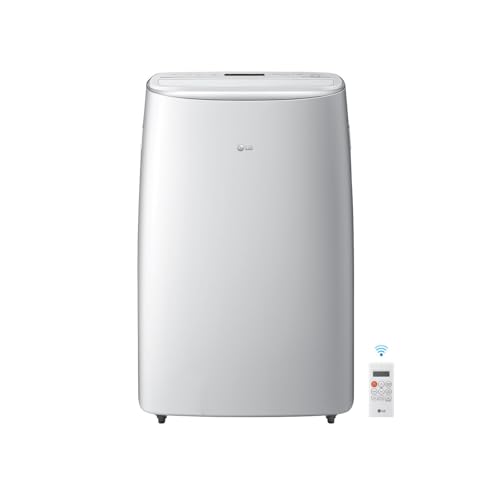
LG 10,000 BTU Dual Inverter Portable Air Conditioner — the LG to beat
Badge: Best all-round LG portable for a main room
- Stated reach: cools up to 500 square feet
- Dual inverter compressor, 115V supply
- Three fan speeds and a 24-hour timer
- Wi-Fi control and remote included
- Suits bedrooms, offices, kitchens, dining rooms per listing
Inverter technology changes the portable experience at its most annoying point: the cycle. A conventional compressor starts with a thump, roars to full effort, overshoots, stops, and lets the room drift warm before thumping again. A dual inverter instead modulates, holding a steadier temperature with a steadier, lower sound. In a bedroom that steadiness is sleep; in an office it is the difference between cooling and a machine that interrupts every video call with its own opinion.
The stated five-hundred-square-foot reach makes this the LG for a main living space or a generous master bedroom, provided the venting is done properly and doors are managed like the thermal boundaries they are. Wi-Fi control earns its keep in a specific ritual: starting the cool-down from downstairs, or from the train home, so the room is ready rather than merely promised. The 24-hour timer covers the simpler version of the same trick for households that keep regular hours.
Ownership caveats are the category’s usual ones, applied honestly. The unit is a substantial piece of furniture that will live in a corner all summer and in storage all winter, so measure both homes for it. Its hose run should stay short and straight; every bend and every extra metre of warm hose radiates heat back into the room the compressor just paid to cool.
Strengths
- Inverter running is quieter and steadier than on-off cycling
- Cooling reach suits a genuine main room, not a token one
- App control makes pre-cooling a lived reality
Trade-offs
- Premium positioning within the portable category
- Large cabinet demands storage space out of season
- Performance still depends heavily on hose installation
Best for: a household cooling one main room properly, all summer, with sleep and calls happening in it. / Not suited for: a tiny spare room, or a buyer who will move the unit between floors weekly.

LG LP1022FVSM — dual inverter with its SACC figure up front
Badge: Best for shoppers who read specifications closely
- Listed as 10,000 BTU SACC (14,000 ASHRAE)
- Stated reach: cools 450 square feet
- Dual inverter, described as ultra quiet
- Wi-Fi app control and window kit positioning
Credit where due: this listing puts both rating languages in its title, SACC first, which lets a careful buyer compare like with like across brands. Its real capacity sits in the same working band as its sibling above, aimed at rooms up to about four hundred and fifty square feet, and the dual-inverter compressor brings the same steadiness of temperature and temper. Households choosing between the two LGs should compare the current listings’ included kit, dimensions, and control details rather than chasing a headline number that does not separate them.
The easy-install emphasis matters more than it sounds. Portable air conditioners fail socially, not mechanically: a badly sealed window panel leaks hot air around the hose all afternoon, the room never quite cools, and the machine gets blamed, returned, or exiled to a garage. A kit that fits common window types cleanly, plus panels that can be trimmed without drama, is worth real money in a heatwave when patience is the scarcest resource in the house.
As a bedroom machine its quiet positioning is the headline. Inverter running at part load, a sensible night routine, and a door kept closed turn a medium-large bedroom into the coolest room in the home — a title every other room will envy by the second week of July.
Strengths
- Transparent dual rating in the listing title
- Inverter quietness aimed squarely at bedrooms
- Installation kit treated as a feature, not an afterthought
Trade-offs
- Overlaps its LG sibling closely; choice needs care
- Still a single-hose class machine with inherent limits
- App setup is one more account in the household
Best for: a specification-literate buyer cooling a medium-large bedroom. / Not suited for: anyone expecting window-unit efficiency from a rolling unit.

LG 7,000 BTU (DOE) Portable Air Conditioner — the small-room LG
Badge: Best for a single small bedroom or study
- Listed as 7,000 BTU DOE / 10,000 BTU ASHRAE
- Stated reach: cools 300 square feet, a 12 by 25 ft room
- LCD remote control included
- Window installation kit included per listing
- Quiet operation positioning for bedrooms
Not every hot room is a ballroom. The nursery over the porch, the box-room office, the guest bedroom that bakes under a low roof — these are three-hundred-square-foot problems, and answering them with a five-hundred-square-foot machine wastes money, floor space, and electricity on every cycle. This smaller LG is the proportionate answer, with its DOE figure stated plainly and a room example printed in the listing so buyers can pace their own floor and compare.
Expectations should shrink with the cabinet. In its intended room, door closed, blinds drawn against afternoon sun, it takes the edge off a hot night completely and holds a study at working temperature through a heatwave afternoon. Ask it to rescue an open-plan kitchen-diner and it will run bravely, loudly, and inconclusively. That is not a defect; it is arithmetic wearing a plastic case.
For renters this size class has a quiet advantage: smaller units are easier to store in a wardrobe over winter, easier to carry up stairs, and easier to justify to a landlord as the temporary appliance they are. Households with exactly one problem room and no ambitions beyond it will find this the most honest purchase in the LG half of the table.
Strengths
- Right-sized for the most common problem rooms
- Room dimensions stated in the listing itself
- Easier storage and carrying than its larger siblings
Trade-offs
- No headroom for heatwaves in bigger spaces
- Conventional compressor cycling, not inverter calm
- Will disappoint anyone who under-measures their room
Best for: one small bedroom, nursery, or study that overheats. / Not suited for: living rooms, open layouts, or sun-trap loft conversions.

BLACK+DECKER BPACT10WT — the value reference point
Badge: Best straightforward alternative under the LG pair
- Listed as 10,000 BTU with 5,500 BTU SACC
- Positioned for rooms up to 450 square feet
- Three-in-one: cooling, fan, and dehumidifying
- Follow Me remote control feature named on listing
BLACK+DECKER’s portable line is the category’s popular benchmark, and this ten-thousand BTU model shows why: the specification is legible, the three-in-one formula covers cooling plus the fan-only and dehumidifying modes shoulder seasons actually use, and the Follow Me remote carries a temperature sensor so the unit responds to conditions where the person sits rather than where the cabinet stands. That last detail is smarter than it sounds in a long room.
Read its SACC figure with respect. Five and a half thousand SACC against a ten-thousand headline is the category’s honesty tax, printed in the title. In practice the unit suits a medium bedroom or a modest living room in a temperate-to-hot climate; in a severe climate or a sun-blasted room, step up a class. Buyers who understand that sentence will be content with this machine for years.
Against the LGs it trades inverter refinement for simplicity and price positioning. There is no compressor modulation to admire, but there is also less to configure, and the ownership experience — clean the filter, empty or drain as conditions demand, seal the window kit well — is the category standard, easily learned in one afternoon.
Strengths
- Legible specification with SACC stated openly
- Remote sensing improves comfort in longer rooms
- Fan and dehumidifier modes extend its useful seasons
Trade-offs
- On-off compressor sound exceeds the inverter LGs
- Real cooling capacity is the SACC figure, not the headline
- Fewer smart features than the smart models below
Best for: a medium room needing proven, uncomplicated cooling. / Not suited for: a light sleeper’s bedroom in a very hot climate zone.

BLACK+DECKER BPACT12WT Smart — connected cooling a size up
Badge: Best smart alternative for a larger bedroom
- Listed as 12,000 BTU with 8,000 BTU SACC
- Positioned for rooms up to 550 square feet
- Smart three-in-one: cooling, fan, dehumidifying
- App-era control set per the smart designation
The twelve-thousand class is where portables start to hold a family-sized room with some dignity, and this smart BLACK+DECKER is the group’s connected option at that size. Eight thousand SACC is a working figure a buyer can plan a five-hundred-square-foot room around, particularly with blinds, door discipline, and a hose run kept short. The smart layer suits households that cool a bedroom from downstairs or start the machine before leaving work — the two rituals that make portable cooling feel like a system rather than an appliance.
Compared directly with the LG dual inverters, the trade is refinement for reach and value positioning. The LGs will sound calmer at part load and sip rather than gulp at the meter; this unit answers with a bigger stated room and a simpler brand ecosystem that many households already own tools and batteries from. Neither answer is wrong; they are answers to different questions asked in the same heatwave.
Dehumidifying mode deserves its own sentence, because in humid climates half of comfort is water, not temperature. A portable that can pull moisture on a muggy evening without overcooling the room earns its floor space in May and September as well as July, which quietly transforms the value calculation for owners in the humid half of the map.
Strengths
- Useful step up in real, SACC-measured capacity
- Smart control supports pre-cooling routines
- Dehumidifying mode widens its working calendar
Trade-offs
- Compressor cycling is audible beside a bed
- Heavier cabinet to roll, store, and carry
- Smart setup may exceed a guest room’s needs
Best for: a larger bedroom or modest living room wanting app control. / Not suited for: a nursery where compressor starts wake the occupant.
BLACK+DECKER BPACT14WT Smart — the biggest room answer here
Badge: Best for the largest single space in a home
- Listed as 14,000 BTU with 10,200 BTU SACC
- Positioned for rooms up to 700 square feet
- Smart three-in-one with Follow Me remote
- Top SACC figure in this comparison
Every category has a point where the portable format is being asked to do a window unit’s job, and this is that point — in a good way, provided the buyer walks in informed. Ten thousand SACC is genuine capacity, enough for a large living room, a combined kitchen-diner, or a primary suite with a seating area, in all but the most punishing climates. The Follow Me remote matters at this scale, because a seven-hundred-square-foot room has climates of its own and the sofa’s weather should outrank the corner’s.
The costs of scale are physical. This is the heaviest, thirstiest, and most conspicuous machine in the group, its hose and window kit are doing the most work, and a sloppy installation wastes more here than anywhere else. Seal the panel, shorten the hose, shade the sun-side windows, and the unit rewards the effort. Skip those steps and the biggest portable in the roundup becomes the biggest disappointment in it.
Households at this size should also ask the honest question the buying guide below repeats: is a portable truly required, or merely habitual? Where a window unit is permitted, it will cool this room more efficiently. Where it is not — the lease, the homeowners’ association, the window shape itself — this BLACK+DECKER is the strongest rolling answer in the present company.
Strengths
- Highest real cooling capacity in this line-up
- Remote sensing suits genuinely large rooms
- Smart features included at the top size
Trade-offs
- Most demanding installation and storage of the six
- Running costs follow its capacity upward
- Portable inefficiency is magnified at this scale
Best for: the largest room in a home where window units are impossible. / Not suited for: small rooms, tight storage, or quiet-critical bedrooms.
Buying guide: reading portable AC specifications without being fooled
Begin with SACC and ignore everything else until that number is found. It is the only figure designed to compare portables fairly, because it accounts for the heat the machine leaks back into its own room. As a rough household translation, a SACC figure around five to six thousand serves a medium bedroom, eight thousand stretches to a larger bedroom or small living room, and ten thousand begins to hold a family room. Climate shifts every one of those bands: a shaded room in a coastal city and a west-facing room in a desert suburb are different sports played on the same-sized field.
Then interrogate the window. Portables vent through sliding panels that suit common sash and slider windows; casement windows that crank outward, very wide openings, and through-wall fantasies all need extra thought and sometimes extra kit. Measure the window before ordering, photograph it, and read the listing’s kit description against the photograph. Renters should also confirm the panel can be removed without marks, since the whole point of the format is leaving no trace in October.
Sound comes next, and it should be imagined at pillow distance in a quiet house, not in a showroom at noon. Inverter models earn their premium here, conventional models earn forgiveness through distance, rugs, and doors. A machine destined for a living room can be allowed a voice; a machine destined for beside a cot should be auditioned during the returns window with the seriousness of a mattress trial.
Water management is the specification nobody reads until the first humid week. Portables pull moisture from cooled air, and designs differ in how much they evaporate out of the hose versus collect internally. In dry heat the question may never arise; in a Gulf Coast August a unit that needs frequent emptying, or a drain hose routed to a bucket, becomes a household chore with a schedule. Read the listing and manual for condensate handling before the weather teaches the lesson at 11 p.m.
Finally, plan the winter. A portable is a summer tenant and a winter storage problem, roughly the size of a small suitcase that cannot be laid on its side in a loft without thought. Homes with a garage corner or a deep wardrobe absorb that cost invisibly. A studio flat pays it in visible floor space for eight months, which occasionally tips the decision toward the smallest adequate unit rather than the largest affordable one.
For a direct format comparison before committing, see portable units weighed against window units in this same cluster, and for venting questions, cooling without a conventional exhaust.
Installing and running a portable so it actually cools
Step 1: Site the unit near the window it will use
Choose the window first and the corner second. The hose should reach its panel with length to spare but without loops of spare hose coiled on the floor radiating heat. Every unnecessary bend costs cooling, and an extended hose stretched to its limit both performs and looks miserable. If the only workable window puts the machine in an awkward spot, accept the awkwardness for the summer; thermodynamics does not negotiate with interior design.
Step 2: Seal the window panel like the weather depends on it
Because it does. Fit the panel snugly, use the foam sealing supplied or improvise more where gaps remain, and check the result from outside if the window allows. A finger’s width of open gap beside a hose panel can admit as much hot air as the machine removes in an hour. This single step explains most of the gap between delighted owners and furious ones writing reviews at midnight.
Step 3: Cool the room’s habits, not just its air
Draw blinds on sun-facing glass before the room heats, keep the door closed while cooling matters, and start the machine before the space is unbearable rather than after. Portables hold temperature far better than they recover it. A room pre-cooled from late afternoon asks the unit for maintenance; the same room at thirty degrees by evening asks for a rescue it will perform slowly and loudly.
Step 4: Keep filters, coils, and drainage boring
Wash or vacuum the air filter on the maker’s rhythm — dusty homes should halve the interval — because a clogged filter strangles airflow and cooling together. Check condensate behaviour during the first humid week so the machine’s habits are known before a full tank stops a unit at midnight. Wipe the cabinet’s intakes when dust films them, and store the whole unit clean, dry, and upright when the season ends, with the hose and panels kept together in one labelled bag.
Mistakes that make good portables look bad
Undersizing is the champion. Buyers measure a room, round down, choose the cheaper class, and spend the summer with a machine at maximum effort producing a room that is merely less hot. Oversizing has subtler costs — short cycling, clammy air, wasted money — yet in portables the greater sin by far is optimism. Second comes hose neglect: long, kinked, uninsulated runs glowing warm against the floor of a room the owner paid to chill.
Third is the open-door paradox, where a household cools a bedroom while its door stands open to a hot hallway and then concludes the unit is weak. Fourth is ignoring humidity, expecting temperature alone to deliver comfort in a climate where moisture is the real burden, and never using the dehumidifying mode sitting in the menu. Fifth is storage amnesia — a unit put away damp or filter-dirty in September returns in June smelling like a basement and performing like one too.
LG or BLACK+DECKER: the honest split
Choose LG when the machine will live in a bedroom or office where its sound is part of the room’s life, because the dual-inverter pair’s steadiness is a daily quality, not a specification-sheet ornament. Choose LG, too, when electricity costs are high enough that modulation pays rent every month. Choose BLACK+DECKER when the priority is the most real cooling per purchase at a given size, when smart features at the larger sizes matter, or when the household simply wants the category’s popular benchmark with a specification it can read at a glance. Both brands ask the same of their owners — honest sizing, sealed venting, clean filters — and both punish the same shortcuts.
Final word on the Lg Portable Ac Reviews
If one machine must be named, the LG dual-inverter ten-thousand is the portable most households will be happiest living beside: steady, quiet-minded, and sized for a main room. The LP1022FVSM stands shoulder to shoulder with it for buyers who value its transparent ratings. Below them, the small LG serves single rooms with proportion, while the BLACK+DECKER ladder offers a legible climb from medium rooms to the largest space a rolling unit can credibly serve. Buy by SACC, seal the window, shorten the hose, and any of the six will do the job its size promises.
A heatwave week with a portable, day by day
Day one is installation day, and it sets the summer’s tone. The household that levels the unit, seals the panel carefully, and tests the drainage in daylight will barely think about mechanics again. The household that stuffs the hose through a gap and hopes will revisit that decision nightly. By day two, routines form: blinds drawn at noon, machine started before the bedroom absorbs the afternoon, door closed without discussion. Day three is when the portable’s real personality emerges — not its cooling power, which was obvious immediately, but its sound as a member of the household, present at meals, calls, and the edge of sleep.
Day four usually brings the humidity lesson in damp climates. The room is cool yet feels unfinished, and someone discovers the dehumidifying mode or the condensate routine the hard way. Day five is the electricity reckoning, when a plug-in meter or a smart plug report reveals what continuous cooling costs per day, and the household starts cooling the occupied room rather than the whole home out of habit. By day six the machine has a name, the remote has a home, and the filter has its first appointment in somebody’s calendar. Day seven, if the sizing was honest, is simply a cool room — the anticlimax every buyer was actually purchasing.
Climate changes the answer
In a dry desert heat, a portable’s job is almost purely thermal: air is hot, moisture is scarce, condensate is a rumour, and the contest is between the machine’s SACC figure and the sun’s enthusiasm for west-facing glass. Shade the glass and even a mid-sized unit holds its room. In a humid subtropical summer the enemy splits — temperature and water arrive together, the machine spends part of its effort wringing moisture, perceived cooling lags the thermometer, and drainage stops being a footnote. Coastal climates ask a third question, about salt air, open windows on kind evenings, and whether a portable is needed for six weeks or six months; the shorter the season, the stronger the case for the smaller, storable unit.
Northern homes with a fortnight of genuine heat face the purest version of the portable argument. No rational owner installs fixed cooling for fourteen nights a year, yet those nights decide whether anyone sleeps. A mid-sized LG or BLACK+DECKER, stored eleven months and deployed like a fire extinguisher for weather, is not a compromise in that household — it is the entire correct strategy, and overspending on capacity for a fortnight is the only real error available.
Running costs, without the brochure gloss
A portable at full effort draws roughly what a small electric heater does, which surprises owners who think of cooling as the gentle opposite of heating. Inverter models trim the average by idling intelligently; conventional models trim nothing but cost less to buy. The household levers are larger than the model choice: every degree of thermostat ambition costs energy, every hour of pre-cooling an empty room is a donation, and every unsealed window gap is a standing order for warm air. Cooling one closed room for the hours it is occupied — the portable’s natural pattern — is usually the cheapest respectable strategy in the whole cooling catalogue.
Filters and kits add pennies by comparison, but storage has a price in small homes that never appears on a meter. Price the summer honestly — purchase, power, space, and the winter wardrobe corner the machine will occupy — and the differences between the six units here sort themselves with unusual clarity.
Renters, landlords, and the politics of a hose
The portable’s founding promise is reversibility, and renters should protect it. Photograph the window before fitting the panel, keep every screw and foam strip in the kit bag, and avoid adhesive improvisations that trade a cool July for a deposit dispute in September. Most leases that ban window units say nothing about a free-standing appliance venting through a removable panel, yet a courteous note to a landlord costs nothing and occasionally produces permission for something better. In flats with homeowners’ association rules about façades, the portable’s invisibility from the street is precisely its qualification.
Households sharing walls should also consider the neighbour’s experience: a unit on a hard floor against a party wall transmits a hum that its owner, sitting on the sound’s soft side, may never hear. A rug or mat under the cabinet is a five-minute courtesy with an outsized effect on domestic diplomacy.
Room by room: where each class earns its keep
The main bedroom rewards quiet above raw power, because its occupant is horizontal, undefended, and listening for eight hours. An inverter LG at a size above the room’s strict requirement, loafing at part load, is the connoisseur’s answer. The living room rewards capacity and remote sensing, since its occupants move, gather, cook nearby, and generate heat by existing in numbers; the largest BLACK+DECKER or the five-hundred-square-foot LG belongs there. A home office rewards predictability — a machine whose sound a microphone tolerates and whose cycles do not wander — and it rewards a timer, because offices overheat on schedules.
Nurseries and children’s rooms add a safety and simplicity filter: stable cabinet, controls a tired parent can work in the dark, and a sound that becomes part of the child’s sleep landscape rather than an interruption of it. Guest rooms reward the opposite of sophistication — a unit a visitor can operate without a manual, which argues for the simpler models and a laminated card of instructions left beside the remote by a thoughtful host. Kitchens, finally, are where portables go to be humbled: ovens outgun them locally and grease coats their filters, so cool the cook by cooling the adjoining space and letting the door do the distribution.
The two-portable strategy nobody plans and many adopt
A common story: a household buys one good portable for the bedroom, survives the summer gratefully, and buys a second, smaller unit the following year for the office or the child’s room. There is no failure in that story. Two right-sized machines in closed rooms outperform one hero unit dragged between spaces, hoses refitted nightly, panels swapped between windows of different widths. Households that suspect this future should buy the bedroom machine first, learn the household’s real cooling geography through one summer, and let experience — rather than a heatwave panic — choose the second unit’s size and brand.
A sizing worksheet in plain language
Measure the room’s floor, then adjust for its life. Add a mental size class if the ceiling is high, the glass is large and sun-facing, the room sits over a garage or under a roof, or more than two adults occupy it in the evening. Subtract nothing for optimism. Match the adjusted size to a SACC band, then buy the machine whose stated room reach sits one comfortable step above the result, because manufacturers’ room claims assume conditions kinder than a real August. Keep the receipt and the packaging through the first heatwave; sizing is a hypothesis, and the returns window is the experiment that tests it.
What owners argue about, and what the arguments teach
Read a season of owner discussion about any of these six machines and three arguments recur like weather. The first is noise, and it is really an argument about expectations: owners who auditioned the category in a shop or read the SACC-and-sound warnings settle quickly, while owners promised library silence by an advertisement feel betrayed by a machine that was never going to whisper. The second argument is cooling power, and it maps almost perfectly onto installation quality — the sealed-panel households report satisfaction at rates the gap-and-hope households never approach. The third is water, raised exclusively by humid-climate owners who skipped the condensate paragraph of the manual, and it dissolves the day a draining rhythm is established.
The teaching across all three is that a portable is a small system, not a product: machine, hose, window, room, and routine either cooperate or quarrel. Reviewers can rank compressors honestly, yet the owner’s half of the system decides the lived result. That is why this roundup spends as many words on sealing foam and door discipline as on inverter technology, and why the cheapest meaningful upgrade to any portable ever sold is an hour of installation care on its first afternoon.
When to walk away from the portable format entirely
Honesty requires the exits to be signposted. If the home has a suitable window and no rule against using it, a window unit cools the same room for less money, less noise, and less electricity — the comparison at portable and window formats faced off makes that case without flinching. If the whole home overheats for months, a ductless mini-split repays its installation within a few summers of bills. If only sleep is suffering and the climate is dry, an evaporative cooler or even a well-placed fan may solve the actual problem at a tenth of the cost, a possibility explored in cooling a room with no exhaust hose. The portable’s kingdom is real but bounded: rented rooms, forbidden windows, single problem spaces, short fierce seasons. Inside that kingdom, the six machines above rule it well.
Accessories and small purchases that change the experience
Three modest companions separate a tolerable portable summer from a good one. The first is extra sealing: foam tape and a proper casement seal where the window type demands it, bought before the heatwave rather than during it, when shelves empty. The second is a short, insulated hose cover for runs that must cross sunlit floor; the hose is a radiator working against its own machine, and dressing it is the cheapest capacity upgrade in the category. The third is a simple plug-in energy monitor, not for obsession but for one informative week — households that see their cooling costs plainly start cooling deliberately, and deliberate cooling is cheaper and more comfortable than the habitual kind.
Beyond those, a spare filter bought in spring, a labelled bag for the window kit’s small parts, and a mat for the cabinet to stand on complete the kit. None of it is glamorous. All of it together costs less than stepping up one model class, and delivers more lived comfort than that step usually does — a ratio worth remembering in a category whose marketing would rather sell capacity than competence.
A note on buying during a heatwave
Heatwaves corrupt shopping. Stocks thin to the models nobody chose in spring, delivery windows stretch, and the temptation to buy any cabinet with a hose becomes physical. The discipline that survives a heatwave is short: know the room’s size and SACC band before opening a single listing, refuse a machine below that band however available it is, and treat a two-day wait for the right unit as cheaper than a summer with the wrong one. Every model in this roundup was verified as listed at the time of writing, yet availability moves with the weather itself — which is, in the end, the portable market’s oldest joke.
There is one more scenario worth naming before the questions, because it fills forums every July: the portable bought for an elderly relative. Choose for that household with extra weight on simplicity and safety — a cabinet that cannot be tipped by a walker, a remote with legible buttons, a timer that removes the need to negotiate stairs at midnight, and a family member assigned to the filter and the condensate so the machine’s chores never become the relative’s burden. Cooling an older person’s room is a genuinely kind purchase; it stays kind only when its maintenance has an owner who is not the person it protects.
Second-hand portables: a tempting shortcut, examined
Every spring, last summer’s portables appear on resale listings at prices that make a careful buyer pause. The format survives moving house better than most appliances, yet three checks decide whether a used unit is a bargain or a borrowed problem. Run it through a full cooling cycle and listen for compressor knocks that no fan noise can excuse. Inspect the hose, panel kit, and remote as a set, because a missing panel insert can cost more in improvisation than the discount saved. And ask how it was stored: a unit put away dry and clean in autumn is a different machine from one sealed damp in a garage, whatever the badge on its front. Buyers unwilling to perform those checks should buy new during a spring promotion instead — in this category, the warranty is worth more than in most, because the failure modes are seasonal and announce themselves precisely when replacement stock is scarcest.
And a final storage ritual, because October behaviour decides June performance. Run the fan alone for an hour to dry the internals, empty every drop the drainage holds, wash the filter and let it dry completely before refitting, coil the hose without kinks, and bag the small kit parts with the remote — batteries removed — taped to the panel. Stand the unit upright in its winter corner and cover it against dust. Owners who perform that small ceremony meet a clean, willing machine when the first hot night returns; owners who skip it meet a smell, a clogged filter, and a missing panel piece, in that order.
Households cooling a room for a baby should add one habit to everything above: verify comfort at cot height, not at standing height, because cool air pools low and a thermostat satisfied at adult chest level can leave the sleeping layer cooler or warmer than intended depending on airflow direction. Aim the louvers away from the cot itself, keep the remote’s sensor — on Follow Me models — in the room’s lived zone rather than beside the cabinet, and let a simple room thermometer, checked across a few nights, arbitrate between settings. Babies cannot file complaints about a badly aimed portable; the adults’ job is to measure on their behalf until the room’s pattern is known.
One more distinction deserves space, because showrooms blur it deliberately: a portable’s fan-only mode is not a failure state to be pitied but a genuinely useful setting for the weeks at either end of summer, moving air through a room that needs circulation more than refrigeration. Households that use fan mode in May and dehumidifying mode in a wet September extract three seasons of service from a machine their neighbours wheel out for six hot weeks. Judged across that longer calendar, the category’s value argument quietly transforms — the cost per month of use falls, the storage months shrink, and the cabinet in the corner stops looking like a single-purpose indulgence.
Lastly, a word about expectations for the first evening, because more returns are born that night than any defect produces. A portable started at seven in a room that has baked since noon will spend its first hours fighting walls, bedding, and furniture that store heat like bricks; the air cools measurably while the room still feels warm to skin and patience alike. Judge the machine on the second evening, after a day of blinds, a sealed panel, and a pre-cooled start. First-night verdicts in this category are weather reports, not reviews.
If the room also houses a purifier, a dehumidifier, or a heater with ambitions, give the appliances a shared plan rather than separate kingdoms: the portable leads on temperature, anything else that moves air should assist its circulation instead of fighting its direction, and no two machines should be set to opposing goals in the same closed space. Small rooms forgive many things, but contradictory appliances are not among them.
Frequently asked questions
Why do portable air conditioners carry two different BTU figures?
The higher figure follows the older ASHRAE method, which measures cooling output without fully charging the machine for the heat it leaks back indoors. SACC applies a seasonal adjustment for exactly that leakage, plus the effect of hot air drawn in through gaps a single-hose design creates. The SACC number is lower, duller, and far more useful when comparing two portables side by side.
Can one portable cool a whole flat if the doors stay open?
Open doors turn one room into several connected volumes, and the machine must then cool the sum of them with air that stratifies and drifts. A large unit in a small, open flat can take the edge off the whole space on a moderate day. In a serious heatwave, closing the door of the room that matters — usually the bedroom — is the difference between a cool refuge and a lukewarm compromise everywhere.
How loud is a portable air conditioner in a bedroom, honestly?
Conventional models announce their compressor starts clearly enough to wake some sleepers, then settle into a fan-and-compressor wash that many people accept as white noise. Inverter models soften both the starts and the running note by avoiding full stops. Placement on carpet, distance from the pillow, and a pre-cooled room that lets the machine idle all matter as much as the model badge.
Do portables need a drain hose running all the time?
Many designs evaporate much of their condensate out through the exhaust during cooling, so continuous drainage is not always required. Humid climates overwhelm that arrangement sooner, and dehumidifying mode collects water deliberately. The practical approach is to learn the unit’s behaviour during its first humid week, then set whatever emptying or draining rhythm its tank and the local weather jointly demand.
What window types cause trouble for portable venting?
Crank-opened casement windows are the classic problem, because the standard sliding panel has nothing to seal against; owners improvise with fabric seals sold for the purpose, with mixed elegance. Very wide sliders may need panel extensions, and tiny bathroom-style windows may defeat a kit entirely. Measuring and photographing the intended window before ordering prevents the particular misery of a heatwave purchase that cannot be vented.
Is a portable worth it where a window unit is allowed?
Usually the window unit wins on efficiency and purchase value for the same room, since its hot side lives outdoors. The portable wins where windows are the wrong shape, rules forbid anything protruding, the machine must move between rooms across a season, or the household cannot lift a window unit into place safely. Our head-to-head at portable versus window cooling compared works through that decision in full.
Related guides
ventless cooling claims examined