Disclosure: As an Amazon Associate, dailyhomedecorating.com earns from qualifying purchases. Links on this page are affiliate links; they cost you nothing extra. Prices and availability change often, so check the current Amazon listing before you buy.
A philips norelco oneblade review has to start by admitting that the OneBlade is not really a razor, and that its not-quite-razor nature is the entire point. Philips built it for the large population of men who do not want a blade-scraped, barbershop-close shave every day — who keep stubble by choice, edge beards with intent, and regard the traditional razor’s closeness as a cost paid in irritation rather than as a benefit. The OneBlade trims, edges, and shaves to a short, even finish that reads as deliberate rather than unfinished, and the current OneBlade 360 generation adds a pivoting blade that follows the face’s contours. This review covers the three current models a shopper actually chooses between: the OneBlade 360 for face, the OneBlade 360 Face and Body, and the OneBlade Pro 360.
All three were verified against current Amazon listings with exact titles and official images confirmed before writing. Their differences are practical rather than mysterious — runtime, combs, body kit, and a travel case — and this review is organised to make the choice between them a five-minute decision based on how you actually groom.
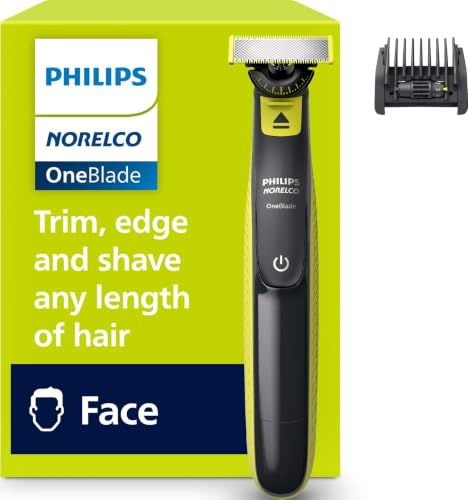
Philips Norelco Oneblade Review: What the Tool Is
The OneBlade’s technology is a flat, fast-moving blade with a protective glide coating and rounded tips, designed to cut hair at skin level without the blade ever quite behaving like a blade. The result is a finish that is smooth to a casual touch and visibly stubbled under scrutiny — the five-o’clock shadow, standardised. For skin that reacts to razors with bumps, burn, and ingrown hairs, that millimetre of mercy is frequently the difference between grooming as a chore endured and grooming as a routine kept. The 360 generation’s contribution is a blade head that pivots to stay in contact around the jaw, chin, and neck, the territories where flat tools traditionally need multiple passes, and every pass is where irritation lives. Around that core, the models differentiate: the face model is the essential tool, the face-and-body model adds a body kit and a longer runtime, and the Pro adds a precision comb with many length settings, an LED display, and a travel case for the man whose grooming kit travels as seriously as he does.
In this guide
Key Takeaways
- The OneBlade trims, edges, and shaves to a short stubble finish; it is not designed to match a traditional razor’s closeness.
- The 360 blade pivots with the face’s contours, reducing the repeat passes that cause irritation.
- The face model runs 45 minutes per its listing; the face-and-body model runs 60 and adds a body kit with a skin guard.
- The Pro 360 adds a 20-length precision comb, an LED display, and a travel case.
- All models work wet or dry, so the tool fits shower groomers and sink groomers equally.
The Three Models at a Glance
| Model | Runtime per its listing | Kit story | Choose it when |
|---|---|---|---|
| OneBlade 360 Face | 45 minutes | 5-in-1 stubble comb | Face grooming is the whole job |
| OneBlade 360 Face and Body | 60 minutes | Stubble comb plus body kit and skin guard | One tool should handle face and body |
| OneBlade Pro 360 | See listing | 20-length precision comb, LED display, travel case | You style precise lengths and travel with your kit |
The ladder is honest: each step buys a defined addition rather than a vague premium. Runtime grows, the comb system grows from five lengths to twenty, and the body equipment appears exactly at the step where the model’s name says it should. A shopper who knows whether they groom their body with the same tool, and whether they keep one beard length or several, can read their answer straight off the table.
How This Review Was Assembled
Each model was confirmed through the retailer’s own product data — exact listing title and official image — before drafting. Runtimes, comb configurations, and kit contents are stated as the listings state them. The grooming guidance — technique, blade care, skin considerations — is the accumulated practical knowledge of this tool class, presented as guidance rather than as laboratory findings, and no hands-on testing programme is claimed. Skin advice is kept general: anyone with a persistent skin condition should take it to a professional rather than to an appliance review.

Philips Norelco OneBlade 360, Face
Badge: the essential tool. The standard 360 is the OneBlade in its purest form: the pivoting blade, a 5-in-1 adjustable stubble comb covering the lengths most men actually keep, wet-and-dry operation, and a 45-minute runtime per its listing. It is marketed partly as a first electric shaver, and that positioning is honest — the tool’s forgiveness makes it a kind introduction to electric grooming for teenagers and for men returning to it after years of cartridges.
Model: OneBlade 360 Hybrid Face per the listing. Runtime: 45 minutes per the listing. Comb: 5-in-1 stubble comb per the listing. Blade: 360 contour blade per the listing. Use: wet and dry per the listing.
Strengths
- The pivoting blade keeps contact around the jaw and neck, cutting down the repeat passes that irritate.
- Five comb lengths cover the realistic stubble wardrobe without a drawer of attachments.
- Wet-and-dry operation lets it live in the shower, the sink, or the travel washbag equally.
Trade-offs
- The finish is a groomed stubble, not a razor’s closeness, and formal occasions may still call for a blade.
- Forty-five minutes is ample for face grooming but the shortest runtime in this comparison.
- Men who groom body hair will need the next model’s kit rather than improvising with the face comb.
Live with this model through a working week and its character clarifies. The Monday shave is a two-minute standardisation of the weekend’s growth. The midweek edge — cheek lines tidied, neck cleaned — takes less time than the kettle. The Friday decision about the weekend’s beard length is a comb click rather than a commitment. That rhythm is the tool’s real specification: it converts grooming from an event into a maintenance habit with a negligible cost per occurrence, which is why its owners tend to look consistently groomed rather than periodically groomed. For face-only needs, the more expensive models in this review add nothing that rhythm requires.
Best for: stubble keepers, beard edgers, sensitive skin, and first-time electric users. Not suited for: men wanting a daily razor-close finish or body grooming. Check price on Amazon

Philips Norelco OneBlade 360, Face and Body
Badge: one tool for the whole map. The Face and Body model keeps the face kit intact and adds the equipment body grooming actually requires: a body comb and a skin guard for the territories where skin is thinner and the cost of a nick is higher, plus a runtime extended to 60 minutes per its listing. The design judgment is sound — body grooming is not face grooming at a different address, and a tool that treats it as such earns its step up.
Model: OneBlade 360 Hybrid Face and Body per the listing. Runtime: 60 minutes per the listing. Kit: 5-in-1 stubble comb, body kit, and body skin guard per the listing. Blade: 360 contour blade. Use: wet and dry.
Strengths
- The skin guard addresses the genuine risk difference of body grooming rather than pretending it away.
- The longer runtime suits full sessions that combine face and body work.
- One charging routine and one blade ecosystem serve the whole grooming map.
Trade-offs
- A face-only groomer is paying for a kit that will live in a drawer.
- Body grooming with a compact tool takes patience on large areas compared with a dedicated body groomer.
- The finish everywhere remains the OneBlade’s signature short trim, which body groomers should want before they buy.
The case for this model is a household census of one: count the territories you actually maintain. Chest, back, underarms, and the rest each have their own risk and their own technique, and the men who maintain several of them are the model’s constituency. For them, the alternative to this kit is a second device with a second charger and a second blade schedule, and the consolidation is worth real drawer space and real money. For the man whose map ends at his neck, the census returns a different answer and the standard model above is the correct, cheaper tool.
Best for: men who groom face and body with one tool. Not suited for: face-only groomers or anyone wanting razor closeness. Check price on Amazon

Philips Norelco OneBlade Pro 360, Face and Body
Badge: the precision and travel flagship. The Pro 360 is the line’s fully dressed model: a precision comb with twenty length settings for beards kept at exact, repeatable lengths, an LED display that reports the battery’s state like an adult, a body kit, and a travel case that turns the whole system into luggage. Its listing frames it around precision styling, and that framing is the honest summary — this is the OneBlade for the man whose beard is a specification rather than an outcome.
Model: OneBlade Pro 360 Face and Body per the listing. Comb: 20-length precision comb per the listing. Display: LED per the listing. Kit: body kit and travel case per the listing. Use: wet and dry.
Strengths
- Twenty length settings make beard lengths repeatable to the click, week after week.
- The LED display ends the surprise dead battery on the morning it matters.
- The travel case makes the full kit genuinely portable rather than theoretically portable.
Trade-offs
- It is the range’s premium, and a one-length stubble keeper will never touch most of its range.
- Precision features reward a groomer who uses them; they do not improve a routine that is already simple.
- Like its siblings, it will not produce a traditional razor’s closeness when an occasion demands one.
Judge the Pro by whether your grooming has numbers in it. If you keep a beard at a specific length, fade between lengths, or maintain different zones at different settings, the precision comb converts those intentions from estimation into routine, and the display and case support a man who grooms in hotels as often as at home. If your grooming has one length and no itinerary, the Pro is a beautifully made answer to questions you do not ask, and the standard 360 will serve you identically at the lengths you actually use.
Best for: precision beard styling, frequent travellers, and face-and-body groomers who want the full kit. Not suited for: simple stubble routines or closeness seekers. Check price on Amazon
Technique: Getting the Most From the Tool
The OneBlade rewards a light hand and punishes pressure, which is the opposite of the cartridge habit most men bring to it. Hold the tool so the blade lies flat against the skin and let its flat face do the alignment; pressing harder does not cut closer, because the design’s closeness is set by the blade’s geometry, and pressure only adds friction where the skin least wants it. Work against the grain for the closest version of its finish, with the grain for the gentlest, and across it for edges. For edging — the cheek line, the neckline, the moustache’s border — use the blade’s edge with the comb off, skin held lightly taut, and short strokes you can see; the tool’s precision is genuinely good here, and most men’s beards look designed rather than grown once the lines are deliberate. Long growth should be combed down to a manageable length first rather than attacked at full length, because the blade is a trimmer at heart and trims best within its stride. Rinse the head under the tap as you go, since a loaded blade drags, and let the tool dry before it goes back in a drawer or a case. None of this is difficult, and all of it together is the difference between the OneBlade as its designers intended it and the OneBlade as a disappointed razor substitute.
Skin, Irritation, and Realistic Expectations
The OneBlade’s reputation rests substantially on skin that cannot tolerate razors, so let that claim be made carefully. A traditional razor’s closeness comes from cutting hair at or below the skin’s surface, and for many men the cost is paid in bumps where curled hairs re-enter the skin, in burn where the blade has planed the surface, and in a general negotiation with their own face conducted daily. A tool that cuts at the surface, with a glide coating and without pressure, removes much of that cost’s mechanism, which is why so many irritation-prone men can use it daily when a razor exiled them to twice a week. That is a comfort claim, not a medical one: persistent bumps, rashes, or any skin condition that worries you belongs in front of a dermatologist, not in front of a product range. Set the expectation correctly and the tool delights — a groomed, even, intentional finish with a fraction of the traditional cost to the skin. Set it as a medical treatment or as a razor’s equal in closeness and it will be judged against promises it never made.
Blade Life and the Cost of Ownership
The OneBlade’s running cost is its replacement blades, and honest ownership arithmetic treats them as the subscription they are. A blade’s life depends on the density of the beard it serves, the frequency of use, and whether it is trimming long growth or maintaining short, with the maker’s guidance giving the planning figure for an average routine. The practical disciplines are simple: keep the blade rinsed and dry between uses, do not press to compensate for a blade that is tiring — replace it instead, because a dull blade’s drag is where this gentle tool can still irritate — and buy replacements from the genuine range that matches your model, since the ecosystem spans generations whose blades are not all interchangeable. Priced across a year, the system’s cost sits comfortably below a premium cartridge habit for most men and above a safety razor’s blades, which is a fair summary of its place in the grooming economy: you are paying for convenience and kindness, at a rate between the cheapest and the dearest ways of removing hair.
Mistakes New OneBlade Owners Make
The first is pressing, imported from cartridge habit, and it manufactures the very irritation the tool exists to avoid. The second is expecting a wedding-morning closeness from a stubble tool and declaring it defective for delivering its design. The third is stretching a blade far past its life to save money, then blaming the tool for the dragging that results. The fourth is buying the Pro for its comb range and then keeping one length forever, a harmless error but an expensive one. The fifth is neglecting the neck’s grain map — neck hair grows in whorls and contrary directions, and the man who learns his own map, once, with the tool in hand and a mirror’s patience, halves his passes there for the rest of his life. Each mistake is a small tuition, and this section exists so that a reader can decline to pay it.
Final Recommendation
Buy the standard OneBlade 360 if your grooming is face-only stubble and edges — it is the line’s essential tool and the correct price for the job. Buy the Face and Body model if your map includes body grooming and you want one ecosystem, one charger, and a skin guard where the skin is thin. Buy the Pro 360 if your beard is kept at deliberate lengths, if you travel with your kit, or if a battery display’s certainty is worth a premium to you. In every case, buy it as what it is — the best-executed stubble tool in its class — and keep a traditional razor in the drawer for the rare mornings that demand its particular closeness. The households this tool suits will find that drawer opening less and less often.
The Stubble Aesthetic: Why This Tool Exists Now
The OneBlade’s commercial logic rests on a cultural shift worth naming, because it explains the tool’s design better than any specification. The clean-shaven face stopped being the default professional standard in most workplaces over the past two decades, replaced first by tolerance for stubble and then by its positive adoption as a maintained look — the three-day growth, kept at exactly three days, indefinitely. That look has a hidden labour problem: natural stubble does not stay at three days, and maintaining it with tools designed for other jobs — a razor that takes it to zero, a beard trimmer that cannot edge or shave — made the look oddly expensive in effort. The OneBlade is the tool designed for the look itself: trim to the length, edge the boundaries, shave the strays to the same finish, all with one head. Understanding that is understanding why its closeness is a feature rather than a compromise. It was never failing to be a razor. It was succeeding at being the first mainstream tool for the face most men actually wear.
Grooming Routines for Three Kinds of Week
The office week. The routine is standardisation: a full pass at the chosen comb length on Monday, a two-minute edge and neck tidy on Wednesday, and a decision on Friday about whether the weekend wears the same length or one click longer. Total weekly investment is measured in minutes, and the face that results never has a day that looks ungroomed or a day that looks overdone, which is the office week’s entire requirement.
The travel week. The routine is consolidation: one tool, its charger shared with nothing else to forget, and a finish that photographs consistently from hotel bathrooms in any light. The Pro’s case and display were designed for this week, but the standard model travels nearly as well, and the wet-and-dry design means the hotel’s amenities are irrelevant — the tool works with whatever water and mirror the room provides.
The growing-it-out month. The routine is boundary maintenance: the beard grows, and the tool’s job narrows to the cheek line, the neck line, and the moustache’s edge, with the comb set long for the occasional evening of the strays. This is the month that teaches owners the tool’s edging precision, and it is why so many committed beard growers keep a OneBlade beside the heavier trimmers — for the lines, it is simply the finer instrument.
Frequently Asked Questions
Does the OneBlade shave as close as a razor?
No, and it is not trying to. The tool is designed to leave a short, even finish — the groomed stubble that many men now wear as their deliberate look — rather than the skin-smooth result of a blade passed at or below the surface. That millimetre of difference is precisely why irritation-prone skin tolerates it so well. Men whose work or preference demands a truly close shave should treat the OneBlade as their daily maintenance tool and keep a razor for the occasions that require its finish.
Can I use the OneBlade in the shower?
Yes; the models in this review are specified for wet and dry use, which means shower grooming, shaving gel, and rinsing the head under the tap are all within the design. Wet use suits many men better, since warm water softens the beard and the tool’s glide improves. Let the device dry after wet sessions before storing it in a closed case or drawer, and follow the listing’s guidance on charging, since charging and water should be kept apart as with any bathroom appliance.
How long does a OneBlade blade last?
It depends on beard density and how often the tool works, with the maker’s guidance providing the planning figure for a typical routine. The reliable signal is performance rather than calendar: when the blade begins to drag, pull, or need extra passes, it is asking to be replaced, and pressing harder to compensate only imports the irritation the tool exists to prevent. Keep a spare blade in the drawer so the replacement is an event of thirty seconds rather than a shopping trip.
Which model should a teenager or first-time shaver get?
The standard OneBlade 360 Face is the natural first tool, and its listing positions it partly for exactly that role. Its forgiveness — no pressure technique to learn, no closeness to overshoot, a comb that standardises length — makes early grooming a success rather than a negotiation, and its 45-minute runtime is more than a young routine consumes. The more elaborate models earn their premiums later, when the groomer’s own map and habits have declared themselves.
Is the Pro 360 worth it over the standard model?
For a groomer who keeps specific beard lengths, yes: the 20-length precision comb makes lengths repeatable in a way the 5-in-1 comb cannot match, and the LED display and travel case serve men who groom away from home. For a groomer who keeps one stubble length at home, the honest answer is that the standard model performs identically at that length, and the premium buys features that will be admired rather than used. Decide by your actual routine, not by the flagship’s completeness.
Can the OneBlade handle a long beard’s first trim?
Yes, with the comb on and a staged approach. Set the comb to a length above your target and take the growth down in passes, lowering the setting as you approach the finished length, rather than asking the blade to clear a full beard in one stride. The tool is a trimmer by design and works best within a trimmer’s patience. Men who regularly alternate between full growth and short styles may also keep a dedicated trimmer for the heavy first pass, but for occasional reductions the OneBlade’s comb system is entirely capable.
Charging, Travel, and Bathroom Logistics
Small logistics decide whether a grooming tool is loved or tolerated, and this class has three worth planning. Charging first: the models’ runtimes are measured in weeks of ordinary face grooming rather than in days, so the practical rhythm is a charge when the tool asks for one, with the Pro’s display removing the guesswork entirely. Keep the charger in the bathroom’s drawer rather than in a travel bag, because a tool whose charger lives elsewhere is a tool that dies at home. Travel second: the wet-and-dry design and the compact head make the OneBlade an easy suitcase citizen, and the Pro’s case converts that ease into organisation, protecting the blade — the one part whose condition decides every shave — from the washbag’s collisions. Bathroom storage third: a rinsed, dried tool kept out of the shower’s constant damp between uses ages better than one stored wet in a caddy, and a spare blade kept in the same drawer as the charger completes a setup that never interrupts a morning. None of this is onerous. All of it together is the difference between a tool that is part of the household’s infrastructure and a tool that is a recurring small negotiation.
The OneBlade Among Its Rivals
The grooming market offers four broad answers to the same face, and the OneBlade’s position among them clarifies its value. Cartridge razors answer with closeness and charge for it in blades and in skin. Electric foil and rotary shavers answer with closeness of a different texture and ask for technique and cleaning rituals of their own. Beard trimmers answer with length control and cannot shave or edge to a finish. The OneBlade answers with the maintained-stubble finish and a gentleness none of the others match, at the price of the closeness two of them offer. A man choosing among the four is really choosing his finish first and his tool second, and the remarkable thing about the current market is that the finish most men wear — deliberate, even, short — is the one that had no dedicated tool until this line created the category. Rivals have since appeared with similar propositions, and a shopper comparing them should run the same tests used in this review: the blade ecosystem’s cost across a year, the comb system’s fit to the lengths actually kept, the wet-and-dry specification, and the availability of genuine replacement blades from a listing that can be checked.
Gifting the OneBlade, and the Household’s Second Tool
The standard model has become a standard gift — for sons, for partners, for fathers whose cartridge costs have become a standing joke — and it gifts well because it needs no sizing, no skin-type consultation, and no expertise to open and use successfully the same morning. The gift improves with one addition: a spare blade in the box, which converts the recipient’s first replacement from a research project into a drawer errand, and a sentence of honest framing — this is a stubble tool, not a razor — that sets the expectation the design intends. Households also commonly adopt the OneBlade as a second tool rather than a replacement: the razor stays for formal closeness, the foil shaver stays because it still works, and the OneBlade quietly becomes the tool used six days out of seven because it is the one that fits the actual week. Manufacturers rarely plan for that adoption pattern, but owners’ bathrooms are full of it, and a tool that wins the weekday against established competition has passed the only review that cannot be argued with.
Beard Lines and the Architecture of a Face
Since edging is half this tool’s profession, give the lines their own doctrine. A beard reads as intentional when its boundaries are deliberate, and the two boundaries that matter are the cheek line and the neck line. The cheek line should follow the face’s own geometry — a gentle line from the sideburn toward the moustache’s corner, kept at the height where the beard’s density is honest rather than where hope places it; lowering it a fraction to where the hair actually grows thickly is the single most flattering edit most beards can receive. The neck line is the one most men get wrong, usually by placing it on the jaw’s edge, which makes the beard look like a strap; the classic placement is above the Adam’s apple, following the curve where the neck meets the jaw’s underside, so the beard has a foundation when seen from the front. The OneBlade’s edge, used without the comb and with the skin held taut, draws both lines cleanly, and the man who spends one careful session establishing them can maintain them in a minute thereafter. That session — unhurried, well-lit, with the grain map of the neck learned in passing — is the highest-value ten minutes in this tool’s entire ownership, because every subsequent week inherits its decisions.
What a Month With the Tool Teaches
The first month with a OneBlade follows a pattern consistent enough to preview. The first shave surprises in both directions — closer than a trimmer led the user to expect, less close than a razor led them to hope — and the verdict formed that morning is usually wrong in whichever direction it leans. By the end of the first week, technique has quietly corrected itself: the hand has learned the flat hold, the pressure has drained out of the strokes, and the neck’s grain map has been discovered by experiment. By the third week the tool has been absorbed into the morning’s infrastructure, and its defining virtue — the two-minute standardisation — has reorganised the user’s sense of what grooming costs. By the end of the month, the user’s face has settled into the consistency that was the actual product: not a spectacular shave on any given day, but no bad days at all, which across a working life is worth more than spectacle. Buyers should therefore discount their first-morning verdict, in either direction, and let the month adjudicate — a courtesy this tool shares with every grooming system ever made, and one its design is unusually likely to reward.
The Blade Ecosystem, Checked Before You Commit
Every grooming system is two purchases — the handle and the consumable — and this review’s standing advice applies here with its usual force. Before committing to any model in this article, find its replacement blades in a live listing, confirm they are the genuine article for your generation of the tool, and note the per-blade cost that your routine’s replacement rhythm will multiply across a year. The OneBlade’s ecosystem is large and actively sold, which is part of the line’s value, but generations and regional variants exist, and the thirty seconds spent matching a blade listing to a model name is the cheapest insurance in grooming. Households that run that check buy the system with open eyes; households that skip it occasionally discover, at the first replacement, that their bargain handle drinks expensive blades. The models reviewed here sit inside the mainstream of the ecosystem, which is one more reason — beyond their listings’ verification — that this review can recommend them without asterisks.
A closing observation for the reader still weighing the standard model against the Pro with a spreadsheet open. The difference between them, across a year of mornings, is not the quality of any single shave — at a shared length, the tools shave alike — but the texture of the routine around the shave: the comb clicked to an exact number rather than estimated, the battery known rather than hoped, the kit arriving in a case rather than in a washbag’s tangle. Men who value routine texture buy the Pro and are right. Men who value only the shave buy the standard and are equally right. The error is buying either while expecting the other’s virtues, and it is the only error this comparison cannot forgive, because it is made with the evidence in plain sight.
Wet Shaving With the OneBlade: Gel, Foam, and the Shower
Because the tool works wet, a set of questions follows it around, and they deserve collected answers. Yes, it can be used with gel or foam, and many men prefer the glide and the visibility of their progress that a thin gel provides; thick foam, by contrast, can hide the edge work that is half the tool’s profession, so edging is usually done on rinsed skin or with gel. Yes, it can be used in the shower, where the beard is at its softest and the rinsing is continuous, and shower groomers tend to report the gentlest results of any routine. And yes, dry shaving is entirely within the design for the quick standardisation that is the tool’s weekday signature, with the understanding that dry skin and a dry beard ask slightly more patience of the blade. The through-line is that the tool adapts to the household’s existing ritual rather than imposing one, which is a rarer courtesy in grooming appliances than it should be, and a real part of why this line has been adopted by men who had rejected every previous electric proposition put in front of them.
Troubleshooting the Common Complaints
Most dissatisfaction with this tool traces to a short, fixable list. Pulling or dragging means the blade is tired or loaded — rinse it, and if the drag survives the rinse, replace it, because no technique compensates for a spent edge. Patchy results mean the grain map has not been learned in the patchy territory, almost always the neck, and the cure is slower, shorter strokes in more directions rather than more pressure. A finish that looks uneven by evening usually means the morning’s length was set longer than the wearer’s growth pattern flatters, and one click shorter on the comb evens the day. Redness after use, in a tool famous for gentleness, usually indicts pressure, a dull blade, or a product used with it that the skin dislikes — change one variable at a time and the culprit identifies itself within a week. And a tool that seems to have lost power is usually asking for a full charge rather than for a service department. Work the list before concluding anything, because in this class the list resolves nearly everything that is not a genuine fault, and genuine faults are what the maker’s warranty exists for.
The Household’s Other Bathrooms
A final practical geography: this tool’s virtues compound in households with more than one groomer. A shared bathroom with two OneBlade users works because the tools are personal but the ecosystem is common — blades, chargers, and combs speak the same language, and a spare bought for one drawer serves both. Guest bathrooms benefit from the tool’s intuitiveness in the same way kitchens benefit from the espresso machine elsewhere in this series: a visitor can operate it without a tutorial, which cannot be said of most grooming technology. And the gym bag, the office drawer, and the second home all reward a tool whose runtime is measured in weeks and whose entire kit fits a washbag’s side pocket. None of these geographies appears in the manufacturer’s headline claims, and all of them show up in why owners, once converted, tend to stay converted across addresses and years.
To close the review on the note it opened with: the OneBlade’s honesty is its engineering. It tells you, in its design and in its listings, exactly what finish it produces, exactly what it costs to run, and exactly which groomer it is for. Tools that honest deserve to be bought honestly — by the census of your own routine — and the men who buy this one that way tend to stop shopping for grooming tools altogether, which is the strongest verdict the category offers.
A Note on Beards Kept Long, and the Tool’s Place Beside Them
Men with substantial beards sometimes dismiss this tool as a stubble device, and they are half right in a way that costs them a good instrument. The OneBlade will not bulk-trim a long beard as efficiently as a dedicated trimmer with a wide head, and pretending otherwise would repeat the category error this review exists to prevent. What it does for the long beard is everything around the bulk: the cheek line drawn with a precision the wide head cannot match, the neck line kept honest, the moustache’s border and the strays on the upper cheek shaved to the skin-adjacent finish that makes a long beard look kept rather than merely long. Many serious beard growers therefore run a two-tool system — the trimmer for the field, the OneBlade for the fences — and report that the fences were the part that always looked amateur before. If your beard is long and your lines matter, that partnership, rather than either tool alone, is this review’s recommendation.
Seasonal Grooming: Summer Skin and Winter Beards
Grooming has seasons, and the tool’s year is worth a paragraph. Summer shortens most men’s beards and exposes more skin to sun and sweat, which raises the value of the tool’s gentleness — a finish achieved without planing the surface cooperates better with sunscreen and with skin already negotiating the season. Summer is also the body model’s season, when its kit earns its premium in a few weeks of concentrated use. Winter lengthens beards for warmth and for style, moving the tool’s work toward the lines and the neck, and its wet-and-dry tolerance for the steamed, softened beard of a hot shower makes it the winter morning’s easiest instrument. Across both, the constant is the maintenance rhythm — blade replaced on performance, tool rinsed and dried, charger resident in its drawer — and the man who keeps that rhythm owns a grooming system that requires no seasonal renegotiation, which is more than can be said for most of the bathroom cabinet.
One last piece of buying advice, small enough to fit the tool itself: whichever model you choose, order it with a spare blade in the same basket. The first replacement always arrives sooner than a new owner’s optimism predicts, and meeting it from the drawer rather than from a delivery window is the difference between a system and a gadget. After that, the routine runs itself.
Why This Category Rewards the Honest Middle
Step back from the models and the OneBlade’s success teaches a general lesson about grooming products. The market’s extremes — the closest possible shave, the longest possible beard, the cheapest possible blade, the most elaborate possible ritual — all serve minorities with strong preferences. The broad middle of men want something less photogenic: to look deliberately groomed on an ordinary Tuesday, with minimum time, minimum skin cost, and no expertise required. Tools designed for that middle were strangely scarce until this line, because the middle is unglamorous to engineer for and impossible to advertise with superlatives. The OneBlade’s design is what designing for the middle looks like when it is done seriously: a finish that suits most faces, a technique that cannot really be failed, a consumable priced between the extremes, and a range that differentiates by honest additions. Readers choosing any grooming tool can reuse the test this review has applied throughout — name your finish, count your territories, price the consumable across a year — and the middle, wherever it lies in that category, will identify itself.
And with the middle named, the choice among this article’s three models collapses to its essentials one final time. Face only: the standard. Face and body: the middle model, bought for its guard as much as for its comb. Precision, travel, and the full kit: the Pro. Everything else in this long review is commentary on those three sentences — useful commentary, we hope, but commentary all the same.
A Short History of the Morning, Abridged by One Tool
There is a reason grooming tools accumulate such loyalty, and it is worth a closing paragraph. The shave is one of the few rituals most men perform daily across an entire adult life, which makes its cost — in minutes, in money, in skin — one of the largest small numbers in a lifetime’s ledger. A tool that halves the minutes and most of the skin cost, while standardising the result, is not a gadget in that ledger; it is a permanent improvement to a daily event, compounding quietly for decades. That is the frame in which the OneBlade’s owners tend to describe it once the novelty has passed, and it is the frame this review recommends for the purchase decision: not which tool wins a specification comparison, but which tool you would choose to meet, every morning, for the next several years. For the stubble-wearing majority, the answer this line offers is a strong one.
Buy it, then, the way you would choose anything you intend to meet daily: for the routine it creates rather than for the morning it impresses. The routine is two minutes, a flat hold, a rinsed blade, and a face that looks like it meant to look that way. Everything this review has said, at this considerable length, is an elaboration of that sentence.
Care of the Tool Itself
A last maintenance note, because the tool’s simplicity invites a neglect its blade does not forgive. Rinse the head after every use and let it dry in the open air of the bathroom rather than sealed in a damp case; a blade stored wet ages faster than a blade stored dry, whatever its coating promises. Keep the pivoting head’s joint free of the hair paste that accumulates there, with a rinse and an occasional brush. Store the tool where it will not be knocked into the sink by the bathroom’s traffic, since the blade’s edge is the whole instrument and it is not armoured. Charge it fully when it asks, rather than in anxious daily top-ups, and keep its charger in one known place. That is the entire liturgy — under a minute a week — and it is the difference between a OneBlade that performs in year three as it did in week three and one that quietly becomes a lesser tool while its owner blames the design.
The Travel Case for the OneBlade
Travel is where this tool’s design brief pays its most visible dividend, and it deserves a paragraph from the road. A single device that trims, edges, and shaves replaces the toiletry bag’s usual committee — trimmer, razor, spare cartridges, the charger for each — with one handle and a blade that is also its own spare for months. The USB-charged members of the family drink from the same cable as a phone, which removes the last dedicated brick from the bag. For the traveller whose beard changes across a trip — trimmed short for the meeting, grown out for the holiday’s second week — the comb set’s range handles the whole arc without a barber. None of this appears in a specification table, and all of it is the kind of advantage that compounds quietly across years of trips, which is why so many OneBlade owners describe the purchase in travel terms even though they bought it for the bathroom mirror.
Rinse the blade under the tap after use, shake it dry, and let it air rather than sealing it wet in a drawer, because the fastest way to shorten any blade’s life is to store it damp against its own residue. The habit costs ten seconds, asks for no oil and no kit, and is the entire maintenance liturgy this tool demands — one more instance of the design’s founding bargain, in which nearly everything a razor traditionally required has been engineered away.
Related Guides
the same maker’s espresso machine reviewed the same maker’s compact purifier story bathroom air and humidity basics bedroom machines for the morning routine’s room a robot vacuum for the floors below meal kits for the household’s other routine compact purifiers for the office desk