Disclosure: As an Amazon Associate, dailyhomedecorating.com earns from qualifying purchases. Links on this page are affiliate links; they cost you nothing extra. Prices and availability change often, so check the current Amazon listing before you buy.
Most purifier searches start with a room; this molekule mini review starts with a person. The Molekule Air Mini — and its Mini+ sibling — were never pitched as whole-room machines. They were pitched as a personal atmosphere: a sculptural little cylinder for the desk, the bedside, the nursery corner, promising to clean the air in your immediate orbit using a technology the company calls PECO, short for photo electrochemical oxidation, instead of simply trapping particles in a filter. It is one of the most recognisable designs the category has produced, and one of the most argued-about. This review does two things. First, it examines the Mini honestly as an idea — what it promises, where the argument around it sits, and who its personal-zone pitch genuinely suits. Second, it does the practical work: when our verification pass went looking for a purchasable Molekule Mini unit listing, the searches returned replacement filters and accessories rather than a buyable machine, so the Mini itself is covered here in prose only, and the linked picks are three verified personal purifiers you can actually buy today.
Quick verdict
The Molekule Mini remains a fascinating object and a difficult recommendation to make with a link, because at verification time there was no unit listing to link to. Its proposition — design-led, quiet, personal-range cleaning built on a proprietary oxidation process rather than a conventional capture filter — still appeals to buyers who want a device that looks like an object rather than an appliance. But a recommendation has to end in a purchase a reader can complete and a filter supply they can maintain, and on both counts the verified alternatives below are the safer deskside companions right now. If your heart is set on the Molekule itself, buy it through the maker’s own channels after confirming the model and its filter programme; if you want the personal-zone job done this week, the three machines under this paragraph are the shortlist.
In this guide
Quick picks: verified personal purifiers
| Pick | Best for | Link |
|---|---|---|
| Pure Enrichment PureZone Mini | Cordless, travel, car and desk | Check price on Amazon |
| GoveeLife Smart Mini | App control and aroma at the bedside | Check price on Amazon |
| Levoit Core Mini-P | A mainstream filter ecosystem in miniature | Check price on Amazon |
How these picks were chosen
The rule for this page was strict: only listings our verification could actually fetch — machine, title, and image confirmed — earned a link. The Molekule unit failed that test twice; its filters did not, which tells its own story about where the marketplace currently stands on this product. The three alternatives were chosen to cover the personal-zone territory the Mini claimed: one cordless traveller for cars and bags, one smart bedside unit with an aroma function, and one miniature from a large mainstream brand whose replacement filters are stocked everywhere. Each is a capture-based HEPA-style machine, which also makes this page a quiet comparison of philosophies: the Molekule’s oxidation pitch against the alternatives’ trap-it-in-a-filter orthodoxy. Readers who want the wider field should browse desktop purifiers compared and portable purifiers for small zones alongside this page.
The Molekule Mini itself, in prose
Start with the object, because the object is the argument. The Mini is a compact cylinder in a matte finish with a leather-style carry handle, designed by people who clearly believed a purifier should earn its place on a desk the way a lamp does. In a category of white plastic boxes, that belief was — and remains — genuinely refreshing, and it explains the product’s following among design-conscious buyers, new parents furnishing a nursery corner, and professionals who spend ten hours a day inside one small personal radius.
The technology claim is the second half of the argument. Where a conventional purifier captures particles on filter media, Molekule’s PECO process is presented as destroying pollutants at a molecular level using a light-activated catalyst — a claim that, if it holds in real rooms, would address gases and very small compounds that capture filters handle less completely. The honest summary for a buyer is that this claim has been contested territory: independent testers and regulators have argued about how well the approach performs outside laboratory conditions, the company has argued back with its own data, and the dispute itself is the fact a purchaser should weigh. A technology still being argued about may absolutely be worth owning — early adopters fund exactly such arguments — but it should be bought as a considered bet, through channels that offer returns, rather than as a settled appliance purchase. Its consumable is also proprietary: the PECO filter programme ties the machine to the maker’s own supply, which makes the maker’s current retail health part of the product in a way a standard HEPA cartridge never is.
Who does the Mini suit, on its own terms? The buyer with a defined personal zone — one desk, one bedside, one feeding chair — who values the design, accepts the contested-science premium, and is comfortable sourcing the unit and its filters directly from the maker. Who should pass? Anyone who needs verified whole-room coverage, anyone whose budget must stretch across years of consumables, and anyone who simply wants the desk job done without joining an argument. For those readers, the three verified machines below are not consolation prizes; they are the orthodox answer to the same question, each with its own character.

Pure Enrichment PureZone Mini — the cordless traveller
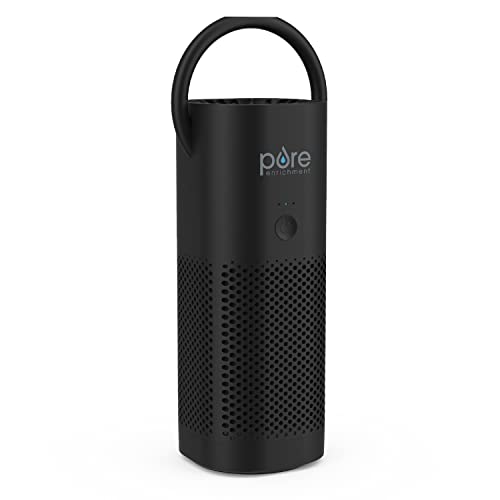
The PureZone Mini takes the personal-zone idea and removes its last tether: it runs cordless, recharging over USB, which makes it the only pick here that can follow its owner from desk to car to hotel nightstand without negotiating for an outlet. Its verified listing pitches it at exactly those micro-environments — cars, offices, school desks — with a small HEPA-style filter doing capture duty at arm’s length. At that range, a tiny machine is not a compromise; the air between the unit and your face is a small volume, and even modest throughput turns it over constantly.
Strengths:
- Cordless operation makes it a genuine travel and car companion, not a desk ornament with a long cable.
- The personal-range brief is honestly sized — it promises a bubble, not a room, and delivers within that promise.
- Simple controls suit shared spaces like classrooms and open offices where an app would be a nuisance.
Trade-offs:
- Battery life bounds its runtime; heavy users will charge it the way they charge a phone.
- Its filter is small, so heavy dust environments shorten the replacement rhythm.
- No smart features — buyers wanting schedules and air readouts should look at the GoveeLife below.
Best for: commuters, students, and travellers who want one purifier that lives in a bag. Not suited for: anyone expecting it to hold a whole bedroom. Check price on Amazon

GoveeLife Smart Mini — the connected bedside pick
The GoveeLife Smart Mini answers the Molekule’s design pitch with a different kind of polish: connectivity. Its verified listing confirms app and voice-assistant control, three speeds and two modes, and an aroma function that lets the unit double as a subtle scent diffuser at the bedside. For the personal zone that matters most — the pillow’s immediate neighbourhood, all night — scheduling and quiet automation are worth more than raw throughput, and this is the only pick here that can be programmed to fade down as you fall asleep and step up before the morning.
Strengths:
- App and voice control make nightly routines genuinely set-and-forget.
- The aroma feature suits bedrooms where the goal is atmosphere as much as filtration.
- A recognisable smart-home brand stands behind its filter supply and app support.
Trade-offs:
- It needs an outlet and a network; it will not travel like the cordless PureZone.
- Aroma pads are another small consumable to keep in the drawer.
- App-dependent features age with the maker’s software support, unlike a purely mechanical unit.
Best for: bedside tables in connected homes. Not suited for: cars, travel bags, or buyers avoiding apps on principle. Check price on Amazon

Levoit Core Mini-P — the mainstream miniature
The Core Mini-P shrinks one of the market’s largest purifier ecosystems into a desktop cylinder with a fragrance sponge in its base. Its verified listing positions it across bedrooms, dorms, offices, and pet corners, and its real advantage is boring in the best way: replacement filters for a Levoit are stocked by everyone, everywhere, and will be for years. Buyers burned by proprietary consumables — the very risk the Molekule’s situation illustrates — will recognise that as the feature that matters most at this size.
Strengths:
- The deepest filter-supply bench of the three picks; consumables will never be a scavenger hunt.
- A fragrance sponge covers the aroma trick without an app or a subscription.
- It introduces younger or newer users to a brand whose larger machines anchor whole rooms later.
Trade-offs:
- Corded only, and its personal range is a desk’s radius, not a room’s.
- No connectivity — schedules mean a plug-in timer or a habit.
- The fragrance sponge’s scent fades and needs refreshing to stay noticeable.
Best for: desks, dorms, and first-time purifier buyers who want zero supply risk. Not suited for: travel or smart-home automation. Check price on Amazon
Buying guide: the personal-zone category, honestly framed
Personal purifiers live or die on one distinction: the bubble versus the room. A bubble machine conditions the few cubic feet around a person and makes no apology for ignoring the rest; a room machine is rated to turn over a whole volume several times an hour. Trouble starts when a bubble machine is bought with room expectations — the classic disappointment behind most returns in this size class. Before buying anything on this page, decide which of the two jobs you actually have. If a partner, a baby, or a roommate shares the space, you have a room job wearing a personal costume, and the honest move is up a size, toward the machines in purifiers for small rooms.
Technology is the second decision, and this page is its clearest illustration. Capture filtration — the HEPA-style media in all three linked picks — is the settled, measurable orthodoxy: particles go in, particles stay in the filter, and performance can be compared across brands. Oxidative and photocatalytic approaches, Molekule’s included, promise to handle what capture misses, particularly gases, but carry contested evidence and proprietary consumables. Neither choice is foolish; they are different risk postures. The third decision is supply. A personal purifier’s filter is small and replaced often, so the cartridge’s price and availability over three years matter more than the machine’s ticket. Price the consumable before the device, every time, in this category above all.
How to set up a personal air zone
Step 1: Place the unit inside arm’s reach of the breathing zone
A bubble machine belongs on the desk beside the keyboard or the nightstand beside the pillow — not on the floor across the room, where its little output dilutes into the whole volume before reaching you. Keep its intake unblocked by papers, books, or bedding, and let its outlet breathe toward you rather than into a wall.
Step 2: Run it before you occupy the zone
Start the unit twenty minutes before you sit or sleep, so the bubble is established when you arrive. Cordless owners should make charging part of the same ritual — the traveller’s version of this step is a cable in the bag, used nightly at the hotel rather than hopefully at the airport.
Step 3: Keep the zone’s own sources down
A personal purifier cannot outrun a scented candle burning six inches from your face or a desk that is never dusted. Wipe the surface weekly, keep fragrances deliberate rather than constant, and let the machine handle the airborne background it was sized for. Small zones reward small housekeeping disproportionately.
Common mistakes with mini purifiers
- Judging by room standards. A bubble machine’s coverage figure is a radius, not a room; read it as such.
- Forgetting the consumable. The filter is the product. An orphaned cartridge format can retire a working machine.
- Buying contested technology as settled science. Novel approaches deserve informed bets, not blind ones.
- Ignoring the cord. Half the disappointment in this class is placement forced by outlet geography; the cordless pick exists for a reason.
- Expecting silence and power together. At arm’s length, every decibel is personal; favour the machine whose working speed you can actually live beside.
Final recommendation
The Molekule Mini remains the most interesting answer to the personal-air question — and, at verification time, an unbuyable one through the channels this page can link, with a technology claim a careful buyer should treat as an open argument rather than a closed case. If you pursue it, pursue it directly with the maker, eyes open, return window noted. For the job itself — a cleaner bubble at a desk, a pillow, or a passenger seat — the verified trio splits the territory cleanly: the PureZone Mini for anyone who moves, the GoveeLife for the connected bedside, and the Core Mini-P for the buyer who wants the deepest filter bench in the business. Any of the three will be cleaning your air this week, which is more than this review could honestly promise for its own headline subject.
Why a purifier became a design object
To understand the Mini’s hold on buyers, it helps to remember what the category looked like when it arrived: tower fans in white plastic, blue LEDs, and a design language borrowed from office equipment. Molekule’s founders — a family with a personal history of asthma and allergies, by the company’s own telling — pitched purification as chemistry rather than filtration, and industrial design as a feature rather than packaging. The Mini’s cylinder, its handle, its fabric-wrapped sibling products: all of it said that the device expected to be looked at, daily, at close range, by someone with taste. That expectation is not trivial. A personal purifier lives inside its owner’s sightline for more hours than almost any other appliance they own, and an ugly one gets unplugged, moved, and eventually closeted — at which point its cleaning performance, whatever the laboratory said, becomes exactly zero.
This is the strongest honest argument for the Molekule proposition, and it survives every argument about its chemistry: an object people keep on the desk gets used, and a used purifier outperforms a superior machine in a cupboard on every day that matters. The alternatives on this page have each absorbed part of that lesson — the GoveeLife’s bedside polish, the Levoit’s friendly miniature proportions — but the Mini remains the category’s clearest statement that in the personal zone, design is not decoration. It is adherence, and adherence is performance over time.
The science argument, laid out for a buyer
Because the dispute around PECO follows this product into every search result, a buyer deserves the shape of it without the shouting. Capture filtration’s evidence is easy to grasp: standardised tests push known particles through media and count what emerges, and decades of that counting underpin the HEPA idea. Oxidation approaches aim at a different target — the gases and ultra-fine compounds that pass through or sit outside capture’s strengths — and their evidence is harder to standardise, because destroying a molecule is a chemical claim, not a counting claim. Critics have argued that real-room performance falls short of the laboratory story and that marketing ran ahead of proof; the company has published its own testing and disputed the critics’ methods. Regulators and advertising watchdogs have, at various points, asked for claims to be tightened. None of that makes the Mini a fraud or a miracle; it makes it a product whose central promise is still being litigated in public, which is precisely why this review insists on the return-window, buy-it-as-a-bet framing. Settled appliances do not require that framing. Interesting ones sometimes do, and the Mini is never less than interesting.
The practical consequence for the personal zone is worth stating plainly: at bubble range, even the orthodox machines are working with small volumes and short distances, so the practical gap between philosophies narrows. A capture filter at arm’s length, turning over a few cubic feet continuously, delivers a benefit you can verify with a tissue on the desk over a fortnight. Whatever the Mini’s chemistry adds beyond that is upside — worth paying for if you believe it, unnecessary if you do not, and impossible for this page to certify either way.
Three desks, three answers
The home-office desk is the personal zone’s capital city: eight to ten hours, a screen that attracts dust like a magnet, a mug going cold beside a keyboard. Here the Core Mini-P’s orthodoxy shines — silent enough at its working speed, stocked everywhere, indifferent to networks. The nursery desk-that-isn’t — the feeding chair’s side table — is the GoveeLife’s natural post: scheduled before the night feeds, quiet at the pillow’s distance, its aroma function used sparingly or not at all around infants, as common sense dictates. The travelling desk — hotel rooms, site offices, a term spent in rented rooms — belongs to the PureZone, the only pick that treats location as a variable rather than a constant. Naming your desk honestly is the whole of the buying decision in this category; the machines divide the territory so cleanly that the territory, once named, chooses for you.
The second-hand trap, and other Molekule-specific cautions
Because new Molekule units are scarce through ordinary retail at the moment, the second-hand market is where many searchers will meet this product — and it is where the proprietary-consumable risk bites hardest. A used Mini is only as good as its remaining filter life and the availability of the next PECO cartridge; a bargain unit with an exhausted filter and an uncertain supply line is not a bargain but a sculpture. If you buy used, price the replacement filter into the offer before comparing it with anything on this page, confirm the cartridge can actually be ordered that week, and treat any seller who cannot demonstrate the machine running as selling décor. The same discipline, in fairness, applies to used examples of the alternatives — but their cartridges sit on ordinary shelves, which is the entire difference.
A second caution belongs to gift-buyers. The Mini is a tempting present — beautiful, unusual, easy to wrap — but a purifier with a proprietary consumable is a subscription disguised as a gift, and the recipient inherits it. If the person you are buying for would delight in the object and happily feed it, give it with the first spare filter included and the supply link written in the card. If they would not, the Levoit on this page makes the same gesture — a personal air upgrade, thoughtfully chosen — without the ongoing obligation.
What the personal zone cannot do
Honesty about limits is this page’s house rule, so let the limits be listed in one place. No machine on this page, and not the Molekule either, will fix a room with a moisture problem, neutralise a smoker’s habit at the scale of a house, or substitute for ventilation when a space is being painted, glued, or renovated. Personal purifiers manage the background of ordinary life — dust, dander, pollen drifting in, the faint staleness of a closed room — inside a small radius. When the problem is bigger than the background, the answer is a bigger category: a room machine for the room, source control for the source, and fresh air whenever the weather and the street allow it. Buyers who keep that hierarchy straight are the ones still satisfied in year two, whichever philosophy they chose.
A season at the desk: living with a bubble machine
The first week with any personal purifier is novelty: you notice the faint movement of air, check the desk for dust like a scientist, and announce the purchase to at least one colleague. By the first month the relationship has usually settled into its permanent shape — the unit fades into the desk’s furniture, its speed chosen by habit, its filter a date in a calendar rather than a thought. The evidence accumulates quietly: the screen wiped less often, the tissue test passed, the afternoon stuffiness at the desk reduced to the ordinary tiredness that no machine can fix. Bubble machines should be judged at that horizon, not at unboxing, because their entire value proposition is cumulative and local. It is also why the adherence argument matters so much in this class: the machine that survives on the desk for a year, inoffensive and stocked with filters, has delivered roughly three hundred days of small improvements, and no specification sheet in the category can outbid three hundred days.
Questions to ask before buying any novel-technology purifier
The Molekule situation generalises, and the generalisation may outlast the product. When any purifier arrives wrapped in a proprietary process, ask five questions before the design seduces you. First: what does the independent evidence say, and who funded the favourable studies? Second: what exactly does the consumable cost per year, and who else sells it? Third: if the maker vanished tomorrow, how long would the machine remain useful — months, on a proprietary cartridge, or years, on a standard one? Fourth: what does the return window actually cover, and have other buyers used it without a fight? Fifth: what does the orthodox alternative at the same price do, measured the boring way? A product that survives those five questions has earned its premium honestly. The Mini survives some of them — its design and its following are real — and struggles with the supply questions, which is exactly the balanced conclusion this review has been building toward since its first paragraph.
Notice what those questions do not ask: whether the technology is fashionable, whether influencers keep it on their desks, or whether the unboxing is beautiful. Novelty is a legitimate pleasure and a terrible warranty. The buyers who end up happiest with experimental appliances are the ones who priced the experiment correctly — as an experiment — and kept an orthodox machine somewhere in the house for the rooms where boring reliability is the whole point.
The dorm room, the studio, and other first homes
There is one more territory where this page’s trio quietly excels, and where the Molekule’s pitch was always strongest: the first small home. A dorm room or studio flat compresses the personal zone and the living zone into the same few square metres, which flatters a bubble machine — its radius covers a meaningful share of the whole dwelling, and its owner is usually a single person whose breathing zone is the point. For a student, the PureZone’s ability to come home in a bag at term’s end is worth more than specifications. For a first flat, the Levoit’s filter bench means the local shop always has the cartridge. For the studio dweller who hosts friends in the same room they sleep in, the GoveeLife’s aroma function earns its keep socially. First homes are where purifier habits form, and the habit — a machine kept running, fed, and within reach — matters more than which of the three badges teaches it.
Noise at pillow distance
Every purifier review eventually discusses noise, but in the personal zone the subject changes character. A room machine’s hum is judged across a room; a bubble machine sits closer to the ear than a bedside clock, and its sound becomes part of the owner’s sleep or concentration at point-blank range. This is where small machines earn or lose their place. A mini that must run at its highest, whiniest speed to do anything will be switched off by Friday, whatever its filter pedigree. The practical test at purchase is therefore not the quietest setting’s brochure figure but the middle setting’s character — the speed at which the machine will actually live — heard at arm’s length, ideally in a shop or within a return window at home. All three picks here can hold a conversation-friendly murmur at their working speeds; the differences are of tone more than volume, and tone is personal in the most literal sense. Light sleepers should weight this section above every other on the page, because in the personal zone the ear is the final reviewer, and it does not read specifications.
Cars: the smallest room you own
The PureZone’s presence on this page rests partly on a space most purifier guides ignore: the car cabin, which is a personal zone with wheels — small volume, high particle load from traffic, upholstery shedding fibres into recirculated air, and occupants breathing within inches of the vents. A cordless mini running on the passenger seat or in a footwell addresses exactly the air its owner breathes on a commute, and its battery rhythm fits the journey pattern naturally: run while driving, charge at the desk. Drivers in heavy traffic, parents doing school runs through congested streets, and rideshare drivers whose cabin is a workplace all get more from this arrangement than from any dashboard novelty. The caution is purely practical — secure the unit so it cannot become a projectile under braking, and never let its cable, when charging, cross the controls. Within those ordinary precautions, the car may be the most rational personal zone of all: the volume is tiny, the exposure is daily, and the bubble is the whole cabin.
Filters, honestly: the small-media economy
Every machine on this page eats small filters, and small filters have an economics of their own that buyers consistently underestimate. The cartridge is little, so it feels cheap; it also loads quickly in real air, so it is bought often; and the annual total quietly rivals the consumable cost of a mid-sized room machine. The discipline that keeps the category honest is to compute the year, not the cartridge: replacements per year at your zone’s dust level, times the cartridge’s price, written down before the machine is bought. Run that sum for the Molekule’s proprietary programme and for each alternative, and the comparison sharpens considerably — the orthodox trio’s cartridges compete in an open market, which disciplines their prices, while a single-source programme prices at whatever the single source decides. None of this is an argument against the Mini’s chemistry; it is an argument for reading any proprietary purifier as a utility contract rather than a product, because that is what, financially, it is.
The small-media rhythm has one compensating virtue: a frequently changed small filter is almost always a fresh filter. Room machines stretch large media across long intervals and spend their last months working through a loaded mat; the mini’s cartridge is young for most of its life. Owners who keep the rhythm get, in effect, a purifier that is perpetually near its best — another reason the category’s satisfaction, when the zone is honestly personal, runs higher than its specifications suggest.
Where the Molekule idea goes from here
Whatever becomes of any single model, the Mini has already changed its category twice: once by proving that buyers would pay for design in an appliance category that had never offered it, and once by forcing the oxidation-versus-capture argument into mainstream buying guides, where it now permanently lives. The linked alternatives on this page are, in part, its legacy — minis with better manners, smarter controls, and friendlier supply chains than the category offered before the argument started. A reader who buys the PureZone for a car, the GoveeLife for a bedside, or the Levoit for a desk is buying into a market the Molekule helped create, even if the Molekule itself must, for now, be admired in prose and purchased, if at all, with open eyes through its maker’s own door. There are worse fates for a product than to be the reason its competitors improved.
Reading the three picks against the Molekule, one last time
It may help, before the questions, to set the comparison out in plain sentences. Against the Molekule’s design: the GoveeLife is handsome in a tech-forward way, the Levoit is pleasantly neutral, the PureZone is utilitarian — none matches the Mini as an object, and the Mini’s lead there is real. Against its technology claim: all three picks use capture media whose performance a buyer can compare without taking anyone’s word for anything, and none claims to destroy what it catches. Against its supply position: all three win outright, today, by the simple fact of their listings existing and their cartridges sitting in ordinary commerce. Against its portability: the PureZone beats it, being cordless, while the other two match its deskbound nature. Add the columns with your own weights — a design-led buyer weights the first column heavily and may still choose the Molekule through its maker; a supply-anxious buyer weights the third and never looks back — and the page has done its work, which was never to crown a winner but to make the trade-offs impossible to miss.
One asymmetry deserves the final word in this section. The alternatives can be returned to a marketplace with ordinary consumer protections if the bubble idea itself disappoints; the experiment, with them, costs a fortnight’s curiosity. The Molekule, bought through scarcer channels, asks for more commitment up front. In a category built on a radius of a few feet, that difference in commitment may matter more than any difference in chemistry — and it is, in the end, the practical heart of this review’s recommendation.
The desk audit: five minutes before you buy anything
Personal purifiers reward a tiny amount of fieldwork, because their territory is tiny. Sit where you will use the machine and look, really look, at the metre around you. Where does the dust land — screen, desk surface, windowsill? Where is the outlet, and would a cable cross your keyboard’s territory or your pillow’s? What shares the surface: a lamp, a plant, a cat with opinions? When is the zone occupied — working hours, sleeping hours, the school run — and does that pattern favour a battery, a schedule, or a simple switch? Finally, where will the spare filter live: the desk drawer, the glovebox, the nightstand? Five minutes of this produces a specification no marketing can argue with, and on this page it will point, almost every time, unambiguously at one of the three picks — or, if the answers keep describing an object of beauty with a science bet attached, at the Molekule itself, bought knowingly.
The audit has a second use: it exposes the zones you do not have. Many households discover, mid-audit, that the desk they imagined purifying is used forty minutes a day, while the sofa corner where someone reads for three hours has no machine at all. Personal purifiers follow hours, not furniture. Put the bubble where the breathing is longest, and let the impressive desk make do with the room’s general air.
A note on children, pets, and the shared bubble
Personal zones are rarely as personal as the brochure photographs suggest. The desk has a cat asleep on the warm laptop; the bedside has a partner whose breathing zone overlaps yours; the nursery chair has, by definition, two occupants. Shared bubbles change the arithmetic gently: the zone’s volume is the same, but its sources double, and the machine’s filter loads accordingly. They also change placement ethics — a unit aimed at one sleeper should not blast the other, and a nursery machine should sit where small hands cannot explore its intake. None of this defeats the category; it merely asks the buyer to audit the zone as it is actually inhabited, a theme this page has returned to often enough that the returning itself is the advice. Machines are bought for the lives in the brochures. They are lived with by the lives in the house.
What to do while you decide
Decision paralysis has an air-quality cost too, because the weeks spent comparing bubble machines are weeks the desk spends unfiltered. The interim measures are unfashionable and effective: dust the zone properly once, including the surfaces above it that rain particles down; move the waste bin and the pet’s bed out of the immediate radius; open a window for ten minutes when the outdoor air is kind, then close it and let the room settle; and if a machine is genuinely imminent, buy the orthodox pick that fits the audit rather than waiting for the contested one’s retail situation to clarify. Clarity, in this product’s case, has been coming for a long time. The desk, meanwhile, is dusty today. Priorities, in the personal zone as elsewhere, should follow the breathing.
And if the audit, the argument, and the interim measures all leave you still wanting the Molekule — that wanting is itself information. Some purchases are appliances and some are affiliations, and a buyer who knowingly chooses the affiliation, filter programme and all, through the maker’s own channel with the return terms read twice, is not this page’s cautionary tale. They are its other intended reader: the one the prose sections were written for.
The bubble, tested: a fortnight experiment any buyer can run
Here is a small experiment that settles, for your own zone, whether a personal purifier earns its place — runnable with any of the three picks inside its return window. On day one, clean the desk or nightstand thoroughly and lay a sheet of dark paper beside the machine’s post. Run the unit at its working speed whenever the zone is occupied, and live normally otherwise. On day fourteen, compare the paper with a second sheet kept across the room, and wipe both surfaces with a white cloth. Most owners see the difference plainly: the zone’s sheet carries visibly less fallout, and the cloth from the desk comes away cleaner than the one from across the room. The experiment is crude, and deliberately so — it measures the thing the category actually sells, which is not laboratory air but a cleaner immediate neighbourhood. A machine that passes it has justified itself in the only court with jurisdiction over a bubble. A machine that fails it should go back inside its window, whatever its technology claims, because the bubble was the whole promise.
Run the same fortnight before buying, with the zone simply cleaned and left machineless, and you own a baseline — the kind of small, personal evidence that outranks every review, including this one. That is the fitting note on which to hand over to the questions: in the personal zone, more than anywhere else in the purifier market, your own two weeks are the authority. Reviews can frame the choice; only the desk can settle it.
Settling the account
Let the review close by settling its own account in the open. The subject could not be linked; that fact has been stated rather than hidden, and the reasons — a verification rule this programme applies to every product, without exception — are the same reasons a reader can trust the three links that do appear. The subject could be, and has been, taken seriously: its design legacy is real, its chemistry is an open and interesting argument, and its owner’s proposition — a beautiful object guarding a small radius of air — remains one the category will keep answering for years. The alternatives are not placeholders for a missing hero; each is the right machine for a named territory, and the territories were drawn from how people actually sit, sleep, drive, and study. If the page has a single sentence to be remembered by, it is the audit’s: put the bubble where the breathing is longest, feed whichever machine guards it, and let a fortnight of your own evidence outrank everyone’s prose — this review’s included.
Remembered by that sentence, the page can afford one more confession: it began as a review of a machine and became, unavoidably, a review of a radius — the few feet of air a person actually lives in, which turn out to be governed by adherence, supply, and sound more than by any laboratory number. The Molekule understood the radius instinctively and dressed it beautifully. The trio that can be bought today understands it administratively — batteries, schedules, stocked shelves — and administration, across three hundred days a year, is its own kind of elegance. Choose the kind you will still be honouring in month nine, and the personal zone will take care of the person inside it.
Month nine is the right horizon for another reason: it is when the second or third filter decision arrives, and with it the moment the purchase’s true nature reveals itself. Owners of the orthodox trio experience that moment as a errand — a cartridge ordered with the groceries, swapped in a minute, forgotten. Owners of scarce-technology machines experience it as a small research project. Neither experience is tragic, but they are different lives, and a buyer choosing between philosophies is really choosing between those two month-nines. Picture yours honestly. The desk will be the same desk; the question is whether the machine on it still feels like furniture or has started to feel like a hobby — and hobbies, unlike furniture, must be loved to be kept.
Loved or merely used, the machine must also be heard — and month nine is when its sound has fully merged with the room’s idea of silence, or has begun, faintly, to grate. Bearings age, dust cakes on blades, and a unit that was a murmur in month one can develop a rattle that no specification warned about. The personal-zone defence is mundane: keep the intake vacuumed, the unit level and unstressed on its surface, and the filter fresh, because a straining fan is a loud fan. Do those things and the bubble stays a bubble — quiet, local, and almost boring. Boring, at arm’s length, for three hundred days a year, is the highest praise this category knows how to earn.
Earn it, then, whichever badge the earning machine wears. The questions below collect the practical residue — the missing link explained once more, the technology in plain terms, the car, the bedroom boundary, the dust, and the filter rhythm — for readers who arrived with one specific uncertainty and want it settled before they choose their radius’s guardian.
Settled, the uncertainty usually leaves behind a simpler one: not which philosophy, but which desk, which pillow, which passenger seat gets the guardian first. That is the right final question for this category, because it admits what the whole review has argued — the machine matters less than the radius, and the radius is yours. Answer it, and the purchase, orthodox or experimental, has already half succeeded.
Half succeeded at the choosing, the rest is keeping: a filter in the drawer, a speed your ear accepts, a post within arm’s reach. Small machines ask small faithfulness, and repay it at the exact scale they promised — a cleaner few feet of the world, held quietly, for as long as the faithfulness lasts.
That repayment, modest and daily, is the personal zone’s whole economy — and the reason a category of very small machines supports a review of this length without apology.
No apology, and no exaggeration either: a radius, honestly kept, is a real thing to own.
Own it knowingly, and it will not disappoint you.
Disappointment, in this category, is almost always a radius misunderstood.
Understand yours, and choose its guardian accordingly.
Frequently asked questions
Why is the Molekule Mini itself not linked in this molekule mini review?
Because verification could not fetch a purchasable unit listing for it — searches returned its replacement filters and accessories instead. This programme links only listings it can confirm, so the Mini is assessed in prose and the linked picks are verified alternatives that do the same personal-zone job.
What is PECO, in plain terms?
It is Molekule’s name for a light-activated oxidation process intended to break pollutants down at a molecular level rather than trapping them on a filter. The approach is the subject of ongoing argument between the maker and independent testers, so treat its benefits as a claim under discussion, not a measurement.
Can a mini purifier clean a whole bedroom?
Not in the way a room machine does. A mini conditions the air immediately around one person. For a whole small bedroom, step up to the machines compared in apartment-sized purifiers.
Which alternative is best for a car?
The PureZone Mini, because it is the cordless one. It can sit in a footwell or on a seat, run from its battery, and recharge over USB between journeys.
Do these minis help with desk dust?
They reduce the airborne fraction that would otherwise settle on the desk and screen, which stretches the interval between wipe-downs. Settled dust still belongs to the cloth, not the machine.
How often do mini filters need replacing?
More often than room-machine filters, because the media is small. Follow each maker’s rhythm, shorten it in dusty or pet-heavy zones, and confirm the cartridge’s price and availability before buying the machine — a lesson this page’s headline subject teaches better than any other.