Disclosure: As an Amazon Associate, dailyhomedecorating.com earns from qualifying purchases. Links on this page are affiliate links; they cost you nothing extra. Prices and availability change often, so check the current Amazon listing before you buy.
A media console buying guide has one job: to turn a wall of near-identical low cabinets into a decision you can defend. This media console buying guide does it the way the furniture deserves — by types first, then by the questions that actually separate a console that serves for a decade from one that merely fills a wall for a season. You will find the picks early, the criteria in plain language, the safety steps treated as part of the purchase rather than fine print, and the mistakes that send buyers back to the listings within the year. Bring a tape measure and a list of your gear; leave with a shortlist of one.
Key Takeaways
- Match width to the screen’s true measured width, with margin on each side; match height to your seated eye level.
- Choose the storage mix from your real gear list — open bays for hot components, doors for clutter, drawers for small things.
- Ventilation is a buying criterion, not an afterthought: never plan to seal a receiver or games console in a closed cabinet.
- Anchoring is part of the purchase — budget the straps, the wall fixings and twenty minutes on day one.
- Solid wood is the premium tier and the decade pick; quality flat-pack at entry-to-mid tiers serves most households honestly.
In this guide
Media Console Buying Guide: What a Media Console Does and the Main Types
A media console supports or sits beneath the television while housing the system around it: source devices, audio gear, cables, media and the living-room overflow that otherwise colonizes every surface. It sets viewing height, grounds the room’s most-watched wall visually, and — properly installed — provides the anchored, stable platform that television safety depends on. Everything in this guide flows from those four jobs: support, storage, presentation and safety.
Open-Shelf Consoles
The lightest form: levels of open shelving on a frame, with nothing hidden and everything breathing. Open-shelf designs are the kindest to hot electronics, the easiest to rewire and the quickest to assemble, and they suit industrial and airy modern rooms. Their cost is exposure — dust settles on every device, cables must be managed visibly, and nothing is hidden from children, pets or guests. Choose this type when your gear runs hot, changes often, and your household’s clutter level is naturally low.
Closed-Cabinet and Credenza Consoles
The furniture-first form: doors and drawers across the full width, gear invisible, the piece reading as a sideboard or credenza. This type wins on looks, child-containment and sheer storage, and it is the natural choice for formal rooms and overflow-heavy households. Its cost is heat and access — plan open or vented positions for hot components, expect to open doors for infrared remotes unless you add a repeater, and remember that what is out of sight still needs dusting. Choose it when the room’s appearance and the storage volume lead your criteria.
Hybrid and Sliding-Door Consoles
The pragmatic middle: an open center bay for the receiver, soundbar or center speaker, closed sides for the mess, sometimes with sliding doors that let you re-decide daily what shows. Hybrids fit the largest number of real households, which is why most picks in this guide are hybrids in spirit. Sliding doors add a special virtue in tight rooms — nothing swings into the seating — at the cost of tracks that want dusting and a mechanism small children find fascinating. Choose this type when your gear list mixes hot and cold, shown and hidden, which is to say: choose it by default until your list proves otherwise.
Consoles with Electric Fireplace Inserts
A popular variant replaces the center bay with an electric fireplace insert, trading equipment space for ambiance and supplemental warmth. These can be lovely in seating-focused rooms whose entire system is a TV and a soundbar. The cautions are real: the insert consumes the bay your receiver wanted, heat and electronics are neighbors that require the maker’s clearances to be respected exactly, and the fireplace’s own electrical draw must be planned into your circuit and cable layout. Choose it only when the gear list is genuinely minimal and the ambiance is the point.
Top Picks at a Glance
Five lines, five honest jobs, spanning entry-to-mid, mid and premium tiers. All are presented in prose only while their listings await verification — compare them on fit, then check the current listing for the exact configuration, finish and dimensions your room needs. The deep single-class assessment lives in the companion media console review, and owner-pattern comparisons across lines are gathered in media console reviews.

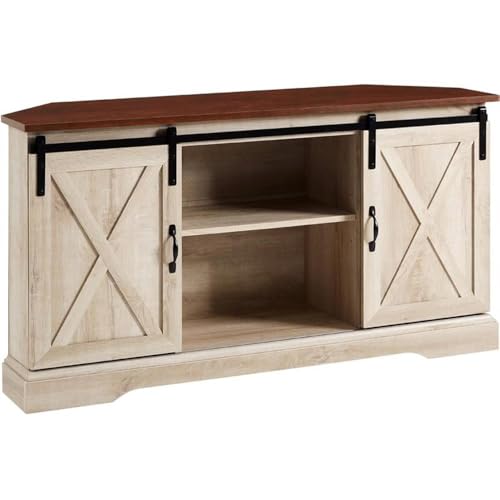
Walker Edison Modern Farmhouse TV Stand — Best Character Pick — mid tier
The farmhouse line from Walker Edison leads with grooved barn-style doors and a warm wood-look finish, and backs the looks with enclosed cabinets that hide the untidy middle layer of a family setup. The open-versus-closed balance suits streaming-plus-consoles households, provided the hottest component gets the most open position available or a rear panel is left off for air. Assembly is an afternoon for two people. Verdict: the pick when the room wants warmth first and the gear list is mainstream.
Best for: Farmhouse and lived-in traditional rooms wanting enclosed storage with genuine personality.
Not suited for: Ventilation-critical cinema builds and strict minimalist rooms.
Simpli Home Warmington TV Media Stand — Best Premium Pick — premium tier
Solid timber, hand-finished grain and a weight that settles a room: the Warmington line from Simpli Home is the buy-it-once entry in this guide. Drawers and cabinets mix for electronics plus overflow, and the top carries a large screen with complete composure. It is a two-person lift in every sense and should be anchored with the same care as its mass deserves. Verdict: the pick when the room is finished changing its mind.
Best for: Settled, formal living rooms and buyers purchasing once for a decade.
Not suited for: Frequent movers and rooms still changing layout.
Bush Furniture Salinas TV Stand — Best Practical Pick — entry-to-mid tier
Bush Furniture’s Salinas line divides its storage into cubbies and cabinets under a mission-influenced face, at the tier where value arguments are easiest to win. It blends beside existing wood tones instead of competing with them, assembles methodically, and shrugs off family use. Verdict: the pick for households buying their first console or furnishing a hard-working family room on a sensible tier.
Best for: Family rooms wanting divided storage, forgiving finishes and an unfussy traditional blend.
Not suited for: Statement-piece hunters and deep-bay cinema builds.
WE Furniture Sliding Door TV Stand — Best Modern Pick — mid tier
The sliding-door designs from WE Furniture make access itself the feature: glide a door and one half of the setup displays while the other disappears, with no door ever swinging into the room. The low, wide stance is the natural base for a wall-mounted screen and a soundbar. Keep tracks dusted and the mechanism stays fingertip-light. Verdict: the pick when modern lines and flexible access matter more than maximum enclosed volume.
Best for: Contemporary rooms, wall-mounted screens and tight seating layouts where swinging doors would collide with furniture.
Not suited for: Drawer-needing households and homes with toddlers fascinated by sliding mechanisms.
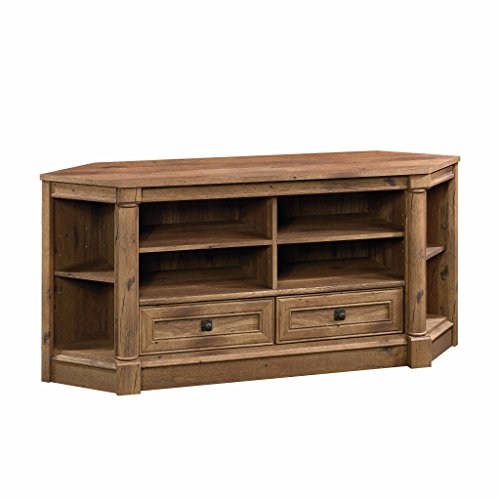
Sauder Harbor View Entertainment Credenza — Best Storage Pick — mid tier
Sauder’s Harbor View line stretches the console into credenza territory: a long, low, louvered-door piece that stores like a sideboard and stages a television like a console. For households whose real problem is volume, this is the honest answer — one footprint instead of a console plus extra cabinets. Assembly is the longest project in this guide and rewards a methodical second person. Verdict: the pick when storage, not style or cinema, is the deciding criterion.
Best for: Overflow-heavy households — games, blankets, albums, two consoles — needing one long storage wall.
Not suited for: Small walls and rooms where a long credenza would dominate.
How Wide and Tall Does It Need to Be?
Width is governed by the screen, and the governing measurement is the television’s true width, not its diagonal marketing size. With the TV standing on the console, leave margin on each side so the base sits fully supported and the pairing looks grounded rather than perched; with the TV wall-mounted, a wider console still reads better, because it is the composition’s base. Height is governed by your seating: the screen’s center belongs near seated eye level, so work backwards from your sofa to the surface height you need, remembering that a soundbar on the top surface raises the effective stack. Depth is governed by your largest component plus its cables — a receiver’s case depth is not its installed depth, and the difference has embarrassed many careful buyers. Measure all three axes against your gear list, and cross-check the screen-size background in best TV stands for 55-inch TVs if your television is in that class.
How Much Storage Do You Actually Need?
Count devices, then count the invisible load. Devices are easy: receiver, consoles, streaming boxes, players, speakers. The invisible load is everything else the TV wall attracts — remotes, batteries, chargers, headsets, game and disc cases, board games, spare throws, photo albums, the router if the connection point lives there. Most households underestimate the invisible load by half, which is why consoles bought exactly full overflow within a year. The buying rule is to spec for your counted load plus one empty bay or drawer of growth. Then assign honestly: hot and remote-controlled devices to open or signal-friendly positions, jumbled small things to drawers, bulk and visual noise behind doors.
How Will You Handle Heat and Cables?
Treat this question as a filter, not a footnote. AV receivers and games consoles exhaust real heat and must not be sealed in closed cabinets; look for open backs, vented or slatted shelves, removable rear panels and generous clearance, and plan the hottest component into the most open position the design offers. For cables, look for rear cutouts positioned where your devices will actually sit, room behind the piece or in a channel for a surge-protected strip, and a layout where no cord needs to cross a walkway. A console that answers heat and cables well will be a pleasure at every upgrade; one that answers them badly will fight you for a decade. If your current setup’s wiring is a mystery, the worked method in how to choose a media console walks the full planning sequence.
What Is It Made From, and Does It Matter?
Solid wood is the premium answer: heavy, repairable, refinishable, and calm under load, at a premium tier and with a two-person lift as part of the deal. Quality veneered engineered panels are the mainstream answer: consistent finishes, lighter handling, honest service at entry-to-mid tiers, with edges and joints that reward gentle treatment. Metal-and-glass designs are the airy modern answer, kindest to ventilation and hardest on fingerprints and dust visibility. What matters most is not the material’s prestige but its match to your life: family rooms forgive veneer and punish delicate glass; settled formal rooms reward timber; hot cinema builds should value open construction over any finish. Check the maker’s stated load rating for the top surface against your television, and never improvise beyond it.
How to Prioritise by Use Case
The streaming household. TV, soundbar, one small box: your priorities are looks, height and a clean top. Almost any type serves; spend on the finish that completes the room, keep one bay free for the inevitable second box, and anchor everything. The gaming household. Consoles plural, headsets, controllers and charging: priorities are ventilation, drawer space for accessories and doors that hide the charging sprawl. Open or mesh positions for the machines themselves are non-negotiable during long sessions.
The cinema household. Receiver, center speaker, multiple sources: priorities are bay dimensions measured against real gear, open-backed airflow, a center position that puts the speaker at the right height, and cable access you can reach without moving the piece. The family-everything household. All of the above plus board games, blankets and toy overflow: priorities are volume, drawers, and safety executed perfectly — anchoring, secured television, one-drawer rule — with the family thinking in best sofas for homes with kids applied across the room, and overflow shelving from best bookshelves if the console alone cannot swallow it.
First Setup and Care Essentials
Set up in the order that keeps you safe and sane. Assemble on a soft surface near the final position, with two people for any panel work and the full lift — consoles are wide, awkward and heavier than they look. Position the piece, level it, and anchor it to the wall with the supplied straps or brackets before any electronics go in; secure the television to the wall or console as its maker directs, fully supported, never overhanging. Wire from the power strip outward, leaving slack at every device, route the bundle through the cutouts, and keep every cord out of walkways. Then load storage low and heavy, test every remote’s line of sight, run the hottest component through a full film and check its bay for heat buildup before you declare the job done.
Care is a light standing routine. Dust the top weekly — it sits under a screen and shows everything. Keep vents and sliding tracks clear, vacuum rear cutouts when you clean behind the piece, and check anchor straps and wall fixings yearly for tautness and soundness. Wipe spills promptly on any finish, use coasters as a household habit rather than a hope, and touch up veneer edges before small chips become peeling invitations. A console cared for this way stays furniture; neglected, it becomes equipment storage with doors.
Mistakes to Avoid
Buying by diagonal size instead of measured width. Specifying storage for devices and forgetting the invisible load. Sealing a receiver behind a closed door. Choosing a fireplace-insert model and then discovering the receiver has no home. Skipping the anchor because the piece feels stable. Ordering before measuring the delivery route — doorways, stairs and hall turns defeat more consoles than defects do. And the subtlest mistake: buying the console before the sofa, then discovering the pair puts the screen at forehead height. Sequence the room — seating, screen height, console — and the geometry takes care of itself. If the plain stand still tempts you after all this, the fair fight is staged in media console vs TV stand.
A Measuring Workshop: The Exact Sequence
Buying guides praise measuring; this one choreographs it. Sit in your primary seat with a tape, a notebook and your phone’s camera. First, eye level: sit as you watch, have a partner hold the tape from the floor to your eye line, and record it — that number governs everything. Second, screen geometry: your television’s true width and height, its stand footprint if it will stand, and the wall run available, stud to stud if you may mount. Third, the gear audit: every component’s width, height and depth, plus a cable allowance behind each, written as a list you will shop with, not a memory you will shop from.
Fourth, the room audit: outlet and antenna positions, the direction and hours of daylight on the screen wall, the walkway lines that cables must never cross, and the delivery route measured at its three tightest points — front door, stair turn, room door. Fifth, the future allowance: one television size up in width, one component added to the gear list, because the console you buy is the console your next upgrade must fit. Photograph the wall, the gear stack and the route. A buyer who completes this workshop in twenty minutes has done more for the purchase than a week of browsing can, and every later step in this guide becomes a comparison against numbers instead of a negotiation with hopes.
Finishes, Color and Light: Buying for Your Room’s Reality
Finish choice is where buying guides usually wave at taste; treat it instead as applied light. A screen wall receives the room’s most concentrated attention and often its trickiest light. Dark finishes ground large screens and disappear in theater-leaning rooms, but they show dust at highlight angles and can swallow a small room’s brightness. Light and natural-wood finishes lift small and north-facing rooms and forgive dust visually, while announcing every scuff and coaster ring to a degree dark finishes hide. High-gloss surfaces reflect lamps and windows into the viewing experience; matte and satin finishes keep the wall quiet, which is why most dedicated viewing spaces choose them.
Coordinate against the room’s fixed points, not its movable ones. Flooring tone, the wall color you will not repaint this year, and any built-in joinery are the console’s true neighbors; sofas and rugs can be re-chosen around an anchor, but floors cannot. The durable rule is contrast with company: the console should differ enough from the floor to define itself, while sharing a temperature — warm with warm, cool with cool — with the room’s woods and metals. Order finish samples where makers offer them and judge them on the actual wall, at the actual hours you watch, because a finish chosen under showroom light is a stranger by your lamplight.
Delivery, Assembly and the First Evening
The purchase is not finished when the order is placed; it is finished when the first film ends and nothing rattles, overheats or glows wrongly. Prepare for delivery by clearing the route you measured, protecting floors at the turns, and deciding the assembly surface — a rug or blanket near the final position, with room to walk around the piece. Check every panel and hardware bag against the parts list before the first screw turns; a missing cam discovered at the end is a weekend lost. Assemble as a pair, in instruction order, without forcing joints, and keep the packaging until the piece stands complete and undamaged.
Then the installation sequence, which this guide treats as part of the product: level the console; anchor it to the wall with the supplied straps or brackets; secure the television, wall-mounted on sound fixings or standing fully supported and strapped; wire from the surge-protected strip outward with slack at every device and no cable across a walkway; load the heaviest storage low; place the hottest component in the most open bay; and run the system through a full, loud, long session while you check for heat, rattles and remote blind spots. That first-evening shakedown, done deliberately, converts a purchase into an installation — and it is the difference between the households in the reviews who praise their consoles for years and those who quietly nurse a grievance against a door, a bay or a hum.
Warranty, Returns and the Paperwork of Furniture
Un glamorous and decisive: furniture at these tiers is bought under policies, and the wise buyer reads three before ordering. The damage policy — what happens when a panel arrives split or a corner crushed, how photographic evidence is submitted, whether a replacement panel ships or the whole piece returns. The return policy — who pays freight on a wide, heavy object, because on furniture the freight is the policy. And the maker’s warranty on structure and hardware, which tells you, in legal language, how long the maker expects the piece to serve; a maker vague about its own furniture’s lifespan has given you information. Keep the instructions, the hardware spares and the purchase record in the console’s own least-used drawer, where the future strap check, door adjustment or panel claim will go looking for them.
The Shortlist Method: From Twenty Listings to One
End the process the way this guide began it: with a method, not a mood. Filter your listings by the non-negotiables first — width against your measured screen, height against your measured eye level, bay dimensions against your measured gear, ventilation architecture against your hottest component, anchoring hardware included. That filter, honestly applied, usually kills most of a long list, and it should: those were never candidates, only photographs. Then rank the survivors by the storage mix against your invisible load, the construction evidence in their descriptions, and the finish against your room’s light. Then — only then — let taste choose among the final two or three, because taste choosing among qualified candidates is pleasure, while taste choosing among photographs is gambling.
A last discipline for the shortlist: write, for the leading candidate, the one-sentence case against it. If the sentence is about a measurement, believe it and move on. If it is about a finish hesitation, order the sample. If it is about tier, return to the horizon question — how long this room keeps this layout — and let the horizon decide, because in this category the horizon is the price. Buyers who finish with that sentence written rarely return to the listings; buyers who skip it often do, carrying a wide, heavy lesson with them.
Reading Reviews and Listings Like an Editor
A buying guide should teach source criticism, because the modern furniture listing is a persuasive document, not a neutral one. Read dimensions in the specifications, never in the lifestyle copy, and distrust any console whose maker will not state its load rating, its materials and its interior bay measurements in plain figures — the absence is the information. Read photographs forensically: a bay shown holding one slim device is a bay photographed to flatter; look for the image, if any, with the back visible, because the back confesses the ventilation and cable truth the front is styled to conceal. Read the questions section of any listing before the reviews; owners ask about exactly the dimensions and duties the maker left vague.
Read owner commentary for patterns, not verdicts, and never for counts or scores — a detail this series enforces by printing none. The patterns that matter repeat across households: doors that arrived misaligned and stayed that way, a bay that a common receiver nearly fits, tracks that glide until the first dusty month, finishes that forgive or accuse. A single complaint is an anecdote; the same complaint in a dozen households is a specification the maker forgot to print. Weight assembly reports heavily, because a console’s build afternoon predicts its decade: pieces that fought their owners on day one rarely make peace by year three.
The Two-Budget Problem: Furniture and Everything It Triggers
First-time console buyers should know that the furniture is the visible part of a slightly larger project, and plan the whole project rather than be ambushed by it. The triggers are predictable: the anchoring hardware and any wall fixings beyond the box’s contents; the surge-protected power strip the cable plan assumes; hook-and-loop ties, labels and perhaps a cable channel for the run to the outlet; felt pads, coasters and the bias light the room’s darkness suddenly requests; and, in receiver households, the small repeater that lets a remote speak through a closed door. None of these is large. Together they are the difference between an installation that feels finished on the first evening and one that dribbles through three weekends of small lacks.
There is also a labor budget, and it is denominated in people: two for the assembly, two for the lift, and — in households where those two people are the same two people — an honest scheduling of the afternoon when both are fresh. Solid-wood and credenza-length pieces deserve a third consideration, which is whether the delivery service’s threshold drop is truly sufficient or whether room-of-choice delivery earns its keep against a staircase. Budgeting these unglamorous lines is not pessimism; it is how a purchase stays inside its tier psychologically as well as financially, and how the first evening ends with a film instead of a hardware-store run.
When to Buy the Bigger Piece on Purpose
Conventional guidance says buy for your needs; this guide adds a deliberate exception, because consoles punish exactness. Buy one size up in width when your household’s trajectory includes a larger screen — which, across a decade, most households’ trajectories do — because width is the one dimension a console cannot fake later, and a screen must never overhang its support. Buy one bay more than the current gear list when a games console generation, a karaoke machine, a turntable revival or a child’s first system is anywhere on the family’s horizon. Buy one tier up in construction when the room is settled, because construction is the dimension whose absence cannot be remedied at any later date.
The exception has limits, and they are the room’s: never buy wider than the wall composes well, never deeper than the walkways forgive, never heavier than your floors, route and two-person lift can honestly handle. Deliberate oversizing is a margin bought inside the room’s measurements, not a defiance of them. Practiced that way, it is the cheapest insurance in the category — the difference between a console that absorbs the household’s growth and one that becomes the ceiling the household’s next decade must duck under.
The Guide’s Own Worked Shortlist
Close with the method performed once, briefly, on an imaginary but typical household, so the abstractions leave footprints. The household: a mid-size screen due for replacement within two years, a receiver and center speaker, one games console, two children under seven, a settled semi-detached living room, board games in exile on a dining shelf. The measuring workshop returns: screen width plus the next size up; eye level from the family sofa; receiver dimensions with cable allowance; a gear list with one growth bay. The filter kills the fireplace-insert models — the receiver needs the center — and the sealed-back designs, and everything narrower than the future screen.
The survivors rank themselves: a hybrid with an open center bay for receiver and speaker, drawers for the remote economy, cabinets for the exiled board games, in a finish that forgives. The tier decision follows the horizon — settled room, decade layout — and lands mid-to-premium, with construction evidence doing the final sorting. The installation is planned with the order: straps, strip, ties, a second pair of hands, a first-evening shakedown with the loudest film the household owns. That is the whole guide in one paragraph, and it is repeatable for any household willing to spend its first twenty minutes with a tape measure instead of a listings page.
Buying for the Household You Actually Have
Guides end, properly, by returning the decision to the only authority that was ever going to make it: the household, with its real gear list, real children, real wall and real horizon. This guide has argued for measurement over mood, construction over photograph, ventilation and anchoring as buying criteria rather than installation trivia, and tiers set by horizons rather than by aspiration. It has shortlisted five lines across those tiers and refused, on principle, to crown one — because the crown belongs to the match, and the match is made in your room’s numbers, not in any article’s preferences.
So the final instruction is procedural. Take the measuring workshop’s five audits. Run the filter of non-negotiables. Rank the survivors by storage honesty and construction evidence. Write the one-sentence case against the leader and answer it. Then buy, install by the ritual — level, anchor, secure, wire, load low, ventilate, shake down — and close the listings. A bought console, well chosen, should end the shopping the day it arrives; the households still browsing a month later are usually the ones who bought a photograph and are shopping, already, for its replacement. Let that not be your household. Measure, choose, anchor, watch.
A Final Word on Patience in This Category
Furniture at this scale rewards the buyer who can wait a week. Finishes can be sampled, rooms can be lived in with tape outlines on the floor, gear lists can be audited twice, and the shortlist can be slept on — and every one of those pauses costs nothing while preventing the category’s only expensive mistakes, which are all measurements skipped in a hurry. The listings will still be there; the wall is not going anywhere; the television is patient. Buyers who treat the console as the decade decision it is, rather than the weekend errand it resembles, join the quiet majority of owners whose reviews, a year later, are about their evenings instead of their furniture.
After the Purchase: The Thirty-Day Review
This guide’s last service is to schedule the review nobody schedules. Thirty days after installation, walk the purchase once more with the guide open. Check the geometry: is the screen’s height still kind at the end of a long film, or has the household quietly added cushions and complaints? Check the heat: every bay, by hand, after the longest session of the month. Check the storage truth: which drawer is already the junk drawer, which bay is the growth space still honorably empty, and which device has begun a second life stacked on top — the earliest symptom of a storage plan that needs one honest rearrangement while rearrangement is still easy.
Check the safety with the same formality: straps taut, fixings sound, the television’s own security untouched by the month’s bumps and dusting, the household rules still known by the household’s smallest members. And check the paperwork: instructions filed in the console’s own drawer, the purchase record with them, the spare hardware bagged and labeled. A console that passes its thirty-day review will, in this guide’s experience, pass its annual ones with a fraction of the attention — because the failures of furniture are almost all born in the first month and merely announced later. Schedule the review the day the piece arrives, while the intention is warm, and let the guide’s work end the way it began: with the household measuring, on purpose, in its own room.
Buying With a Partner, a Family and a Tape Measure
Consoles are rarely bought alone, and the shared purchase has its own method worth printing. Divide the labor by temperament: one partner owns the measurements and the gear audit, the other owns the room — its light, its finishes, its composition — and each holds a veto only inside their own ledger, which prevents the classic deadlock where a bay dimension and a finish preference argue as though they were the same kind of fact. Agree the non-negotiables together, in writing, before any listing is opened: maximum width, the height the eye level demands, the hottest device’s open home, the anchoring plan. Inside those rails, taste can argue freely and safely, because every candidate still standing is already qualified.
Where children are old enough to have opinions, give them the drawer question and nothing else: which drawer should hold the games, the controllers, the art supplies that live downstairs. It is a real contribution — they know the household’s small geography better than anyone — and it converts the new furniture, on arrival, from an adult imposition into a piece with their name already inside it, which pays out in care taken and rules respected for years. The buying of a console, done this way, is a small rehearsal of how the household makes every large decision: measured, divided, agreed at the rails, and finished together. The furniture is almost incidental. Almost.
The Guide in One Breath
For the buyer who reads the last page first: measure the screen’s true width, your seated eye level, every component with its cables, the wall and the delivery route. Filter for width, height, bay size, open ventilation for hot gear and included anchoring hardware, and let everything else go without grief. Rank what survives by storage honesty and construction evidence, choose the tier by your room’s horizon, and install by the ritual — level, anchor, secure the screen, wire with slack, load low, shake down hot and loud. Then stop shopping. The console is bought, the wall is quiet, and the guide’s remaining thousands of words exist only to explain why those few sentences, followed in order, almost never lead a household wrong.
Keep the Guide, Lose the Listings
A last practical word: when the purchase is made, delete the listings, close the tabs and unsubscribe from the alerts. Furniture bought by measurement does not improve under continued comparison, and the console in your room — anchored, wired, quietly running the wall — deserves to be judged against your evenings rather than against next season’s finishes. Keep this guide for the thirty-day review and the annual strap check; lose everything else. The category will still be there, patient and wide, when the next room asks its question.
Closing Note
It is worth stating, as the guide closes, what kind of document it has tried to be: not a catalogue with opinions, but a sequence that any household can run in its own room with a tape, a notebook and an hour. Catalogues expire with their listings; sequences survive, because walls and gear and children keep posing the same questions in the same order. If a future reader runs the measuring workshop, applies the filter, writes the sentence against their leader and installs by the ritual, this guide will have done its work in a home it will never see — which is the only ambition buying guides should honestly have, and the standard this one is content to be judged by.
A Pre-Purchase Measurement and Compatibility Audit for Your Media Console
Use this audit in the final ten minutes before you order a media console, because that is when most buying-guide advice stops being abstract and starts being a tape measure, a doorway and a return label you would rather not need. Write down three numbers for the media console you are considering: the footprint where it will sit or be stored, the largest dimension it reaches in normal use, and the clearance it needs so doors, drawers, lids, handles or moving parts can work without catching. Watch for edge cases in your own home: the pet that investigates everything, the child who treats every new object as furniture, the guest who uses force where you use familiarity, and the weather, light or season that changes how a media console behaves. If you want a concrete listing check, take a name already shortlisted in this guide, such as Walker Edison Modern Farmhouse TV Stand, Simpli Home Warmington TV Media Stand and Bush Furniture Salinas TV Stand, and verify that exact media console listing against the measurements and compatibility questions above, field by field, rather than trusting the headline description alone.
Seasonal thinking helps more than expected: a media console bought in one season will meet different light, humidity, mud, heat, guests and routines in another, so judge its size, storage and upkeep against the hardest season it will face. Photograph your setup once the media console is working well — the position, settings, arrangement or layout you settled on — so that after a move, a deep clean or a seasonal break you can recreate the arrangement that worked instead of rediscovering it. For troubleshooting, start with the boring causes first: power, water, fit, blockage, alignment, a full container, a loose connection or a setting changed by the last person who used the media console, because boring causes account for most apparent failures. Check the floor, wall, ground or surface the media console will meet, since level, texture, moisture and finish decide more about everyday performance in living room furniture settings than most shoppers expect when they are comparing listings on a screen.
When something about the media console disappoints, change one variable at a time — position, setting, timing, load, accessory or technique — and give the change a fair trial, because changing three things at once leaves you with a better or worse result and no idea why. Think about who else will use the media console and what they will do differently: shorter reach, less patience, stronger habits, no interest in the manual, and a tendency to leave things wherever they were last set down. Consider the cleaning rhythm honestly: a media console that needs attention after every use suits a household that enjoys small rituals, and frustrates a household that wants to finish a job and walk away, so match the upkeep to the temperament, not the intention. Share the checklist result with anyone who shares the space, since a media console chosen by one person and resented by another rarely survives, however sensible the purchase looked on paper.
Plan the storage home for the media console before it arrives, naming the exact cupboard, corner, shelf, hook or stretch of floor, because a product without a home migrates around the house and slowly becomes the clutter it was bought to reduce. Then measure the route, not just the destination, since a media console that fits its final spot perfectly can still fail at a narrow hallway, a tight turn, a low doorway or a cupboard mouth that is smaller than the space behind it. Keep a short note of what you adjusted on the media console during the first month, even just a line on your phone, since those notes turn vague impressions into a setup you can repeat, share or troubleshoot months later. Read the manual’s warnings page for the media console even if you read nothing else, because that page is a compressed list of every way the product has ever been misused, and it tells you exactly which of your own habits needs adjusting.
Keep the packaging of a larger media console until those first ordinary tests are done, flattened if space is tight, because re-boxing an awkward shape from scratch is the hidden difficulty inside many otherwise straightforward returns. If a listing for a media console leaves one of those compatibility questions unanswered, treat the gap itself as information and look for the answer in the manual, the dimension diagram or the question section rather than assuming the generous interpretation. Measure before anything else, and measure the media console in its working state rather than its packed or folded state, because handles extend, lids open, cords trail, doors swing and users stand somewhere, and all of that belongs in the measurement.
Frequently Asked Questions
What size media console do I need for my TV?
Start from the television’s true measured width, not its diagonal. The console should extend beyond the screen on each side — a few inches at minimum with the TV standing on it, more when the TV is wall-mounted and the console serves as the visual base. Then check depth against your largest component plus its rear cables, and height against your seated eye level. When in doubt between two sizes, the wider one usually serves longer, because televisions are replaced more often than furniture and they rarely shrink.
Is solid wood worth the premium tier?
For a settled room, generally yes; for a changing one, generally no. Solid wood brings repairability, refinishing potential, substantial load calm and a feel that flat-pack cannot imitate, and spread across a decade its cost per year is small. But it is heavy to move, unforgiving of careless delivery routes and wasted in a room whose layout will change next year. Quality veneered consoles at entry-to-mid tiers serve most households honestly for years — buy timber when the room is finished deciding what it is.
Where should the center-channel speaker go?
Centered under the screen, as close to seated ear height as the furniture allows, with its front edge at or slightly proud of the shelf front so the sound is not boxed in. Many consoles offer a wide center bay or a dedicated soundbar shelf for exactly this. Do not exile the center speaker to the floor or a side cabinet — dialogue clarity is its entire job, and placement is half its performance. If a soundbar replaces it, the same centering rule applies on the top surface or the open bay.
How do I keep a games console cool inside a media console?
Give it the most open home in the layout: an open bay, a mesh-fronted section, or a cabinet whose rear panel can be removed, with clearance on every side and above. Never stack another device directly on it, keep its vents dusted, and leave the door open during long sessions if it lives behind one. After an hour of play, the bay should feel warm at most, never hot; if it feels like an oven, the placement is wrong no matter how tidy it looks, and the machine should move before heat shortens its life.
Can I use a sideboard or dresser instead of a media console?
Sometimes, with three checks. Height: the screen’s center must land near seated eye level, and many dressers are too tall. Ventilation and cables: the back must be openable or the gear must live on top, because sealing hot electronics inside a dresser drawer cavity is the classic failure. Safety: the piece must be anchorable and the television fully supported and secured. A low sideboard often passes all three and can be a beautiful answer; a tall dresser usually fails the first. Measure, do not romanticize.
What should I check on delivery day?
The route first — confirm the packaged piece fits your doorways and turns before the crew is standing in them. Then inspect panels and hardware against the parts list before assembly begins, photograph any damage before you build around it, and assemble near the final position so the finished, heavy piece travels inches rather than rooms. Keep the anchor hardware out of the packaging recycling until the straps are actually fitted, and keep the instructions — the next move, upgrade or strap check will want them.


