Disclosure: As an Amazon Associate, dailyhomedecorating.com earns from qualifying purchases. Links on this page are affiliate links; they cost you nothing extra. Prices and availability change often, so check the current Amazon listing before you buy.
The media console vs tv stand question sounds like a shopping detail and is actually a household philosophy: how much furniture does your television deserve, and how much of your room should it govern? This comparison stages the media console vs tv stand debate fairly — the console’s case argued at full strength, the plain stand’s case argued with equal respect — across storage, safety, heat, cables, looks, effort and commitment, with a verdict per criterion and a final recommendation by use case. No rigged scoring: the stand genuinely wins several rounds below, and for the right household it wins the match.
Key Takeaways
- Quick verdict: choose the console for systems, storage, children and settled rooms; choose the stand for minimal setups, small budgets of space and effort, and temporary homes.
- The console wins on storage, cable management, presentation and anchored safety depth.
- The stand wins on lightness, ventilation by default, moving ease and low commitment.
- Safety is not owned by either side — both must be anchored and both televisions secured; the console simply builds more of that work into the furniture.
- The tiebreaker is your device count: two or more boxes to house settles it for the console; a screen and a soundbar settles it for the stand.
Quick verdict. If your viewing system is a television plus devices, clutter and a room that matters, choose the media console. If your system is a television, full stop — wall-mounted, soundbar beneath, nothing to store — choose the plain TV stand, or even a floating shelf, and spend the difference on seating. The detailed rounds below exist for the large, honest middle: households with some gear, some clutter and some doubt.
In this guide
Media Console Vs Tv Stand: Side-by-Side
Read the comparison in words, criterion by criterion. Purpose: the stand supports a television; the console supports a television and houses its entire system. Storage: the stand offers a shelf or two, open; the console offers bays, cabinets and drawers, open and closed. Cable management: the stand leaves cables visible or loosely gathered; the console routes them through cutouts into a managed bundle. Heat: the stand’s openness ventilates by default; the console must be chosen and loaded with ventilation in mind. Safety platform: the stand is lighter and narrower, demanding its anchoring be taken seriously precisely because it is easy to underestimate; the console is wide, low and load-bearing, an anchor platform by design. Footprint and commitment: the stand is small, light and provisional; the console is wide, heavy and declarative. Style role: the stand is equipment; the console is furniture. Moving: the stand travels in one trip by one person; the console is an event for two.
Storage and Clutter
This round is the console’s home turf, and it is not close. A modern system generates devices, media, accessories and overflow that a stand’s open shelf displays rather than stores — every box visible, every cable on show, every game case in a stack that reads as clutter no matter how neatly it is squared. The console absorbs the same load into assigned interiors: hot devices in open bays, mess behind doors, small chaos in drawers, and living-room overflow — games, blankets, albums — in the volume that remains. Households whose TV wall currently looks like a technology spill will feel this round as the whole argument.
The stand’s honest reply deserves hearing: not every household has the load. A screen, a soundbar and a streaming stick generate almost nothing to store, and a console bought for that system is an empty cabinet — storage in search of clutter, dusting in search of a purpose. Storage you do not need is not a feature; it is a footprint tax. Criterion verdict: console, decisively, for any household with two or more devices or real overflow; stand, by default, for the genuinely minimal system.
Safety and Stability
This round matters most, so it will be argued most carefully. The hazard is real and shared: televisions tip, and furniture under televisions tips, and children are hurt every year in exactly this scenario. Neither side of this comparison is safe by purchase; both are safe by installation. Anchor the furniture to the wall with straps or brackets. Secure the television to the wall or the furniture as its maker directs. Place the screen fully supported, never overhanging. Never let children climb drawers or shelves; open one drawer at a time. Those rules protect a stand household exactly as they protect a console household.
Within those rules, the console holds structural advantages: it is wider and lower, its mass and stored load sit near the floor, its top is dimensioned and rated for screens, and its storage lets heavy items live low where they stabilize rather than decorate. The stand’s countervailing virtue is subtler: its very lightness makes households honest — nobody assumes a small stand is safe unanchored, while a heavy console tempts the dangerous thought that weight alone is protection. It is not. Criterion verdict: console, on structure — provided the anchoring is done; an anchored stand beats an unanchored console every time, and this round is forfeited by whichever side skips the straps. The family stakes behind this round are spelled out in best sofas for homes with kids.
Heat and Ventilation
The stand wins this round on architecture. Open on most sides, it gives receivers and games consoles the one thing they beg for — moving air — without the owner planning anything. Devices on a stand run as their makers intended, and the stand household never learns the phrase thermal shutdown. For a single hot component, especially a hard-working receiver or a marathon games console, the humble open stand is genuinely excellent furniture.
The console’s answer is that ventilation is a solvable design brief rather than a verdict: open center bays, mesh or slatted fronts, removable rear panels and honest clearance give hot gear console-housed airflow that matches the stand’s in practice, while gaining every other console virtue. What the console cannot survive is carelessness — a receiver sealed behind a solid door in a closed cabinet — and the stand household is right to point at that failure mode. Criterion verdict: stand, by default and by forgiveness; console, fully equal, only when its ventilation is chosen and loaded deliberately.
Cables and Everyday Order
Cables are where the two philosophies show their souls. The stand treats cables as weather: they hang, gather, dust and dangle, manageable with ties and channels the owner adds, never truly governed. The console treats cables as plumbing: cutouts where devices sit, a defined home for the surge-protected strip, one bundle, nothing across a walkway, upgrades as swaps instead of archaeology. In a household that changes gear, cleans behind furniture or has small hands exploring, the console’s system is a daily dividend in time, tidiness and small safety.
The stand’s reply is that plumbing has a price in access: a fully routed console rear is more work to rewire than an open stand’s visible spaghetti, and tinkerers who swap components weekly may honestly prefer everything reachable at a glance. Criterion verdict: console, for the settled system and the tidy household; stand, forgiven, for the perpetual tinkerer. Either way, the standing rule binds both sides: no cable crosses a walkway, and slack at every device is kindness to your future self.
Looks and the Room
The console is furniture and the stand is equipment, and rooms can tell. A console grounds a large screen, gives the wall a material and a style — farmhouse warmth, mid-century line, timber gravity — and turns the television area into the room’s composed focal point, the effect every styled photograph of a living room relies on. It also multitasks decoratively: a styled top surface, a plant, a lamp, a stack of books, in a way no equipment shelf invites. For the room-as-public-face household, this round alone can settle the match.
The stand’s aesthetic case is restraint. In small rooms, in rented rooms, in rooms where the television is a guest rather than the host, a low open stand — or a wall mount with a floating shelf — keeps the floor and the sightlines clear and lets other furniture lead. A console in such a room can feel like a battleship in a pond. Criterion verdict: console, for focal living rooms and settled style; stand, for small, quiet or television-secondary rooms. Seating-led rooms, where the chairs in best chairs for watching TV are the real investment, often belong to the stand’s side of this round.
Effort, Moving and Commitment
The stand’s finest round. It arrives light, assembles in minutes or not at all, moves with one person, fits the next apartment sight unseen, and asks nothing of the household’s future. The console arrives as panels and an afternoon, or as solid timber and a two-person lift; it fixes the room’s layout around one wall; it anchors — literally — the household to its current floor plan; and when life changes, it is the piece most likely to be sold, gifted or negotiated over. Renters, students, frequent movers and the layout-restless should weight this round at full value, because it is their daily reality.
The console’s reply is that commitment is the price of every real improvement a home makes, and that in a settled household the effort is paid once and the dividend nightly. Criterion verdict: stand, clearly, for temporary and mobile households; the round simply does not arise for settled ones. The decision framework that weighs this round against your horizon is in is a media console worth it.
Strengths and Trade-Offs of Each Side
The console’s strengths: complete system storage, open and closed; cable management as a built system; a wide, low, anchorable safety platform with room to load heavy and low. The console’s trade-offs: footprint and permanence; ventilation that must be planned; assembly, weight and moving effort. The stand’s strengths: ventilation by default; lightness in every sense — purchase, placement, moving, commitment; honest sufficiency for minimal systems. The stand’s trade-offs: clutter displayed rather than stored; cables as weather; a narrower safety margin that depends entirely on the owner fitting the straps the furniture’s lightness makes easy to skip.
Who Each Option Suits and Who Should Skip Each
Choose the console if you own two or more devices, your TV wall is your living room’s face, children or pets share the room, living-room overflow needs a home, or your room is settled for years. Skip the console if your system is a screen and a soundbar, your tenancy is short, or your layout is still changing. Choose the stand if your setup is minimal, your space is tight, your life is mobile, or your gear runs so hot and changes so often that openness is the whole brief — the dedicated-room pattern in best sofas for a basement theater sometimes pairs with a stand or rack for exactly these reasons. Skip the stand if clutter already bothers you, because a stand will show you all of it, forever, at eye level. The measurement method for the console side, once chosen, is in how to choose a media console.
How to Decide
Ask five branching questions. How many devices need a home by the screen — none or one points to the stand, two or more to the console. Does visible clutter genuinely bother you — yes points console, no forgives the stand. Do children or pets share the room — yes demands the fullest safety platform you will actually anchor, which is usually the console. How long will this room stay this shape — years point console, months point stand. And what runs hottest in your system — a serious receiver or marathon console demands openness, which the stand gives free and the console gives by design. Three or more console answers: buy the console, from the shortlist in media console buying guide. Three or more stand answers: buy the stand without a flicker of guilt, and anchor it like you mean it. The full balance sheet behind these questions is in media console pros and cons, and the screen-size grounding for either choice sits in best TV stands for 55-inch TVs.
Where Each Side Is Best Represented
On the console side, the roundup’s representatives span the brief: the farmhouse line for enclosed character, the Warmington for timber permanence — both assessed in the reviews in this series. On the boundary stands the Salinas, the practical bridge for households whose debate ends in a modest, divided, unfussy piece. The plain stand itself needs no pick slot heroics: choose it wide enough for your screen’s true width, low enough for your eye level, rated for the load, and anchorable — and it will serve its philosophy honorably.

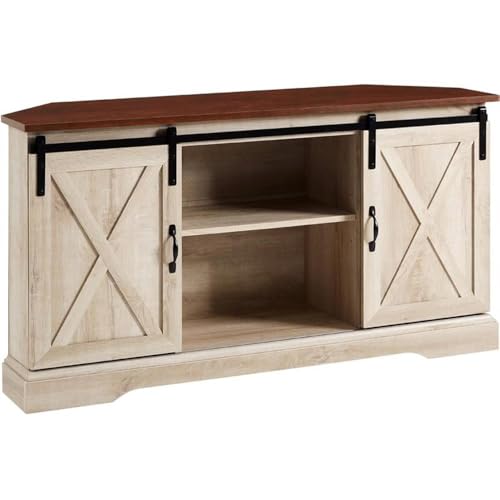
Walker Edison Modern Farmhouse TV Stand — console side — mid tier
Representing the console side: an enclosed, characterful hybrid that houses a full system behind barn-style doors. It embodies the console argument — storage, hiding, presence — in one mainstream piece.
Best for: Households choosing the console for enclosed storage and furniture presence.
Not suited for: Minimal setups that would leave its cabinets empty.
Simpli Home Warmington TV Media Stand — console side — premium tier
The console side at its most committed: solid timber, furniture proportion, decade horizon. If the console wins your household’s debate, this is its fullest expression.
Best for: Settled rooms making the console decision for a decade.
Not suited for: Short tenancies where permanence cannot pay back.
Bush Furniture Salinas TV Stand — stand side spirit — entry-to-mid tier
Listed here deliberately on the boundary: the Salinas is technically a console, but its simple, practical, divided design is the closest this roundup comes to the stand philosophy — support first, storage modest, fuss minimal. It is the compromise candidate for households torn between the two sides.
Best for: Households wanting simple, divided support without credenza commitment — the bridge piece of this comparison.
Not suited for: Buyers who already know they need full console storage.
Final Recommendation by Use Case
The family living room: console, anchored, enclosed, no contest. The streaming-minimal apartment: stand or floating shelf, with the console budget moved to seating. The gaming den: console with open architecture, or an open stand — heat breaks the tie. The cinema build: console for the screen wall if gear lives there; stand or rack thinking if it does not. The rental year: stand, anchored with approved fixings, and the console bought properly in the settled home. The design-led forever room: console, at the tier the horizon justifies. Two philosophies, six households, no loser — only matches and mismatches, which is all furniture buying ever is.
The Cost-of-Ownership Round
Money has been kept out of this comparison’s scoring so far, deliberately, because tiers overlap and figures date; but ownership cost has a shape that survives without numbers, and it deserves a round. The stand’s ownership cost is front-loaded simplicity: a modest piece, no assembly event, no accessories beyond the anchoring every piece of TV furniture demands. The console’s ownership cost is a longer curve: a larger piece at a higher tier in most matchups, an afternoon of assembly, and then a decade of small dividends — storage furniture not bought separately, cable chaos not repeatedly paid for in time, a safety platform not improvised. Judged per year of a settled household’s life, the console’s curve usually flattens below the stand’s; judged across a single year of tenancy, it never gets the chance.
There is also the replacement asymmetry. A stand that disappoints is a small, light problem: it moves to a bedroom, a guest room, a listing, a friend. A console that disappoints is a wide, heavy negotiation with your own floor plan, and its exit costs effort out of proportion to its entry. This asymmetry does not favor either side’s quality; it favors deciding correctly the first time, which is the entire purpose of the rounds above. Households genuinely torn should weight this round heavily: when in doubt, the reversible choice is the stand, and the console can be bought later with the doubt resolved by experience. Criterion verdict: stand, on reversibility and short horizons; console, on cost per year across settled ones.
The Room-Size Round
Small rooms are where this comparison is most often actually fought, so they get a round of their own. The stand’s case in a small room is air: a low, open, narrow-footprint piece leaves the floor visible, the wall light and the room’s few square feet feeling unspent. The console’s case in a small room is consolidation: one piece doing the work of stand, cabinet and basket system can net out smaller than the scattered furniture it replaces, and a sliding-door design keeps its access inside its own footprint. Both cases are true, and the room decides between them by a single question — is your small room short of air, or short of storage? Rooms short of air take the stand; rooms short of storage take the console and are usually startled by how much calmer they feel.
Large rooms reverse the intuitions. A stand under a wall-sized screen in a generous room can look like an apology — the composition’s base too slight for its picture — while the console’s width and furniture presence are exactly what the scale ordered. Theater-leaning large rooms add the ventilation rider: the bigger the system, the more the open architecture matters, and the console must be chosen open-backed and honest, or the stand’s default airflow wins the room by forfeit. Criterion verdict: in small rooms, the room’s shortage decides; in large rooms, the console, with its ventilation homework done.
The Hybrid Answer and the Floating Shelf
No honest comparison should pretend the market offers only two shapes. Between the poles stand the hybrids this series has used as bridges: low divided pieces in the Salinas spirit that store modestly and commit lightly, serving small systems completely and teaching their households which direction their needs are growing. Beyond the stand pole sits the floating shelf — the wall itself as furniture — which wins the looks round in minimalist rooms outright and stores, precisely, a soundbar. And beyond the console pole sits the full credenza and the equipment rack, for storage maximalists and cinema seriousness respectively.
These in-between answers do not dissolve the comparison; they confirm its logic. Every option on the spectrum is a trade among the same currencies — storage, air, safety depth, footprint, effort, commitment — and the console-versus-stand frame is simply the spectrum’s clearest teaching tool. A household that understands the rounds above can place any hybrid on the spectrum in a minute and know what it is buying and what it is forgiving. That understanding, more than any single verdict, is what this comparison was built to leave behind.
A Fair Word for the Loser of Each Round
Comparisons end; households continue, usually with whichever side lost several rounds above — because a household is not a scorecard, and one decisive criterion rightly outweighs five agreeable ones. So a fair closing word for both. To the stand household that lost on storage: your openness is a genuine engineering virtue, your room’s air is real, and your lightness will make every future move a pleasure; anchor your stand, secure your screen, manage your cables with ties and channels, and your setup is not a compromise — it is a philosophy, honestly executed. To the console household that lost on effort and commitment: your afternoon of assembly bought a decade of evenings, your wall is the room’s anchor, and your straps are the quietest safety device in the house; ventilate honestly, dust weekly, and your furniture will argue its own case nightly.
And a shared word, because the rounds above kept returning to it and it outranks every verdict in this article: whichever side you choose, fit the anchors, secure the television fully supported, keep cables out of walkways, give hot electronics their air, and never let a child climb a drawer or a shelf. The comparison decides your furniture. The installation decides your safety. Households that get the second right are free to enjoy the first for years, on either side of the line this article has spent so long drawing.
The Children Round, Argued Separately and Slowly
Children change this comparison so fundamentally that they deserve a round argued at walking pace. Begin with the physics both sides share: a television is a heavy object at a height, a child is a climber with no risk model, and furniture is the meeting point. The controls are identical on both sides — anchor the furniture, secure the screen, keep it fully supported, forbid climbing, supervise the years when forbidding is theoretical. Where the sides differ is in how much help the furniture itself gives. The console gives width, lowness, mass near the floor, doors that close on the fascinating equipment, and drawers that — ruled one-at-a-time and never climbed — organize the small hazards of batteries and cables out of the toddler economy.
The stand gives less help and demands more vigilance, and its defenders should say so plainly rather than pretend the round is tied. What the stand gives a family is a smaller, lighter object that is easier to anchor correctly in the first place and easier to replace with a console when the household’s needs declare themselves — a bridge, honestly used. What it must never be given is a pass on the straps because it looks harmless; light furniture tips too, and a screen’s weight does not care what it was standing on. Criterion verdict: console, for households with children, by the widest margin in this comparison — with the standing condition that an anchored stand remains safer than an unanchored console, always.
The Sound Round
Audio separates the sides more subtly than video does, and dedicated listeners should weigh it. The console offers the soundbar and the center speaker a designed home: centered, at a governed height, with the system’s wiring disappearing behind the same furniture that stages it — and, in enclosed designs, a measurable softening of the small mechanical noises of the equipment itself. It also offers a risk the stand never runs: a speaker entombed in a cavity, a soundbar firing into a shelf, a subwoofer rattling a cabinet into the soundtrack. The console’s sound case is therefore conditional on placement discipline, and this comparison scores it as such.
The stand’s sound case is openness again: nothing boxes a driver, nothing resonates that was not built to, and a center speaker on an open shelf breathes exactly as it would on a dedicated stand. For the household whose audio ambitions are a soundbar and satisfaction, the stand’s audio is flawless and free. For the household building toward a receiver and separates, the console’s staging and cable order become part of the system’s performance rather than its furniture. Criterion verdict: stand, for simplicity and acoustic innocence; console, for systems whose staging and wiring are part of the sound.
The Decade Round: Which Side Ages Better
Run both sides forward ten years and inspect them. The console, well built, has become the room’s elder: its finish patinated or refinished, its drawers still running, three televisions and two system philosophies absorbed without a murmur, its straps checked annually and otherwise forgotten. The console, badly built, has become the room’s apology — sagged, peeled, its doors awry — a decade-long reminder that furniture punishes false economy at furniture timescales. The stand, well or modestly built, has simply persisted: too simple to fail in most of the ways furniture fails, probably migrated through two rooms and a house move, its service unglamorous and complete.
The decade round’s real lesson is asymmetry of risk. The console concentrates more of the household’s money, effort and wall into one object, so its outcomes spread wider — the best decade in this comparison and the worst both belong to it. The stand’s outcomes cluster in the middle: rarely beloved, rarely regretted. Households that measure carefully and buy construction should take the console’s spread gladly, because they are buying its top end. Households that know they will buy quickly, from photographs, under time pressure, should honestly take the stand’s cluster — a mediocre stand is a small problem, and a mediocre console is a wide one. Criterion verdict: console, for careful buyers on settled horizons; stand, as the safer vessel for everyone else’s real habits.
Closing the Comparison
Every round above has now been argued and verdicted, and the pattern across them is the comparison’s true result. The console wins where households are systems — devices, clutter, children, style, years. The stand wins where households are moments — minimal, mobile, provisional, hot-running and simple. Neither victory is a ranking of objects; both are descriptions of fit, and fit is the only currency furniture has ever honestly traded in. The reader who came here for a winner has instead been given something more useful: the ability to walk into any listing, any showroom, any marketplace page, and know within a minute which side of this comparison a given piece belongs to — and whether that side is theirs.
Buy accordingly, install safely, and argue about something more important at dinner. The television will be watched either way; the question was only ever what it would stand on, and what that standing would quietly do for the room, the system and the family, every evening, for years. Both sides of this comparison can answer that question well. Choose the one that answers it for your household, anchor it to the wall, and sit down.
The Rematch Clause: When to Revisit Your Choice
This comparison’s verdicts carry an expiry condition, and honest comparisons should print it. Revisit the choice when the household crosses one of its own thresholds: a second device arrives, and then a third; a child becomes mobile; a lease becomes a mortgage; a screen grows past the stand’s honest width; a receiver replaces a soundbar and starts cooking its shelf. Each crossing moves one of the rounds above, and two or three crossings move the match. Households should feel no loyalty to a verdict they have outgrown — the stand that was right for the apartment is not betrayed by the console that is right for the house; it is succeeded by it, often to a bedroom where it serves another decade.
Revisit in the other direction too, without embarrassment. The console bought for a family system can become surplus when the nest empties and the screen retires to a quiet room; the stand — or the wall mount and a shelf — is not a demotion but a new fit. Furniture decisions are answers to household questions, and the questions change. The only permanent verdicts in this entire comparison are the installation ones, which survive every rematch: anchor the furniture, secure the television, mind the heat, govern the cables, and let no child climb. Those clauses have no expiry, on either side, in any round, ever.
What This Comparison Deliberately Left Out
A note on scope, in fairness to both sides. This comparison priced nothing, because tiers overlap, listings move and figures date faster than furniture; it scored nothing, because a household’s weights are its own; and it named few models, because the argument is between two philosophies that a hundred products express. What it tried to do instead is rarer and, for a decision this size, more useful: to state each side’s best case in its own strongest language, to verdict each criterion without smuggling the conclusion into the premises, and to leave the reader with tests — device count, clutter honesty, children, horizon, heat — that can be run in their own room in five minutes. A comparison that ends with the reader better armed is worth more than one that ends with the reader merely persuaded.
The Scorecard, for Readers Who Insist on One
This comparison has resisted a running total on principle, but principles should bend to readers who have followed the rounds honestly and still want the tally in one place — with its health warning attached. Counting rounds rather than weighting them: the console takes storage, cables, looks in focal rooms and the decade for careful buyers; the stand takes heat by default, effort and moving, reversibility and the minimalist brief; safety goes to the console on structure with the anchoring condition swallowing the difference; sound splits by system; room size splits by shortage. That is a scorecard that reads, accurately, as a portrait of two households rather than a league table — which is why this article weighted its verdicts by use case instead, and why the tally should be the last thing read here, never the first.
If the tally tempts you to decide by arithmetic, run it once more with your household’s weights honestly applied — double the rounds your life actually lives in, halve the ones it does not — and watch the total become a different, truer number. Then check that number against the five branching questions in the decision section, and against the tape outline on your own floor. When article, questions and floor all point the same way, the comparison is finished and the buying can begin. When they disagree, believe the floor: it is the only debater in this entire article that has actually seen your room.
The Pet Round, Briefly and Fairly
Pets were promised fairness in this comparison’s introduction of households, and they get their round, because a large share of both sides’ real-world performance is negotiated with animals. The console’s pet case is containment: doors between a curious cat and the warm, blinking, cable-festooned equipment it would otherwise adopt as a heated bed with chewable vines; a top surface whose resident screen is anchored against the launch-and-land physics of a startled animal; drawers that keep batteries and small parts out of the economy of paws. Hair, the pet household’s universal tax, collects on the console’s top exactly as it does everywhere, and the weekly wipe already budgeted simply changes its payload.
The stand’s pet case is the absence of hiding places and the presence of air: nothing for a pet to be shut inside, no warm enclosed bay to be claimed as a den, every cable visible to the owner’s eye — though visible, the pet will note, is not the same as unreachable, and stand households with chewers must channel and guard their cables with a diligence console households get from their doors. The round’s verdict follows the comparison’s oldest pattern: the console protects the system from the pet, the stand exposes the system to the owner’s management, and both sides owe the animal the same non-negotiables — anchored furniture, a secured screen, and no cable anywhere that a mouth or a paw can turn into an emergency. Criterion verdict: console, for containment; stand, forgiven, where cables are professionally channeled and the pet is past its chewing years.
The Ninety-Second Version
For the reader at the showroom door: count your devices, picture your clutter, name your horizon, feel your hottest component’s need for air, and look at your children if you have them. Two or more devices, clutter that irks, years in this room, children underfoot — walk to the consoles, tape in hand, and buy the one your measurements crown. A screen and a soundbar, a year on the lease, a system that runs hot and changes often — walk to the stands without a backward glance, and anchor the one you choose as though it were the widest credenza in the building. The comparison took thousands of words to argue fairly; the decision, in the end, takes ninety seconds to make honestly. That was always the point of arguing it.
Envoi: The Wall, Either Way
Whichever side of this comparison your household chooses, the wall it produces will be looked at more than any other in the home — during films, across dinners, behind a decade of family photographs. That is the quiet stake underneath every round argued above, and it is why the arguing was worth doing carefully. Choose the side that fits your system, your children, your horizon and your heat; install it as though safety were the whole point, because on the worst day it is; and then let the wall recede, as good furniture lets it, into the background of the life it was bought to serve. The comparison is closed. The evenings are open.
Closing Note
Comparisons, like the furniture they judge, should know when their work is finished. This one has staged its rounds, verdicted them without rigging, and handed its tests to the only household qualified to run them. What remains is not another argument but a wish, offered to both sides equally: may your screen sit at the height your neck prefers, may your cables behave like plumbing and your furniture like furniture, may your straps hold and your evenings lengthen, and may the piece beneath your television — console, stand or whatever honest hybrid your room required — disappear so completely into your family’s life that, years from now, you have to think for a moment to remember which side of this comparison you chose. That forgetting is the trophy both sides were playing for.
The Tie-Breaker Tests: Media Console Against Tv Stand in the Same Room
Head-to-head comparisons of a media console often end in a draw on paper, so this section offers tie-breaker tests you can run mentally against your own room before committing to either side. First tie-breaker: give each contender the worst realistic day in your routine — the biggest load, the tightest timing, the least convenient position — and ask which version of the media console question copes with that day rather than with an average one. Finally, remember that the best media console for your home is the one whose size, habits and upkeep disappear into your routine, leaving only the result behind — a cleaner surface, a better-lit seat, a tidier shelf, an easier job — week after ordinary week. Keep a short note of what you adjusted on the media console during the first month, even just a line on your phone, since those notes turn vague impressions into a setup you can repeat, share or troubleshoot months later.
Photograph your setup once the media console is working well — the position, settings, arrangement or layout you settled on — so that after a move, a deep clean or a seasonal break you can recreate the arrangement that worked instead of rediscovering it. Keep the packaging of a larger media console until those first ordinary tests are done, flattened if space is tight, because re-boxing an awkward shape from scratch is the hidden difficulty inside many otherwise straightforward returns. Plan the storage home for the media console before it arrives, naming the exact cupboard, corner, shelf, hook or stretch of floor, because a product without a home migrates around the house and slowly becomes the clutter it was bought to reduce. If the tie still will not break, choose the media console option whose weakness you can fix with a habit — a mat, a timer, a different storage spot — over the one whose weakness is built into its shape, size or mechanism.
For troubleshooting, start with the boring causes first: power, water, fit, blockage, alignment, a full container, a loose connection or a setting changed by the last person who used the media console, because boring causes account for most apparent failures. Decide in advance what good enough looks like for the job the media console does in your home, because chasing a flawless result usually costs more time than the flaw itself, and most households are happier with a reliable ninety percent they actually repeat. Check the floor, wall, ground or surface the media console will meet, since level, texture, moisture and finish decide more about everyday performance in living room furniture settings than most shoppers expect when they are comparing listings on a screen. Seasonal thinking helps more than expected: a media console bought in one season will meet different light, humidity, mud, heat, guests and routines in another, so judge its size, storage and upkeep against the hardest season it will face.
Third tie-breaker: imagine handing each option to the least patient person in your household, since the version of a media console that survives being used carelessly, quickly and without instructions is usually the version still earning its place in year two. Share the checklist result with anyone who shares the space, since a media console chosen by one person and resented by another rarely survives, however sensible the purchase looked on paper. Think about who else will use the media console and what they will do differently: shorter reach, less patience, stronger habits, no interest in the manual, and a tendency to leave things wherever they were last set down. When something about the media console disappoints, change one variable at a time — position, setting, timing, load, accessory or technique — and give the change a fair trial, because changing three things at once leaves you with a better or worse result and no idea why.
Watch for edge cases in your own home: the pet that investigates everything, the child who treats every new object as furniture, the guest who uses force where you use familiarity, and the weather, light or season that changes how a media console behaves. Use a simple decision checklist at the end: the media console fits the measured space, suits the real frequency of the job, matches the household’s cleaning temperament, has obtainable parts, and has a named storage home — five yeses make a confident order. Fourth tie-breaker: picture removing it, because the option that is easier to clean around, move for guests, store out of season or pass on when you upgrade quietly wins arguments that feature lists never settle for a media console.
Frequently Asked Questions
Is a media console safer than a TV stand?
Structurally, it can be: wider, lower, load-rated and built to be anchored, with storage that keeps heavy items low. But safety in this comparison is earned at installation, not bought at checkout — an anchored stand with a secured television is safer than an unanchored console every time. Whichever side you choose: strap the furniture to the wall, secure the TV fully supported with no overhang, keep children from climbing drawers or shelves, and check the fixings yearly. The safest piece in this entire comparison is the one whose straps were actually fitted.
Can a TV stand handle a receiver and games consoles?
Yes — openly, and with the best natural ventilation in this comparison. What a stand cannot do is hide them, manage their cables into a system, or add drawers and cabinets for the accessories that follow them. If your devices live happily in the open and your clutter tolerance is high, a stand handles a real system honorably. If the sight of the system is the problem, no stand solves it, because displaying the system is what a stand is.
Which is better for a small apartment?
It depends on the apartment’s storage, not just its size. A small apartment with a real system and no other storage often benefits most from a low, wide console doing double duty as the room’s storage wall — one footprint instead of scattered pieces. A small apartment with a minimal system benefits from the stand’s lightness and clear floor. Measure the wall, count the devices, and tape both footprints on the floor before deciding; in small rooms the tape measure is a better oracle than any general rule, including this one.
Do I need a console if my TV is wall-mounted?
Need, no; benefit from, often. The wall mount handles the screen, but the devices, cables, media and overflow still need a home, and the wall beneath a floating screen still wants a visual base. That is the console’s second career, and many wall-mount households are its happiest owners. If, however, your mounted screen pairs with only a soundbar and a hidden stick, the honest answer returns: a floating shelf or nothing, and the console money spent where your household will feel it.
Which option holds up better over years?
The console, when it is well built — simply because it is more furniture, made of more material, with more substantial hardware, and because its storage role keeps it useful across television upgrades. A stand’s simplicity also ages gracefully in its way: there is little to break, and its lightness means it is rarely damaged in moves. The real longevity variable on both sides is construction quality and moving history, not category. Buy the best-built version of the side you choose, anchor it, and either will outlast the television it serves.
What if I cannot decide between a console and a stand?
Buy the bridge or buy time. The bridge is a simple, divided, low-commitment console in the Salinas spirit: modest storage, modest footprint, easy tier — it answers a small system completely and teaches you, within a year, whether your household’s load is growing toward a full console or shrinking toward a stand. Buying time means choosing the stand now, anchoring it properly, and revisiting when the device count or the room settles. Indecision between these two is usually information arriving; either move lets it arrive safely.


