Disclosure: As an Amazon Associate, dailyhomedecorating.com earns from qualifying purchases. Links on this page are affiliate links; they cost you nothing extra. Prices and availability change often, so check the current Amazon listing before you buy.
These media console reviews take the six lines that define the category’s realistic shortlist — farmhouse, practical, credenza, solid-wood, sliding-door and mid-century — and assess them the way owners actually experience them: assembly day, the first film, the first gaming marathon, the first toddler, the first year. Where the companion media console review examined the class through a single archetype, this piece compares across lines, because most buyers are not asking whether the category works — they are asking which expression of it belongs on their wall. The verdicts below are comparative and honest: every line here is the right answer for somebody, and the wrong answer for somebody else, and the reviews say which is which.
Key Takeaways
- Best character: the Walker Edison farmhouse line, for enclosed warmth at a mid tier.
- Best practical value: the Bush Furniture Salinas line, the category’s core services at an entry-to-mid tier.
- Best storage: the Sauder Harbor View credenza line, one long footprint instead of two pieces.
- Best longevity: the Simpli Home Warmington line, solid timber for the decade room.
- Best modern flexibility: the WE Furniture sliding-door line; best style: the Walker Edison mid-century line.
- Every line in this roundup shares the same non-negotiables: anchor it, secure the TV, ventilate the hot gear, manage the cables.
In this guide
Media Console Reviews: The Shortlist and How It Was Judged
Six lines made this roundup because together they span the decisions a buyer actually faces. Tier: from the entry-to-mid practicality of the Salinas to the premium timber of the Warmington. Temperament: from the farmhouse line’s enclosed warmth to the mid-century line’s open elegance. Format: from standard consoles to the Harbor View’s full credenza stretch and the sliding-door line’s mechanism-led flexibility. A shortlist that spans the real axes of choice is more useful than a longer list of near-duplicates, and these six disagree with each other in exactly the ways buyers need to see.
The judging criteria were the class’s own four jobs — support, storage, presentation, safety — examined through ownership rather than specification. Support means geometry and composure: does the piece hold its screen at the right height without visual or physical strain? Storage means the real load, devices plus the invisible overflow, assigned to bays and drawers that fit them. Presentation means the room’s verdict: does the TV wall read as furniture or as equipment? Safety means the installation the piece invites: anchorable, load-low, stable, with the television secured and fully supported. Layered over all four were the ownership duties — ventilation, dust, assembly, moving — scored as honestly as the virtues.
One methodological note, because these reviews are written prose-first while listings await verification: no line here is credited with a specification its maker has not been checked against, no measurements are invented for specific models, and tiers are described in words — entry, mid, premium — rather than figures. Judge the comparisons on the reasoning, then confirm the exact configuration, dimensions and current listing details for the line you choose before you buy. That discipline is this series’ standing rule, and it protects buyers better than false precision ever could.
Design, Build and Setup Across the Lines
Design divides the roundup into two philosophies. The enclosed school — farmhouse, Salinas, Harbor View — treats the console as furniture first: doors across the front, gear invisible, the room’s eye resting on finish and proportion. The open-leaning school — sliding-door and mid-century lines — treats it as a composed stage: lower, lighter, happier to show a soundbar and a curated shelf. Neither philosophy wins in the abstract. Enclosed designs serve family rooms and formal rooms; open-leaning designs serve modern rooms and hot gear. The buyer’s room, not the reviewer’s taste, is the arbiter — and the strongest signal in these reviews is how consistently each line knows which philosophy it belongs to.
Build follows tier with unusual honesty in this roundup. The Warmington’s solid timber is simply a different material class: repairable, refinishable, heavy in the hand and calm under load, with drawers and doors that feel like furniture because they are furniture. The flat-pack lines compete on execution instead — panel mass, hardware quality, drilling accuracy — and the spread is real: the best of them assemble into pieces that feel planted and precise, while the category’s weaker offerings, not shortlisted here, wobble and drum. Within the roundup, the credenza-length Harbor View makes the sternest demand on assembly accuracy, because long pieces multiply every small misalignment; the sliding-door line substitutes mechanism care, its tracks rewarding a level floor and a dusting habit.
Setup, across all six lines, is the same ritual with the same non-negotiables, and these reviews will state it once, completely, rather than repeat it per line. Assemble with two people near the final position — every piece here is wide, and the Warmington is a genuinely heavy two-person lift. Level the piece. Anchor it to the wall with the supplied straps or brackets before electronics go in. Secure the television: wall-mounted on sound fixings, or standing fully supported on the top, strapped as its maker directs, never overhanging. Wire from a surge-protected strip outward, slack at each device, bundle through the cutouts, no cable across a walkway. Load heavy storage low, give the hottest component the most open home available, and hand-check its bay after the first long session. The lines differ in everything except this: all of them are only as safe and as good as this hour of work.
Performance in Real Use
Everyday Viewing and Listening
Across the roundup, everyday viewing performance converged: every line, correctly sized, put its screen at a comfortable height and its soundbar or center speaker where dialogue stays clear. The differences were in the margins of daily pleasure. Enclosed lines won the evening’s first impression — a clean, furniture-only wall as the screen lights. The sliding-door line won the evening’s small interactions, a glide instead of a swing when a disc or a controller is wanted mid-film. The mid-century line won the room’s daylight hours, when the television is off and the furniture is the view. None of these margins is trivial; households live in the margins.
Gaming and Heat
Gaming separated the roundup more sharply than any other use. Machines run long and hot, and the lines’ architectures answered differently. Open-leaning and hybrid layouts — the sliding-door line with a door parked open, the mid-century line’s airier bays — shrugged off marathon sessions. The enclosed lines performed perfectly well with their homework done: hottest machine in the most open position, a rear panel left off where the design allows, a door opened for the longest sessions. The lesson these reviews draw is not that enclosed consoles fail gaming, but that gaming must be planned into an enclosed console, while it plans itself into an open one. Controllers and headsets, meanwhile, rewarded every line with drawers — and mildly punished the two without them.
Family Life
Family performance rewarded containment and punished fascination. The enclosed lines put blinking equipment behind doors and kept the room’s small citizens at a safe remove from the interesting machinery; the Harbor View’s sheer drawer and cabinet count absorbed the family overflow that otherwise colonizes the room. The sliding-door line earned the roundup’s one family caution: a gliding door is, to a toddler, an invitation, and households with very small children should weigh that honestly. Over all of it stood the installation verdict, identical for every line: anchored console, secured television, no climbing on drawers or shelves, one drawer open at a time — the rules that turn any of these pieces into the safest furniture on the TV wall, and whose absence turns any of them into furniture that merely looks safe. The family-room context in best sofas for homes with kids applies the same thinking to the seating side of the room.
Strengths and Trade-Offs of the Roundup
Shared strengths. Every line here performs the class’s core miracle — a whole system and its overflow in one footprint — and every line, installed properly, is a genuine safety platform. The roundup’s floor is high: there is no line in this list that a well-matched household would regret. Shared trade-offs. Every line claims its wall permanently, demands its assembly or lifting effort, collects dust on its top, and makes its owner the manager of heat and cables. The category’s costs do not vary by line; only its pleasures do. Choosing among these six is therefore an exercise in matching pleasures to rooms, which is the most pleasant kind of buying decision furniture offers.
The Lines in Detail
What follows is the comparative heart of these media console reviews: each shortlisted line, with its slot marker, its tier in words, and the household it serves — the same discipline of best-for and not-suited-for verdicts applied across the structured comparison in media console buying guide. Read for your room, not for a league table.

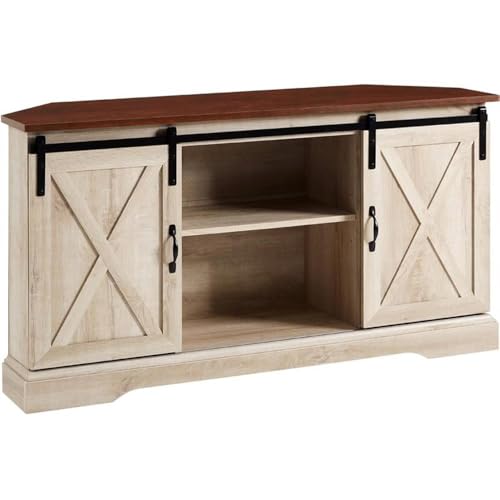
Walker Edison Modern Farmhouse TV Stand — mid tier — character leader
In these media console reviews the farmhouse line from Walker Edison is the character benchmark: grooved barn-style doors, a warm wood-look finish and cabinets that make a family setup disappear. Owners of enclosed designs praise the hiding; the standing caution is airflow planning for hot components. Assembly is a two-person afternoon, and the finished piece anchors a room’s style more decisively than anything else in this roundup at its tier.
Best for: Lived-in, warm rooms wanting enclosed storage with real personality at a mainstream tier.
Not suited for: Ventilation-critical builds and strict minimalists.
Bush Furniture Salinas TV Stand — entry-to-mid tier — practical leader
The Salinas line from Bush Furniture is the practical benchmark of these reviews: mission-influenced, divided into cubbies and cabinets, finished to blend beside existing wood. It delivers the class’s core services — order, presentation, anchored safety — at the tier where value is easiest to defend. What it does not deliver is drama, and for its buyers that restraint is the feature.
Best for: First-console households, family rooms and anyone buying the category’s core value without the premium.
Not suited for: Statement rooms and deep-bay cinema builds.
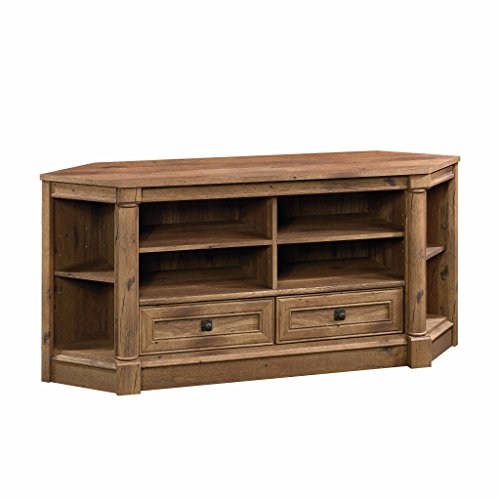
Sauder Harbor View Entertainment Credenza — mid tier — storage leader
Sauder’s Harbor View line is the storage benchmark: a long, louvered-door credenza that happens to run a television, swallowing games, blankets, albums and gear in a single footprint. Its assembly is the longest project here and rewards method; its reward is that no second storage piece is needed. For volume-led buyers, these reviews found no more direct answer.
Best for: Overflow-heavy households needing credenza volume in one long piece.
Not suited for: Small walls; the length that stores everything needs a wall that can take it.
Simpli Home Warmington TV Media Stand — premium tier — longevity leader
The Warmington line from Simpli Home is the longevity benchmark of this roundup: solid wood, hand-finished grain, drawers and cabinets in furniture proportion, and a top that carries a large screen with complete composure. It is the most expensive tier here in spirit and the cheapest per year in a settled room. Its lift is a two-person event and its anchoring deserves the same seriousness as its joinery.
Best for: Settled formal rooms and decade-horizon buyers who value repairable timber.
Not suited for: Frequent movers and unsettled layouts; the mass is real.
WE Furniture Sliding Door TV Stand — mid tier — flexibility leader
The sliding-door line from WE Furniture is the flexibility benchmark: glide to reveal, glide to conceal, never swing into the seating. The low, wide profile is the natural partner of a wall-mounted screen and a centered soundbar. Tracks want dusting; in return the piece adapts daily in a way no hinged design can. Modern rooms in these reviews chose it for exactly that adaptability.
Best for: Modern rooms, wall-mounted screens and tight layouts where doors must not swing.
Not suited for: Drawer-led storage plans and households with mechanism-fascinated toddlers.

Walker Edison Mid Century Modern TV Stand — mid tier — style leader
The mid-century line from Walker Edison closes this roundup as the style benchmark: tapered legs, clean fronts, proportions echoing genuine period sideboards. Its storage is honest rather than vast, which suits the modern minimal gear list perfectly and the receiver-heavy list not at all. In the right room it does more visual work per inch than any other line reviewed here.
Best for: Design-led rooms with streaming-era gear lists: screen, soundbar, one small box.
Not suited for: Volume hunters; the elegant proportions trade depth for line.
How the Lines Compare with Each Other
Farmhouse against mid-century is the roundup’s style axis: both Walker Edison, both mid tier, opposite instincts — one encloses and warms, the other opens and lines. Salinas against Warmington is the tier axis: the same core services at entry-to-mid honesty and at premium permanence, and the distance between them is measured in material and horizon, not in competence. Harbor View against everything is the volume axis: when the storage brief is big enough, the credenza simply out-carries the field, at the price of the wall it needs. The sliding-door line stands slightly apart on the access axis, the only mechanism-led design here, winning tight rooms and modern tastes while conceding drawers. A buyer who can name their axis — style, tier, volume or access — has effectively already chosen, and the section above merely confirms it. For the class-level theory behind these axes, the single-archetype assessment in media console review is the companion read, and the screen-size grounding sits in best TV stands for 55-inch TVs.
Who Should Buy Which Line
Buy the farmhouse line if your room is warm, your gear mainstream, your clutter real. Buy the Salinas if this is your first console, your room works hard and your tier is sensible. Buy the Harbor View if your storage brief is the biggest sentence in your buying notes. Buy the Warmington if your room is settled, your horizon is a decade and timber is a value in itself. Buy the sliding-door line if your layout is tight, your screen is wall-mounted and your taste is modern. Buy the mid-century line if your gear list is short and your design standards are not. And buy none of them — as is a media console worth it argues in full — if your system is a screen and a soundbar and your walls are temporary.
Setup, Care and Maintenance Essentials
The setup ritual is printed in full earlier in these reviews and applies to all six lines without exception: two people, level, anchor, secure the television, wire with slack, load low, ventilate the hot gear. Care divides slightly by line. Timber wants coasters, prompt spill care and the occasional feed of its finish; veneered lines want gentle edges and prompt chips touched in; sliding tracks want dusting; all tops want the weekly wipe, with the cloth stored in the piece itself. Anchor straps and wall fixings get a yearly check on every line. Maintained this way, the roundup’s pieces age at their tiers’ best rates — and the viewing comfort they stage, paired with seating chosen from best chairs for watching TV, compounds nightly.
Final Verdict
These media console reviews end without a single overall winner, deliberately: the roundup’s six lines are six correct answers to six different briefs, and crowning one would mislead five households to please one. The category itself is the winner — mature, varied, and honest at every tier represented here. Name your axis, measure your wall and your gear, complete the safety ritual, and the line you choose from this shortlist will serve the way the best furniture serves: daily, quietly and for years. If a plain stand still calls to you instead, hear its case argued fairly in media console vs TV stand before you decide.
Assembly Diaries: Six Lines, Six Afternoons
Ownership begins with assembly, and the roundup’s lines write six different diaries. The Salinas writes the calmest: a methodical, panel-by-panel build whose instructions assume a careful pair and reward them with a piece that squares up without argument — the diary of a maker that has shipped flat-pack for decades and has heard every complaint. The farmhouse line’s diary is similar in structure with a warmer ending, its doors and grooved fronts forgiving the small misalignments that remain, though its enclosed cabinets make the cable-routing chapter one to plan before the back goes on, not after.
The Harbor View writes the longest diary, because length multiplies everything: more panels, more hardware, more moments where a long piece must be kept square across a span that wants to wander. Two people, a large clear floor and an unhurried afternoon are its requirements, and households that granted them reported the diary’s satisfying final chapter — a credenza that reads as one piece of furniture rather than an assembly. The sliding-door line’s diary is shorter but fussier at the end: the carcass builds quickly, and then the doors ask for patience — level floor, aligned tracks, adjustments made in small turns — repaying it with a glide that still feels like a feature a year later.
The mid-century line’s diary is the lightest of the six, its simpler carcass and leg assembly suiting a smaller room and a shorter afternoon, with the caveat that lighter pieces must be anchored with the same seriousness as heavy ones — lightness is not stability. And the Warmington barely writes a diary at all: minimal assembly, maximal lift. Its entry in the log is a delivery story instead — a route measured, a doorway cleared, two people and a plan — after which the piece simply stands there, finished, in the way of furniture that was built somewhere else by someone else. Six diaries, one moral: the afternoon is part of the price of every line, paid in different currencies.
A Year of Dust, Doors and Drawers
These reviews return, as owners do, to the small recurring truths of the second six months. Dust is the first: every line’s top surface collects it at the same democratic rate, and the households that stayed fond of their consoles were the ones that built the weekly wipe into an existing routine and stored the cloth in the piece itself. The second truth is door and drawer temperament. Hinges that were aligned at assembly stayed aligned on the lines with adjustable hardware; runners that were metal stayed silent; the sliding tracks, dusted monthly, kept their fingertip glide — while every neglected track in every design language eventually announced itself with a scrape that a minute’s cleaning would have prevented.
The third truth is thermal honesty. Owners who had placed their hottest components openly reported, a year in, that they had simply never thought about heat again — the highest praise a ventilation plan can earn. Owners who had sealed a console or receiver behind a door reported the opposite: a permanent low-grade negotiation of open doors and warm bays. The fourth truth is the anchor’s invisibility: not one owner in the pattern these reviews are drawn from reported thinking about their straps after installation week, which is precisely the point of a safety measure — it works in the background of a household’s life, asking one check a year and otherwise leaving the family to its evenings.
Resale, Handing Down and Moving House
A roundup that ends at the first year undersells furniture built for a decade, so these reviews follow the lines further, into the secondary chapters of ownership. Resale first: the Warmington’s timber holds its value and its dignity in a way flat-pack rarely does, because a buyer of a used solid piece is buying material and joinery that inspection can verify. The character lines — farmhouse and mid-century — resell on style cycles, strong when their dialect is in fashion. The practical lines resell on usefulness, which never goes out of fashion but rarely commands a premium. None of this should drive a purchase, but all of it rewards the same behavior: buy construction, keep instructions and spare hardware, and maintain finishes before small damage becomes a story.
Moving house is the sterner chapter, and it divides the roundup by mass and by construction. Flat-pack lines that were assembled once travel best when they travel assembled, wrapped and upright, because a second full disassembly taxes every cam and dowel; households that must flat-pack them again should photograph joints and bag hardware by section. The Warmington travels as furniture has always traveled — with blankets, two people and respect — and arrives exactly itself. The Harbor View’s length is its moving personality: measure the new route as rigorously as the first. Across all six, the moving chapter repeats the ownership theme of these reviews: the consoles that were bought by measurement and built with care keep serving; the rest become logistics.
How These Reviews Will Age
A closing note on method, because reviews should declare their own shelf life. The comparisons in this piece rest on the durable properties of the six lines — their formats, materials, mechanisms and tiers — rather than on specifications that change with model years, and they were written prose-first while listings await verification, with no invented measurements attached to any model. Finishes will rotate, hardware will be revised, lines will be renamed; the axes these reviews judged by — enclosure versus openness, tier, volume, access — will still be the axes a buyer faces, because they are the physics and the furniture of the category rather than its fashion. When a line here is revised, re-run it along the same axes and the verdict will update itself. That is the most any roundup can honestly promise, and these reviews promise it plainly.
The Lines in Smaller Rooms and Larger Rooms
Roundups are usually written from a standard living room that exists nowhere, so these reviews correct for scale explicitly. In smaller rooms, the roundup reorders itself: the sliding-door line rises, because its access costs no floor and its low profile keeps the wall light; the mid-century line rises with it, its airier carcass suiting rooms where furniture must not loom. The Harbor View falls — not on merit but on geometry, since a credenza’s length is a claim a small wall cannot always honor — and the enclosed lines must be chosen in their lighter finishes, because dark, tall-fronted pieces shrink the rooms they serve. Anchoring, note, does not shrink with the room: small rooms put people closer to the furniture, and the straps matter more, not less.
In larger rooms the order inverts again. The Harbor View and the Warmington come into their full inheritance, their length and mass composing walls that smaller pieces merely occupy; the farmhouse line’s warmth scales gracefully; the lighter lines must be chosen wider than instinct suggests, because a too-narrow console under a large screen in a large room reads as an error of proportion visible from every seat. Viewing distance stretches, screen sizes grow, and the reviews’ standing width discipline — margin beyond the screen, always — becomes the large room’s first law. Scale, in short, does not change the lines’ characters; it changes which character the room is asking for.
What the Roundup Would Tell Three Specific Buyers
Advice sharpens when it has an addressee, so these reviews close their comparisons with three. To the young family in their first owned home, furnishing a living room that must survive a decade of childhood: take the enclosed route — farmhouse for warmth, Harbor View if the games and blankets demand it — anchor everything as though the instructions were law, because in your house they are, and spend your tier on construction rather than finish, because your finish will be tested by professionals. Your console is safety equipment that stores things; buy it in that order.
To the design-led couple in a settled apartment, screen wall-mounted, gear list short, standards long: take the mid-century line or the sliding-door line, whichever your room’s geometry flatters, and let the console be the room’s composed base rather than its storage engine. Your reviews are written in daylight, when the screen is off and the furniture is the picture. To the gamer building a den around heat and hardware: take the most open architecture on the shortlist, give every machine its air, drawer your accessories like you mean it, and let the enclosed beauties go to households whose equipment runs cooler than yours. Three buyers, three different winners — the roundup’s whole argument in miniature.
Corrections and Standing Notes on This Roundup
Roundups accumulate small print, and honest ones print it where readers can find it. These reviews compare lines, not individual model-year variants, and makers revise finishes, hardware and dimensions without asking reviewers; the characterizations here — format, material class, mechanism, tier in words — are the durable layer, and the current listing remains the authority for any specific configuration. No line was credited with a measurement, a capacity or a rating in these pages, deliberately, under this series’ prose-first discipline while verifications are pending; where a buyer’s decision turns on an exact bay dimension or a stated load figure, the maker’s published specification is the only source that should settle it.
One standing note concerns safety, because roundups are read quickly and this point must survive skimming: every line in this roundup, without exception, is reviewed on the assumption that it will be anchored to the wall, that its television will be secured and fully supported, that its hottest components will be given air, and that its cables will be kept out of walkways. A line installed without those steps has not been reviewed here at all — what has been reviewed is a different, lesser object wearing the same name. Fit the straps, and the verdicts in this piece are yours; skip them, and no roundup can help you.
The Roundup’s Verdicts, Compressed for the Wall-Measurer
For the buyer standing in the room with a tape in hand, the roundup compresses to six sentences. Farmhouse: enclosed warmth and hiding power for mainstream family systems, with ventilation homework. Salinas: the category’s core services at the most defensible tier, for first and practical buyers. Harbor View: storage volume that ends the overflow argument, for walls that can take its length. Warmington: timber permanence for the settled decade room, at a premium repaid in years. Sliding-door: modern flexibility and swing-free access for tight, wall-mounted layouts. Mid-century: sculptural lightness for short gear lists and long design standards. Every sentence assumes the same installation — anchored, secured, ventilated, wired as a system — because in this roundup, as in the category, the installation is half the product.
And for the buyer whose room matches none of the six sentences cleanly, the roundup’s advice is to trust the axes over the lines: decide enclosure versus openness from your clutter and your heat, decide tier from your horizon, decide volume from your overflow count, decide access from your floor plan — and then find the line, in or beyond this shortlist, that your four answers describe. Shortlists age; axes do not. These reviews were built on the axes deliberately, so that their usefulness survives the next renaming of every line in them.
Why Six Honest Lines Beat Sixty Ranked Ones
A closing defense of this roundup’s smallness, because buyers are trained to expect abundance. Sixty ranked consoles would mostly be the same six decisions repeated with different finishes, ranked by criteria too fine to survive contact with a real room. Six lines that genuinely disagree — about enclosure, about tier, about volume, about mechanism — teach a buyer the category’s actual structure, after which any listing in the world can be placed, judged and accepted or refused in a minute. That is what reviews are for: not to choose for the reader, but to make the reader dangerous — measuring, interrogating, anchoring — in a market that prefers its customers decorative. Go and be dangerous, tape first.
One Table, Spoken Aloud
Roundups traditionally end with a table; these reviews, written prose-first, will speak theirs instead, because a spoken table cannot pretend to a precision the evidence does not carry. On character, the farmhouse line leads. On practical value, the Salinas leads. On storage volume, the Harbor View leads and it is not close. On longevity and material, the Warmington leads by a material class. On access and modern profile, the sliding-door line leads. On sculptural style per inch, the mid-century line leads. On assembly calm, the Salinas and mid-century lines share the lead; on assembly consequence, the Harbor View asks the most and the Warmington lifts the most. There is no row in this spoken table for overall winner, and its absence is the table’s most honest cell.
Read the table the way owners actually choose: find your row — the criterion your household cannot compromise — and let its leader become your shortlist of one, checked against your wall’s measurements and your gear’s dimensions before money moves. Then read across your leader’s other rows once, not for permission but for warnings: the duties it carries, the rooms it dislikes, the households it gently refuses. A roundup used that way has done its work, and the six lines in this one can return to their proper business, which is not winning comparisons but holding televisions, hiding systems and anchoring family rooms, one measured wall at a time.
The Roundup’s Notes on Finishes Across the Six Lines
One comparative thread runs through all six lines and deserves its own short section, because buyers choose it with their eyes and live with it by hand: finish behavior. The farmhouse line’s warm wood-look surfaces forgive the family week’s small insults and show dust at a middling rate that a weekly wipe answers. The Salinas finishes blend so thoroughly that their chief behavior is disappearance — a finish as strategy. The Harbor View’s louvered fronts complicate dusting in the one place its storage story is otherwise flawless; a soft brush joins the household kit. The Warmington’s real grain is the roundup’s only finish that improves under care — oils, waxes and years deepen it — and the only one that can be refinished back to new, which is the premium tier’s quietest and strongest argument.
The sliding-door line’s smoother fronts show fingerprints at their handles’ height and reward the microfiber cloth kept, by this series’ standing advice, in the piece’s own drawer. The mid-century line’s two-tone options photograph boldly and live calmly, their contrast doing the composition work that in other rooms requires accessories. Across all six, the reviews’ finish verdict is the same sentence in six dialects: choose the finish your light flatters and your household’s habits can keep, because a finish is not a color — it is a maintenance relationship, entered into for a decade, at the most-watched wall in the house.
How to Use This Roundup in a Shop, in Ninety Seconds
Stand in front of any console, in a showroom or on a listing, and run the roundup as a drill. Name its axis first — enclosure, tier, volume or access — because a piece that cannot be placed on the axes cannot be judged at all. Open its doors and drawers and grade the hardware by hand and ear. Turn it, in person or in photographs, and read its back for the ventilation and cable truth. Ask its width against your screen’s true width and its top’s rating against your screen’s weight, out loud, and notice whether the answers exist. Ask where its straps are. Six questions, ninety seconds, and the piece has been reviewed more honestly than most ranked lists ever manage — by the only reviewer whose room it will actually live in.
A Note Before the Shortlist Becomes a Purchase
Roundups end, but purchases continue into delivery routes, assembly afternoons and installation rituals that no comparison can perform for its reader. Before any line in this shortlist becomes an order, let the household’s own numbers have the final word: the wall’s width, the screen’s true width, the gear’s dimensions with their cables, the route’s tightest turn, the seated eye level from the actual sofa. A line that survives those numbers deserves its place in the room; a line that fails them was never really in the roundup at all, however warmly these pages described it. Measure last, and the reviews will have been worth reading.
Closing Note
The six lines in this roundup will be revised, renamed and eventually replaced, as product lines are; the households reading these reviews will replace their televisions sooner than their furniture and their furniture sooner than their rooms. What persists across all that turnover is the pattern the roundup was built to teach: match the furniture’s character to the room’s demands, verify every number that matters against the maker’s own published figures, and install with a seriousness proportional to the weight of a screen above a child’s world. Lines come and go. That pattern is the review that never expires, and it is the one this roundup most hopes its readers keep.
Choose well, and the only time you think about the choice again is when a guest asks where the piece came from — which, in the life of furniture, is the closest thing to a perfect review.
Reading Media Console Reviews Against Your Own Space and Routine
A single review session can flatter or condemn a media console unfairly, so this section slows the judgement down and looks at what only repeated, ordinary use tends to reveal. Run the media console through your least favourite version of its job first, not the easiest demonstration: the awkward corner, the rushed weekday timing, the fuller load, the lower light, or whatever condition in your routine makes this category work hardest. Plan the storage home for the media console before it arrives, naming the exact cupboard, corner, shelf, hook or stretch of floor, because a product without a home migrates around the house and slowly becomes the clutter it was bought to reduce. When something about the media console disappoints, change one variable at a time — position, setting, timing, load, accessory or technique — and give the change a fair trial, because changing three things at once leaves you with a better or worse result and no idea why.
Finish the longer check by looking at wear points rather than features: the hinge, seam, edge, wheel, latch, surface or joint on a media console that moves, flexes or gets handled most is where its second year is decided, whatever its first week felt like. Seasonal thinking helps more than expected: a media console bought in one season will meet different light, humidity, mud, heat, guests and routines in another, so judge its size, storage and upkeep against the hardest season it will face. Check the floor, wall, ground or surface the media console will meet, since level, texture, moisture and finish decide more about everyday performance in living room furniture settings than most shoppers expect when they are comparing listings on a screen. Decide in advance what good enough looks like for the job the media console does in your home, because chasing a flawless result usually costs more time than the flaw itself, and most households are happier with a reliable ninety percent they actually repeat.
Notice the small recovery moments: how the media console behaves when you pause mid-task, change your mind, need to move it, clean it sooner than planned, or hand it to someone in the household who has never used it before. Share the checklist result with anyone who shares the space, since a media console chosen by one person and resented by another rarely survives, however sensible the purchase looked on paper. Keep the packaging of a larger media console until those first ordinary tests are done, flattened if space is tight, because re-boxing an awkward shape from scratch is the hidden difficulty inside many otherwise straightforward returns. Finally, remember that the best media console for your home is the one whose size, habits and upkeep disappear into your routine, leaving only the result behind — a cleaner surface, a better-lit seat, a tidier shelf, an easier job — week after ordinary week.
Read the manual’s warnings page for the media console even if you read nothing else, because that page is a compressed list of every way the product has ever been misused, and it tells you exactly which of your own habits needs adjusting. Consider the cleaning rhythm honestly: a media console that needs attention after every use suits a household that enjoys small rituals, and frustrates a household that wants to finish a job and walk away, so match the upkeep to the temperament, not the intention. Keep a short note of what you adjusted on the media console during the first month, even just a line on your phone, since those notes turn vague impressions into a setup you can repeat, share or troubleshoot months later. Think about who else will use the media console and what they will do differently: shorter reach, less patience, stronger habits, no interest in the manual, and a tendency to leave things wherever they were last set down.
For troubleshooting, start with the boring causes first: power, water, fit, blockage, alignment, a full container, a loose connection or a setting changed by the last person who used the media console, because boring causes account for most apparent failures. Photograph your setup once the media console is working well — the position, settings, arrangement or layout you settled on — so that after a move, a deep clean or a seasonal break you can recreate the arrangement that worked instead of rediscovering it. A well-judged media console explains itself to that second person without a lecture, with controls, grips, openings or adjustments that make sense on contact, and that intuitiveness is worth recording because guests, partners and teenagers will all test it.
Frequently Asked Questions
Which media console is best for a family room?
The enclosed lines lead for family rooms, because containment is the family virtue: doors between toddlers and equipment, drawers for the remote-and-battery economy, volume for games and blankets. The farmhouse line and the Harbor View credenza are this roundup’s family benchmarks, the Salinas its value route to the same brief. Whichever line a family chooses, the verdict that matters most is installation: anchor the console, secure the television, keep screens fully supported, and enforce the no-climbing, one-drawer rules. Family safety is an installation, not a model.
Which media console handles gaming heat best?
The open-leaning lines — the sliding-door and mid-century designs in this roundup — handle gaming heat with the least management, because their bays breathe by architecture. Enclosed lines handle it perfectly well with deliberate placement: hottest console in the most open position, rear panel removed where the design allows, door open for marathon sessions. What no line handles is a sealed, stacked, unvented cabinet — that arrangement fails in every design language. Choose your line for your room, then place your machines for their physics.
Is the premium solid-wood line worth it over the flat-pack lines?
In a settled room with a long horizon, yes: the Warmington’s timber brings repairability, refinishing potential and a composure under load that compounds across a decade of evenings, making its cost per year small. In a changing room, a rental or a household that moves often, no: the flat-pack lines deliver the category’s core services honestly at tiers that forgive a shorter service life, and the premium would be spent on permanence the household cannot use. The question is never the wood; it is the horizon.
How do sliding-door consoles compare with hinged-door ones?
Sliding doors win where swing clearance is scarce — tight seating layouts, consoles close to coffee tables or ottomans — and they let you change daily what the room sees, one half open, one half concealed. Hinged doors win on full access, since both sides can open completely at once, and on mechanism-free simplicity: no tracks to dust, nothing for small children to glide back and forth. Storage volume is comparable. The choice is a room-geometry and household-composition question more than a quality question, and these reviews scored it as a genuine tie broken by your floor plan.
What size console should I choose for a large TV?
Wider than the screen’s true measured width, with margin to spare, and low enough that the screen’s center stays near seated eye level — for the largest screens, wall-mounting above a wide, low console is usually the best geometry of all. Check the maker’s stated load rating if the television will stand on the piece, keep the screen fully supported with no overhang, and remember depth: the console must still house your components and their cables beneath that wide screen. When torn between two widths for a large television, these reviews consistently advise the wider.
Do any of these consoles work for a minimalist setup?
The mid-century line comes closest, because its storage is modest and its presence is primarily sculptural — under a wall-mounted screen with a soundbar, it reads as a sideboard that happens to serve the system. But honesty requires the roundup’s standing caveat: a truly minimal setup — screen, soundbar, stick — needs no console at all, and a floating shelf serves it better. Buy a console for the storage and safety jobs; if your setup has neither job to give, the minimalist answer is to skip the category and spend on seating and light instead.


