Disclosure: As an Amazon Associate, dailyhomedecorating.com earns from qualifying purchases. Links on this page are affiliate links; they cost you nothing extra. Prices and availability change often, so check the current Amazon listing before you buy.
Learning how to choose a reclining sofa is mostly learning how to ignore the showroom test, because nearly every reclining sofa feels wonderful for the four minutes you sit on it in a store. The differences that decide whether you still love it in year three are invisible in that test: how the mechanism is built, how far the open sofa reaches into your room, how the cushions are layered, and whether the delivery route into your home can physically accept a piece this heavy. This guide walks through the decision in the order that actually protects you — room first, mechanism second, comfort third, fabric last — and finishes with worked examples and honest examples of the category at different tiers, so the choice you make is the one your room and your household would have made for you.
Key Takeaways
- Measure the room before the sofa: a reclining sofa has a closed size and a much larger open size, and both must fit.
- Wall-hugger mechanisms slide forward and suit tight rooms; full-clearance mechanisms arc backward and need space behind.
- Manual recline is simple and cord-free; power recline is smoother and easier for limited strength, but brings motors and cords to manage.
- Frame and mechanism construction outlast upholstery fashion — buy the skeleton first and the fabric second.
- Plan the delivery like a move: doorways, stairs, detachable backs, and at least two people, because these sofas are very heavy.
The short answer. Choose the mechanism type that fits your room’s clearance, the seat count that matches how many people actually sit together nightly, and the sturdiest frame-and-mechanism build your tier allows. Everything else — colour, cup holders, stitching style — is decoration on top of those three decisions. Get the first three right and almost any specific model in the right category will serve you well; get them wrong and no fabric upgrade will rescue the purchase. The companion pieces in this series go deeper on value and trade-offs: is a reclining sofa worth it pressure-tests whether the category earns its footprint at all, while the reclining sofa buying guide turns the same criteria into a pick-by-pick comparison.
In this guide
What You Need to Know Before Comparing Any Reclining Sofa
A reclining sofa is a regular sofa with a machine inside each seat. That machine — a linkage of hinged steel arms driven by a handle, a lever or a motor — lifts a footrest and tilts the back through a connected motion. Understanding that single fact organises the whole market. Models differ in how many seats recline (both ends is typical on a three-seat; the middle seat often stays fixed unless the back folds down into a tray), in whether the motion is manual or powered, and in the geometry of the linkage, which is what separates a wall-hugger from a full-clearance design. When a listing seems vague, it is usually vague about one of those three things, so learn to ask about them directly before you ask about anything else.
Seat count is the second organising fact, and it is really a question about your household’s evenings. A two-seat reclining sofa — effectively a wide loveseat where both seats move — suits couples and smaller rooms. A three-seat is the family standard, with the caveat that the centre sitter usually gets no recline. Reclining sectionals scale the idea up and add corner geometry, chaise ends and connector hardware to manage. Shoppers comparing across formats often find it clarifying to read the single-seat equivalent of this decision too: how to choose a recliner applies the same mechanism-first logic to one-person chairs, and recliner vs reclining sofa settles which format wins for which household.
Comfort in a reclining sofa comes from three layers working together: the seat cushion (its fill and how it is supported), the back cushion (including whether lumbar support holds up when reclined, when your weight shifts backward), and the recline angle itself. A seat that feels plush upright can feel hammock-like fully reclined if the lumbar zone is soft, because reclining moves your body’s load into exactly that zone. This is why the honest test of any model is a long sit in the reclined position, not a bounce upright. At home you cannot test before delivery, so read descriptions for how the back is structured, favour designs that talk about lumbar support in the reclined position, and treat one-piece overstuffed backs with suspicion if you read for long stretches.
Upholstery divides into fabric, faux leather and genuine leather, and each fails differently. Fabric breathes and hides wear gracefully but absorbs spills and pet hair. Faux leather wipes clean beautifully for the first years and its weakness is surface wear at stress points over longer horizons. Genuine leather is the long-life option at the premium tier, developing character rather than damage, but it asks for occasional conditioning and a bigger budget. Households with children and pets should weight cleanability and repairability over showroom feel; the roundups of best sofas for homes with kids and best microfiber dual reclining sofas show how family-first upholstery choices play out across the wider sofa market.
How to Choose a Reclining Sofa in 8 Steps
Step 1: Measure the Room, the Open Footprint and the Delivery Route
Start with a tape measure, not a catalogue. Record the wall length where the sofa will live, the depth available before the coffee table or opposite seating, and the walkways that must stay open when the sofa is fully reclined. Then measure the delivery route with the same seriousness: every doorway, the turn at the top of the stairs, the hallway pinch point. A reclining sofa is very heavy and its largest dimension is unforgiving, so a model that fits the room but not the route is simply a return waiting to happen. Ask whether the backs detach — on many models they do, specifically to solve this — and note the answer before you order, not on delivery day. Shoppers with genuinely tight access should also browse best sofas for narrow doorways for designs built around difficult routes.
Clearance is the measurement shoppers most often get wrong, because a reclining sofa has two sizes: the one on the listing and the one it becomes when open. Full-clearance designs swing the back backward as the footrest rises, so they need real space behind them — push one against a wall and the back will rub, bind or simply refuse to recline fully. Wall-hugger designs solve this by sliding the seat forward on its base as it reclines, needing only a small gap behind, which makes them the right answer for apartments and tight family rooms. Neither is better in the abstract; they are answers to different rooms. Measure your room, not just the sofa: tape the closed footprint on the floor, then tape the fully reclined footprint, and check the open shape against walkways, doors and the coffee table before you fall in love with a fabric.
Step 2: Pick the Mechanism Geometry — Wall-Hugger or Full Clearance
With your taped outline on the floor, the mechanism geometry chooses itself. If the open footprint of a full-clearance design collides with a wall behind or a walkway in front, you need a wall-hugger, whose seat slides forward as it reclines so the back barely travels backward. If your room is deep and the sofa will float away from walls, full-clearance designs are fine and sometimes feel a touch more spacious in the recline because the whole seat arcs into the motion. Do not let a salesperson convert this into a quality ranking: it is a fit ranking. The same model family often exists in both geometries at similar tiers, so this step narrows the field without costing you comfort. Write your choice down — every later filter assumes it.
Step 3: Decide Manual or Power, Seat by Seat
Manual mechanisms open with a handle or lever and your own leg pressure to close. They are mechanically simple, work during a power cut, cost less at every tier, and suit households that recline a few times a day. Power mechanisms open at a button press, stop at any angle rather than a few preset stops, and are the kinder choice for anyone with limited leg strength, a bad knee or difficulty rising — the powered lift of the footrest and the smooth return genuinely change who can use the sofa independently. The costs are money, weight and electrical housekeeping, covered in the next step. Mixed households sometimes split the difference with power on the most-used seat where the model allows it. Be honest about who sits where nightly; the right seat to motorise is the one your household actually fights over.
Power models add an electrical housekeeping job that manual models do not. On many designs each mechanism has its own motor and its own cord — one cord per mechanism is common — so a three-seat power sofa can mean several cords leaving the back of the frame. Route them deliberately: along the wall, never draped across a walkway where they become a trip hazard, and never pinched under the frame, trapped in the mechanism’s travel path, or pressed between the sofa back and the wall where the recline motion can worry them over time. A cord damaged by repeated pinching is a quiet hazard that only announces itself late. Leave slack for the wall-hugger slide if your model moves forward as it opens, keep cords visible enough to inspect when you vacuum behind the sofa, and plug into a reachable outlet so you can disconnect the sofa fully when small children are exploring or during an electrical storm.
Step 4: Count Reclining Seats, Not Just Seats
Listings headline the seat count; comfort depends on the reclining-seat count. On a typical three-seat reclining sofa the two end seats recline and the centre does not, which is perfect for couples who colonise the ends and a surprise for the teenager exiled to the middle. Some designs fold the centre back down into a console with cup holders, which converts the compromise into a feature for movie nights. Two-seat models usually recline on both sides. Sectionals vary piece by piece — a chaise end typically does not recline, while armless middle seats sometimes do — so map the exact configuration against your household’s seating politics before ordering. If three people recline nightly in your home, you need three reclining positions, and that requirement alone may push you from a three-seat sofa to a sectional or a sofa-plus-chair combination.
Step 5: Judge the Frame and Mechanism Like an Engineer
The frame carries everything and the mechanism moves everything; together they decide the sofa’s lifespan. Look for descriptions that talk about reinforced or hardwood frame construction, corner blocking, and steel mechanism components rather than unspecified metal. A mechanism should move smoothly through its whole travel without grinding, catching or a clunk at the stops — in a showroom, cycle it several times and listen; online, favour brands whose descriptions discuss mechanism construction at all, because silence on the subject is itself information. Weight is a rough ally here: within a tier, the heavier build usually reflects more material in frame and linkage, though it also raises the stakes on delivery planning. This step is where the the best company for reclining sofas roundup helps, since it ranks makers by exactly this kind of construction follow-through.
Treat every reclining mechanism as a set of moving steel parts, because that is exactly what it is. The linkages under the seat and behind the footrest open and close through pinch and crush points that can trap fingers, paws, tails and small toys, especially in the scissor-like space under the footrest as it folds away. Teach everyone in the household — and remind guests — that hands never go into the mechanism, that children do not operate the recline as a game, and that pets stay clear of the linkages and the under-footrest space while any seat is moving. Before you close a footrest, look: a cat asleep underneath or a toddler reaching for a dropped toy is the classic accident pattern with this furniture, and a two-second visual check is the whole prevention. If something is stuck, return the seat to upright slowly rather than forcing the handle or motor.
Step 6: Match Cushion Build to How You Actually Sit
Cushion descriptions reward translation. High-resiliency foam holds its shape and supports longer sits; softer fills feel luxurious for the first month and compact sooner. Pocket-coil seat construction — springs inside the cushion — tends to keep a seat feeling even across years of one favourite spot. If you read or work in the reclined position, prioritise lumbar structure; if the sofa is mostly for upright conversation with occasional recline, seat depth and back height matter more. Households where one person naps on the sofa should check the fully reclined length honestly: a reclined sofa is not a bed, and taller sleepers will bend somewhere. Match the cushion story to your dominant use, not your occasional one, because cushions meet your dominant use every single day.
Step 7: Choose Upholstery for Your Household’s Real Life
Return to the fabric decision with your household’s evidence in hand. Toddlers with cups, dogs with opinions about furniture, a partner who eats curry on the sofa — each argues for wipeable, forgiving surfaces and darker, textured weaves that hide the week between cleans. A quiet adult household can choose for feel: breathable fabric for warm climates, leather for longevity and the way it wipes down to a clean surface. Ask about removable covers or at least removable cushion covers, because the ability to wash or replace the most-worn surface extends the whole sofa’s life. Whatever you choose, plan the care routine at purchase time — the right cleaner bought the same week beats the wrong improvisation discovered at the first spill.
Step 8: Plan Delivery, Placement and the First Week
Finally, respect the weight before the delivery day, not during it. A multi-seat reclining sofa is very heavy — the steel mechanisms add serious mass to an already large frame — so measure doorways, hallway turns, stair widths and any tight landing first, and compare them honestly with the sofa’s largest dimension, remembering that many models arrive with backs detachable precisely to solve this problem. Plan for two or more people to move it, use sliders or a dolly on hard floors, and never lift by the armrests alone: arms are upholstered leverage points, not structural handles, and a sofa lifted by them can suffer frame and mechanism damage before it ever gets sat on. Lift from the base, keep the load level on stairs, and clear the route of rugs and thresholds before the first lift.
Once the sofa is in place, spend the first week deliberately. Cycle every mechanism daily and listen for changes. Check that sectional connectors, if you have them, are latched so seats cannot drift. Sectional owners get one more rule: keep the connectors latched. The brackets joining sectional pieces are what stop individual seats from drifting apart under the repeated push of reclining mechanisms, and an unlatched join quietly opens gaps, misaligns the corner and makes neighbouring mechanisms feel notchy. Whenever the sectional is moved, cleaned under or rearranged, check every connector underneath and click them fully home, then recline each seat once and watch the seams. Treat the check as part of seasonal cleaning and the sectional will keep behaving like a single, solid piece of furniture instead of a fleet of slowly separating rafts. Keep the packaging until the mechanisms have proven themselves through a week of real evenings, and photograph the sofa from all sides on day one — a boring habit that settles any later dispute about delivery damage in minutes.
Gear for This Guide: Reclining Sofas at Each Tier
The models below are named as tier examples so the steps above have something concrete to bite on. Treat each as a representative of its class — the configuration to look for — and check the current listing carefully before buying, since configurations and upholstery options change. Each pick is presented prose-only here, with its placement reserved for a verified listing link at publishing.

Yaheetech Reclining Sofa — entry tier
The Yaheetech reclining sofa line represents the entry tier honestly: straightforward manual recline, family-friendly faux-leather style upholstery that wipes clean, and a footprint aimed at ordinary living rooms rather than media palaces. As a first reclining sofa or a family-room workhorse it teaches you the category’s habits — clearance, mechanism care, cushion behaviour — without a premium commitment. Apply the steps strictly here: entry-tier mechanisms reward gentle, aligned use, and the wall clearance question matters more, not less, when the frame is lighter. Best for: first-time buyers and family rooms. Not suited for: heavy daily reclining by several adults over many years, where a mid-tier mechanism earns its keep.
Sweetcrispy Reclining Sofa — entry-to-mid tier
Sweetcrispy’s reclining sofa offerings sit at the entry-to-mid boundary, typically leaning on fabric upholstery and compact proportions that suit apartments and second living spaces. The fabric route breathes better in warm rooms and reads softer in a small space, at the cost of slower spill response than wipeable surfaces. Measure with particular care in this class: compact closed dimensions sometimes hide a full-size open footprint, so the taped outline from step one does the deciding. Best for: apartment living rooms and guest-friendly flex spaces. Not suited for: households wanting power recline on every seat or a true wall-hugger guarantee without checking the specific model’s geometry.
Homall Reclining Sofa — mid tier
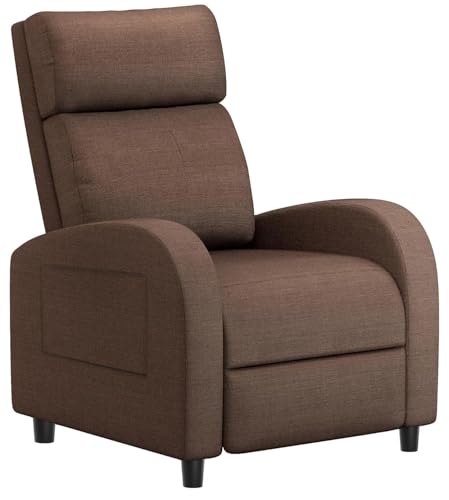
Homall’s reclining sofa line is a mid-tier staple of the online market, generally built around easy-clean upholstery, defined cushioning and configurations aimed at movie-night households, often with the drop-down centre console that turns the middle seat’s compromise into a drinks-and-remotes station. It is the class where step five — mechanism judgement — pays off most visibly, because mid-tier mechanisms vary widely between brands that look identical in photographs. Cycle the action mentally through reviews that mention smoothness and noise. Best for: family movie nights and shared living rooms. Not suited for: formal rooms where a console aesthetic clashes, or centre-seat recliners, who should count reclining positions again.

FDW Reclining Sofa — entry tier
FDW’s reclining sofa models occupy the practical entry tier, the kind of straightforward build households buy for basements, dens and first apartments where the job is honest comfort without ceremony. Expect manual mechanisms and wipeable surfaces, and set expectations by tier: this is the class to buy when the alternative is no reclining sofa at all, and on that comparison it wins easily. The delivery advantages are real too — entry builds are the lightest in the category, though light is relative and the two-person rule still applies. Best for: dens, basements and first homes. Not suited for: buyers seeking a decade-long primary sofa, who should step up a tier for mechanism longevity.
Common Mistakes When Choosing a Reclining Sofa
Measuring only the closed sofa. The single most common failure. The open footprint is the real furniture; the closed footprint is just its storage shape. Tape both, every time, and check the open shape against doors and walkways, not just walls.
Assuming every seat reclines. Centre seats and chaise ends frequently do not. Count reclining positions against the people who will want them nightly, and treat a drop-down console as the consolation feature it is, not as a recline.
Buying the fabric before the mechanism. Upholstery is the part you can protect, cover and clean; the mechanism is the part you live with or return the sofa over. Decide geometry and power first, then dress the decision in a fabric your household can maintain. The reclining sofa pros and cons piece lays out this trade-off pattern across the whole category if you want the balanced version before committing.
Ignoring the delivery route until delivery day. Heavy furniture plus a narrow stair turn equals a sofa living in a hallway while everyone negotiates. Measure the route, ask about detachable backs, and clear the path before the truck arrives.
Forgetting the household’s smallest members. Mechanisms fascinate children and shelter pets. If your home includes either, the safety habits in step five are part of the purchase, and a model whose controls can be supervised or locked deserves extra credit.
Pro Tips from Households That Got It Right
Tape is the cheapest consultant in furniture shopping: a taped outline lived with for two days reveals traffic problems no measurement table can. Sit in your current sofa at the time you would actually recline — evening light and tired legs judge differently from a Saturday showroom. If two models tie, choose the one whose replacement parts and brand support are easier to reach, because mechanisms are wear items on a long enough horizon. And keep a small ritual: a monthly minute to vacuum under the raised footrests and glance at the linkages keeps the machine you bought feeling like the machine you tested. Households graduating from a single chair often compare notes with recliner reviews before scaling up, which is a sensible order of operations.
Worked Examples: Three Buyers, Three Right Answers
The apartment couple. A one-bedroom flat, a living room that is also the dining room, and a wall exactly where a full-clearance back would want to swing. The right answer is a two-seat wall-hugger in fabric, manual or power depending on budget, with the taped open footprint checked against the dining chairs. They give up the centre-console movie feature and gain a sofa that opens fully every night without moving furniture — the correct trade, made by geometry rather than taste.
The family of five. Movie nights are the main event and three people recline by right. A three-seat sofa fails the count, so the answer is a reclining sectional with latched connectors, wipeable upholstery, and a household rule about the under-footrest space because the dog has already claimed it as a cave. Power on the two end seats covers the parents; the kids’ manual seat keeps cords out of the highest-traffic zone. The best massage sectional sofas roundup shows how far the sectional format stretches when comfort features pile up.
The downsizer. Moving from a house to a smaller home, one person with a knee that dislikes pushing a footrest closed. Power recline stops being a luxury and becomes the enabling feature, in a two-seat wall-hugger that fits the new room’s shorter wall. The delivery route — a lift and a tight landing — decides the model as much as comfort does, and detachable backs move from footnote to requirement. The verdict logic in recliner pros and cons mirrors this buyer’s reasoning at single-seat scale.
Materials and Construction, Translated into Plain Language
Listings speak a dialect, and fluency saves money. ‘Kiln-dried hardwood frame’ means the load-bearing skeleton was dried to resist warping — a genuine quality signal. ‘Engineered wood with hardwood reinforcement’ is the mainstream compromise: strong where it matters, economical where it does not. ‘Webbing suspension’ under the cushions feels softer and ages differently from sinuous steel springs, which feel firmer and more even; neither is wrong, but they suit different sitters, and a household that prefers a firm, supportive seat should hear ‘plush webbing’ as a warning rather than a promise. Foam descriptions reward the same scepticism: density language matters more than comfort adjectives, because density is what resists the favourite-seat compaction that makes one end of a sofa feel retired while the other still feels new.
Mechanism descriptions deserve the closest reading of all. Steel linkages, sealed or bushed pivot points and a stated testing regime are the vocabulary of builders; silence is the vocabulary of assemblers. When a listing will not describe its mechanism, assume the tier’s minimum and price your expectations accordingly. The handle or lever side matters too: on manual models the handle’s arc needs clear space, and its position — left or right of each seat — interacts with side tables and lamps in ways that only appear on the first evening. Power buttons live on the seat’s side or a small panel, and their placement relative to a sleeping child’s reach is a detail worth one minute of thought before the sofa arrives, not after.
Upholstery construction hides one more decision: whether cushions are attached or removable. Attached cushions keep a sofa looking composed and prevent the slow migration of seat cushions toward the floor that plagues busy households, but they cannot be rotated, flipped or individually replaced. Removable cushions allow rotation — the single most effective habit for even wear — and make deep cleaning and cover washing possible. Households with a pronounced favourite seat should strongly prefer removable, rotatable cushions, because rotation is the difference between a sofa that ages evenly and one that develops a visible biography of who sat where.
Room Layouts That Work: Placing the Sofa You Chose
Against the wall is the default placement and the one wall-hugger geometry was invented for: the sofa opens forward into the room’s legroom, the coffee table sits at the distance an open footrest dictates, and the television wall faces it in the classic arrangement. Measure the table distance with the footrests open, not closed — a table placed for the closed sofa becomes a shin obstacle the first evening. Leave a genuine walkway at one end rather than squeezing the sofa wall-to-wall; the end gap is where the vacuum, the dog and the midnight walker all need to pass, and it is also where a floor lamp earns its place without crowding the recline handle’s arc.
Floating placement — sofa back to the room, facing a fireplace or windows — suits full-clearance geometry and larger rooms, and it exposes the one part of a reclining sofa designed least for display: the back. Mainstream backs are finished but plain, and a console table behind the sofa civilises the view while giving the room a surface for lamps whose cords then solve themselves along the floor. In open-plan spaces the floating reclining sofa also becomes the room divider, and its open footprint defines the living zone; tape that zone generously, because a divider that blocks the plan’s circulation when open will be resented in both postures.
Corner and L-shaped arrangements, whether as sectionals or a sofa plus chaise, concentrate the household’s lounging in one generous zone and free the opposite wall for storage or a desk. The discipline is the connector and clearance audit: every reclining piece needs its own open space, corner seats recline into diagonal room that tape must verify, and the pieces must be latched so the L keeps its angle under the daily push of mechanisms opening and closing. A corner layout that drifts a few centimetres a week will eventually present as a mechanism problem; it is a connector problem, and it is preventable in five minutes with a torch and a firm click at each bracket.
A Realistic Budget Conversation, Without Prices
Because listings change constantly, this guide talks in tiers rather than numbers — but the tier logic deserves one honest paragraph. The step from entry to mid buys mechanism refinement and cushion construction, and it is the step daily users feel most. The step from mid to premium buys materials — leather, heavier frames, finer tailoring — and it is the step long-horizon owners feel most. Power adds its premium on top of whichever tier carries it. The budget error the steps in this guide are built to prevent is buying one tier too low for your usage and then paying the difference anyway, in discomfort, in early replacement, or in a second purchase — the most expensive sofa is the one bought twice.
There is also a quiet second budget: the room’s. A reclining sofa may retire an ottoman and an armchair, releasing both floor space and the money those pieces would have consumed, and it may demand a side table relocation, a lamp move or a rug resize to sit correctly. Shoppers who budget the room alongside the sofa report the smoothest first months, because the purchase arrives into a space that was prepared for it rather than negotiated with it. Preparation, in this category, is most of the pleasure.
Putting It All Together: A One-Sitting Decision Walkthrough
Sit in the room with this guide and a tape measure, and run the steps in real time. First, tape the closed outline where the sofa will live and live with it through one ordinary evening — walk past it, open the doors, let the household’s traffic argue with the tape. Then extend the tape to the open outline for the geometry you are considering and repeat the evening test mentally at midnight, when a child or a guest crosses the room in the dark. If both outlines survive, measure the delivery route and write down its tightest point. Three measurements, one evening, and the two most common failure modes of this entire category — the room that cannot open the sofa and the route that cannot admit it — are eliminated before a single listing is opened. Everything after this paragraph is refinement.
Now shortlist by configuration, not by photograph: format first (two-seat, three-seat, sectional), then geometry (wall-hugger or full-clearance, as your tape dictated), then drive (manual or power, as your household’s operators dictate), then the reclining-position count against your evening population. Only inside that narrowed field do upholstery, colour and badge get a vote — and by then the field is small enough that the vote is easy. This order feels backwards to shoppers raised on furniture photography, but it is the order the evidence supports: households regret geometry and configuration for years, while upholstery regrets fade into the general patina of a lived-in room within a season.
Finally, rehearse ownership for one minute before ordering. Where will the cords run, if it is power? Who in the household owns the monthly vacuum under the footrests? What is the rule about the space under a raised footrest, and who teaches it to visiting grandchildren? Where does the manual live, and who lifts — from the base, never the arms — when the room is cleaned behind? A purchase that survives these questions is no longer a gamble; it is a plan. The households whose reclining sofas review themselves in superlatives five years later are, without exception in this guide’s research, the households that ran some version of this walkthrough. It takes an evening. The sofa will take a decade. The exchange rate is excellent.
One Last Check: The Household Interview
Before the order, interview the household — briefly, and out loud. Ask each regular viewer where they expect to sit and whether they expect to recline; mismatches between the answers and the configuration are the cheapest problems you will ever solve in furniture, because today they cost a conversation and next month they cost a return. Ask who will clean under the footrests and whether the safety rules are understood by everyone old enough to operate a handle, including the visitors who will inevitably try. Ask where the sofa goes, eventually — the next room, the next home, the relative who has already admired it — because a piece this heavy benefits from having a future. Households that hold this five-minute interview report a particular confidence on delivery day: the sofa that arrives is the sofa everyone already agreed to live with.
And if the interview surfaces a genuine split — one partner longing for the recline, the other for a tailored room — treat the split as design information rather than a contest. The hybrid answers exist precisely for divided households: the two-seat reclining sofa in the family zone and a tailored chair in the formal one, or the reclining sofa chosen in its slimmest leather form as a negotiated peace. Furniture bought as a compromise both parties understand ages better than furniture bought as a victory, because the losing party operates the mechanism daily. The steps in this guide narrow the field; the interview chooses within it. Do both, in that order, and the choice will hold.
A closing practical note on timing your purchase to your life rather than to a promotion calendar. Reclining sofas are at their most valuable in the household’s settled seasons — the years when the room, the people and the evening rituals are stable enough for a decade-scale piece to amortise itself in comfort. If a move, a renovation or a new baby is months away, the wisest version of every step in this guide is sometimes to run the steps, write down the specification they produce, and buy when the household lands. The specification will keep. Tape measures are patient, models refresh without changing their configurations’ logic, and a decision this well prepared does not expire — it waits, which is the final skill this guide hopes to teach: choosing a reclining sofa is not an event but a readiness, and readiness, once achieved, makes the eventual purchase almost clerical.
A Room-by-Room Fitting Walkthrough Before You Choose a Reclining Sofa
Technique matters more with a reclining sofa than most instructions admit, because the same product can feel clumsy or effortless depending on the order you do things in and the setup you repeat each time. Start by standardising your starting position: the reclining sofa in the same place, at the same setting, height or configuration each time, so that any change in results tells you something about the job rather than about a forgotten adjustment. If someone else in the household shares the reclining sofa, agree the same basic sequence together, because two conflicting techniques — different settings, storage spots or cleaning habits — will make even a good product seem inconsistent from one use to the next. Look at replacement parts and consumables for the reclining sofa while you are still comparing, confirming that the pieces most likely to wear, clog, tear, fade or get lost can actually be obtained without replacing the whole product.
If you want a concrete listing check, take a name already shortlisted in this guide, such as Yaheetech Reclining Sofa, Sweetcrispy Reclining Sofa and Homall Reclining Sofa, and verify that exact reclining sofa listing against the measurements and compatibility questions above, field by field, rather than trusting the headline description alone. Slow down at the difficult part rather than speeding up, because most reclining sofa tasks fail at the moment of impatience — the forced fit, the skipped check, the extra load — and a ten-second pause at that moment prevents most of the damage and most of the rework. Test the reclining sofa in the first week under deliberately ordinary conditions rather than saving it for a special occasion, so that any problem surfaces while returning, exchanging or adjusting your setup is still simple. Check the floor, wall, ground or surface the reclining sofa will meet, since level, texture, moisture and finish decide more about everyday performance in living room furniture settings than most shoppers expect when they are comparing listings on a screen.
Keep the packaging of a larger reclining sofa until those first ordinary tests are done, flattened if space is tight, because re-boxing an awkward shape from scratch is the hidden difficulty inside many otherwise straightforward returns. Seasonal thinking helps more than expected: a reclining sofa bought in one season will meet different light, humidity, mud, heat, guests and routines in another, so judge its size, storage and upkeep against the hardest season it will face. When something about the reclining sofa disappoints, change one variable at a time — position, setting, timing, load, accessory or technique — and give the change a fair trial, because changing three things at once leaves you with a better or worse result and no idea why. Think about who else will use the reclining sofa and what they will do differently: shorter reach, less patience, stronger habits, no interest in the manual, and a tendency to leave things wherever they were last set down.
Share the checklist result with anyone who shares the space, since a reclining sofa chosen by one person and resented by another rarely survives, however sensible the purchase looked on paper. Finally, remember that the best reclining sofa for your home is the one whose size, habits and upkeep disappear into your routine, leaving only the result behind — a cleaner surface, a better-lit seat, a tidier shelf, an easier job — week after ordinary week. Read the manual’s warnings page for the reclining sofa even if you read nothing else, because that page is a compressed list of every way the product has ever been misused, and it tells you exactly which of your own habits needs adjusting. Build a tiny finishing ritual: a quick inspection of the result, a wipe, empty, coil, cover or reset of the reclining sofa as appropriate, and a note of anything that felt different, so the next session starts from a known state instead of a mystery.
Watch for edge cases in your own home: the pet that investigates everything, the child who treats every new object as furniture, the guest who uses force where you use familiarity, and the weather, light or season that changes how a reclining sofa behaves. Use a simple decision checklist at the end: the reclining sofa fits the measured space, suits the real frequency of the job, matches the household’s cleaning temperament, has obtainable parts, and has a named storage home — five yeses make a confident order.
Frequently Asked Questions
How much space does a reclining sofa need behind it?
It depends entirely on the mechanism geometry. A wall-hugger design needs only a small gap because the seat slides forward as it opens, while a full-clearance design swings its back backward and needs generous room behind. Rather than trusting a number, tape the fully open footprint on your floor and check it against walls, doors and walkways. If the open shape fits your tape with room to walk, the sofa fits your life; if it only fits on paper, choose the other geometry.
Is manual or power recline better?
Neither is better in general; they serve different bodies and budgets. Manual is simpler, lighter, cheaper and immune to power cuts, but asks leg strength to close and offers a few set positions. Power stops at any angle, opens at a button press, and is the enabling choice for limited mobility, at the cost of motors, weight and cords that need safe routing. Decide by who will operate the seat daily and how often, not by which feels fancier in a showroom.
Can a reclining sofa go through a standard doorway?
Often yes, because many models are designed with detachable backs that dramatically reduce the largest dimension for delivery. But ‘often’ is not a plan: measure your doorways, turns and stairs, compare them with the model’s delivery dimensions in both assembled and backs-removed states, and confirm the route before ordering. If the route includes a tight stair turn, tell the seller before purchase — experienced retailers solve this weekly, but only when they know in advance.
How long should a reclining sofa last?
The honest answer is that the frame and upholstery usually outlast the mechanism’s best years, and lifespan tracks tier and use intensity more than brand promises. A lightly used manual sofa in a formal room can serve for a very long time; a power sectional reclined by a full family every evening works its linkages hard. You extend life by using mechanisms smoothly, keeping linkages clean, latching sectional connectors, and fixing small looseness early instead of letting play in a joint grind into damage.
Are reclining sofas safe around children and pets?
They are safe in households that treat the mechanism with basic respect. The risks are pinch and crush points in the linkages and the space under the footrest, and both are managed by simple rules: look before closing a footrest, keep small hands and paws out of the mechanism, supervise power controls, and teach children that the recline is furniture, not a ride. Households that set those rules on day one report the sofa becomes unremarkable — which is exactly what safe furniture should be.
What if I am choosing between a reclining sofa and separate recliners?
Choose the sofa when shared seating, a unified look and efficient use of wall length matter; choose separate recliners when each person wants a different angle, when the room layout is broken into zones, or when future moves favour smaller pieces. Many households land on a hybrid — a reclining sofa plus one standalone chair. The dedicated comparison, recliner vs reclining sofa, works through the space, cost and comfort maths in detail, and reclining sofa reviews surveys the category once you have settled the format.
Related Guides
is a reclining sofa worth it reclining sofa buying guide reclining sofa pros and cons reclining sofa review reclining sofa reviews recliner buying guide is a recliner worth it best leather triple recliner sofas best sofas that are easy to move recliner review


