Disclosure: As an Amazon Associate, dailyhomedecorating.com earns from qualifying purchases. Links on this page are affiliate links; they cost you nothing extra. Prices and availability change often, so check the current Amazon listing before you buy.
These reclining sofa reviews survey the whole category rather than a single model: the main types on the market, the named lines that represent each tier, and the patterns that emerge when you read across all of them — which features survive contact with real households, which compromises repeat in every range, and which buying mistakes echo through owner reports. Where the companion reclining sofa review puts one mainstream archetype under the microscope, this survey steps back to map the field it sits in, so you can place any specific sofa you are considering — by type, tier and configuration — before you commit. Every line named below is treated prose-only, its placement reserved for a verified listing link at publishing, and every judgement is qualitative by design: check the current listing for the configuration in front of you.
Key Takeaways
- Across the category, satisfaction tracks room fit and mechanism tier far more than brand or upholstery upgrades.
- Two-seat wall-huggers are the most consistently praised format; oversized full-clearance three-seats in small rooms are the most regretted.
- Owner complaints cluster predictably: centre seats that do not recline, cords unmanaged on power models, debris in linkages.
- Entry tiers deliver the category’s core experience honestly; mid tiers buy mechanism refinement; premium buys longevity and leather.
- The safety and care habits — look before closing, vacuum the linkage zone, latch sectional connectors — separate happy owners from frustrated ones.
Survey verdict. The reclining sofa category is mature and honestly segmented: money buys mechanism quality, materials and finish in that order, and the households happiest with their purchase are the ones that matched format and geometry to their room before choosing a badge. The reviews below are organised to let you do exactly that.
In this guide
Reclining Sofa Reviews: The Category at a Glance
Three formats divide the market. Two-seat reclining sofas serve couples and compact rooms, usually with both seats reclining. Three-seat models are the family mainstream, typically reclining at the ends with a fixed or console centre. Reclining sectionals scale the idea around corners for media rooms and large families, adding chaise ends, armless reclining seats and connector hardware. Across all three, two cross-cutting choices recur: manual versus power drive, and wall-hugger versus full-clearance geometry. Any specific product is a point in that grid, and most review confusion comes from comparing points in different cells as if they were rivals. They are not; they are answers to different rooms and households, which is why this survey reviews by cell first and by brand second.
The tiers segment just as cleanly. Entry lines compete on honest basics — manual mechanisms, wipeable upholstery, compact marketing photographs that flatter small rooms. Mid lines add mechanism refinement, better cushion construction and configuration choice, including power options and consoles. Premium lines bring genuine leather, heavier frames and the quiet cycling of linkages built for decades. The survey’s recurring finding is that each tier keeps its promises reasonably well; the failures happen when a household buys one tier and uses it at another tier’s intensity. That single insight organises most of what follows, and it is the same conclusion the value analysis in is a reclining sofa worth it reaches from the money side.
Design, Build and Setup Patterns Across the Market
Build language is the market’s tell. Lines that discuss frame reinforcement, steel linkage components and cushion construction in their descriptions tend to deliver the ownership experience those words imply; lines that discuss only colourways and cup holders are selling the photograph. Across the survey, the reliable differentiators were boring ones: mechanisms that cycle without a clunk at the stops, backs that detach for delivery, cushions with some structural story beyond softness, and sectional connectors that engage with a positive click. Setup patterns were equally consistent — the households reporting the smoothest first months were the ones that placed the sofa at measured clearance, tested full travel at the final position, and routed cords before the first evening rather than after the first trip over one.
Delivery is a design decision too, because these are among the heaviest pieces of furniture a home takes in. The mechanisms that make the seats move are steel, and steel is unforgiving on stairs. Measure every doorway, turn and stair run on the route before ordering, and ask whether the backs detach — on many models they do, which transforms an impossible hallway into a routine one. Moving day needs at least two strong people, a cleared route, and a strict rule: never lift by the armrests alone. Arms are not load-bearing handles; lifting by them can crack frame joints and bend mechanism parts. Grip the base frame, keep the piece level, rest on landings, and set it down rather than dragging it, because dragging twists the very linkages you will rely on every evening.
Geometry deserves its own paragraph in any honest survey, because it generated more regret than any product defect. Before any style decision, settle the geometry. A conventional reclining mechanism arcs backward, so the sofa needs generous clearance behind it and will scuff a wall it touches; a wall-hugger mechanism travels forward as it opens and can live close to the wall, which is why it dominates smaller rooms. The honest way to choose is to measure the room rather than admire the sofa: mark the closed footprint in tape, extend the tape to the fully open footprint, and walk the route a person would take past the open footrest at midnight. If the open shape blocks a doorway swing, a hallway or the path to the bathroom, the design is wrong for the room no matter how comfortable the showroom test felt. Retailers describe clearance qualitatively for a reason — confirm the open shape fits your taped outline before ordering. The market now labels geometry more clearly than it once did, but the survey still found the pattern repeating: buyers measure the sofa, not the room. Do the opposite and you have already avoided the category’s commonest failure.
Performance in Real Use: What Owners Actually Report
Daily Lounging and Screen Time
This is the category’s home fixture and it performs. Across formats, owners describe the same transformation: the evening’s default posture changes, screen time gets longer and more comfortable, and the sofa absorbs hours that used to migrate to beds and armchairs. Power models draw specific praise for partial angles during long viewing — a posture manual stops approximate — while manual owners praise the absence of thought: pull, lean, done. The dissenting reports are almost never about the recline itself; they are about the seat beside it, which leads directly to the next pattern.
The Centre Seat and Other Seating Politics
The most repeated complaint in the category is not a defect at all but a configuration surprise: the middle of a three-seat does not recline. Households that knew it and chose a console centre report satisfaction — the table earns its keep nightly. Households that discovered it after delivery report a grievance out of proportion to the hardware, because seating politics are emotional. The survey’s advice is blunt: count reclining positions against regular viewers before purchase, and if the count fails, change format — two-seat plus chair, or a sectional with more reclining pieces — rather than hoping the middle person will not mind. They will mind, nightly, in the seat with the best view.
Mechanisms Over Months: Noise, Debris and Habits
Mechanism reports follow a fork. Owners who cycle seats smoothly, keep the under-footrest zone vacuumed and respect obstructions report linkages that feel unchanged across seasons. Owners who treat the footrest as a step, let the debris of family life accumulate underneath, or recline against a wall the sofa was never cleared for, report notchiness, noise and looseness — and often blame the brand for what the pattern suggests was usage. Treat every reclining mechanism as a set of moving steel parts, because that is exactly what it is. The linkages under the seat and behind the footrest open and close through pinch and crush points that can trap fingers, paws, tails and small toys, especially in the scissor-like space under the footrest as it folds away. Teach everyone in the household — and remind guests — that hands never go into the mechanism, that children do not operate the recline as a game, and that pets stay clear of the linkages and the under-footrest space while any seat is moving. Before you close a footrest, look: a cat asleep underneath or a toddler reaching for a dropped toy is the classic accident pattern with this furniture, and a two-second visual check is the whole prevention. If something is stuck, return the seat to upright slowly rather than forcing the handle or motor. The survey reads this fork as the category’s central ownership truth: the mechanism is a machine, and machines keep the treatment they are given.
Power Ownership: Delight and Housekeeping
Power owners are the category’s most enthusiastic reviewers and its most specific complainers, sometimes in the same paragraph. The delight is real: effortless motion, exact angles, independence for limited-mobility users. The complaints are housekeeping-shaped: Power models add an electrical housekeeping job that manual models do not. On many designs each mechanism has its own motor and its own cord — one cord per mechanism is common — so a three-seat power sofa can mean several cords leaving the back of the frame. Route them deliberately: along the wall, never draped across a walkway where they become a trip hazard, and never pinched under the frame, trapped in the mechanism’s travel path, or pressed between the sofa back and the wall where the recline motion can worry them over time. A cord damaged by repeated pinching is a quiet hazard that only announces itself late. Leave slack for the wall-hugger slide if your model moves forward as it opens, keep cords visible enough to inspect when you vacuum behind the sofa, and plug into a reachable outlet so you can disconnect the sofa fully when small children are exploring or during an electrical storm. Households that planned the electrics at setup report none of this; households that discovered several cords on delivery day report all of it. The survey’s conclusion is that power is a setup discipline as much as a feature — buy it deliberately, install it properly, and it reviews itself.
Strengths and Trade-Offs of the Category
Strengths.
- Shared, built-in recline that measurably increases how much households enjoy and use their main seating.
- A format and tier for nearly every room and budget, from entry two-seats to premium leather sectionals.
- Family-ready mainstream builds whose wipeable surfaces and robust proportions suit real domestic weather.
Trade-offs.
- Footprint and weight taxes on every format, heaviest on sectionals and power three-seats.
- Configuration traps for the unwary: centre seats, chaise ends and geometry labels that must be verified model by model.
- Light but non-negotiable upkeep — mechanism cleanliness, safety habits, cord management — that static sofas never ask for.
The argued, household-by-household version of this ledger is reclining sofa pros and cons; the survey’s contribution is the observation that the trade-offs are front-loaded and knowable, while the strengths compound nightly — the profile of a category that rewards careful buyers disproportionately.
How the Category Compares with Its Neighbours
| Neighbour | Its strongest claim | The reclining sofa’s answer |
|---|---|---|
| Standalone recliners | Every seat reclines; individual perfection; easier moving | Shared seating, unified look, wall efficiency |
| Static sofas | Looks, price, zero mechanism upkeep | The second posture, built in, for everyone at once |
| Sleeper sofas | Real guest bedding | Daily comfort that does not compromise the seat for the bed |
| Massage sectionals | Feature maximalism | Simplicity, price, and fewer systems to maintain |
The chair comparison is the one shoppers agonise over longest, and the survey’s data sides with the dedicated analysis: recliner vs reclining sofa for the format decision, recliner reviews for the chair field, and best massage sectional sofas for the feature-stacked frontier where the two formats blur. Sectional shoppers carry one extra survey finding: Sectional owners get one more rule: keep the connectors latched. The brackets joining sectional pieces are what stop individual seats from drifting apart under the repeated push of reclining mechanisms, and an unlatched join quietly opens gaps, misaligns the corner and makes neighbouring mechanisms feel notchy. Whenever the sectional is moved, cleaned under or rearranged, check every connector underneath and click them fully home, then recline each seat once and watch the seams. Treat the check as part of seasonal cleaning and the sectional will keep behaving like a single, solid piece of furniture instead of a fleet of slowly separating rafts.
The Lines Reviewed: Tier by Tier

Yaheetech Reclining Sofa — entry tier
The entry tier’s reference line. Yaheetech’s reclining sofa range delivers the category’s core experience — shared recline, wipeable family upholstery, manual simplicity — at the spend where first-time buyers test the format. Survey pattern: high satisfaction where usage is moderate and expectations are tier-honest; strain where several large adults recline heavily every night for years. Best for: first reclining sofas, family rooms on a budget. Not suited for: maximum-intensity use. Verdict: the right way to learn whether your household is a reclining household.

FDW Reclining Sofa — entry tier
FDW’s reclining sofa models share the entry tier with a utility accent: dens, basements, rentals and first apartments where the brief is straightforward comfort. Survey pattern: owners rate them as tools and are pleased as owners of tools are — the sofa does the job without ceremony or surprise. Best for: secondary rooms and first homes. Not suited for: a decade-long primary seat. Verdict: honest utility, bought best by shoppers who know that is what they want.
Sweetcrispy Reclining Sofa — entry-to-mid tier
Sweetcrispy’s reclining sofa line carries the fabric flag at the entry-to-mid boundary. Survey pattern: warm-room and apartment owners praise the breathable, softer presence; spill-heavy households learn the fabric lesson once and adapt their habits or their next purchase. Best for: fabric households, warm climates, compact living rooms. Not suited for: wipe-and-forget expectations. Verdict: the comfort-first alternative within its tier, chosen best by households honest about their cleaning temperament.
Homall Reclining Sofa — mid tier
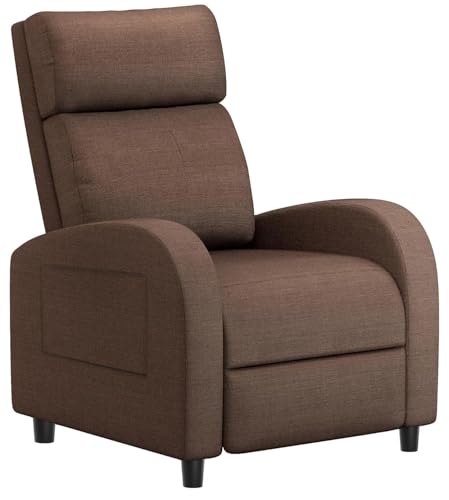
Homall’s reclining sofa line is the mid tier’s mainstream: configuration choice including console centres, family-proof surfaces, and the mechanism refinement step that separates mid from entry under daily use. Survey pattern: the category’s broadest satisfaction, because the line matches the broadest household — the movie-night family. Best for: family rooms and shared living rooms. Not suited for: centre-seat recliners. Verdict: the survey’s default recommendation when no special condition points elsewhere, and the maker-level context sits in the best company for reclining sofas.
ANONER Reclining Sofa — mid tier
ANONER’s reclining sofa offerings occupy the mid tier’s compact, finish-forward corner. Survey pattern: smaller-room owners who verified geometry report the category’s full benefits in rooms that reject full-size formats; the rare regrets trace to unverified clearance assumptions. Best for: compact rooms wanting a finish step-up. Not suited for: shoppers unwilling to measure twice. Verdict: proof that the category scales down gracefully when the buyer does the geometry homework.
Who Should Buy and Who Should Skip: The Survey’s Synthesis
Buy into the category if your household lounges together nightly, your room passes the tape test, and your temperament suits light mechanism care. Within it, buy by condition: compact room → two-seat wall-hugger; family mainstream → mid-tier three-seat with the centre arrangement chosen knowingly; limited mobility → power, on the seats that need it; maximum shared lounging → sectional, with connectors latched and cords planned. The pre-purchase checklist that operationalises all of this is in how to choose a reclining sofa, and the criteria deep-dive is the reclining sofa buying guide.
Skip the category if the room fails the tape, the household hosts more than it lounges, or moves are frequent — and skip it without regret, because the neighbours in the comparison table are genuinely good at their jobs. A static sofa with an ottoman serves the formal household better; standalone recliners serve the individualists; a sleeper serves the guest-heavy. The category’s maturity means its alternatives are mature too.
Setup, Care and Maintenance Essentials
The survey’s happiest owners share a routine so light it barely qualifies as one: place at measured clearance and test full travel on day one; route cords along the wall before the first evening; look underneath before closing any footrest; vacuum the linkage zone monthly; re-latch sectional connectors after any move; report early mechanism changes while the purchase is young. That is the whole liturgy, and the distance between households that keep it and households that do not is the distance between the category’s five-year success stories and its cautionary tales. Care for upholstery by material — wipeable surfaces wiped, fabric treated promptly, leather conditioned seasonally — and the sofa’s public face ages as gracefully as its mechanism.
Final Verdict
Reviewed as a field, the reclining sofa category earns a confident recommendation for its intended households and an equally confident steer-away for its unintended ones — which is what a mature category looks like. Its best formats (two-seat wall-huggers, mid-tier family three-seats, honestly built sectionals) deliver a daily comfort transformation that owners continue to praise years in, and its failures are overwhelmingly failures of fit and homework rather than of furniture. Do the measuring, count the reclining positions, buy the tier your usage justifies, and join the satisfied majority of this survey.
Deep Dive: What Separates the Survey’s Best from Its Rest
Reading across the whole field, the best-reviewed lines share four habits that have nothing to do with price. They describe their mechanisms — materials, construction, testing — in plain text where shoppers can find it. They state their geometry honestly, naming whether the seat slides or the back swings, instead of hiding behind clearance adjectives. They publish configuration diagrams that admit which seats recline, including the ones that do not. And they design for the delivery: detachable backs, sensible packaging, dimensions stated for the route as well as the room. A line doing all four is telling you how it thinks, and makers who think about mechanisms, geometry, honesty and delivery tend to build sofas that review well for the same reasons.
The rest of the field is not dishonest, exactly; it is merely quieter where it matters and louder where it does not. The survey’s practical translation: when two lines compete for your shortlist and one answers the four habits while the other answers with lifestyle photography, the first line has already won the only round that predicts ownership. This is also why the survey weights construction language over feature lists — cup holders, storage pockets and stitching styles are visible in any photograph, while the things that decide year three are visible only in the words a maker chooses to publish.
The Configuration Traps, Catalogued
The survey collected the category’s recurring surprises into one catalogue, because every one of them is avoidable in an hour. Trap one: the centre seat that does not recline, discovered by the household’s third viewer. Trap two: the chaise end of a sectional that does not recline, discovered by the person who claimed it. Trap three: the wall-hugger that is not — a full-clearance model placed against a wall on the strength of an adjective. Trap four: the power sofa’s cord count, discovered on delivery day by a household with one inconvenient outlet. Trap five: the doorway that the assembled sofa cannot pass, discovered with the sofa in the hallway. Five traps, five tape measures and listing diagrams that disarm them all — the survey knows of no sixth that is not a variation on these.
Upholstery Across the Survey
Upholstery satisfaction followed household honesty more than material. Fabric households that chose fabric knowingly — for breathability, for warmth, for a softer look — reported contentment even while acknowledging slower spill response; the pattern in best microfiber dual reclining sofas is representative. Faux-leather households prized the wipe-clean week and accepted the long-horizon surface wear as the material’s known tax. Leather households, concentrated at the premium tier, reported the deepest long-term satisfaction and the largest initial commitment, in that order. The survey’s only unhappy upholstery cohort was the mismatched one: households that bought a surface for its photograph and lived with it against its nature.
The Survey’s Method, and Its Limits
A word about how to use a survey honestly. This one synthesises the category’s structure — its formats, tiers, configurations and the recurring patterns in how ownership unfolds — rather than laboratory-testing individual units, and its judgements are qualitative by design: no invented measurements, no borrowed scores, no prices that would stale before the ink dried. That method is strong exactly where purchases are decided — fit, configuration, tier, habits — and deliberately silent where only a specific listing, read carefully on the day, can speak: current configuration options, current upholstery choices, current delivery terms. Use the survey to know what to ask; use the listing to get the answers; use the tape measure to settle disagreements between the two.
The same method explains this survey’s confidence about patterns and its humility about badges. Badges change their lines, configurations and construction between seasons in ways no survey can freeze; patterns — the centre-seat surprise, the geometry regret, the cord discovery, the stewardship fork — recur across every season the category has produced. A shopper armed with the patterns can walk into any season’s market and shop it well, which is the only kind of guidance worth publishing under a reviews headline. The companion deep dive, reclining sofa review, supplies the single-archetype texture that a survey, by its nature, must summarise.
One Sofa, Five Households: The Survey in Miniature
Imagine the survey’s archetypal mid-tier three-seat delivered, in turn, to five homes. To the film-loving family with a generous room it becomes the centre of their evenings and reviews itself in superlatives. To the small flat it becomes a beautiful obstruction, returned or resented in proportion to the tape work skipped. To the grandparents it becomes, in power form, the chair that kept the living room theirs. To the formal entertainers it becomes the room’s apology, admired by nobody and reclined in twice a year. To the careful stewards it becomes a decade of service; to their neighbours with the identical sofa and no vacuum habit, a three-year lesson. The sofa did not change. The survey’s entire argument is in that paragraph: in this category, the household is the specification, and the reviews merely report how well the specification was written.
The Survey’s Buying Shortlist, Distilled
Everything this survey found can be carried into a shop — physical or digital — on one mental card. Card line one: format follows population (two regular viewers, two seats; three or more, count the reclining positions, not the seats). Line two: geometry follows the tape (wall-hugger against a wall, full-clearance only with space behind, open footprint always). Line three: drive follows the operator (power for limited strength and marathon angles, manual for simplicity and lightness). Line four: tier follows intensity (nightly multi-person use buys mid or above; occasional use may honestly buy entry). Line five: upholstery follows the household’s spill and cleaning reality. Line six: the route is part of the product (doorways, stairs, detachable backs, two lifters, never the armrests). A shopper who can recite the card does not need this survey open on their phone; the survey’s patterns have become their instincts, which is the fate good guidance should hope for.
To the card, the survey adds one behavioural note gathered across every section: the households in the satisfied majority shopped slowly at exactly two moments — the measuring, and the configuration check — and quickly everywhere else. They did not agonise over badges, because badges were never the variable that predicted their evenings. They agonised, briefly and productively, over whether the open sofa fit the room and whether every regular viewer got a reclining seat, because those were. Imitate their allocation of worry and the market’s thousand near-identical listings collapse into a short, manageable list — the same collapse this survey performed at category scale, now available at the scale of one household, one room, one tape measure.
Closing the Survey
A category survey ends where it began: with a mature, honestly segmented market that rewards homework out of proportion to the homework’s difficulty. The reclining sofa is not a mysterious product. Its comforts are real and nightly, its costs are geometric and knowable, its tiers keep their promises, and its failures are overwhelmingly appointments the buyer missed with a tape measure. That is, in the end, an optimistic finding — it means the difference between the category’s happiest owners and its regretters is not luck, wealth or brand sorcery, but an hour of measuring and a configuration read carefully. The survey hands you both. The room, the household and the evenings are yours, and they were always the specification that mattered.
What the Survey Expects Next from the Category
Surveys should end by looking forward, carefully. The category’s visible trajectories are three. First, geometry keeps improving its manners: wall-hugger and forward-sliding designs grow more capable and more common, steadily shrinking the footprint con that has historically been the category’s largest. Second, power keeps democratising: what was a premium feature drifts toward the mainstream, bringing its cord-and-control housekeeping to households that did not grow up with it — which makes the setup disciplines in this survey more relevant, not less, with every season. Third, the compact end keeps refining: two-seat and apartment-scale designs with honest mechanisms are the field’s most active frontier, because the small home is where the category’s second-posture trick is worth most. None of these trajectories changes the survey’s core advice, because the advice was never about this season’s models. It was about rooms, households and habits, and those change more slowly than catalogues.
One trajectory deserves a caution rather than a welcome: feature accumulation. The category’s frontier models stack massage, heating, cooling, charging and storage onto the reclining base, and each addition is one more system to power, maintain and eventually retire. The survey’s pattern-matching is blunt about this — satisfaction follows the core mechanism’s quality and the room’s fit, while feature stacks mostly follow marketing. The feature-rich frontier has its showcase in best massage sectional sofas, and households tempted by it should apply the survey’s oldest question with extra firmness: which of these systems will still be earning its place in year three? Buy the ones with an answer. Decline, politely, the ones with only a demonstration.
The Survey’s Last Word to Three Readers
To the first-time buyer: the category is kinder than its size suggests. Measure the room, count the recliners, choose the honest tier, and you will very likely join the satisfied majority this survey describes — the entry and mid lines exist precisely to let you learn the category without betting the household budget on your first specification. To the upgrading owner: your experience is the survey’s best data, so spend it on the configuration regrets you actually have — the geometry, the centre seat, the drive — rather than on a badge change that repeats them in a finer fabric. To the sceptic who has read this far unconvinced: the survey respects the position. The alternatives are good, the cons are real, and a household that declines this category with its eyes open has used these reviews exactly as intended.
Reading Owner Reviews Without Being Mislead by Them
Since this survey will send many readers to owner commentary, it closes its evidence sections with a field guide to reading it. Weight the specific over the sweeping: a report that names the configuration, the room and the month of ownership carries information; a verdict without circumstances carries only weather. Weight the pattern over the anecdote: one gritty linkage is a story, the same report across a season of owners is a specification. Discount the delivery-day review, written in the first flush of novelty or grievance, in favour of the six-month report, when the household and the sofa have finished negotiating. And read the negative reviews for their nouns — geometry, centre seat, cords, route — because in this category the nouns repeat with a fidelity that amounts to a checklist, while the adjectives vary with temperament. The reader who mines owner commentary this way will find it confirms this survey’s patterns with almost suspicious consistency, which is less a tribute to the survey than to the category’s honest, repetitive physics.
A final reading skill: notice what owner reviews in this category almost never mention. They do not mention regret about reclining itself. They do not report wishing the sofa were a static one with better tailoring, once the household was a reclining household. The silence is data — it says the category’s core transaction, money for nightly shared comfort, clears its market test in household after household, and that the variance lives entirely in execution: fit, configuration, tier, habits. A survey could ask for no cleaner conclusion, and shoppers could ask for no more actionable one. The product is proven. The specification is yours to write.
Envoi: The Category, Fairly Summarised
If this survey were limited to a single paragraph for the reader in a hurry, it would be this one. Reclining sofas give several people a supported lean-back posture from one piece of furniture, and households that lounge together nightly find that gift transformative out of all proportion to its simplicity. The costs are a larger footprint in both postures, a serious weight that turns delivery and moving into operations, a mechanism that asks for cleanliness and respect, and — on power models — cords that ask for planning. The market segments honestly by tier, the formats divide cleanly by household, and the failures are overwhelmingly failures of measurement rather than of manufacture. Measure your room, count your recliners, buy your tier, keep the habits. The rest of this survey — and the rest of this series — exists to help you do those four things well.
How to Use This Survey in the Shop
Take three artefacts of this survey into the actual purchase and leave the rest behind with confidence. The first is the grid: format, geometry, drive, tier — locate any candidate sofa in it before you let yourself like the candidate, because liking is sticky and grids are not. The second is the trap catalogue: centre seat, chaise, geometry label, cord count, doorway — five checks that take an hour in total and retire the category’s entire literature of regret. The third is the stewardship question, asked of yourself rather than the sofa: will this household vacuum a linkage zone monthly, look before it closes a footrest, and latch a connector without being reminded by a drifting sectional? If the three artefacts all return favourable answers, the survey’s work is done and the market’s remaining differences are matters of taste, availability and support — grounds on which any careful shopper can decide without further guidance. If any artefact returns a warning, believe it the first time. Surveys exist so that individual households do not have to repeat the category’s collective education at retail prices.
Surveys, like sofas, should be judged by whether they leave the room more usable than they found it. This one set out to replace a thousand listings’ worth of noise with a grid, a trap catalogue and a stewardship question, and to name the category’s lines honestly at their tiers without pretending to laboratory knowledge it does not have. If it has done that — if a reader can now walk into any season’s version of this market and shop it calmly — then the survey has earned its place in the series, and the remaining work belongs, properly, to the reader’s own room, household and tape measure, which were always going to have the final word in any case.
And if the survey’s patterns ever feel abstract, reduce them to the scene they all describe: a room, an evening, a household leaning back together while a machine they chose carefully does its quiet work underneath them. Every format decision, tier argument and trap in these pages exists to protect that scene — or to warn, honestly, when a different household’s scene would be better served by different furniture. The survey has no favourite sofa. It has a favourite outcome, and the outcome is that scene, in the homes where it belongs, night after night, year after year.
New lines will enter this category next season with new names for old configurations, and the survey’s grid will receive them without surprise: a format, a geometry, a drive, a tier. Readers who have internalised the grid own something more durable than any single review — they own the category’s grammar, and grammar outlives vocabulary every time.
That is the survey’s promise and its limit, stated together: patterns you can trust, applied to a room only you can measure.
Reading Reclining Sofa Reviews Against Your Own Space and Routine
A single review session can flatter or condemn a reclining sofa unfairly, so this section slows the judgement down and looks at what only repeated, ordinary use tends to reveal. Run the reclining sofa through your least favourite version of its job first, not the easiest demonstration: the awkward corner, the rushed weekday timing, the fuller load, the lower light, or whatever condition in your routine makes this category work hardest. Watch for edge cases in your own home: the pet that investigates everything, the child who treats every new object as furniture, the guest who uses force where you use familiarity, and the weather, light or season that changes how a reclining sofa behaves. Keep a short note of what you adjusted on the reclining sofa during the first month, even just a line on your phone, since those notes turn vague impressions into a setup you can repeat, share or troubleshoot months later.
Measure before anything else, and measure the reclining sofa in its working state rather than its packed or folded state, because handles extend, lids open, cords trail, doors swing and users stand somewhere, and all of that belongs in the measurement. Read the manual’s warnings page for the reclining sofa even if you read nothing else, because that page is a compressed list of every way the product has ever been misused, and it tells you exactly which of your own habits needs adjusting. Check the floor, wall, ground or surface the reclining sofa will meet, since level, texture, moisture and finish decide more about everyday performance in living room furniture settings than most shoppers expect when they are comparing listings on a screen. Think about who else will use the reclining sofa and what they will do differently: shorter reach, less patience, stronger habits, no interest in the manual, and a tendency to leave things wherever they were last set down.
Photograph your setup once the reclining sofa is working well — the position, settings, arrangement or layout you settled on — so that after a move, a deep clean or a seasonal break you can recreate the arrangement that worked instead of rediscovering it. Seasonal thinking helps more than expected: a reclining sofa bought in one season will meet different light, humidity, mud, heat, guests and routines in another, so judge its size, storage and upkeep against the hardest season it will face. Finally, remember that the best reclining sofa for your home is the one whose size, habits and upkeep disappear into your routine, leaving only the result behind — a cleaner surface, a better-lit seat, a tidier shelf, an easier job — week after ordinary week. Plan the storage home for the reclining sofa before it arrives, naming the exact cupboard, corner, shelf, hook or stretch of floor, because a product without a home migrates around the house and slowly becomes the clutter it was bought to reduce.
Test the reclining sofa in the first week under deliberately ordinary conditions rather than saving it for a special occasion, so that any problem surfaces while returning, exchanging or adjusting your setup is still simple. A well-judged reclining sofa explains itself to that second person without a lecture, with controls, grips, openings or adjustments that make sense on contact, and that intuitiveness is worth recording because guests, partners and teenagers will all test it. Finish the longer check by looking at wear points rather than features: the hinge, seam, edge, wheel, latch, surface or joint on a reclining sofa that moves, flexes or gets handled most is where its second year is decided, whatever its first week felt like. Keep the packaging of a larger reclining sofa until those first ordinary tests are done, flattened if space is tight, because re-boxing an awkward shape from scratch is the hidden difficulty inside many otherwise straightforward returns.
Decide in advance what good enough looks like for the job the reclining sofa does in your home, because chasing a flawless result usually costs more time than the flaw itself, and most households are happier with a reliable ninety percent they actually repeat. Consider the cleaning rhythm honestly: a reclining sofa that needs attention after every use suits a household that enjoys small rituals, and frustrates a household that wants to finish a job and walk away, so match the upkeep to the temperament, not the intention. Notice the small recovery moments: how the reclining sofa behaves when you pause mid-task, change your mind, need to move it, clean it sooner than planned, or hand it to someone in the household who has never used it before.
Frequently Asked Questions
Which reclining sofa format gets the best reviews overall?
The two-seat wall-hugger collects the most consistent praise, because it fits the most rooms, reclines for both its sitters and carries the lightest weight and delivery burden in the category. Mid-tier three-seats follow closely for families who choose the centre arrangement knowingly. Sectionals inspire the strongest enthusiasm and the strongest regrets in the same breath — they are the format where homework matters most, because their scale magnifies both the comfort and every mistake.
Are expensive reclining sofas actually better, or just nicer-looking?
Better, in a specific order: mechanism refinement and cycle life first, cushion construction second, materials and finish third. A premium leather build such as those surveyed in best leather triple recliner sofas is buying decades of linkage smoothness and an upholstery that ages into character. What money does not buy is immunity from the category’s rules — a premium sofa reclined against a wall still scuffs, and its cords still need routing. Spend up for longevity, not for exemption.
What do owners most wish they had known before buying?
Three things, in order: that the open footprint, not the closed one, is the furniture; that the centre seat of a three-seat usually does not recline; and that delivery is an operation requiring measurements, detachable backs and two strong people. All three are knowable in an hour with a tape measure and a careful listing read, which is why this survey repeats them without apology — they are, empirically, the difference between the category’s happy and unhappy reviews.
How long do reclining sofas last in typical family use?
The frame and upholstery set a long horizon; the mechanism sets the practical one, and it tracks tier and treatment. Entry builds in heavy daily family use show their years soonest; mid and premium builds with the light care routine in this survey serve far longer. The most useful predictor is the first season: a mechanism that cycles smoothly and quietly after months of family use, kept clean and unforced, is on the long-life track. Report early changes rather than adapting to them.
Is power recline reliable enough to recommend?
Yes, with the setup discipline this survey describes. Powered mechanisms are mature technology, and owner satisfaction with the motion itself is high. The reliability conversation is really about installation: cords routed unpinched along the wall, one cord per mechanism on many models accounted for, outlets reachable, and a household that treats the controls with the same respect as the manual mechanism’s pinch points. Installed carelessly, power adds failure modes; installed properly, it adds years of independent comfort for the people who need it most.
Where should I start if I am new to the category?
Start with fit, not products: tape your room’s open footprint, count your regular recliners, and decide manual versus power by who will operate the seats. Then read the selection sequence in how to choose a reclining sofa, place your room and household in this survey’s grid of format, geometry and tier, and only then compare named lines. Shoppers who start with products end up reviewing sofas; shoppers who start with fit end up owning the right one.
Related Guides
how to choose a reclining sofa is a reclining sofa worth it reclining sofa buying guide reclining sofa pros and cons reclining sofa review recliner reviews how to choose a recliner best sofas for narrow doorways best microfiber dual reclining sofas is a recliner worth it recliner buying guide recliner pros and cons recliner review


