Disclosure: As an Amazon Associate, dailyhomedecorating.com earns from qualifying purchases. Links on this page are affiliate links; they cost you nothing extra. Prices and availability change often, so check the current Amazon listing before you buy.
These recliner reviews take the wider view that a single-chair review cannot: several representative recliners, assessed side by side as a class, so you can see how the category’s main designs differ in mechanism, fit, upholstery, and temperament before choosing which corner of it to shop in. Each model below is presented prose-only while verification is pending, positioned by tier in words, and judged on the same evidence — how it is built, how it sits through a real evening, and what living with it actually asks of a household.
Key Takeaways
- No single winner: the right recliner depends on body, room, and household more than on brand.
- The heritage premium end wins on sizing choice and mechanism refinement; the entry end wins on accessibility.
- Fabric models suit warm rooms and readers; leather-look models suit spill-prone family life.
- Every model here shares the same safety rule: linkage clear, children supervised, pets out from under the footrest.
Short verdict. Shortlist by type before you shortlist by model. A wall-hugger that fits your room will beat a finer chair that does not, every evening of its life.
In this guide
Recliner Reviews: The Class at a Glance
Value in a recliner hides in the parts you cannot photograph. Frame material, linkage gauge, cushion density, and motor quality decide whether a chair is a decade-long companion or a two-year disappointment, and none of them show up in a lifestyle picture. This is why two chairs that look near-identical can sit at entirely different tiers, and why the cheaper one is sometimes the honest bargain and sometimes merely cheaper. Read the construction details the maker is willing to state, weigh the warranty on the mechanism as a signal of the maker’s own confidence, and be suspicious of any listing that talks only about softness and style.
Mechanism feel is a quality you notice every single day. A good linkage moves in one unhurried sweep, settles without a clunk, and holds its position when you shift your weight to reach for a drink. A cheaper linkage can feel notchy, spring back a little when you settle, or develop a faint wobble at the footrest hinge after months of use. You cannot judge any of this from a listing photograph, which is why the returns route and the warranty on the mechanism matter as much as the upholstery. Treat the frame and linkage as the chair itself, and everything draped over it as clothing.
Think about who shares the chair before falling for a fabric. A household with dogs that treat the recliner as a second bed needs a tight weave that claws cannot easily pick loose, in a colour that forgives hair between cleans. A chair destined for a sunny window needs a fade-resistant cover, because upholstery fades unevenly and the back of a recliner takes the sun full on. Removable, washable covers on the seat cushion are worth real money in a family room. Whatever you choose, run your hand across it and sit down in your usual clothes: some textured weaves that look wonderful can feel scratchy against bare legs on a warm evening.
Models Worth a Closer Look
Every model below is presented prose-only while verification is pending, positioned by tier in words rather than by any fixed figure. Judge each against the fit, clearance, and mechanism checks in this guide rather than against its photographs.
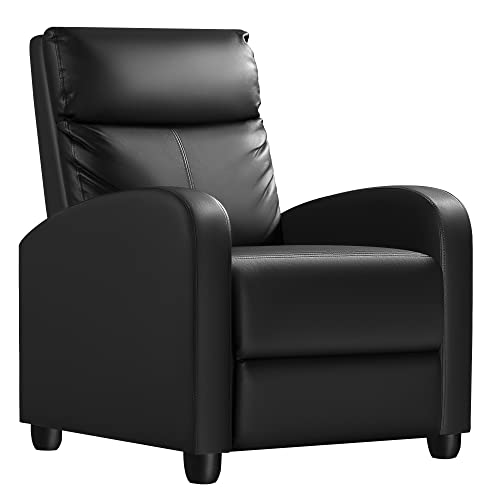
Homall Recliner Chair
Best for: smaller rooms, first apartments, and anyone wanting the reclining experience at the most accessible tier. Not suited for: very tall sitters who need a long footrest, or households wanting genuine leather longevity.
The Homall Recliner Chair is a compact, single-seat manual recliner in faux leather with a straightforward side-handle action and a space-conscious footprint. It sits at the entry tier of the recliner market, and that positioning tells you where its maker spent the money: on the balance of frame, cushioning, and finish that tier allows. Treat it as a representative of its class as much as a single product, because the checks that matter — linkage smoothness, seat fit for your body, and clearance in your room — are the checks that decide whether any chair in this class earns its floor space in your home.
In daily use, expect the ownership pattern of its class. Routine care is unglamorous and decisive. Vacuum the crevices weekly, because crumbs and grit migrate to exactly the fold where the seat meets the back, and grit is an abrasive that works on upholstery and linkage alike every time the chair moves. Wipe spills promptly with whatever the cover’s maker recommends, and resist the urge to soak fabric covers, since damp padding dries slowly and smells of its adventure. Leather wants dusting and occasional conditioning away from direct heat. Keep the chair out of punishing direct sun where you can, and rotate your sitting spot if the chair is wide enough to allow it, so one cushion corner does not age alone. The honest limitation of the Homall Recliner Chair, as with most chairs at its tier, is that no single recliner suits every body and every room at once, so let your own measurements and your room’s tape-measured clearances have the final word over any listing’s enthusiasm.
Esright Massage Recliner
Best for: sitters who enjoy gadget comforts and want a heated, vibrating seat for film nights. Not suited for: buyers who prefer the simplest possible mechanism with the fewest electrical parts to maintain.
The Esright Massage Recliner is a feature-led recliner pairing a reclining action with built-in warmth and vibration functions, usually finished in easy-wipe faux leather. It sits at the entry to mid tier of the recliner market, and that positioning tells you where its maker spent the money: on the balance of frame, cushioning, and finish that tier allows. Treat it as a representative of its class as much as a single product, because the checks that matter — linkage smoothness, seat fit for your body, and clearance in your room — are the checks that decide whether any chair in this class earns its floor space in your home.
In daily use, expect the ownership pattern of its class. The mechanism asks for very little, but it asks firmly. Keep the area under and behind the chair clear of stored blankets, toys, and charging cables, because anything that drifts into the linkage’s path will be found by moving steel. Listen to the chair: a new squeak, a grinding note, or a motion that suddenly needs more effort is information, and catching a loose fixing early is the difference between a small adjustment and a bent frame. Never oil a mechanism blindly or force a stuck footrest with your full weight. If a power model misbehaves, unplug it, check the cord’s path and connections, and only then start suspecting the motor. The honest limitation of the Esright Massage Recliner, as with most chairs at its tier, is that no single recliner suits every body and every room at once, so let your own measurements and your room’s tape-measured clearances have the final word over any listing’s enthusiasm.
Yaheetech Recliner Armchair
Best for: fabric lovers, warm rooms where leather feels sticky, and relaxed reading corners. Not suited for: homes needing a wipe-clean surface for toddlers, pets, and frequent spills.
The Yaheetech Recliner Armchair is a fabric-upholstered manual recliner with a padded, lounge-first shape and an adjustable backrest angle for reading and resting. It sits at the entry tier of the recliner market, and that positioning tells you where its maker spent the money: on the balance of frame, cushioning, and finish that tier allows. Treat it as a representative of its class as much as a single product, because the checks that matter — linkage smoothness, seat fit for your body, and clearance in your room — are the checks that decide whether any chair in this class earns its floor space in your home.
In daily use, expect the ownership pattern of its class. Routine care is unglamorous and decisive. Vacuum the crevices weekly, because crumbs and grit migrate to exactly the fold where the seat meets the back, and grit is an abrasive that works on upholstery and linkage alike every time the chair moves. Wipe spills promptly with whatever the cover’s maker recommends, and resist the urge to soak fabric covers, since damp padding dries slowly and smells of its adventure. Leather wants dusting and occasional conditioning away from direct heat. Keep the chair out of punishing direct sun where you can, and rotate your sitting spot if the chair is wide enough to allow it, so one cushion corner does not age alone. The honest limitation of the Yaheetech Recliner Armchair, as with most chairs at its tier, is that no single recliner suits every body and every room at once, so let your own measurements and your room’s tape-measured clearances have the final word over any listing’s enthusiasm.

Sweetcrispy Recliner Chair
Best for: style-led small rooms and anyone furnishing a first proper living room on a sensible tier. Not suited for: sitters wanting an oversized, sink-in lounge chair with maximum sprawl.
The Sweetcrispy Recliner Chair is a streamlined modern recliner with clean lines, a compact frame, and an easy manual recline aimed at smaller living spaces. It sits at the entry tier of the recliner market, and that positioning tells you where its maker spent the money: on the balance of frame, cushioning, and finish that tier allows. Treat it as a representative of its class as much as a single product, because the checks that matter — linkage smoothness, seat fit for your body, and clearance in your room — are the checks that decide whether any chair in this class earns its floor space in your home.
In daily use, expect the ownership pattern of its class. The mechanism asks for very little, but it asks firmly. Keep the area under and behind the chair clear of stored blankets, toys, and charging cables, because anything that drifts into the linkage’s path will be found by moving steel. Listen to the chair: a new squeak, a grinding note, or a motion that suddenly needs more effort is information, and catching a loose fixing early is the difference between a small adjustment and a bent frame. Never oil a mechanism blindly or force a stuck footrest with your full weight. If a power model misbehaves, unplug it, check the cord’s path and connections, and only then start suspecting the motor. The honest limitation of the Sweetcrispy Recliner Chair, as with most chairs at its tier, is that no single recliner suits every body and every room at once, so let your own measurements and your room’s tape-measured clearances have the final word over any listing’s enthusiasm.
La-Z-Boy Recliner
Best for: buyers investing for the long term who want sizing choice, sturdy linkage, and a maker with a long recliner pedigree. Not suited for: shoppers at an entry tier, or anyone who needs a chair light enough to move often.
The La-Z-Boy Recliner is the heritage name in reclining, standing here for the well-built, size-varied, mechanism-warranted end of the market rather than one single model. It sits at the premium tier of the recliner market, and that positioning tells you where its maker spent the money: on the balance of frame, cushioning, and finish that tier allows. Treat it as a representative of its class as much as a single product, because the checks that matter — linkage smoothness, seat fit for your body, and clearance in your room — are the checks that decide whether any chair in this class earns its floor space in your home.
In daily use, expect the ownership pattern of its class. Routine care is unglamorous and decisive. Vacuum the crevices weekly, because crumbs and grit migrate to exactly the fold where the seat meets the back, and grit is an abrasive that works on upholstery and linkage alike every time the chair moves. Wipe spills promptly with whatever the cover’s maker recommends, and resist the urge to soak fabric covers, since damp padding dries slowly and smells of its adventure. Leather wants dusting and occasional conditioning away from direct heat. Keep the chair out of punishing direct sun where you can, and rotate your sitting spot if the chair is wide enough to allow it, so one cushion corner does not age alone. The honest limitation of the La-Z-Boy Recliner, as with most chairs at its tier, is that no single recliner suits every body and every room at once, so let your own measurements and your room’s tape-measured clearances have the final word over any listing’s enthusiasm.
Divano Roma Furniture Recliner
Best for: media rooms and anyone who wants a plush, cinema-leaning seat at a middle tier. Not suited for: formal rooms needing a low-profile chair that visually disappears.
The Divano Roma Furniture Recliner is a generously padded contemporary recliner, often in leather-look upholstery, with a bold lounge silhouette. It sits at the mid tier of the recliner market, and that positioning tells you where its maker spent the money: on the balance of frame, cushioning, and finish that tier allows. Treat it as a representative of its class as much as a single product, because the checks that matter — linkage smoothness, seat fit for your body, and clearance in your room — are the checks that decide whether any chair in this class earns its floor space in your home.
In daily use, expect the ownership pattern of its class. The mechanism asks for very little, but it asks firmly. Keep the area under and behind the chair clear of stored blankets, toys, and charging cables, because anything that drifts into the linkage’s path will be found by moving steel. Listen to the chair: a new squeak, a grinding note, or a motion that suddenly needs more effort is information, and catching a loose fixing early is the difference between a small adjustment and a bent frame. Never oil a mechanism blindly or force a stuck footrest with your full weight. If a power model misbehaves, unplug it, check the cord’s path and connections, and only then start suspecting the motor. The honest limitation of the Divano Roma Furniture Recliner, as with most chairs at its tier, is that no single recliner suits every body and every room at once, so let your own measurements and your room’s tape-measured clearances have the final word over any listing’s enthusiasm.
Design, Build and Setup Across the Class
What the chair stands on changes how it feels and how your floor fares. A fixed-base recliner sits planted and stable, the safest temperament for a chair that will be climbed into daily. A swivel base lets you turn toward conversation or a screen without shuffling the whole chair, and a glider base adds a gentle fore-and-aft soothe that many readers love. A rocker base gives the classic nursery motion, though a rocking recliner needs even more respect for the space behind it and for small fingers and paws near its moving base. Each moving base adds moving parts, and moving parts are where long-term wobble is born.
Weight follows the motor. A power recliner is a heavy piece of furniture, noticeably heavier than its manual equivalent, and that matters on delivery day, on rearrangement day, and on the day you move house. Plan for two people for any recliner move, manual or powered, and never drag a recliner across the floor by its footrest or arms, which twists the linkage and can bend the very parts that keep the motion smooth. Many designs split into a removable back and base for doorways, which is the civilised way to move them. Lift with the frame, keep the chair upright where you can, and let the mechanism travel unloaded.
Clearance is also a safety margin, not just a comfort one. Space behind the chair is where a curious pet will nap and where a toddler will inevitably explore, so a chair that must sit close to a wall is another argument for a forward-sliding wall-hugger design. In front, leave the footrest’s swing completely unobstructed, because a footrest that strikes furniture mid-travel strains the linkage and can jolt the sitter. Rugs deserve a thought too: a thick pile rug under the base can tilt the chair slightly and change how the mechanism sits, while a low, firm rug keeps the base honest and the motion predictable.
Performance in Real Use, Model Type by Model Type
For Reading Corners
Fit is personal in a way no size chart fully captures, but a few honest checks get you close. When you sit upright with your feet on the floor, your knees should bend comfortably at the seat edge without the cushion front pressing hard into the back of your calves. When the footrest rises, your heels should rest on it rather than dangle past its end, and your lower back should stay in contact with the backrest instead of sliding into a slouch gap. Head support matters more than people expect: the top of the backrest should meet your head without forcing it forward, so you can read or watch a screen without a cricked neck.
For Media Rooms
Lighting and side tables are part of the recliner decision, even though they never appear on its listing. A reading recliner wants a lamp that lands over the shoulder of your favoured side and a table within easy reach that stays reachable when the footrest is up, because once you are reclined, standing up to fetch a drink feels like a genuine expedition. Keep that table out of the footrest’s swing. If the chair will serve a screen, check the reclined sightline to the television from the actual seat, not from standing height, because reclining tips your view upward and a screen mounted for upright sofas can sit uncomfortably low or high.
For Family Rooms With Pets and Children
There is a safety truth that belongs in every conversation about mechanisms, and it is simple enough to state plainly. The linkage underneath and behind a recliner has pinch and crush points where steel parts scissor together as the chair opens and closes. Keep children’s hands well clear of that linkage at all times, and keep pets from crawling under an extended footrest or sleeping in the gap behind the chair. Never let children play on an open footrest, ride it up and down, or treat the chair as climbing equipment. The mechanism is strong precisely because it moves heavy loads, and that strength deserves respect in a family room.
For Small Rooms
Placement starts with clearance, and clearance should be measured by eye and by tape in plain, practical terms before the chair ever leaves its box. A standard recliner needs generous open space behind it for the back to travel into, and clear space in front for the footrest to swing up and out without meeting a coffee table, an ottoman, or a passing shin. A wall-hugger or zero-wall design needs far less room behind because the seat slides forward instead, but it still needs its full frontage free. Walk the path the chair will take through the room and look at the whole arc of its motion, not just its closed footprint.
Strengths of the Class and Trade-offs of the Class
Strengths of the Class
- Real choice: size, motion, upholstery, and assistance can all be matched to the household
- Mature designs at the premium end with mechanisms refined over decades
- Entry models that put genuine reclining comfort within reach of first homes
Trade-offs of the Class
- Quality spread within the class is wide, and listings rarely reveal it
- Shared weaknesses: weight, footprint, and one-spot upholstery wear
- Feature-led models can distract from frame and fit, which matter more
How the Models Compare With Each Other
The compact manual chairs, represented here by the Homall and Sweetcrispy designs, trade sprawl for placement freedom and suit the smaller room and the first home. The fabric Yaheetech leans toward the reader, breathing well and asking for spill discipline. The feature-led Esright adds warmth and vibration for film households that enjoy them. The Divano Roma pattern brings a plush media-room presence at a middle tier. The La-Z-Boy name stands for the considered end: more sizes, a more refined linkage, and a price of admission that buys longevity rather than novelty. Read across the row and the category’s logic is clear — you are always trading size, features, and refinement against tier and weight.
Who Should Buy Which Recliner
Body size cuts both ways in this category. A petite sitter in an oversized chair ends up perched, feet off the floor, with the lumbar curve of the backrest landing in entirely the wrong place. A tall or broad sitter in a compact chair gets knees higher than hips, shoulders above the backrest, and armrests that crowd rather than support. Many recliners now come in distinct sizes rather than one compromise shape, and choosing the right size matters more than choosing the right colour. If two people of very different builds will share the chair, favour the fit of the person who will use it most, and be honest about that priority.
A recliner changes a room’s balance more than any other single chair, because it is deep, tall-backed, and visually upholstered on every side including the back you see when it floats mid-room. In a formal layout, one recliner among upright chairs can look like a guest who has taken their shoes off, which is either charming or jarring depending on the household. Lower-profile, track-arm designs in a fabric close to the sofa’s tone blend in most easily. Swivel recliners earn their keep in open-plan spaces, turning between a conversation grouping and a screen without breaking the layout. Think of the recliner as the room’s exclamation mark and place it where emphasis belongs.
Setup, Care and Maintenance Essentials
The mechanism asks for very little, but it asks firmly. Keep the area under and behind the chair clear of stored blankets, toys, and charging cables, because anything that drifts into the linkage’s path will be found by moving steel. Listen to the chair: a new squeak, a grinding note, or a motion that suddenly needs more effort is information, and catching a loose fixing early is the difference between a small adjustment and a bent frame. Never oil a mechanism blindly or force a stuck footrest with your full weight. If a power model misbehaves, unplug it, check the cord’s path and connections, and only then start suspecting the motor.
Stability deserves a deliberate check once any recliner is in place. Set the chair on its intended floor, sit down, and work the mechanism through its full travel while paying attention to the base. It should sit stable and level, without rocking on a corner, creeping across hard flooring, or twisting as the footrest takes your weight. On hard floors, a rocking or swivel base that is even slightly uneven will announce itself with every motion and can mark the surface beneath it over time. Felt pads or a low, firm rug under the base calm most of this. If the chair rocks where it should not, fix the footing before blaming the mechanism.
Final Verdict on the Class
Reviewed together, these recliners confirm that the category is healthy at every tier and dishonest only in its photography, which never shows the room a chair needs or the body it truly fits. Choose by measurements and mechanism, treat features as garnish, enforce the household safety rules from the first evening, and any of the designs above can be the right chair. Choose by a picture alone and even the finest of them can disappoint.
How to Read Recliner Listings Without Being Misled by Headlines
This section exists to look again after the first impression has faded, because the qualities that sell a product in the first hour are rarely the ones that decide whether it is still liked in month three. It adds a layer that a feature list cannot give you, grounded in the living room furniture context this recliner will actually live in. Where this guide names examples such as Homall Recliner Chair, Esright Massage Recliner, Yaheetech Recliner Armchair, use them as test cases for the checks below rather than as shortcuts past them.
Build a simple decision checklist and score it in writing. Five lines are enough: fit in the space, fit with the routine, ease of cleaning or upkeep, quality of the parts that move or wear, and how the recliner will be stored or will look when it is not the centre of attention. Score each contender quickly, then look only at the lowest scores, because purchases are usually ruined by their weakest point rather than saved by their strongest. If two options tie, choose the one whose weakness is cheapest or easiest to live with. This sounds mechanical, and it is meant to: a written checklist is the best defence against the very human habit of falling for the last photograph you looked at.
Finally, plan the first fortnight. Decide where the recliner will live from day one, what it replaces, what accessory or companion it needs straight away and what small job you will use to learn its habits while returning it is still simple. Keep the packaging until that learning period is over, note anything that surprises you, and deal with a mismatch early rather than adapting yourself around a poor fit for years. The households that end up happiest with a recliner are rarely the ones that researched longest; they are the ones that checked fit honestly, bought for the ordinary week, and paid attention during the first days instead of assuming the decision ended at checkout.
One more angle is worth your time: the second-order costs. A recliner changes what happens around it. It can demand a different cleaning product, a new storage habit, a moved piece of furniture, a rearranged cupboard or a standing arrangement with the people you live with. List those knock-on effects before you buy and decide whether you accept them as part of the deal. Sometimes the answer is an easy yes, and the recliner earns its place by improving the whole routine around it. Sometimes the honest answer is that the supporting changes are the real project, and the purchase should wait until you are ready for them. Either answer is useful; the only bad outcome is discovering the knock-on effects by accident, one irritation at a time, after the decision can no longer be revisited.
It also helps to separate the problems a recliner can solve from the problems it merely moves. If the underlying difficulty is space, the answer may be a smaller format or a different location rather than a more elaborate model. If the difficulty is time, look for the option that removes steps rather than the one that performs each step slightly better. If the difficulty is that several people want different things, a compromise design that everyone rates as good enough will usually outlast a specialist design that one person loves and everyone else avoids. Naming the real problem in one sentence, out loud, before you order, is a surprisingly powerful filter, and many shoppers find that the sentence itself points at a different recliner than the one they started out researching.
Frequently Asked Questions
Which recliner type suits a small room best?
Clearance is also a safety margin, not just a comfort one. Space behind the chair is where a curious pet will nap and where a toddler will inevitably explore, so a chair that must sit close to a wall is another argument for a forward-sliding wall-hugger design. In front, leave the footrest’s swing completely unobstructed, because a footrest that strikes furniture mid-travel strains the linkage and can jolt the sitter.
Which recliner is easiest to keep clean?
Upholstery decides how a recliner ages in public. Genuine leather develops a patina, shrugs off spills with a quick wipe, and asks for occasional conditioning to stay supple, but it shows scratches and costs the most in any range. Faux leather and bonded materials imitate the look at an entry tier, wipe clean just as easily, yet can peel or crack where heat, sunlight, and friction gang up on them over the years.
Are the massage and heat features worth choosing?
The honest way to judge worth is cost against evenings. A recliner is among the most-used objects in a home, sat in daily, often for hours, by the people who most deserve comfort in the household. Spread across that much use, the difference between an entry chair that sags early and a mid-tier chair that holds its shape is small per evening and enormous per year. That logic has a limit, of course: past a certain tier you are paying for leather grade, brand heritage, and refinement rather than durability.
How do I compare recliners fairly?
Seat height quietly decides how easy a chair is to live with, especially for anyone who finds low furniture a struggle. A higher seat with a firm front edge makes standing up a shorter journey, while a deep, soft, low seat is wonderful for curling up and genuinely hard to leave gracefully. Armrest height plays its part as well, because you push down through the arms every time you rise. None of this is about medical promises, and a recliner is furniture, not therapy.
What safety checks apply to every model?
There is a safety truth that belongs in every conversation about mechanisms, and it is simple enough to state plainly. The linkage underneath and behind a recliner has pinch and crush points where steel parts scissor together as the chair opens and closes. Keep children’s hands well clear of that linkage at all times, and keep pets from crawling under an extended footrest or sleeping in the gap behind the chair. Never let children play on an open footrest, ride it up and down, or treat the chair as climbing equipment.
Manual or power across the class?
The manual-versus-power decision shapes cost, weight, placement, and daily feel all at once. A manual recliner is lighter, cheaper to buy at any given quality level, can sit anywhere in the room including the middle of it, and opens with a decisive pull or push that becomes second nature within a week. A power recliner opens slowly and silently, stops at exactly the angle you want rather than the next notch the linkage offers, and often adds a powered headrest or lumbar adjustment that manual chairs rarely match.
Related Guides
- how to choose a recliner
- is a recliner worth it
- recliner buying guide
- recliner pros and cons
- how to choose a reclining sofa
- reclining sofa pros and cons
- is a reclining sofa worth it
- best sofa cover for leather recliners
- best sofas for older adults
- best two seater sofas
- best sofas for homes with kids
Living With a Recliner, Week After Week
The honest way to judge worth is cost against evenings. A recliner is among the most-used objects in a home, sat in daily, often for hours, by the people who most deserve comfort in the household. Spread across that much use, the difference between an entry chair that sags early and a mid-tier chair that holds its shape is small per evening and enormous per year. That logic has a limit, of course: past a certain tier you are paying for leather grade, brand heritage, and refinement rather than durability. Find the tier where construction is genuinely solid, and let extra budget buy upholstery and looks with a clear conscience.
One underrated test is the return journey: sit in the chair, recline fully, and then come back upright and stand, all in one unhurried sequence, and notice where the effort lives. In a well-sorted chair the effort is small and evenly spread. In a poorly sorted one you will haul on the arms, shuffle your hips forward, or arrive upright with a small lurch. That sequence, repeated daily for years, is the real product you are buying, far more than any single reclined pose. Judge the whole journey, not the destination photograph.
Noise is a comfort feature nobody lists. A mechanism that clunks at the end of its travel will wake a sleeping partner, startle a dog, and slowly train you to recline less often than you want to. Power motors should hum rather than whine, and manual linkages should travel without a springy boing at the catch point. In a quiet house, in the evening, these small sounds are the difference between a chair that disappears into relaxation and one that announces every adjustment to the whole room like a stage prop.
Consider the second sitter, because recliners are rarely as private as their buyers imagine. Partners borrow them, grandchildren colonise them, and guests make a beeline for the one chair in the room that obviously reclines. A chair bought for one body will serve many, so a middle-of-the-road firmness and a size that accommodates a range of heights will age better socially than a chair moulded precisely to one person’s preferences. If the chair truly is for one reader in one corner, ignore this and fit it like a shoe. Otherwise, buy for the household the chair will actually meet.
Delivery deserves the same planning as the chair itself. Measure doorways, hallway turns, and stairwell corners against the chair’s boxed and unboxed shapes, and favour designs whose backs detach, because a recliner back that lifts off turns an impossible doorway into a non-event. Clear the route, protect the floor along it, and keep children and pets entirely out of the delivery path, since a recliner in transit is heavy, awkward, and blind. Once the chair is placed, keep its packaging until you have sat in it through a full evening; the box you throw away on day one is the box you want on day three.
Heat and massage features divide opinion neatly, so treat them as personal garnish rather than core value. Gentle warmth through a backrest is pleasant on a cold evening, and simple vibration can feel relaxing after a long day, but neither substitutes for a chair that fits and supports properly in the first place, and neither should be bought with any expectation beyond comfort. Buy the chair for its frame, fit, and mechanism, and let features be the pleasant extra they are. A well-built plain recliner will out-satisfy a feature-stuffed chair on a flimsy frame every single winter.
Think about the chair’s neighbours in the room as a system. A recliner beside a fixed sofa creates a natural hierarchy of comfort that guests read instantly, and households usually solve it by rotation or by pairing the recliner with the best lamp and table so its occupant hosts from it. In media rooms, the recliner’s raised footrest changes legroom for the row behind if there is one. In reading corners, a recliner plus a small bookshelf and a lamp is a complete room within a room. Plan the system, and the chair choice usually makes itself.
Armrests deserve more scrutiny than they get, because they work every time you sit, rise, read, or reach. A good arm is wide enough to rest a forearm without it rolling off, padded enough for a long chapter, and firm enough at its front end to push against when standing. Arms that slope away, sit too low, or end in soft decorative rolls all tax the same daily movements. Rest your arms where they naturally fall while you test a chair, and if you find yourself holding them up or tucking them in, the chair is asking you to adapt to it rather than the other way round.
The headrest is where recliners quietly succeed or fail for screen watchers. Recline tips your whole body back, and a headrest that does not meet the head at the new angle leaves your neck holding your head up for the length of a film. Better designs shape the top of the backrest to cradle rather than push, and powered headrests that tilt independently solve the geometry outright. Readers face the mirror problem upright, where a tall back can push the head forward over a book. Test both postures with something in your hands, because that is how the chair will actually be used.
Temperature is a comfort factor hiding inside the upholstery choice. Leather and leather-look covers feel cool at first touch, then warm to the body and can feel sticky in a hot room against bare skin. Fabric breathes, stays neutral, and suits rooms that run warm or sitters who run warm themselves. In a cold room the same fabric feels instantly friendlier than a cold leather surface on a winter morning. None of this appears in a product photograph, yet it greets you at every single sitting, which makes it worth a deliberate thought before the fabric decision is treated as purely decorative.
A recliner’s silhouette from behind matters in any room where the chair floats away from a wall, because the back is fully upholstered furniture that the room sees all day. Some designs finish the back cleanly with tailored panels; others show the honest machinery of the category under a looser cover. Neither is wrong, but they suit different rooms. In a through-room where the chair’s back faces a dining space or an entrance, favour the tailored finish. Against a wall or in a dedicated media corner, spend the money on the sitting side instead and let the back be plain.
Sound carries differently through a quiet house at night, and a recliner joins the household’s acoustic life whether you plan it or not. The soft thump of a footrest settling, the click of a handle, the low hum of a motor — each becomes part of the evening soundscape for partners, children, and anyone asleep nearby. Households with a light sleeper should weight smoothness and quiet heavily in the choice, favouring mechanisms that travel without drama at either end of their range. It is a small criterion that grows larger every night for years.
Guests read a recliner instantly, and households develop customs around it without ever discussing them. The chair becomes a named place — a reading chair, a grandfather chair, the good seat — and social peace depends on the custom being fair. If one chair will carry that status, its fit should favour the household member whose claim is strongest, and everyone else should understand the arrangement before delivery day rather than after it. Furniture this personal benefits from a little honesty at the buying stage, when feelings are still hypothetical.
The floor under a recliner works harder than the floor under any other chair, taking concentrated weight through a small base while the mechanism shifts loads fore and aft. On timber and laminate, a protective mat or low firm rug spreads that work and prevents the slow marking that rocking and swivelling bases can leave. On carpet, the base can settle into the pile and change the chair’s level over time, which a periodic lift and reseat corrects. Check the footing seasonally as part of ordinary care, the way you would check anything mechanical that your household leans on daily.
Two recliners side by side are a different purchase from one, and worth planning as a pair. Matched chairs give a room symmetry and give two sitters equal comfort, which settles the best-seat question permanently. They also double every demand: two footprints, two mechanisms to keep clear, and on power models two cords to route with the same discipline. Mismatched pairs, one generous and one compact, can suit couples of different builds better than identical chairs. Either way, measure the pair’s combined open shape, because two footrests rising together need a room that was planned for exactly that.
A recliner in a rented home carries extra questions that owners never face. Weight matters more when the chair must leave by the same stairs it entered, and floor protection matters more when the floor is someone else’s. Compact manual models with detachable backs are the renter’s friends, while the heaviest powered designs are commitments better made in a settled home. None of this rules the category out for renters; it simply moves portability and protection up the priority list, ahead of features that a settled household might rank first.
The first fortnight with a new recliner is an adjustment period for body and chair alike. Firm fill softens into its working shape, the mechanism’s motion becomes familiar, and the sitter learns the chair’s particular sequence of handle, weight shift, and settle. Judge the purchase at the end of that fortnight rather than the end of the first evening, but judge it honestly then: a chair that still fights you after two weeks of daily use is telling you something that another month will only repeat more expensively.
Where a recliner meets a window deserves a thought, because sunlight is both the pleasure of a reading corner and the enemy of upholstery. A chair angled to take daylight over the shoulder gains the best natural reading light in the house, while its back takes the fading that direct sun delivers over seasons. Sheer curtains, a considered angle, or a fade-tolerant fabric resolve the tension. Pets, meanwhile, will claim the sunlit seat whenever it is empty, which is one more reason the household rule about keeping them clear applies before the chair moves, not while it is moving.
Storage has no place inside a recliner’s moving envelope, and this rule deserves stating as plainly as possible. The space under the seat, behind the back, and beneath an extended footrest is working space for steel parts, not a hiding place for blankets, magazines, toys, or charging bricks. Anything stored there will eventually meet the mechanism, and the meeting helps neither object. Give the room a basket or a side table for the things that gather around a favourite chair, and keep the chair’s own territory completely clear as a permanent household habit.


