Affiliate disclosure: Daily Home Decorating participates in the Amazon Associates program and may earn from qualifying purchases through links in this guide, at no extra cost to you. Product images and listings below were retrieved through Amazon Creators API. We have not physically tested these products. Check the exact configuration, dimensions, package count, weight, delivery, and return terms on the live page before ordering.
The best sofas that are easy to move are designed around access as well as comfort. A sofa may fit the living room but fail at a narrow hallway turn, apartment stairwell, elevator, or basement landing. Modular pieces, removable legs, and detachable backs can make some models easier to transport, but a “no assembly” or “modular” label does not guarantee that every box will fit your route or that the furniture is light enough to carry without help.
This guide explains how to measure the move, what sofa designs may simplify handling, what to ask the seller, and how to reduce the chance of damage to the sofa or home. Product examples are current Amazon listings to inspect, not rankings or lifting recommendations. Always check the manufacturer’s handling instructions and use enough capable helpers or professional movers for bulky furniture.

Start with the route, not the sofa photo
Measure the doorway, hallway, stairwell, elevator, landing, and final room. Record the narrowest width and the height at each turn. Measure the route in both directions because a sofa may have to turn sideways or tilt at a particular point. Note door hardware, handrails, light fixtures, low ceilings, and corners that reduce usable space. An open doorway measurement can be smaller than the door slab’s nominal size once trim and hardware are included.
Ask the seller for the product’s assembled dimensions, package dimensions, number of cartons, and weight per package. A sofa delivered in several boxes can be easier to route than one rigid frame, but the modules may still be large or heavy. Check whether legs, arms, and backs detach, and whether the instructions permit removing them. Do not assume a feature shown in a photo is removable.
Measure the final room too. There must be space to unpack and assemble the sofa without blocking the only exit. If it is a sleeper or recliner, include the open footprint. Plan the location before delivery so movers are not asked to carry a heavy piece back and forth through narrow passages.
Which designs may be easier to move?
Modular sofas
A modular sofa separates into pieces that connect to form a sectional. Moving the modules individually may be simpler than carrying one large frame. It can also make it easier to use a stair turn or elevator. But individual pieces still have weight and dimensions, and connectors need to be handled as directed. Check the number of modules, how they attach, and whether the chosen layout can be reassembled in the new room.
Modular sofas are useful when a household changes its layout or moves between rooms. Before buying, make sure replacement connectors or covers are available and label the pieces if they look similar. Take a photo of the original arrangement and save the assembly instructions. This can make reassembly faster after a move.
Detachable backs and legs
Some sofas have backs or legs that can be removed for transport. This can reduce the largest dimension, but it adds hardware that must be stored and reattached. Confirm whether the parts are designed to be removed and how the manufacturer recommends doing so. Keep bolts, washers, and brackets in labeled bags taped to a protected part of the frame, not loose in a moving box.
Do not force a back or arm off because it appears to be a separate panel. Some pieces are permanently attached or require a specific tool. If the instructions are unclear, ask the seller or manufacturer. For older sofas, an upholsterer or furniture technician can advise whether disassembly is safe.
Compact sofas and loveseats
A smaller sofa may be easier to move than a sectional, especially when the residence has narrow stairs. A loveseat or apartment sofa can offer useful seating without the larger footprint. Compare the actual dimensions and seat capacity, since product names such as “apartment sofa” do not define a universal size.
Compact furniture can still be heavy if it has a solid frame or a sleeper mechanism. Check package weight and handle design. Consider whether a sofa can be rotated during the move without damaging upholstery or scraping walls. A smaller item may require fewer people, but do not estimate safe lifting based on appearance alone.
Three modular sofa listings to inspect
The examples below are Creator API-returned listings that describe modular or sectional designs. Their titles do not prove that moving them is easy. Use the exact listing to check module count, package dimensions, weight, assembly instructions, and delivery options. Product specifications and seller terms can change.

This listing describes a four-seat modular sectional and claims no assembly is required. Confirm what that means for the selected version: connecting modules may still be necessary, and package weights still matter. Check the assembled width, the size of each piece, and whether the ottoman is a separate module. Do not assume that a “no assembly” label means one person can carry the shipment.

This product is described as a large modular U-shaped sofa. A modular format can allow the pieces to move separately, but its total seat count and size may still require multiple helpers and significant floor area. Check the number of cartons, module weight, and delivery method before ordering. Make sure the arrangement can fit through the route and into the room.
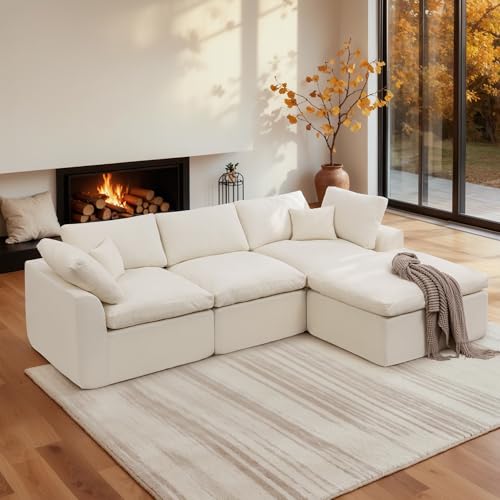
This listing describes a modular L-shaped configuration with an ottoman. Confirm which pieces are included and whether the chaise position can be changed. An ottoman may be easier to carry separately than a fixed extension, but the remaining modules still need to fit the stairs and doorway. Check whether the seller provides room-of-choice delivery or assembly.
Ask about package dimensions and delivery
Before checkout, ask how many packages the sofa arrives in and get the dimensions and weight of each one. Verify whether the boxes can pass the narrowest point of the route. A carton may be wider than the furniture’s assembled depth, and a shipping box can be awkward to rotate on a staircase. If the listing does not provide package details, contact the seller or manufacturer rather than guessing.
Check whether delivery is curbside, threshold, room of choice, or assembly service. Curbside delivery can leave the buyer responsible for moving the packages through the home. Room-of-choice service may have access limits or extra fees. Ask whether the team will use stairs, remove packaging, and assemble the sofa. Save the answers with your order records.
Understand the return process for oversized furniture. Confirm how long you have to report damage, whether return freight is paid by the seller, and whether the original packaging is required. Photograph cartons and components as they arrive. Do not discard hardware or packaging until you have inspected the sofa and verified the fit.
Protect floors, walls, and the sofa
Use a clear route before moving furniture. Remove rugs, toys, and loose cords, and protect vulnerable corners where a sofa might brush the wall. Furniture sliders can help on suitable floors, but use products intended for the surface and the sofa’s weight. Do not drag a sofa across hardwood, tile, or carpet without checking the manufacturer’s recommendations.
Wrap upholstery in a clean moving blanket or protective cover and secure the wrap without adhesive touching the fabric. Protect exposed legs and corners. Keep bolts and small parts in a labeled bag. If the sofa has a power recliner, disconnect it according to instructions and secure the cord so it cannot snag. Do not lift a powered mechanism by its moving parts.
When loading a vehicle, support the frame where the maker recommends and avoid stacking heavy boxes on cushions. Keep modules upright if the instructions specify an orientation. If a piece is too large or heavy for the available helpers, hire professional movers rather than risking injury or property damage.
Prepare a sofa before moving
Remove loose cushions, pillows, blankets, and detachable legs. Photograph the sofa and its configuration before disassembly. Put hardware in labeled bags, and keep the manual accessible. If there are connectors between modules, mark each piece and its position. This preparation helps prevent confusion at the new location.
Clean the sofa before wrapping it. Dust, crumbs, and grit can rub into upholstery during transport. Follow the care code and avoid using a wet cleaner shortly before wrapping. If any part is damp, let it dry completely. Store loose cushions in breathable protective bags and avoid compressing them under heavy items.
For a sleeper or recliner, close and secure moving parts as directed. Never leave a footrest extended in transit. Remove power adapters and remote controls, and pack them separately. If the mechanism has a lock or transport position, use it according to the manufacturer’s instructions.
Compare sofa styles by move frequency
If you expect to move frequently, consider pieces that can separate and fit through common access points. A compact sofa with removable legs may be more practical than a large fixed-frame sectional. If you plan to stay in one home for many years, a larger sofa may be worth the extra delivery effort if it fits the room and is comfortable.
Consider modular systems with replacement parts, available covers, and connectors that can be reconfigured. Check whether the maker sells additional modules or support pieces. A modular sofa is useful only if its configuration works for the new space. Confirm that pieces can be used independently or combined in a way you actually need.
Do not choose based on the word “portable” alone. Compare actual package weights, assembled dimensions, and handling instructions. Some compact sleepers contain heavy frames or mattresses. A sectional with many modules may involve more pieces to manage even if each piece is smaller than one rigid sofa.
Moving through stairs and elevators
Stairs require planning because the sofa’s center of gravity changes as it turns. Measure the stair width, headroom, landings, and angle of each turn. Check whether the sofa can tilt without hitting the ceiling or railing. Do not remove a handrail or door as a shortcut without considering safety, permissions, and repair.
For an elevator, measure the door opening, interior depth, and ceiling height. Consider how the package can be turned inside. The elevator’s weight limit applies to the combined load of people and furniture, so check the building rules and manufacturer guidance. Schedule use with building management if required.
If the route is uncertain, ask a professional mover for an assessment before ordering. Some movers can advise whether a particular sofa can be carried or whether a different item is needed. A pre-move assessment can be less costly than a failed delivery or a damaged wall.
Make moving easier in the room too
Choose a sofa location that leaves room to clean behind and underneath it. A model with visible legs may allow a vacuum to reach the floor more easily, while a floor-hugging sofa may need to be moved for cleaning. If you rearrange often, avoid placing heavy tables or lamps in a way that must be cleared every time the sofa moves.
Use a rug pad and stable side tables to keep the seating area organized, but make sure items can be moved without lifting the sofa. Keep power cords near outlets and away from the route. A simple floor plan can show where each module goes if you reconfigure the layout later.
Keep the model number, assembly guide, and care instructions in a home file. If you replace a connector or leg, use the part specified by the manufacturer. Avoid improvised fixes that could weaken the frame or make the sofa unstable.
Common mistakes when buying a move-friendly sofa
- Checking only the assembled dimensions and ignoring carton size.
- Assuming modular means lightweight or easy for one person to carry.
- Assuming “no assembly” means no connections or setup are needed.
- Forgetting stair turns, elevator interiors, and ceiling clearance.
- Leaving the delivery team without clear access or service expectations.
- Removing structural parts that the manufacturer does not intend to detach.
- Dragging furniture without protecting floors and upholstery.
- Discarding packaging before checking fit and condition.
Most moving problems can be prevented by measuring the route and asking for package details. If the information is missing or the route is complex, contact the seller or a professional mover before placing the order.
Related buying guides
For a configurable seating option, see our guide to modular sofas. If you need compact convertible seating, compare loveseat sleeper sofas. For sofa delivery and return questions, see our online sofa store guide. Confirm current model details and route measurements before buying.
Final checklist before ordering
Measure the route and room, obtain package dimensions and weights, confirm which parts detach, and check delivery and return terms. Decide who will move and assemble the sofa. Protect the floor, walls, and upholstery, keep hardware labeled, and follow the maker’s instructions for recliners and sleepers. If the sofa is too heavy or the route is uncertain, use a professional moving service.
The easiest sofa to move is the one whose pieces and packaging suit the actual route. Modular designs and detachable parts can help, but measurements and verified handling details matter more than a product label. Plan the move before purchasing, and choose a sofa that will still fit comfortably once it reaches the room.
Consider stairs, floors, and carrying posture
Moving a sofa is physically demanding even when its parts separate. Use a team that can communicate and keep a clear path. Follow professional guidance for lifting and do not twist while carrying. If anyone involved has a physical limitation, ask a professional mover to handle the item. Stop if the load feels unstable or blocks the carrier’s view.
Protect the floor at thresholds and turns. A heavy sofa can scratch wood or chip tile if it slips. Use suitable moving blankets and floor protection that will not slide underfoot. Avoid placing a concentrated load on delicate flooring without checking the surface requirements. Once the sofa arrives, remove protective materials promptly and inspect the floor for marks.
When using a dolly, make sure it is designed for the sofa’s weight and that the item is secured according to the equipment instructions. Do not stack loose modules in a way that can shift. Keep fingers away from pinch points when setting sections down or connecting them. If stairs are involved, a moving team with appropriate equipment is often the safer choice.
Think about pets and young children during the move
Keep pets and children away from the moving route and work area. A doorway can become crowded quickly when movers need to turn a sofa or package. Close doors or use a separate room to keep animals from darting underfoot. Do not let children play with connectors, bolts, plastic wrapping, or straps.
After assembly, check that all modules connect securely and that no sharp edges or loose hardware remain exposed. Dispose of plastic packaging and fasteners promptly. If the sofa has a recliner, keep children away while testing the mechanism and explain that the moving footrest is not a toy. Follow the manufacturer’s supervision instructions.
Protect the frame during disassembly
Before removing a leg or back, confirm that the part is designed to come off and identify the correct tool. Photograph each step and store the hardware in a labeled container. Do not use a power tool at a high setting that can strip a fastener. If a bolt resists, stop and check the manual rather than applying more force.
Some sofas use connectors that are hidden under fabric or attached to a specific module. Keep connector plates aligned and do not bend them during transport. If a connector is damaged, ask the manufacturer for the correct replacement. A loose or mismatched connector can allow sections to shift when someone sits down.
For upholstered backs or arms, avoid pulling on fabric or piping. Lift from a solid frame area identified by the instructions. If the sofa has no clear lifting points, ask a mover or the manufacturer. Carrying by an arm can strain the frame and loosen the upholstery.
Choose furniture that can adapt to the next home
If you move often, choose a shape that can be reconfigured for different rooms. A modular sectional may split into a straight sofa plus chaise, but check the maker’s available layouts. A movable ottoman can serve as a footrest or separate seat, provided it remains stable on the floor. Keep the connector hardware and any extra feet with the product paperwork.
Measure the new home before moving day and confirm the sofa will fit its planned position. A modular configuration can solve a width problem but may not provide the same seating depth or arm support as the original layout. Sketch the pieces and label their positions so that reassembly does not rely on memory.
Consider the sofa’s future care and replacement options. A product with available covers or cushions may be easier to maintain through multiple moves. Ask whether the seller or manufacturer still supports the model and how to order small parts. Keep the invoice, model name, and purchase date in a digital folder.
Coordinate timing with building rules
Apartment buildings and condominiums may require elevator reservations, moving permits, insurance certificates, or set move-in hours. Ask building management before ordering a large sofa. Confirm whether the service elevator is available and whether the delivery team can access it. A scheduled delivery that conflicts with building rules can be delayed or refused.
In a house, consider access through a garage, side door, or patio if the main route is narrow. Check whether the alternate opening is large enough and whether the path is level and clear. Do not remove a window or door without permission and qualified help. Outdoor access may also depend on weather and safe footing.
Allow time for assembly and inspection before the room is needed. A modular sofa may need unpacking, connection, cushion placement, and cleanup. If the furniture arrives just before guests or a move deadline, there may not be time to resolve missing parts or damage. Schedule with a reasonable buffer.
Keep a moving inventory
List every module, ottoman, leg set, connector, power adapter, and remote. Photograph the items before loading. This inventory helps identify missing parts at the destination and makes it easier to re-order a component. For multiple sofas, write the model name on the bag or box so connectors are not mixed.
Check the manufacturer’s warranty before disassembly. Some warranties may require assembly or transport steps to follow specific instructions. Save the manual and any correspondence with the seller. If professional movers are involved, note the sofa’s existing condition before the move and report any damage through the mover’s process.
After delivery, inspect the sofa and test any moving mechanisms without forcing them. Confirm that the sections are stable, legs are level, and cords are intact. If the furniture rocks or a connector does not lock, stop using it until the issue is corrected. A careful inspection protects both the sofa and the people using it.