Disclosure: As an Amazon Associate, dailyhomedecorating.com earns from qualifying purchases. Links to Amazon on this page are affiliate links; they cost you nothing extra. Prices and availability change often, so check the current Amazon listing before you buy.
Working from home changed what a chair has to survive. The best work from home chairs for back pain are not simply office chairs moved into a spare room — they are chairs that share a home: rolled across bedroom floors, borrowed by a partner for an evening class, sat in for the workday and then for the household’s paperwork, all in a room that still has to be a bedroom at night. And because home workers take their breaks at home, the chair is also where recovery happens — the recline between calls, the ten minutes with heat on your back at lunch — rather than a walk to a colleague’s desk.
This guide reviews six picks for that reality: five ergonomic chairs spanning budget to flagship, chosen for lumbar support that adjusts to real backs, plus a massage chair pad, included honestly as an add-on, for the break-time half of home comfort. Nothing here treats or cures anything — chairs support comfort, and persistent pain deserves a clinician — but a chair that fits your back, your desk, and your room removes the furniture from your list of problems. Companion reading: Best Work Chairs For Lower Back Pain for the office-focused comparison, and Best Task Chairs For Home Office for the wider task-chair field.
Where to Buy
Every pick below is sold on Amazon, where you can check the current price, configuration, and return terms before you buy. For a back-comfort purchase, treat the return window as part of the product and keep the packaging until it closes.
- HON Ignition 2.0 Ergonomic Office Chair — Check on Amazon
- SIHOO M18 Ergonomic Office Chair — Check on Amazon
- Ticova Ergonomic Office Chair — Check on Amazon
- FLEXISPOT ErgoX Premium Ergonomic Office Chair — Check on Amazon
- Hbada P5 Ergonomic Office Chair — Check on Amazon
- COMFIER Shiatsu Neck and Back Massager with Heat — Check on Amazon
In this guide
Quick Picks
| Pick | Badge | Why it earns its place |
|---|---|---|
| SIHOO M18 Ergonomic Office Chair | Best Overall | Adjustable lumbar support and headrest, breathable mesh, and a wide cushion — the balanced home-office answer. |
| HON Ignition 2.0 Ergonomic Office Chair | Best Budget | Commercial mesh chair with alignment-focused lumbar support and a full warranty, built for shared household duty. |
| FLEXISPOT ErgoX Premium Ergonomic Office Chair | Best Premium | Dynamic lumbar support, adjustable seat depth, and a nap footrest for the dedicated home office. |
| Ticova Ergonomic Office Chair | Best for Long Workdays | Lumbar support adjustable in height and depth, with 3D armrests and a pressure-spreading seat. |
| Hbada P5 Ergonomic Office Chair | Best Compact | S-shaped mesh back and a footrest in a small footprint for bedroom-corner offices. |
| COMFIER Shiatsu Neck and Back Massager with Heat | Best Add-On | A shiatsu pad with heat, compression, and vibration that turns your chair into a break-time recovery seat. |
Key Takeaways
- At home, fit includes the room: casters for your floor, arms that clear your desk, and a footprint your bedroom can spare.
- Adjustable lumbar support — positioned at your curve’s height, and ideally its depth — is the core back-comfort feature in every price band here.
- Home workers sit longer unbroken stretches than office workers; a chair that invites movement and recline breaks is a back feature, not a luxury.
- Shared chairs need fast refits; dedicated chairs reward deep personal tuning. The list has both kinds.
- Comfort framing only: these chairs support comfortable sitting. Persistent, worsening, or radiating pain needs professional assessment, not a product page.
How These Picks Were Chosen
The pool was filtered for home-office realities layered over ergonomic ones. Ergonomically, every chair here offers adjustable lumbar support, adaptable armrests, and a tilt that permits posture variety; fixed-bump chairs were excluded. Domestically, each pick was checked for the home context — published dimensions for room planning, caster and floor information, weights that a person can move when the room changes jobs, and designs that look acceptable in a home rather than a facilities catalog, with the honorable exception of the HON, whose commercial plainness is the price of its durability.
The COMFIER pad is included under an add-on standard, labeled as a pad wherever it appears: many home workers own a decent chair and lack only the recovery element — heat and massage during breaks — that an office worker gets from walking around a building. The pad supplies that element to the chair you have.
All specifications come from the verified pool’s manufacturer information. Comfort language follows the makers’ own framing — support, alignment, relief of everyday fatigue from long sitting — and this guide adds no medical promises of its own.
The 6 Best Best Work From Home Chairs for Back Pain — Reviewed

SIHOO M18 Ergonomic Office Chair
Our badge: Best Overall
The SIHOO M18 Ergonomic Office Chair is the home-office default done right: adjustable lumbar support, an adjustable headrest, 2D armrests, a wide cushion, tilt lock, and a breathable mesh back that keeps a spare room’s summer workdays comfortable. It provides four support points — head, back, hips, hands — for users roughly 5’6″ to 6’2″, passed BIFMA testing and a static pressure test, and supports up to 150 kg, with free replacement parts during the warranty period.
Strengths
- Adjustable lumbar support and headrest cover the fit points home workers need most.
- Breathable mesh suits bedrooms and spare rooms that run warm.
- Tested build with parts support — a chair that can be maintained at home.
Trade-offs
- Seat depth may be generous for shorter users.
- Lumbar depth is not separately tunable as on the Ticova.
- Assembly takes eight steps and a clear floor.
| Color | Charcoal |
| Size | Pack of 1 |
| Dimensions | 27.5 x 21 x 11 inches |
| Weight | 31.526103466 pounds |
The M18’s home virtue is that it behaves like furniture a household can own: settings that stay where you put them, a mesh back that does not care about the room’s temperature, and a silhouette that reads as a chair rather than equipment. Its lumbar support adjusts to the curve of the person who owns the desk, and because the chair serves work, study, and the occasional game in most homes, that one good fit gets used for everything.
For the back specifically, the combination that matters is lumbar position plus the wide cushion: the cushion lets you shift your sitting position through the day without leaving the support zone, which is how home workers — who lack the office’s natural interruptions — manufacture the movement their backs need.
Choose the M18 if you want the balanced answer for a home desk. Skip it if you are well under its height range — the Hbada below is sized for smaller users and smaller rooms.
Best for: Home workers who want adjustable lumbar comfort in a versatile chair / Not suited for: Petite users or depth-specific lumbar tuning

HON Ignition 2.0 Ergonomic Office Chair
Our badge: Best Budget
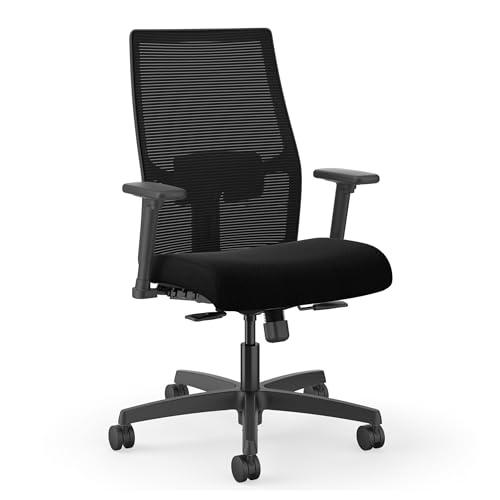
The HON Ignition 2.0 Ergonomic Office Chair is the shared-household warrior: a mid-back mesh task chair with lumbar support that encourages alignment, arms adjustable in height and width, and a standard tilt, supporting up to 300 lb under the HON Full Warranty. It was designed for offices where chairs serve whoever sits down; a home where the desk chair also serves a partner’s evening course and a teenager’s homework is the same job in a smaller building.
Strengths
- Alignment-focused lumbar support in an airflow-friendly mesh back.
- Width- and height-adjustable arms refit quickly between household users.
- Commercial durability and a full warranty at a home-friendly position.
Trade-offs
- Lumbar support is shaped rather than deeply personal.
- No headrest for reclined calls.
- Corporate looks in a domestic room.
| Color | Black |
| Size | Oversized |
| Dimensions | 28.5 x 27 x 44.5 inches |
The Ignition’s back story is alignment through simplicity: the support encourages your lower back into its natural curve and the mesh keeps you cool while it does it, without a bank of adjustments for the next user to undo. In a shared home chair, that restraint is the feature — the chair is never found in someone else’s configuration, because there is barely a configuration to find.
It is also the budget-honest way to protect a back at home: commercial build, real warranty, and money left over for the desk setup — monitor at eye level, keyboard at elbow height — that does the other half of home back comfort.
Choose the Ignition if the chair is shared or the budget is real. Skip it if the chair is yours alone and your back wants personal tuning.
Best for: Shared home desks and budget buyers who want alignment support / Not suited for: Solo users seeking deep personal lumbar adjustment

FLEXISPOT ErgoX Premium Ergonomic Office Chair
Our badge: Best Premium
The FLEXISPOT ErgoX Premium Ergonomic Office Chair is the dedicated home office flagship: dynamic lumbar support that follows your posture, a five-level adjustable back, adjustable seat depth and height, a 3D headrest, 3D armrests, recline and tilt, breathable mesh, a class 4 gas lift, and a nap footrest — for users roughly 5’1″ to 6’2″ with a stated maximum of 400 lb. In a home office, where the chair is also the break room, that footrest and recline system is not indulgence; it is the recovery infrastructure offices provide with sofas and walking routes.
Strengths
- Dynamic lumbar support stays in contact as your posture changes across the day.
- Seat depth adjustment lets your back actually reach the support.
- Footrest and recline build real breaks into the same square footage.
Trade-offs
- Needs a room that can spare the recline footprint.
- Setup is an evening’s project.
- Premium position in the range.
| Color | Black |
| Size | Overall Depth 44″ |
| Weight | 38 pounds |
The ErgoX understands the home worker’s specific failure mode: not bad posture in a single hour, but unbroken posture across six. Its dynamic support answers the first hours; its recline and footrest answer the breaks, letting you change your body’s shape entirely without leaving your workspace — a genuine back-comfort feature in a home where the alternative is the bed or the couch, both of which end the workday’s rhythm.
FLEXISPOT’s candid fit range and premium construction suit the buyer furnishing a permanent home office. If your spare room has become your career’s headquarters, this is the chair that treats it that way.
Choose the ErgoX if your home office is permanent and your back is the priority line in its budget. Skip it for temporary or tiny setups — the Hbada was designed for those.
Best for: Dedicated home offices that need support plus built-in breaks / Not suited for: Small or temporary workspaces

Ticova Ergonomic Office Chair
Our badge: Best for Long Workdays
The Ticova Ergonomic Office Chair brings precision to the home desk: lumbar support adjustable in height and depth, a curved foam headrest adjustable in height and angle, 3D armrests with thick padding, a rocking back to 130 degrees with adjustable resistance, and a 3.4-inch W-shaped foam seat with a waterfall edge. Home workers with the longest days — the ones whose commute is now twenty steps and whose office never closes — are exactly who that precision serves.
Strengths
- Two-axis lumbar adjustment for a genuinely personal fit.
- Pressure-spreading foam seat under a breathable mesh back.
- Rocking function supports the posture variety home days need.
Trade-offs
- Tuning takes days of small changes.
- Foam seat softens over years.
- Recline needs depth behind the desk.
| Color | Black |
| Size | 70D x 26W x 54H cm |
| Weight | 17.5 Kilograms |
At home, nobody ergonomics-checks you. The Ticova’s depth-adjustable lumbar is the self-employed version of that check: you can reproduce the exact fill your curve wants, and change it as your body changes across a season. The chair passed BIFMA testing and a static pressure test, and its return policy fits the tune-at-home process.
The W-seat deserves its sentence in a back guide: by spreading pressure across a larger area and keeping the front edge from pressing your thighs, it keeps your pelvis in the neutral position that lets the lumbar support do its work. Backs are systems, and Ticova designs like it knows.
Choose the Ticova if your home workdays are long and your back is particular. Skip it if you want automatic simplicity.
Best for: Long-day home workers who will tune a precise fit / Not suited for: Set-and-forget buyers

Hbada P5 Ergonomic Office Chair
Our badge: Best Compact
The Hbada P5 Ergonomic Office Chair is the bedroom-corner specialist: an S-shaped mesh backrest that conforms to your spine, lumbar support that adjusts up and down, a swiveling 2D headrest, armrests that clear the desk so the chair tucks away, a recline to 135 degrees, and a retractable footrest for breaks — sized for users roughly 5′ to about 5’10”, and certified through SGS and BIFMA testing.
Strengths
- S-shaped back and adjustable waist support sized for smaller users.
- Compact footprint with a footrest — back care in a corner.
- Tuck-under arms return the room to a bedroom at night.
Trade-offs
- Height range excludes taller users.
- Firmer mesh seating feel.
- Modest seat-height travel.
| Color | Black |
| Size | 27.56 x 27.56 x 49.41 inches |
| Weight | 44 pounds |
Small-room home workers face a double bind: the chairs that fit their bodies often do not fit their rooms, and the chairs that fit their rooms abandon their backs. The P5 refuses the trade. Its S-curve back and moving lumbar support deliver real support at apartment scale, and the footrest gives a small room a break space without a second piece of furniture — a back feature disguised as a space feature.
For students, first apartments, and spare-room desks, it is the pick that respects the whole problem. The chair’s tested construction reassures in a size class where build quality often thins out.
Choose the P5 if your office is a corner and you are inside its height range. Skip it if you are tall. Small-room workers will also appreciate Best Sleeper Chairs For Small Spaces for the room’s other furniture job.
Best for: Compact home offices within the stated height range / Not suited for: Tall users or full-size dedicated offices

COMFIER Shiatsu Neck and Back Massager with Heat
Our badge: Best Add-On
The COMFIER Shiatsu Neck and Back Massager with Heat is a chair pad, not a chair — this guide labels it as such everywhere — and it is the home worker’s break room in a box. Separate shiatsu neck nodes adjust up and down from the wired controller; four deep-kneading back nodes offer upper, lower, full-back, or spot massage; rolling massage, gentle heat, three levels of air compression at the waist and hips, and three levels of seat vibration complete the menu, with a 15-minute auto shutoff keeping sessions sensible. It straps onto office chairs, recliners, and sofas, and the maker notes it is FSA and HSA eligible.
Strengths
- Full menu of kneading, rolling, heat, compression, and vibration for break-time comfort.
- Adjustable neck nodes fit users roughly 5’3″ to 6’0″.
- Moves between the desk chair and the evening recliner in seconds.
Trade-offs
- An add-on, not a seating solution; your chair still has to fit you.
- At about 19 pounds corded, it lives where you place it rather than traveling lightly.
- The heat is intentionally gentle — soothing warmth, not a heating pad.
| Color | Gray |
| Size | 1 Count (Pack of 1) |
| Dimensions | 30 x 17 x 18 inches |
| Weight | 17.63698096 pounds |
The COMFIER’s role in a home back-comfort system is the scheduled pause. Home workers are famously bad at breaks — no colleagues, no corridor, no reason to stand — and a 15-minute session in your own chair, with the timer handling the discipline, manufactures the pause and makes it feel like a reward rather than an interruption. The intensity flap softens the kneading for sensitive days, and the removable, washable neck cover keeps the pad fresh in daily service.
It also serves the whole household: parents, partners, and grandparents all find their way to the chair with the massage pad. As a gift-able, eligibility-friendly comfort device, it is the most shareable pick in this guide.
Choose the COMFIER if your chair fits and your breaks need building. Skip it as a remedy for a chair that does not fit — that purchase comes first. For neck-focused comfort, compare Best Chairs For Neck Support.
Best for: Home workers whose chairs fit and whose breaks need a reason / Not suited for: Anyone expecting a pad to substitute for a fitting chair
Comparison Table
| Pick | Color | Dimensions | Weight | Check price on Amazon |
|---|---|---|---|---|
| SIHOO M18 Ergonomic Office Chair | Charcoal | 27.5 x 21 x 11 inches | 31.526103466 pounds | Check price on Amazon |
| HON Ignition 2.0 Ergonomic Office Chair | Black | 28.5 x 27 x 44.5 inches | — | Check price on Amazon |
| FLEXISPOT ErgoX Premium Ergonomic Office Chair | Black | 10.0787401472 x 10.0787401472 x 20.6299212388 inches | 38 pounds | Check price on Amazon |
| Ticova Ergonomic Office Chair | Black | 27.165354303 x 9.842519675 x 20.866141711 inches | 17.5 Kilograms | Check price on Amazon |
| Hbada P5 Ergonomic Office Chair | Black | 27.56 x 27.56 x 49.41 inches | 44 pounds | Check price on Amazon |
| COMFIER Shiatsu Neck and Back Massager with Heat | Gray | 30 x 17 x 18 inches | 17.63698096 pounds | Check price on Amazon |
How to Choose the Best Work From Home Chairs for Back Pain
Fit the back, then fit the room
Start with the lumbar question — support that adjusts to your curve’s height, and depth if your curve is deep — then immediately check the domestic questions: will the casters suit your floor, will the arms clear your desk, will the recline fit your wall distance, and can the chair be moved when the room changes jobs? Home chairs fail on the second list as often as the first, and both lists are in the listings if you read for them.
Decide whether the chair is yours or the household’s
A dedicated chair rewards deep personal tuning — the Ticova and FLEXISPOT pattern. A shared chair rewards quick, obvious refits and durable simplicity — the HON pattern, or automatic chairs. Be honest about the chair’s real user list before choosing its adjustment philosophy; a precisely tuned chair that three people reset daily will spend its life misadjusted for everyone.
Build breaks into the furniture plan
Home work removes the office’s incidental movement, so the chair setup must replace it: a recline you will actually use, a footrest if your room has no lounge chair, or a massage pad that makes the pause pleasurable. When you compare finalists, ask which one makes your breaks better, not just your typing. Backs judge the whole day, including its pauses.
Set the desk to the chair, every time
Monitor top near eye level, keyboard at relaxed-elbow height, feet flat — on the floor or a footrest — and the chair close enough that you are not reaching. At home, desks are often dining tables and kitchen counters with the wrong heights; a chair with a generous height range, or a desk adjustment, closes that gap. The best chair under a wrong-height desk is a compromise you will feel by Friday.
Trial at home, where the chair will live
Home chairs can only be judged at home — on your floor, at your desk, across your real week. Buy with a workable return window, tune one setting at a time over several days, and judge by end-of-day comfort. Keep the box until the window nearly closes; exchanging a chair that your back rejects is the system working as intended.
How Do You Build a Back-Friendly Routine in a Home Office?
Anchor the day with three habits. First, a two-minute setup check each morning: seat height, lumbar position, monitor distance — chairs drift, housemates borrow, and yesterday’s perfect setup is not guaranteed today. Second, scheduled movement: stand, walk, or stretch briefly every half hour or so, using household anchors — the kettle, the doorbell, the laundry — as timers, since home offices lack the office’s natural interruptions. Third, a deliberate midday reset: recline fully for a few minutes, or run a 15-minute pad session, and let your back experience a completely different shape before the afternoon.
Close the day as deliberately as you open it. A short walk after the last call — the home worker’s substitute commute — transitions your body out of sitting mode, and parking the chair squared to the desk signals to the household, and to you, that the office is shut. Backs thrive on rhythm as much as on furniture.
Problem: Your back stiffens most on video-call days — Calls freeze posture. Between calls, change your recline angle deliberately, and during long calls, use the chair’s tilt rather than perching forward toward the camera.
Problem: The chair feels right but the desk feels wrong — It probably is wrong: home desks are often dining-height. Raise the chair and support your feet, or adjust the desk; do not let your shoulders pay for a table’s design.
Problem: A household member keeps changing your settings — Mark your positions discreetly, or move to a chair whose fit philosophy tolerates sharing. Negotiation is also an ergonomic tool.
Problem: You forget every break until evening — Externalize the reminder: timers, the pad’s auto shutoff used as a session cue, or household routines. Willpower is the least reliable break system in any home.
Problem: Your back prefers the couch by Friday — That is data, not weakness: your chair setup needs a change. Revisit lumbar depth and seat depth first; they are the two settings that drift furthest from right without announcing it.
The Home Office Difference: Why Office Advice Is Not Enough
Standard ergonomic advice assumes an office: a dedicated desk at a standard height, a chair used by one person, facilities-grade flooring, and a building full of reasons to stand up. Home inverts every assumption. Desks are improvised, floors are bedroom carpet or rental hardwood, chairs are shared and moved, and the day’s only architect is you. That is why this guide’s criteria add the domestic layer — room fit, sharing, break infrastructure — to the ergonomic one, and why a chair that triumphs in a corporate review can disappoint in a spare room.
The encouraging news is that home also offers what offices cannot: total control. You can tune the chair across a week without a facilities ticket, place the desk by the window, schedule your breaks around your own energy, and add a massage pad to your chair without asking anyone. Used deliberately, the home office can be the most back-friendly workplace you have ever had — it just does not become one by accident. The posture side of that project continues in Best Chairs For Back Posture.
Setting Up a Bedroom Office Your Back and Your Sleep Both Accept
When the office is the bedroom, the chair carries a second responsibility: it must let the room become a bedroom again. Compact footprints, tuck-under arms, and chairs that park neatly — the Hbada pattern — protect your sleep environment from your workday, and that separation matters to backs too, because rest is part of the comfort system. Keep work light out of the bed’s sightline where you can, store the day’s papers in the chair’s zone rather than the room’s, and let the evening ritual of squaring the chair away mark the boundary.
If the bedroom is also where you recover on a stiff day, the COMFIER pad’s double life — desk chair by day, recliner by evening — makes it a particularly efficient purchase for small homes. One device, two rooms’ worth of comfort, and no extra furniture footprint at all.
The Rest of the House Is Part of the System
One advantage home workers hold over every office worker is that their recovery furniture is twenty steps away — and one risk is that it is too inviting in the wrong way. The couch and the bed are poor places to finish a workday’s sitting, because both encourage the slumped, twisted postures that undo a morning of good support. The smarter home pattern keeps recovery upright or deliberately reclined: a proper lounge chair, a glider, or the massage pad in your desk chair, each of which changes your body’s shape without collapsing it. Households that think this through often find the evening chair matters to the next morning’s back almost as much as the desk chair does, which is why the lounging and reclining options in Best Chairs For Lounging belong in a back-conscious home’s wider plan.
Sleep is the other half of the system, and it is the half no chair can sell you. Backs report the night as faithfully as the day, and a home worker whose mattress and pillow fight them will blame the chair for a debt incurred at 3 a.m. If your setup is right and your mornings are still stiff, audit the bed before you replace the chair — and if discomfort persists through both audits, that is the point at which professional advice stops being optional and becomes the plan.
A Week-One Diary: How to Know Your Chair Is Working
Keep a five-line diary for your new chair’s first week; it converts vague impressions into a decision. Each evening, note where you sat well, where you fidgeted, the one adjustment you changed, and a single end-of-day comfort word. By day four, patterns announce themselves: the fidget always at the same hour points to the break schedule, the ache always in the same place points to the one setting still wrong, and the day everything felt unremarkable is the day the setup arrived. Home workers are their own ergonomics department, and this small record is its entire toolkit — five lines a day, kept for one week, in exchange for years of sitting in a chair you chose on evidence.
The Home Worker’s Chair Budget: Spending Where Backs Notice
Home workers furnishing an office on a finite budget face a real allocation problem, and backs should win it in a specific order. Spend first on the chair’s fit fundamentals — adjustable lumbar support and a seat that suits your body — because those are felt every minute. Spend second on the desk relationship: a monitor raised to eye level and a keyboard at the right height, which together cost little and multiply the chair’s benefit. Spend third on the floor and feet — casters that suit the surface, a footrest if the desk is tall — because a chair fighting its floor is a chair half-fitted. Only then spend on enrichment: the massage pad, the premium materials, the footrest recline.
The order matters because households reliably invert it, buying the impressive chair and then perching at a laptop on a dining table, wondering why the investment did not pay. The picks in this guide respect the order at every level: the HON delivers the fundamentals with money left for the desk, the SIHOO covers fundamentals and fit completely, and the FLEXISPOT and COMFIER earn their places only after the foundations exist. A back cannot tell what its chair cost. It can tell, precisely, whether the system around it was assembled in the right order.
Video Calls, Camera Angles, and Your Back
The video call quietly redesigned home posture. Workers perch forward toward laptop cameras, hold a presentable stillness for an hour that they would never impose on themselves off-camera, and stack books under laptops in arrangements that satisfy the lens and punish the neck. A back-conscious call setup separates the two problems: raise the camera to eye level with a stand or shelf so your head — and with it your whole spine — can stay in the chair’s supported position, and use an external keyboard if the laptop’s height then strands your hands. During long calls, give yourself permission the office never required you to ask for: recline. The chairs in this guide recline precisely so a call can be taken in a supported lean rather than a forward hunch, and the difference accumulates across a call-heavy week into the difference between a back that ends Friday tired and one that ends it fine. Camera etiquette has no clause requiring discomfort; set the room up so your best posture is also your best angle.
When the Whole Household Works From Home
Two and three home workers under one roof turn chair buying into household planning, and the households that do it well follow a simple doctrine: one excellent chair per worker, bought in order of need, beats a simultaneous order of mediocre chairs for everyone. Start with the worker whose back or hours demand most, furnish that desk completely — chair, screen height, floor — and learn from it before buying the second setup, because the first month teaches a household more about its real habits than any guide can. Shared spaces add one more consideration: sound. Chairs that squeak, casters that rumble on hardwood, and reclines that thump walls are domestic irritants in a shared work room, and the quiet, smooth chairs in this guide — tested mesh builds and quality lifts — earn their places in multi-worker homes on acoustics alone. Finally, stagger the big purchases if the budget requires it, and let the massage pad serve as the household’s shared comfort device in the meantime; one pad, unlike one chair, genuinely can serve everyone.
Seasons of Home Work: Summer Heat and Winter Stiffness
Home offices have seasons, and backs feel them. Summer turns spare rooms into warm boxes where a foam-backed chair becomes a personal sauna — the months when the mesh backs in this guide justify themselves daily, and when a breathable chair is the difference between a workday and a wilt. Winter reverses the complaints: cold rooms stiffen everything, chairs feel harder, and the warm-up your body used to get from a commute no longer exists. Counter it deliberately — a warmer room for the first working hour, a slower, more mobile start to the sitting day, and the heat of a massage pad used as a morning ritual rather than an afternoon rescue. The chair that serves you in both seasons — mesh for summer, heat and support for winter — is not two chairs; it is the system this guide assembles, chosen once and used with seasonal intelligence.
The Chair You Keep: A Closing Thought on Fit
Home workers cycle through chairs more slowly than offices do, which makes each choice heavier — and the evidence of a good choice quieter. The right chair does not announce itself with a revelation; it announces itself in a year of unremarkable afternoons, in work that got done, in a back that was never the day’s headline. If you are reading this guide with an aching back at a kitchen table, know that the unremarkable afternoon is an achievable, purchasable thing — it is assembled from a fitting chair, a desk set to meet it, breaks that actually happen, and the patience to tune all three across one honest week. That is the whole secret, and every pick in this guide is a legitimate place to start.
A Work-From-Home Back Routine That Actually Happens
The routine that survives is the one attached to things you already do. Stand and walk while the kettle boils and the coffee brews — that is two movement breaks before lunch without a single alarm. Take calls standing when the camera allows it, and walking when it does not. Keep a two-minute reset for the top of each hour: stand, walk to a window, roll your shoulders, sit back down and consciously re-set your posture in the chair — feet planted, back met by the backrest, shoulders down. None of this is exercise, and that is precisely why it works: it asks nothing you can fail at, costs no willpower worth budgeting, and quietly delivers the position variety that back comfort at a desk is actually made of. Pair it with a chair that supports the sitting chapters — the six in this guide — and the work-from-home back stops being a project and becomes a background condition, which is all anyone working from a spare room ever wanted.
Common Buying Mistakes
Buying an office chair for a dining-table desk
If your desk is a dining table, its height is not office height, and the chair must compensate — or the desk must change. Check the pairing, not just the chair, before blaming your back’s report on the seat.
Letting the chair be the whole ergonomic plan
Monitor height, keyboard position, and break habits carry half the outcome. A flagship chair under a laptop on a coffee table is a flagship wasted.
Choosing deep tuning for a shared chair
Precision settings do not survive sharing. If the household uses the chair, choose fast refits or automatic adaptation, and save the connoisseur chairs for dedicated desks.
Skipping the floor question
Bedroom carpet and rental hardwood punish the wrong casters daily. Confirm the chair’s floor specification, and protect the surface with a rug or mat chosen for rolling.
Treating a massage pad as a chair substitute
The pad is the break, not the seat. If your chair does not fit your back, fix that purchase first; the pad’s comfort lands on a foundation that has to exist.
Final Recommendation
For most home workers, the SIHOO M18 Ergonomic Office Chair is the right center of the home office: adjustable lumbar comfort, breathable mesh, tested build, and household versatility at a fair position. In a dedicated office, step up to the FLEXISPOT ErgoX for dynamic support and built-in breaks — its Check on Amazon listing details the full system. Shared desks should take the HON Ignition, small rooms the Hbada P5, and any well-fitting chair can add the COMFIER pad for its breaks. Fit the back, fit the room, schedule the movement — and let professionals handle anything beyond comfort.
Frequently Asked Questions
What makes a chair good for back comfort at home specifically?
The same lumbar adjustability that matters in an office, plus the domestic virtues: casters matched to home floors, a footprint the room can spare, quick refits if the chair is shared, and a recline or break feature you will actually use, since home days lack the office’s natural movement.
How do I know if the lumbar support is in the right place?
It should fill the inward curve of your lower back, around belt level, feeling like a resting hand rather than a push. Set height first, then depth if available, and judge at the end of a full work session. If you cannot feel the support without thinking about it, or it presses your ribs or pelvis, it is positioned wrong.
Is a massage pad worth it for home workers?
For many, yes — as a break device. Heat and kneading for 15 minutes at midday gives home workers the deliberate pause that office life builds in, and pads like the COMFIER add compression and vibration options. It complements a fitting chair; it does not replace one.
My home desk is a dining table. Does that matter?
It matters a great deal. Dining tables sit higher than desks, which changes the chair height your body needs and can leave your feet dangling or your shoulders raised. Compensate with the chair’s height range plus a footrest, or change the desk. Do not let a table’s dimensions dictate your posture for years.
How often should I get up when working from home?
Briefly and regularly — a short stand, walk, or stretch roughly every half hour is the commonly used rhythm, anchored to household cues so it actually happens. The chair’s job is to support the sitting between those breaks and to make the breaks easy to take.
When is back pain more than a chair problem?
When it persists despite a well-fitted setup, worsens over time, radiates into a leg, or comes with numbness, weakness, or an injury. Those are reasons to seek professional assessment promptly. A chair is a comfort tool, and this guide’s picks are recommended strictly on that basis.


