Disclosure: As an Amazon Associate, dailyhomedecorating.com earns from qualifying purchases. Links to Amazon on this page are affiliate links; they cost you nothing extra. Prices and availability change often, so check the current Amazon listing before you buy.
The best chairs for neck support start with a simple fact: your head weighs about as much as a bowling ball, and your neck carries it all day — which is why the last hour of a long sitting is so often a neck hour. The failure is usually geometric: a screen that pulls the head forward, a backrest that ends where the neck’s need begins, a headrest that exists as decoration — fixed too high, too low, or too far forward — while the head hovers unsupported through calls, reading, and the reclined thinking that fills a workday. The best chairs for neck support treat the head as part of the sitting system: headrests that adjust in height and angle until they meet your head where it actually rests, backrests tall enough to matter, and reclines that let the whole spine — neck included — unload.
This guide reviews five chairs with real headrest systems plus one massage pad, honestly labeled as an add-on, whose adjustable neck nodes serve existing chairs. The framing is comfort: these products support your head and neck during sitting, which is a genuine and daily relief; they do not treat neck conditions, and pain, numbness, or tingling in the arms or hands belongs in professional care, promptly. The full-spine context is in Best Chairs For Back Posture, and the longest sitting days are in Best Chairs For Computer Programmers.
Where to Buy
Every pick below is sold on Amazon, where you can check the current price, color options, and availability before you buy.
- Ticova Ergonomic Office Chair — Check on Amazon
- FLEXISPOT ErgoX Premium Ergonomic Office Chair — Check on Amazon
- SIHOO M18 Ergonomic Office Chair — Check on Amazon
- Homall Gaming Chair — Check on Amazon
- Respawn 110 Pro Ergonomic Gaming Chair with Footrest and Recline — Check on Amazon
- COMFIER Shiatsu Neck and Back Massager with Heat — Check on Amazon
In this guide
Quick Picks
| Pick | Badge | Why it earns its place |
|---|---|---|
| Ticova Ergonomic Office Chair | Best Overall | A big curved foam headrest adjustable in height and angle, on a chair whose lumbar and arms adjust too — the complete neck chain at a fair price. |
| FLEXISPOT ErgoX Premium Ergonomic Office Chair | Best Adjustable | A 3D headrest plus dynamic lumbar and seat-depth control — neck support tuned as precisely as the rest of the spine. |
| SIHOO M18 Ergonomic Office Chair | Best Budget | An adjustable headrest and lumbar in a breathable mesh chair rated to 330 lb — neck support without the premium. |
| Homall Gaming Chair | Best for Work-Play | A flexible headrest and massage lumbar pillow on a reclining, footrest-equipped chair built for long sessions. |
| Respawn 110 Pro Ergonomic Gaming Chair with Footrest and Recline | Best for Long Sessions | A cushioned headrest on a 155-degree infinite-lock recline — the neck rests at every angle the day invents. |
| COMFIER Shiatsu Neck and Back Massager with Heat | Best Add-On | Not a chair — a pad whose shiatsu neck nodes adjust up and down to knead your actual neck, on the chair you already own. |
Key Takeaways
- A headrest only supports if it meets your head: height and angle adjustment are the feature; everything else is upholstery.
- Neck comfort is a chain — screen height, backrest angle, lumbar position, and headrest fit — and the chair owns three of the four links.
- Recline is neck support: the head’s weight transfers to the chair only when you lean back into a headrest that is correctly placed.
- The COMFIER is an add-on for an existing chair, labeled as such — its adjustable neck massage is a comfort session, not a posture system.
- Comfort framing only: persistent pain, numbness, or tingling needs a professional, not a product.
How These Picks Were Chosen
Every chair in the pool with a headrest was audited on the headrest itself: does it adjust in height, does it adjust in angle, is it sized and shaped to cradle a head rather than poke a neck, and does the chair’s recline bring the headrest into play at the angles where support matters? Fixed decorative headrests — the category’s commonest fraud — were excluded wherever the pool offered adjustable alternatives. The backrest and lumbar were scored as the headrest’s foundation, because a headrest on a badly fitted chair is a well-placed cushion on a broken chain.
The five chairs that passed divide by philosophy: full adjustment (Ticova, FLEXISPOT), value adjustment (SIHOO), and session comfort (Homall, Respawn). The sixth slot went transparently to the COMFIER pad, whose neck nodes adjust more precisely than most chairs’ headrests and which serves the many readers whose current chair needs help rather than replacement.
Specifications come from the verified pool, with package-style dimensions omitted where they occur and flagged in the sources file.
The 6 Best Best Chairs for Neck Support — Reviewed

Ticova Ergonomic Office Chair
Our badge: Best Overall
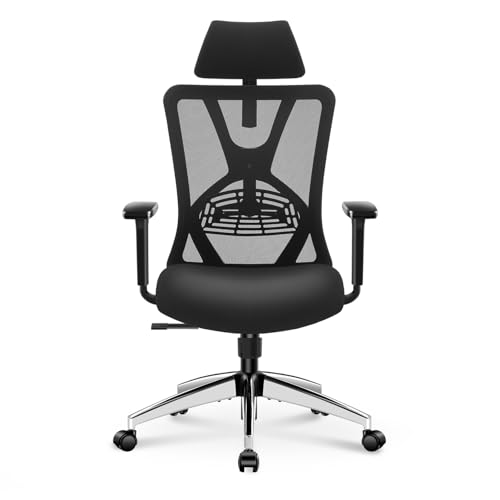
The Ticova Ergonomic Office Chair leads because its headrest is the real article: a big, curved foam pillow, adjustable in height and angle, shaped to cradle the head rather than perch beneath it — mounted on a chair that also adjusts its lumbar in height and depth, its armrests in three dimensions, and its tilt to a 130-degree rock, with a spine-shaped mesh backrest and a 3.4-inch W-shaped waterfall seat. The neck does not live alone, and the Ticova is the rare chair at its price that fits the whole chain.
Strengths
- Curved foam headrest, adjustable two ways — support that can actually find your head.
- Two-axis lumbar and 3D arms complete the posture chain below the neck.
- BIFMA-tested build at a mid-range price.
Trade-offs
- The pool’s dimension figures appear to be package measurements.
- Foam seat breathes less than full mesh.
- The headrest’s curve suits most heads; very tall torsos should verify the height range.
| Color | Black |
| Size | 70D x 26W x 54H cm |
| Weight | 17.5 Kilograms |
The headrest setup is a two-minute ritual with a day’s payoff: sit back, lean into your working recline, and set the pillow so it meets the curve where your head meets your neck — supporting the head’s weight without pushing it forward. Most sitters have never experienced a correctly placed headrest, because most chairs cannot place one; the Ticova’s revelation is how much of the day’s neck fatigue was simply an unsupported head, carried by muscles that were never consulted. Its mesh keeps the back cool through the same long sessions, and its price keeps the whole system honest.
Choose the Ticova if you want the complete neck-support chain without a premium. Skip it if you need seat-depth adjustment as well — the FLEXISPOT below adds it.
Best for: All-day sitters whose necks clock out before they do / Not suited for: Depth-adjustment seekers

FLEXISPOT ErgoX Premium Ergonomic Office Chair
Our badge: Best Adjustable
The FLEXISPOT ErgoX Premium Ergonomic Office Chair treats the neck as the top of an adjustable system: a 3D adjustable headrest above a five-level back, dynamic lumbar support, seat depth adjustable from 17 to 20 inches, seat height from 20.1 to 22.4 inches, 3D armrests, tilt, and a nap footrest — for users 5’1″ to 6’2″, rated to 400 lb. The headrest’s three dimensions matter because heads rest at different heights and angles depending on the torso below them, and the ErgoX is the only chair here that lets you solve for all of it.
Strengths
- 3D headrest: height, angle, and depth of support, tunable to one neck.
- The full chain adjusts with it — depth, lumbar, arms — so the headrest’s foundation is fitted too.
- Nap footrest makes the reclined reset complete, neck included.
Trade-offs
- Premium price in this guide.
- The pool lists package-style dimensions for this model.
- Its precision requires a setup session to unlock.
| Color | Black |
| Size | Overall Depth 44″ |
| Weight | 38 pounds |
The ErgoX’s neck case is the reclined hour: code review, the long call, the video — the postures where the head’s weight should be the chair’s problem. With the seat depth set so your back owns the backrest, the dynamic lumbar holding the curve, and the headrest dialed to your recline angle, the whole spine unloads as one system. It is the chair for the sitter who has tried pillows and bolt-on headrests and is ready for the integrated answer. The posture-first context is developed in Best Chairs For Bad Posture, where this chair also leads.
Choose the FLEXISPOT if your neck deserves the fully adjustable system. Skip it if you will not spend twenty minutes setting it up.
Best for: Precise, whole-spine tuning with a real headrest / Not suited for: Setup-averse buyers

SIHOO M18 Ergonomic Office Chair
Our badge: Best Budget
The SIHOO M18 Ergonomic Office Chair brings neck support to the budget tier without faking it: an adjustable headrest atop four support points — head, back, hips, hands — with an adjustable lumbar, 2D armrests, a wide cushion, a breathable mesh back, tilt lock, and a frame tested to 330 lb, for sitters roughly 5’6″ to 6’2″. For the sitter whose current chair ends at the shoulder blades, the M18’s headrest is the single most felt upgrade in this guide relative to its price.
Strengths
- Adjustable headrest and lumbar at an entry price.
- Mesh back keeps long sessions cool against the support.
- 330 lb tested capacity and a wide cushion.
Trade-offs
- Headrest adjusts less elaborately than the 3D systems above.
- Sized for average-to-tall sitters.
- 2D armrests only.
| Color | Charcoal |
| Size | Pack of 1 |
| Dimensions | 27.5 x 21 x 11 inches |
| Weight | 31.526103466 pounds |
The M18’s headrest does the essential thing — it moves to your head’s resting height — and its mesh back makes the supported position the cool one, so sitters stay in contact with their support instead of migrating forward into the neck-straining perch. In warm rooms and long days it is the budget chair most likely to still be loved in year two. Its eight-step assembly and three-year parts coverage complete a value case this guide makes without reservation.
Choose the SIHOO if the budget is firm and the neck is tired. Skip it if you are petite or need a headrest that angles as well as rises.
Best for: Budget neck support for long, warm days / Not suited for: Petite sitters

Homall Gaming Chair
Our badge: Best for Work-Play
The Homall Gaming Chair supports the neck the gaming way: a flexible headrest pillow positioned on a tall backrest, a massage lumbar pillow below it, a recline to 135 degrees, a slide-out footrest, and high-density foam under PU leather on a BIFMA-certified base rated to 300 lb. The tall back is the point — gaming chairs rise behind the head where office chairs stop at the shoulders — and the recline-plus-footrest lets the neck’s whole chain, head to hips, take the break together.
Strengths
- Tall backrest with a headrest pillow that meets the head in recline.
- Recline and footrest unload the whole spine, neck included.
- Massage lumbar pillow adds comfort at the chain’s other end.
Trade-offs
- The headrest is a pillow on straps — positionable, less precise than mounted 3D units.
- PU leather warms in hot rooms.
- Gaming looks divide households and offices.
| Color | White |
| Size | 19.7 inches x 18.5 inches x 50.4 inches |
| Dimensions | 18.5 x 20.9 x 50.4 inches |
| Weight | 39.7 pounds |
For the work-play desk, the Homall’s neck support arrives exactly when it is needed: not during the upright sprint, but in the reclined review, the cutscene, the thinking lean — the postures where an unsupported head costs the most. The pillow’s flexibility is a feature for varied sitters, since it can be placed for a tall torso’s high rest or a shorter one’s lower one without tools. Streamers and creators will note the chair reads well on camera; the quiet-and-camera criteria are developed in Best Chairs For Podcasting.
Choose the Homall if your desk serves work and play and your neck clocks the long sessions. Skip it for formal offices or mesh-only preferences.
Best for: Work-play desks and reclined sessions / Not suited for: Formal offices

Respawn 110 Pro Ergonomic Gaming Chair with Footrest and Recline
Our badge: Best for Long Sessions
The Respawn 110 Pro Ergonomic Gaming Chair with Footrest and Recline builds neck support into the longest recline in this guide: a cushioned headrest on a backrest that reclines to 155 degrees with an infinite angle lock, dual-density foam, lumbar support, a reinforced retractable footrest, tilt control, and 360-degree swivel, supporting up to 275 lb in breathable gray fabric. At 155 degrees your head is nearly a passenger — and the headrest is there, cushioned, at every degree between upright and there.
Strengths
- Infinite-lock recline: the headrest serves at your angle, not a preset’s.
- Dual-density foam supports the head’s rest without a hard spot.
- Fabric breathes through marathon sessions.
Trade-offs
- 275 lb capacity ceiling.
- Headrest is cushioned and fixed-position rather than multi-adjustable.
- A large footprint among this guide’s chairs.
| Color | Gray Fabric |
| Size | 28.50″ D x 26.75″ W x 51.50″ H |
| Dimensions | 28 x 26.4 x 51.2 inches |
| Weight | 46.3 pounds |
The Respawn’s philosophy is that neck fatigue is a session-length problem: it accumulates across hours and postures, so the chair answers with range — the recline that lets you change the neck’s load completely, the footrest that makes the change total, the fabric that keeps the long sit cool. Students and remote workers whose days blend into evenings at one desk are its natural owners, and its calm gray makes it the gaming chair a shared room can live with.
Choose the Respawn if your sessions are long and your neck wants range over precision. Skip it if you need the headrest itself to adjust in three dimensions — the FLEXISPOT’s does.
Best for: Marathon sessions with full recline support / Not suited for: Precision headrest adjusters

COMFIER Shiatsu Neck and Back Massager with Heat
Our badge: Best Add-On
The COMFIER Shiatsu Neck and Back Massager with Heat is included as what it is — a pad for your existing chair, not a chair — and its neck system is genuinely the most adjustable in this guide: separate shiatsu neck nodes that move up and down from the wired controller until they align with your neck, paired with four deep-kneading back nodes (upper, lower, full-back, and spot modes), rolling massage, gentle heat, three levels of air compression, and three levels of seat vibration, under a 15-minute auto shutoff, for users roughly 5’3″ to 6’0″. The maker notes FSA and HSA eligibility.
Strengths
- Neck nodes that travel to your neck — kneading where your neck actually is.
- Heat and compression complete a real comfort session.
- Upgrades any sound chair; moves between home and office.
Trade-offs
- It cannot give a chair a headrest or fix its geometry — sessions, not support.
- Corded, and about 19 pounds in place.
- Heat is intentionally mild.
| Color | Gray |
| Size | 1 Count (Pack of 1) |
| Dimensions | 30 x 17 x 18 inches |
| Weight | 17.63698096 pounds |
The COMFIER’s honest role is the day’s punctuation: the fifteen minutes when the neck that carried the head all day gets kneaded, warmed, and compressed back to neutral. Sitters whose chairs are sound but whose necks end the day in knots will find it the most satisfying purchase in this guide; sitters whose chairs lack headrests entirely should buy the chair first and let this be the second act. Used in that order, it is loved; used as a substitute for support, it is blamed for a geometry it never claimed to fix.
Choose the COMFIER if your chair is right and your neck wants a daily session. Skip it if your chair has no headrest at all — that is the first purchase.
Best for: Neck comfort sessions on an existing chair / Not suited for: Replacing a missing headrest
Comparison Table
| Pick | Color | Dimensions | Weight | Check price on Amazon |
|---|---|---|---|---|
| Ticova Ergonomic Office Chair | Black | — | 17.5 Kilograms | Check price on Amazon |
| FLEXISPOT ErgoX Premium Ergonomic Office Chair | Black | — | 38 pounds | Check price on Amazon |
| SIHOO M18 Ergonomic Office Chair | Charcoal | 27.5 x 21 x 11 inches | 31.526103466 pounds | Check price on Amazon |
| Homall Gaming Chair | White | 18.5 x 20.9 x 50.4 inches | 39.7 pounds | Check price on Amazon |
| Respawn 110 Pro Ergonomic Gaming Chair with Footrest and Recline | Gray Fabric | 28 x 26.4 x 51.2 inches | 46.3 pounds | Check price on Amazon |
| COMFIER Shiatsu Neck and Back Massager with Heat | Gray | 30 x 17 x 18 inches | 17.63698096 pounds | Check price on Amazon |
How to Choose the Best Chairs for Neck Support
Demand a headrest that adjusts — twice
Height adjustment places the pillow at your head’s level; angle adjustment tilts it to meet your head’s rest position rather than your neck’s. One without the other is half a headrest. The Ticova and FLEXISPOT offer both; pillow-style headrests (Homall) adjust by repositioning; fixed headrests should be presumed decorative until a long test sit proves they happen to fit your exact torso — a lottery this guide does not recommend playing.
Fit the chain, not just the top link
The head balances over the spine, so the spine’s setup is the neck’s setup: lumbar supporting the curve, seat depth placing your back against the backrest, arms carrying the forearms so the shoulders drop. A headrest fitted atop a slumped chain meets a head that is no longer above it. When you test a chair, set the whole chain in order and only then judge the headrest — most “bad headrests” are good headrests on unfitted chairs.
Check your screen before blaming the chair
The commonest neck villain is a low or distant screen pulling the head forward for hours — a posture no headrest can rescue, because the head has left the chair entirely. Raise the screen until its top third meets your eye line at arm’s length, and the head returns to the headrest’s jurisdiction. Laptop users: a riser and a separate keyboard are the neck purchase; the chair is the second one. The full station setup is in Best Task Chairs For Home Office.
Match the headrest to your recline habits
Upright workers need a headrest that stays politely out of the way until leaned on; reclined thinkers and callers need one that carries the head at their working angle — which is where angle adjustment and the gaming chairs’ tall backs earn their keep. Inventory your day honestly: the headrest that matters is the one at the angle you actually inhabit at 4 p.m.
Know the boundary of furniture
Neck discomfort that persists in a well-fitted chair, pain that radiates, numbness or tingling in the arms or hands, or any symptom after an injury — these are referrals, not shopping. This guide’s products serve everyday sitting fatigue. Cross the boundary promptly and without embarrassment; professionals exist for exactly the cases furniture cannot help.
How Do You Set Up a Headrest Correctly?
Sit in your fitted chair — lumbar set, back against the backrest — and lean back to your most-used recline. The headrest should meet the back of your head at the curve where head meets neck, supporting the head’s weight so your neck muscles can idle. If it pushes your chin down, it is too high or angled too far forward; if it meets only your neck, it is too low and will act as a fulcrum — the one configuration worse than none. Adjust in small steps across a full day: the right position at 9 a.m. should still be right at the 4 p.m. recline.
Then check the upright position: sitting tall, your head should clear the headrest or touch it lightly — a headrest that shoves the head forward during upright work is set for someone else’s recline. Two positions, one headrest, both verified: that is the whole setup, and it takes less time than the meeting you will spend enjoying it.
Problem: The headrest pushes your head forward — Angle it back or lower it slightly; if it cannot move, it is the wrong headrest for your torso, and a chair with a two-way adjustable unit is the fix.
Problem: Your neck still aches with a good headrest — Audit the screen and the chain: monitor height first, then lumbar and seat depth. The headrest is the last link; the ache usually starts earlier in the chain.
Problem: The headrest is fine upright but useless reclined — It lacks angle range for your recline. A 3D unit, or a gaming chair whose tall back and pillow were designed for recline, covers the leaned-back hours.
Problem: You share the chair and the headrest is always wrong — Choose quick, tool-free adjustment and reset it as part of sitting down — or a pad like the COMFIER whose neck nodes re-aim from a controller in seconds.
Problem: Your head never touches the headrest at all — You are sitting forward of your chair: seat too deep, desk too far, or screen too low. Fix the cause in that order and the headrest will finally get its sitter back.
The Neck Through the Working Day
Neck load is a day’s accumulation, and the chair’s support works best inside a rhythm: upright sprints with the head balanced and free, reclined chapters where the headrest takes the weight entirely, and standing breaks where the whole chain resets. The sitters who end the day comfortable are rarely the ones with the finest headrest alone — they are the ones whose chairs offer all three positions and whose habits use them. That is why this guide weights recline range and footrests alongside headrest mechanics: the neck rests when the body changes state, and the chair’s job is to make every state a supported one.
Reading, Calls, and Screens: Three Necks
Your neck works three different jobs, and a good setup serves all three. Reading drops the head’s angle — a headrest set for it, or a book raised on a stand, keeps the load honest. Calls recline it — the headrest’s home ground, where the Ticova and FLEXISPOT units earn their price in a single long meeting. Screens fix it forward at a set distance — where monitor height, not furniture, is the governing variable. When a sitter says a chair “doesn’t support my neck,” the diagnostic question is which of the three necks is complaining; the answers in this guide were chosen to cover all three, but only a sitter who knows their own day can weight them.
Neck Support Beyond the Desk
The desk is where neck support is bought, but not where all of it is spent. The reading chair subjects the neck to the book’s downward angle for the longest unbroken stretches in the house; the television chair to the screen’s fixed geometry; the car to the headrest that was designed for safety rather than comfort and should be left exactly as the maker set it for that purpose. The transferable skill from this guide is the fitting habit: wherever you sit for an hour, ask where your head’s weight is going. In the reading chair, the answer should be a headrest, a high back, or a pillow placed with the same care as the desk’s setup — the lounging chairs in Best Chairs For Lounging include the high-back and pillowback designs that answer it. In the evening’s other seats, a cushion behind the head at the right height converts furniture that was never designed for necks into furniture that behaves as if it were. The neck does not care which room it is in; it cares whether its load has somewhere to go, and a household that has learned to ask the question in every room has learned the real content of this guide.
One Good Chair, Several Necks: The Shared-Household Problem
Households share chairs and do not share necks. The headrest fitted to a tall partner’s recline is a chin-shove to a shorter one; the lumbar that cradles one spine pokes another’s. The solutions are the ones this guide has quietly favored all along: adjustment that is quick and tool-free, so re-fitting is a ten-second habit rather than a project (the Ticova and FLEXISPOT pattern); self-adjusting designs that re-derive their support from whoever sits (the philosophy the posture guides praise); and, in the pad’s case, neck nodes that re-aim from a controller between users. The household rule that makes any of them work is social, not mechanical: settings are personal, resetting them is normal, and nobody’s configuration is the chair’s “real” one. Families that adopt the rule stop having the low-grade daily friction of the mysteriously wrong chair; families that do not, re-litigate it at every sit. Buy the adjustment range your household’s range of necks requires, and let the chair be re-fitted as casually as the car seat is — which is to say, every time, without comment.
The Two-Week Headrest Diary
Neck support, like posture, is proven over days rather than minutes, and a simple diary turns the return window into an experiment with a verdict. Days one and two are for setup alone: the chain in order, the headrest placed by this guide’s method, no conclusions drawn — new chairs feel strange before they feel right, and the neck is the last part of the body to file its report. Days three through seven are evidence days: a single line each evening recording when the neck first asked for attention, what you were doing — typing, calling, reading, reviewing — and whether the headrest was in use or abandoned. Patterns emerge with embarrassing clarity from five lines of data: the ache that arrives only on call-heavy days indicts the recline fit; the one that arrives by ten in the morning indicts the screen; the one that never arrives at all is the sound of a correctly fitted chair.
Week two is the refinement: one variable at a time, each given a day — headrest angle on Monday, its height on Tuesday, the lumbar depth beneath it on Wednesday, because the head’s address moves when the spine’s does. By day fourteen the diary should show the neck’s first complaint arriving later, softer, or attached to a cause you can name and fix outside the chair. If it shows instead the same complaint at the same hour despite every honest adjustment, believe it: the chair’s geometry and your neck are not compatible, and the window you preserved is the correct tool for that discovery. The sitters who end up with chairs their necks love are not luckier than other sitters; they are simply the ones who ran the experiment instead of hoping the showroom minute was prophecy. Two weeks, one line a day, and the most personal specification in furniture becomes a measured fact about your own body — which is the only authority this guide has ever claimed to serve.
The Neck and the Voice: A Note for Talkers, Teachers, and Callers
Some sitters use their necks professionally in a second sense: their voices are their instruments, and the voice is produced by a structure that hangs, in part, from the neck’s posture. Teachers, callers, streamers, singers, and the meeting-heavy professions all discover the same correlation sooner or later — the days the neck ends wrecked are the days the voice ends tired, because tension in the carrying structure becomes tension in the instrument. This guide makes no medical claim about that relationship; it simply notes that the sitters who talk for a living consistently report their headrests and reclines as voice equipment, and arrange their chairs accordingly: the headrest fitted for the call posture, not the typing one; the recline used deliberately during listening, so the talking chapters begin from a rested neck; the screen raised so the head — and with it the whole vocal apparatus — balances instead of reaching.
If your work is talking, weight this guide’s recline-and-headrest picks accordingly — the Ticova’s two-way unit, the FLEXISPOT’s 3D system, the Respawn’s long recline for the listening hours — and treat the setup session as instrument care, which for you it literally is. The rest of the advice holds unchanged: fit the chain in order, raise the screen, keep the diary for two weeks, and let the professionals handle anything that persists. Your neck carries your head all day and your voice all career; a chair that supports the first has a way of protecting the second, and few purchases serve two masters so honestly for so little.
Travel, Hotels, and the Neck Away From Home
The neck’s support system is hardest to maintain away from the fitted chair, and frequent travelers feel the gap first: the hotel desk chair with its decorative headrest at the wrong altitude, the conference chair designed for banquets, the relative’s spare seat that hosts the holiday’s laptop hours. The portable principles from this guide travel better than any product: raise the screen by whatever the room offers — the hotel ironing board has leveled many a laptop — place a rolled towel or a cushion where a lumbar should be, and give the head a rest to find during calls, even if the rest is a pillow borrowed from the bed and arranged with intent. None of it equals the home setup, and it is not meant to; it is meant to keep a three-day trip from undoing a well-fitted home base, the way a travel toothbrush maintains what the dentist built.
The deeper lesson of the road is diagnostic. Travelers often discover, in the hotel chair’s failures, exactly which features of their home chair their necks depend on — the headrest’s angle, the lumbar’s depth, the recline’s range — knowledge that sharpens the next home purchase into precision. And the reverse holds: a neck that suffers at home but rests on the road is telling its owner that the home chair, however expensive, is fitted wrong, and that the two-week diary in this guide is overdue. The neck keeps its accounts everywhere it sits. The wise sitter reads them wherever they are written, and brings the lessons home to the one chair that can be made perfect: the one at their own desk, waiting with its adjustments ready.
There is one more constituency quietly relying on this purchase that deserves naming before the verdict: your future self, at the end of a decade of working days. Necks keep ledgers. The hours spent craned, propped, and unsupported do not vanish when the laptop closes; they accrue, quietly, into the stiffness that greets the morning and the caution that greets the gym. The hours spent balanced and rested accrue too, in the opposite column, as the unremarkable comfort of a neck that simply never becomes a topic. No one can run the counterfactual on their own spine, and this guide will not pretend otherwise — but the direction of the arithmetic is not in doubt, and it points, every working day, at the chair and its headrest and the screen raised to meet them. Buy the support now, fit it honestly, and let the ledger fill with the good kind of entries. It is the cheapest long-term investment in this entire guide, and its beneficiary has been patiently waiting for you to make it.
Setup day deserves one concrete promise from this guide: the full fitting sequence — chain, headrest, screen — takes under an hour, most of it spent sitting still and paying attention. It is the highest-value hour in the entire purchase, worth more than any single specification on any listing, and it is the hour most buyers skip. Do not skip yours.
Your neck has carried your head through every working day of your life without once being consulted about the furniture. This purchase is the consultation.
Common Buying Mistakes
Counting a fixed headrest as neck support
A pillow that cannot move fits the torso it was designed around, which is statistically not yours. Adjustability is the support; the cushion is just its vehicle.
Fitting the headrest before the rest of the chair
Headrest position is meaningless until the seat, lumbar, and recline are set — the head’s address depends on the whole chain’s. Set the chair in order, headrest last, or set it forever.
Ignoring the screen and blaming the chair
A low monitor will defeat the finest headrest ever bolted to a chair. Raise the screen as part of the same purchase; the neck cannot tell where its relief came from, and neither should you care.
Buying the pad instead of the missing headrest
The COMFIER kneads beautifully and supports nothing. If your chair has no headrest, that absence is the purchase; the pad is the pleasure that follows it.
Judging the headrest in a three-minute upright sit
Neck support declares itself in the reclined hour. Test at your working angles, across a full day, inside the return window — or accept the verdict of hour three as your own fault for not asking it earlier.
Final Recommendation
For most sitters, the Ticova Ergonomic Office Chair is the answer: a genuinely adjustable curved headrest on a chair that fits the whole chain below it, at a price that respects the budget. For precision, the FLEXISPOT’s 3D system — start from its Check on Amazon listing. On a budget, the SIHOO; for sessions, the Respawn; for the chair you already own, the COMFIER’s traveling neck nodes. Fit the chain, raise the screen, lean back into a headrest that was placed for your head — and let your neck spend the day carrying ideas instead of a bowling ball.
Frequently Asked Questions
What makes a headrest actually supportive?
Adjustability and placement: it must rise or lower to your head’s resting height and angle to meet the curve where your head meets your neck, at the recline angles you actually use. A big curved shape helps it cradle rather than poke. Fixed headrests support only the torsos they were modeled on.
Should my head touch the headrest while I type?
Lightly or not at all — upright typing balances the head over the spine, and the headrest waits for the lean. If it pushes your head forward while you type, it is set too high, too far forward, or at the wrong angle; adjust until upright is free and reclined is carried.
Is a gaming chair good for neck support?
The tall-backed ones can be excellent for reclined work — their headrest pillows meet the head at angles office chairs rarely reach, and their reclines unload the whole chain. For upright precision, the adjustable ergonomic chairs fit more exactly. Many sitters’ days contain both postures; choose for the hours that dominate yours.
Can a massage pad replace a headrest?
No. The COMFIER’s neck nodes knead and warm wonderfully, in fifteen-minute sessions; they hold nothing up. Support is geometry, available all day; massage is a session. This guide recommends them in that order and labels them accordingly.
Why does my neck hurt even in an ergonomic chair?
Usually the chain or the screen: a lumbar set wrong, a seat too deep, or — most often — a monitor low enough to pull your head forward out of the chair’s reach all day. Work the setup in order (seat, lumbar, arms, screen, headrest) across a full day before concluding the chair failed. Persistent or radiating symptoms deserve a professional’s assessment.
How do I know if the headrest fits my height?
Sit back and lean to your working recline: the pillow should contact the back of your head, not your neck and not the crown. Torsos differ more than chairs expect, which is why the adjustable units in this guide list their sitters’ height ranges — check yours against them before ordering.


