Disclosure: As an Amazon Associate, dailyhomedecorating.com earns from qualifying purchases. Links to Amazon on this page are affiliate links; they cost you nothing extra. Prices and availability change often, so check the current Amazon listing before you buy.
Finding the best tubs for seniors is really a safety conversation before it is a style conversation. A standard bathtub asks a lot of an older body: a high step over the wall, a slippery floor while you are off balance, a hard landing surface if anything goes wrong, and then the same climb in reverse while wet and relaxed. The best tubs for seniors reduce every one of those demands. They lower the entry, add traction underfoot, support the back so sitting down and standing up are controlled movements, and hold heat long enough that a soak never has to be rushed.
This guide reviews six tubs that approach senior bathing from different directions. A walk-in tub with a door removes the step-over entirely. Low-threshold alcove tubs keep a familiar layout but cut the climb. Freestanding soaking tubs with verified non-slip floors and double walls suit seniors who still step in confidently but want traction and warmth. Each pick below is assessed on entry height, floor grip, back support, capacity, and how forgiving it is on an ordinary day when knees, hips, or balance are not at their best. If you are also comparing bathing options for other household members, our notes on Best Two Person Hot Tubs For Sale cover shared soaking, and Best Hot Tubs For Families looks at larger formats.
Where to Buy
Every pick in this guide is sold on Amazon, where you can check the current price, delivery options, and listing details before you buy. Bathroom fixtures are heavy and freight delivery is common, so confirm the delivery method and return terms on the listing itself.
- American Standard Walk-In Combo Whirlpool and Air Spa — Check on Amazon
- Kohler Underscore 60″ Soaking Bathtub — Check on Amazon
- Empava 59 Inch Freestanding Bathtub — Check on Amazon
- WOODBRIDGE Acrylic Freestanding Soaking Tub — Check on Amazon
- KINGSTON BRASS 60-Inch Alcove Acrylic Bathtub — Check on Amazon
- Fine Fixtures Acrylic Alcove Soaking Bathtub — Check on Amazon
In this guide
Quick Picks
| Pick | Badge | Why it earns its place |
|---|---|---|
| American Standard Walk-In Combo Whirlpool and Air Spa | Best Overall | A door replaces the step-over entirely, and the outward-opening design suits seated entry. |
| Kohler Underscore 60″ Soaking Bathtub | Best Low Step-Over | A 19-inch step-over height keeps a deep soak without the usual climb. |
| Empava 59 Inch Freestanding Bathtub | Best Anti-Slip Floor | Textured anti-slip bottom, ergonomic back support, and a moderate footprint. |
| WOODBRIDGE Acrylic Freestanding Soaking Tub | Best Compact | A 54-inch footprint with a verified non-slip surface and double-wall warmth. |
| KINGSTON BRASS 60-Inch Alcove Acrylic Bathtub | Best Alcove Fit | Drops into a standard three-wall alcove with a tile flange and apron front. |
| Fine Fixtures Acrylic Alcove Soaking Bathtub | Best Budget | Alcove practicality with sloped lumbar support and a handy storage ledge. |
Key Takeaways
- Entry is the first filter: a walk-in door or a step-over at or below about 19 inches changes bathing from a climb into a step.
- A textured or verified non-slip floor matters most at the two riskiest moments — stepping in and standing up to get out.
- Molded lumbar support is not a luxury for seniors; it controls the slide that makes standing up from a reclined position difficult.
- Double-wall acrylic holds bath heat longer, so a therapeutic soak does not need topping up with hot water mid-bath.
- Alcove tubs are the least disruptive upgrade because they reuse the existing three-wall layout and plumbing position.
- No tub replaces grab bars: plan bar placement alongside whichever pick you choose.
How These Picks Were Chosen
We started from the verified product pool for this topic and read every specification and feature list against a senior-specific checklist. Entry method came first: door entry, step-over height, and whether the bather can sit down in a controlled way rather than lowering themselves over a wall. Floor traction came second — only tubs whose verified details mention a non-slip or anti-slip surface earned credit for it, and we did not assume traction on any model that does not state it. Third was back and lumbar support, because a supported recline is what lets a senior bather rise again without help. Fourth was heat retention, since seniors are often advised to soak for joint comfort and a tub that goes cold quickly shortens the soak that matters.
We filtered out the largest statement tubs in the pool — a 75-inch, 82-gallon freestanding model is a wonderful soak for a mobile adult but its scale, weight, and deep walls work against senior entry and exit, so it does not appear here even though it is a fine tub in other contexts like Best Hot Tubs For Families. We also excluded a trim kit that appears in the pool data under a tub heading; it is a faucet trim, not a bathtub, and it is flagged in the sources file for this article. What remains is a deliberate spread: one true walk-in, two low-threshold alcove designs, two freestanding tubs with verified non-slip floors, and one straightforward alcove replacement. Every specification quoted in the mini spec boxes comes directly from the verified pool data; where the pool gives no figure, we say nothing rather than guess.
One honesty note about method: this is desk research against manufacturer-supplied specifications, not hands-on testing with senior bathers. Entry heights, capacities, and materials are verified from the pool; judgments about which design suits which mobility level are reasoned from those facts and from widely understood bathing-safety principles. If a bather uses a wheelchair or transfer bench, treat the walk-in pick as the starting point and confirm door swing and interior dimensions against the specific transfer setup before ordering.
The 6 Best Tubs for Seniors — Reviewed

American Standard Walk-In Combo Whirlpool and Air Spa
Our badge: Best Overall
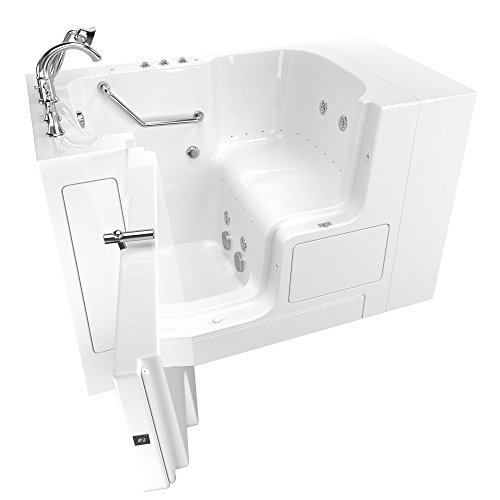
The American Standard Walk-In Combo Whirlpool and Air Spa is the only pick in this guide that removes the central problem of senior bathing altogether: there is no wall to climb. Its outward-opening door lets the bather walk in, sit down, close the door, and only then fill the tub. For a senior with a hip replacement, severe arthritis, or balance concerns, that sequence is the difference between bathing independently and waiting for help.
Strengths
- Door entry eliminates the step-over, the single highest-risk movement in senior bathing.
- Outward-opening door design suits seated entry and works with a transfer approach.
- Combo whirlpool and air spa format supports long, warm, joint-friendly soaks.
Trade-offs
- The bather must sit in the tub while it fills and drains, which lengthens the total bathing routine.
- At 151 pounds and 40 inches tall, it is a substantial unit that needs a planned installation.
- The 52-inch length is shorter than a standard tub, so tall bathers sit more upright than stretched out.
| Color | White |
| Dimensions | 52 x 32 x 40 inches |
| Weight | 151 pounds |
The daily reality of a walk-in tub deserves plain description. You step through the door onto the tub floor, sit on the built-in seat, swing your legs in, and close and latch the door. The tub fills around you. That fill-and-wait period is the honest cost of the design, and most owners adapt by treating it as part of the ritual — a robe within reach, a book on the ledge. The drain wait matters more for seniors who chill easily, so a bathroom that holds warmth, or a space heater used safely outside the splash zone, makes the routine comfortable rather than merely tolerable.
Where this tub earns Best Overall is independence. A bather who cannot safely clear a 20-inch tub wall simply cannot use the other five picks alone, whatever their other virtues. The walk-in restores unassisted bathing, which is a dignity issue as much as a safety one. The 32-inch width is generous enough for a seated bather to shift position, and the 40-inch wall height that looks imposing in the specifications is exactly what allows a deep, shoulder-level soak once seated — deep water supports the body and makes standing from the seat easier, because buoyancy does part of the lifting.
Installation planning is the main project here. The unit is heavy, the door seal must be kept clean and inspected, and the fill and drain times depend on your home’s water pressure and drain capacity. None of that is a reason to avoid it; it is a reason to measure the bathroom door and the path from the street before ordering, and to have the conversation about a dedicated circuit and drain sizing with your installer early. Seniors planning to age in place for a decade will usually find this the most future-proof single purchase in the guide.
Best for: Seniors who cannot safely step over a tub wall and want to bathe independently / Not suited for: Bathers who want a quick in-and-out shower-style routine or a long stretched-out soak
Choose it if independent entry is the priority and you accept the fill-and-drain wait as the price of that independence. Skip it if the bather is fully mobile and simply wants a more comfortable standard tub — the alcove picks below deliver that with far less installation work.

Kohler Underscore 60″ Soaking Bathtub
Our badge: Best Low Step-Over
The Kohler Underscore 60″ Soaking Bathtub attacks the entry problem from the opposite direction: keep the familiar alcove tub, but lower the wall. Its verified 19-inch step-over height is explicitly designed to retain the depth of a standard 21-inch bath while making the climb shorter, and for the large group of seniors who are mobile but stiff, that two-inch difference at the hip is genuinely meaningful.
Strengths
- 19-inch step-over height lowers the entry climb without giving up soaking depth.
- Molded lumbar support helps the bather sit down and rise in a controlled way.
- Slotted overflow allows a deeper fill than a standard overflow position.
Trade-offs
- It is still a step-over tub; bathers who cannot lift a leg to hip height need the walk-in instead.
- At 128 pounds it is one of the heavier alcove options and needs a careful two-person set.
- The integral apron gives a finished look but limits access beneath the tub after installation.
| Color | White |
| Dimensions | 60 x 32 x 19 inches |
| Weight | 128 pounds |
The Underscore’s 68-gallon capacity is the largest among the alcove picks here, and capacity matters for seniors in a specific way: deeper water means more buoyancy, and buoyancy is assistance. A bather floating slightly is a bather whose joints carry less load while repositioning, and who can push up from the lumbar-supported backrest with the water helping rather than fighting. The molded lumbar support deserves emphasis — it holds the lower back at an angle that keeps the bather from sliding flat, and sliding flat is the position from which older bathers most often cannot recover without calling for help.
The three-wall alcove format with integral flange is the other senior-friendly trait, though it is about the household rather than the bather: the flange helps prevent water seeping behind the wall, the apron finishes the front without extra carpentry, and the whole unit replaces a standard 60-inch tub in the same footprint. For a family updating a parent’s bathroom over a weekend-plus timeframe, that predictability matters. Pair it with a well-placed grab bar at the entry point and another at the back wall, and the bathroom’s risk profile drops substantially without changing how the room looks or is used by anyone else.
Who should be cautious? A bather whose limitation is specifically leg lift — post-surgical hip precautions, for example — will still find 19 inches too much on a bad day. That is the walk-in’s territory. But for the senior whose complaint is general stiffness, sore knees, and a healthy caution about the old tub’s height, this is the most balanced traditional tub in the guide.
Best for: Mobile seniors who want a lower climb and a deep, supported soak in a standard alcove / Not suited for: Bathers with strict leg-lift restrictions or who need seated door entry
Choose it if you want the least disruptive renovation that still makes a real difference to entry effort. Skip it if entry itself, at any wall height, is the problem — go straight to the walk-in pick.

Empava 59 Inch Freestanding Bathtub
Our badge: Best Anti-Slip Floor
The Empava 59 Inch Freestanding Bathtub earns its place on one verified detail that matters enormously to senior bathers: a textured anti-slip bottom, certified alongside its cUPC compliance. Freestanding tubs are usually style purchases; this one pairs the freestanding format with the floor grip and ergonomic back support that make it a defensible senior choice for bathers who still step in and out confidently.
Strengths
- Textured anti-slip bottom adds traction at the two riskiest moments of the bath.
- 15-inch soaking depth with ergonomic back support and a 45-gallon capacity.
- Double-wall acrylic construction helps the bath stay warm for longer soaks.
Trade-offs
- Freestanding placement means stepping over a full-height wall with no surrounding ledge to hold.
- Requires an externally installed faucet, which is an added purchase and plumbing decision.
- At 59 inches it suits one bather well but is not a stretched-out tub for very tall users.
| Color | White |
| Size | 59 Inch |
| Dimensions | 59.1 x 29.5 x 26.8 inches |
| Weight | 66.1 pounds |
The adjustable leveling feet are a quiet safety feature. A freestanding tub that rocks, even slightly, is a hazard for a bather using the rim for balance during entry; a properly leveled tub is a stable handhold and drains toward its center outlet as designed. During installation, insist on the leveling step and test the tub for any movement before the first fill. The 66.1-pound weight — light for its class — also makes precise placement easier for the installers, which indirectly improves the quality of the finished job.
In daily use, the ergonomic back support and the anti-slip floor work as a pair. The backrest angle keeps the bather’s torso raised enough that rising begins from a semi-recline rather than a flat float, and the textured floor gives the feet purchase for that push. The double-wall construction holding heat is a comfort point with a safety edge: a bather who is warm relaxes, and a bather who starts shivering hurries, and hurrying in a wet tub is how falls happen. At 45 gallons it also fills faster and uses less water than the big statement tubs, which suits households mindful of both time and the water bill — a theme we return to in Best Bang For Your Buck Hot Tubs.
Be honest about the freestanding format’s limits, though. There is no wall on three sides to mount grab bars within easy reach of the tub itself; bars must go on a nearby wall, positioned for the entry point you actually use. A senior whose balance is deteriorating should treat this as a tub for now, not a tub for the next decade. For a confident bather who wants traction and support in a modern-looking package, it is the strongest freestanding option here.
Best for: Confident senior bathers who want verified anti-slip traction and back support in a freestanding design / Not suited for: Bathers who need wall-mounted support within arm’s reach on multiple sides
Choose it if balance is good, grip is the worry, and the bathroom layout suits a freestanding centerpiece. Skip it if the bather’s stability is declining — an alcove or walk-in will serve longer.
WOODBRIDGE Acrylic Freestanding Soaking Tub
Our badge: Best Compact
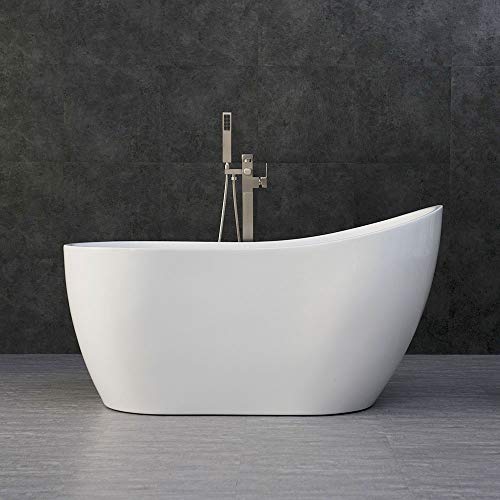
The WOODBRIDGE Acrylic Freestanding Soaking Tub is the small-bathroom answer in this guide: a 54-inch freestanding tub whose verified non-slip surface meets ASTM slip-resistance standards, in a footprint that fits bathrooms where the 59- and 67-inch models simply will not go. For a senior in a smaller home, compact does not mean compromised here — the double-walled construction keeps water warm and the capacity is a sensible 55 gallons.
Strengths
- Non-slip surface verified to ASTM slip-resistance standards.
- Double-walled design holds heat for longer, unhurried soaks.
- 54-inch length fits small bathrooms that rule out larger freestanding tubs.
Trade-offs
- The 29-inch wall height is the tallest step-over among the freestanding picks here.
- Freestanding format offers no integral ledge for toiletries or a steadying hand at the back.
- Its compact interior suits shorter bathers best; tall users will sit with knees bent.
| Color | Brushed Nickel |
| Size | 54 inches long |
| Dimensions | 54 x 29 x 29 inches |
| Weight | 75 pounds |
The honest tension in this pick is height versus footprint. The tub is short front-to-back and end-to-end, which is why it fits a small bathroom, but its walls stand 29 inches, and a senior must clear that height on entry. The non-slip floor helps once you are in — the moment of standing, turning, and stepping out happens on a surface designed for grip — but the step itself is a real one. This is a tub for a senior whose leg lift is still good and whose bathroom is small, not for a bather already struggling with a standard tub wall. Read the dimensions against your own mobility, not against the photograph.
Material quality is a genuine strength. The Lucite acrylic reinforced with resin and fiberglass is the same construction approach used in far larger models, with an easy-clean, stain-resistant surface that keeps its gloss. For a senior household, easy cleaning is a safety feature in disguise: a tub that wipes clean without aggressive scrubbing or harsh chemicals is a tub that actually gets cleaned, on a schedule, by whoever is able. The reinforced bottom is rated by the manufacturer for very substantial loads, which translates in practice to a floor that feels solid rather than flexing underfoot — flex is unsettling for a nervous bather, and this floor does not have it.
Heat retention from the double wall rounds out the case. In a 55-gallon tub, the water you fill is the water you soak in; there is no need to run the hot tap mid-bath and shuffle around a scalding stream. Seniors soaking for joint comfort get the full, even warmth for the full session. If the bathroom is small, also consider ventilation: a compact room steams up quickly, and a clear, dry floor outside the tub is part of the exit routine. A bath mat with a non-slip backing, placed where the first step lands, completes this pick properly.
Best for: Seniors with good leg lift in small bathrooms who want a verified non-slip floor and a warm soak / Not suited for: Bathers who already struggle to clear a standard-height tub wall
Choose it if space is the constraint and mobility is not yet. Skip it if wall height is the complaint — the Kohler’s lower step-over or the walk-in serves that need directly.

KINGSTON BRASS 60-Inch Alcove Acrylic Bathtub
Our badge: Best Alcove Fit
The KINGSTON BRASS 60-Inch Alcove Acrylic Bathtub is the straightforward replacement pick: a three-wall alcove tub with a tile flange, integral apron, and right-hand drain that goes where the old tub came out. For senior households, predictability is a feature — the walls around an alcove are exactly where grab bars belong, and this format keeps all of them within reach of the bather.
Strengths
- Three-wall alcove design puts grab-bar mounting surfaces on three sides of the bather.
- Tile flange and integral apron simplify a watertight, finished installation.
- 58.2-gallon capacity and 14-inch water depth give a real soak in a standard footprint.
Trade-offs
- A standard-height step-over remains; it does not lower entry the way the Kohler does.
- Drain kit is not included, so budget and plan for that separate purchase.
- Right-hand drain only in this configuration — confirm your plumbing side before ordering.
| Color | Glossy White |
| Size | 60 inch (L) x 30-11/16 inch (W) x 22-1/16 inch (H) |
| Dimensions | 60 x 30.69 x 22.06 inches |
| Weight | 95 pounds |
Why recommend a conventional alcove tub in a senior guide at all? Because the alcove is the safest room layout for bathing once bars are installed. A bather in an alcove tub is never more than an arm’s length from a wall, and walls are where studs are, and studs are what grab bars anchor to. A freestanding tub in the middle of a room can be beautiful and still leave a falling bather with nothing to catch. For a senior whose children are helping plan the renovation, the alcove-plus-bars combination is often the most protective dollar spent, even though the tub itself is the least exotic object in this guide.
The acrylic construction with fiberglass and resin reinforcement keeps the unit to 95 pounds — manageable for a two-person set into the alcove — and the surface cleans with the non-abrasive products described in our guide to the Best Cleaner For Bath Tubs. The 14-inch water depth to the overflow is honest, standard soaking depth: enough to cover the lap and lower back of a seated bather, which is where warmth does its work for stiff hips. Taller or heavier bathers who want depth should look at the Kohler’s slotted overflow instead.
Installation notes: confirm right-hand drain against your existing plumbing before anything else, because alcove tubs are handed and the wrong hand is a return freight problem. Order the drain kit at the same time as the tub. And schedule the grab-bar installation into the same project — while the walls are open or the studs are being located anyway, bars cost little extra and the bather gains the full benefit from day one rather than as a later retrofit.
Best for: Senior households renovating an existing alcove who will pair the tub with properly anchored grab bars / Not suited for: Bathers who need a lowered step-over or door entry today
Choose it if the layout stays and the safety plan is bars plus a sound, standard tub. Skip it if entry height is already a daily struggle — spend the difference on the lower or door-entry designs.

Fine Fixtures Acrylic Alcove Soaking Bathtub
Our badge: Best Budget
The Fine Fixtures Acrylic Alcove Soaking Bathtub covers the alcove basics with two senior-relevant comforts: sloped lumbar support for a controlled sit and rise, and a ledge that keeps soap and toiletries within seated reach. It is the value route into this guide — an acrylic-and-fiberglass alcove tub, in a left-hand configuration, with the drain included.
Strengths
- Sloped lumbar support helps the bather sit and rise without sliding flat.
- Drain included and a pre-fixed tile flange simplify the installation list.
- A usable ledge keeps essentials within reach of a seated bather.
Trade-offs
- Standard step-over height; no entry assistance is built into the design.
- Left-hand configuration only here — right-hand bathrooms need the other variant.
- The ledge is handy but narrow; it is not a seat or a transfer surface.
| Color | White |
| Size | 60″ x 30″ – Left Hand |
| Dimensions | 30 x 60 x 21.5 inches |
| Weight | 65 pounds |
The ledge deserves more credit than it usually gets in a senior context. Reaching and twisting are fall triggers; a bather who must twist around for a shampoo bottle stored on a far corner is a bather off balance in a wet box. A ledge along the tub keeps the essentials in front of a seated bather, in the direction they are already facing. Combined with the lumbar slope — which keeps the torso angled up rather than slid down — the design quietly removes several small risky movements from every bath. Small risks, removed daily, are what actually prevent falls.
At 65 pounds this is the lightest alcove pick in the guide, which matters for renovation logistics in a senior’s home: a lighter tub is easier to maneuver through hallways and into the alcove without damaging walls, and the adjustable legs help the installer level it precisely. Level is not cosmetic — a level tub drains fully, and a tub that drains fully does not leave a standing film of soapy water to dry into a slippery residue for the next bath. That chain of cause and effect is the unglamorous core of bathroom safety, and this tub supports it. The acrylic surface is also described as resistant to salts and oils, which suits bathers who use bath salts for comfort soaks.
Position this pick honestly: it is a good standard tub with thoughtful touches, at the accessible end of the guide’s range. It does not solve entry. If the budget conversation is really about where the next dollars protect best, this tub plus professionally installed grab bars can out-protect a fancier tub installed alone — a point worth weighing alongside the options in Best Hot Tubs Under $2000, where tier framing matters more than brand names.
Best for: Budget-conscious senior households who want lumbar support and an in-reach ledge in a standard alcove / Not suited for: Bathers who need entry assistance now rather than comfort improvements
Choose it if the bather manages a standard step-over fine and the money is better spent on bars and installation. Skip it if mobility is declining noticeably — buy for the bather of next year, not just today.
Comparison Table
| Pick | Entry style | Dimensions | Capacity / depth | Check price on Amazon |
|---|---|---|---|---|
| American Standard Walk-In Combo | Door entry, seated | 52 x 32 x 40 inches | Deep seated soak | Check price on Amazon |
| Kohler Underscore | 19-inch step-over, alcove | 60 x 32 x 19 inches | 68 gallons | Check price on Amazon |
| Empava 59 Inch | Step-over, freestanding, anti-slip floor | 59.1 x 29.5 x 26.8 inches | 45 gallons, 15-inch soak | Check price on Amazon |
| WOODBRIDGE 54 Inch | Step-over, freestanding, non-slip floor | 54 x 29 x 29 inches | 55 gallons | Check price on Amazon |
| KINGSTON BRASS Alcove | Step-over, three-wall alcove | 60 x 30.69 x 22.06 inches | 58.2 gallons, 14-inch depth | Check price on Amazon |
| Fine Fixtures Alcove | Step-over, alcove, left hand | 30 x 60 x 21.5 inches | Standard soaking depth | Check price on Amazon |
How to Choose the Best Tubs for Seniors
Start with the entry, honestly assessed
Watch the bather get into the current tub, or honestly reconstruct it. If a leg must be lifted to hip height with both hands holding something, the step-over is already at the edge of safe. As a working guide: a step-over around 19 inches or lower suits many mobile seniors; anything at standard height (roughly 20-22 inches) or the tall walls of freestanding tubs (up to 29 inches) demands good leg lift and balance; and if either is unreliable, door entry is the correct answer, not a smaller compromise. Assess for a bad day, not a good one — the tub must be safe when the bather is tired, sore, or recovering.
Prioritize floor traction you can verify
Look for the words non-slip or anti-slip in the manufacturer’s own specification, ideally tied to a standard or a textured floor. A glossy uninterrupted acrylic floor is the default in this category and it is genuinely slippery when soapy. If a tub you love has no stated traction, plan on a quality adhesive tread set or a suction mat as part of the purchase — and understand that mats must be lifted and dried to stay hygienic. Verified traction built into the floor, as on the Empava and WOODBRIDGE picks, removes that maintenance burden.
Treat back support as a standing-up feature
Molded lumbar support and ergonomic backrests are usually sold as comfort. For seniors they are mechanics: a supported semi-recline keeps the body’s center of mass closer to the feet, so the rise to standing is a push rather than a heave. Test the logic against your own experience — rising from a low flat sofa is hard for the same reason rising from a flat-slid position in a tub is hard. Prefer pronounced lumbar shaping, and be wary of very long, flat tub floors where a shorter bather simply slides away from the backrest.
Match capacity to strength and water supply
Capacity runs from about 45 gallons in this guide to 68 in the largest alcove pick. More water means more buoyancy and an easier rise, but also longer fills, more hot water demand, and more weight on the floor — a full 68-gallon tub plus bather is a serious load that older floor structures should be checked for. Walk-in tubs invert the equation: the bather waits during fill and drain, so a fast drain and a water heater that can sustain the fill matter more than raw gallons. Size the choice to the home as well as the body.
Plan grab bars as part of the tub purchase
No tub in this guide includes the bars, and every bather in it benefits from them. Minimum useful set: one vertical or angled bar at the entry point for the step in and out, and one horizontal bar on the back wall for the sit-to-stand movement. Bars must anchor into studs or proper blocking — suction-cup handles are not weight-bearing safety devices and should never be the plan. Alcove layouts make bar placement easiest, which is a real point in their favor; freestanding tubs need bars on the nearest wall, positioned for the actual entry side.
Think about the cleaner, not just the bather
In many senior households, the person cleaning the tub is also a senior. Smooth non-porous acrylic that releases soap film with a soft cloth and a mild cleaner — the routine in Best Bathtub Cleaner For Plastic Tubs applies to acrylic care generally — keeps cleaning a light task. Jetted systems add a periodic line-flushing chore. Freestanding tubs add a floor gap behind them that must be reached. Count the cleaning posture each design demands before you fall for its silhouette.
How Should a Senior Bathing Routine Be Set Up for Safety?
The routine matters as much as the fixture. Set the water temperature before entry and test it with a wrist or a bath thermometer; senior skin senses heat less reliably and scalds happen at temperatures a younger bather would flinch from. Many households set the water heater to a safe maximum and still test at the tub. Fill the tub before stepping in for step-over models, so the bather climbs into still water rather than a running stream, and place everything — soap, shampoo, towel, robe — within reach of the seated position before the bath starts. The goal is a bath with zero mid-bath errands.
Entry and exit deserve a fixed sequence. Sit on the tub edge or a transfer bench first, swing the legs over second, then lower into the water holding the bar — reversing the order on exit, and pausing seated on the edge until any light-headedness from the warm water passes. Warm water dilates blood vessels, and standing quickly after a long soak is a classic faint trigger. A full minute seated on the edge is not caution theater; it is physiology. Keep the bathroom door unlocked and, for seniors living alone, a phone or alert pendant within reach but outside the splash zone.
Problem: The bather feels dizzy on standing after a soak — Sit back down immediately, call for help if alone and unwell, and shorten future soaks with slightly cooler water; rise in stages, sitting on the tub edge first.
Problem: The tub floor feels slick despite a non-slip surface — Soap and conditioner film builds up over any texture; clean the floor area with a mild cleaner and rinse fully, and check that bath oils are not being added before entry.
Problem: Water cools before the soak is finished — Prefer double-wall models for long soaks, fill slightly hotter at the start within safe limits, and keep the bathroom door closed to hold room warmth.
Problem: A walk-in tub’s door seal weeps slightly — Wipe the seal and its mating surface clean; hair and soap residue are the usual cause. Persistent leaking after cleaning needs the manufacturer’s seal guidance, not more force on the latch.
Problem: Getting cleaning products that are safe for acrylic — Use only non-abrasive, acrylic-safe cleaners; the approach in Best Cleaner For Bath Tubs covers which product types to avoid on these surfaces.
Walk-In Tubs Versus Low Step-Over Tubs: Which Future Are You Buying For?
The deepest decision in this guide is not which tub but which trajectory. Mobility rarely improves with age, and a tub is a ten-to-twenty-year fixture. A low step-over alcove tub is the right purchase for a senior whose limitation is stiffness — sore knees, a cautious hip — and whose leg lift and balance are sound. It renovates easily, serves every other household member normally, and with grab bars it can remain safe through a long, gradual decline. It fails suddenly, though, at the moment leg lift goes: there is no partial credit for a wall you can almost clear.
The walk-in fails gradually instead. Its costs — the fill wait, the drain wait, the installation project — are present from day one and never get worse, while its benefit, door entry, covers a far wider range of futures including a carer assisting from outside. Households should weigh who is making this decision: a 68-year-old buying for themselves at 78 often chooses differently than a 78-year-old buying for next winter. Neither answer is wrong, but buying the step-over tub twice — once now, once when it stops working — is the expensive path. If there is genuine doubt about leg lift over the next five years, the walk-in is the financially and physically safer single purchase.
Designing the Rest of the Bathroom Around a Senior Bather
A tub does not make a bathroom safe by itself, and the surrounding decisions are mostly cheap. Flooring outside the tub should be matte and textured rather than polished; the first wet step out of the tub is statistically as dangerous as anything inside it. Lighting should be bright and shadow-free at the tub area — aging eyes need more light to judge edges and water depth — and a night light path from bed to bathroom prevents the most dangerous bath trip of all, the half-asleep one. Keep a sturdy, purpose-made bath seat or transfer bench if the bather uses one, stored where it does not itself become a trip hazard.
Storage placement follows the same logic as the Fine Fixtures ledge: everything the bather needs should be reachable from a seated position without twisting. That may mean moving daily items from a high cabinet to a low shelf or a caddy at the tub’s end. Towels should hang where the bather can reach them while still seated on the tub edge, because standing wet and reaching is another classic fall. Finally, if the bathroom is being renovated anyway, consider a handheld shower head on a slide bar alongside any of these tubs: it lets a seated bather rinse hair and the tub itself, and it makes assisted bathing far easier if that day comes. Small additions, planned once, compound into a bathroom that stays usable for years — and for households thinking about bathing beyond one room, the outdoor considerations in Best Place For Hot Tubs and even Best Solar Bird Bath Water Pumps for garden water features follow the same reach-and-traction logic.
Common Buying Mistakes
Buying for today’s mobility instead of next year’s
A tub that is merely manageable today becomes unusable on the first bad winter. The consequence is a second renovation or a bather who stops bathing safely. Assess entry on a stiff, tired day, and choose the design that still works then.
Choosing a tall freestanding tub for its looks
Statement tubs with 27- to 29-inch walls are the hardest step-over in the category. In a senior bathroom that silhouette can end independent bathing. If a freestanding design is wanted, verified non-slip floors and nearby wall bars are mandatory, not optional.
Skipping grab bars because the tub “has handles”
Rim grips and faucet handles are not rated to catch a falling body, and pulling on a faucet can damage plumbing. The consequence of trusting them is a fall plus a leak. Install stud-anchored bars as part of the same project.
Ignoring drain hand and door swing
Alcove tubs are handed; walk-in doors need clear swing space. Ordering the wrong hand or discovering a door that strikes the toilet turns a weekend project into freight returns. Measure and sketch the room before ordering, including the path the tub travels to reach it.
Forgetting the fill-and-drain wait of walk-in tubs
Buyers seduced by door entry sometimes miss that the bather sits through filling and draining. For a senior who chills easily, that changes the routine and may need a warmer bathroom. It is a manageable trade-off — but only if it is expected.
Final Recommendation
For most senior households, the decision forks on one question: can the bather still step over a wall safely on a bad day? If not, the American Standard Walk-In Combo Whirlpool and Air Spa is the recommendation — door entry is the only design here that removes the risk entirely, and it is our Best Overall pick for exactly that reason. If the step-over is still manageable, the runner-up is the Kohler Underscore: check its current listing via Check on Amazon and note the 19-inch step-over and lumbar support that make it the gentlest traditional tub in the guide. Confident bathers in small bathrooms should look at the WOODBRIDGE; budget renovations should pair the Fine Fixtures or KINGSTON BRASS alcove tubs with professionally installed grab bars. Whichever route you take, buy for the bather of five years from now — that is the whole secret to choosing among the best tubs for seniors.
Frequently Asked Questions
What is the safest type of tub for seniors?
A walk-in tub with a door is the safest entry design because it removes the step-over entirely and lets the bather sit before the water rises. For seniors who still step over comfortably, a low step-over alcove tub with a non-slip approach and stud-anchored grab bars is the next safest arrangement.
How low should a step-over be for an older bather?
Around 19 inches or lower is a meaningful improvement over standard tubs, and the Kohler Underscore in this guide is built to exactly that figure while keeping full soaking depth. The right test is personal: the bather should be able to clear the height while holding a bar, on a stiff day, without lifting the leg with their hands.
Are freestanding tubs a bad idea for seniors?
Not automatically, but they demand more: higher walls, no surrounding walls for bars, and a faucet that is purchased separately. Models with verified non-slip or anti-slip floors and good back support — the Empava and WOODBRIDGE here — suit confident bathers. Declining balance points to alcove or walk-in designs instead.
Do walk-in tubs use more water than regular tubs?
They hold a deep volume around a seated bather, comparable to a full standard tub, but the bigger practical factors are fill and drain time, since the bather waits inside for both. A home with slow drainage or a small water heater should have both checked before installation.
Can grab bars be added to any of these tubs?
Grab bars mount to the bathroom walls, not the tub, so they can accompany any pick — alcove layouts simply make placement easiest because walls surround the bather on three sides. With a freestanding tub, bars go on the nearest wall at the entry side. They must anchor into studs or blocking to be weight-bearing.
What should I do about a slippery existing tub before replacing it?
As an interim step, clean the floor thoroughly to remove soap film, add a quality suction bath mat or adhesive treads, and install a grab bar — then treat replacement as the real fix if entry height is the problem. Interim measures address grip, not the climb, and the climb is where the serious falls happen.


