Disclosure: As an Amazon Associate, dailyhomedecorating.com earns from qualifying purchases. Links to Amazon on this page are affiliate links; they cost you nothing extra. Prices and availability change often, so check the current Amazon listing before you buy.
Asking for the best place for hot tubs sounds like a shopping question, and it is actually two questions wearing one coat. The first is geographic and physical: where on your property should a hot tub live so that it is used constantly, survives its climate, and never becomes a structural regret? The second is commercial: where should you buy one so the price, delivery, and support are right? This guide answers both, in that order — because the best purchase from the best retailer still fails if the tub lands in the wrong corner of the yard, and because the perfect corner cannot rescue a bad buying channel. The best place for hot tubs turns out to be a method, not a dot on a map.
The picks below pair products with placements deliberately. The pool’s inflatable spas — Intex, Coleman, Bestway — are reviewed as the placement-flexible formats: they forgive experimentation, move when the yard plan evolves, and let you test a location for a season before committing anything permanent. One indoor soaking tub represents the placement most buyers forget to consider: the bathroom, where a deep fresh-fill soak needs no site work at all. Two prose-only formats — the permanent hard-shell spa and the cold plunge corner, the latter under strict cold-plunge framing — complete the placement map. Wherever you land, the structural and climate logic here connects to Best Hot Tubs For New England, Best Hot Tubs For Florida, and the family sightlines in Best Hot Tubs For Families.
Where to Buy
Every linked pick in this guide is sold on Amazon, where you can check the current price, delivery options, and listing details before you buy — and where, for placement-flexible inflatables, the buying channel itself is part of the placement strategy: order, test a site for a season, and let experience choose the permanent spot.
- INTEX 28425EH PureSpa Bubble Massage Spa Set — Check on Amazon
- Coleman SaluSpa Miami Energy-Efficient AirJet Inflatable Hot Tub — Check on Amazon
- Bestway SaluSpa Cancun Energy-Efficient Inflatable Hot Tub — Check on Amazon
- Empava 59 Inch Freestanding Bathtub — Check on Amazon
- Hard-shell spa on a dedicated pad (prose-only pick — see review)
- Dedicated cold plunge corner (prose-only pick — see review)
In this guide
Quick Picks
| Pick | Badge | Why it earns its place |
|---|---|---|
| INTEX 28425EH PureSpa Bubble Massage Spa Set | Best Overall | The most complete placement-flexible spa — test sites without committing to any of them. |
| Coleman SaluSpa Miami AirJet Inflatable Hot Tub | Best for Decks and Small Yards | Compact footprint and freeze protection for the tight, four-season site. |
| Bestway SaluSpa Cancun Inflatable Hot Tub | Best Compact | Wicker-finished patio placement that reads as furniture, not equipment. |
| Empava 59 Inch Freestanding Bathtub | Best Indoor Placement | The bathroom option: deep soaking with no site, pad, or weather at all. |
| Hard-shell spa on a dedicated pad | Best Permanent Placement | Prose-only: the forever site, engineered once and enjoyed for decades. |
| Dedicated cold plunge corner | Best for Recovery Rituals | Prose-only placement pick: a small, shaded, drained corner for cold water only. |
Key Takeaways
- The best place is close to the door, visible from the house, sheltered from wind, and on structure that can carry filled weight.
- Filled weight is the placement fact buyers most underestimate — water, vessel, and bathers together are a serious load.
- Wind exposure costs more heat than cold air does; a sheltered corner is an energy upgrade.
- Privacy, sightlines, and the neighbor’s windows are placement features as real as the pad.
- Inflatables let you audition a site for a season — the cheapest placement research there is.
- For buying: favor channels with clear delivery terms, included essentials, and reachable support over a marginal price edge.
How These Picks Were Chosen
Each pick was scored as a product-plus-placement system. The inflatables led because placement flexibility is the scarcest resource in hot tub ownership: a spa that can move six feet to escape a wind corridor, or migrate from patio to garage for a storm, converts placement from a gamble into an experiment. The Intex’s completeness — cover, treatment systems, saltwater-ready design — made it the best experimental platform; the SaluSpas’ compact footprints and freeze protection suited the deck and small-yard cases. The Empava represents the indoor placement honestly: it is a bathtub, labeled as such, included because “where should our soaking live?” is a question some households should answer with “the bathroom,” and its double-wall construction and included drain make it the pool’s most placement-ready indoor option.
The prose-only picks cover the placements the pool’s products cannot: the permanent hard-shell site, described by its engineering requirements rather than a brand, and the cold plunge corner, a placement concept served in the pool only by a single cold plunge product discussed within its own guide contexts — cold-plunge framing only, never a hot tub. Excluded: the baby tubs, the cleaners and chemicals (they belong to the care routine wherever the tub lands), and the faucet trim kit in the pool data, which is not a tub. The buying-channel analysis in the later sections reflects the general structure of the market — marketplaces, dealer showrooms, warehouse clubs, and direct sellers — without inventing prices for any of them.
The 6 Best Place for Hot Tubs — Reviewed

INTEX 28425EH PureSpa Bubble Massage Spa Set
Our badge: Best Overall
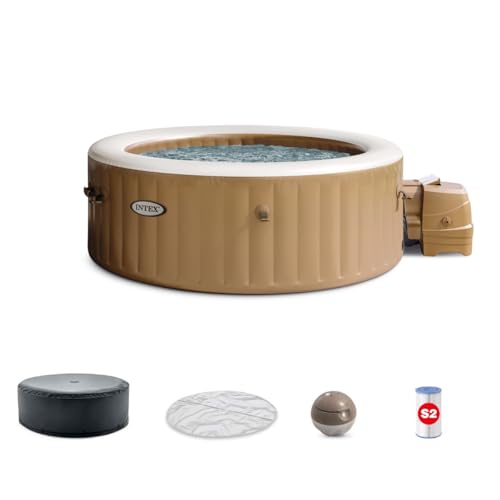
The INTEX 28425EH PureSpa Bubble Massage Spa Set is the best first answer to the placement question because it refuses to finalize it. A 210-gallon, four-person inflatable with Fiber-Tech walls, an included energy-efficient cover, hard water treatment, and saltwater-ready design, it can spend a season on the patio, a winter stored, and a second season by the garden fence — teaching you, with data, where your household actually soaks. No other format lets a family audition the most important variable in hot tub ownership at this cost of being wrong.
Strengths
- Relocatable: placement becomes an experiment instead of a commitment.
- Complete package supports any site — cover and care systems included.
- Four-person room makes the test honest for family households.
Trade-offs
- Still needs a level, load-capable surface and proper electrical access at every site.
- No named freeze-protection system in the verified data — winter sites need vigilance or storage.
- Frequent moving wears any inflatable; audition deliberately, not restlessly.
| Color | Tan |
| Size | 4-Person |
| Dimensions | 22.25 x 25.375 x 32.75 inches (package); spa outer 77 x 28 inches per features |
| Weight | 99.66 pounds |
Run the audition properly and it teaches four lessons in one season. Distance: you will learn the exact number of steps beyond which winter soaking stops happening. Wind: you will feel which corner the evening breeze owns and what it does to your heat and your patience. Privacy: you will discover the sightlines — yours out, the neighbors’ in — that no daytime site visit reveals. And ground truth: you will learn whether your chosen surface stays level and dry through real weather. Each lesson is worth more than any specification when the permanent decision arrives, whether that decision is a hard-shell pad on the winning corner or the discovery that the inflatable, right where it is, was the answer all along.
Site requirements while auditioning are not optional: a flat surface that will not pond, no sharp substrate under the ground cloth, an outlet arrangement that follows the maker’s electrical guidance exactly — no extension cords, ever — and drainage that does not send 210 gallons toward your foundation when the season turns. The saltwater-ready care path in Best Salt Water Hot Tubs For Sale keeps the water side of the experiment as simple as the placement side.
Best for: First-time owners and evolving yards where placement is still a question / Not suited for: Buyers who already know their site and want permanence
Choose it if the map is not yet drawn. Skip it if the pad is already poured — the hard-shell pick below is your native format.

Coleman SaluSpa Miami Energy-Efficient AirJet Inflatable Hot Tub
Our badge: Best for Decks and Small Yards
The Coleman SaluSpa Miami Energy-Efficient AirJet Inflatable Hot Tub owns the placement problem of the small property: 71 inches round, 120 AirJets, Freeze Shield for four-season sites, and insulation that respects the heating bill. On decks — the placement question this pick most often answers — its honest counsel comes first: a filled spa with bathers is a heavy point load, and any deck placement deserves a structure check before a purchase, not after. Ground-level decks and reinforced structures are the safe venues; an aging elevated deck is a conversation for a builder, not a product listing.
Strengths
- Compact footprint fits the small-yard and ground-deck geometry.
- Freeze Shield suits the exposed, four-season placement.
- Timer scheduling aligns heating with use, wherever the site lands.
Trade-offs
- Deck placement always requires a load assessment — no exceptions.
- Two-to-four-person scale limits group placements like party decks.
- At 101.2 pounds boxed, even this “portable” pick is a two-person move.
| Color | Black |
| Size | Energy Efficient 2.0 |
| Dimensions | 71 x 71 x 26 inches |
| Weight | 101.2 pounds |
Small-yard placement is an art of adjacencies. The Miami thrives within a short dash of the door — the winter rule — beside a privacy screen or a fence line that breaks the wind, under a pergola or sail that keeps debris and summer sun off the cover. It suffers in the far corner behind the shed, however picturesque, because distance is a usage tax collected nightly. The New England guidance in Best Hot Tubs For New England adds the roof-shed-line rule for snowy regions; the Florida guidance in Best Hot Tubs For Florida adds the lanai logic for screened ones. Same spa, different maps — placement is climate written in space.
For families, the small-yard sightline rule is absolute: the spa where the kitchen window sees it. Supervision geometry is placement geometry, and the family guide’s framing in Best Hot Tubs For Families treats the cover and the sightline as one safety system.
Best for: Small yards, ground-level decks, and four-season compact sites / Not suited for: Unverified elevated decks or large-group hosting
Choose it if your site is small and your seasons are real. Skip it if the structure question cannot be answered — answer it first, with a builder if needed.

Bestway SaluSpa Cancun Energy-Efficient Inflatable Hot Tub
Our badge: Best Compact
The Bestway SaluSpa Cancun Energy-Efficient Inflatable Hot Tub is the placement pick for spaces that are seen: the designed patio, the rental garden, the courtyard where equipment-looking equipment would spoil the room. Its grey wicker finish performs a small magic trick — the spa reads as patio furniture — while delivering the same 120 jets, Freeze Shield, and insulated construction as its sibling. In placement terms, it is the tub for sites where aesthetics are a genuine constraint, such as HOA-governed patios and design-led terraces.
Strengths
- Wicker finish integrates the spa into furnished outdoor rooms.
- Full freeze protection and insulation in the compact footprint.
- MaxHold and Tritech construction tolerates seasonal repositioning.
Trade-offs
- Pool data lists placeholder dimensions; features confirm 71 x 26 inches — verify on the listing.
- Finish camouflage changes nothing about load, level, or electrical requirements.
- Two-to-four-person ceiling applies as with its sibling.
| Color | Grey Wicker |
| Size | Energy Efficient 2.0 |
The rental placement case deserves its own paragraph, because the Cancun may be the best renter’s hot tub in this series. No permanent alteration, no pad, no electrical project beyond the maker’s plug guidance, and full removal at lease end — while delivering a genuine 104-degree soak in the meantime. Landlords who permit them generally care about exactly the things this format respects: no structural change, no water damage risk from a level site with a ground cloth, and a tenant who can take the whole installation away. If you rent, get the permission in writing, place it on the most level ground available, and keep the cover discipline that protects both the spa and the property.
HOA and condo placements add a paperwork layer: many associations govern outdoor structures, water features, and even patio loads. The inflatable’s classification as temporary furniture helps in some communities and not others; the five-minute call to the association before purchase is the cheapest placement step in this entire guide.
Best for: Designed patios, rentals, and HOA-conscious placements / Not suited for: Buyers needing maximum room or a permanent installation
Choose it if the site is seen, rented, or rule-governed. Skip it if none of those apply and the Intex’s extra room is available to you.

Empava 59 Inch Freestanding Bathtub
Our badge: Best Indoor Placement
The Empava 59 Inch Freestanding Bathtub represents the placement hiding in plain sight: indoors. It is a bathtub — this guide labels it plainly — and as a placement answer it eliminates the entire outdoor problem set. No pad, no wind, no freeze, no sightlines, no storm plan: a 59-inch double-wall acrylic soaker with a 15-inch depth, ergonomic back support, an anti-slip floor, and the drain and overflow in the box, placed in the one room of the house engineered from the start to hold water safely.
Strengths
- Placement requires only a bathroom: no site work, no weather exposure, no structure debate.
- Double-wall insulation and 45-gallon economy suit nightly use.
- Fresh-fill water deletes the standing-water care routine entirely.
Trade-offs
- It is not an outdoor hot tub and offers no jets — the placement trade is explicit.
- Freestanding faucet is a separate purchase and plumbing decision.
- The bathroom’s size sets the ceiling: 59 inches needs a real room.
| Color | White |
| Size | 59 Inch |
| Dimensions | 59.1 x 29.5 x 26.8 inches |
| Weight | 66.1 pounds |
Who should choose the indoor placement? Households in severe climates whose outdoor season is short; apartment and condo owners whose outdoor space is a balcony that should never carry a spa’s load; privacy absolutists; and anyone whose soaking ritual is solitary, nightly, and quiet. The indoor answer also pairs rather than competes: many two-venue households run an outdoor inflatable for the social season and an indoor soaker for the rest of the year, a system whose cold-climate version is detailed in the New England guide. The Empava’s adjustable leveling feet and included hardware make its placement the simplest project in this article — the site work is a faucet decision and an afternoon.
The value frame from Best Bang For Your Buck Hot Tubs applies with force indoors: a placement with no site costs and no running systems is the placement whose total cost is knowable to the dollar on day one. For buyers whose “best place” question is really “where can this not go wrong,” the bathroom is a formidable answer.
Best for: Indoor-placement households, severe climates, and privacy-first soakers / Not suited for: Anyone whose dream is specifically outdoors and jetted
Choose it if the bathroom is your sanctuary already. Skip it if the stars are non-negotiable — placement honesty cuts both ways.
Hard-Shell Spa on a Dedicated Pad
Our badge: Best Permanent Placement
This pick is prose-only: the pool holds no hard-shell spa, so the permanent placement is described as an engineered site rather than a product. The canonical version: a level concrete pad or properly engineered deck section, a dedicated electrical run installed by a licensed electrician, drainage that carries splash and drain-downs away from the house, service access on the equipment side, and a cover-lifter’s clearance behind the chosen edge. Done once and done right, this site serves for decades and accepts spa replacements without re-engineering.
Strengths
- A permanent site maximizes use: always ready, always in its place, part of the property.
- Engineered structure and power remove the placement risks entirely.
- Service access and drainage planning make the ownership decade smooth.
Trade-offs
- The site is a construction project with permits and professionals attached.
- Permanence punishes misjudged locations for as long as you own the home.
- Moving house leaves the investment behind — priced into the property, one hopes.
| Type | Prose-only — permanent site format, no pool product |
| Format | Engineered pad, dedicated power, planned drainage |
| Best pairing | Proven soakers in long-term homes |
The siting counsel for permanence is the distilled wisdom of every section in this guide: within a short dash of the door; out of the wind’s corridor and the roof’s shed line; visible from the house’s living spaces; private from the neighbors’ main windows; clear of overhanging trees that rain debris and sap; and oriented, if you are fortunate, toward the view you actually love at night. Rehearse the site with an inflatable season if there is any doubt — the audition method of the first pick exists precisely to protect this pick’s permanence. Tier framing for the total project lives in Best Hot Tubs Under $6000.
Best for: Long-term homeowners with a proven habit and a chosen corner / Not suited for: The uncertain, the mobile, or the soon-to-renovate
Choose this placement if the habit and the house have both declared themselves. Skip it if either is still speaking in pencil.
Dedicated Cold Plunge Corner
Our badge: Best for Recovery Rituals
The final pick is a placement, described in prose only, for the water ritual that is not a hot tub at all: the cold plunge corner. Framing discipline matters — a cold plunge is cold water, full stop — and its ideal place differs from a spa’s in instructive ways. It wants shade, because its enemy is heat gain; a small footprint, because plunges are one-person and brief; a drain within hose reach, because small cold volumes are refreshed often; and proximity to the workout space or the sauna-and-spa zone, because plunges live inside routines.
Strengths
- Tiny footprint: a corner, a shaded side-yard strip, a garage bay edge.
- Shade-first siting inverts the spa’s sun logic and cuts temperature creep.
- Pairs with a hot tub placement to form a complete contrast-therapy corner.
Trade-offs
- It is not a hot tub placement — no heat, no jets, no group soaking, ever.
- Cold water still needs sanitation discipline; cold is not sterile.
- Unshaded sites will fight the sun all summer and lose by noon.
| Type | Prose-only — placement concept, no pool product |
| Format | Shaded, drained, single-person cold-water corner |
| Best pairing | Homes with an existing spa or training space |
Households building the full water corner often place the plunge within a few steps of the hot tub — close enough for contrast routines, far enough that the two systems’ covers, steps, and drainage do not interfere. In hot climates the corner graduates from accessory to co-headliner, as the Florida guide argues in Best Hot Tubs For Florida. Keep the plunge’s water honest with the same test-strip discipline as any standing water, and let its lid earn its keep against sun and debris. The garden’s smaller water features teach the same lesson at smaller scale — the maintenance rhythm behind Best Solar Bird Bath Water Pumps is the plunge corner’s rhythm in miniature.
Best for: Athletes and contrast-ritual households adding a cold station / Not suited for: Anyone actually shopping for hot water — return to the picks above
Choose this placement if cold is a deliberate part of your ritual. Skip it if it is not — a plunge corner without a plunge habit is a very clean bucket.
Comparison Table
| Pick | Placement type | Footprint / Size | Placement strength | Check price on Amazon |
|---|---|---|---|---|
| INTEX PureSpa | Audition-anywhere inflatable | 77-inch outer, 210 gallons | Tests sites for a season | Check price on Amazon |
| Coleman SaluSpa Miami | Deck / small-yard inflatable | 71 x 26 inches | Compact four-season site | Check price on Amazon |
| Bestway SaluSpa Cancun | Patio / rental inflatable | 71 x 26 inches | Furniture-blend finish | Check price on Amazon |
| Empava 59″ | Indoor bathroom placement | 59.1 x 29.5 inches | No site work at all | Check price on Amazon |
| Hard-shell on pad | Prose-only permanent site | Engineered pad | Decades of readiness | Check price on Amazon |
| Cold plunge corner | Prose-only placement | Single-person corner | Shade-first cold station | Check price on Amazon |
How to Choose the Best Place for Hot Tubs
Start with the load: structure before scenery
Calculate the filled reality — vessel, water at roughly eight pounds per gallon, and the bathers — and match it to the surface honestly. Concrete pads and ground-level placements forgive; decks must be verified; balconies should be presumed no until an engineer says otherwise. This single check prevents the category’s worst outcomes, and it costs nothing but arithmetic.
Measure the dash: distance from the door
Time the walk from your back door to each candidate site, in imagination, in January, in a robe. Sites beyond a short dash lose soaks every week of the cold season. Convenience is not a soft preference; it is the strongest known predictor of whether a hot tub is used or becomes yard sculpture.
Read the wind and the roof
Wind steals heat and comfort; roof lines shed water and, in the north, snow loads. Stand in the candidate spot on a breezy evening and look up. A fence panel, a hedge, or a pergola can redeem a windy site — but choose the sheltered site when one exists, because it is free forever.
Audit privacy and sightlines at night
Visit the site after dark. Note the neighbors’ lit windows, the street’s sight angles, and your own house’s view of the spot — families need the inward sightline for supervision as much as they need the outward one for privacy. Screening is cheaper before the tub lands than after.
Plan water in, water out, and power honestly
A hose reach for filling, a drainage path that respects foundations and neighbors for emptying, and electrical access that follows the maker’s and your code’s requirements exactly. These three logistics decide whether ownership feels effortless or improvised, and they are all visible before purchase to anyone who walks the site with a tape and a notebook.
Where Should You Buy a Hot Tub? The Channel Question
The commercial half of this keyword deserves the same clear eyes. Online marketplaces — the channel of every linked pick in this guide — offer the widest inflatable selection, transparent listing details, and delivery to the door; their support is the manufacturer’s, so verify warranty routing before you need it. Local dealer showrooms offer wet tests, white-glove delivery, and a service relationship — genuinely valuable for hard-shell purchases, and priced accordingly. Warehouse clubs rotate a small number of models with strong return policies and thin expertise. Direct-from-maker sites split the difference. The channel rule that survives all cases: buy where the delivery terms, the included essentials, and the support path are written down plainly, and treat a suspiciously better price with an unwritten support story as the expensive option wearing a costume.
Problem: The perfect-looking site floods after rain — Grade and drainage were never checked. Move the inflatable, or engineer the permanent site’s drainage before the spa arrives; water features should never share a puddle with your foundation.
Problem: The spa is technically fine and never used — Distance, wind, or exposure is taxing every soak. This is a placement failure with a placement cure: move the flexible formats, shelter or screen the permanent ones.
Problem: The neighbors can see everything — A night audit was skipped. Screens, planting, and repositioning (for inflatables) fix most sightlines; build the screen before the first soak, not after the first awkward wave.
Problem: Fill and drain days turn the site into mud — The drainage path was imagined, not tested. Run a full drain once with a hose in hand before committing a permanent spa to the site; water should leave toward a drain or a planted area that can take it, never pooling against the pad or the foundation.
Problem: The deck feels spongy under the filled spa — Stop, drain, and get a structural assessment. This is the load rule announcing itself; no soak is worth a structure’s complaint.
The Placement Factors Nobody Mentions Until Year Two
Leaves: a site under a deciduous tree is a paradise in July and a debris factory in October, and cover-off soaking under a shedding tree is a skimming marathon. Sound: pumps and bubbles carry at night; a site under a neighbor’s bedroom window manufactures friction no fence can fully fix, and a site near your own bedroom window does the same at 2 a.m. filtration cycles. Access for service: permanent spas need a technician’s body-width on the equipment side — a spa entombed by landscaping is a repair bill with a gardening surcharge. Winter path: the route you will actually clear of snow, which argues again for the short dash. And resale realism: a well-sited pad reads as an amenity to buyers; a spa marooned in a swampy corner reads as a removal cost. Placement is the longest-lived decision in the category — the tubs themselves come and go on the same good site for decades.
One more slow factor: the ground itself moves. Soil settles, frost heaves, and a pad poured level in spring can sit a degree off by the third winter — enough to leave a hard-shell’s waterline visibly tilted and its equipment side pooling meltwater. Sites on freshly filled soil are the worst offenders, which is why builders let new pads cure and why a site beside a recent extension or a new retaining wall deserves extra suspicion. Recheck level at the first anniversary, not the tenth: shimming or re-leveling early is a small job, while a shell that has sat twisted for years wears its seals unevenly and keeps the receipt.
Climate Rewrites the Map
The national placement answer dissolves, on inspection, into regional ones. In New England, the map is drawn by snow, roof lines, and the dash — the regional guide’s rules govern. In Florida, it is drawn by shade, screening, and storm posture. In the desert Southwest, shade and dust rule; in the Pacific Northwest, rain management and moss-slick paths; in the Midwest, wind above all. The constants that survive every region are the short dash, the honest structure, the inward sightline, and the wind check — the rest is local knowledge, and the most reliable source of it is the neighbor two doors down who has owned a spa for a decade. Ask them where they would put it if they could move it. Their answer is this entire article, customized.
Common Buying Mistakes
Choosing the far, scenic corner
The view is glorious and the usage is nil, because distance and wind tax every session. Place for the ritual you will repeat nightly, not the postcard you will photograph twice.
Skipping the structural check on decks
Filled weight is unforgiving arithmetic. An unverified deck under a spa is the category’s most dangerous economy. Verify, reinforce, or place on the ground.
Buying before the night audit
Daytime site visits miss the sightlines, lighting, and sound travel that define evening soaking. Audit at the hour you will soak, or accept surprises as tuition.
Forgetting service access on permanent installs
Landscaping a hard-shell into a sealed alcove of shrubs converts every repair into a demolition. Leave the equipment side reachable, forever, by design.
Chasing the cheapest channel for a permanent spa
On a decade-long machine, support is a feature with a price. The channel that cannot describe its service path is selling you the spa and keeping the decade.
Final Recommendation
If your placement is still a question, start where this guide starts: the INTEX 28425EH PureSpa Bubble Massage Spa Set, placed on your best-guess corner — level, sheltered, close to the door, visible from the house — and let a season of real soaking draw the true map. The runner-up for small and four-season sites is the Coleman SaluSpa Miami — Check on Amazon. When the map is proven, pour the pad there and buy the permanent format with confidence. The best place for hot tubs is not found on a listing page; it is the corner where structure, shelter, privacy, and a short dash agree — and the best buying decision is the channel that puts a well-chosen tub on that corner with its support story written down.
Permits, Codes, and Neighbors: The Paperwork Layer of Placement
Placement has a legal geography that physical guides skip at the owner’s peril. Permanent spas commonly trigger local rules: electrical permits for the dedicated circuit, setback distances from property lines and septic systems, barrier requirements — fencing or locking covers — that many jurisdictions impose on any body of water, and in some communities, rules about drainage discharge. Inflatables often sit outside the permit net, which is one more argument for the audition strategy: a season of inflatable soaking proceeds while the household learns its jurisdiction’s permanent-spa requirements at leisure, from the building department’s own publications rather than from a violation notice. HOA and condo communities add their private layer on top of the public one, governing everything from visibility to noise to water features entirely. The five-minute calls — building department, association, and, for deck placements, a builder — are the cheapest placement steps in existence, and they belong before the purchase, when every answer is still free.
Neighbors deserve a paragraph of their own, because placement diplomacy is a real variable in a spa’s lifespan. A spa sited with its pump’s hum aimed at a neighbor’s bedroom window, its steam drifting over their patio, and its sightlines into their kitchen will generate a decade of low-grade friction that no fence fully settles. The same spa rotated ninety degrees, screened thoughtfully, and introduced with a conversation — sometimes even an inaugural invitation — becomes a neighborhood amenity. Owners consistently underrate this: the best place for a hot tub includes the social map, and the social map is drawn by exactly the kind of attention the physical sections of this guide teach.
The Second Season: When Placement Proves Itself
Every placement looks right in its first month. The verdict arrives in the second season, when the household’s real patterns have overwritten the installing optimism: the soak count tells you whether the dash was short enough, the energy bills tell you whether the wind audit was honest, the cover’s condition tells you about the debris load you actually live under, and the grass — dead in a ring, muddy at the entry — tells you where the household truly walks. Wise owners treat the second season as the placement review they scheduled at purchase: inflatables migrate to the corner the data chose, permanent sites get their screens, windbreaks, and path improvements, and the spa settles into the geography it will keep for years.
This is also when the buying-channel choice proves itself. The dealer who answers in year two, the marketplace listing whose warranty routing works, the maker whose parts are findable — the channel is a placement in the market, and its quality is measured on the same second-season clock. Judge both placements then, fix the one that failed, and the third season is the one owners describe when they say the spa simply became part of the house.
The Site Sketch: Drawing Your Answer Before You Buy
End the placement process the way professionals begin it: with a sketch. One page, roughly to scale, showing the house’s door, the candidate site, the path between them, the prevailing wind’s direction, the roof lines above, the neighbors’ windows, the trees, the outdoor outlet and hose bib, and the drainage’s downhill. Mark the dash in steps, the sightlines in arrows, and the structure under the site in a note. Live with the sketch for a week — tape it to the fridge — and walk the yard with it twice, once at the hour you will soak and once in the worst weather the week offers. Nearly every placement regret in this guide’s case knowledge is visible on such a sketch to an owner who has lived with it for seven days: the far corner indicts itself in steps, the wind corridor announces itself in the evening walk, the roof line hangs over the chosen spot in the drawing exactly as it will over the spa. The sketch costs an evening. The pad costs a project. In placement, as in the rest of this category, the cheapest thinking is the thinking done before anything heavy arrives — and the sketch is where that thinking becomes a decision the whole household can see, question, and finally sign.
Multi-Spa Households and the Geography of More Than One Water
Some households end up, happily, with more than one body of water — the spa and the cold plunge, the outdoor tub and the indoor soaker, the pool and the spa that shares its deck — and their placement becomes a small exercise in urban planning. The principles scale gracefully. Keep the wet zone contiguous: systems that share a deck, a drainage logic, and a maintenance round get maintained together, while the orphan feature across the yard gets orphaned care. Separate the chemistries’ storage from the children’s geography as one zone, not per-feature improvisations. Let the hot and cold stations stand within a few steps for the contrast ritual, but let their covers, steps, and drainage never touch. And preserve one dry, furnished island in the middle of the wet zone — the chair, the towel rail, the surface for drinks — because a water garden with nowhere to sit dry is a facility, not a retreat. Households planning toward a second water feature should place the first one as if the second were already decided: the corner chosen for the spa today is the anchor the plunge, the sauna, or the great indoor soaker will orient to tomorrow. Placement, done with that foresight, stops being a decision per purchase and becomes what it always secretly was — the design of the household’s water life, one honest corner at a time.
A Placement Blessing: The Five-Minute Final Walk
Before any order is placed, give the chosen site one final ceremony: stand in it at soaking hour with the household, in silence, for five minutes. Listen for the road, the neighbor’s television, the pump hum of someone else’s equipment. Look at what the soakers will actually see — the fence’s best panel, the tree’s canopy, the corner of sky the roof leaves open. Feel the wind do whatever it does at that hour, in that corner, in this season. Confirm the dash one last time with a robe over one arm. Placement guides, this one included, can enumerate a hundred factors, but the site must finally pass the test of the body standing in it, imagining the thousandth soak rather than the first. If the five minutes feel like a brochure, pour the pad. If they feel like a compromise being talked into existence, move the corner — the audition season and the site sketch exist precisely so that this walk happens while moving is still free.
Frequently Asked Questions
Can a hot tub go on a deck?
Sometimes — on ground-level or properly reinforced decks, after a genuine load assessment of the filled weight plus bathers. Elevated or aging decks need a builder’s verdict first. When in doubt, ground placement is the safe default.
How close to the house should a hot tub be?
Close enough for a short, clearable dash in winter — most satisfied owners site within a few steps of the door, balanced against local code clearances and the house’s own sightlines and noise considerations.
Is a concrete pad always required for a hard-shell spa?
A level, engineered, load-rated surface is required; concrete is the common answer, with properly built deck sections and pad systems as alternatives when they are genuinely rated for the filled weight. “Looks solid” is not a rating.
Where is the best place to buy a hot tub?
Where delivery terms, included essentials, and the support path are explicit: marketplaces excel for inflatables, dealers earn their premium on hard-shell service and installation. The written support story matters more than a small price difference.
Can I put an inflatable hot tub on grass?
On level, cleared grass with a proper ground cloth, many owners do — but expect settling, mud at the edges, and a dead-grass footprint. A patio, pad, or deck surface is the kinder long-term site.
What is the most common placement regret?
Distance. Owners consistently wish they had placed the spa closer to the door and out of the wind. Both are free to get right before the tub lands and expensive to fix afterward — which is why the audition season with an inflatable is this guide’s core advice.
Can a hot tub go under a pergola or gazebo?
Yes, and shelter is often what turns a good site into a great one — rain stays off the cover, snow load drops, and winter soaks gain a roof’s worth of comfort. Three checks make it work: the structure’s posts and footings must stand clear of the spa’s service access, the roof must be high enough that steam and splash do not live against its timbers, and any electrical work still follows code clearances exactly. Build the shelter for the spa’s replacement as well as the spa: the vessel that goes under it in ten years will be a different size, and posts set with margin are a kindness to that future project.


